
The Emission of Greenhouse Gases from Agricultural Farmland in South Africa: A Review
Agricultural farmlands and other agro-practices release the greenhouse gases (GHG) such as carbon dioxide, methane and nitrous oxide in the atmosphere which contributes to global warming. The effect of agriculture on greenhouse gases outflows has turned in to a key issue, considering these gases are affected by agricultural development. This review is focused on GHG emission from agricultural farmland in South Africa. The emission is discussed with other countries in aspect of Agricultural, forestry and Land-use practices (AFOLU) sector. Not every country has managed to compile their first and second communication to the United Nations Framework Convention on Climate Change (UNFCCC) and emissions for almost a decade of data were available for some countries. In this review the GHG inventory and mitigation-policies are also discussed. A few methodologies can be considered to improve the efficiency of the best agricultural farmlands. It is very much perceived that management of practice increase GHG emission in some countries however there are some research gaps and the agricultural sector will face challenges in years to come. A mutual strategy to fill the research gaps for GHG emission data available must consist of collaboration of international systems, implementing new appropriate and improved technologies to provide more knowledge about the emission of greenhouse gas.
Introduction
GHG are gases that are released by agricultural practices and other sectors into the atmosphere for example Methane (CH4), Carbon dioxide (CO2), Nitrous Oxide (N2O) and etc. Studies revealed that GHG emission contribute towards climate change globally. Greenhouse gases have different way of producing emissions from farms and the environmental factors that affect the rates of greenhouse gas emission pathways are pH, moisture, oxygen concentration and temperature. South Africa is considered to be the major emitter of greenhouse gases in Africa with 65% emission rate and It is estimated that in 1990 and 1994 Agricultural soils in South Africa emitted 14,9 and 17,8 million tons of CO2 eq respectively [1]. The country’s double agriculture economy consists of a solid commercial sector and subsistence- orientated farming in countryside regions which comprise of an intensive management system of agricultural lands. In South Africa the major source of greenhouse gases in crop production is through the application of synthetic nitrogen (N) fertilizer. Tongwane et al revealed that the production of maize which makes it the largest source of greenhouse gas emissions compared to other field crops and on average the vegetables have the largest greenhouse gas emissions intensities. In 2010 it was reported that the soils in AFOLU emitted an estimated GHG of approximately 21.2-24% Mg CO2 eq. Material for bio-fuel generation incorporates waste material from animal feed and non-eatable harvests; through the digestion of atmospheric CO2, the biofuel is formed and the consumption of bio-fuel won’t increase the atmospheric CO2, which is progressively good when contrasted with consuming fossil fuel. In a study Zhang et al., it was shown that the bio char alteration altogether diminished complete circuitous CO2 while expanding CH4 discharges from paddy soil. Comparing other sectors and agricultural practices, GHGs emissions are not well-known. Land-use and land-cover change is among the most significant human modifications of the Earth’s surface property [2]. Transformation or overuse of land by development for instance extreme expulsion of vegetation, consumption, deforestation and different types of degradation can eliminate GHG, but reclamation can GHG from the environment [3].
In literature the N2O is of incredible significance since it can remain in the climate for over 114 years and has a warming potential multiple times more noteworthy than CO2. Globally, N2O discharge reaches about 17.7 Tg every year, with 6.7 Tg (37.8%) from human-centered sources. In the event that we consider the significance of N2O as a GHG and how much farming soils added to start it, the improvement of procedures to reducing N2O in the climate ought to essentially incorporate rural practices. The utilization of N manure stimulates process-based and burning CO2 outflows from the formation of NH3. The production of N compost release CO2 from the NH3 by burning and the emission of N2O from the denitrification of N inputs. The critical range in evaluated discharge factor of GHG for connected N is compelled by the vulnerability in release factors of N2O, highlighting the requirement for future research to gain more knowledge on the indirect and direct emissions of N2O.
In Sub-Saharan Africa (SSA) it is revealed that greenhouse gas emission is limited when compared to potential. The continent consists of greenhouse sink and a source continent. Agricultural practices including livestock manure produce gases such as CH4 and CO2. According to the environmental protection agency (EPA) some of these GHGs emissions are released by FOLU. In highly dense populated countries such as China and India; the agricultural mitigation of these nations without a major contribution to global greenhouse gases mitigation would lead to substantial food calories loss. China is persistently expanding its endeavors to lessen CO2 outflows because of double weight locally and universally. In particular, China has focused on accomplishing crest carbon outflows no later than 2030 [4].
There are agricultural systems that offer possibilities for mitigation of GHG flux which are complex and heterogonous [5] Analyzing the changes in greenhouse emission caused by the impact of agricultural practices it is essential to ponder on all GHGs together. Several GHGs are affected by many mitigation practices and for each practices, the data available is used to assess the impact on all GHG. Therefore this study provides a compilation of GHGs from various sectors in agricultural farmlands in South Africa and tries to provide ways of mitigating these emissions.
Greenhouse Gas Emission From Agricultural Farmland
Agricultural GHG outflows in SSA are considerably high, adding up to 26% of the African continents complete emission (Valentini et al., 2014) compared with 8.4% of absolute GHG discharges in the USA (US EPA, 2016).
| Agricultural Land | Management system practice | Impact on GHG CO2 N2O CH4 | Country (source) |
|---|---|---|---|
| Crop land | Synthetic N fertilizer | $\cdot$ $\cdot$ $\cdot$ | Zimbabwe (Nyamadzawo G.), South Africa (Tongwane et al., [1]) |
| Crop land | Crop Residues | $\cdot$ | South Africa (Tongwane et al., [1] Tanzania (Sugihara et al., [6]) |
| Crop land | Crop type | $\cdot$ | South Africa (Tongwane et al., [1]) |
| Forest land | Deforestation | $\cdot\cdot\cdot$ | Brazil (Denman et al., [7], Forster et al., [8]). Ghana (MacCarthy et al.), South Africa (DEA, 2018) |
| Forest land | Harvesting | $\cdot\cdot\cdot$ | South Africa (DEA, 2018) |
| Grazing grass land | Burning | $\cdot$ | Brazil (Denman et al., [7], Forster et al., [8]) |
| Grazing grass land | Grazing | $\cdot$ | Inner Mongolia (Wolfet al.) |
| Grazing grass land | Land-use change | $\cdot\cdot\cdot$ | South Africa (DEA, 2018) |
Table 1: shows the effect of management practices on greenhouse gas (GHG) emissions.
* illustrates increasing, • indicates no change, and – indicates decreasing. Table 1: shows the effect of management practices on greenhouse gas (GHG) emissions.
Recognizing controls on the outflow of GHG from SSA, agricultural land is testing on the ground that both regular varieties related with atmosphere and soil type. The executive elements including supplements (especially treatment) and harvest type influence the release of GHG. Agricultural terrains (lands utilized for agricultural production, comprising of cropland, oversaw field and changeless yields including forestry service and bio-vitality crops) possess about 40 to 50% of the Earth’s territory surface [4]. Few studies have reported (Table 1) on CO2, N2O and CH4 emissions from agricultural farmlands.
Croplands
Regarding N2O emissions per unit land area (kg-N ha-1); Nyamadzawo G (2015) in Zimbabwe reported that through application of N fertilizer smallholder farming areas ranges between 15-120 kg N ha-1 and this can be as inorganic N or natural composts or blends of both inorganic N and other natural fertilizers, while the rates extends between 120-290 kg N ha-1 for commercial ranches. This indicated that the rates are low when compared to other developed countries with high rates of 400 kg N ha-1. Consequently, the effects of these manure application (N fertilizer) rates on emission of GHG, results to a decrease in crop production. With the future escalation of agricultural production to satisfy the developing need for sustenance in an increasing global population, there is the tendency to utilize more fertilizer for agricultural production which may cause high GHG emission. Therefore it is advisable to use the organic manure to improve crop production, mitigate GHG emission and can be cost effective. DEA (2014) estimated that between 2000 and 2014 GHG from grassland and croplands increased by 1.2% and 16.7% respectively. According to Tongwane, et al. [1], applying synthetic fertilizer to the soil stands as the main source of greenhouse gas. In 2012 a total of 5.2 million tons of CO2 equivalence emissions from crops in South Africa by production of field crops where cereal showed the highest (table 2) with an increase by 57% of CO2 emission as compared to other crops. This means the GHG emission rate increases as more chemical fertilizers are used in agricultural production.
| Crop | Synthetic Fertilizer | Crop Residues | Lime | Total GHGs | ||||
|---|---|---|---|---|---|---|---|---|
| CO -eq (tons) 2 | % | CO -eq (tons) 2 | % | CO –eq (tons) 2 | % | CO –eq (tons) 2 | % | |
| Cereals | 2,155,691 | 72.6 | 504,106 | 72 | 80,799 | 57.2 | 3 540,596 | 68,0 |
| Legumes and oil | 200,137 | 6.7 | 31,965 | 4.6 | 352,695 | 22.9 | 584,797 | 11,2 |
| Vegetables | 257,659 | 8.7 | 40,147 | 5.7 | 44,629 | 2.9 | 342,435 | 6,6 |
| Other field crops | 355,832 | 12 | 123,786 | 17.7 | 262,867 | 17.1 | 742,485 | 14,3 |
| Total | 2,969,319 | 100 | 700,004 | 100 | 1,540,990 | 100 | 5,210,313 | 100 |
Table 2: Greenhouse gas emissions from different crop management practices in South Africa in 2012 (source: Tongwane et al. [1])
Forest lands
Forestry and emission of GHG establish a two-way relationship, i.e. increasing biomass can results in expansion of forest carbon stock, and through deforestation and forest degradation can reduce emissions. On equalization, forest carbon losses fundamentally exceed the increases over all locales and forest carbon stock lost is one of the biggest causes of discharge in SSA. In 2012, more than 30% of the region’s total GHG was estimated to have contributed emissions of 889 million tCO2eq. In Brazil a study was conducted demonstrating that in 2005 the CO2 in the atmosphere increased (Table 1) from 280 ppm to 380 ppm. This increase resulted from cement industry, deforestation and burning on the other hand CH4 emission are mainly biomass burning, landfill, fuel combustion and cattle breeding [7, 8]. The emission of N2O from agricultural soils were assessed in 457Gg in 2005, thus any technique that targets diminishing the concentration of GHG need to pay attention to agricultural soils, since this is the fundamental wellspring of N2O. In addition decreasing N lost in the air as N2O can build the N use efficiency, as it expands the measure if accessible to plants, expanding harvest yield. In South Africa, The GHG inventory (Table 3) did not include the FOLU trend after interpreting the data, it can be concluded that there was no change in GHG emission hence the management practices (Table 2) data was not included [9].
Grazing Grassland
Literature stated that studies were conducted reporting GHG emissions in grasslands; there is a gap remaining in comprehension of GHG emissions in these structures. It was found that in sandy soil (where biological soil crust was from Botswana grazing grassland) the soil CO2 efflux was significantly higher in sandy soil where biological soil crust was displaced and calcrete where the biological soil crust was covered under the sand. The outcomes showed the significant of biological soil crust for C cycling in dry lands and increased grazing, which eliminate biological soil crust through internment and crushing, which unfavorably influenced C sequestration and capacity [10]. However, another study by Rosenstock, et al. estimated GHG influxes from two fields in western Kenya and found that the emission of CO2 extended from 13.4 to 15.9 MgC02 ha-1 yr-1, like levels found in Amazon [11, 12]. The impact on livestock grazing on pastureland demonstrated that the different grazing animal does have an influence on emission of N2O. A study from Saggae et al. showed that pastureland where sheep grazed on emitted less N2O as compared to sites where cattle grazed, while the most reduced emissions were accounted for in a non-grazed area. However in Inner Mongolia a study Wolf, et al. discovered that emission from grassland was the lowest in where intense grazing was experienced and high emissions on non-grazed sites. From these results it can be said that grazing can reduce N2O emission considering the type of animal. Hence a careful study on the type of animal for grazing and the particular grass or non-grassland will be of high interest.
Greenhouse Gas Inventories
The Republic of South Africa in August 1997 united with most of the countries globally to improve the UNFCCC. In 1998 the country used 1990 information to equip their first national GHG inventory. South Africa used IPCC guidelines for National GHG inventory that was established in 1999. In 2004 it was published using the updated 1994 data. An agreement was made that 2000 national inventory should consist of 2006 Intergovernmental Panel on Climate Change (IPPC) Guidelines to improve clearness and accuracy and for researchers to familiarize with the recent inventory preparation guidelines (DEA, 2014). As indicated by the guidelines on national GHG inventories, emission by agricultural sector must be accounted for. From Land use, Land-use Change and forestry (LULUCF), afforestation, deforestation and reforestation must be accounted for, while GHG outflows and sequestration due to cropland and grassland are not required for the inventories [13].
| Greenhouse gas source and sink sector | Emission (Gg CO ) 2 | Difference (Gg C0 ) 2 | Change (%) | |
|---|---|---|---|---|
| 2000 | 2015 | 2000 - 2015 | 2000 - 2015 | |
| Total net emissions (incl FOLU) | ||||
| Total gross emissions(excl FOLU) | 439157 | 529821 | 90664 | 20.6 |
| Energy | 342592 | 408893 | 66301 | 19.4 |
| IPPU | 33564 | 47090 | 138526 | 40.3 |
| AFOLU (excluding FOLU) | 50713 | 49673 | -1040 | -2.1 |
| AFOLU (including FOLU) | ||||
| Waste | 12288 | 24165 | 11877 | 96.7 |
Table 3: Changes in South Africa’s gross and net emissions between 2000 and 2015 By Sector (Source: DEA, 2018).
The national GHG inventory in South Africa was published by the DEA (2014) the document show a report focusing on a ten year period (2000-2010) stating that the emission of the GHG from different sectors in South Africa is increasing. According to DEA (2018) the South African GHG inventory includes Agriculture, Forestry and Other Land Use (AFOLU) and Waste. The latest GHG emissions inventory covers the period of 2000 to 2015 and covers CO2, CH4, N2O, Hydroflourocarbons (HFCs) and Perflourocarbons (PFCs). Table 3 presents a summary of the Changes in South Africa’s gross and net emissions between 2000 and 2015 By Sector. In the table 3, Gross GHGs emissions reduced by 1.11% (5 766 Gg CO2e) between 2012 and 2015. This reduction is as a result of a 4.5% decline in the emissions from the Energy sector. The IPPU, AFOLU (excluding FOLU) and Waste sectors all depict a rise between 2012 and 2015 (of 26.8%, 2.2% and
10.2%, respectively). The Energy sector contributed largely to South Africa’s gross emissions in 2015, consisting of 77.3% of the total emissions. This was followed by the AFOLU sector (excl. FOLU) (9.3%), the IPPU sector (8.9%) and the Waste sector (4.6%).
Policy and Mitigation
In 1992, the UNFCCC was implemented with the target of balancing out worldwide GHG fixations in the environment at a level that would avoid hazardous anthropogenic obstruction with the climate framework [14]. It is in this manner that one of the goals of South Africa’s national policy on climate change, is to makes a reasonable commitment to the worldwide exertion to settle the GHG fixations in the air at a level that stays away from hazardous anthropogenic obstruction with the climate framework inside a time allotment that empowers maintainable social, ecological and economic improvement (South Africa, 2011). To accomplish this goal, the UNFCCC urged signatory nations to help inquire about and precise perceptions on both environmental change adjustment and moderation of GHG outflows. Bockel, et al. reported that the UNFCCC received a proposal from 43 countries for Nationally Appropriate Mitigation Actions (NAMAs) in 2010 [15]. NAMAs proposal stated that activities from agriculture and forestry were known to be used as an alternative option to establish the reduction of GHG emissions in 59% and 94%, respectively.
In the Agricultural sector, the Bureau for Food and Agricultural Policy (BFAP) has implemented a model to extend changes in agricultural products. The model is a financial recursive, fractional balance model which integrate technological, social, economic, political and environmental components [16]. This model has been used for gathering South African conditions making it more valuable, a study was conducted using this model for the purposes of generalizing activity data for GHG emission baseline for the AFOLU sector in South Africa [16]. Suitable policies can arrange agricultural practices and in forestry service towards worldwide sharing of inventive innovations for the efficient utilization of land assets, to help powerful mitigation options [17]. Mitigation choices for the agricultural sectors are not frequently featured as far as the AFOLU sector is believed to have restricted potential [18]. Smith, et al. stated that strategies for mitigating GHGs falls into three categories (a) Reducing emissions- Farming discharges to the air significant measures of CO2, CH4 and N2O [5]. The fluxes of these gases can be decreased by overseeing all the more efficiently the flows of nitrogen and carbon in agricultural environments. (b) Enhancing sequestration/removals- Numerous examinations worldwide have now appeared critical measures of soil C can be put away thus, through a scope of practices fit to neighborhood conditions (Lal R). (c) Displacing/avoiding emissions- Harvests and deposits from agricultural lands can be utilized as a source of fuel, either legitimately or after change to fuel, for example, ethanol or diesel. Previously, the LULUCF contributed in mitigation emission [19]. The clean development mechanism (CDM) characterizes 90% of agriculture’s mitigation potential and prohibits soil carbon sequestration from agriculture [20]. This type of mechanism was introduced by UNFCCC and the Kyoto protocol. AFOLU mitigation alternatives can advance maintenance of biological diversity [21] both by decreasing deforestation [22] and utilizing reforestation/afforestation to re-establish bio-diverse networks on recently implemented farmlands [23]. In any case, advancing land-use (e.g. planting one culture on different sites) can have antagonistic reaction decreasing biodiversity [24, 25].
Future Outlook in Baseline Emission of Afolu Sector
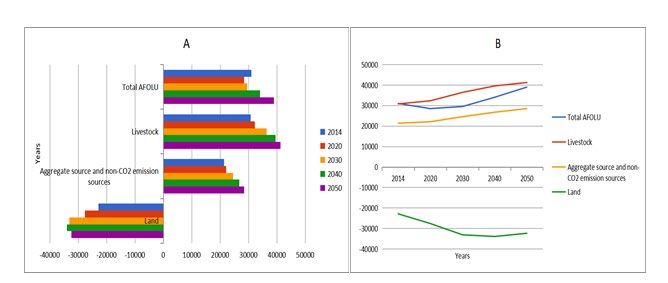
A gap was recognized in that South Africa doesn’t have base- line emissions for AFOLU sector against which mitigation possibilities can be estimated. This implies the future em- anation projection of AFOLU sector gets rejected and this gives a fragmented image of South Africa’s mitigation poten- tial. Lately baselines have developed in significant in South Africa also in some countries have utilized to characterize their mitigation as far as emanation reductions. A well- es- tablished baselines demonstrating future GHG emission lev- el will let South Africa to have an advantage in showing its commitment towards the worldwide objective of decreas- ing emanation from AFOLU sector [18]. The future baseline emissions for AFOLU sector (figure 1a, b) in South Africa are illustrated specifically land and agricultural sector. The pro- jection shows that between 2014 and 2050 the Total AFO- LU emissions will increase from 30 9449.4 GgCO2eq to 38 9382.2 GgCO2eq and emission from aggregated and non-CO2 emission sources are estimated to increase from 21 326.34 2 GgCO2eq to 28 443.83 2 GgCO2eq between 2014 and 2050.
Conclusion
The improvement of living standards and population growth, mostly in developing countries will increase GHG emissions to higher rates in the future. This is revealed in Table 1 that in some parts of Africa and other countries, the management practices increased the rates of GHG emissions in the aspects of FOLU. The South African GHG inventory indicates that the emission trends of other sectors have been increasing from the year 2000 to 2015 (DEA, 2018). The FOLU sector was excluded due to data unavailability. To decrease exponential growth of GHG emissions in Africa, it is required to implement new climate policies. The policies and measures to ensure the climatic framework against human- induced change must be suitable for a particular state for every nation in Africa and ought to be incorporated with national advancement programs, considering that financial improvement is fundamental for receiving measures to address environmental change [14]. The AFOLU sector as a source release GHG from biological processes. More information is needed on these biological processes that have significant effect on the GHG emanation, their uses, and management strategies that will create new possibilities for the agricultural improvement under well-disposed ecological conditions [26]. Consumers and producers need to take a responsibility for the anthropogenic activities on the environment to avoid higher rates of GHG emission, because AFOLU sector has the potential to reduce-mitigation of the anthropogenic gases. Mitigation policies should implement a well-organized GHG agricultural development in regions that are developing, alternatively not affecting the developed system. Developing countries require better and beneficial data in emissions by AFOLU sector [27, 28, 29], given the possibility to recognize a cost effective activities that are beneficial to associate mitigation, improvement of goals into a single articulate package. A common policy is required to fill research gaps for the emission of GHGs and the accessible information should establish systems that are used globally [30], and developing new technologies by providing data about the GHG emissions that will be beneficial to all regions.
Acknowledgments
The team of experts would like to extend a sincere thanks to all the members of the Jilin Agricultural University, Department of Resources and Environmental Science, and all the participants of this review article, for their contributions.
References
-
Tongwane T, Mdlambuzi T, Moeletsi M, Tsubo M, Mliswa V, et al. (2016) Greenhouse gas emissions from different crop production and management practices in South Africa. Environmental Development 19: 23-35.
-
Foley JA, DeFries R, Asner GP, Barford C, Bonan G, et al. (2005) Global consequences of land use. Science 309(5734): 570-574.
-
Pielke RA (2005) Land use and climate change. Science 310(5754): 1625-1626.
-
Dong-Gill K, Thomas AD, Pelster D, Rosenstock T, Sanz- Cobena A (2016) Greenhouse gas emissions from natural ecoystems and agricultural lands in Sub-Saharan Africa: synthesis of available data and suggestions for further research. Biogeoscience 13(16): 4789-4809.
-
Smith PD, Martino Z, Cai D, Gwary H, Janzen P, et al. (2007) Agriculture. In Climate Change 2007: Mitigation. Contribution of Working Group III to the Fourth Assessment Report of the Intergovernmental Panel on Climate Change In: Metz B, Davidson OR, Bosch PR, Dave R, Meyer LA (Eds.), Cambridge University Press, Cambridge, United Kingdom and New York, USA, 498.
-
Sugihara S, Funakawa S, Kilasara M, Kosaki T (2012) Effects of land management on CO2 efflux and soil C stock in two Tanzanian croplands with contrasting soil texture. Soil Biology and Biochemistry 46: 1-9.
-
Denman KL, Brasseur G, Chidthaisong A, Ciais P, Cox PM, et al. (2007) Couplings between changes in the climate system and biogeochemistry. In: SOLOMON S, et al. (Eds.), Climate change 2007: the physical science basis. Cambridge: Cambridge University Press, pp: 499-588.
-
Forster P, Ramaswamy V, Artaxo P, Berntsen T, Betts R, et al. (2007) Changes in Atmospheric Constituents and in Radiative Forcing. In: Climate Change 2007: The Physical Science Basis. Contribution of Working Group I to the Fourth Assessment Report of the Intergovernmental Panel on Climate Change Solomon S, Qin D, Manning M, Chen Z, Marquis M, et al. (Eds.), Cambridge University Press, Cambridge, United Kingdom and New York, NY, USA.
-
Kuikman PJ, Velthof GL, Oenema O (2003) Controlling nitrous oxide emissions from agriculture: Experiences in the Netherlands. In: Proceedings of the 3rd International methane and nitrous oxide mitigation conference. Beijing, pp: 415-422.
-
Thomas AD (2012) Impact of grazing intensity on seasonal variations in soil organic carbon and soil CO2 efflux in two semiarid grasslands in southern Botswana. Philos Trans R Soc Lond B Biol Sci 367(1606): 3076- 3086.
-
Rosenstock TS, Mathew M, Pelster DE, Butterbach-Bahl K, Rufino MC, et al. (2016) Greenhouse gas fluxes from agricultural soils of Kenya and Tanzania. J Geophys Res 121: 1568-1580.
-
Davidson EA, Verchot LV, Cattanio JH, Ackerman IL, Carvalho J (2000) Effects of soil water content on soil respiration in forests and cattle pastures of eastern Amazonia, Biogeochemistry 48: 53-69.
-
Gattinger A, Jawtusch J, Muller A (FiBL) (2011) Mitigating Greenhouse Gases in Agriculture: A challenge and opportunity for agricultural policies.
-
UN (1992) United Nations Framework Convention on Climate Change. United Nations.
-
Bockel L, Gentien A, Tinlot M, Bromhead M (2010) From Nationally Appropriate Mitigation Actions (NAMAs) to Low-Carbon Development in Agriculture: NAMAs as Pathway at Country Level. Food and Agricultural Organization, Rome, Italy, pp: 32.
-
Bureau of Food and Agricultural Policy (2015) BFAP Baseline Agricultural outlook 2015-2024.
-
Bustamante M, Robledo-Abad C, Harper R, Mbow C, Ravindranat NH, et al. (2014) Co-benefits, trade-offs, barriers and policies for greenhouse gas mitigation in the agriculture, forestry and other land use (AFOLU) sector. Glob Chang Biology 20(10): 3270-3290.
-
Luanne BS, Aidan J, Henri Martin Van Nierop, Elanie van Staden, Jared L, et al. (2016) Towards the development of a GHG emissions baseline for the Agriculture, Forestry and Other Land Use (AFOLU) sector, South Africa. Clean Air J 26(2): 34-39.
-
Murphy D, De Vit C, Drexhage J, Nolet J (2009) Expanding Agriculture’s Role in Post-2012 Climate Change Regime. International Institute for Sustainable Development, Winnipeg, Canada.
-
FAO (2010) “Climate-Smart” Agriculture. Policies, Practices and Financing for Food Security, Adaptation and Mitigation. Food and Agriculture Organization of the United Nations, Rome, Italy.
-
Smith P, Ashmore MR, Black HIJ, Burgess PJ, Evans CD, et al. (2013) The role of ecosystems and their management in regulating climate, and soil, water and air quality. J Appl Ecol 50: 812-829.
-
Putz FE, Romero C (2012) Helping curb tropical forest degradation by linking REDD+ with other conservation interventions: a view from the forest. Current Opinion in Environmental Sustainability 4(6): 670-677.
-
Harper RJ, Beck AC, Ritson P, Hill MJ, Mitchell CD, et al. (2007) The potential of greenhouse sinks to underwrite improved land management. Ecol Eng 29(4): 329-341.
-
Koh LP, Wilcove DS (2008) Is oil palm agriculture really destroying tropical biodiversity? Conserv Lett 1(2): 60- 64.
-
Gardner TA, Burgess ND, Aguilar-Amuchastegui N, Barlow J, Berenguer E, et al. (2012) A framework for integrating biodiversity concerns into national REDD+ programmes. Biological Conservation 154: 61-71.
-
Muñoz C, Paulino L, Monreal C, Zagal E (2010) Greenhouse gas (CO2 and N2O) emission from soils: A review. Chil J 70(3): 485-497.
-
Dick J, Kaya B, Soutoura M, Skiba U, Smith R, et al. (2008) The contribution of agricultural practices to nitrous oxide emissions in semi-arid Mali. Soil Use Manage 24(3): 292-301.
-
Kurgat BK, Stöber S, Mwonga S, Lotze-Campen H, Rosenstock TS (2018) Livelihood and climate trade-offs in Kenyan peri-urban vegetable production. Agric Syst 160: 79-86.
-
Oertel C, Matschullat J, Zurba K, Zimmermann F, Erasmi S (2016) Greenhouse gas emissions-A review. Geochemistry 76(3): 327-352.
-
Romeu-Dalmau C, Gasparatos A, von Maltitz G, Graham A, Almagro-Garcia J, et al. (2018) Impacts of land use change due to biofuel crops on climate regulation services: Five case studies in Malawi, Mozambique and Swaziland. Biomass Bioenergy 114: 30-40.
- Enhancement of Vegetative Growth and Fruit Yield in Cucumber (Cucumis sativus L.) via Spiritual Blessing (Biofield) Energy Intervention
- Production of Açaí (Euterpe oleracea Mart.) under Different Agroforestry System Management Intensities in Amazonian Floodplain (Varzea) Forests
- Coffee and the Production Region: What is the Secret to the Expression "Quality"?
- Experiential Agripreneurship Training in Sub-Saharan Africa: Integrating a Business Incubator into Postgraduate Livestock Education at the University of Buea
- Advances in Agricultural High-Quality Development
- Linking Compost Residue to ABAGE in Plants - a Short Note