
Climate Variability and Environmental Quality's Effects on Rice Yield in Nigeria (1971-2012): A Bounds Test for Cointegration Approach
The paper determined the effects of climate variability and greenhouse gas emission on rice productivity in Nigeria. Unit root tests were conducted using Philip Perron tests which indicated that the series were mixtures of I(0) & I(1) variables. The ARDL model for cointegration test was then applied in determining the long-run effects of GHG emission and climate variability and change on rice yield. The series' residuals were subjected to cointegration test and other diagnostics required in time series modelling. The estimated F-statistics confirmed the presence of a long-run steady state relationship among the series. On the long-run, the yield of rice in Nigeria was determined by the natural logs of rainfall, CO2 emission, price of rice, pesticide application and arable land area cultivated. The study recommends that programmes to facilitate greener economy, steady supply of water such as agroforestry/afforestation and irrigation promotion as well as supply of pesticides and rice varieties at affordable prices for rice cultivation should be put in place in Nigeria in order to ensure sustainable production of rice in the country. The study provides unique evidence on the effects of climate variability and environmental quality on rice yield in Nigeria.
Introduction
Rice is one of the world’s most important staples. Nigeria ranks as the second largest importer of rice in the world Food and Agricultural Organization FAO [1]; Central Bank of Nigeria [2]; Cardoni and Angelucci [3]. In terms of consumption, Nigeria is the continent’s leading consumer of rice FAO [4]. Even though Nigeria is Africa`s largest producer of rice (United States Department of Agriculture, USDA, 2019) [5], it barely meets the country`s local demand for rice consumption due to the large population and the local conditions that makes the local production not price competitive. Observed that 70percent of the annual rice demand in Nigeria was met by local rice producers [6]. Agricultural Transformation Agenda, ATA (2011) [7] and Ayanwale and Amusan (2012) noted that Nigeria bridged the demand-supply gap by importing milled rice worth N356 billion (approximately 2.253 USD as at early part of 2014). This development and the growing concern over Nigerian increasing foreign currency reserve drain as a result of rice import was noted to be the major motivation for the decision of the Nigeria government to give high priority to rice production in her Agricultural Transformation Agenda in the immediate past Federal Government. Most of Nigerian rice farmers (90%) were small scale farmers who apply low- input strategy to agriculture, using minimum inputs and recording low outputs (FAO, 2013) [1]. As indicated by FAO (2020) [4], rice doubles as an important food security crop and a cash crop for small-scale producers who only consume 20% of their production and market the remainder. Nigeria rice productivity is adjudged to be among the lowest within neighbouring countries, with average yields of 1.51tonne/ ha. Nigeria is the largest rice producing country in West Africa, but ironically, is also the second largest importer of rice in the world.
Researchers have in the past pondered on the possible causes of low rice productivity in Nigeria which has largely driven her to be the second largest importer of the commodity in the world [8, 9]. However, there are some gaps in the above works. They were either location specific or did not use econometric approaches that could explain long-run effects of climate variability on productivity of rice in the country. Besides, despite the fact that research has shown that dependency on rainfed ecology with its attendant vulnerability to the vagaries of climate affected the yield of rice in Nigeria negatively [10], there has not been a rigorous research engaging the study of possible effects of climate change and environmental quality on the productivity of rice in Nigeria. That climate change is having its toll on Nigerian agricultural sector is no longer news. Evidence from Nigerian Meteorological agency (NIMET) (2011) have affirmed this. According to Saul E, et al. [11], the 2008 reports by the Nigerian Meteorological Agency affirms that changes have already been observed in climate parameters such as temperature, rainfall and extreme weather events in Nigeria [12]. In addition, the analysis of temperature and rainfall data collected from the Nigerian Meteorological Agency (NiMet) review on the climate of Nigeria 1981 and 2017 showed persistent increase in the maximum temperatures and e increasing trend of rainfall in recent times in the country, often resulting in floods. The variations on temperature and rainfall negatively affect agricultural production in Nigeria.
In the above context and going by the concern that food security threat posed by climate change was greatest for Africa, especially Nigeria, there is a need to assess the impact of climate variability and environmental quality on aggregate productivity of rice in Africa’s most populous country. Hence, as highlighted by Agbola P, et al. [13], understanding the climatic changes and their effects on agricultural productivity and rural livelihood becomes paramount as a measure to ensure food security. Specifically, the current study adopted the cointegration approach to evaluate the effect of climate change and variability alongside environmental quality (proxied by CO2 emissions levels) as well as inputs and price effects on productivity of rice in Nigeria since 1971- 2012. The findings of this study can potentially guide policy makers and relevant stakeholders in ensuring sustainable rice production in Nigeria thereby advancing the Sustainable Development Goal (SDG) 2 of “zero hunger” among most small-scale farmers who rely on rice production for their livelihood.
Research Methods
The study is a survey focused on Nigerian’s rice economy with respect to verifying the environmental quality and climate change implications for productivity variation in the country’s rice sub-sector. Nigeria is made up of 36 States and a Federal Capital Territory. She has a total area of 924,000square kilometres (approximately 92.4million ha) African Development Bank, ADB [14]. Nigeria has a GDP (current US$) of $568.5billion as at 2014 and has an estimated total population of 177.5million 2014 for the same year World Bank [15]. With these data, Nigeria is the largest economy and also the most populous country in Africa more than twice the size of Sweden. The climate is equatorial and semi-equatorial with an estimated CO2 emission (metric tons per capita) of 0.5 recorded for 2011.
Data and Sampling Techniques
The study utilizes time series data spanning across 41 years (1971-2012) obtained from the FAOSTAT and World Bank`s World Development Indicators. Availability of data on the variables of interest guided the choice of the time frame.
Bound Testing Approach
The study employed the autoregressive-distributed lag (ARDL) of Pesaran MH, et al. [16, 17]. The cointegration approach (bounds testing) possess some econometric advantages over the other single cointegration approaches [16]. One, the usual endogeneity issues plus inability to test hypotheses on the estimated long-run coefficients associated with the Engle-Granger method are no longer present to contend with. Secondly, the short-run and long run parameters of the model to be estimated are estimated simultaneously. Another advantage stems from its assumption of all variables being endogenous. Besides, the approach is devoid of the worry over establishment of the level of stationary of the variables. The ARDL approach to testing for the presence of a long-run relationship between the variables in levels is therefore applicable regardless of whether series are purely I(0), purely I(1), or fractionally integrated Halicioglu F, et al. [18]. Lastly, Narayan (2004) as cited in Halicioglu F, et al. [18], indicates that the small sample properties of the bounds testing approach are far superior to that of multivariate cointegration. Following Pesaran MH, et al. [16], the vector auto regression (VAR) of order $p$, denoted VAR $(p)$, for rice yield function was presented as follows:
$$h \text{ riceyd}_t = \mu + \sum_{i=1}^{p} a h \text{ riceyield}_{t-i} + \varepsilon_t \text{ (Implicit form of the model)} \tag{1}$$
where $\text{lnriceyd}_t$ is the vector of both $x_t$ and $y_t$, where $y_t$ is the responding variable which is the level of rice yield in Nigeria over the period under study, $x_t$ is the vector matrix representing the dependent variables. Pesaran MH, et al. [16] indicates that the variable $y_t$ must be I(1) variable, but the regressor $x_t$ can be either I(0) or I(1). Fortunately, in the current study, the series for the dependent variable, $\text{lnriceyd}_t$, was I(1) as shown in Table 1. The rice yield response model performed in the current study adopted the long-run (cointegrating) form of equation:
$$\text{lnriceyd}_t = \alpha_1 \text{lnrain}_t + \alpha_2 \text{lnpestcd}_t + \alpha_3 \text{lnland}_t + \alpha_4 \text{lnfert}_t + \alpha_5 \text{lnCO}_2 \text{kt}_t + \alpha_6 \text{intemp}_t + \alpha_7 \text{lnrp}_t + \varepsilon_t \tag{2}$$
where the measure of the rice productivity, yield of rice, $\text{riceyd}_t$, is the ratio of output of rice in tonnes to area of land cultivated to rice in hectares; $\text{rain}$ is the annual mean rainfall value in the country in mm; $\text{pestcd}_t$ represents the quantity of pesticides applied in Nigerian farms in litres; land is the total land arable crop land area in Nigeria, measured in hectares. $\text{Fert}_t$ is the quantity of inorganic fertilizer applied to crops in the country over the period of study in tonnes; $\text{CO}_2$ measures the quantity of $\text{CO}_2$ emissions in kilotons observed for the Nigerian environment; $\text{temp}$ measures the observed mean annual temperature for Nigeria; and $rp_t$ refers to index of rice price in Nigeria. $\text{ln}$ refers to natural logarithm transformation; $t$ refers to time period while $\varepsilon_t$ is the random error term.
In addition to the earlier specified model, a unified error correction model (UECM) was developed as follows:
$$\Delta h \text{ riceyd}_t = \alpha_0 \text{+ } \alpha_1 \Delta h \text{ riceyd}_{t-i} + \alpha_2 \Delta h \text{ riceyd}_{t-i} + \alpha_3 \Delta h \text{ riceyd}_{t-i} + \alpha_4 \Delta h \text{ riceyd}_{t-i} + \alpha_5 \Delta h \text{ riceyd}_{t-i} + \alpha_6 \Delta h \text{ riceyd}_{t-i} + \alpha_7 \Delta h \text{ riceyd}_{t-i} + \varepsilon_t \tag{3}$$
The cointegration procedure by Pesaran MH, et al. [16] is summarized as follows. The F-statistics (Wald test) guides the application of the ARDL hence; it is the first necessary step to be carried out. Consequently, a joint significance test that assumes no presence of cointegration should be performed for equation (1). The null and alternative hypotheses are as follows:
$$H_0 = \beta_1 = \beta_2 = \beta_3 = \beta_4 = \beta_5 = \beta_6 = \beta_7 = 0 \text{ (no long-run relationship)} \tag{4}$$
Against the alternative hypothesis $H_0 \neq \beta_1 \neq \beta_2 \neq \beta_3 \neq \beta_4 \neq \beta_5 \neq \beta_6 \neq \beta_7 \neq 0 \tag{5}$$
The F test used for this procedure does have a non-standard distribution Pesaran MH, et al. [16]. Two sets of critical values for a given significance level where one assumes that all regressors are I(1) and the other when all regressors are purely I(0). The H0 is rejected if the computed F statistic exceeds the upper critical bounds value. We fail to reject the H0 if the F-statistic is below the lower critical bounds value, hence the results suggest that there is no cointegration. In a case where the F-statistics falls with the critical bounds value, then the test is deemed as inconclusive. In this case, knowledge of the order of the integration of the underlying variables become mandatory before any conclusive inferences can be derived Pesaran MH, et al. [16]. In the presence of a long-run relationship, an appropriate lag selection criterion is used to estimate equation (3). A parameter stability test could also be carried out in the 2nd step in the ARDL cointegration procedure for the selected ARDL representation of the error correction model. A general error correction model (ECM) of equation (2) is formulated as follows:
$$\lambda = \begin{bmatrix} \lambda_Y & \lambda_X \\ \lambda_Y & \lambda_X \end{bmatrix} \tag{7}$$
The diagonal elements of the matrix are unrestricted, so the selected series can be either I(0) or I(1). If $\lambda_Y = 0$, then Y is I(1). In contrast, if $\lambda_Y < 0$, then Y is I(0). ECt-1 represents the error correction term, which results from the long-run relationship. The error correction term is excluded from equation (3) in the absence of cointegration amongst the variables in question. According to Halicioglu F, et al. [18] the Granger causality test may be applied to equation (6) as follows:
- By evaluating the statistical significance of the lagged differences of the variables for each vector; the measures of the short-run causality are obtained;
- Verifying if the error correction term for the vector is statistically significant to establish existence of a long- run relationship exists. The presence of a cointegration resulting from equation (2) does not necessarily guarantee stability of the estimated coefficients as contended in Halicioglu F, et al. [18]. Thus, stability test of also known as cumulative sum (CUSUM) test based on the recursive regression residuals, was conducted. When running these tests, the short-run dynamics are incorporated into the long-run through residuals. As far as the plot of these statistics fall within the critical bounds of 5% significance, one assumes that the coefficients of a given regression are stable. The stability tests are usually implemented and checked by means of graphical representation.
Results and Discussions
The Phillips Perron (PP) unit root test was applied to check the order of integration of the series. The results are presented in Table 1. The results implies that the series were mixtures of I(0) and I(1) justifying the need to use the ARDL model for our analysis. The results of the bounds co- integration presented in Tables 2 & 3 suggest that the null hypothesis of no co-integration is hereby rejected at the 10% significance level. The computed F-statistic of 5.2 is greater than the upper critical bound value of 3.92 (Table 3), thus confirming the presence of a long-run relationship between yield of rice,(riceyld) and the hypothesized determinants (i.e. rainfall, pesticides, land area, fertilizer application, CO2 emissions, temperature and rice price).
| SN | Variable | Unit Root Test Results (PP) Test at Levels | Unit Root Test Results (PP) Test at 1st difference | ||||
|---|---|---|---|---|---|---|---|
| Adj. t-Stat | Prob.* | Remark | Adj. t-Stat | Prob.* | Remark | ||
| Fertilizer | -3.732640 | 0.0070 | I(0) | -8.076899 | 0.0000 | I(1) | |
| Pesticide | -1.851577 | 0.3513 | NS | -9.080297 | 0.0000 | I(1) | |
| Temperature | 2.168876 | 0.9999 | NS | -5.742490 | 0.0000 | I(1) | |
| Rain | -5.939200 | 0.0000 | I(0) | -20.61688 | 0.0001 | I(1) | |
| Rice Yield | -3.340035 | 0.0192 | I(0) | -11.27956 | 0.0000 | I(1) | |
| Rice land area | 0.590626 | 0.9878 | NS | -6.781875 | 0.0000 | I(1) | |
| Rice Price | 2.920461 | 1.0000 | NS | -7.400911 | 0.0000 | I(1) |
Table 1: Unit Root Tests on the series (Philips Perron Approach). _NB: The null hypothesis stated that the series were non-statio
Table 1: Unit Root Tests on the series (Philips Perron Approach). NB: The null hypothesis stated that the series were non-stationary [I(1)], or contains a unit root. The rejection of the null hypothesis is based on MacKinnon (1996) critical values. The lag length are selected based on AIC criteria. This ranges from lag zero to lag two. *, and * indicate the rejection of the null hypothesis of non-stationary at 1%, 5% and 10% significant level, respectively.
| Dependent Variable: LNRICEYD | ||||
|---|---|---|---|---|
| Variable | Coefficient | Std. Error | t-Statistic | Prob.* |
| lnriceyd(-1) | -0.064 | 0.227 | -0.280 | 0.782 |
| lnrain | 0.043 | 0.120 | 0.360 | 0.722 |
| lnrain(-1) | 2.737 | 1.523 | 1.797* | 0.084 |
| lnpestcd | -0.012 | 0.025 | -0.471 | 0.641 |
| lnpestcd(-1) | 0.030 | 0.027 | 1.137 | 0.266 |
| lnpestcd(-2) | 0.063 | 0.033 | 1.895* | 0.069 |
| lnland | 0.022 | 0.200 | 0.111 | 0.912 |
| lnland(-1) | 0.233 | 0.122 | 1.905* | 0.068 |
| lnfert | -0.037 | 0.060 | -0.613 | 0.546 |
| lnco2kt | -0.193 | 0.103 | -1.866* | 0.073 |
| lntemp | -1.188 | 1.822 | -0.652 | 0.520 |
| lnrp | 0.160 | 0.083 | 1.928* | 0.065 |
| lnrp(-1) | -0.085 | 0.096 | -0.882 | 0.386 |
Table 2: ARDL Bounds Test for Cointegration Analysis. (***)Note: Computed F-statistic: 5.036(Significant at 0. 01 (or 1%) margina
- lnrp(-2)
- -0.309
- 0.093
- -3.313**
- 0.003 c
- 0.584
- 7.851
- 0.074
- 0.941
- R-squared
- 0.731
- Adjusted R-squared
- 0.586
- F-statistic
- 5.036
- Prob(F-statistic)
- 0.000
- Log likelihood
- 42.365
Table 3: Estimated Model Based on Equation (4).
- NB: , * denotes significant at 5% and 1% statistically significant levels
- Null Hypothesis: No long-run relationships exist
- Test Statistic
- Value k
- F-statistic
- 5.022542***
- 7
- Critical Value Bounds
- Significance
- I0 Bound
- I1 Bound
- 10%
- 1.92
- 2.89
- 5%
- 2.17
- 3.21
- 2.50%
- 2.43
- 3.51
- 1%
- 2.73
- 3.9
Table 4: ARDL Bounds Test for Cointegration Analysis.
Based on the AIC and SBC criteria with maximum of 2 lags, two models were estimated to determine the best-fitted model. Maximum dependent lags: 2 (Automatic selection). We finally selected the AIC based ARDL model whose lags were: 1, 1, 2, 1, 0, 0, 0, and 2. The selected model had more variables with statistically significant slope coefficients at very low p values than the SIC based counterpart equation.
Diagnostics
Following the principles of time series modelling in
econometric analysis as exposed in Greene Wh, et al. [19];
Gujarati DN, et al. [20, 21], several diagnostic tests were
conducted. These include tests for normality, stability,
heteroscedasticity and serial correlation. The respective
diagnostics tests (See Appendix) conducted included test
for normality of residuals’ distributions, heteroscedasticity
and serial correlation tests. The tests, with their estimated
values, respectively included, JB Statistics=1.1503 [p>0.10],
$$ \text{Breusch-Pagan-Godfrey} \quad \text{F-statistic}=3.1916 \quad [\mathrm{p}<0. \quad 05] $$
and Breusch-Godfrey Serial Correlation LM Test (F-Stat)
=0.695966 [p>0.10]. The test for the stability residual or
rather specification test, i.e. the Ramsey RESET Test gave an
estimated t-statistic of 0.9904 at [p>0.10].
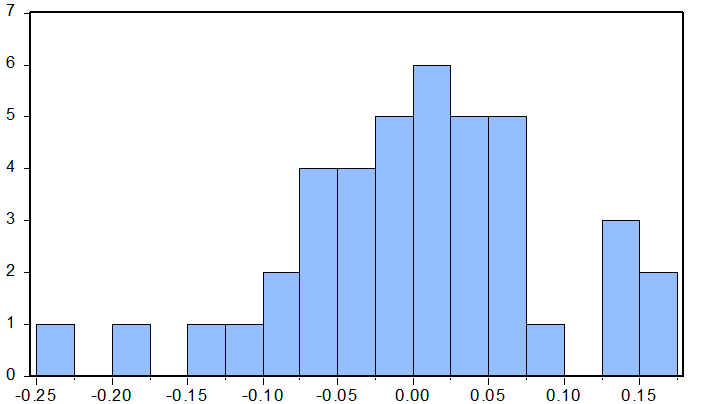
The estimated statistics was significant even at p-values of 0.10 (i.e. 10% level of statistically significance level) apart from the heteroscedasticity test. The inference for these is that the estimated residuals for the model were normally distributed with mean equals to zero and devoid of significant presence of serial correlation. When heteroscedasticity was noted we applied the White heteroskedasticity-consistent standard errors & covariance option of the model estimation to correct it.
The Ramsey RESET result which was equally not significant even at 10percent level indicates that the model’s residuals were stable and the model was well specified. The CUSUM test result in Figure 2 affirms the stability of the residuals which showed that the residuals did not deviate from the 5 percent level of significance boundaries [22].
Having established the existence of a cointegrating relationship among [LNRICEYDt, LNRAINt, LNPESTCD, LNLANDt, LNFERTt, LNCO2KTt, LNTEMPt and LNRPt] based on the bounds test results presented in Table 1, the Granger causality test was performed to equation (3), such that only the rice yield vector was estimated with an error correction term. Table 4 summarises the results of long-run and short- run Granger causality. Thus, the Granger causality test of the cointegration equation is summarized in the table.
Results in Table 4 which recorded the short run causality test output in the first panel of the table, indicates that the differenced values of natural log of pesticide application [i.e. d (lnpestcd(-1))] at first lag with estimated t-statistic of -2.142 exerted a significant (p<0.05) negative effect on rice yield in Nigeria within the short run over the period in review. Similarly, the differenced values of natural log of rice price [d (lnrp (-1))] in its first lag, significantly (p<0.01) exerted a negative effect on the yield of rice in Nigeria over the period in review.
| Cointegrating Form | |||||
|---|---|---|---|---|---|
| Variable | Coefficient | Std. Error | t-Statistic | Prob. | |
| d(lnrain) | 0.047 | 0.187 | 0.253 | 0.802 | |
| d(lnpestcd) | -0.010 | 0.027 | -0.359 | 0.723 | |
| d(lnpestcd(-1)) | -0.060 | 0.028 | -2.142** | 0.042 | |
| d(lnland) | 0.018 | 0.106 | 0.166 | 0.869 | |
| d(lnfert) | -0.033 | 0.035 | -0.957 | 0.347 | |
| d(lnco2kt) | -0.220 | 0.095 | -2.321** | 0.028 | |
| d(lntemp) | -1.763 | 1.103 | -1.598 | 0.122 | |
| d(lnrp) | 0.176 | 0.068 | 2.601** | 0.015 | |
| d(lnrp(-1)) | 0.291 | 0.089 | 3.264*** | 0.003 | |
| CointEq(-1) | -1.052 | 0.125 | -8.422*** | 0.000 | |
| Cointeq = LNRICEYD - (2.6143*LNRAIN + 0.0765*LNPESTCD + 0.2398 | |||||
| *LNLAND -0.0346*LNFERT -0.1810*LNCO2KT -1.1169*LNTEMP | |||||
| -0.2198*LNRP + 0.5490) | |||||
| Long Run Coefficients | |||||
| Variable | Coefficient | Std. Error | t-Statistic | Prob. | |
| lnrain | 2.614 | 1.336 | 1.957** | 0.061 | |
| lnpestcd | 0.076 | 0.033 | 2.322** | 0.028 | |
| lnland | 0.240 | 0.122 | 1.968* | 0.060 | |
| lnfert | -0.035 | 0.060 | -0.577 | 0.569 | |
| lnco2kt | -0.181 | 0.081 | -2.223** | 0.035 | |
| lntemp | -1.117 | 1.714 | -0.652 | 0.520 | |
| lnrp | -0.220 | 0.059 | -3.746** | 0.001 | |
| c | 0.549 | 7.396 | 0.074 | 0.941 |
Table 5: ARDL Cointegrating Short and Long Run Forms.
NB:*, , * denote significant at 10%, 5% and 1% statistical significant levels respectively. Table 4: ARDL Cointegrating Short and Long Run Forms.
On the short run too, we found the differenced form of natural log of CO2 emission levels [d(lnco2kt)] to have a significant effect on the predicted estimates of rice yields over the period in review. The short run slope coefficient of -0.220 estimated had t-ratio estimate of -2.321, which was statistically significant at p<0.05. What these results imply is that pesticides increase in the levels of pesticides by rice farmers in the country and increase in price of rice were reducing the yields recorded in rice production in Nigeria on the short run. Similarly, increase in CO2 emission levels (air pollution or increase in poor environmental quality) was contributing negatively to the attainment of rice productivity increase in Nigerian agricultural industry over the period in review, albeit, on the short run. The results of the bounds test are also confirmed by the lagged error correction term ECTt, with expected sign of -1.052 which is statistically significant at the one percent significant level [23]. With regard to the speed of adjustment estimated, it was found to be lower than the estimated ARLD implying that the convergence to equilibrium in long-term will take a long time.
On the long run, it was found (as displayed in the second panel of Table 4 that variability in rainfall level and CO2 emission levels were affecting the levels of rice yield in Nigeria over the period in review. The slope coefficient estimates of the natural logs of rainfall (2.614 at p<0.10) and that of CO2 emission levels (-0.181 at p<0.05) were significantly influencing the variations in yields of rice in the economy positively and negatively respectively. Thus, while rainfall increase was associated with increase in yield of rice, we found that increase in the emission levels of CO2 in Nigerian atmosphere during the period in review was associated with yield reduction in Nigerian rice farms. Another factor which acted against the increase in rice yield growth in the study on the long run is increase in price of rice. This probably affected the yield in form of increase in price of rice seeds planted when rice prices increased since we understand from price theory that increase in price do send signals to suppliers to boost their productivity and supply. The estimated slope coefficient of this variable (price) was -0.220 at p<0.01. Contrary to the effect of pesticide application outcome in our study for the short run which indicated a significant negative effect on rice yield we found that on the long-run pesticide application in rice farms exerted a positive (coefficient = 0.076) significant (p<0.05) effect on rice yield in the country [22]. Similarly, increase in arable land allocation to rice farming whose slope coefficient estimate was 0.240 indicated a significant (p<0.10) positive effect on the yield of rice in the study. Since we used natural log of both the dependent and independent variables our reported slope coefficients equally represented elasticities of the means.
Conclusion and Policy Recommendations
This study attempted to provide fresh empirical evidence on effects of climate change and environmental quality (especially CO2 emission) on productivity levels of one of Nigeria’s and worlds most important staple crop, rice. We utilized the autoregressive distribution lag (ARDL) to investigate the responses (short-run and long-run) of rice yield to CO2 emission, climate variables and input as well as price factors that could affect yield of rice in Nigeria. The results from the bounds tests conducted indicated a long-run relationship with the rice yield as the dependent variable. In agreement with the worries of environmental economists, we found that climate related variables, especially rainfall as well as poor environmental quality arising from increase in greenhouse gas emissions (as a result of increased economic activities and unsustainable method of economic production) were significantly influencing long-run yields of rice in Nigeria over the period in review. While variability and high cost of rice seeds (as implied from rice price increase) as well as increase in land area cultivated to rice was affecting the long run yield variability in Nigeria, we found the use of pesticide to have different effects depending on whether it was on long-run or short run. On the long run increased use of pesticide was healthy to rice yield increase in the study. However, on the short run, it was indicated that the application of the pesticide was reducing yield suggesting farmers were probably not applying the chemicals optimally or sustainably on their farms. Based on the findings it was recommended that programmes to facilitate greener economy, boosting of steady supply of water such as practice of agroforestry/ afforestation, irrigation promotion as well as implementation of other climate smart agricultural practices need to be put in place and encouraged. It is also recommended that supply of pesticides, use of organic method or natural method of pest control and provision of improved rice varieties at affordable prices for rice cultivation should be put in place in Nigeria in order to ensure sustainable production of rice in the country.
References
-
Cardoni P, Angelucci F (2013) Analysis of incentives and disincentives for rice in Nigeria. Technical Notes Series Monitoring Africa Food and Agricultural Policies FAO, Rome, pp: 40.
-
Central Bank of Nigeria CBN (2013) Statistical Bulletin, Central Bank of Nigeria: Abuja 23(22).
-
(2012) World trade report: Agricultural Bulletin. Food and Agricultural Organization of United Nations: Rome 75.
-
FAO (2020) Nigeria at a glance. FAO in Nigeria.
-
(2019) Grain and Feed Annual 2019: Nigeria’s Imports of Wheat and Rice to Rise. United States Department of Agriculture (USDA).
-
Tiamiyu SA, Kolo IU, Adewale GA, Ugalahi UB (2014) Trend analysis of milled rice consumption in Nigeria. International Journal of Agricultural Policy and Research 2(10): 329-333.
-
Agricultural Transformation Agenda (ATA) (2011) Rice transformation working document. Agricultural Transformation Agenda of the Federal Government of Nigeria, Abuja: Federal Republic of Nigeria, pp: 35.
-
Onoja AO, Achike AI (2010) A comparative analysis of resource efficiencies in rice production under small- scale farmer-managed irrigation schemes and rainfed systems in Kogi State, Nigeria. Research Journal of Agriculture and Biological Sciences 6(6): 1816-1561.
-
Okoruwa VO, Ogundele OO (2006) Technical efficiency differentials in rice production technologies in Nigeria. The Nigerian Institute of Social and Economic Research (NISER), Nigeria.
-
Anushieokwu OS (2011) Analysis of Government Initiatives on Rice Production in Nigeria. Journal of Advances in Agricultural Science and Technology 2(6): 89-93.
-
Saul E (2015) Impact of climate change on agriculture and food security in Nigeria: challenges and adaptation. Global Advanced Research Journal of Medicinal Plant (GARJMP) 3(1): 1-9.
-
NIMET (2008) Nigerian meteorological agency report. Nigerian Meteorological Agency (NIMET): Abuja.
-
Agbola P, Fayiga AO (2016) Effects of climate change on agricultural production and rural livelihood in Nigeria. Journal of Agricultural Research and Development 15(1).
-
(2010) Gender, poverty and environmental indicators on African countries. African Development Bank Group.
-
(2015) Nigeria. The World Bank.
-
Pesaran MH, Shin Y, Smith RJ (2001) Bounds testing approaches to the analysis of level relationships. Journal of Applied Econometrics 16(3): 289-326.
-
Peseran MH, Shin Y (1999) An autoregressive distributed lag modelling approach to cointegration analysis. In: Strom S, et al. (Eds.). Econometrics and Economic Theory in 20th Century: The Ragnar Frisch Centennial Symposium, Chapter 11, Cambridge University Press, Cambridge.
-
Halicioglu F (2008) The J-Curve dynamics of Turkey: An application of ARDL model. Munich Personal RePec Archive.
-
Greene WH (2008) Econometric analysis. 5th (Edn.), New Delhi, India: Pearson Education.
-
Gujarati DN (2006) Essentials of econometrics. 3rd (Edn.), New York: Mc Graw Hill.
-
Gujarati DN, Sangeetha E (2007) Basic econometrics. 4th (Edn.), New Delhi & New York: Mc Graw Hill.
-
Noodezh HR, Moghimi S (2015) Environmental costs and environmental information disclosure in the accounting systems. International Journal of Academic Research in Accounting, Finance and Management Sciences 5(1): 13- 18.
-
Ugbah PA, Olaniyan O, Francis SD, James A (2019) Impact of Climate Change on Growing Season in Nigeria: Seasonal Rainfall Prediction (SRP) as Assessment and Adaptation Tool. Handbook of Climate Change Resilience, pp: 1-27.
- Enhancement of Vegetative Growth and Fruit Yield in Cucumber (Cucumis sativus L.) via Spiritual Blessing (Biofield) Energy Intervention
- Production of Açaí (Euterpe oleracea Mart.) under Different Agroforestry System Management Intensities in Amazonian Floodplain (Varzea) Forests
- Coffee and the Production Region: What is the Secret to the Expression "Quality"?
- Experiential Agripreneurship Training in Sub-Saharan Africa: Integrating a Business Incubator into Postgraduate Livestock Education at the University of Buea
- Advances in Agricultural High-Quality Development
- Linking Compost Residue to ABAGE in Plants - a Short Note