
Scoring Central American White-Tailed Deer (Odocoileus Virginianus Nelsoni) Antlers, in Motozintla, Chiapas, Mexico
On July 6th, 2020, a white-tailed deer in Chiapas was captured and rescued by residents from Canoas neighborhood in Motozintla de Mendoza. Chiapas, Mexico. According to local rumors, the specimen was chased by illegal hunters and feral dogs. A few hours after its capture, the white-tailed deer perished due to beats in its hind legs and from a myocardial stroke, caused by stress (capture myopathy). Later, the animal's body was used to measure the antlers set, the Method 17-T Entry Form for white-tailed deer with typical antlers from the Safari Club International (SCI) was used with a measuring tape in inches. The following measurements were taken to the antler set: a) Length of main beam, b) Length of typical tines, c) Circumference of main beam and d) Inside span of main beams. These measures gave a total score of 394/8 SCI points. This score is low, considering that the reported individual was a juvenile male with an age of approximately 2.5 years old, presenting a single point in the antler set. Finally, one of the important events found is that the white-tailed deer showed the detachment of the velvet that covers the antlers, even traces were found that the antlers were recently carved since they presented pieces of leaves adhered to the main branch of the left antler. The event occurred in July (rainy season), and may be due to the genetic characteristics of their parents, the type and quality of the habitat, the quality of forage and the variations of rain and droughts (seasonal), as well as the daylight hours.
Introduction
Mexico has 14 subspecies of white-tailed deer (Odocoileus virginianus) [1]. The biogeographic distribution area of the white-tailed deer subspecies of the state of Chiapas, Mexico (Odocoileus virginianus nelsoni) is limited to the physiographic regions of the eastern and northern mountains of the state. This subspecies is also distributed in Central America, particularly in Guatemala. All this geographical area of distribution is included within the physiographic of the Sierra Madre of Chiapas and Guatemala. Most of the original ecosystems of tropical evergreen forest, pine-oak forest and tropical deciduous forest [2, 3], which are the types of vegetation of the main natural habitats where this white-tailed deer of Chiapas development has been brutally devastated during the last 60 years, in order to give way to agriculture and extensive livestock [4].
The Sierra Mariscal Region of the State of Chiapas, Mexico is made up of ten municipalities: Amatenango de la Frontera, Bejucal de Ocampo, Bella Vista, Chicomuselo, El Porvenir, Frontera Comalapa, La Grandeza, Mazapa Madero, Siltepec and Motozintla. It borders to the north with Regions IV De Los Llanos and XV Meseta Comiteca Tojolabal, to the east with the Republic of Guatemala, to the south with Region X Soconusco and to the west with Regions VI Frailesca and IX Istmo Costa [5]. In the municipality of Motozintla, three types of vegetation predominate: Pine-oak forest, tropical evergreen forest and tropical deciduous forest. In this region, livestock activities which are not suitable are carried out due to the type of land and the type of vegetation, mainly of cattle, goats, and sheep, their primarily use if for meat, wool and milk. However, even with these activities and anthropogenic pressures, there is a natural distribution of the white-tailed deer of Chiapas and other wildlife species.
The white-tailed deer species play an important role for sport hunting in Mexico and North America. Sport hunters look for them for their antlers set. The importance of the measurement and registration of Odocoileus virginianus nelsoni antlers is its hunting approach, which according to the Grand Slam refers to obtaining hunting trophies from a group of animal species or subspecies [6]. It should be noted that the Boone and Crockett Club, officially registered the typical trophies from 170 points for white-tailed deer in general and from 110 points for Coues deer subspecies (Odocoileus virginianus couesi); the typical trophies are classified to 195 and 120 points respectively [7]; many of the Mexican subspecies do not qualify under this system due to their smaller body dimensions and antler set [6].
The SCI (Barnhart and Schwabland [8]), have a category for the other Mexican subspecies, including southeast subspecies (thomasi, nelsoni, yucatanensis and truei). This measurement system was important in establishing the Hubert Thummler Award to the Deer of Mexico [9, 10]; which has been an important contribution to the rural areas, where it is still distributed this species. Villarreal et al. (2014) [11] mentions that seven new regional categories of white-tailed deer trophies for Mexico were established for the SCI Record Book of Trophy Animals. These new categories of game trophies of the SCI for the white-tailed deer in the country, including the O. v. nelsoni in the category of Central American white-tailed deer. He also mentions that this regionalization seeks for the increase of the demand for regional big game trophies, in a more homogeneous way in rural areas of Mexico. Documentation of the measurements and records of white-tailed deer of Chiapas antlers sets, is extremely important to ratify its ecological and hunting importance that can have this subspecies in the country, and economic benefits that can arise with the sustainable use of tropical cervids, as the case in this region of the State of Chiapas.
Materials and Methods
This investigation was carried out with equipment and materials from Universidad de Ciencias y Artes de Chiapas (UNICACH) Sede Motozintla, located in the city that has the same name, in the State of Chiapas, México.
On July 6th, 2020, a white-tailed deer in Chiapas was captured and rescued by residents from Canoas neighborhood in Motozintla de Mendoza. Chiapas, Mexico (Figure 1c). According to local rumors, the specimen was chased by illegal hunters and feral dogs. A few hours after its capture, the white-tailed deer perished due to beats in its hind legs and from a myocardial stroke, caused by stress (capture myopathy). Later, the animal’s body was used for other scientific studies.
To measure the antlers set, the Method 17-T Entry Form for white-tailed deer with typical antlers from the Safari Club International (SCI, 2018) [12] was used with a measuring tape in inches.
Results and Discussion
With the Method 17-T Entry Form for white-tailed deer, with typical antlers from the SCI, the following measurements were taken to the antler set (Figure 1b): a) Length of Main beam, b) Length of typical Tines, c) Circumference of main beam and d) Inside span of main beams. These measures gave a total score of 394/8 SCI points. This score is low, considering that the reported individual was a juvenile male with an age of approximately 2.5 years, presenting a single point in the antler set. In addition, there is a comparison with that registered for the Mexican white-tailed deer reported by Villarreal, et al. [13], which is 653/8 SCI points, and the record in the Mixteca Poblana Region being 88 SCI points, and by Villarreal (2013) [4] that reports 18 to 60 points of the Boone and Crockett Club-B&C (no penalties) for 4 and 6 tines; the reported value is far below.
However, starting in 2013, this subspecies of O. v. nelsoni , is already included in one of the seven hunting regions in which Mexico has been subdivided in the SCI Sport Hunting World Record Book [11], now the 14 Mexican white-tailed deer subspecies can be registered internationally as world- renowned hunting trophies, that is, this subspecies of white- tailed deer is now listed in the international market for sport hunting and tourism, and for this reason, it has the same hunting importance as any African antelope or European deer [4]. It´s important to mention that the best white-tailed deer antler trophies are thrown between 5.5 and 6.5 years of old. Additionally, taken on the following measures average physical body: total length (tip of the nose to the tail tip at the back) 1413 mm., total length of tail 168 mm., length of hind legs 413 mm., height of the animal measured at the withers 710 mm., and skull length 203 mm.
Finally, one of the important events found is that the white-tailed deer showed the detachment of the velvet that covers the antlers, even traces were found that the antlers were recently carved since they presented pieces of leaves adhered to the main branch of the left antler (Figure 1a). The event occurred in July 2020 (rainy season), and might be due to the genetic characteristics of their parents, the type and quality of the habitat, the quality of forage and the variations of rain and droughts (seasonal), as well as the daylight hours. This is highly relevant, as documented and reported by Villarreal (2006 and 2013) [14], is that, late September or early October, the new antlers of the white-tailed deer are carved and polished against the branches and trunks of the bushes and trees, leaving them clean and ready for combat with other males during the female mating season (December and January).
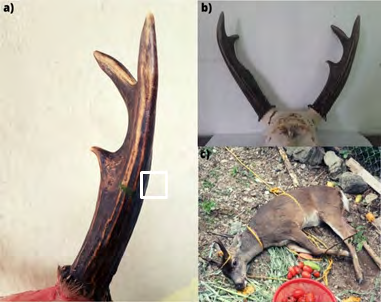
Figure 1: a) Leaves attached to the main beam of the left antler, a trace that the white-tailed deer had recently carved. b) Antlers set of the white-tailed deer of Chiapas. c) Rescue and capture of Odocoileus virginianus nelsoni residents from Canoas neighborhood in Motozintla de Mendoza. Chiapas, Mexico.
References
-
Hall E (1981) The mammals of North America. Wiley- Interscience, New York, pp: 1091-1097.
-
Leopold AS (1950) Vegetation zones of Mexico. Ecology 31(4): 507-518.
-
COTECOCA (Comisión Técnico Consultiva para la Determinación Regional de los Coeficientes de Agostadero) (2001) SAGARPA, Delegación en el Estado de Chiapas, Subdelegación Agropecuaria, pp: 33.
-
Diversified Livestock: Ecological, Hunting and Economic Importance of Mexican White-tailed Deer. Secretariat of Agriculture, Livestock, Rural Development, Fisheries and Food (SAGARPA) and the National Committee for the Diversified Livestock Product System, Mexico. pp: 184-190.
-
CEIEG (Comité Estatal de Información Estadística Y Geográfica) (2014) Gobierno del Estado de Chiapas, México.
-
Villarreal O (2002) The Mexican white-tailed deer Grand Slam, a sustainable alternative. Animal husbandry archives 51(194): 187-193.
-
Nesbitt WH, Reneau J (1991) Records of North America White-tailed deer. Second Ed. The Boone and Crockett Club. Dumfries, Virginia, USA.
-
Barnhart LI, Schwabland J (1994) Safari Club International, Measurer’s Manual. IX Ed. Associate Editor: Holt Bodinson, pp: 42-46.
-
Reyes JM (1996) Strategies for the strengthening of the hunting activity: Bases for the conformation of a book of trophies of sport hunting in Mexico. Memories of the V Symposium on deer in Mexico. UNAM, ANGADI, UQR, pp: 180-181.
-
Villarreal O, Villarreal J, Viejo J, Reséndiz R, Romero S (2014) New trophy categories for white-tailed deer (Odocoileus virginianus) from the International Safari Club for Mexico RECIA. Colombian Journal of Animal Science 6(2): 382-388.
-
Villarreal J (1996) Las 14 subespecies mexicanas de venado cola blanca (Odocoileus virginianus). Requieren de un libro de récords de caza para beneficio de la especie. Memorias del V Simposio sobre venados en México. UNAM, ANGADI, UQR. Pp: 65-68.
-
SCI (Safari Club International) (2018) Official Measuring Forms, Method 17-T For white-tailed deer with typical antlers.
-
Villarreal O, Plata-Pérez FX, Hernández-Hernández JE, Franco-Guerra FJ, Aguilar-Ortega B, et al. (2011) The White-tailed Deer in the Mixteca Poblana. Therya 2(2): 103-110.
-
Villarreal J (2006) White-tailed Deer, Hunting Management and Use 2nd (Ed.,). Unión Ganadera Regional de Nuevo León, Guadalupe, Nuevo León, Mexico, pp: 411.
- Enhancement of Vegetative Growth and Fruit Yield in Cucumber (Cucumis sativus L.) via Spiritual Blessing (Biofield) Energy Intervention
- Production of Açaí (Euterpe oleracea Mart.) under Different Agroforestry System Management Intensities in Amazonian Floodplain (Varzea) Forests
- Coffee and the Production Region: What is the Secret to the Expression "Quality"?
- Experiential Agripreneurship Training in Sub-Saharan Africa: Integrating a Business Incubator into Postgraduate Livestock Education at the University of Buea
- Advances in Agricultural High-Quality Development
- Linking Compost Residue to ABAGE in Plants - a Short Note