
Organic Crop Productivity Demonstration Using Tillage And Biofertilizer Management Approaches At Kulumsa, Southeastern Ethiopia
Organic agriculture assures sustainability of crop production with low or no use of external agricultural inputs. It is practiced under small scale level for high value crop such as coffee in Ethiopia. Although crop rotation as part of organic agriculture is practiced in food security crops like wheat and faba bean, it is not implemented under large scale production schemes. Thus, a field research was conducted to test and demonstrate organic farming and associated tillage and fertility trials at Kulumsa, southeastern Ethiopia. Interventions were deep plowing followed by soil harmonization using alfalfa and lathyrus planting in 2016. Then, all the planted biomass were converted to the soil during the second heavy plowing before setting up the trials. Separate sets of large blocks (20 ha) of field experiments were undertaken in 2017 main cropping season. Tillage experiments using mechanized and oxen plowing treatments were compared in faba bean and tef demonstration fields in 2.28 ha per each crop. Faba bean productivity was higher in oxen than tractor plowed field. Although non-significant, application of bio fertilizer gave better faba bean yield with tractor than oxen plowed field. Tef yield was better in oxen than tractor plowed field. Similarly, five crops (0.75 ha each) were evaluated for their productivity in organic model farm experiment under green manure and with additional decomposed animal manure. Organic based bread wheat (3300 kg/ha) production showed above national average yield. Productivity of potato was 24,444 kg/ha and that of fresh alfalfa biomass was11, 640 kg/ha. Thus, agroecological system approaches such as proper tillage, soil harmonization and crop rotation showed significant effect to reduce weed species composition and increased productivity at last.
Introduction
Organic agriculture is a holistic production management system which promotes and enhances agro-ecosystem health, including biodiversity, biological cycles, and soil biological activity [1]. It is the use and application of natural products and processes to maximizes production and productivity of agricultural commodities in a sustainable way. It focuses on the health of soil, plant, animal, human and our planet by far. It emphasizes the use of management practices in preference to the use of off-farm inputs, taking into account that regional conditions require locally adapted systems. This could be possible using agronomic, biological, mechanical methods rather than using synthetic materials (chemical fertilizers, pesticides) within a system [2]. Therefore, proper cropping systems (crop rotation, intercropping...) and safe crop management practices such as addition of decomposed crop residues, compost and animal manures with proper tillage operations can facilitate nutrient recycling and use/ absorption for sustainable management of natural resources.
As part of organic farming, modern crop rotations consider knowledge on nutrient balances, soil fertility and crop health effects. They are widely unknown in Ethiopia. Regional cropping systems or methods are rather based on tradition than on agronomic expertise and often focus on few crops only. In the Arsi, region farmers mainly grow wheat (75-90% of the farmland) and to a smaller extent, some other crops (faba bean, pea, maize, barley, tef). Most of the self- sufficiency and small-scale farms (average farm-size: 1-2 ha) have no understanding of modern crop rotation strategies (weed and disease prevention, nutrient recycling) and also rarely use external farm inputs due to lack of money, no experience of market integrated production and difficulties of supply infrastructure [3]. Most of the training and support is on increasing external farm inputs (mechanization, mineral fertilizer, pesticides). However, without understanding the concept of crop rotation the use of external farm inputs is not sustainable (increasing production problems like soil degradation and costs for decreasing efficiency due to “sick cropping systems”) [3].
The Ethiopian agricultural research system as a whole so far released more than 1000 varieties of different crops in the conventional methods in the past half century. Wheat/ faba bean production systems and release of varieties and production technology packages in the value chains are among the most popular, though the average production of wheat at small-scale level remained as 2.1 t/ha and that of faba bean 3.6t/ha [3]. Research recommendation showed that wheat production could be increased up to 6 t/ha even if the potential said to be 9 t/ha. All those production gaps could not be closed up or narrowed down due to adoption of technologies in the conventional systems. On the other hand, production of wheat using knowledge based organic system elsewhere in the world showed that it is possible to attain 6 t/ha without the additional classical conventional farm inputs. Hence, starting with organic system crop research and cropping sequence trials with proper improvement of soil fertility has a potential to enhance productivity of agricultural crops productivity. Therefore, the overall objective of these activities was to demonstrate and compare current cropping systems with organic and other no/low external input crop rotations with respect to soil fertility and yield.
Material and Methods
Description of the Study Area
The experiments were conducted at Kulumsa Agricultural research center (KARC) during main cropping season of May 2016 to December 2017 at field number 70 on 20 ha of land. KARC is located at Oromia National Regional state in Arsi Zone, which is 167 km South East of Addis Ababa at 8°01’10’’N and 39°09’11’’ E at an average elevation of 2210 m above sea level. It was established in 1966 and it is one of the major research centers responsible for wheat/faba bean- based value chain research. The agro–climatic condition of the area is moist 2 (tepid to cool moist mid to high altitude) and receives a unimodal mean annual rain fall of 809.2 mm from March to September, where the peak month of rain fall is from July to August. It has a dominant soil texture of clay soil (Luvisols) with an average pH of 6.0. The maximum and minimum mean temperature is 23.1 and 9.9°C, respectively. The soil analysis conducted in 2016 revealed that the average content of the soil was 5.95, 14.25, 0.17, 2.33 and 4.02 of pH, available P (ppm), %nitrogen, %organic carbon and % organic matter, respectively. Despite the loss of nitrogen in the soil by different factors, the low nitrogen content in this field shows that implementation of crop rotation coupled with different treatments improves the availability and nutrient status of the soil.
Experimental Set Up and Treatment Arrangement
The soil was homogenized with sweet clover from July to September 2016to have uniform fertility gradient, improved soil structure and reduced weed infestation. Due to persistent weed seed bank in the soil, sweet clover was under plowed and replaced by grass pea in the residual moisture in September 2016. Grass pea stubble mulching was carried out in November 2016 and stays decomposed until March 2017. First plowing carried out in March 2017 using mould board plow, followed by disc plow in May 2017 and final plow at planting in June-July 2017 (planter fitted with power harrow). Weather data was recorded throughout the cropping seasons. Moreover, pre and post-harvest weed survey was conducted in 2016 and 2017 main cropping seasons following an inverted “W” pattern using a 1 m by 1 m quadrat [4]. The types of weeds were counted and identified using a colored reference manual of Stroud and Parker [5]. Excel was used to calculate the mean values and plotting the graph.
Trial I: Soil Tillage Demonstration Trial
The experiment was conducted in a randomized block design with one replication. The treatments were tractor and oxen plow tillage in a plot size of 60 by 18 m2 area per treatment. The total area for each crop (faba bean and tef) was 2.28 ha. The treatments were oxen plow only, tractor plow only, oxen plow and herbicide application, tractor plow and herbicide application, oxen plow and mechanical weed control, and tractor plow and mechanical weed control. In case of faba bean, two non-commercialized bio fertilizer strains (strain 1018 and 1035) were used in both oxen and tractor plow treatments. Bio fertilizer strains were applied at the rate of 0.5 kg/ha. The strains were mixed thoroughly with faba bean seed using lukewarm water and sugar. Two tablespoons of sugar were mixed with 0.5 liter of water to be used in sticking the seed with bio fertilizer. Except the addition of bio fertilizer, the same treatments were used in tef demonstration too. The seeds were sown by tractor at the rate of 175 and 7 kg/ha in faba bean (Variety Dosha) and tef (Eragrostis tef) variety Kora, respectively. Tef is a unique and gluten free staple food for Ethiopians. Ethiopia is the center of origin for tef. No additional chemical fertilizer was added for both crops in this experiment.
Trial II: Organic Model Farm
The experiment was conducted in a randomized block design with one replication. The treatments were five field crops (bread wheat, malt barley, faba bean, potato and alfalfa) rotation with 50 by 150 m2or 0.75 ha area for each crop. The total area became 4.5 ha. The seed rate was 125 kg/ha (bread wheat), 85kg/ha (malt barley),175 kg/ha (faba bean), 6 kg/ha (alfalfa) and 18-20 q/ha (potato). The crop varieties used were: bread wheat (Kingbird), malt barley (Ibon), faba bean (Dosha), alfalfa (CL-77), and potato (Gudene). Kingbird is an early maturing and rust resistant bread wheat variety. Gudene is a late blight resistant potato variety. The seeds were planted in a row. Potato was planted in 0.30 intra and 0.75 m inter row spacing by using tractor. No additional input (chemical fertilizer) was added. The biomass of alfalfa was taken from 23 sampling point by using 0.25 m2 quadrat. Alfalfa was slashed and mulched at time of flowering. Relevant yield and yield related data were collected. Hand weeding was carried out in a regular interval to avoid weed infestation.
Results and Discussion
Weather data and crop production
Planting was carried following weather forecast. The world meteorological agency forecasted El Nino occurrence in 2017 main cropping season. Despite late onset of rainfall (affects crop establishment), the distribution favored crop growth and development in the later stages. Late onset and low rainfall distribution in June led to delayed planting time such as in faba bean (Figure 1).
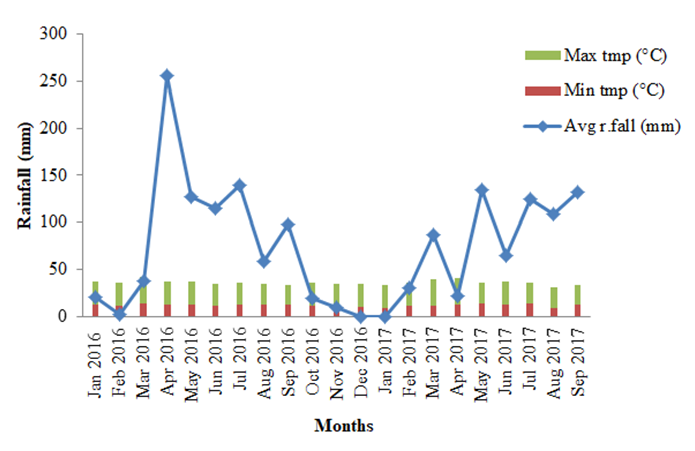
Figure1: Weather data at KARC from January 2016 to September 2017.
That is why; the seeds were shriveled (though it is a moisture stress sensitive crop as compared to the others crops). Although the rainfall was below expected, it was optimum for better crop performance/yield in the succeeding months. However, there was no as such big difference between the maximum and minimum temperature throughout the stated months to affect crop growth and development.
Demonstration of Tillage Treatments on Fab Bean and Tef Production
Faba bean and tef (Table 1) demonstration trials were established in June 2017 as per the layout. Mechanization and oxen plowing treatments were compared in the demo fields. Except the late onset of rain that affected the faba bean performance as a whole, tef performed very well. Tef mechanized planting at low seed rate (7.5 kg/ha) showed better performance than the recommended (25-30 kg/ha) rate. Late onset of rain at planting limits application of pre- emergence herbicide on faba bean. On the other hand, low grass weeds infestation minimizes cost of post-emergence herbicides application in the later crop growth stages in both faba bean and tef. That is why; the weed control mostly relies on hand weeding. Dominance of broadleaf in this field associated with specialization of the weed species to the previous precursor legume crops in the field.
| Crop types and tillage treatment | Tillage types | Productivity (kg/ha) | Remark | |
|---|---|---|---|---|
| 1. | Faba bean tillage plot | Tractor (TR) | 2957 | |
| 1. | Faba bean tillage plot | Oxen plow (OP) | 3360 | |
| 1. | Faba bean tillage plot | Strain 1018+TR | 4240 | Both strains were not commercialized bio fertilizers in faba bean |
| 1. | Faba bean tillage plot | Strain 1018+OP | 2440 | Both strains were not commercialized bio fertilizers in faba bean |
| 1. | Faba bean tillage plot | Strain 1035+TR | 3680 | Both strains were not commercialized bio fertilizers in faba bean |
| 1. | Faba bean tillage plot | Strain 1035+OP | 3480 | Both strains were not commercialized bio fertilizers in faba bean |
| 2. | Tef tillage plot | Tractor (TR) | 1654 | |
| 2. | Tef tillage plot | Oxen plow (OP) | 2106 |
Table 1: Productivity of faba bean and tef demonstration plots in different tillage types at field number 70 in 2017 main croppin
Faba bean productivity was better in oxen plow treatments as compared to tractor; but bio fertilizer treatment with tractor offers better yield advantage than oxen plow (Table 1). Despite small differences, the two bio fertilizer strains (1018 and 1035) performed better in faba bean yield. Therefore, bio fertilizer with good seedbed preparation resulted in good yield. In this instance, oxen plow seems better in yield than tractor. Tef yield was also better in oxen plow than tractor. This might be related to the small size of tef and low trampling effect of oxen plowed field in tef emergence, growth and development than tractor plowed field in yield.
Demonstration Of Organic Model Farm
In organic model farm, the productivity of the five crops under rotation was shown in Figure 2.
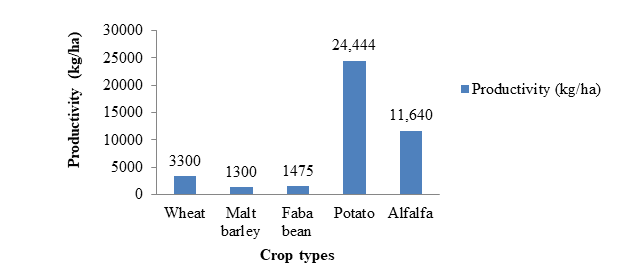
The five field crop (bread wheat, malt barley, faba bean, potato and alfalfa) rotation in organic model farm showed good results except malt barley. Malt barley was planted in
1.5 ha according to the field layout and randomization. It was supposed to be rotated by tef in the subsequent cropping sequences. Unfortunately, the low yield in malt barley plot might be related to poor drainage and/or land leveling (non- uniform slope) on that side of the farm. The productivity of wheat and malt barley was 3300 and 1300 kg/ha, respectively. The bread wheat productivity showed optimistic future and closed to conventional (research plot with no additional external input) production. Faba bean productivity was 1475 kg/ha. Late on set of rainfall contributed to low productivity though not disappointing without additional external inputs. Potato productivity was 24,444 kg/ha which was encouraging. The average fresh biomass of alfalfa harvest was equivalent to 11,640 kg/ha. The stubble was slashed and plowed under for further decomposition.
Tillage and crop rotation effects on weed species composition
As shown in Table 2, 21 weed species in 15 families were recorded in 2016. While in 2017, a total of 15 types of weed species in 9 families were recorded (Table 3). However, the type and extent of weed species in 2016 was greater than 2017. Broadleaf weeds, followed by grasses and sedges, respectively, inhabited the majority of the field. This might be resulted from high weed seed bank deposit in the soil due to long years of cereal dominated cropping system.
| Family | Type of weed species | Number | |
|---|---|---|---|
| 1. | Amarantaceae | Amaranthus hybridus L. | 1 |
| 2. | Caryophyllaceae | Spergula arvensis L. | 1 |
| 3. | Chenopodiaceae | Chenopodium opulifolium Koch. | 1 |
| 4. | Commelinaceae | Commelina latifolia A. Rich. | 1 |
| 5. | Compositae | Galinsoga parviflora Cav., Guizotia scabra (Vis.) Chiov. and Sonchus asper (L.) Hill | 3 |
| 6. | Convolvulaceae | Convolvulus arvensis L. | 1 |
| 7. | Cyperaceae | Cyperus sp. | 1 |
| 8. | Malvaceae | Hibiscus sp. | 1 |
| 9. | Oxalidaceae | Oxalis latifolia H.B.K. | 1 |
| 10. | Papaveraceae | Argemone ochroleuca L. | 1 |
| 11. | Plantaginaceae | Plantago lanceolata L. | 1 |
| 12. | Poaceae | Bromus pectinatus Thunb., Phalaris paradoxa L.,Setaria pumila (Poir.) Roem and Shult. and Snowdenia polystachya (Fresen) Pilg. | 4 |
| 13. | Primulaceae | Anagalis arvensis L. | 1 |
| 14. | Rubiaceae | Galium spurium L. Var. africanum Verdc. | 1 |
| 15. | Solanaceae | Nicandra physalodes Scop. and Solanum nigrum L. | 2 |
| Sub total | 21 | ||
Table 2: Number and composition of weed species at field number 70 in 2016 main cropping season at Kulumsa.
Aggressive weeds such as Snowdenia polystachya was not observed as a problem in most of the field trials in 2017. This might be attributed to proper and timely tillage operation by using appropriate implements and also the effect of deep- rooted rotational crop.
| Family | Type of weed species | Number | |
|---|---|---|---|
| 1. | Amarantaceae | Amaranthus species | 1 |
| 2. | Compositae | Bidens species, Cardus species, Galinsoga parviflora Cav., and Guizotia scabra (Vis.) Chiov. | 4 |
| 3. | Chenopodiaceae | Chenopodium album L. | 1 |
| 4. | Commelinaceae | Commelina benghalensisL. | 1 |
| 5. | Cyperaceae | Cyperus esculentus L. | 1 |
| 6. | Oxalidaceae | Oxalis species | 1 |
| 7. | Poaceae | Digitaria scalarumL. and Snowdenia polystachya (Fresen) Pilg. | 2 |
| 8. | Polygonaceae | Polygonium species and Rumex species | 2 |
| 9. | Solanaceae | Datura stramonium L. and Solanum nigrum L. | 2 |
| Sub total | 15 |
Table 3: Number and composition of weed species at field number 70 at Kulumsa in 2017 main cropping season.
Conclusion
Weather data is critical to assure planting calendar and crop productivity. Bio fertilizer responds better in tractor than oxen plowing plot in faba bean production. However, oxen plowed plot yields better than tractor plowed in non- biofertilizer treated seeds. In organic model farm, the productivity of the five field crops (bread wheat, malt barley, faba bean, potato and alfalfa) under rotation was encouraging with no external inputs. Bread wheat productivity was almost comparable to the conventional approach. Potato productivity was also promising. Fresh biomass productivity of alfalfa was interesting either to use as a feed or to be incorporated to the soil as green manure. Though it was a one year experiment, organic model farming shows encouraging result under good agricultural practices in increasing crop yield and reducing weed pressure in the tested site and similar agro ecologies for further recommendation.
Declarations
Funding
This study was funded by the German Federal Ministry of Economic Corporation and Development (BMZ) through Deutsche Gesellschaft für Internationale Zusammenarbeit (GIZ) GmbH, Green Innovation Center, Ethiopia under grant number 81197664-2016. Besides to partial financial support received from Ethiopian Institute of Agricultural Research (EIAR), it also allocated land and arranged logistics. No funding was received to assist with the preparation of this manuscript.
Conflict of interest
The authors have no relevant financial or non-financial interests to disclose.
Consent for Publication
Informed consent was obtained from all individual for publication of this paper.
Data Availability Statement
All data generated or analyzed during this study are included in this published article.
References
-
Kristiansen P, Taji A, Reganold J (2006) Organic Agriculture: A Global Perspective. CSIRO Publishing, pp: 484.
-
FAO (1999) Organic Agriculture. Food and Agriculture Organization of the United Nations, Rome.
-
EDT-GIZ (2016) Establishment of sustainable crop rotation demonstration (EDT) trials at the Kulumsa Agricultural Research Centre and on selected small-scale farms in the Arsi region, Ethiopia. Project document. Organic agriculture project (EDT-GIZ), Kulumsa Agricultural Research Centre, financed by Green Innovation Centre – Ethiopia.
-
Thomas AG (1985) Weed survey system used in Saskatchewan for cereals and oil seed crops. Weed Sci 33(1): 34-43.
-
Stroud A, Parker C (1989) A weed identification guide for Ethiopia. FAO, Rome, pp: 278.
- Enhancement of Vegetative Growth and Fruit Yield in Cucumber (Cucumis sativus L.) via Spiritual Blessing (Biofield) Energy Intervention
- Production of Açaí (Euterpe oleracea Mart.) under Different Agroforestry System Management Intensities in Amazonian Floodplain (Varzea) Forests
- Coffee and the Production Region: What is the Secret to the Expression "Quality"?
- Experiential Agripreneurship Training in Sub-Saharan Africa: Integrating a Business Incubator into Postgraduate Livestock Education at the University of Buea
- Advances in Agricultural High-Quality Development
- Linking Compost Residue to ABAGE in Plants - a Short Note