
Morphological Evaluation of Selected Capsicum Genotypes in Kashere, Gombe State, Nigeria
The aim of this study was to determine the phenotypic variation and relationship among capsicum species grown in Kashere, Gombe State. The field experiment consisted of six (6) varieties of pepper laid in a randomized complete block design in three replications. Growth and yield characters were recorded. Significant differences were observed among the studied peppers in terms of growth and yield performance. Variety 4 significantly gave the highest yield compared with other varieties studied during the period of the study. Significant positive and negative relationships were observed among the characters of the pepper studied. From the above studies, variety 4 could be suggested for production in Kashere and its environs.
Introduction
Pepper (Capsicum annuum L.) fruits have high nutritive and culinary value and are commonly used as a seasoning to provide special flavor to cooked food [1, 2]. Capsicum not only gives a pretty color and flavor to the foods but also provides minerals and vitamins C, A, B complex, and E. Capsaicin present in chilli pepper is used as medicine for treatment of many human diseases like lumbago, neuralgia, rheumatic disorders and non-allergic Rhinitis.
Pepper (Capsicum sp) is an economically important crop belonging to the family Solanaceae. It originated from South and Central America where it is still under cultivation [3].
The major center of diversity is Brazil where representatives at all cited levels are found Costa LV, et al. [4]. Peppers are considered the first spice to have been used by human beings and there is archaeological evidence of pepper and other fossil foods from as early as 6000 years ago [5]. The genus Capsicum has five domesticated species (C. annuum, C. frutescens, C. chinense, C. pubescens and C. baccatum) of which C. annuumis the most widely cultivated species worldwide [6]. Pepper was introduced into Europe by Columbus and other early new explorers in the sixteenth century and cultivation spread throughout the world [7]. It is a small perennial shrub characterized by white or greenish-white corolla, one or more pedicels at a node with varying fruit sizes and shapes [8]. The crop can also be distinguished by its pungency which varies with cultivar but generally higher in smaller fruit types than larger thick-fleshed types. Pepper grows relatively quick with a maturity period of 3-4 months. In Nigeria, it is grown in home gardens and convenient sites near settlements often as intercrop but it is now grown as a monocrop on large scale by both peasant and commercial farmers. This study aimed at assessing the differences among different peppers with cultivated sweet pepper (C. annuum L.). Yield is a determining factor for crop improvement. Chili pepper, as in other crops, yield is a quantitative trait that is influenced by a number of yield contributing parameters. Differences in plants are the first step in understanding how to improve or produce new plants. Hence the need to evaluate the morphological performance of different peppers varieties and to study the correlation between morpho-physiological characters in Kashere.
Correlation networks of chili pepper (Capsicum spp.) traits may increase the effectiveness of genotype selection, as both correlated traits and clusters of traits can be identified, Leaf dimensions are correlated with a cluster of fruit traits, which has implications for indirect selection in breeding programs, the same general structure of correlations involving chili pepper fruit traits is found with both phenotypic and genotypic information, which indicates high values of broad-sense heritability and high aptitude of the genotypes for agronomic and ornamental breeding programs. For plant breeding purposes, correlation studies help to determine the traits on which selection should be based. Usually, several characters should be considered for characterizing chili [9].
The wide gap between present low yield and the potential yield of pepper in Nigeria is an indication of constraints that are limiting pepper production. Some of these limiting factors are environmental, while other factors are choice of suitable varieties due to agronomic or cultural practices. Some of the major constraints also include inadequate fertilizer, weeds, chemicals, storage, and transportation facilities. However, the per-hectare yield of pepper can be increased by adopting proper package of practices like choice of suitable varieties specific to a particular location, timely planting among others. Generally, it is in view of this background that this study was undertaken with the aim of exploring opportunities to improve the productivity of pepper through the choice of suitable cultivar which maximizes yield. The broad objective of study is to determine the variation among pepper species using morphological characters; to determine the relationship among variables of the studied pepper.
Methodology
Location of Experiment
The field work was conducted at the Agronomy Research Farm of the Federal University of Kashere, Gombe state. The state is located at an elevation of 431m above the sea level. It lies between latitude 10015’N and 10-2500N and longitudes 11010’E and 11.1670E. The state falls within the northern guinea savanna zone of Nigeria (NPC, 2006). Gombe state has two distinct climates the dry season (November-may) and rainy season (June-October) with an average rainfall of 850mm/annum and relative humidity of 15-60% in northern zone, 25-50% in the central zone and up to 80% in the southern zone.
Treatment and Experimental Design
The field experiment consisted of phenotypic characterization of pepper genotypes using standard descriptors for Capsicum sp developed. Seeds of these genotypes were germinated and raised in nursery for 21 days, with 8-h light/16-h dark photoperiods, and then transplanted in the field, 10 plants per species. Six varieties of pepper were laid out in a randomized complete randomized design with three replications. The experimental plot consist of 60 plants (10 per variety) arranged in a randomized complete block design with 3 three replications. The experimental plot consists of plot size 17m x 7= 119m2, bed size 2m x 2m = 4m2 spacing between plants 75cm x 25cm, spacing within plant 25cm x 25cm. Before germinating, seeds were treated with fungicide as seed dressing chemicals.
Data Collection
The growth, yield and yield component characters were recorded according to established capsicum descriptors [10]. These include plant height, stem girth, leaf area, and number of leaves, fruit length and fruit weight. Three stand of the plant was tagged from which the parameters were taken. The data collected was analyzed using analysis of variance to estimate the variance among studied varieties. Significant F-test was compared using LSD to compare the treatment means using SAS version 9.4.
Results and Discussion
Variation on the Growth Performance of the studied Pepper Varieties Plant Height
Figure 1 shows the significant growth trend of plant height of different pepper varieties grown at teaching and research farm in federal university of kashere (FUK) during the experiment in the year 2021. Variety 6 recorded the tallest plant height compared to other varieties significantly (p< 0.05). At 8 weeks after planting Followed by variety 5, 3 and 4 has the almost the same plant height, the differences might be due to the genetic makeup of the plant (varieties). The plant height increased progressively after two weeks interval among the studied varieties (Figure 1: At 8 weeks after transplanting). Similar work was reported by Orobiyi A, e al. [11].
![Figure 1: At 8 weeks after transplanting). Similar work was reported by Orobiyi A, e al. [11].](/fulltextimages/8890/fig_1.png)
Leaf Area
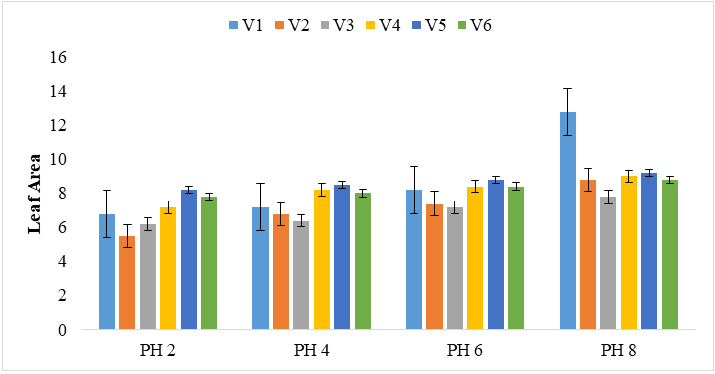
Figure 2 shows the significant different leaf area of different pepper varieties, variety 1 has the larger leaf area compared to other varieties significantly (p< 0.05) at week
8. Followed by variety 5, 4, 2 and 3 has the lowest leaf area; the differences might be due to the genetic makeup of the plant (varieties). The leaf area increased progressively after two weeks’ interval among the studied varieties (Figure 2). Similar work was reported by Shotorbani NY, et al. [12].
Number of Leaves
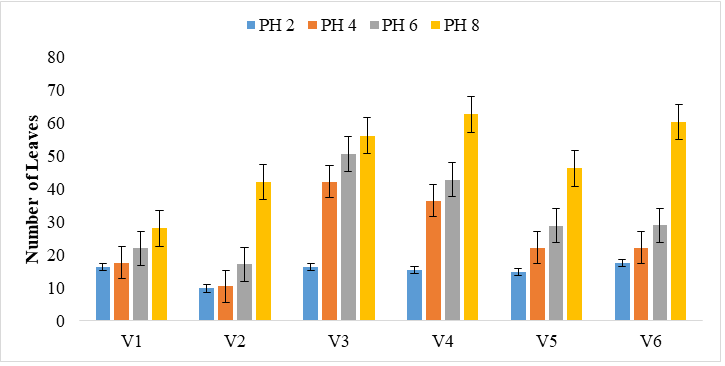
Figure 3 shows the numbers of leaf different pepper varieties, variety 4 recorded the highest number of leaves compared to other varieties significantly (p< 0.05) at week 4, but declined at week 5. Followed by variety 3, Variety 1 has the lowest number of leaves in almost all the weeks; the differences might be due to the genetic makeup of the plant (varieties). The number of leaves increased progressively after a week interval among the studied varieties (Figure 3). Similar work was reported by Setiyono RT, et al. [13].
Stem Girth
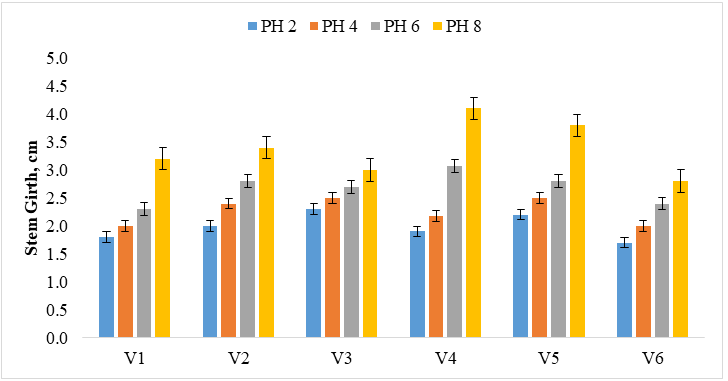
Figure 4, Shows the stem girth of different pepper variety, variety 4 recorded the compared to other varieties significantly (p< 0.05). Followed by variety 5, 2, 1 and 6 has the lowest stem girth; the differences might be due to the genetic makeup of the plant (varieties). The stem girth increased progressively after two weeks interval among the studied varieties. Similar work was reported by Shotorbani NY, et al. [12].
Variation on the Yield and Yield Components of the Studied Pepper Varieties Individual Fruit Weight and Fruit Length
Table 1 below presented the individual weight and fruit length of the studied varieties of the pepper. It showed differences exist among the different varieties with respect to the individual fruit weight during the period of the experiment (Table 1). V6 recorded the highest weight which was significantly similar with V5 and V6. V1 gave the least weight of individual fruits. Variety 5 also has the highest fruit length compared to other varieties which was not significantly different.
| Variety | Individual Fruit Weight (g) | Fruit Length (cm) |
|---|---|---|
| V1 | 2.2b | 5 |
| V2 | 2.6b | 5.8 |
| V3 | 3.0ab | 6.2 |
| V4 | 3.4a | 7.1 |
| V5 | 3.8a | 7.3 |
| V6 | 3.2a | 6.8 |
| Level of Significance | * | NS |
| LSD (P<0.05) | 0.9 | 2.5 |
Table 1: ** Shows the Individual Fruit weight (IFW) and Fruit Length of the different studied varieties of pepper during the 2020
Means followed by same letters are not significantly different. LSD = Least Significantly Difference, * = Significance at 5% level of probability. Table 1: Shows the Individual Fruit weight (IFW) and Fruit Length of the different studied varieties of pepper during the 2020/2021 rainy season at Teaching and Researcher farm.
Table 2 showed the relationship between the variable of the studied pepper varieties. Significant relationships were observed among the morphological characters of the pepper varieties. There was a negative strong relationship between Plant Height (PH) and Leaf Area (LA) which means that as the plant height increases leaf area decreases significantly (Table 2). On the other hand, significant, positive and strong relationship (r = 0.98) exist between fruit weight (FW) and fruit length (FL), PH and FW, PH and NL (Table 2). This indicated that as the fruit length increases fruit weight of pepper also increases [14]. Similarly, as the plants increased in height the fruit weight, fruit length and number of leaves of pepper increase.
| Variables | PH | LA | SG | NL | FL | FW |
|---|---|---|---|---|---|---|
| PH | 1 | |||||
| LA | -0.905* | 1 | ||||
| SG | -0.08995 | -0.00938 | 1 | |||
| NL | 0.756205* | -0.79424* | 0.093692 | 1 | ||
| FL | 0.75065* | -0.63118 | 0.45033 | 0.762819 | 1 | |
| FW | 0.713699* | -0.58914 | 0.457937 | 0.667104* | 0.980359* | 1 |
Table 2: Correlation coefficient among the different studied characters of pepper during the period of the experiment.
PH: Plant height, LA: Leaf area, SG: Stem girth, NL: Number of leaves, FL: Fruit length, FW: Fruit weight, *= significant at 5%. Table 2: Correlation coefficient among the different studied characters of pepper during the period of the experiment.
Conclusions and Recommendations
The study was carried out using six (6) different varieties of pepper, in which variety 4 and 6 were found good for Kashere community and its environs. From the results obtained, it revealed enough genetic variability among the studied six varieties at each stage of growth. It was observed that the varieties used in this work were limited to Kashere location; therefore, future studies must widen the scope of seeds collection to cover all regions and districts in the country. Further studies should consider using SSR primers to screen molecular variability among the varieties. Biochemical parameters such as dry matter and total pungency should be taken into consideration in future studies.
References
-
Bosland PW Votava E (2000) Peppers: Vegetable and spice Capsicums. Oxford, Wallingford: CABI.
-
Asare P, Galyuon IKA, Sarfo JK, Tetteh JP (2011) Morphological and molecular based diversity studies of some cassava (Manihot esculenta crantz) germplasm in Ghana. African Journal of Biotechnology 10(63): 13900- 13908.
-
Doku HA, Danquah EY, Amoah AN, Nyalemegbe K, Amoatey HM (2013) Genetic diversity among 18 accessions of African Rice (OryzaglaberrimaSteud.) using simple sequence repeat (SSR) markers. Agricultural Journal 8(2): 106-112.
-
Costa LV, Lopes R, Lopes MTG, De Figueiredo AF, Barros WS, et al. (2009) Cross compatibility of domesticated hot pepper and cultivated sweet pepper. Crop Breeding and Applied Biotechnology 9(1): 37-44.
-
Hill TA, Ashrafi H, Reyes Chin Wo S, Yao J, Stoffel K, et al. (2013) Characterization of Capsicum annuumgenetic diversity and population structure based on parallel polymorphism discovery with a 30K Unigene Pepper GeneChip. Plos One 8(2): 1-16.
-
Andrews J (1984) Peppers: The domesticated Capsicums. Austin: University of Texas Press, pp: 125.
-
Dias GB, Gomes VM, Moraes TMS, Zottich UP, Rabelo GR, et al. (2013) Characterization of Capsicum species using anatomical and molecular data. Genet Mol Res 4(2): 1-14.
-
Nsabiyera V, Logose M, Ochwo Ssemakula M, Sseruwagi P, Gibson P, et al. (2013) Morphological Characterization of Local and Exotic Hot Pepper (Capsicum annuum L.) Collections in Uganda. Bioremediation, Biodiversity and Bioavailability 7(1): 22-32.
-
Olawuyi OJ, Jonathan SG, Babatunde FE, Babalola BJ, Yaya OOS, et al. (2014) Accession × treatment interaction, variability and correlation studies of pepper (Capsicum spp.) under the influence of arbuscular mycorrhiza fungus (Glomus clarum) and cow dung. American Journal of Plant Sciences 5(5): 683-690.
-
(1995) Descriptors for Capsicum (Capsicum spp.). International Plant Genetic Resources Institute, Rome, Italy; the Asian Vegetable Research and Development Center, Taipei, Taiwan, and the Centro Agronómico Tropical de Investigación y Enseñanza, Turrialba, Costa Rica, pp: 110.
-
Orobiyi A, Dansi A, Assogba P, Loko LY, Dansi M, et al. (2013) Chili (Capsicum annuumL.) in southern Benin: production constraints, varietal diversity, preference criteria and participatory evaluation. International Journal of Agricultural Science and Soil Science 3(4): 107-120.
-
Shotorbani NY, Jamei R, Heidari R (2013) Antioxidant activities of two sweet pepper Capsicum annuum L. varieties phenolic extracts and the effects of thermal treatment. Avicenna J Phytomed 3(1): 25-34.
-
Setiyono RT, Udarno L (2011) Exploration of black pepper (Piper nigrum L.) in Sukabumi (Eksplorasi tanaman lada (Piper nigrum) di Sukabumi) War. Penelit dan Pengemb Tanam Ind 17 (2): 6-9.
-
Magaji UG, Rafii MY, Ismail MR, Malek MA, Latif MA (2014) Heritability and Genetic Advance among Chili Pepper Genotypes for Heat Tolerance and Morphophysiological Characteristics. Hindawi Publishers.
- Enhancement of Vegetative Growth and Fruit Yield in Cucumber (Cucumis sativus L.) via Spiritual Blessing (Biofield) Energy Intervention
- Production of Açaí (Euterpe oleracea Mart.) under Different Agroforestry System Management Intensities in Amazonian Floodplain (Varzea) Forests
- Coffee and the Production Region: What is the Secret to the Expression "Quality"?
- Experiential Agripreneurship Training in Sub-Saharan Africa: Integrating a Business Incubator into Postgraduate Livestock Education at the University of Buea
- Advances in Agricultural High-Quality Development
- Linking Compost Residue to ABAGE in Plants - a Short Note