
Vaccines against Cattle Ticks: Current Status
Rhipicephalus microplus, famous as the cattle tick, is a hematophagous ectoparasite distributed worldwide in tropical and subtropical regions. Its infestations represent a threat to the cattle industry since they generate a negative economic impact on cattle production and animal welfare. The method par excellence for tick control is based on applying chemical agents. However, their use has had limited efficacy, often accompanied by environmental contamination and the selection of tick’s resistant to most chemical agents, rendering them ineffective. One of the alternative methods to combat R. microplus infestations is the development of vaccines. Two commercial vaccines are based on the Bm86 antigen, TickGARD®, and Gavac®. However, the efficacy is highly variable between different geographical regions. While it is true that other alternatives have been tested, the search for vaccine antigens that provide high protection against R. microplus remains a challenge in which genomic, transcriptomic, and proteomic studies are required. This review briefly summarizes the current situation regarding the discovery of candidate antigens for vaccines against ticks in cattle, as well as the methodologies employed for their search and development.
Development
Ticks are arthropod ectoparasites that infest a wide range of animal hosts, including humans. In addition to the direct harm caused to their hosts, they are often responsible for pathogen transmission that impacts public and animal health [1]. To date, almost 900 species of ticks have been described [2]; among these species, the Rhipicephalus microplus is the most important tick for the cattle industry.
In addition, it is responsible for significant global economic losses, especially in tropical and subtropical countries [3, 4]. Globally, controlling tick populations through the recurrent use of chemical acaricides has been the primary strategy [5]. However, this method has significant disadvantages, such as weak efficacy in some regions due to the selection of acaricide-resistant ticks, environmental contamination, and drug residues in cattle products (milk and meat) [3]. Vaccination is one of the alternatives for the control of R. microplus. It has several benefits compared to chemical acaricides, such as environmental safety, absence of human and animal health risks, no drug residues in meat and milk, ease of administration, and cost [4].
The feasibility of using recombinant protein vaccines as a long-term sustainable, cost-effective alternative control method against ticks has been demonstrated since the development and commercialization of the recombinant Bm86 antigen in the early 1900s: TickGARD® (Hoechst Animal Health) and Gavac® (Heber Biotec) derived from Australian and Cuban tick strains, respectively [6]. However, TickGARD® is no longer commercially available [7], and Gavac® continues to be marketed mainly in several Latin American, Asian, and Oceanic countries, showing variable efficacy against various geographic strains of R. microplus [8, 9].
The search and discovery of new candidates for anti- tick vaccine development have two approaches: The first is the use of “exposed” antigens, proteins, or peptides secreted in the tick’s saliva during the attachment and feeding of these ectoparasites on the host. Because these molecules are exposed to the host by every tick feeding, acquired immunity against exposed antigens is naturally established and stimulated by multiple ticks feeding. In contrast, “concealed” antigens are invisible to host immune mechanisms, and the natural feeding of ticks does not stimulate the acquired immunity against concealed antigens. Therefore, repeated immunizations are required to maintain adequate levels of protective antibodies [10, 11]. These antigens are potential vaccine candidates if: a) they are associated with a play key role in tick biology, such as regulating physiology, modulation of host immune response, and transmission of pathogens by ticks; b) these induce long-lasting and effective immune responses in the host; and c) these induce cross-reactive immunity in the host against different tick species [1, 12].
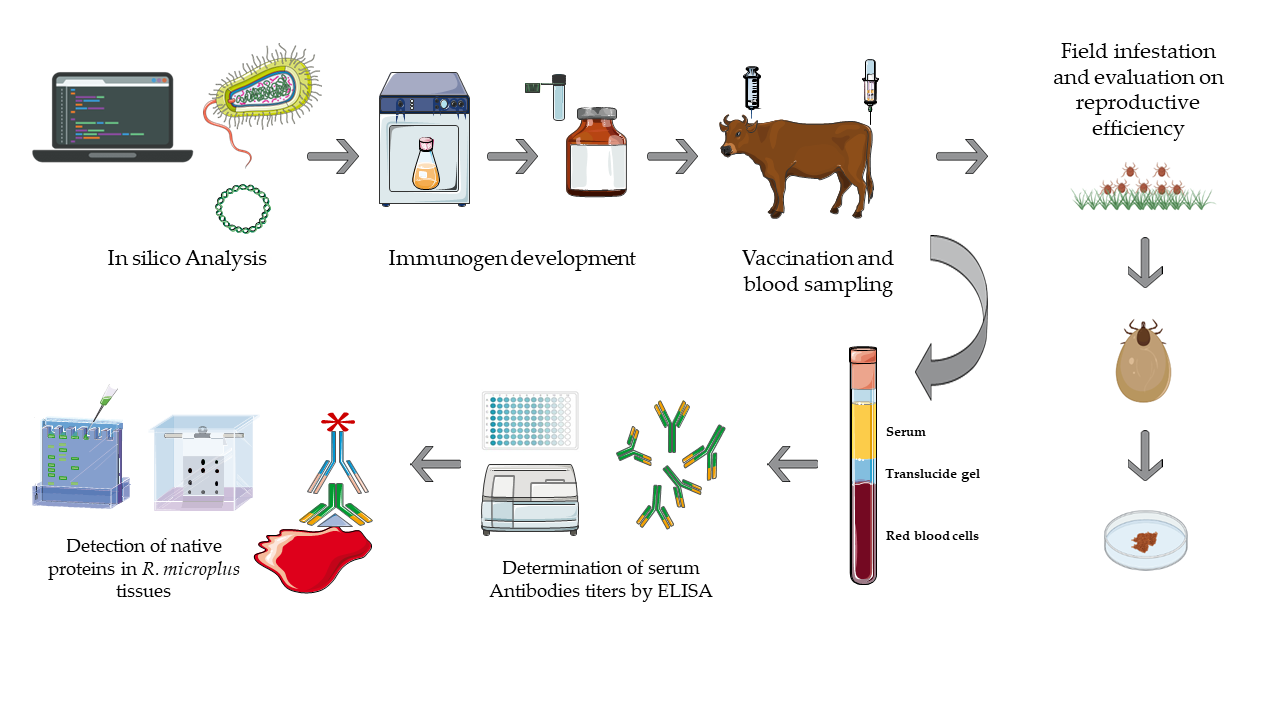
Identifying new candidate antigens for anti-tick vaccines is mainly based on reverse vaccinology (RV), a methodology that focuses on functional genomics, bioinformatics, and system biology [13]. This methodological approach begins with an analysis of the sequences present in the databases identified in genomes, transcriptomes, and proteomes, subsequently uses a bioinformatics program to recognize those sequences with immunogenic characteristics, finally tests the antigen in vaccine trials and evaluates its efficacy in the control of parasites [4]. This approach has obtained important results in developing new vaccines against R. microplus, such as identifying antigens (peptides) capable of triggering a specific immune response that affects tick feeding [14, 15].
The exponential growth of genomic, proteomic, and transcriptomic data is the key to performing studies based on identifying genes encoding candidate antigens to develop an effective vaccine against R. microplus. In addition, genome sequences can provide important information for creating studies of comparative genomics studies and knowing the organization, location, and length of genes associated with parasite-host interaction, which could be important for combating tick infestation [14]. However, transcriptomes of ovaries [16], salivary glands, and larvae have been reported [17, 18]. The complexity of the R. microplus genome has made its publication in the database difficult since it is approximately 7.1 Gpb in length, 70 % of which is repetitive DNA, which explains the difficulty of its assembly [19].
Developing an effective vaccine begins with identifying an antigen capable of introducing a long-lasting and effective immune response in the host [20]. First, it requires multiple in silico analyses of the nucleotide sequences and peptide sequence of the candidate antigen, e.g., B and T cell epitope prediction [21, 22], search for families and functional domains [23], identification of transmembrane regions [24], hydrophobicity analysis [25], secondary and tertiary structure prediction [26], signal peptide prediction [27] and identification of potential glycosylation sites [28]. The discovery of new vaccine antigens should also be guided by in vivo expression data. Gene expression levels can be a good correlation point concerning protein expression and can therefore be used to infer whether a protein is potentially expressed [29].
Following the identification of an antigen candidate for the production of an anti-tick vaccine, it is necessary to produce enough antigen to obtain the scientific “proof of concept” in a cattle model to study the effects of vaccination on tick populations of interest, using biotechnology tools as recombinant proteins [1, 4]. Many new antigens against ticks have been expressed as recombinant proteins and have conducted vaccination trials as candidate vaccines around the world and demonstrated to induce a certain level of protective immunity [1, 4, 11]. Therefore, based on the available literature, this review will focus on some antigens evaluated in cattle vaccination trials by various research groups worldwide (Tables 1 & 2).
| Single-antigen | ||||
|---|---|---|---|---|
| Antigen | Localization | Tick species | Efficacy (%) | References |
| Boophilus microplus 95 (Bm95) | Gut | R. microplus | 89 | [8] |
| Boophilus yolk pro-cathepsin (BYC) | Egg | R. microplus | 25.24 | [30] |
| Boophilus annulatus 86 (Ba86) | Gut | R. annulatus | 83 | [31] |
| 5′ -nucleotidase | Malpighian tubules | R. microplus | No efficacy | [32] |
| R. microplus Ferritin 2 (RmFER2) | Gut | R. microplus | 64 | [33] |
| Subolesin (SUB) | Intracellular | R. microplus | 37.2-60 | [34-36] |
| Subolesin (SUB) | Intracellular | R. annulatus | 60 | [34] |
| Glutathione S-transferases-Haemaphysalis longicornis (GSTHl) | Salivary glands | Haemaphysalis longicornis | 57 | [37] |
| Rhipicephalus microplus Larvae Trypsin Inhibitors (RmLTI) | Larvae | R. microplus | 32 | [38] |
| Hyalomma anatolicum 86 (rHaa86) | Gut | H. anatolicum | 36.5 | [39] |
| Boophilus microplus 91 (Bm91) | Salivary glands | R. microplus | 6 | [40] |
| Flagelliform Silk Protein (SILK) | Salivary gland | R. microplus | 62 | [35] |
| Tick receptor for outer surface protein A (TROSPA) | Gut | R. microplus | No efficacy | [35] |
| R. microplus Aquaporin 1 (RmAQP1) | Gut | R. microplus | 68–75 | [41] |
| Bm7462® | Gut | R. microplus | 72.4 | [42] |
| R. appendiculatus Subolesin (SUB) | Intracellular | R. appendiculatus A. variegatum | 47-90 50-89 | [43] |
| A. variegatum Subolesin (SUB) | Intracellular | R. appendiculatus A. variegatum | 83-86 47-76 | |
| R. microplus peptide Subolesin (pSub) | Intracellular | R. microplus | 67 | [44] |
Table 1: Candidate recombinant antigens for the control of tick infestations in cattle.
| Multi-antigenic | ||||
|---|---|---|---|---|
| Antigen | Localization | Tick species | Efficacy (%) | References |
| Rhipicephalus microplus 86 (Bm86) + R. microplus 91 (Bm91) | Gut Salivary glands | R. microplus | No reported Reduction in the number of engorged ticks and egg weight | [45] |
| Ubiquitin-Major surface protein 1a (UBQ- MSP1a) | Chimeric | R. microplus | No efficacy | [46] |
| Subolesin-Major surface protein-1a (SUB- MSP1a) | Chimeric | R. microplus | 81 | [46] |
| Elongation factor 1 alpha- Major surface protein 1a (EF1a-MSP1a) | Chimeric | R. microplus | 38 | [46] |
| Boophilus microplus 95- Major surface protein 1a (Bm95-MSP1a) | Chimeric | R. microplus | 64 | [46] |
| Haemaphysalis longicornis-Glutathione-S transferase (GST-Hl) + Rhipicephalus microplus-vitellin-degrading cysteine endopeptidase (VTDCE) + R. microplus- Boophilus Yolk Cathepsin (BYC) | Salivary glands Egg Egg | R. microplus | 51.3–61.6 | [47] |
| Q38 | Chimeric | R. microplus | 75 | [35] |
| Subolesin (SUB) + B. microplus 86 (Bm86) | Intracellular Gut | R. microplus | 97 | [48] |
| Reprolysin Rhipicephalus microplus- Metalloprotease 4 (rBrRm-MP4) | Chimeric | R. microplus | 60 | [49] |
| R. microplus 39 (Rm39) + R. microplus 76 (Rm76) + R. microplus 180 (Rm180) + R. microplus 239 (Rm239) | Salivary gland | R. microplus | 73.2 | [50] |
| Rhipicephalus microplus Larvae Trypsin Inhibitors-Boophilus microplus Campo Grande-Heat-Labile enterotoxin B (RmLTI- BmCGLTB) | Chimeric | R. microplus | 55.6 | [51] |
| Subolesin + Heat inactivated Mycobacterium bovis (SUB+IV) | Intracellular Inactivated bacteria | R. microplus | 65 | [52] |
| R. microplus peptide Subolesin (pSub) + B. microplus 86 (Bm86) | Intracellular Gut | R. microplus | 49 | [48] |
Table 2: Candidate recombinant multi-antigens for the control of tick infestations in cattle.
Since the commercialization of Bm86 almost 30 years ago, despite the efforts of multiple research groups, vaccines with other antigens and higher efficacy against R. microplus and other tick species are still unavailable [7]. However, the fact that Bm86 alone has been used as a reference antigen may be supported due to a positive correlation between anti- Bm86 IgG antibody titers, a decrease in tick infestations, and the prevalence of several tick-borne diseases [53, 54].
Ideally, vaccine efficacy should be greater than 50% [51], and several recombinant antigens have demonstrated greater efficacy in inoculated cattle, which suggests they are potential candidates (Table 1). However, the commercial success of a new generation of vaccination against ticks cannot be guaranteed simply by having an antigen that performed well in vaccine pen trials, field trials are required to assess the vaccine’s performance under real-life rearing conditions [47] (Figure 1) and few studies have been reported under field conditions in cattle [40, 47, 48, 55]. Furthermore, meeting the requirements of safety and efficacy demonstrated under field conditions is only part of the equation for taking a new antigen as a product to market [10], and most of the protocols used in experiments to assess recombinant antigens against ticks employ confined cattle.
Current research should focus on optimizing or improving vaccine formulations of existing vaccine or vaccine candidates that are effective against R. microplus, and multi-species tick infestations to contribute to the reduction in the use of acaricides in regions where ticks are endemic, as well as the prevention of tick-borne diseases [56]. One of the strategies to improve efficacy in tick vaccines is multi-antigen vaccines, which consist of a combination of two or more antigens [57]. Initial evidence supporting this approach came from a synergistic effect between more than one tick antigen in different immunization trials in cattle [45, 47]. These have been administered in the form of chimeric proteins or co- administered simultaneously. However, the results of these trials have been controversial, with some trials reporting disappointing results and others showing attractive results for further evaluation (Table 2).
In conclusion, anti-tick vaccine research has greatly advanced since the development and commercialization of the recombinant Bm86; both single-antigen and multi- antigen vaccines required more research studies to understand specific immunological responses to anti-tick vaccines and improve their efficacy, which depends on a wide array of factors such as host species and/or breed, host age, immunocompetence or prior exposure to ticks, the nature antigen, the type of adjuvant used, the formulation, the route of administration employed, and the immunization scheme [11, 58]. For vaccine development and implementation of effective control strategies against ticks, the recent advances in omics technologies and bioinformatics analyses have allowed us to discover new antigens and test them as candidate vaccines much faster and less expensive than in the past [1]. However, further innovation in technologies and strategies will be necessary to turn new antigens into novel vaccines and provide the cattle industry with this safe and effective method for tick population control.
References
-
Abbas MN, Jmel MA, Mekki I, Dijkgraaf I, Kotsyfakis M (2023) Recent Advances in Tick Antigen Discovery and Anti-Tick Vaccine Development. International Journal of Molecular Sciences 24: 4969.
-
Estrada-Peña A, Mihalca A, Petney T (2017) Ticks of Europe and North Africa. In: 1st (Edn.), Springer Cham, Switzerland, pp: 5-10.
-
Rodriguez-Vivas RI, Jonsson NN, Bhushan C (2018) Strategies for the control of Rhipicephalus microplus ticks in a world of conventional acaricide and macrocyclic lactone resistance. Parasitology Research 117(1): 3-29.
-
Pereira DFS, Ribeiro HS, Gonçalves AAM, da Silva AV, Lair DF, et al. (2022) Rhipicephalus microplus: an overview of vaccine antigens against the cattle tick. Ticks and Tick- borne Diseases 13(1): 101828.
-
Estrada-Peña A, Szabó M, Labruna M, Mosqueda J, Merino O, et al. (2020) Towards an Effective, Rational and Sustainable Approach for the Control of Cattle Ticks in the Neotropics. Vaccines 8(1): 9.
-
Lagunes-Quintanilla RE, Bautista-Garfias CR (2020) Immunological control: an alternative against cattle ticks. Ecosistemas y Recursos Agropecuarios 7: e2263.
-
Guerrero FD, Miller RJ, Pérez de Leon AA (2012) Cattle tick vaccines: many candidate antigens, but will a commercially viable product emerge?. International Journal for Parasitology 42(5): 421-427.
-
García-García JC, Gonzalez IL, González DM, Valdés M, Méndez L, et al. (1999) Sequence variations in the Boophilus microplus Bm86 locus and implications for immunoprotection in cattle vaccinated with this antigen. Experimental & applied acarology 23(11): 883-895.
-
Martínez-Arzate SG, Sánchez-Bermúdez JC, Sotelo- Gómez S, Diaz-Albiter HM, Hegazy-Hassan W, et al. (2019) Genetic diversity of Bm86 sequences in Rhipicephalus (Boophilus) microplus ticks from Mexico: analysis of haplotype distribution patterns. BMC Genetics 20(1): 56.
-
Thomas S (2022) Vaccine Design: Methods in Molecular Biology Volume 2. In: 1st (Edn.), Humana, New York, USA, pp: 243-259.
-
Antunes S, Domingos A (2023) Tick Vaccines and Concealed versus Exposed Antigens. Pathogens 12(3): 374.
-
Ndawula C (2021) From Bench to Field: A Guide to Formulating and Evaluating Anti-Tick Vaccines Delving beyond Efficacy to Effectiveness. Vaccines 9(10): 1185.
-
Valle MR, Guerrero FD (2018) Anti-tick vaccines in the omics era. Frontiers in Bioscience-Elite 10(1): 122-136.
-
de la Fuente J, Waterhouse MR, Sonenshine ED, Roe MR, Ribeiro MJ, et al. (2016) Tick Genome Assembled: New Opportunities for Research on Tick-Host-Pathogen Interactions. Frontiers in Cellular and Infection Microbiology 6: 103.
-
Lew-Tabor AE, Bruyeres AG, Zhang B, Rodríguez-Valle M (2014) Rhipicephalus (Boophilus) microplus tick in vitro feeding methods for functional (dsRNA) and vaccine candidate (antibody) screening. Ticks and Tick- borne Diseases 5(5): 500-510.
-
Heekin M, Guerrero FD, Bendele KG, Saldivar L, Scoles GA, et al. (2013) The ovarian transcriptome of the cattle tick, Rhipicephalus (Boophilus) microplus, feeding upon a bovine host infected with Babesia bovis. Parasites & Vectors 6: 276-283.
-
Garcia GR, Chaves-Ribeiro JM, Maruyama SR, Gardinassi LG, Nelson K, et al. (2020) A transcriptome and proteome of the tick Rhipicephalus microplus shaped by the genetic composition of its hosts and developmental stage. Scientific Reports 10(1): 12857.
-
Tirloni L, Braz G, Nunes RD, Gandara ACP, Vieira LR, et al. (2020) A physiologic overview of the organ-specific transcriptome of the cattle tick Rhipicephalus microplus. Scientific Reports 10(1): 18296.
-
Barrero RA, Guerrero FD, Black M, McCooke J, Chapman B, et al. (2017) Gene-enriched draft genome of the cattle tick Rhipicephalus microplus: assembly by the hybrid Pacific Biosciences/Illumina approach enabled analysis of the highly repetitive genome. International Journal for Parasitology 47(9): 569-583.
-
Fuente J, Merino O (2013) Vaccinomics, the new road to tick vaccines. Vaccine 31(50): 5923-5929.
-
Clifford JN, Høie MH, Deleuran S, Peters B, Nielsen M, et al. (2022) BepiPred-3.0: Improved B-cell epitope prediction using protein language models. Protein Science 31(12): e4497.
-
Rice P, Longden I, Bleasby A (2000) EMBOSS: the European Molecular Biology Open Software Suite. Trend in Genetics 16(6): 276-277.
-
Paysan-Lafosse T, Blum M, Chuguransky S, Grego T, Lázaro-Pinto B, et al. (2022) InterPro in 2022. Nucleic Acids Research 51(D1): D418-D427.
-
Krogh A, Larsson B, Von Heijne G, Sonnhammer EL (2001) Predicting transmembrane protein topology with a hidden Markov model: application to complete genomes. Journal of Molecular Biology 305(3): 567-580.
-
Kyte J, Doolittle RF (1982) A simple method for displaying the hydropathic character of a protein. Journal of Molecular Biology 157(1): 105-132.
-
Waterhouse A, Bertoni M, Bienert S, Studer G, Tauriello G, et al. (2018) SWISS-MODEL: homology modelling of protein structures and complexes. Nucleic Acids Research 46(W1): W296-W303.
-
Almagro-Armenteros JJ, Tsirigos KD, Sønderby CK, Nordahl Petersen T, Winther O, et al. (2019) SignalP 5.0 improves signal peptide predictions using deep neural networks. Nature Biotechnology 37(4): 420-423.
-
Gupta R, Brunak S (2002) Prediction of glycosylation across the human proteome and the correlation to protein function. Pacific Symposium on Biocomputing pp: 310-322.
-
Haag AF, Liljeroos L, Donato P, Pozzi C, Brignoli T, et al. (2023) In Vivo Gene Expression Profiling of Staphylococcus aureus during Infection Informs Design of Stemless Leukocidins LukE and -D as Detoxified Vaccine Candidates. Microbiology Spectrum 11: e02574-e02622.
-
Leal AT, Seixas A, Pohl PC, Ferreira CAS, Logullo C, et al. (2006) Vaccination of bovines with recombinant Boophilus Yolk pro-Cathepsin. Veterinary Immunology and Immunopathology 114(3-4): 341-345.
-
Canales M, Almazán C, Naranjo V, Jongejan F, de la Fuente J (2009) Vaccination with recombinant Boophilus annulatus Bm86 ortholog protein, Ba86, protects cattle against B. annulatus and B. microplus infestations. BMC Biotechnology 9: 1-8.
-
Hope M, Jiang X, Gough J, Cadogan L, Josh P, et al. (2010) Experimental vaccination of sheep and cattle against tick infestation using recombinant 5′‐nucleotidase. Parasite immunology 32: 135-142.
-
Hajdusek O, Almazán C, Loosova G, Villar M, Canales M, et al. (2010) Characterization of ferritin 2 for the control of tick infestations. Vaccine 28: 2993-2998.
-
Almazán C, Lagunes R, Villar M, Canales M, Rosario- Cruz R, et al. (2010) Identification and characterization of Rhipicephalus (Boophilus) microplus candidate protective antigens for the control of cattle tick infestations. Parasitology Research 106(2): 471-479.
-
Merino O, Antunes S, Mosqueda J, Moreno-Cid JA, Pérez de la Lastra JMP, et al. (2013) Vaccination with proteins involved in tick-pathogen interactions reduces vector infestations and pathogen infection. Vaccine 31: 5889- 5896.
-
Shakya M, Kumar B, Nagar G, de la Fuente J, Ghosh S (2014) Subolesin: a candidate vaccine antigen for the control of cattle tick infestations in Indian situation. Vaccine 32: 3488-3494.
-
Parizi LF, Utiumi KU, Imamura S, Onuma M, Ohashi K, et al. (2011) Cross immunity with Haemaphysalis longicornis glutathione S-transferase reduces an experimental Rhipicephalus (Boophilus) microplus infestation. Experimental parasitology 127(1): 113-118.
-
Andreotti R, Cunha RC, Soares MA, Guerrero FD, Leite FP, et al. (2012) Protective immunity against tick infestation in cattle vaccinated with recombinant trypsin inhibitor of Rhipicephalus microplus. Vaccine 30(47): 6678-6685.
-
Kumar B, Azhahianambi P, Ray DD, Chaudhuri P, de la Fuente J, et al. (2012) Comparative efficacy of rHaa86 and rBm86 against Hyalomma anatolicum anatolicum and Rhipicephalus (Boophilus) microplus. Parasite Immunology 34(6): 297-301.
-
Lambertz C, Chongkasikit N, Jittapalapong S, Gauly M (2012) Immune response of Bos indicus cattle against the anti-tick antigen Bm91 derived from local Rhipicephalus (Boophilus) microplus ticks and its effect on tick reproduction under natural infestation. Journal of parasitology research 2012: 907607.
-
Guerrero FD, Andreotti R, Bendele KG, Cunha RC, Miller RJ, et al. (2014) Rhipicephalus (Boophilus) microplus aquaporin as an effective vaccine antigen to protect against cattle tick infestations. Parasites & Vectors 7: 1-12.
-
Patarroyo JH, de Sousa Neves E, Fidelis CF, Tafur-Gómez GA, de Araujo L, et al. (2020) Bovine immunization with a recombinant peptide derived from synthetic SBm7462® (Bm86 epitope construct) immunogen for Rhipicephalus microplus control. Ticks and tick-borne diseases 11: 101461.
-
Kasaija PD, Contreras M, Kabi F, Mugerwa S (2020) Vaccination with Recombinant Subolesin Antigens Provides Cross-Tick Species Protection in Bos indicus and Crossbred Cattle in Uganda. Vaccines 8(2): 319.
-
Mendoza-Martínez N, Alonso-Díaz MA, Merino O, Fernández-Salas A, Lagunes-Quintanilla R (2021) Protective efficacy of the peptide Subolesin antigen against the cattle tick Rhipicephalus microplus under natural infestation. Veterinary Parasitology 299: 109577.
-
Willadsen P, Smith D, Cobon G, McKenna RV (1996) Comparative vaccination of cattle against Boophilus microplus with recombinant antigen Bm86 alone or in combination with recombinant Bm91. Parasite immunology 18(5): 241-246.
-
Almazán C, Moreno-Cantú O, Moreno-Cid JA, Galindo RC, Canales M, et al. (2012) Control of tick infestations in cattle vaccinated with bacterial membranes containing surface-exposed tick protective antigens. Vaccine 30(2): 265-272.
-
Parizi LF, Reck J, Oldiges DP, Guizzo MG, Seixas A, et al. (2012) Multi-antigenic vaccine against the cattle tick Rhipicephalus (Boophilus) microplus: a field evaluation. Vaccine 30(48): 6912-6917.
-
Schetters TPM, Jansen T (2014) Vaccine against Rhipicephalus Ticks. Intervet International BV. WO2014154847 A1.
-
Ali A, Parizi LF, Guizzo MG, Tirloni L, Seixas A, et al. (2015) Immunoprotective potential of a Rhipicephalus (Boophilus) microplus metalloprotease. Veterinary parasitology 207(1-2): 107-114.
-
Maruyama SR, Garcia GR, Teixeira FR, Brandão LG, Anderson JM, et al. (2017) Mining a differential sialotranscriptome of Rhipicephalus microplus guides antigen discovery to formulate a vaccine that reduces tick infestations. Parasites & Vectors 10: 206.
-
Csordas BC, Cunha RC, Garcia MV, da Silva SS, Leite FL, et al. (2018) Molecular characterization of the recombinant protein RmLTI-BmCG-LTB: protective immunity against Rhipicephalus (Boophilus) microplus. PLoS One 13: e0191596.
-
Contreras M, Kasaija PD, Merino O, de la Cruz-Hernandez NI, Gortazar C, et al. (2019) Oral vaccination with a formulation combining Rhipicephalus microplus Subolesin with heat inactivated Mycobacterium bovis reduces tick infestations in cattle. Frontiers in Cellular and Infection Microbiology 9: 45.
-
de la Fuente J, Rodriguez M, Redondo M, Montero C, Garcia-Garcia JC, et al. (1999) Field studies and cost- effectiveness analysis of vaccination with Gavac (TM) against the cattle tick Boophilus microplus. Vaccine 16: 366-373.
-
Cunha RC, Pérez de León AA, Leite FPL, Pinto LDS, Santos Júnior AGD, et al. (2012) Bovine immunoprotection against Rhipicephalus (Boophilus) microplus with recombinant Bm86-Campo Grande antigen. Revista Brasileira de Parasitologia Veterinária 21(3): 254-262.
-
Torina A, Moreno-Cid JA, Blanda V, Fernández de Mera IG, de la Lastra JM, et al. (2014) Control of tick infestations and pathogen prevalence in cattle and sheep farms vaccinated with the recombinant Subolesin-Major Surface Protein 1a chimeric antigen. Parasites & Vectors 7: 10.
-
de la Fuente J, Estrada-Peña A (2019) Why new vaccines for the control of ectoparasite vectors have not been registered and commercialized?. Vaccines 7: 75.
-
Willadsen P (2008) Antigen cocktails: valid hypothesis or unsubstantiated hope?. Trends in parasitology 24: 164-167.
-
Ndawula C, Tabor AE (2020) Cocktail anti-tick vaccines: the unforeseen constraints and approaches toward enhanced efficacies. Vaccines 8(3): 457.
- Enhancement of Vegetative Growth and Fruit Yield in Cucumber (Cucumis sativus L.) via Spiritual Blessing (Biofield) Energy Intervention
- Production of Açaí (Euterpe oleracea Mart.) under Different Agroforestry System Management Intensities in Amazonian Floodplain (Varzea) Forests
- Coffee and the Production Region: What is the Secret to the Expression "Quality"?
- Experiential Agripreneurship Training in Sub-Saharan Africa: Integrating a Business Incubator into Postgraduate Livestock Education at the University of Buea
- Advances in Agricultural High-Quality Development
- Linking Compost Residue to ABAGE in Plants - a Short Note