
An Experimental Study on Efficacy of Ultra-Diluted Phytolacca decandra in Growth-Promoting Effect on Cicer areitinum (Chickpea) Seeds through Hydroponics
Homoeopathic dilutions are applied to plants to boost their active constituents, cleanse them, speed up their growth and fruit production, enhance their metabolism, and control illnesses. The purpose of this known research prospective study was to evaluate that how homoeopathic medicines worked. Cicer arietinum L. was the subject of this controlled, experimental, prospective investigation to determine the impact of the homoeopathic drugs Phytolacca decandra Mother tincture (MT) and 30CH, 200CH on plant development. This research aids in evaluating and establishing the function of homoeopathy in plant growth propagation. Cicer areitinum seeds were grown on the Research Facilitation centre, Sarada Krishna Homoeopathic Medical College campus in a specified location. These were divided into four groups: 30 Seeds each were soaked with Phytolacca decandra Mother tincture, Phytolacca decandra 30CH, Phytolacca decandra 200CH, and Phytolacca decandra 200CH, Plain alcohol. Germination index calculated. Control Group, Phytolacca decandra 30CH, Phytolacca decandra 200CH treated as nutrient medium in separate Beakers and chickpea plant were grown in hydroponics. The entire plant was measured for Root length, Shoot length after 20 days. Chlorophyll content assessed. After 5 days, Seeds treated with Phytolacca decandra shows higher germination rate than seeds treated with plain alcohol. The seeds treated with Phytolacca decandra 200 CH have growth promoting effect on Cicer areitinum L (Chick pea) seed. Cicer areitinum was the subject of this controlled, experimental, prospective investigation to determine the impact of the homoeopathic drugs Phytolacca decandra Mother tincture (MT) and 30CH, 200CH on plant development. This research aids in evaluating and establishing the function of homoeopathy in plant growth propagation.
Introduction
Physical, chemical, biological availability of macro and micro nutrients all show overall increase in soil quality in organic farming, which is indicative of improved soil health and sustainability of crop production [1].
One of the most recent methodologies in agricultural research is agro homeopathy. Recent scientific research has demonstrated that potentized homoeopathic remedies can change the physiological processes in plants. It can change the rate at which enzymes work, as well as the amount of total sugar, protein, and chlorophyll in plants. The use of homoeopathy also helps to some extent eliminate biotic and abiotic stressors. Antifungal, antimicrobial, anti-insecticidal, etc. properties of many homoeopathic medicines have been reported in cases of biotic stressors. Other methods of abiotic stress regulation, such as salt stress, drought stress, cold stress, metal toxicity, mechanical damage, etc., can occasionally be more expensive or less effective. However, careful selection of homoeopathic medicines can be both economical and highly successful in terms of increasing the tolerance of diverse crop species to abiotic stress [2].
In the context of the plant model, the Christian Friedrich Samuel Hahnemann Similia principle is equally important. Similia principle has been shown by certain studies to be extremely helpful in helping plants endure abiotic stressors. Homeopathic remedies can be used safely for a variety of applications at extremely high dilutions (Seed germination, betterment of soil health, growth of seedlings, flowering, fruiting, protection against diseases and to overcome environmental stresses). However, before using these medications, precautions must be followed (correct selection of homoeopathic pharmaceuticals and their potency, proper dilution of drug with water). The wrong drug choice can have a negative impact on crops, and higher drug dilutions (1:500 or 1:1000) with water are thought to benefit plants more. With Careful drug selection and potency, agro homeopathy can be a highly effective and affordable substitute that can boost farmers’ revenue by reducing the cost of chemical fertilizers and pesticides as inputs [2].
With the exception of Sulphur-containing amino acids, which can be supplemented by include cereals in the diet every day, chickpea has large amounts of all the essential amino acids. Following starch, dietary fibre, oligosaccharides, and simple sugars like glucose and sucrose as the main storage carbohydrates are. Despite having little lipid content, chickpeas are high in linoleic and oleic acids, which are essential for good nutrition. Important sterols found in chickpea oil include stigmasterol, campesterol, and sitosterol.
Chickpea seeds also include Ca, Mg, P, and particularly K. Important vitamins like riboflavin, niacin, thiamin, folate, and the precursor to vitamin A, alpha-carotene, are all found in abundance in chickpeas [3].
Phytolacca decandra is a Homoeopathic remedy which is prepared from the plant extract. Phytolacca extracts, showing a range of pharmacological activities including antioxidant, anti-inflammatory, anti-parasitic, antifungal, anticancer, and insecticidal effects and growth factor. This causes seeds to swell resulting in greater germination and better established plants [4].
It is said that seeds will absorb more water. Phytolacca decandra known as poke weed is a plant has been grown as feed for livestock. It helps in reducing cholesterol level and inflammations. It also helps to enhancing our immunity and detoxifying the body [5].
Azadirachtin 0.03 percent EC, Tephrosia vogelii and Phytolacca dodecandra as plant extracts. Additionally, as positive and negative controls, respectively, imidacloprid and water were used. The entomopathogens and azadirachtin produced the best growth and yield characteristics, which were typically not significantly different [6].
However, plants grown in this manner do not develop good plant characteristics such as good root systems, shoot systems, nutritional characters, and also will not have enough time to grow and mature properly. This is true even though chemical fertilizer increases plant growth and vigour, thereby meeting the world’s need for food security. Toxic compounds from chemically generated plants will build up in the human body and are extremely harmful. The manufacture of these chemicals, whose byproducts include some toxic chemicals or gases like NH4, CO2, CH4, etc. that will create air pollution, is when the harmful effects of chemical fertilizers begin. Additionally, water contamination results from the discharge of untreated industrial waste into neighboring bodies of water [7].
At the Post Graduate Research Center, studies were conducted to determine the effects of gibberellic acid (50 ppm) and oxygenated peptone (1 percent aqueous solution) on chick pea (Cicer arietinum L. cv. Vijay) germination by pre-sowing soaking for 6 hours. Both remedies accelerated the germination process. While oxygenated peptone outperformed GA treatment in terms of root length, shoot/ root ratio, biomass, and vigor index, GA treatment was beneficial for increasing shoot length, mobilization efficiency, emergence index, speed of germination, and co-efficient of germination. While oxygenated peptone exhibited a greater increase in total carbs and soluble protein concentration, GA
led to relatively higher nucleic acid production [8].
Application of nano technology is now available in various fields of science due to the extensive research being undertaken throughout the world. Nanotechnology has the potential to revolutionize agriculture the new tools to enhance the ability of plant to absorb specific nutrients [9]. Perhaps the drug of which as complete an analysis has been made as of any is Phytolacca decandra After evaporation and incineration, which remove the organic constituents, there remain 8.4 percent of the inorganic of these 6.8 percent are soluble and consists mostly of the salts of potash, while insoluble remainder ,1.6 percent consists of calcium, iron and silica [10].
The use of homoeopathy on plants was first mentioned about 200 years ago by Baron von Boenninghausen, who was the son-in-law of Hahnemann, the founder of homoeopathy. Boenninghausen noted that the excess or leftover remedies he threw into his plant pots were having an effect on the plants [11].
Materials and Methods
Good quality seeds are collected from the Department of Millets, TNAU, P N Pudur, Tamil Nadu. Phytolacca decandra Medicines are brought from Dr. Wilmar Schwabe, New Delhi, India. GMP Certified Company.
Process of Germination
On the first day of the selected good quality seeds of 30 each of four sets were taken and soaked in 4 different containers having medicines of 200CH, 30CH, mother tincture and control. The soaked seeds will be soaked for one whole day and the next day it was kept in bits of white cloths tied for sprouting for about a day.
Results
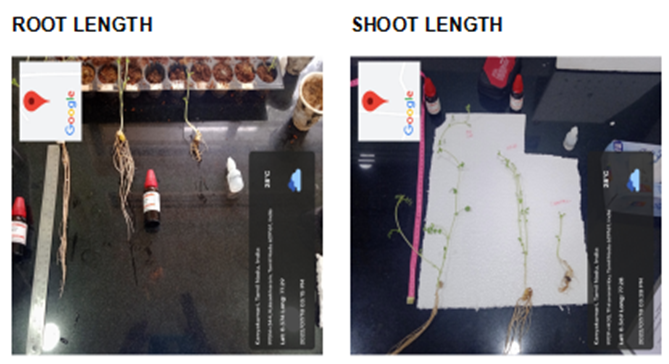
After sprouting the seeds were taken and transferred to thermacol trays marked as 30CH, 200CH mother tincture and control. After the period 20 days, the growth rate of the plant was measured (Figures 1-3).
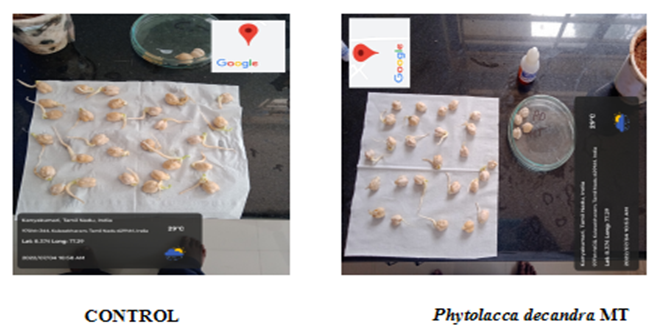
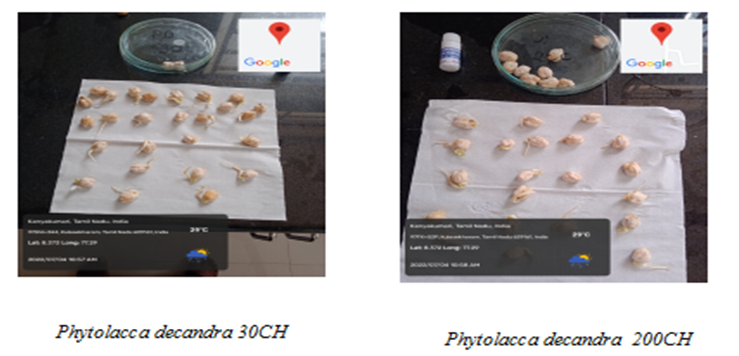
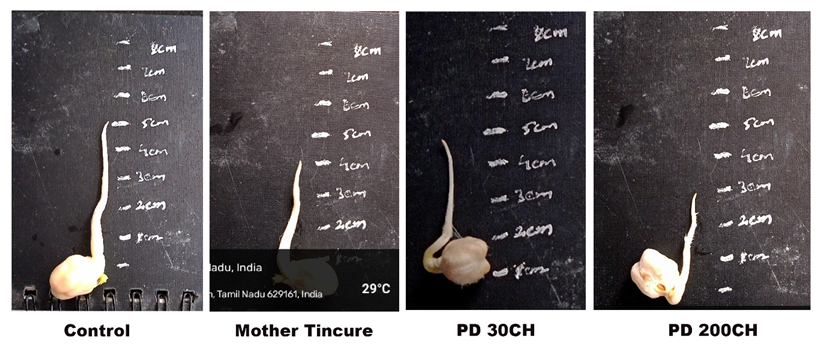
Chick pea seeds of cultivar were sown in thermacol trays. The seedlings were transplanted 7days after into the treated solution in beaker. Phytolacca decandra and the placebo was added to the water on the first day and every 6 days thereafter, at the same time as the water was changed. Various daily measurements were recorded. Plants were harvested 20 days after transplanting when final measurements of growth were made (Figures 4 & 5).
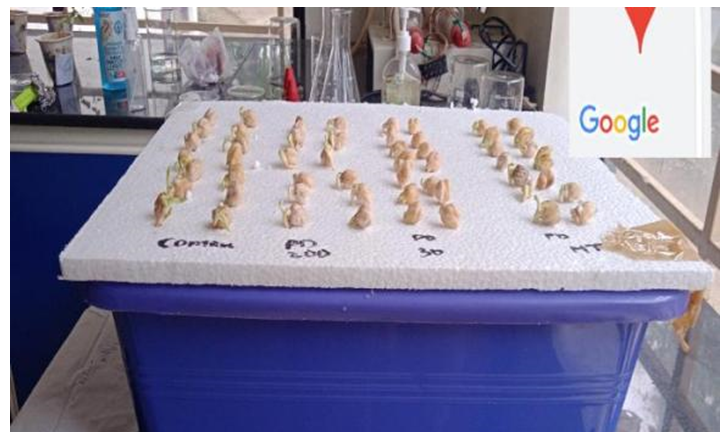
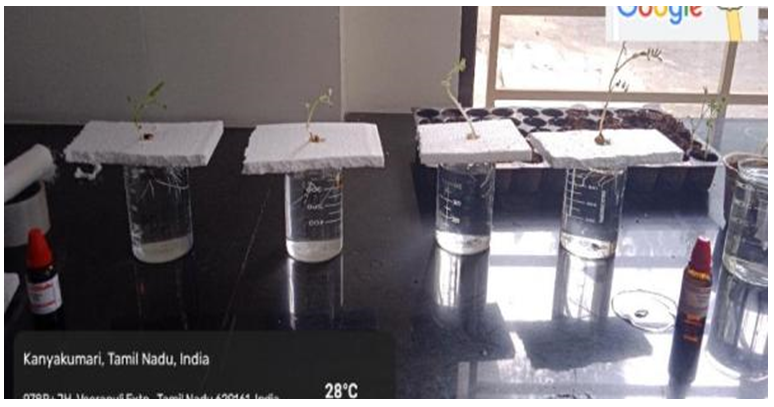
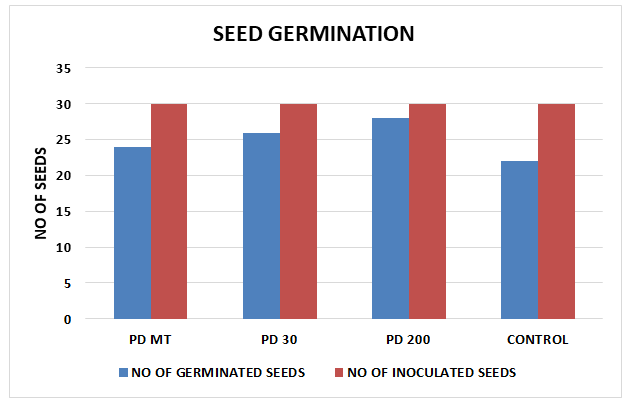
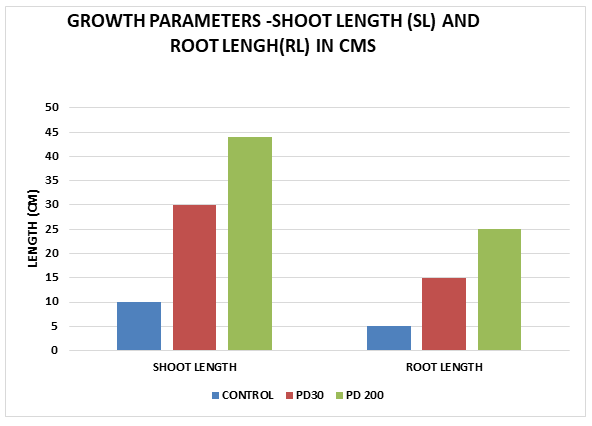
Measurement of Germination of Chick Pea Seeds Control, Mother Tincture, PD 30, PD200 (Table 1) and (Figures 6-9)
| S. No | Parameters | Control | Treatments | ||
|---|---|---|---|---|---|
| PD-MT | PD 30 | PD 200 | |||
| 1 | Speed of germination (SG) * | 2 ± 1 | 3± 1 | 4± 1 | 6± 1 |
| 2 | Shoot Length (cm.)* | 10± 1 | 26± 1 | 31.8± 1 | 43.6 ± 1 |
| 3 | Root Length (cm.) * | 4.6± 1 | 10.4± 1 | 15.4± 1 | 25.8± 1 |
| 4 | Chlorophyll | ||||
| a) | Wavelength(nm) | ||||
| i) | OD 645nm | 0.032 | 0.042 | 0.073 | 0.172 |
| Chlorophyll -a | 2.689818 | 0.255691 | 0.0810699 | 0.046185 | |
| ii) | OD 663nm | 0.212 | 0.68 | 0.181 | 0.262 |
| Chlorophyll-b | 0.703035 | 0.066618 | 1.6962876 | 3.9020152 | |
| Total | 0.697407 | 0.18906 | 1.5818148 | 3.54704372 |
Table 1: Germination Index, Shoot Length, Root Length (cm), Chlorophyll Content (nm) of Control, PD-MT, PD 30CH, PD 200CH.
*Mean Value of 30 Germinated Seeds Table 1: Germination Index, Shoot Length, Root Length (cm), Chlorophyll Content (nm) of Control, PD-MT, PD 30CH, PD 200CH.
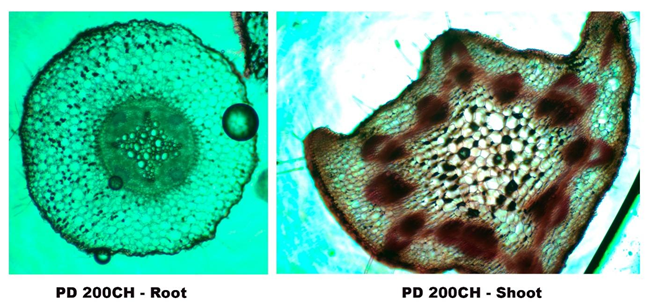
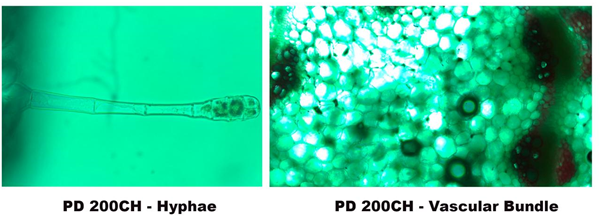
Statistical Analysis
Anova (Tables 2-3)
| Dependent Variable: Germination | ||||||
|---|---|---|---|---|---|---|
| Tukey HSD | ||||||
| (I) Variety | (J) Variety | Mean Difference (I-J) | Std. Error | Sig. | 95% Confidence Interval | |
| Lower Bound | Upper Bound | |||||
| Control Group | MT | -0.5333 | 0.3445 | 0.412 | -1.431 | 0.365 |
| 30 CH | -0.4833 | 0.3445 | 0.5 | -1.381 | 0.415 | |
| 200 CH | -.9167* | 0.3445 | 0.044 | -1.815 | -0.019 | |
| MT | Control Group | 0.5333 | 0.3445 | 0.412 | -0.365 | 1.431 |
| 30 CH | 0.05 | 0.3445 | 0.999 | -0.848 | 0.948 | |
| 200 CH | -0.3833 | 0.3445 | 0.682 | -1.281 | 0.515 | |
| 30 CH | Control Group | 0.4833 | 0.3445 | 0.5 | -0.415 | 1.381 |
| MT | -0.05 | 0.3445 | 0.999 | -0.948 | 0.848 | |
| 200 CH | -0.4333 | 0.3445 | 0.591 | -1.331 | 0.465 | |
| 200 CH | Control Group | .9167* | 0.3445 | 0.044 | 0.019 | 1.815 |
| MT | 0.3833 | 0.3445 | 0.682 | -0.515 | 1.281 | |
| 30 CH | 0.4333 | 0.3445 | 0.591 | -0.465 | 1.331 | |
| *The mean difference is significant at the 0.05 level. |
Table 2: Multiple Comparisons.
| Sum Of Squares | Df | Mean Square | F | Sig. | |
|---|---|---|---|---|---|
| Between Groups | 2905.73 | 2 | 1452.87 | 130.11 | 0 |
| Within Groups | 134 | 12 | 11.167 | ||
| Total | 3039.73 | 14 |
Table 3: ** Growth Parameters (Root Length and Shoot Length).
P>0.05 Values are statistically significant. Table 3: Growth Parameters (Root Length and Shoot Length).
Discussion
An essential stage in a plant’s life cycle is seed germination. Most species’ chances of survival depend on this process. The process of germination is quite delicate. Seed germination is influenced by numerous factors, including environmental and endogenous ones. Previous experiments conducted in chick pea treated with lactobacillus produces growth promoting effect [12]. It was often believed that soils already had an adequate amount of this element, potassium (K) did not attract much attention until recently. Furthermore, in many developing nations, very low rates of potash fertilizer use in agriculture caused a rapid loss of K in the rhizosphere soil. This has a number of detrimental effects, including restricting the use of nitrogen and phosphorus fertilizers to their full potential. It has been suggested that K fertilizers be used extensively in agriculture to make up for these losses [13]. Another research Study on K limitation in hydroponically grown leafy greens has mostly focused on lettuce. The second most popular leafy green ingested in the United States is spinach, although there is a dearth of knowledge regarding spinach’s use of the K limitation there. Similar studies on low-potassium spinach have also been conducted in Italy, however the potassium reduction was only 26.9% compared to the control group. This is because not all of the potassium in their study was eliminated. By limiting the K input in the hydroponic fertilizer [14].
After exposing the corn (Zea mays L.) to varying concentrations of CuSO4 and ZnSO4, the plant’s ability to tolerate heavy metals was evaluated during germination and seedling growth. No metal tested had an impact on germination, although rising ZnSO4 concentrations significantly hindered early development. Both metals caused toxicity signs in the seedlings, although at different concentrations of ZnSO4 more chlorotic and necrotic patches were seen than CuSO4. The concentration had an impact on the metal buildup. Seedlings of Z. mays acquired more copper in their roots but more zinc in their shoots [15].
The main obstacle to plant growth in acidic soils is aluminum toxicity, however there are no practical solutions at this time. Alternatives are therefore sought, including homoeopathic medicine. The purpose of this study was to assess the effects of the homoeopathic remedies Calcarea carbonica 6CH, Calcarea carbonica 12CH, alumina 6CH, and alumina 12CH on the vigor and germination of lettuce seeds exposed to hazardous quantities of aluminium in paper-solution. At the same time, a novel method for using homoeopathic treatments on plants was being developed (pelleting) [16].
Conclusion
Phytolacca decandra is plant which has 6.8 percent of potash salts. Schussler in his biochemic remedies explains salts in plants may have acquired vital properties that their corresponding salts in the mineral kingdom do not possess. In present study, the application of potentised homoeopathic medicine Phytolacca decandra 30CH and Phytolacca decandra 200CH on Cicer areitinum L demonstrated a beneficial result in germination and growth parameters like root length and shoot length. Moreover, the higher dilution Phytolacca decandra 200CH more effects than lower dilution Phytolacca decandra 30CH. By application of ultra-diluted drugs through hydroponics enhances the eco-friendly environment to the plants and also the humans. Application of ultra-diluted materials through hydroponics in agriculture can encourage early plant germination and improve plant productivity.
Acknowledgements
My Sincere thanks to my mother, father, Wife and Son. My thanks to Research Facilitation Centre of Sarada Krishna Homeopathic Medical College and Hospital for giving me these faculties for undertaking this research. I thank Mamtha Nandhini M. Tech (Agriculture Engineering) for her timely help and suggestions.
References
-
Ramesh P, Panwar NR, Singh AB, Ramana S, Yadav SK, et al. (2010) Status of organic farming in India. Current Science 98(9): 1190-1194.
-
Sushobhan S, Indrani C, Arjina K, Sabyasachi C, Sumanta D (2018) Agrohomeopathy: An emerging field of agriculture for higher crop productivity and protection of plants against various stress conditions. 5(4).
-
Jukanti A, Gaur P, Gowda C, Chibbar R (2012) Nutritional quality and health benefits of chickpea (Cicer arietinum L.): A review. British Journal of Nutrition 108: 11-26.
-
Bailly C (2021) Medicinal properties and anti- inflammatory components of Phytolacca (Shanglu). Digital Chinese Medicine 4(3): 159-169.
-
Wynn SG, Fougère BJ (2007) Veterinary Herbal Medicine: A Systems-Based Approach. Veterinary Herbal Medicine, pp: 291-409.
-
https://agris.fao.org/agris-search/search. do?recordID=DJ20210357319.
-
Chandini RK, Kuma R, Om P (2019) The Impact of Chemical Fertilizers on our Environment and Ecosystem. 11(2): 71-86.
-
Thakare U, Patil N, Malpathak N (2011) Performance of chick pea under the influence of gibberellic acid and oxygenated peptone during germination. Advances in Bioscience and Biotechnology 2(1): 40-45.
-
(2016) International journal of research studies in agricultural sciences. 2(5).
-
William Boericke MD, Willis A Dewey MD (2020) Twelve tissue remedies of Schussler by William Boericke and Willis A Dewey. Homeopathy Resource by HomeobookCom, pp: 28-35.
-
https://www.narayanaverlag.com/advanced_search_ result.php?keywords=Vaikunthanath+Das+Kaviraj
-
Atanupramanik, AdityKr’s, Das (2018) Studythe effects of seed germination and plant growth promoting activity of Lactobacillus sp.
-
Soumare A, Djibril SARR, Diédhiou AG (2022) Potassium sources, microorganisms, and plant nutrition— challenges and future research directions: A review. Pedosphere 33(1): 105-115.
-
Levine, Christopher Mattson, Neil (2021) Potassium- Deficient Nutrient Solution Affects the Yield, Morphology, and Tissue Mineral Elements for Hydroponic Baby Leaf Spinach (_Spinacia oleracea_ L.). Horticulturae 7(8): 213.
-
Seema M, Hussain A, Athar Z (2005) Germination and seedling growth of corn (Zea mays L.) under varying levels of copper and zinc. International Journal of Environment Science and Technology 2(3): 269-274.
-
Bonfim FPG, Dores RGAD, Martins RR, Casali E, Vicente WD (2010) Germination and vigor of lettuce seeds (_Lactuca sativa_ L.) pelleted with homeopathic preparations Alumina and _Calcarea carbonica_ subjected to toxic levels of aluminum. International Journal of High Dilution Research 9(33).
- Enhancement of Vegetative Growth and Fruit Yield in Cucumber (Cucumis sativus L.) via Spiritual Blessing (Biofield) Energy Intervention
- Production of Açaí (Euterpe oleracea Mart.) under Different Agroforestry System Management Intensities in Amazonian Floodplain (Varzea) Forests
- Coffee and the Production Region: What is the Secret to the Expression "Quality"?
- Experiential Agripreneurship Training in Sub-Saharan Africa: Integrating a Business Incubator into Postgraduate Livestock Education at the University of Buea
- Advances in Agricultural High-Quality Development
- Linking Compost Residue to ABAGE in Plants - a Short Note