
Elements for Devising a Methodology to Assess the Potential for Scaling up Agroecological Initiatives
Given the positive impacts of agroecology on crop yields, conservation of natural resources and biodiversity, food sovereignty, climate adaptation and livelihoods of rural people, scaling up thousands of isolated successful agroecological experiences in the territories, constitutes an urgent mechanism to transform agrifood systems. We explore two pathways: Farmers lighthouses and the Campesino a Campesino methodology (CaC) as strategies to expand successful agroecological initiatives to reach a greater number of farmers and cover a broader geographic area. After identifying the diversity of opportunities and barriers to the scaling up of agroecology it is possible for stakeholders to determine the actions needed to scale up agroecology. A scalability checklist is proposed as an aid in prioritizing alternatives to scale up and to identifying some of the actions that can be taken to facilitate the scaling up process. The amplification dynamics in a particular region can be assessed utilizing ten amplification indicators which include social organization, participation in networks, community leadership, and degrees of dependency on policies or markets among others, as well as degree of adoption of on-farm agroecological practices, all of which capture farmer lighthouses’ potential to amplify territorial upscaling.
Introduction
In recent years, agroecology has emerged as an alternative paradigm for agriculture that enables a transition towards environmentally sound and socially just modes of production, while addressing multiple crises affecting the food system [1]. Given this potential, scaling up or massifying the thousands of successful agroecological experiences, most of them isolated and dispersed in the territories, constitutes an urgent need to transform agrifood systems at the agro- landscape level.
Researchers concerned with the issue of scaling up (also called amplification, territorialization, massification) of agroecology have focused their concerns on two key questions [2]:
- What conditions make agroecology grow from “islands of success” to cover a greater territorial or national extension, in addition to receiving recognition and institutional support?
- What aspects, drivers and dimensions must be present in a territory for agroecology to be nurtured, grow and spread to cover a greater number of farms and a broader geographical level, thus positively influencing local food systems?
Addressing these questions implies defining and understanding the main factors that limit and/or enable the scaling up of agroecological processes in a particular territory. This allows the various actors to define necessary collective actions to carry out the scaling up process [3].
The amplification of agroecology combines (a) vertical processes that involve institutional changes and (b) horizontal ones that imply a geographical and social extension involving more people and communities. Scaling up means that an increasing number of families practice agroecology, in wider geographical areas, implying that more people are involved in the processing, distribution and consumption of agroecologically produced food [2].
The purpose of this paper is to offer some practical methodological ideas that may be useful for implementing, managing and evaluating a process of scaling up of successful agroecological innovations
Drivers of the Massification of Agroecology
Scaling up is defined as a process of expanding successful agroecological innovations in a geographic space to reach a greater number of farmers and cover a broader geographic area [4]. To better understand the processes of scaling up agroecology, ECOSUR researchers in Chiapas, Mexico, analyzed five cases of massification around the world, identifying key factors that in each case allowed agroecological initiatives to grow beyond isolated local experiences [2]. This study identified eight drivers that were common among various agroecological massification case studies analyzed worldwide. Key elements included the existence of some type of crisis that triggered the process and the existence of strong organizational structures within the social movements which channeled the collective response to these crises. This social process gains strength where local networks use horizontal pedagogical methods that allow farmers to share efficient agroecological practices in order to adopting them massively. At the same time, the existence of local markets and favorable policies expand the opportunities for agroecological scaling and the transformation of the agrifood system [5].
Existing evidence shows positive outcomes in the massive use of agroecological practices on food security and nutrition of poor rural households by enhancing availability and accessibility of food through boosting crop diversity and total production output. More complex agroecological systems, that included multiple components (e.g., crop diversification, mixed crop-livestock systems and farmer- to-farmer networks) are more likely to have positive food security and nutrition outcomes [6].
Territorial Transformation Domains
Agroecology represents a transformative vision and practice of agro-landscapes and local food systems, but there are multiple dimensions of governance and power velations that can enhance or inhibit agroecology-driven transformations.
In every territory there is usually an established dominant agricultural regime and associated rules that maintain the agrochemical dependent monoculture status. These systems are entrenched and hard to change and tend to reproduce themselves while inhibiting agroecological innovations [7]. Overcoming the “blockades” imposed by these regimes requires changes in the political-economic power, however many times change occurs at the local level despite a non-conducive dominant structure. In such cases, “the local space” becomes the physical dimension for the social construction of an agroecological territory, where a concrete agroecological proposal can be built and crystallized. For this to happen communities must reach the necessary consensus for collective action through social arrangements that potentiate the synergies among actors.
In many rural territories throughout the developing world there are groups of farmers that constitute “spaces of hope” exhibiting innovative socio-technical alternatives that differ in their principles and configurations from the conventional agricultural approaches. Many of these spaces manifest themselves in a variety of forms of agroecological design and management, which in most cases persist in marginality, isolated from the sometimes hostile pressures of the dominant regime. Such counter-hegemonic movements advance food sovereignty alternatives based on agroecology, establishing the basis for biodiverse and resilient agroecological alternatives [7].
Researchers at Coventry University describe six domains of transformation that exist at the interfaces between the existing regime and alternative spaces [7]. These domains are critical in sustainability transitions because of their catalytic role in opening up opportunities for alternatives to thrive. Within each domain, there are institutional and socio- economic factors and processes that limit the expansion of agroecology and others that enable it (Table 1).
| Enabling factors | Disabling factors | |
|---|---|---|
| Access and control of land, water, seeds, biodiversity, among others. | Community tenure systems | Inequity and insecurity in individual or collective access to land and natural resources (water, seeds, etc.). |
| Access and control of land, water, seeds, biodiversity, among others. | Gender inclusion | Lack of community organization and institutional support. |
| Access and control of land, water, seeds, biodiversity, among others. | Open systems for access to seed, traditional knowledge, etc. | Lack of community organization and institutional support. |
| Production, exchange and mobilization of local knowledge | Existence of exchange networks | Centralized, hierarchical technology transfer systems |
| Production, exchange and mobilization of local knowledge | Horizontal processes of pedagogy | Invalidation of “non-scientific” knowledge systems |
| Production, exchange and mobilization of local knowledge | Integration of different types of knowledge, local knowledge especially of women. | Regimes that undermine local knowledge and farmers’ rights |
| Systems for the exchange of products, inputs, labor, among others | Traditional exchange systems (informal markets, barter, minga, etc.). | Markets that favor volume and standardization |
| Systems for the exchange of products, inputs, labor, among others | Exchange of seeds, animals, labor, within and between territories. | Markets that emphasize export |
| Systems for the exchange of products, inputs, labor, among others | Exchange of seeds, animals, labor, within and between territories. | Concentration and consolidation of input markets. |
| Multi-stakeholder networks | Community organizing and collective action mechanisms | Regimes that block or disable local speech and collective action |
| Multi-stakeholder networks | Links with local governments and other sectors (universities, NGOs, etc.) that support agroecology | Lack of institutional support |
| Equity at various levels | Valuing the multifaceted role of women and young people in communities. | Patriarchal models of agricultural production and development |
| Equity at various levels | Initiatives that promote women’s and youth’s access to resources, education, health and self-organization | Emphasis on external markets that undermine women’s role in family and community food self-sufficiency. |
| Speech and language | Existence of a language that presents agroecology as a culturally sensitive and systemic approach. | Discursive frameworks that block the systemic vision and the social and political dimension of agroecology. |
| Speech and language | Connection of agricultural issues with environmental, cultural, health dimensions, among others. | Alarmist discourses that justify productivist approaches. |
| Speech and language | Connection of agricultural issues with environmental, cultural, health dimensions, among others. | Dominance of disciplinary and reductionist approaches. |
Table 1: Enabling and disabling factors that condition the expression potential of transformation domains [7].
A study conducted by the Centro Internacional de Agricultura Tropical (CIAT) identified a wide diversity of barriers to the scaling up of agroecology in various Andean countries and evaluated to what extent the limiting factors were addressed by the current public policy instruments [8]. For example, in Ecuador, the key limiting factors identified by the stakeholders were: limited strategies of market channels differentiation, limited partnerships between farmers with solidarity cooperatives and consumers and limited credit for agroecological production. In Colombia lack of political dialogue platforms where farmers’ voices are taken into account, lack of public budget for agroecology implementation and lack of technical assistance and extension services were mentioned as main limitations. Identifying the main limiting factors for the scaling up of agroecology in each country, allowed stakeholders involved to determine the actions needed to scale up agroecology, such as:
- Securing access to land, seeds and water
- Promote market access through public procurement, labelling systems, and diversification of marketing strategies.
- Providing financial funds to promote the transition to agroecology.
- Promote the institutionalization, financing and implementation of public policies for agroecology, among others.
Pathways for the Amplification of Agroecology
A key challenge of agroecology lies in translating agroecological principles into practical strategies for soil, water and biodiversity management to improve production and resilience, so that they can be widely disseminated and expanded, both in number of farmers as well as on a larger geographical scale [9]. Understanding the ways in which successful farmers use biodiversity and the ecological foundations that govern their complex systems, and then disseminating these principles via Farmer-to-Farmer/ Campesino a Campesino (CaC) methodologies, is an effective way to accelerate the development of productive, sustainable and resilient agroecosystems.
Another way is to discover and make visible in the territories, successful farms managed by peasants based on agroecological principles in such a way that they serve as demonstration modules or “agroecological lighthouses” from which agroecological principles and lessons are irradiated towards rural communities. Such lighthouse farms represent for other farmers spaces of hope from which it is possible to find guidelines on how to build the base of a sustainable and resilient productive strategy [9]. In general, the farms with the greatest potential for scaling have special characteristics such as small/medium size, high levels of crop and genetic diversity, animal integration, active use of traditional practices, independence from external inputs, secure land tenure, linked to local markets and others [9].
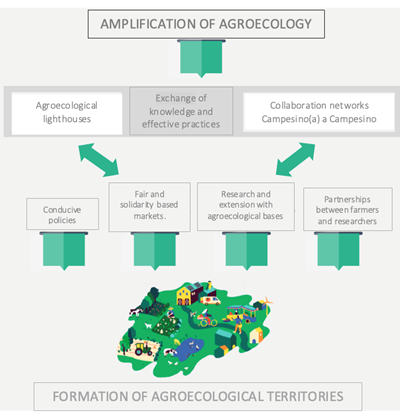
Farmers who manage agroecological lighthouses in their territories could be considered effective leaders who use different strategies to build trust and leverage cooperation, connect networks and create links between sectors of society to counteract the formal or institutionalized power opposed to transformations. The ability of the CaC methodology to amplify agroecology as a source of human and social capital creation highlights the need to understand what social and cultural factors can influence agroecological amplification and territorialization processes, since creating a broader movement becomes a powerful force for agroecological amplification [10]. Of course, both strategies (lighthouses and CaC) must be complemented with conducive policies and solidarity markets between farmers and consumers in order to give greater economic viability to the process of amplifying agroecology (Figure 1).
Farmer to Farmer Methodology (Campesino A Campesino- CaC)
The movement Campesino a Campesino (CaC) is a peasant-based movement that emerged in Guatemala, flourished in Mexico and Nicaragua, and has spread to Central America, Cuba, and now many other countries. An example exists in Peru where the Sierra Productiva project allows the exchange of innovative knowledge among farmers thus catalyzing transformative changes. CaC training is conducted by the Yachachiq, who are peasant technology leaders who train others by leading by example through the “learning by doing” method. ” The CaC methodology is a cultural phenomenon that creates pedagogical mechanisms linking peasant communities at regional and municipal levels and across national borders using agroecology and horizontal learning networks. CaC uses participatory methods based on the local needs of peasants and allows the socialization of the rich traditional knowledge associated to their cultural conditions and historical identities [10].
For more than thirty years, the CaC movement, which now involves several hundred thousand farmer promoters, has helped peasant families in rural Latin America improve their livelihoods and conserve their natural resources. The promoters of CaC have shown that, given the possibility of freely generating and sharing agroecological knowledge among themselves, small producers are perfectly capable of adopting agroecological practices, achieving great advances in food production compared to conventional farmers, while preserving agrobiodiversity and using minimal amounts of agrochemicals when needed.
The process typically consists of a successful farmer from a community acting as a promoter sharing his or her innovations with a group of producers from that or another
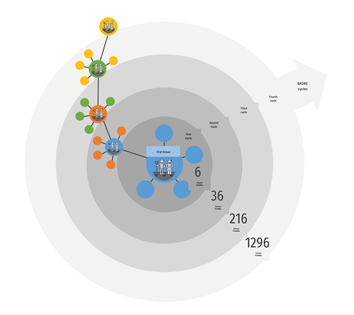
community. Each one of these producers tests the new designs or practices and once their effectiveness has been proven, they share with other neighboring farmers, creating a rapid multiplying process, which allows hundreds of farmers to learn and incorporate agroecological innovations in only one year (Figure 2).
Depending on the level of social organization, the leadership of the promoter(s) and the pedagogical methods used, the process may start with 6 people trained in a first cycle, by the end of the fourth cycle more than 1200 people can be trained.
Principles
The Campesino a Campesino methodology includes a series of principles and steps that generally govern these exchanges and the collective adoption of innovations (Table 2).
Know the reality and start slowly and small. The diagnosis allows to know the key problems of the farms, establish priorities. This principle facilitates reflection, evaluation and identification of actions with the broadest and fastest impact, with lower cost and risk.
Encourage exchange of experiences. It begins with identifying and mobilizing a farmer who already has proven solutions to common agricultural problems in the area. Those with similar problems will begin small-scale experimentation to test whether the farmer’s technique works on their farms as well. They will assess the achievements and keep moving forward.
Limit the introduction of technologies. It is not necessary to introduce many agroecological practices or technologies at the same time. It is more effective to master innovations one by one and consolidate and integrate them little by little. It should start with those techniques that face and solve the biggest production problems and, at the same time, cause the lowest initial costs; that are easy to perform and lead more quickly to beneficial outcomes. It usually begins with the restoration of soil quality and crop diversification.
- Steps
- Get fast and recognizable success. It is important to achieve the broadest and fastest impact. The enthusiasm to see that the actions work as a generator of new ideas and provides an effective stimulus to continue with the agroecological conversion.
- Experiment on a small scale. Experimenting is nothing more than testing, checking, adapting and adopting a new technique or solution. Through this principle, farmers become active experimenters and innovators, and their farm becomes a rich laboratory of experimentation and innovation.
- Develop a multiplier effect. The multiplication and exchange between and by the peasants, on the results and experiences obtained, is the way by which the extension and massification of successful agroecological practices and management can be achieved.
Table 2: Principles and steps that guide the methodology Peasant to Peasant (Campesino a Campesino) [2,10].
Agroecological Lighthouses
In most rural territories there are successful diversified farms that represent “agroecological lighthouses” from which the agroecological principles are irradiated to the community and to farmers from other regions, helping them to design farms that feature efficiency, diversity, synergy and resilience. These farms provide living testimonials on how to design and manage fields according to agroecological principles [3]. These lighthouses can be considered productive models that demonstrate that by applying agroecological principles it is possible to produce food in a resilient, efficient and stable manner, expanding the environmental and social impacts of this proposal in the territory. The design of an agroecological lighthouse consists in a type of ecological engineering tactic assembling the components of the agroecosystem (crops, animals, trees, etc.) in such a way that the temporal and spatial interactions between these components optimize the recycling processes of nutrients and organic matter, the biotic regulation of pests and the stabilization of crop yields, improving the resilience and stability of the agroecosystem [10].
Demonstration farms are called “agroecological lighthouses” where technical knowledge and agroecological processes are shared to guide local producers towards more sustainable agricultural systems. In a broader sense, any project located in the field that provides demonstration, education and training, from local practice, can be called an agroecological lighthouse. Agroecological lighthouses and the farmers who run them promote agroecological principles through networking, leadership and teaching, and through the demonstration and dissemination of production and management practices at the farm level [11]. In order for the designs and management practices featured in a lighthouse to be spread it is necessary that the models and practices that are featured are credible and based on solid evidence, relevant to addressing local problems, able to be tested while showing results relatively quickly and are easy to be transferred and adopted [2].
| Practices | Qualify When | Does not Qualify When | |
|---|---|---|---|
| Environmental | Agroecological management | Ecologically based management of soil, water, biodiversity, pests, diseases and weeds | Conventional management |
| Environmental | Agroecological management | System diversified in time and space. | Apply chemical pesticides and fertilizers. |
| Environmental | Agroecological management | Multiple interactions that enhance ecological processes on the farm | Leaves soil uncovered. |
| Environmental | Agroecological management | Polycultures | Monoculture with weak internal connections |
| Environmental | Shows improvements in natural resources | Recovers and improves the soil. | Soil erosion, soil disturbance |
| Environmental | Shows improvements in natural resources | Preserves and harvests water. | Loss or inefficient use of water |
| Environmental | Shows improvements in natural resources | Increases biodiversity. | Eliminates beneficial flora and fauna. |
| Environmental | Shows improvements in natural resources | Rescues local germplasm | Uses commercial seeds |
| Environmental | Efficiency | Recycle, reuse local resources. | Import external resources. |
| Environmental | Efficiency | Human/animal labor | Depends on agrochemicals and fuel energy |
| Environmental | Efficiency | Capture and use renewable energy | Depends on agrochemicals and fuel energy |
| Environmental | It does not pollute the environment | It does not use agrochemicals and does not generate toxic waste | Contamination with agrochemical residues |
| Environmental | It does not pollute the environment | Biomass recycled | Biomass goes to waste |
| Environmental | Responds to the needs of peasant families | Produces various crops for food self-sufficiency and surplus for local markets. | Privileges high yields of a particular crop for sale |
| Environmental | Responds to the needs of peasant families | Small or medium-sized farms | Large scale farms |
| Environmental | Responds to the needs of peasant families | Family food produced on farm | Imports food from outside |
| It is productive, diverse and profitable | Responds to the needs of peasant families | Promotes monoculture | |
| Economic | Be a sustainable operation. | More than 60% of resources come from self-management. | Relies heavily on external subsidies or funding. |
| Economic | Be a sustainable operation. | Generates its own financial resources through educational and demonstration activities | Depends on sporadic and discontinuous off-farm income generation |
| Sociocultural | Close relationship with local producers | Generates networks. | It has no relationship with neighboring peasant communities. |
| Sociocultural | Close relationship with local producers | Training, teaching, and demonstration activities | It does not benefit the local community, |
| Sociocultural | Close relationship with local producers | Receives visits constantly | it receives visits sporadically |
| Sociocultural | Close relationship with local producers | Agroecological designs relevant to local biophysical and socio-cultural conditions | Not relevant to local reality |
| Sociocultural | Close relationship with local producers | It shows an impact, and this is transmitted to neighboring families. | No impact on local community |
| Sociocultural | Close relationship with local producers | It allows the evaluation of the impact on peasant communities | No evaluation of impacts |
Some lighthouses have been established by NGOs consolidated over time, with more or less stable funding sources, made up of multidisciplinary and highly motivated work teams. Their technical, social and cultural proposals are nourished by their work with the peasant communities of the area where they are established. They work based on real small or medium sized farms, where they replicate the conditions of the peasants of the sector implementing agroecological practices. Every year these lighthouses receive thousands of visitors, especially peasant farmers, professionals and agricultural students. Table 3 lists some attributes and practices that should be considered to assess whether or not a demonstration farm qualifies as an agroecological lighthouse [11].
Agroecological lighthouses and the farmers and/or technicians who manage them are critical links in farmer- to-farmer networks, amplifying the dissemination of agroecological knowledge and practices within and outside their territories. Beyond the dissemination of knowledge and practices, agroecological lighthouses create social capital in rural communities which is key to creating relationships with different local and outside actors and allies.
Verification of the Scaling Potential of Agroecological Initiatives
When starting a process of agroecological scaling up it is important to obtain relevant information and take into consideration the following steps:
- Clearly identify the agroecological systems and/ practices to be disseminated.
- Identify the leading farmers with efficient farms exhibiting a local impact.
- Determine the methods to be used in scaling up (agroecological lighthouses, farmer-to-farmer networks, or others).
- Determine the role, functions and responsibilities of the people and organizations involved in the process.
- Establish the expectations that people manifest about the amplification process (coverage area, number of farmers, among others).
- Determine the factors that may enable or disable the process and identify strategies that possibly overcome such limitations.
When evaluating the scaling potential of agroecological initiatives it is important to design a scalability checklist that may be used as an aid in prioritizing alternatives to scale up and as a means of identifying some of the actions that can be taken to facilitate and simplify the scaling up process.
The scalability checklist in Table 4 is intended as a basic test to assess scalability based on a series of factors already discussed. Each check
- placed in Column A indicates a factor that facilitates the amplification process, and each check
- in Column C represents a complicating factor that limits amplification. There is the possibility of performing 17 checks
- in the checklist. The more
- (10 or more
- ) marked in column A, indicates that the conditions facilitate the scaling up process. If more than 60% of
- are in column C, it indicates that there are barriers that need to be overcome to carry out the amplification of agroecology. If most
- fall in column B, it means that there are equal number of conditions that facilitate or complicate the scaling up process.
| Scalability Categories | A | ← Easier Scaling | B | Harder Scaling → | C | |
| 1. How compelling is the strategy or innovation to scale? | 1 | Based on solid evidence | Poor or no evidence | |||
| 1. How compelling is the strategy or innovation to scale? | 2 | Existence of a successful and convincing productive models | There is no successful model | |||
| 1. How compelling is the strategy or innovation to scale? | 3 | Relatively homogeneous environmental and socio-economic context. | Diverse, heterogeneous contexts | |||
| 1. How compelling is the strategy or innovation to scale? | 4 | Users see visible impact | Non-visible impact | |||
| 2. How strong is the support for change? | 5 | Model implemented and supported by experienced and respected farmers | No support | |||
| 2. How strong is the support for change? | 6 | Urgent sense to solve concrete problems | No sense of urgency | |||
| 2. How strong is the support for change? | 7 | Addresses a priority community issue | Does not address priority problems | |||
| 2. How strong is the support for change? | 8 | Strong leadership coalition committed to change | Weak leadership | |||
| 3. Does the model offer advantages over existing practices? | 9 | The community considers existing practices and solutions to be inadequate | Existing practices are considered adequate | |||
| 3. Does the model offer advantages over existing practices? | 10 | Alternatives show superior effectiveness to established practices | No evidence of superiority | |||
| 3. Does the model offer advantages over existing practices? | 11 | Based on traditional systems and practices | Deviates from traditional practices | |||
| 3. Does the model offer advantages over existing practices? | 12 | Implementable within existing physical, economic and human resources. | Requires many additional resources | |||
| 3. Does the model offer advantages over existing practices? | 13 | Does not require major changes in government policies | Requires substantial political changes | |||
| 4. How easy is the model to transfer and adopt? | 14 | Existence of a collaboration network between users | There is no network | |||
| 4. How easy is the model to transfer and adopt? | 15 | It does not require modification, only optimization of existing systems | Requires total transformation | |||
| 4. How easy is the model to transfer and adopt? | 16 | Involves a transition process with various stages of adoption | Requires no transition | |||
| 4. How easy is the model to transfer and adopt? | 17 | Requires training, supervision and monitoring with simple indicators | No monitoring | |||
| # Total ✓ |
Table 4: Scalability checklist.
$$ \mathrm {E} = \mathrm {E} _ {1} + \mathrm {E} _ {2} + \dots + \mathrm {E} _ {n} $$ ) in column A implies a factor that facilitates the scaling up process. Each verification ( ) in column B implies an average value of facilitation. Each verification ( ) in column C represents a complicating factor that limits scalability.
The Scalability Checklist main purpose is to stimulate, not replace, dialogue and a serious discussion about the opportunities and difficulties of the scaling up process. It is not intended to determine what can and cannot be amplified, but rather the list helps to prioritize alternatives and to identify actions that should be taken to facilitate the amplification process.
Methodology to Estimate the Potential for Scaling up Agroecological Initiatives
The methodology presented here was developed by a group of researchers in Japan and focuses on agroecological lighthouses and their ability to broaden the adoption of agroecological principles and practices by other farmers in surrounding territories [12]. As emphasized above, the farmers who run the lighthouse farms are of key importance when promoting agroecological principles in the surrounding community and among farmers in other regions. Depending on the level of leadership of the farmer or his/her ability to extend to others his/her experience, a lighthouse can provide a pedagogical space for the development of agroecological systems, influencing farmers in nearby geographic areas to adopt new agroecological designs thus providing alternative paths to the dominant industrial agricultural model.
The proposed methodology allows to examine the ways in which agroecology can be amplified by lighthouse farmers in a particular territory. The methodology uses a few simple indicators to quickly observe the scaling potential of a given agroecological farm, which implies identifying farmers whose farms exhibit the attributes that characterize a lighthouse. (see Table 3). Through field interviews and direct observations of the various target farms, researchers together with the participating farmers, collectively choose a series of amplification indicators that capture particular aspects of successful lighthouse farms. The indicators reflect socio ecological dimensions of each farmer and his/her farm, allowing the assessment of the key drivers that would enhance the scaling of the designs and management that characterize the farms under study.
In addition to requiring the participation of farmers in the selection of suitable indicators, the methodology emphasizes the collective definition of common criteria on how to qualify each indicator. Indicators are evaluated using criteria that allow each indicator to be given a value from 1-5 [1 represents low scaling potential, 2.5 medium, and 5 high] as described in Table 5.
| Evaluation criteria | |||
|---|---|---|---|
| Indicators | Value 1 (Low) | Value 2.5 (Medium) | Value 5 (High) |
| A. Motivation to seek alternatives (health, lifestyle change, conserving nature, autonomy, market opportunities, among others) | Mainly economic motivation | Economic and environmental motivation | Deep reasons, concerned about community welfare and natural resources. |
| B. Social Organization (member of local, regional or national associations of farmers, member of cooperatives, directly linked to consumers, among others) | Individual, isolated, little or no connection with other farmers and/or the community | Little or medium connection with the external community | Well connected to the local community, including connections at regional and national levels. |
| C. Participation in networks that share experiences and knowledge | Does not engage in exchanges | Occasionally participates in activities to exchange techniques, practices and knowledge | He/she actively participates in exchange processes, visits, trainings, among others. |
| D. Use of efficient traditional and/or agroecological practices (rapid and notable impact on yields, conservation of resources, among others) | It uses conventional inputs and techniques, ignores traditional practices, combines some organic inputs. | Use practices of substitution of chemical inputs for organic | Combines traditional practices, and farm redesigns based on agroecology |
| E. Dependence on external inputs and markets | Indebtedness, high dependence on external inputs, sells to intermediaries, does not set its own prices | Occasional purchase of some inputs and sometimes sells to middlemen, average level of debt. | High level of control over market relations, can set own prices, does not depend on external inputs |
| F. Leadership (motivating and mobilizing speech, stimulates and influences the community, among others. | It does not exercise leadership of any kind. Farmer is rather a follower. | Farmer has a discourse, but has little mobilizing impact on the community | Motivates and influences the community, engages with local authorities, influences local policies |
Table 5: Indicators and evaluation criteria to estimate the agroecological scaling potential of lighthouse farms in a rural commu
Farmer has no allies and no relationships with external organizations, it is not open to collaborate with researchers.
G. External partners, relations with external organizations Ignorant of policies or not taking advantage of policies that could benefit him/her.
H. Benefits from favorable local/national policies I. Favorable markets (participation in alternative food networks, direct links with consumers, among others) It depends only on conventional markets; industrial markets determine his/her sale circuits.
Close relations with universities, NGOs. extension services, among others. Open to collaboration in research and in the co-creation of solutions Has some allies, open to collaborating, but not taking an active role.
Sometimes takes advantage of policies, but does not implement all recommendations Takes strategic advantage of existing policies.
Some products in conventional markets and others in alternative markets Actively involved in local or alternative markets. High solidarity with consumers.
Applies certain principles, open to options, but attached to certain technical recipes. Little understanding of agroecological principles and processes Table 5: Indicators and evaluation criteria to estimate the agroecological scaling potential of lighthouse farms in a rural community [12].
For example, indicator 3 “participation in networks to share experiences and knowledge” would be given a lower score [1] in case “Does not participate in knowledge sharing”; a medium score [2.5] if “Participates occasionally in the exchange of knowledge, practices and technical information”; and a high score [5] if “Actively participates in farmer-to-farmer exchanges, open to visitors, participates in training processes, is a promoter.” After conducting the survey and the visit, the scores are jointly analyzed, identifying the farms that exhibited low indicator values [<2.5], and the group comes up with recommendations of new design and management decisions aimed at improving the areas with deficient indicators, thus improving the agroecological scaling potential of each farm. Using data from the first assessment as a baseline, farmers can track after a few months, whether adoption of the recommended design and management practices improved poorly performing indicator values. A comparison between several farms that are at different stages of agroecological transition allows a group of farmers to identify the most advanced farms that exhibit higher average scores [>3.5] considered as lighthouses with amplification potential (Figure 3).
![Figure 3: Weighted values that estimate the scaling potential of several farms in Japan [12].](/fulltextimages/10627/fig_3.png)
| J. Focuses on principles and processes rather than technologies and “magic bullets.” | Attached to technical recipes and magic solutions. Does not understand or care about agroecology. | Applies certain principles, open to options, but attached to certain technical recipes. Little understanding of agroecological principles and processes | Understands agroecological principles and processes, uses flexible approaches, does not adhere to technical recipes |
Table 6: Indicators and evaluation criteria to estimate the agroecological scaling potential of lighthouse farms in a rural
- Key Questions
- Does the process generate early success by creating excitement in communities?
- Does it maximize the use of local resources and knowledge, but also integrate efficient new practices?
- Do adopters use community knowledge to understand problems and design interventions to improve farming systems?
- Do users focus on principles rather than technologies?
- Does it encourage farmers to diversify their farming systems?
- Does it encourage farmers to experiment to improve soil and water management and in situ conservation of local seeds?
- Does the process strengthen local organizations to manage the process?
- Is social and human capital enhanced?
- Is there good collaboration between farmers and other actors (NGOs, research institutions, local governments, among others) working on agroecological solutions and sustainable food systems?
- Are vulnerable actors such as women, children and the elderly, as well as farmers’ organizations, strengthened?
- Is there productive use of people’s collective capacities to work fairly and collectively to solve common problems?
- Are specific actions that require collective action encouraged, such as agroecological soil conservation practices, seed banks and local markets?
- Is a bottom-up farmer-led approach ensured? Are farmers positioned in the driving seat of the process through appropriate methodologies to promote horizontal innovation, exchange and learning?
Table 7: Key questions to evaluate the progress and scope of the scaling process at the community level.
The methodology has a few limitations that can be overcome by devoting more time to: a) assessing how the farm and farmer are able to create and maintain social relations and networks and b) become more familiar with the territory, as there is the risk of obtaining a partial picture of the farmers’ role as an agroecological lighthouse.
Conclusions
The scaling up of agroecology implies several simultaneous transitions, at different scales embracing social, ecological, economic, cultural, institutional and political dimensions. The goal is to create a socio-ecological process that leads to more families trying to agroecologically expand their management practices in wider territorial areas involving more people not only in the production of food, but also in its processing, distribution and consumption. The final objective is to challenge and transform the industrial food system through the massification of agroecology which drives the emergence of more socially just, ecologically biodiverse and resilient forms of local agriculture.
At the heart of the strategy to release the transformative potential of agroecology, is the need to spread knowledge about agroecological principles and designs through participatory farmer-to-farmer led learning and uncovering the visibility of successful farms that act as demonstration sites or lighthouses. Scaling up agroecological interventions to large farming populations is not a straightforward task. There is a need for guided efforts to scale up, to avoid the passing of too much time for a new evidence- based intervention to be broadly implemented. Scaling up agroecology innovations is far more complex than simply transferring information about practices, seeds or inputs; it entails building human and social capacity in the community by accessing appropriate knowledge to facilitate learning and innovation, which has been recognized as essential in the successful territorialization of agroecology [7].
This is why the scaling up of farmer led successful agroecological initiatives requires a methodological approach based on a series of indicators that can capture the best farmer experiences and unleash their potential to amplify territorial upscaling of agroecology. Despite its limitations, the proposed methodology allows to:
- identify the numerous barriers to and opportunities for the scaling up of agroecology in a given territory.
- develop a scalability checklist used for prioritizing alternatives to scale up and for identifying some of the actions that can be taken to facilitate the scaling up process.
- propose the use of simple indicators to quickly observe the scaling potential of a given agroecological farm and the way in which agroecology can be amplified by lighthouse farmers in a particular territory.
References
-
Akram-Lodhi H (2021) The ties that bind? Agroecology and the agrarian question in the twenty-first century. The Journal of Peasant Studies 48(4): 687-714.
-
Mier y Terán Giménez Cacho M, Giraldo OF, Aldasoro M, Morales H, Ferguson BG, et al. (2018) Bringing agroecology to scale: key drivers and emblematic cases. Agroecology and Sustainable Food Systems 42(6) : 637– 665.
-
Rosset P, Altieri MA (2017) Agroecology: Science and Politics. Black Point, NS: Fernwood Publications.
-
Parmentier S (2014) Scaling-up agroecological approaches: What, why and how. Oxfam-Solidarity Brussels, pp: 472-480.
-
Dumont AM, Wartenberg AC, Baret PV (2021) Bridging the gap between the agroecological ideal and its implementation into practice. A review. Agronomy for Sustainable Development, 41(3), 1-17.
-
Bezner Keer R, Madsen S, Stüber M, Liebert J, Enloe S, et al. (2021) Can agroecology improve food security and nutrition? A review. Global Food Security 29: 100540.
-
Anderson CR, Bruil J, Chappell MJ, Kiss C, Pimbert MP (2019) From transition to domains of transformation: Getting to sustainable and just food systems through agroecology. Sustainability 11(19): 5272.
-
Valdivia-Díaz M, Le Coq JF (2022) Roadmap for the scaling up of Agroecology in Ecuador. CCAFS Info note. Wageningen, Netherlands: CGIAR Research Program on Climate Change, Agriculture and Food Security (CCAFS).
-
Nicholls CI, Altieri MA (2018) Pathways for the amplification of agroecology. Agroecology and Sustainable Food Systems 42 (10): 1170-1193.
-
Holt-Giménez E (2007) Campesino A Campesino: Voices from Latin America’s Farmer to Farmer Movement for Sustainable Agriculture. Food First Books Oakland CA, pp: 779-781.
-
Infante Lira A (2017) Los faros agroecológicos. Definición y caracterizacióna partir de una experiencia de reconstrucción rural en el secano de Chile central. Agroecología 10(1): 73-78.
-
McGreevy SR, Tamura N, Kobayashi M, Zollet S, Hitaka K, et al. (2021) Amplifying Agroecological Farmer Lighthouses in Contested Territories: Navigating Historical Conditions and Forming New Clusters in Japan. Frontiers in Sustainable Food Systems 5: 1-18.
- Enhancement of Vegetative Growth and Fruit Yield in Cucumber (Cucumis sativus L.) via Spiritual Blessing (Biofield) Energy Intervention
- Production of Açaí (Euterpe oleracea Mart.) under Different Agroforestry System Management Intensities in Amazonian Floodplain (Varzea) Forests
- Coffee and the Production Region: What is the Secret to the Expression "Quality"?
- Experiential Agripreneurship Training in Sub-Saharan Africa: Integrating a Business Incubator into Postgraduate Livestock Education at the University of Buea
- Advances in Agricultural High-Quality Development
- Linking Compost Residue to ABAGE in Plants - a Short Note