
Relations of Legumes with Soil Health and Succeeding Crops
In recent decades, soil degradation has increased dramatically on a global scale. It is urgently necessary to promote food security and lessen the effects of climate change by restoring and maintaining the health of our soils. Improvements in soil structure have been demonstrated to help mitigate the effects of soil degradation, which is a crucial feature that influences soil health that is becoming more widely acknowledged. So the use of technologies and methods are important in this context. Growing of legume crops in cropping system is an option. Legumes possess a unique attribute known as nitrogen fixation, which enables them to form symbiotic associations with nitrogen-fixing bacteria residing within specialized root structures called nodules. Through this remarkable process, atmospheric nitrogen is converted into a biologically available form, enriching the soil with this essential nutrient and reducing the dependence on synthetic nitrogen inputs and minimizing environmental degradation caused by excessive fertilizer usage. Furthermore, legumes actively participate in nutrient recycling, releasing essential elements within the soil. By absorbing nutrients from deep in the soil profile, legumes prevent leaching and subsequent loss of these valuable resources. In addition to their nutrient recycling power, legumes also play an important role in improving soil structure. Their extensive root systems penetrate deep into the soil, effectively breaking up compacted layers and enhancing water infiltration. In conclusion, recognizing and harnessing the potential of legumes can revolutionize farming practices, ensuring long-term soil fertility and productivity, environmental sustainability, and food security for generations to come.
Introduction
In intensive agriculture, farmers often use chemical fertilizers in excess amount to produce a tremendous yield in the short term Ahmadi AY, et al. [1], Bedoussac L, et al. [2], and progressive use of these fertilizers lead to nutrient imbalance which adversely affects soil health in the long term because of their susceptibility to losses through gaseous form and by leaching [3, 4]. At the same time, it takes about 70 percent more food to feed the 11 billion inhabitants by the end 21st century [5]. As a result, science and technologies must address these challenges. Among the many possibilities, a legume-based cultivation system is an option for responding in this context.
Legumes belong to the Leguminosae or Fabaceae family and are well-known for their biological nitrogen fixation and nutritive values [6, 7, 8]. Legumes have a vital role in integrated soil fertility management because of their capability to fix atmospheric nitrogen (N2) in symbiosis with rhizobia species [9, 10].
They supply soil organic matter resources in the soil, thus improving soil physical, chemical and biological properties and crop yield [11, 12]. Legumes increase microbial growth in soil for nutrients recycling [13].
The inclusion of legumes in the cropping system can increase carbon (C) stock [14, 15]. Furthermore, legumes in the intercropping system can remain N stock for succeeding crops [16, 17, 18]. In addition to N and C, Phosphate-solubilizing bacteria with legumes can change organic P to inorganic P through the solubilization and mineralization processes [19].
Here are some studies about the importance of the legume–based cropping system which describes the positive role of legumes in crop yield. Yusuf AA, et al. [20], Kumar S, et al. [21] reported a higher yield of maize and high N uptake in legume-based cropping systems compared to sole cropping. Mupangwa W, et al. [22] found the highest yield of maize crop from 3307–3,576 kg ha-1 and 3,609 kg ha-1, respectively in the including of common bean and groundnut rotation. Legume-based cropping compared to mono-cropping makes the optimum resource of all nutrients for crop productivity [23, 24]. For the efficient use of available natural resources, crop productivity per unit area, and minimizing the risk of crop failure, appropriate intercropping including legumes is very important [25]. Monoculture can cause a decrease in soil fertility and productivity, nutrient loss, weed and pest infestations, etc.
eventually result in low yield [26, 27].
The aims of this review are to describe the role and importance of legumes in human nutrition and livestock feeding and also their benefits for soil fertility and crop productivity through their inclusion in the cropping system. The positive effects of legumes on succeeding crops will also be described.
Classification of Legumes
Legumes are the third-largest angiosperm family that contain more than 18,000 species [28, 29]. Legumes seeds are surrounded by pods [28, 30, 31]. They are valuable sources of protein, minerals, and vitamins that are essential to human and animal nutrition. Legumes are also well- known for improving crop yields and soil fertility through the BNF mechanism. According to their use and consumption, legumes are divided into four main categories: pulses, oil seed legumes, vegetable legumes, and forage legumes.
Pulses
Pulses are crops that are only cultivated for their dry grains/seeds. For instance, peas, beans, lentils, and chickpeas (Table 1). Around 72.3 million metric tons of pulses were produced between 2011 and 2013 on 80.3 million hectares of land worldwide, with dry beans coming in first [32].
| Beans | Lentils | Chickpeas | Peas | |
|---|---|---|---|---|
| Adzuki beans | Lupin beans | Green lentils | Desi chickpeas | Green peas |
| Bambara beans | Mung beans | Red lentils | Kabuli chickpeas | Yellow peas |
| Cranberry beans | Mungo beans | Yellow lentils | Pigeon peas | |
| Faba or fava beans | Navy beans | |||
| Great Northern beans | Pink beans | |||
| Kidney beans | Pinto beans | |||
| Lima beans | Yellow beans | |||
| Cowpeas and black-eyed peas | Vetch |
Table 1: ** List of Pulses.
Source: Marinangeli CP, et al. [33]. Table 1: List of Pulses.
Oil Seed Legumes
Production of seed oil contributes to the food security of a population that is expanding quickly. Fourty percent of all the calories consumed by low-income families come from oilseeds [34]. Legumes with oil seeds are higher in lipids and play a significant part in the industrial use of oil. In addition to protein and carbohydrates, the seeds of Arachis hypogea, Pongamia pinnata, and Glycine max each have around 52, 35, and 20% oil contents, respectively [35].
Vegetables Legumes
Vegetable legumes are harvest from the field before drying (green). The consumers are aware of these legumes’ well-balanced diet and can utilize them fresh, cooked or processed. Vegetable legumes are a valuable source of vitamins, minerals, carbohydrates, and other bioactive compounds that promote well health. The market prices of vegetable-type legumes are high Singh RJ, et al. [36], and snap bean and snap pea are the most popular varieties in vegetable legumes [37].
Forage Legumes
Forage legumes are those crops that are used to feed livestock and have plant parts that may or may not contain grain [34]. They are commonly used for grazing, silage, and hay in both monocultures and mixed cultures with other species, especially grasses [38]. There are numerous species of legumes for forage, but 153 species are known important forage legumes worldwide [39]. Among the 153 species, 20 species Table 2 are at the top for cultivating more for forage, fodder, grazing, silage, hay, and so on. Among the 20 species, alfalfa for hay, white clover, Leucaena and birdsfoot trefoil for grazing, and red clover for silage are more popular.
| Popular name | Scientific name | Popular name | Scientific name |
|---|---|---|---|
| Lucerne, Alfalfa | Medicago sativa | Calliandra | Calliandra calothyrsus |
| White clover | Trifolium repens | Common vetch | Vicia sativa |
| Leucaena, Guage, Subabul | Leucaena leucocephala | Pigeon pea | Cajanus cajan |
| Red clover | Trifolium pratense | Lablab, Poor-man’s bean | Lablab purpureus |
| Birdsfoot trefoil | Lotus corniculatus | Sesban, Egyptian pea | Sesbania sesban |
| Cowpea | Vigna unguiculata | Broad bean, field bean | Vicia faba |
| Subclover | Trifolium subterraneum | Sainfoin | Onobrychis viciifolia |
| Mata raton | Gliricidia sepium | Hairy vetch | Vicia villosa |
| Persian clover | Trifolium alexandrinum | Common bean, string bean | Phaseolus vulgaris |
| Stylo, Tropical lucerne | Stylosanthes guianensis | Sulla | Hedysarum coronarium |
Table 2: ** Forage Legumes.
Source: Food and Agricultural Organization (FAO) [39]. Table 2: Forage Legumes.
Role of Legumes in Soil Health and Crop Productivity
The inclusion of legumes in cropping system improves the nutrient balance of the soil, which increases soil fertility and crop productivity. The BNF process in legume – based cropping enhancing the soil fertility. Legumes can modify their rhizosphere in addition to fixing nitrogen by exuding organic acids (such as psionic acid, citric acid, etc.) that increase the availability of P for both the legumes and the crop that follows. Legume residues increase carbon (C) sequestration, enable soil aggregate stabilization, and reduce soil bulk density. Due to their deep root systems, legumes can assist in increasing soil porosity, breaking up subsoil hard pans and recycling nutrients. Legumes can therefore help the current and next crops grow more effectively by possessing the following attributes.
Legumes in Intercropping
Cultivating two or more crops in the same location at the same time is known as intercropping. There are four main kinds of intercropping:
- mixed intercropping,
- row intercropping,
- strip intercropping, and
- Relay intercropping [40].
Because of BNF, including legumes in an intercropping system can increase soil fertility and buildup soil organic matter for crop productivity [41]. Intercropping is better for the environment than a single cropping system in places with scarce access to water, nutrients, and light [42]. Growing legumes with cereals in intercropping provides better canopy and effective soil conditions for better resource uptake through rhizosphere activities [43]. Legumes-based intercropping increases water use efficiency through root distribution in soil horizons and decreases evaporation through better vegetative canopy [44].
Microbial communities can be enhanced by legume- based intercropping [43]. The soil microbial community is very important in soil function, such as nutrient cycling, decomposition of organic matter, and processes of nitrification, mobilization, and mineralization, and soil structure stability, all of which are important for crop growth and development [45]. Singh RP, et al. [46] showed that intercropping among legumes and cereals is more important in dry land agriculture. The intercropping of maize with soybean FU ZD, et al.[47], maize with pigeon peas, groundnuts, and cowpea Mucheru-Muna M, et al. [48], millet with groundnuts and sorghum with cowpea Nyoki D, et al. [49], rice with pulses, and barley with faba bean are reported by Mouradi M, et al. [50].
Legumes and Soil Properties
In an intensive cropping system, frequent tillage of the soil and excessive doses of inorganic fertilizers cause the breakage of aggregate particles and the breakdown of soil organic matter. This causes physicochemical and biological health degradation of the soil. Because of these unfavorable agronomic practices, cultivated land is becoming less productive. The negative effects of these practices are soil compaction, reduction of soil organic matter, and lower crop productivity [51]. Legumes-based cropping systems have an outstanding role in providing organic matter into the soil, thus improving both the physicochemical and biological characteristics of the soil [11, 43].
Soil Physical Properties: The main soil physical properties are soil density, porosity, aggregate stability, and texture, which are associated with soil aeration, water holding capacity, water infiltration, runoff, and soil erosion [52]. Legumes can improve the soil’s physical properties through the production of biomass for the biological activities in the soil [14]. A review of works of literature from the authors showed that a legume-based cropping system can increase the macro and micro aggregates for soil structure from 52–111%, compared to sole cropping Chamkhi I, et al. [43], legumes, due to their residue in soil, increase water infiltration and soil formation Mousavi SF, et al. [53], legumes roots are reaching about 6–8 feet deep into the soil and thus can make better soil porosity, promote air exchange, and water percolation Yuvaraj M, et al. [7], the protein content and symbiotic process in legumes’ sticky properties, bind the soil aggregates. This binding of aggregate increases pores and decreases both soil erodibility and crusting.
Soil Chemical Properties: The chemical properties of soil, such as cation exchange capacity (CEC), soil pH, level of nutrients, and soil organic matter content, are so important for soil fertility, crop productivity, and ecologically friendly crop production. These properties of the soil can be improved in a legume-based cropping system [54]. Legumes are a vital source of soil organic matter that provides N, P, also sequesters C in the soil from their residues and atmospheric carbon dioxide (CO2) [14]. Legumes add organic acids to the soil through the decomposition of organic matter, which reduce soil pH. This reduction in pH important in alkaline soil with high pH. A review of the literature by Kumar R, et al. [55], Dhakal Y, et al. [12] showed that green legumes contribute to avoiding nutrient leaching, preventing weed development, and decreasing the destructive influence of agrochemicals. In addition, soil organic matter is a slow-releasing source of nitrogen (N), which significantly prevents air and water pollution compared to chemical-nitrogen fertilizers [56].
Soil Biological Properties: The biodiversity of the microbial community and the availability of energy for their activities to decompose organic matter are crucially important as far as the soil biological properties are concerned. The process of organic matter decomposition is very important because, without energy, nutrients cannot be used by the crop. Legumes are crops that provide energy for microbiological activities Ye X, et al. [57] and increase the diversity of the microbial community by incorporating different legumes in cropping systems [21, 58, 59]. In addition, Schelud’ko AV, et al. [60] found that legumes’ exudation of lectins can promote the mobility of growth-promoting rhizobacteria and their activity in the root zone.
The beneficial effects of a legume-based cropping system on the physical, chemical, and biological properties and soil health are shown in (Figure 1).
![Figure 1: Beneficial Effects of Legumes - Based Cropping on Soil Properties [43].](/fulltextimages/11274/fig_1.jpeg)
Legumes as Green Manure
Green manure is the incorporation of green plants to improve soil fertility and productivity for subsequent crops and long-term purposes. Green manure is used in two ways: “in-situ,” where the green manure crops are grown for a short period and contributed in the same area, and “ex-situ,” where the green manure crop are collected from nearby areas and added to the soil 15–30 days prior to the planting of a main plant [61]. There are many crops for green manuring, while green legumes are very popular for N fixation and reducing the use of synthtic N fertilizers [62]. Legume green-manure crops are better than non-legumes by having the desired characteristics of agronomic performance, adaptability, and tolerance to biotic and abiotic stresses [63]. Legumes green-manure has many advantages, including lowering the amount of nutrients loss to the environment as a result of gaseous losses, surface runoff and leaching, which are enhancing soil quality with organic matter, preventing soil erosion, increasing the diversity and biological activity of microbial populations, and using fewer fertilizers.
Legumes and Fertilizer use Reduction
Nitrogen is the element that is most abundant on Earth, but its scarcity severely restricts crop growth and productivity [34]. Amounts of N and P estimated to be used in agriculture today are more than 40 and 20 x 106 million tons, respectively, will be needed to meet crop production needs in 2040 [64]. The land, water, and atmosphere are negatively impacted by this widespread usage of inorganic fertilizers. To maintain a sustainable agricultural system, chemical fertilizers must be replaced with another substance. Exudates that transmit signals to rhizobia in the root zone and the availability of nutrients through the BNF are both achievable in cropping systems based on legumes use [65].
Legumes can reduce the amount of fertilizer needed for the following crop by just requiring the initial dose of nutrients. Food legumes can save 170–220 kg ha-1 of nitrogen compared to non-legume crops, and an additional 40–70 kg ha-1 of nitrogen can be saved for the following crop, according to research of Fustec J, et al. [66], Varma D, et al. [67]. According to Bues A, et al. [68], clovers can conserve between 30 and 60 kg ha-1 of nitrogen for the crops that follow by using BNF without applying additional nitrogen. Compared to non-legumes, including forage and grain legumes in crop rotation for 4 to 5 years can reduce nitrogen use by 30-90 kg ha-1 [69]. Compared to other systems, legume-based cropping can cut the consumption of nitrogen fertilizer by 38% [70]. Consequently, biological nitrogen fixation contributes to ecologically friendly agricultural systems by decreasing the requirement for commercial N fertilizers Kebede G, et al. [71] as well as energy for fertilizer manufacture and delivery [72].
Phosphorus is another primary macronutrient for plant growth after nitrogen (N). Soil usually contains high amounts of P, which is mostly unavailable to plants [73]. Legumes can change the form of inaccessible P into an available form by reducing the pH of the rhizosphere Nwoke OC, et al. [74], and allowing the phosphatase enzyme to enter the soil, which aids in the decomposition of P-containing organic materials [75].
Legumes as a Benefit for Subsequent Crops
Proper crop rotation is related to the quantity of sequestered nitrogen in the soil for succeeding crops [14]. So, it is crucial to include proper legumes in crop rotation [16]. The addition of legumes improves the production and other qualities of succeeding crops [76]. Legumes provide N to future crops via the BNF process Preissel S, et al. [76], add organic matter to improve soil structure Hernanz JL, et al. [77], mobilize P Shen J, et al. [78], increase soil water holding capacity Angus JF, et al. [79], and decrease the detrimental effects of pests [80]. It has been shown in a legume-based intercropping system that all the fixed nitrogen by the legume is not used by the current crop; instead, some of the fixed nitrogen is left for subsequent crops [16, 17] (Figure 2). Legumes increase the production of succeeding crops, according to the evidence presented by a number of researchers. According to Ahmadi AY, et al. [81], the yield of wheat was about 5% higher in the land where soybeans had been the preceding crop than it was for maize. In comparison to non-legumes, Yusuf AA, et al. [20] showed a 34% higher yield of maize in rotation with legumes. Ahmad T, et al. [82] found a favorable link between the production of rice and legumes, with a 0.6-1.1 t ha-1 higher yield than cereals. In this situation, adding legumes to the crop rotation is crucial for boosting and maintaining the productivity of future crops.
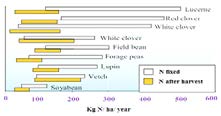
Source: Meena RS, et al. [28]. Figure 2: Estimates of the Amount of N-Fixed and the Amount left over after Harvest.
Conclusion
This review concluded from the aforementioned topics that legumes have the capacity to fix atmospheric nitrogen, solubilize phosphorus, boost soil microbial diversity and activity, add plentiful plant residues, recycle nutrients, enhancing soil fertility and productivity and have positive impacts on the productivity of subsequent crops. Legumes are also a cost-effective, environmentally friendly, bioactive and other antioxidant substances as well as sustainable source of protein, starch, dietary fiber, vitamins, and mineral nutrients that are beneficial for a healthier lifestyle and the suppression of hunger. Furthermore, Legumes which are used for different forms of feeding such as hay, silage, and pasture are asignificant source of animal feeds, because they have higher levels of dry matter and digestible proteins than grasses. So, using legume crops in crop production systems can improve the environment, the economy, and nutrition security.
References
-
Ahmadi AY, Arien M (2022) Poultry manure effects on yield and some agronomic components of soybean (Glycine max L.) under Khost Agro-Ecological Conditions, Afghanistan. International Journal of Agriculture Environment and Food Sciences 6(1): 1-6.
-
Bedoussac L, Journet EP, Hauggaard Nielsen H, Naudin C, Corre Hellou, et al. (2015) Ecological principles underlying the increase of productivity achieved by cereal-grain legume intercrops in organic farming. A review. Agronomy for sustainable development 35: 911- 935.
-
Amoah AA, Miyagawa S, Kawakubo N (2012) Effect of supplementing inorganic fertilizer with organic fertilizer on growth and yield of rice-cowpea mixed crop. Plant Production Science 15(2): 109-117.
-
Savci S (2012) An agricultural pollutant: chemical fertilizer. International Journal of Environmental Science and Development 3(1): 77-80.
-
United Nations (2017) Population Division World population prospects: Key findings and advance tables, the 2017 revision. Department of Economic and Social Affairs, Working paper no. ESA/P/WP1248.
-
Vanlauwe B, Hungria M, Kanampiu F, Giller KE (2019) The role of legumes in the sustainable intensification of African smallholder agriculture: Lessons learnt and challenges for the future. Agriculture, ecosystems and environment 284: 106583.
-
Yuvaraj M, Pandiyan M, Gayathri P (2020) Role of legumes in improving soil fertility status. Legume Crops- Prospects, Production and Uses pp: 1-8.
-
Meena RS, Lal R (2018) Legumes for soil health and sustainable management. In: Meena RS, Das A, Yadav GS, Lal R (Eds.), Legumes for Soil Health and Sustainable Management pp: 1-31.
-
Lemke RL, Zhong Z, Campbell CA, Zentner R (2007) Can pulse crops play a role in mitigating greenhouse gases from North American agriculture? Agronomy Journal 99(6): 1719-1725.
-
Courty PE, Smith P, Koegel S, Redecker D, Wipf D (2015) Inorganic nitrogen uptake and transport in beneficial plant root-microbe interactions. Critical Reviews in Plant Sciences 34(1-3): 4-16.
-
Fageria NK, Baligar VC, Bailey BA (2005) Role of cover crops in improving soil and row crop productivity. Communications in soil science and plant analysis 36(19-20): 2733-2757.
-
Dhakal Y, Meena RS, Kumar S (2016) Effect of INM on nodulation, yield, quality and available nutrient status in soil after harvest of greengram. Legume Research-An International Journal 39(4): 590-594.
-
Lal R (2012) Climate change and soil degradation mitigation by sustainable management of soils and other natural resources. Agric Res 1: 199-212.
-
Lal R (2015) Restoring soil quality to mitigate soil degradation. Sustainability 7(5): 5875-5895.
-
Jensen ES, Peoples MB, Boddey RM, Gresshoff PM, Hauggaard Nielsen H, et al. (2012) Legumes for mitigation of climate change and the provision of feedstock for biofuels and biorefineries. A review. Agronomy for sustainable development 32: 329-364.
-
Briggs DG (2005) Assessing and managing stands to meet quality objectives. In: Harrington CA, Schoenholz SH (Eds.), Productivity of western forests: a forest products focus. USDA forest service Pacific Northwest research station, General Technical Report PNWGTR-642, Portland, OR, USA, pp: 141-152.
-
Lithourgidis AS, Dordas CA, Damalas CA, Vlachostergios D (2011) Annual intercrops: an alternative pathway for sustainable agriculture. Australian journal of crop science 5(4): 396-410.
-
Akinnifesi FK, MakumbaW, Sileshi G, Ajayi OC, Mweta D (2007) Synergistic effect of inorganic N and P fertilizers and organic inputs from Gliricidia sepium on productivity of intercropped maize in Southern Malawi. Plant and Soil 294: 203-217.
-
Behera BC, Yadav H, Singh SK, Mishra RR, Sethi BK, et al. (2017) Phosphate solubilization and acid phosphatase activity of Serratia sp. isolated from mangrove soil of Mahanadi river delta, Odisha, India. Journal of Genetic Engineering and Biotechnology 15(1): 169-178.
-
Yusuf AA, AbaidoomRC, Iwuafor ENO, Olufajo OO, Sanginga N (2009) Rotation effects of grain legumes and fallow on maize yield, microbial biomass and chemical properties of an Alfisol in the Nigerian savanna. Agriculture, ecosystems and environment 129(1-3): 325-331.
-
Kumar S, Sheoran S, Kumar SK, Kumar P, Meena RS (2016) Drought: a challenge for Indian farmers in context to climate change and variability. Progress Res Int J 11: 6243-6246.
-
Mupangwa W, Nyagumbo I, Liben F, Chipindu L, Craufurd P, et al. (2021) Maize yields from rotation and intercropping systems with different legumes under conservation agriculture in contrasting agro-ecologies. Agriculture, ecosystems and environment 306: 107170.
-
Zhang G, Yang Z, Dong S (2011) Interspecific competitiveness affects the total biomass yield in an alfalfa and corn intercropping system. Field crops research 124(1): 66-73.
-
Ram K, Meena RS (2014) Evaluation of pearl millet and mungbean intercropping systems in Arid Region of Rajasthan (India). Bangladesh Journal of Botany 43(3): 367-370.
-
Seran TH, Brintha I (2010) Review on maize based intercropping. Journal of agronomy 9(3): 135-145.
-
Lal R (2014) Societal value of soil carbon. Journal of Soil and Water Conservation 69(6): 186A-192A.
-
Lal R (2016) Soil health and carbon management. Food Energy Secur 5(4): 212-222.
-
Meena RS, Lal R (2018) Legumes and sustainable use of soils. Legumes for soil health and sustainable management, pp: 1-31.
-
(2016) (FAO) Food and Agricultural Organization
-
Staniak M, Księżak J, Bojarszczuk J (2014) Mixtures of legumes with cereals as a source of feed for animals. Organic agriculture towards sustainability 6: 123-145.
-
Kouris-Blazos A, Belski R (2016) Health benefits of legumes and pulses with a focus on Australian sweet lupins. Asia Pacific journal of clinical nutrition 25(1): 1-17.
-
Joshi PK, Rao PP (2017) Global pulses scenario: status and outlook. Annals of the New York Academy of Sciences 1392(1): 6-17.
-
Marinangeli CP, Curran J, Barr SI, Slavin J, Puri S, et al. (2017) Enhancing nutrition with pulses: defining a recommended serving size for adults. Nutrition reviews 75(12): 990-1006.
-
Graham PH, Vance CP (2003) Legumes: importance and constraints to greater utilization. Plant Physiol 131: 872- 877.
-
Song Y, Wang XD, Rose RJ (2017) Oil body biogenesis and biotechnology in legume seeds. Plant Cell Reports 36: 1519-1532.
-
Singh RJ, Chung GH, Nelson RL (2007) Landmark research in legumes. Genome 50(6): 525-537.
-
Didinger C, Thompson HJ (2021) Defining nutritional and functional niches of legumes: A call for clarity to distinguish a future role for pulses in the dietary guidelines for Americans. Nutrients 13(4): 1100.
-
Phelan P, Casey IA, Humphreys J (2013) The effects of simulated summer-to-winter grazing management on herbage production and white clover persistence in a grass-clover sward. Grass Forage Sci 69(2): 251-265.
-
(2013) (FAO) Food and Agricultural Organization
-
Gogoi N, Baruah KK, Meena RS (2018) Grain legumes: impact on soil health and agroecosystem. Legumes for soil health and sustainable management, pp: 511-539.
-
Raji SG, Dörsch P (2020) Effect of legume intercropping on N2O emissions and CH4 uptake during maize production in the Great Rift Valley, Ethiopia. Biogeosciences 17(2): 345-359.
-
Yin W, Chai, Q, Zhao C, Yu A, Fan Z, et al. (2020) Water utilization in intercropping: A review. Agricultural Water Management 241: 106335.
-
Chamkhi I, Cheto S, Geistlinger J, Zeroual Y, Kouisni L, et al. (2022) Legume-based intercropping systems promote beneficial rhizobacterial community and crop yield under stressing conditions. Industrial Crops and Products 183: 114958.
-
Layek J, Das A, Mitran T, Nath C, Meena RS, et al. (2018) Cereal+ legume intercropping: An option for improving productivity and sustaining soil health. Legumes for soil health and sustainable management, pp: 347-386.
-
Panhwar QA, Jusop S, Naher UA, Othman R, Razi MI (2013) Application of potential phosphate-solubilizing bacteria and organic acids on phosphate solubilization from phosphate rock in aerobic rice. The Scientific World Journal.
-
Singh RP, Shriniwas S, Padmanabhan MV, Das SK, Mishra PK (1990) Field manual on watershed management. Field manual on watershed management.
-
FU ZD, Li ZHOU, Ping CHEN, Qing DU, Ting PANG, et al. (2019) Effects of maize-soybean relay intercropping on crop nutrient uptake and soil bacterial community. Journal of Integrative Agriculture 18(9): 2006-2018.
-
Mucheru-Muna M, Pypers P, Mugendi D, Kung’u J, Mugwe J, et al. (2010) A staggered maize–legume intercrop arrangement robustly increases crop yields and economic returns in the highlands of Central Kenya. Field crops research 115(2): 132-139.
-
Nyoki D, Ndakidemi P (2016) Intercropping system, rhizobia inoculation, phosphorus and potassium fertilization: A strategy of soil replenishment for improved crop yield. International Journal of Current Microbiology and Applied Sciences 5(10).
-
Mouradi M, Farissi M, Makoudi B, Bouizgaren A, Ghoulam C (2018) Effect of faba bean (Vicia faba L.)–rhizobia symbiosis on barley’s growth, phosphorus uptake and acid phosphatase activity in the intercropping system. Annals of Agrarian Science 16(3): 297-303.
-
Meena RS, Bohra JS, Singh SP, Meena VS, Verma JP, et al. (2016) Towards the prime response of manure to enhance nutrient use efficiency and soil sustainability a current need: a book review. 112(1): 1258-1260.
-
Dexter AR (2004) Soil physical quality: Part I. Theory, effects of soil texture, density, and organic matter, and effects on root growth. Geoderma 120(3-4): 201-214.
-
Mousavi SF, Yousefi-Moghadam S, Mostafazadeh-Fard B, Hemmat A, Yazdani MR (2009) Effect of puddling intensity on physical properties of a silty clay soil under laboratory and field conditions. Paddy and Water Environment 7: 45-54.
-
Mugwe J, Mugendi D, Okoba B, Tuwei P, O’Neill M (2004) Soil conservation and fertility improvement using leguminous Shrubs in central highlands of Kenya: NARFP Case study. Managing nutrient cycles to sustain soil fertility in sub-Saharan Africa, pp: 608.
-
Kumar R, Seweta S, Manisha S, Asha S (2010) Effect of organic amendments on soil mycoflora. Asian Journal of Plant Pathology 4(2): 73-81.
-
Meena BL, Fagodiya RK, Prajapat K, Dotaniya ML, Kaledhonkar MJ, et al. (2018) Legume green manuring: an option for soil sustainability. Legumes for soil health and sustainable management, pp: 387-408.
-
Ye X, Liu H, Li Z, Wang Y, Wang Y, et al. (2014) Effects of green manure continuous application on soil microbial biomass and enzyme activity. Journal of Plant Nutrition 37(4): 498-508.
-
Eriksen J (2005) Gross sulphur mineralisation– immobilisation turnover in soil amended with plant residues. Soil biology and Biochemistry 37(12): 2216- 2224.
-
Alvey S, Yang CH, Bürkert A, Crowley DE (2003) Cereal/ legume rotation effects on rhizosphere bacterial community structure in West African soils. Biology and fertility of soils 37: 73-82.
-
Schelud’ko AV, Makrushin KV, Tugarova AV, Krestinenko VA, Panasenko VI, et al. (2009) Changes in motility of the rhizobacterium Azospirillum brasilense in the presence of plant lectins. Microbiol Res 164(2): 149-156.
-
Maitra S, Zaman A, Mandal TK, Palai JB (2018) Green manures in agriculture: A review. J Pharmacog. Phytochem 7(5): 1319-1327.
-
Baddeley JA, Pappa VA, Pristeri A, Bergkvist G, Monti M, et al. (2017) Legume-based green manure crops. Legumes in cropping systems, pp: 125-138.
-
Meena BL, Majumdar SP, Meena VK, Dotaniya ML (2016) Response of compaction with sulphur fertilization to nutrient content, uptake and economics of barley on highly permeable soil. International Journal of Agriculture Sciences 8(34): 1719-1722.
-
Rajwar A, Sahgal M, Johri BN (2013) Legume–rhizobia symbiosis and interactions in agroecosystems. Plant microbe symbiosis: fundamentals and advances, pp: 233-265.
-
Raza A, Zahra N, Hafeez MB, Ahmad M, Iqbal S, et al. (2020) Nitrogen fixation of legumes: Biology and Physiology. The Plant Family Fabaceae: Biology and Physiological Responses to Environmental Stresses, pp: 43-74.
-
Fustec J, Lesuffleur F, Mahieu S, Cliquet JB (2010) Nitrogen rhizodeposition of legumes: a review. Agron Sustain Dev 30: 57-66.
-
Varma D, Meena RS, Kumar S, Kumar E (2017) Response of mung bean to NPK and lime under the conditions of Vindhyan Region of Uttar Pradesh. Leg Res 40(3): 542- 545.
-
Bues A, Preissel S, Reckling M, Zander P, Kuhlman T, et al. (2013) The environmental role of protein crops in the new Common Agricultural Policy. European Parliament, Directorate General for Internal Policies, Policy Department B: Structural and Cohesion Policies, Agricultural and Rural Development, pp: 112.
-
Dusa EM (2009) Researches regarding the productivity of oat-lentil intercropping in the organic agriculture system. Res J Agric Sci 41(1): 22-26.
-
Reckling M, Preissel S, Zander P, Topp K, Watson C, et al. (2014) Legume futures report 1.6-effects of legume cropping on farming and food systems, legumesupported cropping systems for Europe.
-
Kebede G, Assefa G, Feyissa F, Mengistu A (2016) Forage legumes in crop-livestock mixed farming systems: A review. International Journal of Livestock Research 6(4): 1-18.
-
Lüscher A, Mueller‐Harvey I, Soussana JF, Rees RM, Peyraud JL (2014) Potential of legume‐based grassland– livestock systems in Europe: a review. Grass and forage science 69(2): 206-228.
-
Meena RS, Meena PD, Yadav GS, Yadav SS (2017) Phosphate solubilizing microorganisms, principles and application of microphos technology.
-
Nwoke OC, Diels J, Abaidoo R, Nziguheba G, Merckx R (2008) Organic acids in the rhizosphere and root characteristics of soybean (Glycine max) and cowpea (Vigna unguiculata) in relation to phosphorus uptake in poor savanna soils. African Journal of Biotechnology 7(20).
-
Gilbert GA, Knight JD, Vance CP, Allan DL (1999) Acid phosphatase activity in phosphorus‐deficient white lupin roots. Plant Cell and Environment 22(7): 801-810.
-
Preissel S, Reckling M, Schläfke N, Zander P (2015) Magnitude and farm-economic value of grain legume pre-crop benefits in Europe: A review. Field Crops Research 175: 64-79.
-
Hernanz JL, Sánchez-Girón V, Navarrete L (2009) Soil carbon sequestration and stratification in a cereal/ leguminous crop rotation with three tillage systems in semiarid conditions. Agriculture, Ecosystems and Environment 133(1-2): 114-122.
-
Shen J, Yuan L, Zhang J, Li H, Bai Z, et al. (2011) Phosphorus dynamics: from soil to plant. Plant physiology 156(3): 997-1005.
-
Angus JF, Kirkegaard JA, Hunt JR, Ryan MH, Ohlander L, et al. (2015) Break crops and rotations for wheat. Crop and pasture science 66(6): 523-552.
-
Robson MC, Fowler SM, Lampkin NH, Leifert C, Leitch M, et al. (2002) The agronomic and economic potential of break crops for ley/arable rotations in temperate organic agriculture. Advances in agronomy 77: 369-427.
-
Ahmadi AY, Salari MW (2022) Evaluation of Sowing Density and Agro-Ecological Conditions on Wheat (Triticum aestivum L.) Yield and Components. Ekin Journal of Crop Breeding and Genetics 8(2): 128-138.
-
Ahmad T, Hafeez FY, Mahmood T, Malik KA (2001) Residual effect of nitrogen fixed by mungbean (Vigna radiata) and blackgram (Vigna mungo) on subsequent rice and wheat crops. Australian Journal of Experimental Agriculture 41(2): 245-248.
- Enhancement of Vegetative Growth and Fruit Yield in Cucumber (Cucumis sativus L.) via Spiritual Blessing (Biofield) Energy Intervention
- Production of Açaí (Euterpe oleracea Mart.) under Different Agroforestry System Management Intensities in Amazonian Floodplain (Varzea) Forests
- Coffee and the Production Region: What is the Secret to the Expression "Quality"?
- Experiential Agripreneurship Training in Sub-Saharan Africa: Integrating a Business Incubator into Postgraduate Livestock Education at the University of Buea
- Advances in Agricultural High-Quality Development
- Linking Compost Residue to ABAGE in Plants - a Short Note