
Effect of Farming Methods on Solanum Lycopersicum Plant
The cultivation of Solanum lycopersicum, commonly known as tomato, is a critical aspect of global agriculture, with various farming methods employed to enhance plant growth and yield. This project investigates the effect of different farming methods, including organic and conventional practices, on the growth, development, and yield of Solanum lycopersicum plants. The study utilizes a comparative approach, analyzing key parameters such as plant height, leaf area, fruit weight, and nutrient content. The results demonstrate that organic farming methods significantly influence the growth and yield of Solanum lycopersicum plants compared to conventional methods. Organic farming promotes sustainable agricultural practices, enhances soil health, and reduces environmental impact. The findings of this study contribute to the ongoing discourse on sustainable farming practices and their impact on crop productivity, highlighting the importance of organic farming in ensuring food security and environmental sustainability.
Abbreviations
RBD: Randomized Block Design.
Introduction
Tomato (Solanum lycopersicum 2n = 2 × = 24), one of the important species of the Solanaceae family that first appeared in the region of Andes Mountains in South America, is one of the most cultivated vegetables in the world. India is the second largest producer of tomatoes in the world. Of all the climatic factors affecting vegetable production, temperature is considered very important. Temperature affects growth and development of vegetables in terms of seed germination, development of economic parts, flowering, pollination, fruit set, quality of produce, seed production, seed storage, seed dormancy and occurrence of disease and pests [1]. The growth and development of most vegetable crops are adversely affected at temperatures less than 5°C.
Tomato is a warm season crop requiring a temperature from15° to 30°C. Nimje S, et al. [2] reported poor yield in tomato under greenhouse as compared to open field crop because of higher temperature during growth, flowering and fruiting period in the green house. Tomato is one of the most important protective food crops of India. India ranks second in the area as well as production of tomato next to China.
Tomato (Solanum lycopersicum) belongs to the genus Lycopersicon under Solanaceae family. Tomato is rich source of vitamins A, C, potassium, minerals and fibers. Tomato is one of the most important protective food crops of India. Of all the climatic factors affecting vegetable production, temperature is considered very important. Temperature affects growth and development of vegetables in terms of seed germination, development of economic parts, flowering, pollination, fruit set, quality of produce, seed production, seed storage, seed dormancy and occurrence of disease and pests.
Polyhouse farming elevates tomato cultivation to new heights, where innovative techniques yield high-value crops even during off-seasons. The synergy of polythene and agro shed nets within a well-ventilated polyhouse creates an optimal environment for your tomato plants to thrive. Controlled factors such as light, temperature, humidity, and water 5 usage lead to premium produce and increased rewards. average fruit yield of around 120- 140 q can be realized in 1000 m2 area of polyhouse. polyhouse farming is the process of growing crops in an environment where the temperature, humidity, and fertilizers are all controlled by automated equipment.
Review of Literature
Ganesan M [3] studied the effects of temperature on plant growth and yield of tomato in poly-greenhouses and open field condition. The air temperature in the open field condition was lower than in the poly-greenhouse treatments throughout the growth period. Poly-greenhouse with ventilation gaps in the triangular roof and four sidewalls was found more suitable for better plant growth and yield of tomato than those with the other ventilation gaps in poly- greenhouses and open field condition. Air temperature in the open field condition was lower than in the polygreenhouse treatments throughout the period.
Chauhan R [4] revealed that the tomato cultivation under poly houses has significantly contributed to the yield. The reasons for higher total cost were high price of seed/ seedlings, large number of labour required and depreciation and interest on fixed cost which increases the total cost of tomato cultivation under poly houses.
Boyaci S , et al. [5] used in greenhouses covered with polyethylene film were Fog and natural ventilation (Fog+NV) system in the first greenhouse, a Fan and pad cooling (FP) system in the second greenhouse, and natural ventilation (NV) system in the third greenhouse. The systems started to be operated in cases where the temperature exceeded 28°C and the natural ventilation was insufficient to reduce the internal temperature.
Jain S, et al. [6] Production and marketing constraints under poly house cultivation have also been identified. Simple statistical tool like Averages and percentages were used to compare, contrast and interpret the results properly. Comparative economic analysis of tomato cultivation under poly houses and open field conditions were made on per acre b [7].
Materials and Methods
Materials
Field:
- Normal farming.
- Polyhouse farming.
Methods
- Morphological study of crop: Morphological study of crop such as plant height, morphological features, leaf size, fruit size, etc was measured from both polyhouse plants as well as non-polyhouse plants.
- Observation: Plants were observed carefully for the presence of diseases, determination of plant health, irrigation parameters, etc.
- Pest management: diseased fruits and plants were observed and information of various Traps for pest management was collected.
- Environmental condition: environmental conditions such as temperature, amount of water supply, biotic and abiotic stress were monitored.
- Microbial analysis: Soil samples from both the polyhouse and non-polyhouse were observed for microbial analysis on the Nutrient Agar plate.
Results
The observation and result obtained from the present study are described below. Efforts made to justify objectives of study, has showed significant outcome.
| R1 | R2 | R3 | R4 | Average | |
|---|---|---|---|---|---|
| Plant height | 5.1ft | 5.2ft | 4.10ft | 5ft | 5ft |
| Number of Leaves | 62 | 55 | 63 | 59 | 60 |
| Number of fruits | 70 | 68 | 72 | 70 | 70 |
| Weight of fruits | 85gm | 88gm | 95gm | 92gm | 90gm |
| Length of Leaves | 8in | 8in | 8in | 8in | 8in |
| Width of Leaves | 3in | 3in | 3in | 3in | 3in |
| Plant height | 3.1ft | 3.7ft | 3.4ft | 3.5ft | 3.5ft |
| Number of Leaves | 50 | 53 | 50 | 57 | 50 |
| Number of fruits | 57 | 52 | 53 | 58 | 55 |
| Weight of fruits | 90gm | 92gm | 91gm | 87gm | 90gm |
| Length of Leaves | 8in | 8in | 8in | 8in | 8in |
| Width of Leaves | 3in | 3in | 3in | 3in | 3in |
Table 1: Harvesting Stage of Polyhouse Method.
Results of the observation are as stated in the tables above, Effect of farming methods showed changes in Plant heights, Number of leaves, Number of fruits and weight of fruits, while the Length and width of leaves showed no changes as the average size of the leaves was same in both the methods.
Experimental Design: Randomized Block Design (RBD).
One factor analysis , commonly referred to as one way analysis of variance is a statistical method used to compare the methods of polyhouse farming and normal farming method on determine the methods on compare the one factor analysis.
| Source of Variation | DF | Sum of Squares | Mean Squares | F-Calculated | Significance |
|---|---|---|---|---|---|
| Replication | 3 | 28.169 | |||
| Treatment | 5 | 29,661.43 | 5,932.29 | 1,150.39 | 0.00000 |
| Error | 15 | 77.351 | 5.157 | ||
| Total | 23 | 29,766.95 |
Table 2: Analysis of Variance Table in Polyhouse Method.
| Treatment | Character 1 | |
|---|---|---|
| Mean | S.E. | |
| 1 | 4.850 | 0.25 |
| 2 | 59.750 | 1.8 |
| 3 | 70.000 | 0.82 |
| 4 | 90.000 | 2.2 |
| 5 | 8.000 | 0.000 |
| 6 | 3.000 | 0.000 |
| C.D | 3.454 | |
| SE(m) | 1.135 | |
| SE(d) | 1.606 | |
| C.V. | 5.783 |
Table 3: Table of Mean, Standard Errors and C.D.
| Source of Variation | DF | Sum of Squares | Mean Squares | F-Calculated | Significance |
|---|---|---|---|---|---|
| Replication | 3 | 5.680 | |||
| Treatment | 5 | 25,922.451 | 5,184.490 | 1,151.984 | 0.00000 |
| Error | 15 | 67.507 | 4.500 | ||
| Total | 23 | 25,995.639 |
Table 4: Analysis of Variance Table in Normal Method.
| Treatment | Character 1 | |
|---|---|---|
| Mean | S.E. | |
| 1 | 3.425 | 0.125 |
| 2 | 52.500 | 1.658 |
| 3 | 55.000 | 1.472 |
| 4 | 90.000 | 1.080 |
| 5 | 8.000 | 0.000 |
| 6 | 3.000 | 0.000 |
| C.D | 3.227 | |
| SE(m) | 1.061 | |
| SE(d) | 1.500 | |
| C.V. | 6.006 |
Table 5: Table of Mean, Standard Errors and C.D.

Figure 1A
Figure 1B
Figure 1C
Figure 1D
Figure 1E
Figure 1F
Mulching Paper Parameters:
| Per row length | 2ft bed |
|---|---|
| 2.5ft furrow | |
| Distance between bed | 1 meter wide |
| Length of bed | 800 meter |
| Distance between plants | 1.5ft |
Table 6: Mulching Paper is used in Both Farming Methods.
Different Types of Traps Observed in Both Farming Methods:
- Delta traps: tomato leaf minor, diamond back moth.
- Water traps: tomato leaf minor, brinjal shoot fruit borer.
- Funnel trap: help in reducing the damage to the crop.
Identified Disease on the Plants:
- Blossom End Rot
- Leaf Mold of Tomato
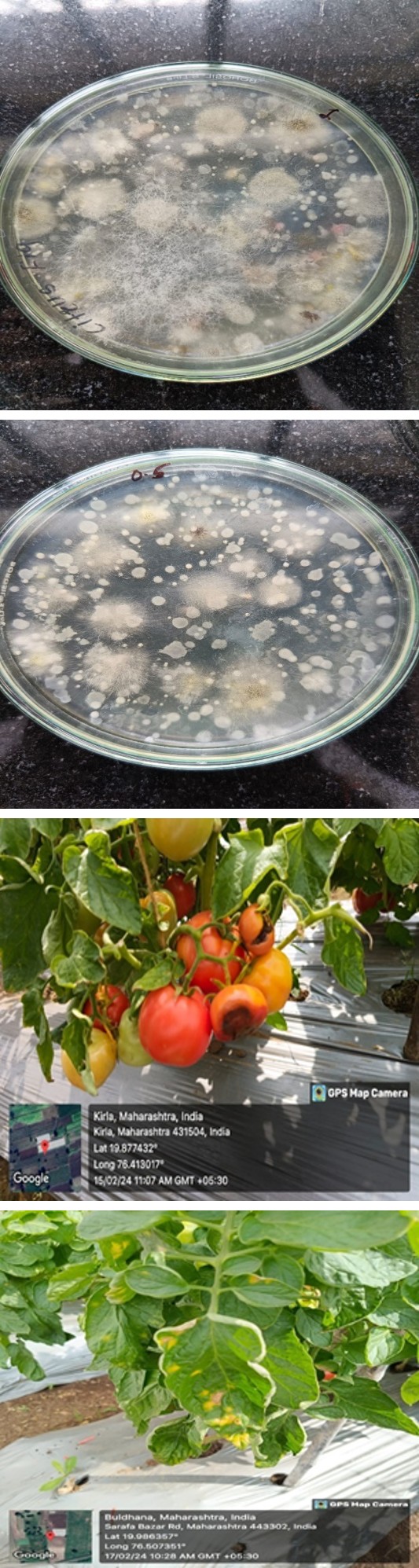
Figure 2A
Figure 2B
Microbial Analysis: Colonies Observed on the Nutrient Agar Plate Inoculated with Soil Samples:
Figure 3A: Polyhouse Soil Sample.
Figure 3B: Non-Polyhouse Soil Sample.
Discussion
The results of this study indicate that farming methods have a significant impact on the growth and yield of Solanum lycopersicum plants. Organic farming practices, characterized by the use of natural fertilizers, crop rotation, and biological pest control, promote plant growth and development compared to conventional methods that rely on synthetic fertilizers and pesticides. One key finding is the higher nutrient content in tomatoes grown using organic methods, which is consistent with previous research demonstrating the nutritional benefits of organic produce. The increased nutrient content in organic tomatoes is attributed to the use of organic fertilizers, which enhance soil fertility and promote nutrient uptake by plants. Another important finding is the positive effect of organic farming on soil health. Organic farming practices improve soil structure, increase microbial diversity, and enhance nutrient cycling, leading to healthier soil and sustainable agricultural production. In contrast, conventional farming methods often degrade soil quality over time, leading to erosion, nutrient depletion, and reduced crop yields.
The findings of this study support the growing body of evidence that organic farming is a viable and sustainable alternative to conventional agriculture. Organic farming promotes biodiversity, reduces the use of synthetic chemicals, and enhances soil health, contributing to long- term environmental sustainability. However, further research is needed to fully understand the mechanisms underlying the beneficial effects of organic farming on crop growth and yield.
Conclusion
This study investigates the impact of farming methods on Solanum lycopersicum (tomato) plants, focusing on organic and conventional farming practices. The research compares plant growth, development, yield, and nutrient content between the two farming methods. The results show that organic farming methods significantly enhance the growth and yield of Solanum lycopersicum plants compared to conventional methods. Organic farming promotes sustainable agricultural practices, improves soil health, and increases the nutrient content of tomatoes. These findings contribute to the ongoing discourse on sustainable agriculture and highlight the benefits of organic farming for food security and environmental sustainability.
The study concludes that organic farming methods have a positive impact on Solanum lycopersicum plant growth, development, and yield compared to conventional methods. Organic farming promotes sustainable agricultural practices, enhances soil health, and increases the nutrient content of tomatoes. The findings underscore the importance of organic farming in ensuring food security, promoting environmental sustainability, and improving the nutritional quality of crops. Further research is needed to fully understand the mechanisms underlying the beneficial effects of organic farming on crop growth and yield.
References
-
Singh G (1997) Genetic variability & habitability in tomato (_Solanum lycopersicum_) genotypes during summer season under plastic house condition. Indian Journal of Agricultural Sciences 68(6): 304-306.
-
Nimje S, Shyam B (1993) Effect of plastic greenhouse on plant micro-climate & vegetable crop production. Farming System 9(1-2): 13-19.
-
Ganesan M (2002) Effect of poly-greenhouse models on plant growth and yield of tomato (Lycopersicon esculentum). Indian Journal of Agricultural Sciences 72(10): 586-588.
-
Chauhan R (2016) Studies on temperature in the culture of fruiting vegetables, Effects of air and soil temperature on the raising of tomato and cucumber seedlings. Technical Bullettin 10: 59-70.
-
Boyaci S, Akyüz A (2018) Effect of Greenhouse Cooling Methods on the Growth and Yield of Tomato in Mediterranean Climate. International Journal of Horticulture Agriculture and Food Science 2(6): 199- 207.
-
Jain S, Suwalka C, Shekhawat PS (2021) Comparative analysis of the economics of crop cultivation under the poly house & open field conditions in rajasthan. Indian Journal of Economics and Development 17(1): 222-226.
-
Macglasson WB, Adata I (1977) High temperature effects on style elongation abscise acid level and tomato fruit set. Australian Journal of Plant physiology 3: 80817.
- Enhancement of Vegetative Growth and Fruit Yield in Cucumber (Cucumis sativus L.) via Spiritual Blessing (Biofield) Energy Intervention
- Production of Açaí (Euterpe oleracea Mart.) under Different Agroforestry System Management Intensities in Amazonian Floodplain (Varzea) Forests
- Coffee and the Production Region: What is the Secret to the Expression "Quality"?
- Experiential Agripreneurship Training in Sub-Saharan Africa: Integrating a Business Incubator into Postgraduate Livestock Education at the University of Buea
- Advances in Agricultural High-Quality Development
- Linking Compost Residue to ABAGE in Plants - a Short Note