
Diversity of Grasshoppers with Some Aspects of Bioecology of Aiolopus simulatrix (F. Walker), 1870 (Acrididae: Orthoptera) in White Nile State, Sudan
Background: Locusts and grasshoppers are serious pest to crops in many areas of the world and can cause economic losses through plagues and outbreaks causing threat to Food Security in the affected areas. Aims: Study was conducted in White Nile State (WNS), Sudan to specify the species composition of grasshoppers and to determine the seasonal abundance of Aiolopus simulatrix (F. Walker), the Sudan Plague Locust (SPL) and the most important biotic and abiotic factors governed its population for two consecutive seasons. Methodology: Field surveys were carried out in 4 localities in White Nile State viz., Kosti, Rabak, Al-gablain and Al-Salam to determine the species composition of grass hoppers as well as seasonal abundance of f Aiolopus simulatrix (F. Walker) following (Luong- Skovmand, 2005) method. Results: The study revealed 14 grasshopper’s species in WNS. The population of nymphs A. simulatrix were increased during August and September and that of adults were increased in October in both seasons. The most preferred host for SPL is Sorghum and millet but more than thirty plants were found to be as alternative hosts. The dark clay soils were found the most suitable to be utilized by females for egg laying, hibernation and aestivation. The correlation of grasshopper population was found highly positive, moderately positive and strongly negative with quantity of rain, relative humidity, sun rise and temperature respectively. The study revealed for the first time predatory birds’ prey on nymphs and adults of SPL grasshopper these birds are Egret (Bublcus ibis), carmine bee-eater, (Meropes nubicus) and two rare endangered birds Abdims Stork (Ciconia abdimii) and White Stork (Ciconia ciconia). Conclusion: The compiled information in this study is considered as a baseline for researchers to initiate a program for integrated management for SPL in WNS and all the country.
Abbreviations
SPL: Sudan Plague Locust; WNS: White Nile State; Humidity; IHTMS: Temperature Monitoring System; RH: Relative Humidity.
Introduction
Research Problems
White Nile State is very important state wherein staple crops such as sorghum and millet are grown in large areas. Grasshoppers are the main factor that hidered production of sorghum and millet. No data available on the grasshopper composition and no data regarding the seasonality of the most important species.
Objective
The present study was conducted to determine the species composition of grasshoppers and to assess the seasonal abundance of A. simulatrix with regards to bioecological factors that governing its population dynamics to develop a control strategy against this species in White Nile State.
Literature Review
Acridoidea is a Superfamily of grasshoppers including locust in the Order Orthoptera, they are commonly known as the short – horned grasshopper and placed in the Suborder Caelifara. Locust and grasshoppers are serious primary pests to crops in many areas of the world and especially in Africa causing economic losses [1, 2, 3, 4, 5]. The most economically important grasshoppers specie including Aiolopus simulatrix, O. senegaliensis, Pnorisa carinata, Pyrgomorpha cognates spp and Hieroglyphs digenesis were reported by Hassan A [6] in the mechanized Sorghum farms and in Kassala State in Sudan causing 80% loss to sorghum in 1968. In 2003, CNN [7] reported that swarms of grasshoppers are threatening food production in central Sudan. A. simulatrix occurs throughout the Sahelian belt eastward to the Sudan and Egypt and to south-west Asia, where it extends north to Turkestan and east to Bangladesh [8]. Across this wide range, the species shows considerable ecological and biological plasticity, it occurs in a wide range of habitats and may survive the dry season in the adults or egg stage. In the Sudan and Sahel, however, these characteristics are expressed more narrowly [9, 10]. The grasshopper; A. simulatrix, which is Known as Sudan Plague Locust, is the most devastating pest of cereal crops and it was reported to attack Sorghum, millet, groundnut, wheat, rice as well as grasslands and ranks second to the major locust species in importance in Sudan [11, 12, 13, 14]. A. simulatrix occurs throughout the Sahelian belt eastwards to the Sudan and Egypt and to Southeast Asia, where it extends north to Turkestan and east to Bangladesh [8].
Across the wide range, the species shows considerable ecological and biological plasticity, it occurs in a wide range of habitats and may survive the dry season in the adult or the egg Stage. There are two generation per year. The first generation begins in savannahs region of central Sudan of June and the Second generation Starts in September in the North at Butana area, north of Kordofan and Darfur Regions. Egg Hatching need about 18 days for the first generation and about 23 – 28 days for the second generation through August to September. Newly hatched nymphs go through 5 molts to reach adult stage spending 35-50 days_. A. simulatrix_ was more abundant during the rainy periods than during other times. Seasonal abundance of pests’ populations showed their periodic fluctuations all a year around but the reasons of changes in the population are not always fully understood. Generally, the abundance of grasshopper populations is influenced by availability and diversity of host plants, weather patterns and location [15, 16, 17]. Even in temperate environments, precipitation may be an important factor influencing grasshoppers Seasonality [18, 19]. Many grasshoppers prefer moist conditions for reproduction, but prolonged wet periods may result in extensive mortality [20, 21]. In their study, Ahmed M, et al. reported that, the highest species abundance of grasshoppers was recorded in the month of July and August and the lowest was reported in November to January.
Conceptual Framework
Study area: Field surveys were carried out in White Nile State of Sudan to determine the seasonal abundance of A. simulatrix. White Nile state is located in the southern part of Sudan between latitudes 120 5” - 150 5” N and longitudes 310 39” - 330 15” E bordering Khartoum State in the North, North Kordofan State in the west, South Kordofan State and Republic of South Sudan in the South east and Gezira and Sinnar State in the East. The area of the studies was 39701
km2 with total human population of 1,726,356 working mainly in agriculture and livestock [22].
Methodology
Species Composition of Grass Hoppers
Field surveys were carried out in 4 localities in White Nile State viz., Kosti, Rabak, Al-gablain and Al-Salam to determine the species composition of grass hoppers following method.
Seasonal abundance of A. simulatrix
To monitor the seasonal abundance of nymphs and adults of Sudan Plague Locust. The surveys starting from the beginning of the rainy seasons in the two consecutive cropping seasons 2020/2021 and 2021/2022 at the 1st May up to the 31st of October applying nymphs and adults’ assessment techniques.
Seasonal Abundance of Nymphs of A. simulatrix
To assess the seasonal abundance of nymphs of A. simulatrix method was used.
A metal quadrate (one square meter) was used to determine the abundance of A. simulatrix when grass cover height was less than 20 cm. In each visit to each site, counts always started at 08.00 to 11.00 AM weekly. All grasshopper nymphs in and jumping out of the quadrate at every five- meter interval were counted and recorded. This procedure were repeated 100 times to obtain the number of all nymphs in 100 m2, and then density per hectare were calculated using the following equation: X=Y/100× 10000 Whereas: X = Density nymphs per hectare. Y = total number of all nymph species counted in 1m2 repeated 100 times.
For confirmation, some nymphs were sampled from the field and transported to the laboratory and examined for nymphal instars age (N1 to N5) using certain feature and size, such as wing lengths and colors.
Seasonal Abundance of Adults of A. simulatrix
To assess the population density, adults of A. simulatrix were counted the second day to the nymph count in the same sites. The transaction was carried out by walking along 100 meters (taking normal paces) from one end of the site, across wind or upwind to facilitate counting, all the adults of grasshopper species that flew out half a meter on each site was recorded on the survey sheet. The grasshoppers that flew into the square meter were not counted, so as to avoid double counting (Luong-Skovmand, 2005). Thus, number of grasshoppers in a hectare was calculated using the following equation: A=B/1000× 10000 Whereas: A = Density of the grasshoppers adults of all species per hectare. B = Total number of all species counted in 1,000 m2. Biotic and a biotic factors influencing the population of A. simulatrix:
To assess the ecological factors influencing the abundance of A. simulatrix, some important information considering rainfall quantity (mm), and natural vegetation’s (grass), soil description as: type, moisture (Wet/dry) using soil moisture measuring device (SONKIR – 3-in-1).
Some essential materials were used in the survey including hand lens for identification, hand tally counter to count the number of insects, shovel to remove soil, dissecting kit to study the morphology and anatomy of insects, sample boxes, Indoor Humidity and Temperature Monitoring System (IHTMS), Book of locusts and some grasshoppers of the central region for identification, wind speed meter all in 1 (Air flow, Temp, R.H and Compass), also A. simulatrix Sudan Plague Locust Survey (SPL) Form.
Statistical Analysis
ANOVA analysis for compiled data was conducted using SAS 0.9 computer-based program. Data were transformed prior to analysis when needed and means were separated applying Tukey test.
Pearson correlation analysis of population of A. simulatrix versus climatic factors; temperature, RH, rain quantity (mm), sun shine, was performed using the same statistical program. Data of weather condition were provided by White Nile Climate Station.
Results
Species Composition of Grass Hoppers
Out of ten thousand inspected samples of grasshoppers collected from the four localities of White Nile State, only fourteen species of grasshoppers were recorded in Table 1. Species belonging to Family Acrididae comprised 71.4% while family Pyrgomorphadea represented 21.4% and Tettigoniidae ca 7.1% of the identified species. Among these species are the Long-horned locust hoppers, Savannah grasshoppers , the African migratory locust and senegalensis grasshopper.
Seasonal Abundance of A. simulatrix in White Nile State
The study revealed the presence of Sudan Plague Locust in the different surveyed localities during the two consecutive seasons.
Significant difference on the population of nymphs and adults was recorded between different months of each season for the two consecutive seasons for the four White Nile State localities.
Seasonal Abundance of A. simulatrix in Four Localities of White Nile
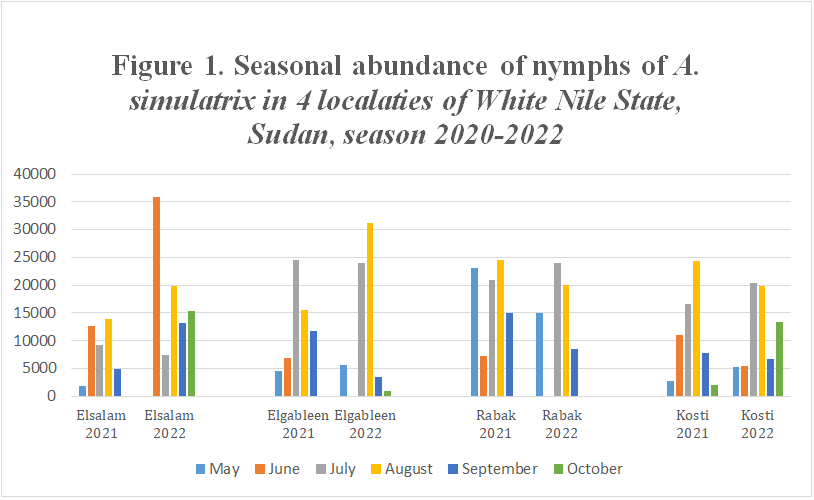
Kosti Locality Nymphs: Same trend of seasonal abundance of nymphs of Sudan Plague Locust was observed for both consecutive seasons 2020/2021 and 2021/2022. The population started very low in May, increased gradually in June and July and crested in August. The population observed decreased drastically in September until it reached plateau in October (Figure 1).
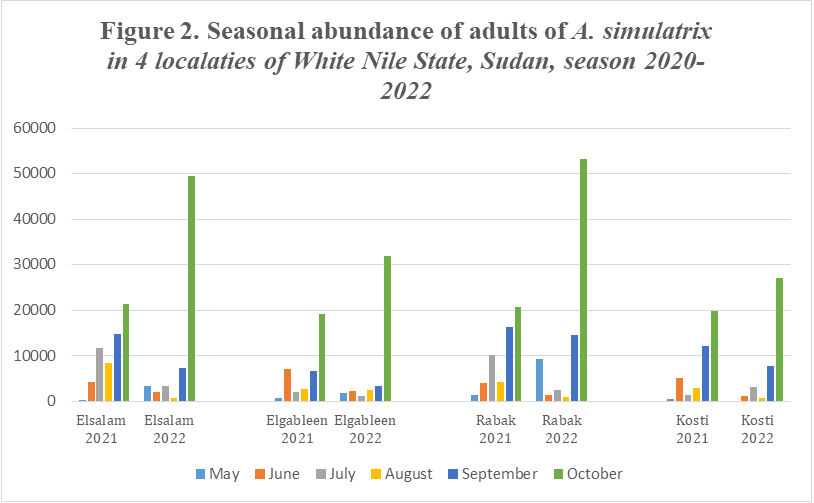
Adults Figure 2, showed the seasonal abundance of adults of A. simulatrix which started with very low numbers in May 2021 (420 adults/hectare) then it burst out in June to (5127 adult/ hectare).In July the population decreased hugely to 1412.5 and start to increase slightly (2842.5) while in August, flared up to (12037.5) in September and peaked in October with (19892.5 adults/hectare).
In 2022, the population of adults of (SPL) in this area was observed in June and July with 1057.5 and 3092.5 locust/ hectare respectively and decreased to low levels in August and September and suddenly increased to very high number in October. The study revealed that, the mean population of adults of SPL in 2022 is greater than that of 2021.
Rabak Locality Nymphs: The result of abundance of nymphs of SPL was found to be similar to that reported in Kosti locality, Figure 1, In both seasons, the population was found very high in May, decreased extremely to low levels in June and it flared up in July reached high numbers In September, the population decreased moderately and reached the plateau in October.
Adults: In 2021, the population of the SPL was fluctuated and peaked three times during July, September, October with (10057.5, 16385, and 20607.5 adults/hectare) respectively. The population started with 927 adult/hectare in May 2022, increased in June, July with 1427.5, 2575 respectively and return to the same point of May in August. Sudden high increment of the population (14550) was recorded in September and was augmented to reach (53300 adult/ hectare) Figure 2.
Elgableen Locality Nymphs: The population density of nymphs of SPL in Elgabalain locality for the two consecutive seasons (2021 and 2022) was shown in Figure 1), The number of nymphs in Elgableen area started with high numbers in May 2021. Slight increment of population was observed in June while abruptly it increased in July and then decreased slightly and gradually in August and September while no nymphs were recorded in October.
In May in season 2022, the population of nymphs of A. simulatrix started with 5625 nymphs/hectare and decreased to zero level in June and sudden flareup was recorded in July with (24075) nymphs/hectare). The population was peaked in August and significantly decreased in October.
Adults: The population density of adults of A. simulatrix was found in high numbers in June, September and October of 2021 with 6987.5, 6605 and 19260 adults/hectare respectively. In 2022, less than 3500 adults/hectare were recorded for May, June, July and September while October witnessed very high number of adult/hecatreca 31925 (Figure 2).
Elsalam locality Nymphs: The results on seasonal abundance of nymph of SPL per hectare for 2021 and 2022 is presented in Table 5. The number of nymphs started with (1875)/hectare in May 2021. The population burst out and peaked two times in June and August with (12625 and 13875) nymphs/hectare respectively. Eventually the number of nymphs/hectares decreased steadily to reach 4825 in September and reached zero in October.
In 2022, the population of nymphs of A. simulatrix started with very high number (35800 nymphs/hectare) in June 2022 and drastically decreased to 7425 in July and then increased in August with 19825 nymphs/hectare and decreased slightly in September and October with 13175 and 15300 nymphs/hectare) respectively (Figure 1).
Adults: The population density of adults of A. simulatrix increased progressively during the first three months of the season, then decreased in August (8480 adults/hectare) and increased progressively in September and October of 2021 to reach 14835 and 21332 adults/hectare respectively.
In 2022, the population density started around 2000 adults/ hectare for the first three months and decreased drastically in August to 757.5 adults/hectare. In September, the population of A. simulatrix started to increase (7245 adults/ hectare) and peaked in October with (49425) adults/hectare (Figure 2).
Observations on ecology of Sudan Plague Locust at White Nile State, Sudan.
Habitat The Sudan Plague Locust (A. simulatrix) was detected in a wide range of grassland habitats, including both moist and dry grasslands. Also it was found in cultivated fields (rainy or riverine), abandoned agriculture, woodlands, riverine areas.
Host and Harboring Plants of A. simulatrix
Host plants: In this study, nymphs and adults of A. simulatrix were observed early in the rainy season feed mainly on newly sprouting seedlings of sorghum and millet while during the end of the seasons it attacks the ears in milky or unripe stage of both crops. On other hand More than twenty plant species were reported utilized by A. simulatrix for feeding and/ or hiding, mating, sheltering during the survey in different regions for seasons (May – October) (2020-2021 and 2021- 2022) as presented in Table 6. More than thirty plant species were utilized by A. simulatrix for feeding, sheltering and hiding.
Soil Types: The prevailing soils in all surveyed areas in White Nile State in the areas dominated by A. simulatrix were black cracked clay, sandy clay and loamy soils.
In the clay soil areas, the pest was found mainly in the valleys of the major rivers, favoring the black cracking clays where it can shelter in the cracks from the sun or the cold (hibernation or aestivations).
Females were observed laying their eggs in 5-11 cm depth in soil. in bare soils at the edges of dense patches of wild or cultivated sorghum or millet to ensure food for the emerged first instars.
Role of temperature and R. H%
It was observed that, the A .simulatrix had no night activity after sunset under field conditions. The activity of SPL stopped at a temperature of 22.5 Co and relative humidity of 88%, and a wind speed of 19.3 km/hour.
The result of correlation of population of A .simulatrix versus different climate factors revealed strong positive correlation with rain quantity(R2 = 0.9132), a moderate positive correlation with relative humidity (RH)) (R2= 0.5592 , a strong negative correlation with sun rise (R= -0.8793) as well as temperature (R = -0.7978).
Predatory Birds of A. simulatrix
The study revealed some predatory birds’ prey on grasshopper nymphs and adults, such as cattle Egret (Bublcus ibis), carmine bee-eater, (Meropes nubicus) and the two rare endangered birds Abdims Stork (Ciconia abdimii) and White Stork (Ciconia ciconia).
Discussion
This study revealed presence of 14 species of grasshoppers belonging to three families; Acrididae, Pyrgomorphidae and Tettigoniidae, in White Nile State while in Sudan, the whole country there are 235 grasshopper’s species belonging to the family Acrididae depicted and preserved in Insect Museum Unit of Agricultural Research Corporation, Sudan. Abushama FTE, et al. [23] reported seven species of grasshoppers (Acrididae) from Khartoum State on the southern banks of the blue Nile near Khartoum city and Tuti Island at the junction of the Blue Nile and White Nile. This state is bordering White Nile state and as seen the difference in numbers of grasshoppers between the two states. From this study, only three genera and one species were reported by Kariuki PK [24] who described 18 species of grasshoppers in Nakuru county in Kenya. Two species of grasshoppers recorded in this study were reported from North Kordofan State by Rahama ORM, et al. [25]; Elamin AEH, et al. [26].
In this study, the seasonal abundance of SPL nymphs in the localities of White Nile State revealed increment of population of nymphs during July and August in, Kosti, Rabak, Elgabalain localities except Elsalam locality. While the population of the adults of SPL has been increased during October for the two consecutive seasons. These obtained results of the abundance of nymphs and adults are in agreement of the biology of this pest where eggs hatching need about 18 days for the first nymphal stage and it takes about 23 – 28 days for the second stage this period may coincided with August to September. Grasshopper goes through 5 metamorphoses to reach adult stage spending 35- 50 days [27]. Same trend of these results was reported by Elamin AEH, et al. [28] and Rahama ORM, et al. [26] on the rainy seasons.
The present investigation regarding the habitats of the 4 localities revealed more than 14 plant species utilized by A. simulatrix for feed, shelter and hiding, Leonard A, et al. [29] reported many host plants for Short- and Long-Horned Grasshoppers in East Africa, only Cynodon dactylon (L.) was found among them in this study.
Our results also indicate that the clay cracking soil was observed to be suitable for the adult stage as they provide good shelter of cold and hot habitat. Same results were also stated by Batten A [30], Popov GB [31], Elamin AHA [32], and Abuhasubu MA [33].
No doubt that, the ecological factors played very important role on the increase of the population of insects, as reported in this study strong positive correlation was found between the population of the pest and with rain quantity, this finding were in accordance with that obtained by Elamin AHA [32], Popov GB [34] where they stated that, the rainfall and temperature were the important environmental conditions affecting hatchability of eggs and development of nymphs. Soil type and grasses are conducive and affected biology; especially egg laying and hatching, behavior as well as ecology of the grasshoppers and locusts [33].
The study was also recorded some predatory birds of A. simulatrix such as cattle egret, (Bublcus ibis), Carmine bee- eater (Merops nubicus), and the two rare endangered birds Abdims Stork (Ciconia abdimii) and White Stork (Ciconia ciconia).
These findings are the first observations for biological control agents of A. simulatrix in the study area in Sudan, Nayeem R, et al. [35] reported that there was no natural enemies of A. simulatrix in India.
| Scientific name | Family | |
|---|---|---|
| Senegalese grasshopper | Oedalens senegalensis (Krauss, 1877) | Acrididae |
| Yellow-winged grasshopper | Acroylus longipes (Charpentier, 1845) | Acrididae |
| Sudan Plague Locust | Aiolopus smilatrix (F. Walker, 1870) | Acrididae |
| Red-winged grasshopper | Acroylus partuelies (Herrich-Schäffer, 1838) | Acrididae |
| Nigerian grasshopper | Oedaleus nigeriensis (Uvarov, 1926) | Acrididae |
| African migratory locust | Locusta migratoria migratoriodes (Reiche & Fairmaire, 1849) | Acrididae |
| Four-spotted grasshopper | Kraussaria angulifera (Krauss, 1877) | Acrididae |
| Sahelian Tree Locust | Anacridium melanorhodoum (Finot, 1907) | Acrididae |
| Devil grasshopper | Diabolocatontops axillaris (Thunberg, 1815) | Acrididae |
| Cotton grasshopper | Hieroglyphus africanus (Uvarov, 1922) | Acrididae |
| Confused grasshopper | Pyrgomorpha cognate (Krauss 1877) | Pyrgomorphidae |
| Spinning grasshopper | Chrotogonus senegalensis (Krauss 1877) | Pyrgomorphidae |
| Calotropis grasshopper | Poekilocerus bufonius hieroglyphicus (Klug, 1832) | Pyrgomorphidae |
| Long-horned grasshopper | Tettigonia spp (Krauss, 1902) | Tettigoniidae |
Table 1: The most numerous species of grasshoppers identified in the study areas.
| Months | Nymphs/hectare | Adults/hectare | ||
|---|---|---|---|---|
| Season 2021 | Season 2022 | Season 2021 | Season 2022 | |
| May | 2750(3.2)C | 5300(4.2)D | 420(1.7)D | 00(0.7)D |
| June | 10975(7.8)B | 5450(4.2)D | 5127.5(6.6)C | 1057.5 (2.6)CD |
| July | 16550(12.8)A | 20400(13.6)A | 1412.5(2.9)D | 3092.5 (4.9)C |
| August | 24400(15.1)A | 19775(13.3)AB | 2842.5(4.7)CD | 657.5 (2.2)CD |
| September | 7800(7.1)B | 6650(7.8)C | 12037.5(10.8)B | 7755(8.7)B |
| October | 2000(2.8)C | 13300(10.7)BC | 19892.5(14.1)A | 27050 (15.8)A |
| SE± | 1.3 | 1.3 | 1 | 1.2 |
| C.V% | 63.64 | 65.35 | 37.39 | 50.54 |
Table 2: Population density of A. simulatrix (Nymphal instars and adults per hectare) for seasons 2020/2021 and 2021/2022, Kosti
Means followed by the same letter (s) are significantly equal at (p<0.05). Means between brackets were divided by 100 and were transformed subjected to √ X +0.5
| Months | Nymphs/hectare | Adult/hectare | ||
|---|---|---|---|---|
| Season 2021 | Season 2022 | Season 2021 | Season 2022 | |
| May | 23100 (15.2) A | 15000(10.8) AB | 1372.5 (3)C | 9275 (8.3) B |
| June | 7175 (6.2) C | 00 (0.7) C | 4062.5 (5.3) C | 1427.5(2.9) C |
| July | 20875 (12.6) AB | 24000(14.4) A | 10057.5 (9.6) B | 2575(4.2) C |
| August | 24450 (15.4) A | 20050 (12.6) A | 4225 (5.3) C | 950 (2.6) C |
| September | 14925(10.8) B | 8525(8.8) B | 16385 (12.8) A | 14550(11.8) B |
| October | 00 (0.7) D | 00(0.7) C | 20607.5(14.1) A | 53300(22.6) A |
| SE± | 1.5 | 1.5 | 1 | 1.6 |
| C.V% | 53 | 63.8 | 40.86 | 46.58 |
| Season 2021 | Season 2022 | Season 2021 | Season 2022 | |
| May | 4475(3.9)CD | 5625(5.6)CD | 612.5(1.8)D | 1825(3.2)B |
| June | 6925(4.7)C | 00(0.7)E | 6987.5(7.8)B | 2145(3.6)B |
| July | 24550(15.1)A | 24075(9.9)B | 1977.5(4)CD | 1100 (3)B |
| August | 15575(12.3)AB | 31125(14.5)A | 2772.5(5.2)BC | 2370(4)B |
| September | 11750(10.4)B | 3452.5(7.5)BC | 6605(6.6)BC | 3435(5.6)B |
| October | 00(0.7)D | 1000(2.1)DE | 19260(13.9)A | 31925(17.8)A |
| SE± | 1.4 | 1.7 | 1 | 1.2 |
| C.V% | 60.4 | 117.97 | 47.99 | 46.18 |
Table 3: Population density of A. simulatrix (Nymphal instars and adults per hectare) for seasons 2020/2021 and 2021/2022. Rabak
Means followed by the same letter (s) are significantly equal at (p<0.05). Means between brackets were divided by 100 and were transformed subjected to √ X +0.5.
Means followed by the same letter (s) are significantly equal at (p<0.05). Means between brackets were divided by 100 and were transformed subjected to √ X +0.5
| Months | Nymphs/hectare | Adults/hectare | ||
|---|---|---|---|---|
| Season 2021 | Season 2022 | Season 2021 | Season 2022 | |
| May | 1875(2.7) C | 00(0.7) D | 340(1.5) E | 3425(4.9) BC |
| June | 12625(9)AB | 35800(16.3)A | 4170 (4.7)D | 2042.5(3.6)C |
| July | 9175(8.4)AB | 7425(6.2)C | 11770(9.8)BC | 3395(4.8)BC |
| August | 13875(9.9)A | 19825(13.3)AB | 8480(8.6)C | 757.5(2.2)C |
| September | 4825(6.2)B | 13175(10.1)B | 14835 (11.9)AB | 7245 (8.3)B |
| October | 00(0.7)C | 15300(10.9)B | 21332.5(14.5)A | 49425(21.8)A |
| SE± | 1.2 | 1.6 | 1.1 | 1.5 |
| C.V% | 88.45 | 73.22 | 45.57 | 46.75 |
Table 4: Population density of A. simulatrix (Nymphal instars and adults per hectare) for seasons 2020/2021 and 2021/2022, Elsala
Means followed by the same letter (s) are significantly equal at (p<0.05).
Means between brackets were divided by 100 and were transformed subjected to √ X +0.5
Very high C.Vs
In the abstract and results you have mentioned that there is a correlation between population density and abiotic factors (rain fallm, temperature. etc whereas there is no metrological data and analyzed correlation!!
| Common name | Local name | Scientific name | Family |
|---|---|---|---|
| Potato Weed | Danab Elagrab | Heliotropium europaeum | Boraginaceae |
| False amaranth | Lablab | Digera muricata | Amaranthaceae |
| slender amaranth | Lissan Eltair | Amaranthus viridis | Amaranthaceae |
| Rough cocklebur | Ramtouk | Xanthium brasilicum | Asteraceae |
| Common Basil | Rehan | Ocimum basilicum | Lamiaceae |
| Solanum | Gubbain | Solanum dubium | Solanaceae |
| Nut grass | Seada | Syperus rotundus | Syperaceae |
| Alexandrian senna | Senamakka | Cassia senna | Fabaceae |
| Leucas | Umgalloat | Leucas urticifolia | Lamiaceae |
| Spurge | Umlubeina | Euphorbia spp. | Euphorbiaceae |
| Indian nettle | Um-imairat | Acalypha indica | Euphorbiaceae |
| Indian gooseberry | Sorieb | Phyllanthus spp. | Phyllanthaceae |
| Lemongrass | Nal | Symbopogon sp. | Poaceae |
| Roomrapes | Striga | Striga hermonthica | Orobanchaceae. |
| Cameroon grass | Adar | Sorghum arundinaceum | Poaceae |
| Ground morning glory | Taber | Convolvulus sp | Convolvulaceae |
| Spade Flower | Umhobiaba | Hybanthus spp. | Violaceae |
| Bermuda grass | Nageel | Cynodon dactylon | Poaceae |
| Plumed Cockscomb | Danab-elagrab | Celosia argentia | Amaranthaceae |
| Common sowthistle | Molaita | Sonchus oleraceus | Asteraceae |
| Jungle rice | Difera | Echinochloa colona | Poaceae |
| Common purslane | Regla | Portulaca spp. | Portulacaceae |
| Bristly foxtail. | Lisaig | Setaria verticillata | Poaceae |
| African cabbage | Tamalaika | Cleome gynandra | Capparaceae |
| Flannel weed | Umshadida | Sida alba | Malvaceae |
| Indian sandbur | Haskaneet | Cenchrus biflorus | Poaceae |
| Puncture vine | Diraisa | Tribulus terrestris | Poaceae |
| Turf grass | Ankooj | Ischaemum afrum | Poaceae |
| Hogweeds. | Rabaa | Boerhavia repens | Nyctaginaceae |
| Dwarf Heliotrope | Rabaa | Heliotropium supinum | Boraginaceae |
| Jew’s mallow | Molokhia | Corchorus spp. | Malvaceae |
| Indian mallow | Hambook | Abutilon sp. | (Malvaceae) |
| Nightshade | Enab elmiskeen | Solanum nigrum | Solanaceae |
Table 5: Plants utilized by A. simulatrix for feeding, protective mimicry, mating and sheltering in White Nile State (May – Octob
It would have been better if we have information about plant density so as to correlate SPL population density with plant density in each locality. More over food preference for SPL could have been found out if we just report the plant species while counting the nymphs [36, 37, 38].
References
-
Millist N, Abdalla A (2011) Benefit-cost analysis of Australian plague locust control operations for 2010-11. ABARES report prepared for the Austrian plague locust commission pp: 1-17.
-
Latchinisky AV (2013) Locusts and remote sensing: a review. Journal of Applied remote sensing 7075099.
-
Zhang L, Hunter DM (2017) Management of locusts and grasshoppers in China. Journal of Orthoptera Research 26(2): 155-159.
-
Rowly J, Bennet O (1993) Grasshoppers and locusts: The plague of the Sahel. The Panos Institute 22(7): 309-355.
-
Diop T (1997) Inventaire Commented de la bibliographies sure le croquet senegalais, O. senegalensis (Krauss,1877). Insect Sci Applic 17(3-4): 277-291.
-
Hassan A (1978) Chemicalization of plant production in the tropics and subtropics. Pests of national importance in the Sudan in: 4th Scientific Conference, Sudan, pp: 165-181.
-
CNN (2003) A report on grasshoppers swarms in the Sudan, Gezira Scheme.
-
Hollis D (1968) A revision of the genus Aiolopus Fieber (Orthoptera: Acridoidea). Bulletin of the British Museum (Natural History) 22(7): 309-355.
-
Fishpool LD and Popov GP (1984) The grasshopper Fauna of the Savannas of Mali, Niger, Benin and Togo. In: (Edn.), Bulletined Institute Fundamental of Africa Noire Tomo, pp: 3-4.
-
Fishpool LD, Cheke RA (1984) Protracted eclosion and viability of Oedaleus senegalensis (Krauss) eggs (Orthoptera: Acrididae). Entomologist’s Monthly, 219: 119.
-
Walker F (1870) Catalogue of the Specimens of _Dermaptera Saltatoria_ in the Collection of the British Museum, In: (Edn.), London, Printed for the Trustees of the British museum, London.
-
Joyce RJV (1952) The ecology of grasshoppers in eat central Sudan. Anti-locust bulletin 11: 1-99.
-
Song H (2011) Density-dependent phase polyphenism in no model locusts: a minireview. Psyche: A Journal of Entomology 1: 741769.
-
CORP (1982) The locust and grasshopper agricultural manual.
-
Gage SH, Mukerji MK (1977) A perspective of grasshopper population distribution in Saskatchewan and interrelationship with weather. Environ. Entomol 6(3): 469-479.
-
Kemp WP, Kalaris TM, Quimby WF (1989) Rangeland grasshopper (Orthoptera: Acrididae) spatial variability: Macroscale population assessment. Journal of Economic Entomology 82(5): 1270-1276.
-
Whipple SD, Brust ML, Farnsworth-Hoback KM, Hoback WW (2012) Rangeland grasshopper numbers and species composition in Nebraska: A comparison of region and sampling location. Journal of Orthoptera Research 21(2): 269-277.
-
Habtewold T (1993) Ecolology and management of grasshopper (Orthoptera:Acrdidae) of cereals in central Ethiopia, Sewdish University of Agricultural Sciences, Sweden.
-
Capinnera JL, Thompson DC (1987) Dynamics and Structure of grasshoppers assemblages in short grass prairies. Canadian Entomologist 119(6): 567-575.
-
Mulkern GB, Mongolkiti S (1980) Grasshopper feeding behaviour and development of edible carriers for grasshopper control agents. Review Society Entomology Argentina 36: 59-84.
-
Dempstera JP (1963) The population dynamics of grasshoppers and locusts, Biological Review 38(4): 490- 529.
-
Ibrahim EG, Osman MH, Ahmed DS, Salem BS, Mohamed SH (2015) Prevalence of ticks (Acari: Ixodidae) and Theileria annulata antibodies in White Nile State, Sudan. Journal Adv Vet Anim Res 2(1): 69.
-
Abushama FTE, Elhag EAG (1971) Distribution and Food‐ plant Selection of the Riverain Acridids near Khartoum. Zeitschrift für Angewandte Entomologie, 69(1‐4): 212- 221.
-
Kariuki PK (2022) Diversity of Grasshoppers and Locusts, Life Parameters, Fat and Protein Content of _Acanthacris Ruficornis_ in Nakuru County, Kenya. Doctoral dissertation, Kenya.
-
Elamin AEH, Rahma ORM, Mohamed AO (2019) Field Monitoring of the Senegalese Grasshopper Oedaleus senegalensis (Orthoptera: Acrididae) by Light Trap in North Kordofan State, Sudan. American Journal of Materials Science and Application 7(1): 19-24.
-
Rahama ORM, Ahmed MOB, Yassin MM (2017) Seasonal occurrence of the tree locust Anacridium melanorhodon melanorhodon on Acacia Senegal in North Kordofan State, Sudan. International Journal of Tropical Drylands 1(2): 65-68.
-
Lockwood JA (2023) Locusts: an introduction. In: 2nd Edn Biological and Environmental Hazards, Risks, and Disasters, Hazards and Disasters Series pp: 97-108.
-
Elamin AEH, Abdalla AM, Naim AME (2013) Studies on Population Dynamics of Senegalese Grasshopper (Oedaleus senegalensis) in Kordofan of Sudan. World Journal of Agricultural Research 1(5): 85-89.
-
Leonard A, Khamis FM, Egonyu JP, Kyamanywa S, Ekesi S, et al. (2020) Identification of edible short-and long- horned grasshoppers and their host plants in East Africa. Journal of Economic Entomology 113(5): 2150-2162.
-
Batten A (1969) The Senegalese grasshopper Oedaleus senegalensis Krauss. Journal of Applied Ecology 6(1): 27-45.
-
Popov GB (1989) Nymphs of the Sahelian grasshoppers (An illustrated guide). Research London pp: 690.
-
Elamin AHA (2010) Bio-ecology of the Senegalese grasshopper _O. senegalensis_ (Orthoptera: Acrididae) in Kordofan Region, Thesis, Sudan.
-
Abuhasbu MA (1989) Training Course on Desert Locust Control in Arabic Home, Other locust Species and Grasshoppers (Theory part) Wad Madni Sudan pp: 29- 34.
-
Popov GB (1980) Studies on oviposition, egg development and mortality in Oedaleus senegalensis (Krauss) (Orthoptera: Acrididae) in the Sahel. In: (Edn.), Centre for Overseas Pest Research, Miscellaneous Report, London, pp: 53-48.
-
Nayeem R, Usmani K (2012) Taxonomy and field observations of grasshopper and locust fauna (Orthoptera: Acridoidea) of Jharkhand, India. Munis Entomology & Zoology 7(1): 391-417.
-
Hussain AMS, Mursalin A, Kamrul AMD (2018) Species diversity, seasonal abundance and morphometric analysis of grasshopper (Orthoptera: Caelifera) in Rajshahi city, Bangladesh. Serangga 23(1): 24-34.
-
Colvin J (1997) Biotic and a biotic factor affecting the population dynamics of the Senegalese Grasshopper, Oedaleus senegalensis. In: krall S, Peveling, Diallo DBA (Eds.), New strategies in locust control. (Edn.), Birkhauser Verlag Basel, Switzerland.
-
Gahukar RT, Reddy GV (2019) Management of economically important insect pests of millet. J Integr Pest Manag 10(1): 28.
- Enhancement of Vegetative Growth and Fruit Yield in Cucumber (Cucumis sativus L.) via Spiritual Blessing (Biofield) Energy Intervention
- Production of Açaí (Euterpe oleracea Mart.) under Different Agroforestry System Management Intensities in Amazonian Floodplain (Varzea) Forests
- Coffee and the Production Region: What is the Secret to the Expression "Quality"?
- Experiential Agripreneurship Training in Sub-Saharan Africa: Integrating a Business Incubator into Postgraduate Livestock Education at the University of Buea
- Advances in Agricultural High-Quality Development
- Linking Compost Residue to ABAGE in Plants - a Short Note