
Seasonal Population Trends of Lepidosaphes beckii, Dialeurodes citri and its Parasitoids on Balady Orange Orchid in Egypt
Field studies were conducted on the purple Lepidosaphes beckii(Newman), Dialeurodes citri(Ashmead), and their parasitoids in Sharkia Governorate over two consecutive years, from September 2022 to August 2024. During the first season, L. beckii exhibited two significant population peaks on leaves: the first in November 2022 with 1,205 individuals, followed by another in July 2023 with 1,416 individuals. In the second season, L. beckii again showed two annual peaks, with the highest count in October 2023 reaching 1,508 individuals, and another peak in June 2024 with 1,405 individuals. The highest parasitism rate of Aphytis lepidosaphes on L. beckii was recorded at 26.13% in July 2023 and 27.18% in July 2024. Meanwhile, D. citri experienced three population peaks during the first season, occurring in October 2022, April 2023, and August 2023, with counts of 61, 40, and 93 individuals per 125 leaves, respectively. In the second year, two peaks were noted, one in January and another in August 2024, with counts of 43 and 67 individuals per 125 leaves. The maximum parasitism rate of Encrasia lahorensis on D. citri was observed at 36.60% in November 2022 and 52.20% in October 2023.
Saleh AAA¹*, Hafez AA², Shalaby FF² and Maghraby HM¹
¹Plant Protection Research Institute, (A.R.C), Dokki, Giza, Egypt ²Faculty of Agriculture, Moshtohor Benha University, Egypt lahorensis on D. citri was observed at 36.60% in November 2022 and 52.20% in October 2023.
Keywords: Lepidosaphes beckii; Dialeurodes citri; Parasitoids; Balady Orange Orchid
Abbreviations
PPRI: Protection Research Institute; ARC: Agricultural Research Center.
Introduction
Scale insects and the whitefly Dialeurodes citri are significant pests that pose a serious threat to citrus trees, leading to considerable damage within agro ecosystems both in Egypt and globally [1, 2]. The primary symptoms of infestation include yellowing, drying, and dropping of leaves, along with diminished and weakened vegetative growth, ultimately resulting in a decrease in both the quality and quantity of fruit produced [3]. Infestations in severe cases lead to the death of whole trees themselves [4, 5]. Of late, some of the most injurious pests to citrus trees have been identified as the purple scale insect, L. beckii, and Dialeurodes citri [6, 7, 8]. L. beckii produces four generations per year and prefers the shady parts of citrus trees [9]. All ages of purple scale insects exist in orchards year-round; hence overlapping generations exist. However, peak populations occur in early seasonal periods [10]. Aphytis lepidosaphes Compere (Hymenoptera: Aphelinidae) is a key biological control agent that is globally successful in regulating the scale of the purple scale in various areas [11, 12, 13]. According to Hafez, et al. [13] it was found that larval stages of L. beckii were parasitized by the nymphs of Aphytis spp., mostly over January and February. These early stages of the population decline of the parasitic one were mainly during the wintertime while the occurrence frequency was noted to be lower during the rest of the period of the year, spring, summer, and autumn [14]. The specific parasitoid of the citrus whitefly, Encarsia lahorensis (Howard) was a species with a fairly narrow range. Dialeurodes citri(Ashmead), which is a parasitoid of the citrus whitefly. natural enemy Studies was the first one to identify the phenomenon [15, 16]. Field surveys conducted in 1981 and 1982 indicated that 59 counties had been invaded [17]. This study is set for starting the new year in 2022 to analyze the population level of purple scale insect, Lepidosaphes beckii,(Newman), the citrus whitefly Dialeurodes citri, and the their parasitoids on Balady orange trees from September 2022 to August 2024 in the Kafr Saqr district of Sharkia Governorate.
Materials and Methods
Experiments were done over two successive years (2021-2022 and 2022-2023) on balady orange trees in Abo Nada village kafr saqr district, Sharkea, Governorate, orchards. This included many varieties of citrus which were infected by scale insects. The citrus trees were 15 years old and shielded from any chemical exposure. Irrigated over five faddens area in varieties, balady orange (fifteen years old) and no chemical applications. 5 trees were used to represent this commercialization; monthly samples of this variety were taken randomly. The samples were kept in hermetically sealed bags and they were, same day also, came to the laboratory. The surfaces of the leaves (North, south, east, west and middle) of each of the five trees were studied (n=125). The plant samples were placed with data slips into paper bags and the tops secured with rubber bands. On that day, all samples, which included leaves, buds, and branches, were put into pots and were taken to the Department of Biological Control Research, Sharkea Branch, Plant Protection Research Institute (PPRI), Agricultural Research Center (ARC).
The scale insects were detached wrong! with a very fine hair brush under a dissection stereo-microscope and were then put in 70% ethanol. After that, the insects and their parasitoids were mounted in Hoyer’s medium on microslides. The insects were brushed using a fine needle that was fixed firmly on a plant host and were then preserved in 70% ethanol. The mounts were manufactured with the help of the insects, microscope slides, and Hoyer’s medium. The type material was then placed in the Plant Protection Research Institute, Agricultural Research Center. The last peak of the infestation was eventually reached with the pests hosted the population of the purple scale insect, Lepidosaphes beckii (Newman)., the citrus white fly, and their parasitoids on balady orange trees were estimated over a period from September 2022 to August 2024 in Kafr Saqr district, Sharkia Governorate.
Results and Discussion
Population Density of Citrus Purple Insect, L. beckii on Leaves on Balady Orange Trees During The Two Successive Years
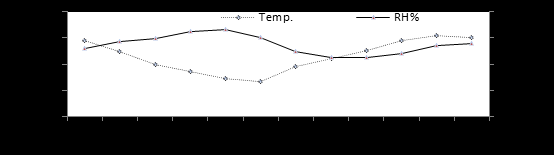
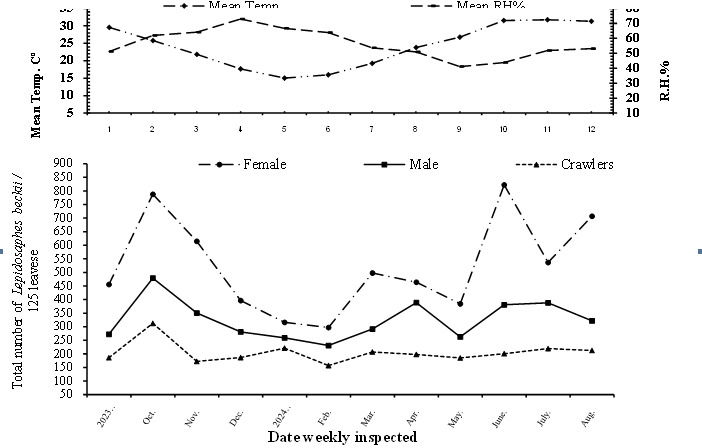
In the first year, the data presented in Figure 1 reveal that the adult stage of the purple scale insect, L. beckii, experienced two notable peaks on leaves: one in November 2022 with 1,205 individuals, and another in July 2023 with 1,416 individuals, observed at temperatures of 19.87°C and 30.83°C, along with relative humidity levels of 59.62% and 54.08%, respectively. The emergence of L. beckii was first noted in September, with a count of 757 individuals across 125 leaves, reaching its initial peak in November. The population showed an increase in October and November, peaking in November at 1,205 individuals per 125 leaves, before declining in December. The second peak occurred in July 2023, with a subsequent decrease in August. Following this, a gradual increase in population was observed from September to November. In the second year, as illustrated in Figure 3, the population of the insect began anew, starting with 915 individuals in September, followed by a rise in October_. L. beckii_ again displayed two annual peaks on leaves, with the peak in October 2023 recording 1,508 individuals, and another in June 2024 with 1,405 individuals, at temperatures of 25.78°C and 31.51°C, and relative humidity levels of 61.99% and 43.82%. The highest count of the season was recorded in October 2023, totaling 1,580 individuals across 125 leaves. During the years 2022/2023 and 2023/2024, the total respective counts were 11597 and 12653 individuals per 125 leaves. Crawlers peaked in density during August 2023, reaching 315 crawlers per 125 leaves in the first season; in the second season, this density peaked at 313 crawlers per 125 leaves in October. The first season witnessed three peaks in crawler populations, occurring in October 2022 and in January and August 2023, with counts of 213, 154, and 315 individuals per 125 leaves, respectively. On the contrary, the lowest population (101 individuals per 125 leaves) was recorded in February 2023 under temperature (13.21°C) and relative humidity (60.13%).
Research by Helmy [18] and Amin [19] identified four peaks of L. beckii infestations occurring in September, November 1971, March, and May 1972. They noted that these peaks coincided with four annual generations happening at similar intervals, indicating that July was the optimal time for chemical applications. Abdel-Fattah, et al. [20] presented a different study in which detected three discrete months of L. beckii abundance in December, April, and July, and associated generations at the same months over two consecutive years at Shebin El-Kom. Additionally, Abou-Setta [21] documented peaks in mid-December 1977, May, and November 1978, which also represented three generations. The first generation, which occurred from November to February, was identified as the overwinter generation; the second spanned March to June as the spring generation, and the third took place from July to October.
In second year, the peak of density Crawlers was in October 2023 with 313 crawlers per100 leaves at temperature level of 25.78ºC and relative humidity of 61.99%. By February 2024, their numbers decreased to 157 crawlers per 125 leaves. Notably, crawler populations exhibited two significant peaks: one in October 2023 and another in January 2024, with counts of 313 and 221 crawlers per 125 leaves, respectively, at temperatures of 25.78ºC and 15.03ºC, and relative humidity’s of 61.99% and 66.68% (Figure 2).
For female crawlers, the highest density occurred in November 2022, totaling 711 females per 125 leaves at 19.87ºC and 59.83% RH. The lowest count was noted in February 2023, with just 267 females per 125 leaves at 13.21ºC and 60.13% RH. Throughout the year, females exhibited three peaks: in November 2022, and again in April and July 2023, with densities of 711, 467, and 652 individuals per 125 leaves, respectively (Figure 1). In the second year, the highest female density was observed in June 2024 at 823 females per 125 leaves, measured at 31.51ºC and 43.82% RH. The lowest count was in February 2024, with 297 females per 125 leaves at 15.95 ºC and 63.84% RH.
During this time, female populations also peaked in October 2023 and June 2024, with numbers of 788 and 823 females per 125 leaves, respectively, at temperatures of 25.78ºC and 31.51ºC, and relative humidity’s of 61.99% and 43.82% (Figure 3).
For males, the first season saw two peaks in March 2023, with 251 males per 125 leaves, and again in July 2023, reaching 470 males per 125 leaves, at temperatures of 18.90ºC and 30.83ºC, and relative humidities of 49.56% and 54.08%. The lowest density for males was observed in February 2023, at just 140 males per 125 leaves (Figure 1). In the second year, male density peaked in October 2023 with 479 males per 125 leaves at 25.78 ºC and 61.99% RH, while a lower count of 231 males per 125 leaves was recorded in February 2024 at 15.95 ºC and 63.84% RH. Males displayed two peaks in October 2023 and April 2024, with counts of 479 and 389 males per 125 leaves at temperatures of 25.78ºC and 23.81ºC, and relative humidity’s of 61.99% and 50.95%. It has been reported that L. beckii can have three to four generations based on the host plant and location. According to this study results, there are four generation as L. beckii occurred on C. aurantii by using the method of age structure.
The findings align with those of Amin [19] and Habib [9] who noted that the scale insect observed undergoes three to four generations. Similarly, Tawfeek [22] and Megalla [23] reported variability in infestation levels of armored scale insect species across different locations, with L. beckii notably thriving in Alexandria and Sharkia. Belguendouz, et al. [24] observed that L. beckii typically completes three generations annually on both host plants: one in summer, another in spring, and the last in fall, with a significant peak in population during July. Stathas, et al. [25] recorded three population spikes of the purple scale, L. beckii, on citrus in June, August, and October. Moreover, research by Jun-Hua, et al. [26] highlighted that Neoseiulus barkeri responds to volatile substances released from citrus leaves affected by red citrus mites and scale insects (Figure 4).
This response is influenced by the chemical signals from the feeding activities of Panonychus citri and other sucking insects, which are critical for N. barkeri’s host and site selection. In the experiment by Zaabta, et al. [27] on dynamics of Lepidosaphes beckii, it was suggested that the purple scale insect progresses through three generations (autumn, first spring, second and summer, third. During this research, Aphytis lepidosaphes Compere was identified as a parasitoid of Lepidosaphes beckii.
Percentage of Parasitism
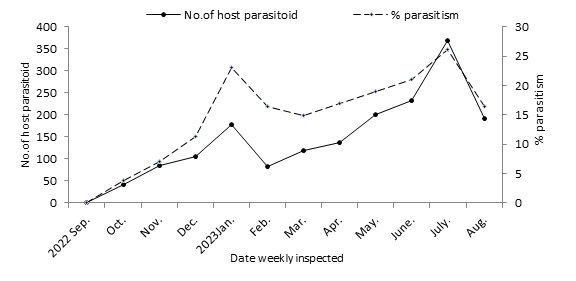
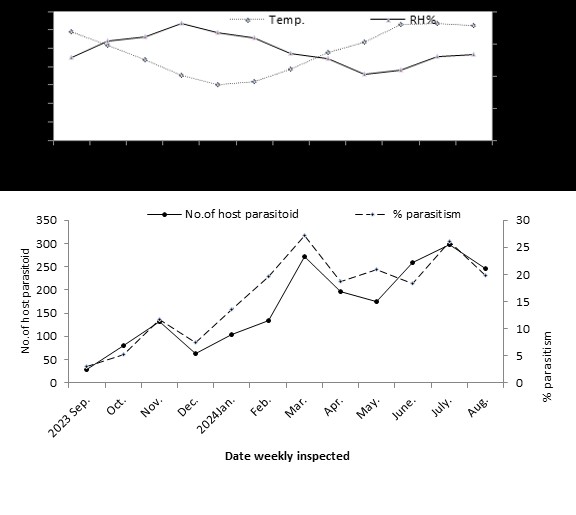
During the 2022/2023 season, the parasitism rate of Aphytis lepidosaphes on Lepidosaphes beckii on balady orange trees in Kafr Saqr was observed to have two distinct periods of activity. In January 2023, the rate was recorded at 23.14%, while in July 2023, it increased to 26.13%. These measurements were taken at temperatures of 14.61ºC and 30.83ºC, with relative humidity levels recorded at 66.20% and 54.08%, respectively (Figure 2). In the following season, 2023-2024, three peaks of activity were reported: November 2023 saw parasitism rates of 11.59%, 27.18%, and 26.03% in March and July 2024, with corresponding temperatures of 21.81ºC, 19.25ºC, and 31.73ºC, and relative humidity rates of 64.10%, 53.68%, and 51.79% (Figure 4). Previous studies have also highlighted this relationship. Hafez, et al. [12] identified A. lepidosaphes as the primary parasitoid of L. beckii, with total parasitism reaching its peak between October and December, ranging from 29.7% to 40.2%. Additional peaks were noted in January (21.6%), May (16.1%), and July (15.4%). Moraes, et al. [28] reported that from August to November, parasitism of M. beckii ( L. beckii) was at its highest, largely unaffected by climatic factors, with A. lepidosaphes being the dominant parasitoid. In fact, Abbas [29] has shown that A. lepidosaphes is the most often over-riding controlling agent of L. beckii. Moreover, Aly, et al. [3] revealed the significance of maximum and minimum temperatures affecting the populations of L. beckii and its parasitoid A. lepidosaphes while relative humidity had negligible effect.
Population Density of Citrus Insect, Dialeurodes citri (Ashmead) on Balady Orange Trees During the Two Successive Years
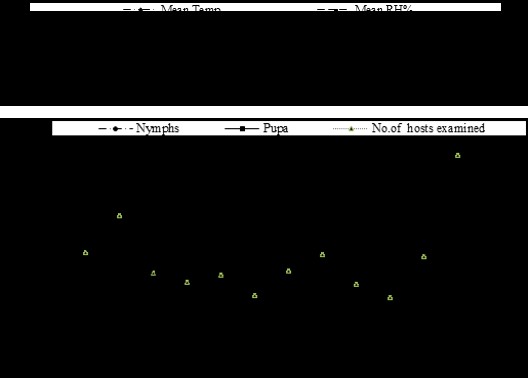
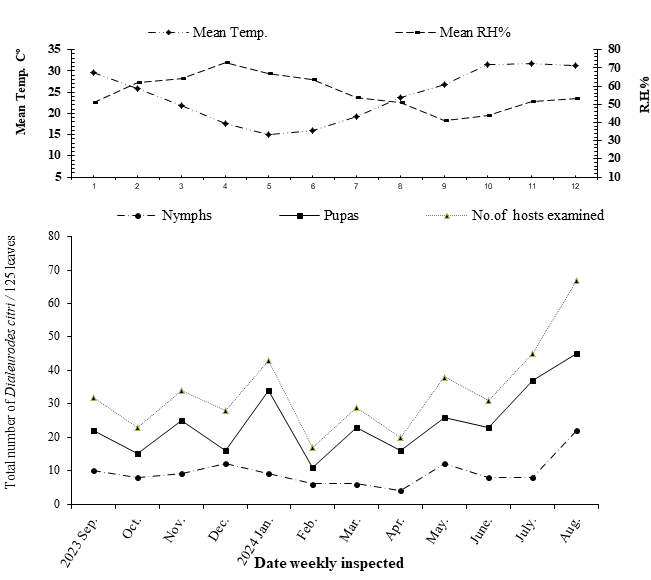
Results presented in Figure 5 show that the population of D. citri population reached its peak (93 individuals per 125 leaves) in August, when the mean temp was 30.02ºC and RH was 55.50%. The population initially stood at 41 individuals per 125 leaves in September, gradually increasing in October before declining from November 2022 to February 2023. Subsequently, the population rebounded, reaching 31 individuals per 125 leaves in both March and April 2023, followed by a resurgence to its annual high in August 2023.
Notably, D. citri recorded three population peaks in October 2022, April 2023, and August 2023, counting 61, 40, and 93 individuals per 125 leaves, respectively (Figure 5). In the second year, two population peaks were documented, occurring in January and August 2024, with counts of 43 and 67 individuals per 125 leaves, paired with temperatures of 15.03ºC and 31.31ºC and relative humidity of 66.68% and 53.12%, respectively. Initially, the population started at 32 individuals per 125 leaves in September 2023 at a temperature of 29.56ºC with and relative humidity of 51.21%, followed by a decrease to 23 individuals per 125 leaves in October 2023, before increasing again in November 2023_. D. citri_ likewise exhibited peaks in January and August
2024, measuring 43 and 67 individuals per 125 leaves under the stated temperature and humidity conditions. The dynamics of D. citri populations on balady orange trees across the years 2022/2023 and 2023/2024 are outlined in Figures 5 and 7. The analysis revealed mean populations of 448 and 407 individuals per 125 leaves in 2022/2023 and 2023/2024, respectively. Meanwhile, observations from orchards in the Chlef region demonstrated that the average daily temperatures were 19.5°C for spring and 30.5°C for autumn, with an average daily humidity level of 65%, and no rainfall, showed a favorable climate for D. citri adult emergence.
Boukhalfa, et al. [30] noted that the appearance was around mid-April in the citrus sub-humid zone of Mitidja . In contrast, earliest recorded sightings of adults in France and Spain were in May [31]. D. citri populations were most dynamic during the flush period as highligted by Singh, et al. [32], thus suggesting that when temperatures are lower, emergence is further postponed into diapause. Evidence also from Algeria showed that spring egg densities can hit up to
3000 eggs/dm² on clementine [33]. D. citri is considered a polyphagous pest with its primary hosts in citrus but it also has been recorded on over 70 plant species in 30 families typically in Mediterranean regions [34]. In Croatia, hosts such as Jasminum spp. and Diospyros kaki were some of the most infested apart from citrus where as in Italy, D. citri was found on a range of Oleaceae plants except citrus species [35] (Figures 7 & 8).
Percentage of Parasitism
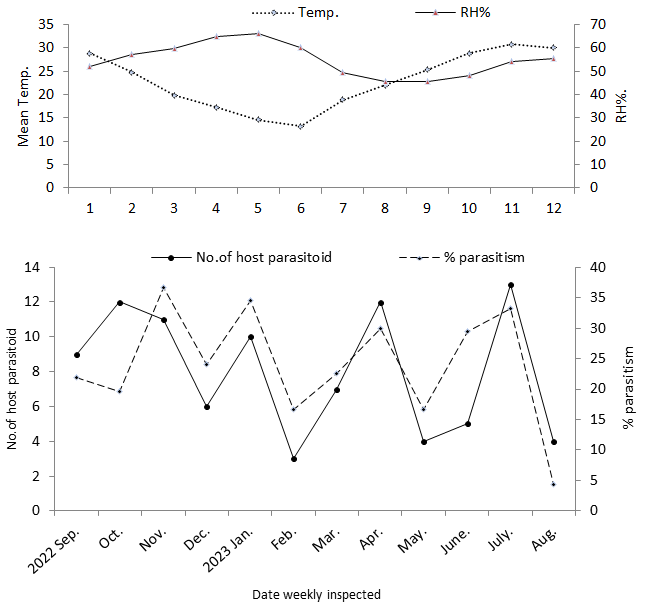
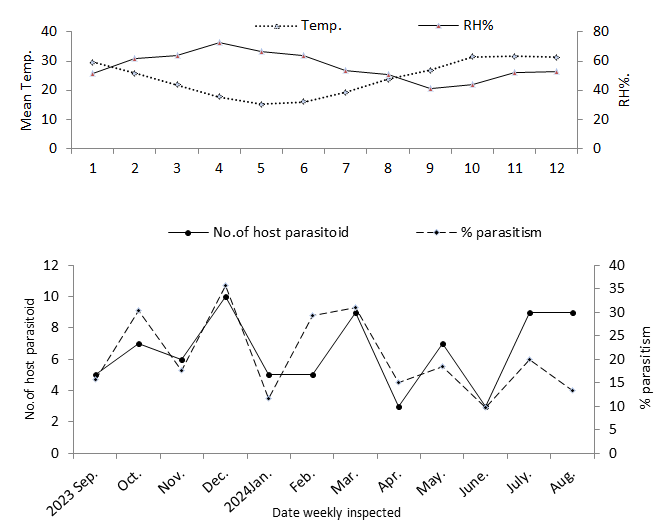
During the 2022/2023 season, the parasitism rate of Encrasia lahorensis on Dialeurodes citri (Ashmead) was assessed on balady orange trees in Kafr Saqr. Notably, three periods of parasitoid activity were documented in November 2022, with parasitism percentages recorded at 36.60%, 34.50%, and 30.0% in January, April. The corresponding temperatures during these evaluations were 19.87ºC, 14.61ºC, and 21.98ºC, with relative humidity levels of 59.62%, 66.20%, and 45.44% RH (Figure 6). In the subsequent season of 2023-2024, three additional peaks of activity were noted in October and December 2023, as well as in July 2024, with parasitism rates of 52.20%, 35.71%, and 20%, respectively. The temperatures recorded during these periods were 25.78ºC, 17.66ºC, and 31.73ºC, while the relative humidity levels were noted at 61.99%, 72.93%, and 51.79% RH (Figure 8). In natural ecosystems, parasitoids and predators typically help control whitefly populations. Encarsia lahorensis (Howard) is an endoparasitoid of the citrus whitefly_, Dialeurodes citri_ (Ashmead). Woglum [15] first identified this parasitoid while researching natural enemies in India [15, 16] . Interesting field surveys conducted between 1981 and 1982 showed populations of E. lahorensis established in 59 counties [17, 36]. However, in agricultural settings, the balance is frequently disrupted by the excessive use of chemicals, resulting in persistent whitefly populations [37, 38].
References
-
Radwan S (2003) Toxicological studies on some scale insects infested mango and guava trees. Ph. D. Thesis. Fac Agric Cairo Univ pp: 1-221.
-
Anjos DV, Tena A, Maura Torezan-Silingardi H, Pekas A, et al. (2021) Ants affect citrus pests and their natural enemies in contrasting ways. Biological Control 158: (104611).
-
Aly N (2011) Population dynamics of the purple scale, _Lepidosaphes beckii_ (Hemiptera: Diaspididae) and its parasitoid _Aphytis lepidosaphes_ (Hymenoptera: Aphelinidae) as a new threat pest on mango trees in Egypt. Egypt Acad J biolog Sci 4(1): 1-12.
-
Cohic F (1955) Rapport d’une mission aux établissements français d’l’Océanie. Fascicle III. Enquête sur les parasites animaux des cultures. Institut Français d’Océanie, Nouméa, ORSTOM, pp: 68.
-
Gill RJ (1997) The scale insects of California. Part 3. The armored scales (Homoptera: Coccoidea: Coccidae). Technical Series in Agricultural Biosystematics and Plant Pathology No. 3. California Department of Food and Agriculture, Sacramento, California, USA, pp: 307.
-
Davidson JA, Miller DR (1990) Armored scale insects their biology, natural enemies and control 4B Elsevier/ Netherlands pp: 603-632.
-
Wang Z, Pang J, Liao C, Zhang Q, Sun D (2021) Determination of etoxazole in different parts of citrus fruit and its potential dietary exposure risk assessment. Chemosphere 268: 12883.
-
Butter NS, Dhawan AK (2021) A Monograph on Whiteflies. In: 1st (Edn.), India: CRC Press, pp: 236.
-
Habib A, Salama HS, Amin AH (1971) Population Studies on Scale Insects Infesting Citrus Trees in Egypt. Zeitschrift für Angewandte Entomologie 69: 318-330.
-
Fadamiro HY, Xiao Y, Hargroder T, Nesbitt M, Umeh V, et al. (2008) Seasonal Occurrence of Key Arthropod Pests and Associated Natural Enemies in Alabama Satsuma Citrus. Environmental Entomology 37(2): 555-567.
-
Abdel-Fattah MI, El-Saadany G (1978) The role of parasitoids in the control of the purple scale, _Lepidosaphes beckii_ (New.) in Egypt. Zeitschrift für Angewandte Entomologie 87(1-4): 154-159.
-
Hafez MB, El-Minshawy AM, Donia AR (1987a) Population fluctuations on parasites of _Lepidosaphes_ _beckii_ Newm. and _Ceroplastes floridensis_ Comst. Anzeiger für Schädlingskunde 60(1): 6-9.
-
Hafez MB, El-Minshawy AM, Donia AR (1987b) Parasitic efficiency of some hymenopterous _Aphytis_ spp. on the purple scale insect _Lepidosaphes beckii_ Newm. J Appl Entomol 103(1-5): 135-138.
-
Malr (1997) Agricultural pest control program. Annual book of Ministry of Agriculture and Land Reclamation. Egypt pp: 5-40.
-
Woglum RS (1913) Report of a trip to India and the Orient in search of the natural enemies of the citrus whitefly. USDA Bureau of Entomology Bulletin 120: 1-58.
-
Nguyen Ru, Sailer RI (1979) Colonization of a citrus whitefly parasite, _Prospaltella lahorensis_, in Gainesville, Florida. Florida Entomologist 62: 59-65.
-
Rose M, DeBach P (1981) Citrus whitefly parasites established in California. California Agriculture 35: 21- 23.
-
Helmy EI (1975) Evaluation of certain synthesis insecticides for the control of scale insects in ARE. MSc Thesis, Fac Aagric Ain-Shams Univ Egypt, pp: 118.
-
Amin AH (1970) Studies on the population dynamics of certain scale insect in relation to their control. PhD Thesis, Fac Aagric, Ain-Shams Univ, Egypt pp: 180.
-
Abdel Fattah MI, El-Minshawy AM, Darwish ET (1978) The seasonal abundance of two scale insects, _Lepidosaphes beckii_ (New.) and _Aonidiella aurantii_ (Maskell.) infesting citrus trees in Egypt. Proc. 4th Conf Pest Control, NRC, Cairo, Egypt 1: 78-84.
-
Abou-Setta MM (1981) The influence of certain spray parameters on the efficiency of insecticides for controlling scale insects on citrus trees. M.Sc. Thesis, Fac. Aagric., Ain-Shams Univ., Egypt, pp: 78.
-
Tawfeek ME ( 2012) Distributions of armored scale insects infesting citrus trees in different localities in Egypt. Journal of Entomology 9: 429-434.
-
Megalla ARY (2021) Studies on some pests and their natural enemies associated with certain fruit trees in Egypt. M.Sc. Thesis Faculty of Moshtohor Benha University pp: 198.
-
Belguendouz R, Biche M, Allal L, Houmani Z (2015) Influence of habitat on the development of _Lepidosaphes_ _beckii_ (Hemi. Diaspididae) and the determination of the a convenable period of control on citrus (on lemon and orange) in the region of Mitidja 2009-2010 (Algeria). Agriculture and Biology Journal of North America 6(2): 47-51.
-
Stathas GJ, Skouras PJ, Kontodimas DC (2015) Data on ecology of the purple scale _Lepidosaphes beckii_ (Newman) on citrus in Greece. Bulletin OEPP/EPPO Bulletin 45(1): 128-132.
-
Jun-Hua H, XueLian W, Yao-Hai W, Ting-Shan Y, Hao-Qiang L, et al. (2016) Behavioral response of _Neoseiulus barkeri_ to Carrizo citrange leaves damaged by _Panonychus citri_ and sucking insects. Chinese Journal Entomology 53(1): 30-39.
-
Zaabta I, Boukhobza L, Mimeche F, Biche M (2020) Role of _Aphytis lepidosaphes_ Compere, 1955 (Hymenoptera: Aphelinidae) in limiting _Lepidosaphes beckii_ (Newman, 1869) (Homoptera: Diaspididae) populations in an orange orchard in Rouiba (Algeria). Biodiversity Journal 11(1): 35-40.
-
Moraes LAH, Silva de (1987) Rate of parasitism of _Mytilococcus beckii_ (Newman, 1869) (Homoptera, Diaspididae) in oranges of the cultivar Valencia (_Citrus sinensis_ (L.)Osbeck) in the Taquari region, RS. Agronomia- Sulriograndense 23(1): 41-47.
-
Abbas MST (1992) Comparative rates of infestation by four scale insects on citrus trees with special reference to rates of parasitism on the purple scale _Lepidosaphes_ _beckii_. Egypt J Agric Res 70(2): 477-486.
-
Boukhalfa H, Bonafonte P (1979) Dynamique des populations de _Dialeurodes citri_ ASH dans UN verger d’orange Hamlin en mitidja. Fruits pp: 1-5.
-
Onillon JC (1975) Sur quelques aspects de la lutte biologique contre les Aleurodes des agrumes. Algerian Annals of Agronomy 5(6): 219-229.
-
Singh S, Sandhu RK, Haldhar M, Reddy P, Deka S, et al. (2021) Integrated Pests Management in Citrus Crops. In: Pest Management in Dryland Horticultural Crops. Haldhar SM, Maheswari SK (Eds.), New Delhi, India (Eds), Biotech. Books.
-
Messaoud B, Boukhalfa H (1987) Bioécologie de l’aleurode des agrumes: _Dialeurodes citri_ (Ash.) (Homoptera : Aleyrodidae) dans un verger de clémentiniers en Mitidja. Thèse de Magister en Sciences Agronomiques, Institut National Agronomique d’El Harrach, Alger, Algeria, pp: 102.
-
Uygun N, Ohnesorge B, Ulusoy R (1990) Two species of whiteflies on citrus in Easten Mediterranean: _Parabemisi_ _amyricae_ (Kuwana) and _Dialeurodes citri_ (Ashmead). Morphology, Biology, Host plants and Control in Southern Turkey. J Appl Ent 110: 471-482.
-
Zanic K, IgrcBarcic J, Kacic S (2001) _Dialeurodes citri_ (Ashmead, 1885) in the Adriatic Region of Croatia. Agriculturae Conspectus Scientifics 66(3): 161-168.
-
Sailer RI, Brown RE, Munir B, Nickerson JCE (1984) Dissemination of the citrus whitefly (Homoptera: Aleyrodidae) parasite Encarsia lahorensis (Howard) (Hymenoptera: Aphelinidae) and its effectiveness as a control agent in Florida. Bulletin of the Entomological Society of America 30: 36-39.
-
Hodges GS, Evans GA (2005) An identification guide to the whiteflies (Hemiptera: Aleyrodidae) of the South- Eastern United States. Florida Entomologist 88(4): 518- 534.
-
Mound LA, Halsey SH (1978) Whitefly of the World. A Systematic Catalogue of the Aleyrodidae (Homoptera) with Host Plant and Natural Enemy Data. London/ Chichester: British Museum (Natural History)/John Wiley & Sons.
- Enhancement of Vegetative Growth and Fruit Yield in Cucumber (Cucumis sativus L.) via Spiritual Blessing (Biofield) Energy Intervention
- Production of Açaí (Euterpe oleracea Mart.) under Different Agroforestry System Management Intensities in Amazonian Floodplain (Varzea) Forests
- Coffee and the Production Region: What is the Secret to the Expression "Quality"?
- Experiential Agripreneurship Training in Sub-Saharan Africa: Integrating a Business Incubator into Postgraduate Livestock Education at the University of Buea
- Advances in Agricultural High-Quality Development
- Linking Compost Residue to ABAGE in Plants - a Short Note