
Cultural Control of Cacao Witches’ Broom Disease (Moniliophthora perniciosa) in Colombia: Results of Two Cases
Witches’ Broom (Moniliophthora perniciosa) is one the most harmful diseases of the cacao crops in South and Central America. It affects the vegetative growing of the trees as well as organs like pods and flower cushions. In Colombia, it was recorded for the first time in 1929 in the region of Tumaco, department of Nariño. Between 1960 and 1977 the disease spread to almost all areas of the country. At the beginning, the control was focused on growing resistant genotypes, especially crosses with SCA-6 and SCA-12 clones. Nonetheless, due to their low levels of production, it was necessary to change towards more productive varieties regardless their susceptibility to Witches’ Broom. The control platform tested in the two cases described here (cultural control that consisted in cutting off and freely discarding all affected organs on the ground) demonstrated that is easy to manage the disease when is detected early but also is possible to recover abandoned farms through the canopy renovation method. The cultural control constitutes the most effective and low-cost management procedure, especially when the disease is detected on time.
Introduction
Witches’ Broom is one of the diseases with the highest impact on the cacao crops in South America. In Brazil, despite all preventive plans, the cacao production fell from 400000 to 150000 metric tons in a decade, after the arrival of the pathogen [1]. Currently, Cacao Witches’ Broom has a wide range of distribution. It’s reported in South and Central America in countries such as Brazil, Bolivia, Colombia, Ecuador, Guyana, Peru, Venezuela, Panama and the Caribbean Islands [2]. Holliday cited by Evans (2007) [1], considers that “if the disease is discovered early enough it can be eradicated without too much difficulty”. Consequently, this paper presents two control cases: one about a cacao farm where Withes’ Broom disease appeared for the first time, and the other about a farm that suffered an epidemic episode of the disease.
Some General Aspects
In Colombia, the disease was first recorded in 1929 in the region of Tumaco, South of the country, but by 1977 it had spread to departments such as Caquetá, Huila, Valle, Arauca, Guaviare, Caldas, Antioquia y Cauca [3]. “Common” cacao, the predominant genetic material, presented high susceptibility to the disease so the country was forced to grow hybrids with different grades of resistance. Nevertheless, it was verified that these hybrids had limitations regarding genetic incompatibility and low yields, thus making necessary to agree on a careful selection of the clones based on their properties and the characteristics of each region. Cacao growers are obtaining significant results related to disease control through pruning contaminated organs and freely disposing them on the ground (cultural control).
Symptoms of the Disease
Recognizing the disease symptoms is essential for proper control. It affects, not only the vegetative meristems originating the characteristic brooms, but also the flower cushions (cushion brooms) and pods in all their stages of development (Figure 1).
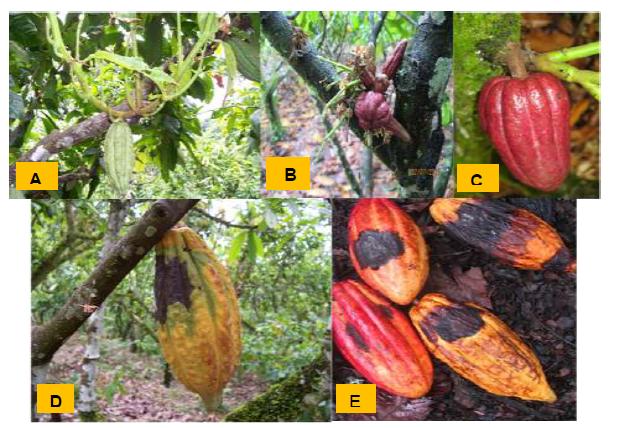
The most common symptom is the characteristic shoot or broom, caused by the hypertrophic growth of an infected bud (Figure 1A) which gives it its name [4]. The symptoms in infected pods vary depending on the plant genome, age of the pod and the time of infection [2]. Symptoms in green pods include necrosis of the infected area (black spot) followed by premature ripening (Figure 1D). Symptoms in pods near ripening comprise shrinking necrosis of the infected area along with destruction of the internal tissue (Figure 1E).
Epidemiology
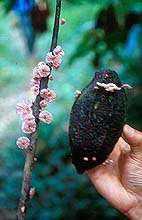
Garcés (1946) [5], affirms that the brooms stay green for three weeks, they get dry for one more, and then they start to produce basidiocarps even 14 weeks after their formation. According to Aranzazu [4], in the Urabá region of Colombia, a broom takes four months from its initial appearance until it becomes a source of inoculum. Once diseased tissue begins to produce fruiting bodies (basidiocarps, Figure 2), it can continue to do so for two years or more under wet conditions. At the beginning, a large number of basidiocarps are produced, but the numbers normally decline after the first year. Significantly fewer fruiting bodies are produced on detached brooms discarded on the ground, than on brooms attached to the cocoa trees [4]. Basidiospores released from basidiocarps are carried by the wind, although they are susceptible to dehydration and survive only one hour in direct sunlight [4].
Although Baker et al. [6] affirmed that infection occurs within 100 meters from the source, Evans (2016) [6] found out 20% of cacao trap plants had become infected although they were around 800-1500 meters from the nearest cacao plantations. “A high relative humidity combined with a fall in temperature favors basidiospore release; the greater the difference between relative humidity and temperature, the greater the rate and duration of spore liberation” [6]. The spores remain viable under normal conditions for nearly 12 hours and the median range of dispersion is 70- 80 km. They are released from late evening to early morning avoiding the effects of sunlight and low humidity, which rapidly kill the spores. There is risk in leaving pruned brooms on the ground so is recommendable to remove and destroy them, Evans (2016) [6].
Cultural Control
Phytosanitary pruning of the infected organs reduces the amount of inoculum, and thus the infection level, but it will never be a suitable pathogen eradication procedure [4]. Rocha and Wheeler (1985) [7] confirmed daily moisture drought regime between 8-16 hours generates the fructification of 95% of the brooms that are in this phase. In Colombia, the regimes of moisture–drought that favor the production of basidiocarps mostly occur in the seasons of April–May and October–November. Consequently, to get an effective control of the disease in those seasons, the cacao trees should stay free of brooms during the pruning processes of February-March and July- August.
Case 1. When the Disease is Detected for the First Time
Cacaoteras del Dique was a cacao farm located in the low region of the Cauca river in the North of Colombia (150 meters above the sea level) with a humid-tropical weather. Its crops comprised 150000 thirteen-year-old hybrid cacao trees. In January 1980, the first shoots infected by the Witches’ Broom were found in trees located near pathways. A rigorous inspection of the farm trees was immediately carried out and all diseased organs were cut and discarded on the ground (cultural control). The first inspection was made for a period of three months. The information collected from January 1980 to June 1983 (three and half years) is displayed in Table 1 [8].
| Number Of Diseased Trees | |||||||||||
|---|---|---|---|---|---|---|---|---|---|---|---|
| Month | Years | Diseased Trees Per Month | |||||||||
| 1980 | 1981 | 1982 | 1983 | ||||||||
| January | 175 | 16 | 9 | 1 | 201 | ||||||
| February | 90 | 27 | 24 | 0 | 141 | ||||||
| March | 51 | 41 | 32 | 0 | 124 | ||||||
| April | 32 | 12 | 9 | 3 | 56 | ||||||
| May | 53 | 4 | 0 | 1 | 58 | ||||||
| June | 28 | 0 | 1 | 2 | 31 | ||||||
| July | 36 | 16 | 3 | 55 | |||||||
| August | 50 | 30 | 3 | 83 | |||||||
| September | 21 | 11 | 0 | 32 | |||||||
| October | 4 | 4 | 0 | 8 | |||||||
| November | 4 | 0 | 0 | 4 | |||||||
| December | 8 | 7 | 0 | 15 | |||||||
| Year Total 549 | 549 | 168 | 81 | 7 | 805 |
Table 1: Number of trees affected by Witches’ Broom per month in the years 1980-1983.
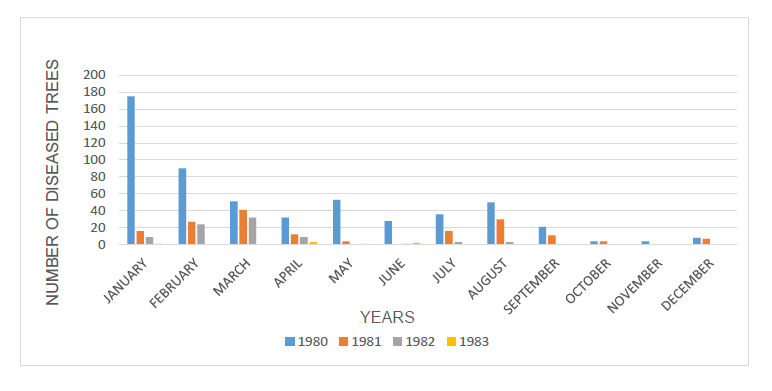
The number of diseased trees throughout the observation period evidently decreases. The highest number was in 1980 (549 trees), it descended to 168 in 1981, 81 in 1982 and 7 in 1983. The increment of affected trees from 1980 to 1983 was 259, which only represents 47% of the first year. The disease didn’t have any impact on the crop the following five years. The highest number of contaminated trees was found in the first three months of each year (Figure 2). From June 1983 and ahead, the control of Witches’ Broom was reduced to trimming the affected organs during the pruning of February-March and July-August. Cultural control (cutting and discarding on the ground contaminated organs) can be considered the best measure so far. The organs discarded do not have epidemiological importance.
Case 2. When the Disease is Found during Endemic Stage
España, a cacao farm in the municipality of Dabeiba, Northwest of Colombia, 800 meters above the sea level, average temperature of 25°C, relative humidity of 75% and 2200 millimeters of rain per year. Its crops comprised 3000 hybrid cacao trees (twenty-five years or older) in total abandonment because of Witches’ Broom disease [9]. 150 trees were treated using the method of canopy renovation that consisted in cutting off the main shoots from 30, 40 or 50 centimeters from the fork. In some trees, it was possible to keep the branches that were still in good conditions. All cut-off branches were discarded on the ground. 20 trees were chosen for the purpose of keeping a record of newly formed brooms. Two months after canopy renovation, each tree was pruned leaving the branches that would form the new canopy. Every four months after canopy renovation, the number of brooms detached from the trees was recorded for the following eighteen months. Table 2 shows the newly formed brooms that were cut off from the twenty selected trees during the period of January 84 to August 85.
| Number Of Witches' Broom | |
|---|---|
| January / 84 | 25 |
| April | 20 |
| June | 0 |
| September | 2 |
| January / 85 | 14 |
| April | 54 |
| August | 2 |
| TOTAL | 117 |
| Average/ month | 0.29 |
| /tree | |
Table 2: Monthly number of detached Witches’ Broom per tree in the 20 selected trees for the period of January 84 to Table 2: Mon
It should be considered that the new brooms in the canopy building process are caused by near affected trees, but cutting them off help canopies to stay in perfect conditions. The monthly average of 0.29 brooms per tree is a relatively low figure taking into account the epidemic stage of trees surrounding the area. 20 out of 150 trees (13.3%) submitted to canopy renovation died; the remaining entered into a normal production phase 2 years later.
Discussion and Conclusions
Effectively, Witches’ Broom is one of the most impactant diseases of cacao crops because it can reach levels that force the total abandonment of the plantations. However, when the disease is detected early, after three and half years the level of the infection comes lowing to its minimum degree through cultural control which consists in the removal of all organs with symptoms of the disease and their free disposal on the ground. But, the cultural process should be carried out twice a year (first round immediately after the main harvest is finished and the second five-six months later). It can be concluded that it is easier to control Witches’ Broom when is detected before an epidemic stage is reached. Nevertheless, also it is possible to recover severely affected crops through the canopy renovation method. Although the brooms were discarded on the ground, this practice didn’t have significant impact like infection sources on the trees submitted to cultural control. Other aspects that should be considered inside the cultural control are the pruning and tree height (no more than 3.5 meters), because they help to facilitate the detection and removal of the diseased organs and keep labor-cost low, respectively.
References
-
Evans HC (2007) Cacao diseases- the trilogy revisited. Phytopathology 97(12): 1640-1643.
-
Silva SDVM, Luz EDNM, Cordero O, Peres K, Bezerra JL (2001) Rediscricao da sintomatología causada por _Crinipellis perniciosa_ em cacauiero. Agrotropica. 14(1): 1-24.
-
Barros O (1978) Algunos aspectos de la “Escoba de Bruja” en Colombia. El Cacaotero Colombiano 7(2): 43-56.
-
Wood GAR, Lass RA (1985) Cocoa. Tropical Agriculture Series. Longman Group Limited. 620 p.
-
Garcés C (1946) La Escoba de Bruja del cacao. Revista Facultad de Agronomía de Medellín Universidad Nacional, Colombia 6(24): 329-369.
-
Evans HC (2016) Cacao diseases. A history of Old Enemies and New Encounters. Bryan A. Bailey. Lindel WM (Eds.), Springer 633 pages.
-
Rocha HM, Wheeler B (1985) Factors influencing the production of basidiocarps and the deposition and germination of basidiospores of _Crinipellis_ _perniciosa_, the causal agent of witches’ broom disease on cocoa (_Theobroma cacao_ L.). Plant Pathology 34(3): 319- 328.
-
Cubillos GG (1983) Tres años y medio del manejo de la enfermedad Escoba de Bruja en la Hacienda Cacaoteras del Dique. El Cacaotero Colombiano 25: 21-26.
-
Grisales A, Cubillos G (1985) Rehabilitación de poblaciones de cacao deterioradas por Escoba de Bruja mediante el método de “renovación de la copa”. El Cacaotero Colombiano. 31: 36-41.
- Enhancement of Vegetative Growth and Fruit Yield in Cucumber (Cucumis sativus L.) via Spiritual Blessing (Biofield) Energy Intervention
- Production of Açaí (Euterpe oleracea Mart.) under Different Agroforestry System Management Intensities in Amazonian Floodplain (Varzea) Forests
- Coffee and the Production Region: What is the Secret to the Expression "Quality"?
- Experiential Agripreneurship Training in Sub-Saharan Africa: Integrating a Business Incubator into Postgraduate Livestock Education at the University of Buea
- Advances in Agricultural High-Quality Development
- Linking Compost Residue to ABAGE in Plants - a Short Note