
A Large-Scale Remote Connection among Virtual ICT Laboratories Ranging over Multiple Network Segments
The prevalence of Covid-19 has made it impossible to put various kinds of scientific experiments into practice, especially in Japanese senior high schools, because scientific experiments necessarily require many students to gather in the inside of one laboratory and to keep academic discussion with each other. This is the reason why on-line lectures, which can be substituted for on-site lectures, have been developed. Actually, the network skills enabling lectures and meetings to be delivered among the conference venues on the Internet such as Zoom, Microsoft Teams and Google Meet cannot help senior high school teachers to conduct on-line scientific experiments. More concretely speaking, they point out that there exist some problems accompanying on-line lectures, some of which can be summarized as the following: • Problem 1: Though Zoom can deliver the one-way lectures where the contents are streamed from teachers to students only, it cannot deliver the round-trip lectures where the contents are streamed not only from teachers to students but from students to teachers. • Problem 2: It is difficult to deliver some contents from teachers to students and other contents from students to teachers in parallel. In this paper, we introduce a method of constructing virtual ICT laboratories which enables teachers and students to participate in a common ICT experiment where they can deploy such network application tools as web browsers and web servers and they can observe individual ICT settings mutually. This method can be realized by the simultaneous combined use of Zoom, SoftEther VPN and Cisco Packet Tracer. Throughout this paper, this method is assumed to be applied to several groups of teachers and students belonging to senior high schools which are geographically separated from each other. We can classify this system into the following: • Case 1: The case where several PCs on which virtual ICT laboratories are deployed by teachers and students exist in a common network segment. • Case 2: The case where several PCs on which virtual ICT laboratories are deployed by teachers and students exist in several network segments which are geographically separated from each other. It is one thing to realize Case 1 and quite another to realize Case 2, because the former case does not need the Internet, but the latter case needs it. In other words, while the network circumstances following Case 1 require wireless LAN routers, the network circumstances following Case 2 require some other network application tools such as SoftEther VPN and so on.
Abbreviations
LAN: Local Area Network; ICT: Information and Communication Technology Laboratory; PCs: Personal Computers; VPN: Virtual Private Network.
Introduction
In this section, firstly, we introduce the several applications which are used for constructing virtual ICT laboratories and the way of deriving synergistic effects from simultaneous combined use of them as the following:
- Cisco Packet Tracer playing the role of virtual ICT laboratories.
- Wireless LAN routers playing the role of establishing mutual local connections among PCs on which Cisco Packet Tracers are activated.
- SoftEther VPN playing the role of establishing mutual remote connections among PCs on which Cisco Packet Tracers are activated.
- Zoom playing the role of observing the experiments conducted by teachers and students mutually.
Secondly, we introduce the difference between the mutual remote connections and the mutual local connections. Exactly speaking, the mutual remote connections (resp. mutual local connections) are defined as the network connections, which are composed of ICT laboratories participating in an common experiment and ranging over the several network segments (resp. the network connections, which are composed of all ICT laboratories participating in an common experiment and sharing one network segment with each other) [1].
Thirdly, we point out that, if we assume that there exist more than three ICT laboratories being on board PCs, then, from the point of view of network extensibility, network connections can be classified into the following:
- If any virtual ICT laboratory is equipped with only one network listening port, then we cannot construct the network consisting of all virtual ICT laboratories, where any pair of two virtual ICT laboratories can make packets commute between them, because no virtual ICT laboratories can forward packets.
- If any virtual ICT laboratory is equipped with more than two listening ports, then we can construct the network where any pair of two virtual ICT laboratories can make packets commute between them, because every virtual ICT laboratory can forward any packets having reached it to another one.
Such relations between the network extensibility and the listening ports, with which virtual ICT laboratories are equipped as stated above, play an important role for the purpose of bringing about synergistic effects. As for the mathematical aspects of network connections, we can refer to Knuth, et al. [2] and Santos O and Muniz J [3] respectively. Moreover, the multiuser listening system, which is implemented by Cisco Packet Tracer, can decompose a complex network into several virtual ICT laboratories and can establish mutual bidirectional connections between any pair of two components. As for the multiuser listening system [3].
Mutual Connection of Geographically Separated two Virtual ICT Laboratories
In this section, we prepare two PCs and introduce the basic method of connecting two virtual ICT laboratories, each of which is implemented on each PC (Figure 1). The whole structure can be illustrated as the following:
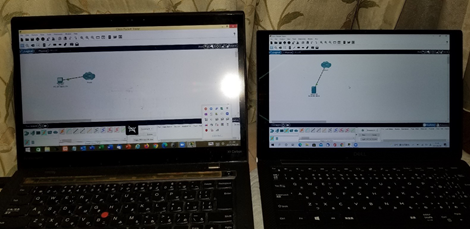
In this figure, we can see two PCs and two virtual ICT laboratories are implemented on them, respectively. These two PCs are connected to each other through a wireless LAN router. Moreover, the web client and the web server are activated in the left-hand side virtual ICT laboratory and the right-hand side one, respectively (Figure 2). Here is another figure showing the web client browsing the homepage presented by the web server as the following:
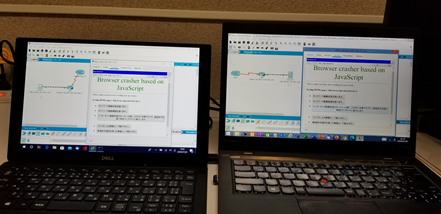
In this figure, the left-hand side PC is in charge of the virtual ICT laboratory where the web client is browsing the web contents, and the right-hand side PC is in charge of the other virtual ICT laboratory where the web server provides the contents. The web contents which are displayed in the left-hand side virtual ICT laboratory are exactly the same ones as the web contents which are displayed in the right- hand side virtual ICT laboratory (Figures 3 & 4). In other words, the left- hand side virtual ICT laboratory reflects the web contents provided by the right-hand side one as the following:
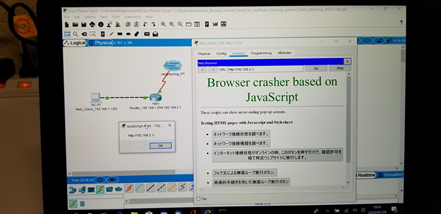
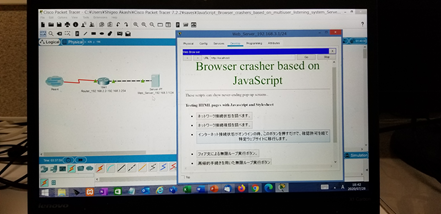
The upper figure and the lower one show the left-hand side virtual ICT laboratory and the rights-hand side one which are extracted from Figure 2, respectively.
Though there exists a large difference between the connections based on wireless LAN routers and the connections based on SoftEther VPN, we cannot answer the question asking which of these two tools is applied to realizing network connections. Because it is reasonable that the experiment conductors such as teachers and students should not be conscious of the method of network connections, while their own virtual ICT laboratories are activated and their experiments are in progress.
Application of SoftEther VPN and Zoom to Advanced Mutual Observation
In the previous section, we have shown that the simultaneous combined use of wireless LAN environments and the multiuser-listening systems provided by Cisco Packet Tracer can implement mutual remote connection of several virtual ICT laboratories with each other. Actually, there still remain some problems which can be stated as the following:
- The problem asking how large the distance between two virtual ICT laboratories can be extended geographically.
- The problem asking how each of virtual ICT laboratories can observe the other virtual ICT ones.
Exactly speaking, near remote connections being realized with the SoftEther VPN can be extended into far remote ones, and moreover, the teleconference-supplying system being realized with Zoom enables each of the virtual ICT laboratories to observe the other ones. As a result, while SoftEther VPN plays important roles in solving the former problem, Zoom plays important roles in solving the latter one.
Fortunately, these two solutions are compatible with each other, even if the simultaneous combined use of SoftEther VPN and Zoom is applied to multiple virtual ICT laboratories which are geographically separated far from each other (Table 1). These solutions are summarized as the following:
| Mutual Near Remote Connection | Mutual Far Remote Connection | |
|---|---|---|
| Positional relation | Buildings in the inside of a university campus | Buildings located in Tokyo and Osaka |
| Available applications | Wireless LAN routers | SoftEther VPN administration servers |
| Roles of the Internet | unnecessary | necessary |
Table 1: Geographical Classification of Mutual Remote Connections.
Now we can show two figures, the former of which illustrates two virtual ICT laboratories which are not equipped with Zoom and the latter of which illustrates two virtual ICT laboratories which are equipped with Zoom as the following (Figure 5 and 6).
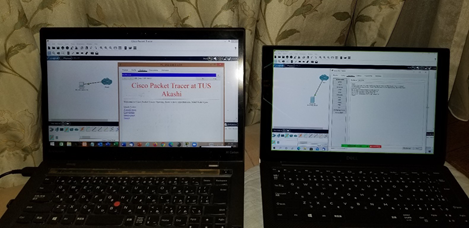
In this figure, there are two virtual ICT laboratories, neither of which can observe the other one (Figure 5).
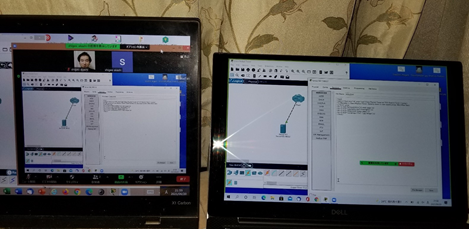
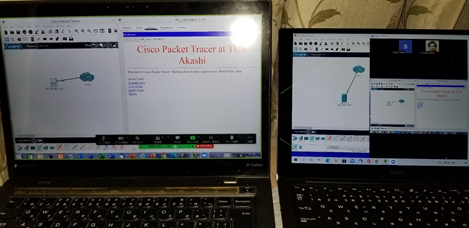
In this figure, there are two virtual ICT laboratories, each of which can observe the other one, because both of these two virtual ICT laboratories have activated Zoom. Exactly speaking, the right-hand side virtual ICT laboratory makes itself serve as Zoom host, and the left-hand side virtual ICT laboratory is observing the right-hand side one (Figure 7). If the Zoom host played by the right-hand side virtual ICT laboratory is replaced with the left-hand side one, then the replacement can be illustrated as the following:
Remark
As we introduce in the previous sections of this paper, Cisco Packet Tracer can activate more than three virtual ICT laboratories in parallel, we can see three virtual ICT laboratories being activated in the following (Figure 8):
As for the SoftEther VPN and the Zoom [4, 5, 6], respectively. Especially, as for NAT traversal, which is a network skill removing an obstacle interrupting the realization of far remote connections [1].
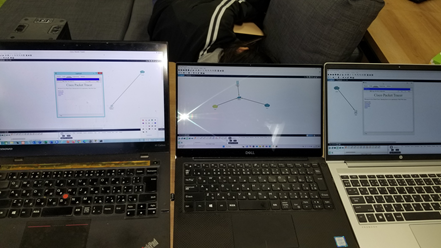
This figure shows that both the network users who belong to the left-hand side virtual ICT laboratory and those who belong to the right-hand side one are browsing the web contents provided by the web server which belongs to the virtual ICT laboratory situated in the central part of this figure.
Conclusion
In this paper, we use three applications, namely, Cisco Packet Tracer, SoftEther VPN and Zoom. The multiuser listening system provided by Cisco Packet Tracer enables to build up multiple virtual ICT laboratories, the teleconference- supplying system provided by Zoom enables an ICT experiment conducted by virtual ICT laboratories to be observed visually by all the participants, and the NAT traversal provided by SoftEther VPN can change the mutual near remote connections to the mutual far remote ones. Therefore, the observability of the mutual far remote connections composed of multiple virtual ICT laboratories can be regarded as a synergistic effect of these systems.
References
-
Ford B, Srisuresh P, Kegel D (2006) Peer-to-Peer Communication Across Network Address Translators. arXiv:cs pp: 1-14.
-
Knuth DE (1973) The Art of Computer Programming, Addison- Wesley Publishing Company, Massachusetts.
-
Santos O and Muniz J (2017) CCNA Cyber Ops Secfnd 210-250. Cisco Press.
-
SoftEther VPN Project. University of Tsukuba.
-
Say hello to Zoom One.
-
Packet Tracer Multiuser Feature. Cisco Networking Academy.
- Revolutionizing Property Measurement Through Artificial Intelligence: The Journey of PropertyMeasure.ai
- AI Infused Business Model Innovation for Competitive Advantage in the Era of Big Data and Digital Transformation
- Use of CPM/PERT in the Effort to Eradicate Polio
- Integrated Multimodal Deep Learning Framework for Early Detection of Mouth Cancer Using CT Imaging and Clinical Symptom Analysis
- Artificial Intelligence in Medical Robotics and Assistance: An Overview
- Server Migration with Multipath-QUIC