
Evaluation of Agility in Indian Pittu Players: A Correlation Study
Introduction: Pittu is indigenous south Asian sports. These sports comprised of seven flat stones and ball therefore also known as “Seven Stones” game. Pittu performance has not been widely evaluated and no study till date has evaluated agility performance of pittu players. Therefore, this study was aimed to evaluate the agility performance of both male and female pittu players. Our secondary aim was to evaluate correlation of agility with anthropometric variables of pittu players. Materials and Methods: This study was a cross sectional type of study, which was done on 49 pittu players between age group of 15-22 years. This study included 34 males and 15 female pittu players of different states & age group, came to Bhopal for attending Second Senior National Pittu Championship, organized by Madhya Pradesh Pittu Association under pittu Federation of India. Data consisting of anthropological variables was collected alongside with agility scores of each player. We assessed correlation between agility and anthropological variables. Results: There was a negative correlation found between agility and weight (0.037), agility and height (0.0001) & agility and muscle-mass (0.004). Conclusion: This study presents the data of anthropometric variables and agility of male and female Pittu Players. Further, the result from this study shows that there was a significant correlation of Illinois agility test with anthropological factors like weight, height and muscle mass of pittu players.
Introduction
‘Pittu’ or ‘Pittu Garam’ is a seven stones and ball sport which is one of the indigenous South Asian Sports [1]. This sport consists of piles of flat stones which needs to be topple by one team and same team try to reconstruct the piles of flat stones again while the other team try to hit another team with ball [2]. The team that topples the piles of stones is named as “seekers” and other team that hit seekers with the ball is termed as “hitters” [3]. Pittu is played by both rural and urban population of different states of India [4]. It is known by different names like Lagori in Karnataka [5]. Yedu penkulata or dikori in Andhra Pradesh; Pithu garam in Punjab & Himachal; Satodiyu in Gujarat; dabba kali in Kerala [6]; Sitoliya in Rajasthan [7]; lingorchya in Maharashtra; Ezhu kallu in Tamil-Nadu [6]. Despite the game that is almost being forgotten and becoming extinct in past few decades, the inaugural world cup held in 2015 was a huge success paired with Indian lagori premier league. The Indian premier league that was held in November 2017 had gathered great momentum across nation which was organized by amateur lagori federation [5]. In year 2020 formation of the pittu federation of India have taken place and the first national tournament with 14 states and 24 teams was held in Indore followed by one in Bhopal in 2020 [8].
Pittu is the sport where fitness and good speed of athletes play very important role in their performance. This sport requires much proficiency like sudden direction change and good speed so that pittu players can arrange the pile of stones without getting hit by the ball thrown by opposite team. For this purpose, agility of the players is considered as a significant ability to win the match. Agility performance plays a vital role in many team sports [9]. It is an important factor of many motor skills [10].
Agility is defined as the ability of a person to change the directions suddenly during running. It evaluates the ability of an athlete or a player to turn in different directions, at different angle and different speed [11]. Agility training encourages athlete’s body to improve balance during dynamic movement it also helps in improving cognitive function [12]. The agility training protects areas such as lower back, shoulder, ankle while moving rapidly, to grab the stones for making stack or to avoid touching of ball, when the opponent throws it towards the player [9].
Illinois agility test is a reliable and valid test to assess agility [13]. This test involves both; moving the body as rapidly as possible as well as changing direction. This test can assess one’s weakness and strength in different sports or task which can help in directing training goals [14]. Till date no studies have been found which assessed agility in male and female pittu players. Thus, we designed this study to evaluate agility in young adult pittu players. Secondly, we evaluated correlation of agility with anthropometric variables.
Methodology
This study follows STROBE Statement guideline for observational study.
Participants
In our cross sectional research study, we aimed to investigate the performance and physical attributes of pittu players, specifically focusing on a group of 34 males and 15 females. These players were selected from various states across India, including M.P, Chhattisgarh, Bihar, Maharashtra, Gujarat, Delhi, and Punjab. We intentionally recruited participants from diverse backgrounds to ensure a representative sample. The players were chosen based on their involvement in the Second Senior National Pittu Championship 2022, held in Bhopal, Madhya Pradesh, India a prestigious event in the sport.
The selected players belonged to a wide range of age groups, spanning from 15 to 22 years. This age range was chosen to capture the developmental stage of young adults who have been actively participating in pittu. Additionally, we considered the participants’ variable body physiques to account for the potential influence of physical attributes on their performance. Furthermore, we correlated agility performance with anthropometric variables.
It is worth noting that we excluded individuals with a recent history of musculoskeletal injuries from our study. This decision was made to minimize the potential confounding effects of such injuries on the players’ performance and physical characteristics. Furthermore, we respected the choices of participants who expressed their unwillingness to take part in our study. By doing so, we aimed to ensure ethical considerations and maintain a cohesive and committed group of participants for our research analysis.
Pittu Game
Pittu is a team sport that involves two groups of 12 players each, with separate categories for men and women. The game revolves around hitting assembled blocks in the center of the playground. The team that wins the toss becomes the seekers and tries to hit the blocks with a ball, while the opposing team, known as the hitters, aims to catch the ball. Seekers have three chances to hit the blocks, and if they fail, the hitters get their turn. If a seeker successfully hits the blocks but a hitter catches the ball before it touches the ground, the ball is passed to the hitters. The game continues with each team trying to hit the blocks and prevent their reconstruction by the opposing team. Players need to be quick, observant, and agile, with good running speed, strength, and concentration. Pittu requires strong teamwork and strategic coordination among players to succeed.
Anthropometric Variables Assessment
For measuring height stadiometer was used and for weight, BMR, bone mass, protein, muscle mass, body water, body fat and BMI FITDAYS smart Bluetooth scale from Health Sense (Model No BS171 Manufactured in China) was used, for calculating time digital stopwatch was used.
Illinois Agility Test
To conduct the Illinois agility test we require adequate space, a timer, measuring tape and 8 cones are required. The individual starts by lying face down by the first cone. Starting from cone one, athlete has to touch the tip of the cone with their right hand. Athlete is required to run to cone two, which is placed at a distance of 10m away from the first. He then runs to cone three at this point the individual has to weave around cones 4,5,6,7. After this he has to again weave through 7, 6, 5, 4 cones. He will then run to cone 8. The time to complete task is then recorded.
Timer starts from the point of beginning and continues till the player reaches to the finish point. Once the player reaches to the finish point, the timer is stopped. From three successful trials best time is calculated.
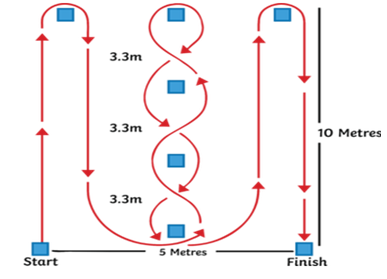
Figure1: Arrangement for Illinois Agility Test.
Statistical Analysis
We applied Shapiro-Wilk for the evaluation of normality of the data. We found that our data was normally distributed. Therefore, we used parametric test for the analysis of our data. The data of agility and anthropometric variables is presented as mean and standard deviation values. We used independent sample t-test for comparing anthropometric variables and agility test between males and females. Pearson’s co-relation test was used to evaluate the correlation between Agility and Anthropometric variables.
Results
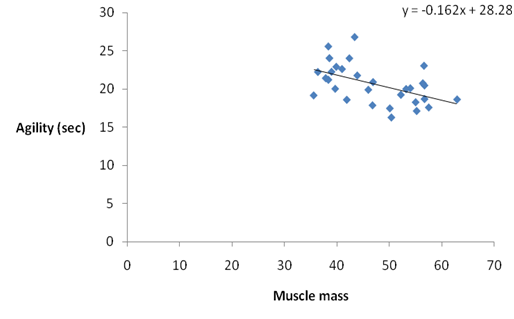
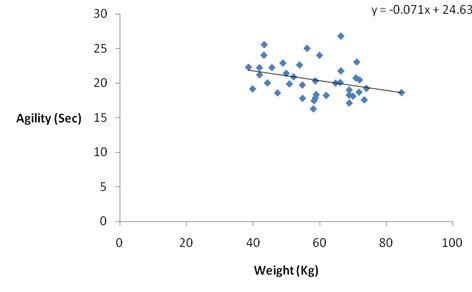
The result of our study presents anthropometric characteristics Table 1 and agility performance Table 2 of pittu players. The data presents mean and standard deviation values and reveals that there was a significance difference found between male and female for variables that are; height, weight, muscle mass and agility in pittu players. Correlation analysis revealed that there was negative correlation found between agility and weight Figure 2 agility and height Figure 3 and agility and muscle mass Figure 4.
| Sr. no | Overall (Mean± S.D) | Male (Mean± S.D) | Female(Mean± S.D) | t- value | p- value | |
|---|---|---|---|---|---|---|
| 1 | Age (Years) | 19.47 ± 2.24 | 19.47±2.36 | 19.47±2.13 | 0.006 | 0.996 |
| 2 | Height (cm) | 166.24 ± 6.07 | 171.76±5.98 | 160.73±6.16 | 5.89 | 0 |
| 3 | Weight (Kg) | 56.24 ± 8.94 | 62.1± 8.51 | 50.38±9.38 | 4.3 | 0 |
| 4 | Bone mass(Kg) | 2.62 ± 0.33 | 2.69±0.44 | 2.56±0.23 | 1.09 | 0.278 |
| 5 | Protein (%) | 26.04 ± 3.11 | 26.57±2.11 | 25.52±4.12 | 1.17 | 0.246 |
| 6 | Body water (%) | 54.88 ± 4.03 | 54.87±3.16 | 54.90±4.90 | -0.02 | 0.977 |
| 7 | Muscle mass (%) | 45.33 ± 4.46 | 49.62±5.07 | 41.05±3.85 | 5.82 | 0 |
| 8 | Body fat (%) | 14.93 ± 3.34 | 14.25±5.61 | 15.61±10.08 | -0.6 | 0.549 |
| 9 | BMI (kg/m2) | 19.86 ± 3.15 | 20.80±3.13 | 18.92±3.18 | 1.93 | 0.059 |
| Sr. no | Overall (Mean± S.D) | Male (Mean± S.D) | Female (Mean ± S.D) | t-value | p-value | |
| 1 | 20.91 ± 1.83 | 19.06 ± 1.65 | 22.76 ± 2.01 | -6.73 | 0.0001 |
Table 1: Anthropometric variables of participants.
The above table presents mean and standard deviation values of anthropometric variables and their comparison between males and females. Bold values represent a significant difference at p<0.05 level of significance between males and females.
The above table presents mean and standard deviation value of Illinois Agility test Scores (in seconds). A significant difference at p<0.05 level of significance was found in agility scores between males and females.
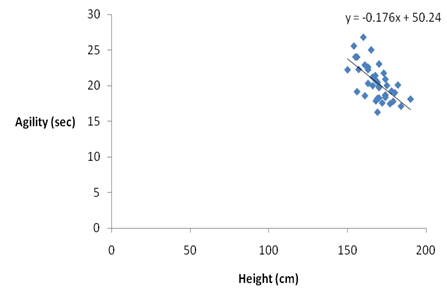
The above Figure presents correlation between height and agility performance. A significant negative correlation was obtained between height and agility scores of pittu players.
The above Figure presents correlation between weight and agility performance. A significant negative correlation was obtained between weight and agility scores of pittu players.
The above figure presents correlation between muscle mass and agility performance. A significant negative correlation was obtained between muscle mass and agility scores of pittu players.
Discussion
This study was conducted to evaluate sports “Pittu” performance in players. For this study total 49 pittu players were selected with age group from 15-22 years. Anthropometric factors such as age, height, weight, BMI, muscle mass; bone mass, body water, and protein were collected of pittu players. Illinois agility test was performed in these players to assess their fitness, and speed of change in direction.
There was a significant difference (p<0.005) seen in between males and female players with respect to anthropometric variables such as height, weight, and muscle mass. The selected participants of our study are from age group 15-22 years that is mainly adolescent’s populations. Adolescent’s period consists of different physiological changes which play an important role in the development of players and this can lead to marked differentiation in the performance of players.
The present result showed a significant negative correlation between agility and Anthropometric variable that are height, weight, muscle mass (is not fatty mass of body), which means that subjects with decreased height, weight, muscle-mass, variable would have lower agility score (which indicates a good performance in athletes). No relationship existed between agility and others anthropometric variables.
Anthropological factors like weight is believe to be linked by players performance and this can vary in male and females. The relationship between athlete’s performance and their anthropological factors can help in evaluating their sport. In a study by Dhapola DR, et al. [15] a significant relationship was shown, which coincides with our findings between weight and agility. Another study by Mohr BR, et al. [16] represented the significant relationship between height, jumping ability and agility in players. These researches showed similar findings as ours indicating lesser weight associated with greater agility.
In the given study, a significant negative correlation was found between height and agility performance in Pittu players. This means that individuals with decreased height tend to have higher agility scores, indicating better performance in terms of agility. Several plausible explanations can be considered to understand this correlation between height and agility in the context of anthropometry. The first explanation can be the lower center of gravity in short heighted persons that provide them with greater stability and balance, which can be advantageous during quick changes in direction required in agility tasks.
The other reason can be a lower body mass, that may cause less inertia and can accelerate and decelerate the person more quickly, contributing to improved agility performance. Other reasons may include limb length and joint angularity, muscle fiber composition and biomechanical considerations, such as stride length, stride frequency, and joint angles, which impact agility performance.
Lesser weight contributes in increase in pace and swiftness of players. Players with shorter heights were found to be faster during the agility test, reacting quicker in pittu sport’s because their centre of gravity is lower and hence have greater stability while changing directions. Greater agility was observed in players with reduce muscle mass because increased muscle mass increases bulkiness in body and needs more power to propel their body, therefore agility was found to be reduced. Additionally, the other anthropological factors that we have collected like protein, age, bone-mass etc. is not being significant to agility and players performance in pittu sport.
Limitations
Our study was not without limitations. Firstly, the participants in our study were limited to the age group of 15-22 years, which primarily includes adolescents. This restriction may not capture the full range of age groups and their performance variations in pittu sport. However, this newly promoted field of indigenous sports lacks population of experienced adult players. Secondly, the study acknowledges a significant difference between male and female players in anthropometric variables such as height, weight, and muscle mass. However, the number of males and females in the study was not equal. Therefore, this limitation hinders a comprehensive understanding of how gender influences performance.
Conclusion
In conclusion, this study aimed to assess the role of agility in the performance of Pittu players, a traditional Indian sport. The findings highlight the significance of agility as a crucial factor for optimal performance in Pittu. Through the utilization of the Illinois agility test, we were able to gather valuable quantitative data on the agility performance and anthropometric variables of Pittu players. Additionally, our analysis revealed that male Pittu players exhibited significantly higher levels of agility performance compared to their female counterparts. The results of our study also demonstrate a noteworthy correlation between agility performance and anthropometric factors such as height, weight, and muscle mass in Pittu players. This suggests that these physical attributes play a role in determining the agility capabilities of the athletes. These findings emphasize the importance of agility training and development in the context of indigenous sports like Pittu. Coaches and athletes can benefit from this information by incorporating agility- focused exercises and strategies into their training programs. By recognizing the significance of agility in Pittu and understanding its association with anthropometric factors, we provide valuable insights for enhancing the performance and sport-specific training of Pittu players. This research contributes to the existing body of knowledge surrounding indigenous sports and underscores the need for targeted interventions to optimize athletic capabilities in this domain.
Acknowledgement
We would like to acknowledge Miss. Bhavna Jairath and Miss. Priyanshi Paliwal for helping us in data collection. We would also like to thank Roopesh Gurjar, Sonam Lodhi and Poudel Ganesh Sharma for their support. We acknowledge Pittu players for their participation and their valuable time.
Conflict of Interest
None
References
-
Bhupender B (2014) Traditional game pittu gram. India Study Channel 21: 17.
-
Naveen (2021) Lagori or Pitthu garam all about the sport.Love Travel- Life.
-
Nishi (2022) Top 10 Traditional games of India. Inventiva.
-
Pithoo (2005) Indian institute of technology Kanpur. India.
-
Sunaad R (2023) Churmuri. India Ink.
-
Jupiter Infomedia Ltd (2015) Seven stone Indian traditional game. E-magazine. India.
-
Nirmal R, Singh R (2022) Traditional games of Rajasthan. Jaipur Rajasthan, India. Techniajz.
-
The Times of India (2022) Sharma Sachin. Get ready for three thrilling days of ‘Satodiyu’ in Vadodara.
-
Paul DJ, Gabbett TJ, Nassis GP (2016) Agility in Team Sports: Testing, Training and Factors Affecting Performance. Sports Med 46(3): 421-442.
-
Di Domenico F, D’isanto T (2019) Role of speed and agility in the effectiveness of motor performance. Journal of Physical Education and Sport19: 1836-1842.
-
Sheppard JM, Young WB (2006) Agility literature review: Classifications, training and testing. Journal of Sports Sciences 24(9): 919-932.
-
Lennemann LM, Sidrow KM, Johnson EM, Harrison CR, Vojta CN, et al. (2013) The influence of agility training on physiological and cognitive performance. The Journal of Strength & Conditioning Research 27(12): 3300-3309.
-
Hachana Y, Chaabène H, Nabli MA, Attia A, Moualhi J, et al. (2013) Test-retest reliability, criterion-related validity, and minimal detectable change of the Illinois agility test in male team sport athletes. The Journal of Strength & Conditioning Research 27(10): 2752-2759.
-
Vertimax (2023) Top benefits of agility training in athletes and why it’s important. Tampa, Florida, USA.
-
Dhapola MS, Verma B (2017) Relationship of body mass index with agility and speed of university players. International Journal of Physical Education, Sports and Health 4(2): 313-315.
-
Mohr DR, Haverstick MJ (1956) Relationship between height, jumping ability, and agility to volleyball skill. Research Quarterly. American Association for Health, Physical Education and Recreation 27(1): 74-78.
- An Evaluation of Distraction Control in Experienced Cyclists During a 20 Minute Time-Trial Performance
- Do Games Missed Predict Rankings in the NBA A Machine Learning Approach
- Elite Taekwondo Athletes: The Relationship among Sport Psychology, Mental Health, and the National Sport Organization
- Immediate Effect of Continuous Running on Red Blood Cells (RBC), Packed Cell Volume (PCV) and Red Blood Cell Distribution Width (RDW) Among Physically Trained Boys
- Echocardiographic Insights into Left Ventricular Functional Adaptation in Track and Field Athletes: A Comprehensive Review
- Could there be a Relationship between early Specialization and Load Management Practices in Professional Athletes