
Studies on Nodulation Diversity and Leg Haemoglobin Content of Vigna Trilobata (L.) Verde. Cultivars from Andhra Pradesh and Telangana States
Vigna trilobata was one of the important forage crops cultivated regularly in South India. In Andhra Pradesh and Telangana this crop was raised regularly as either intercrop or on margins of the crop fields. The nodules from V. trilobata plants raised in earthen pots filled with soils from different districts of A. P and Telangana were collected for the morphological studies. The total number of nodules per plant ranged from 98 to 253. Maximum number of nodules per plant of more than 200 was recorded in plants from Guntur and Khammam district plants. The characteristic pink colored root nodules were recorded in the plants collected from Krishna district soils. Brown colored nodules with white stripes were recorded in the nodules collected from Vizag, East and West Godavari, Khammam and Krishna district soils. Majority of the nodules are either Globose or round in shape. The highest leg-haemoglobin content in the nodule was 520μg/g in plants collected from Khammam at 90 DAS.
Introduction
The Genus Vigna encompasses nearly 100-150 species which are annual or perennial legumes [1, 2]. Vigna is one of the major nodulating Genera in the family Leguminoseae. Out of 150 species, only 41 were reported to be nodulated including Vigna trilobata [1]. Vigna trilobata commonly called as Pillipesara, African gram, Jungle mat bean, Mukni, was mainly cultivated as short term pasture and green manure crop in India, Pakistan, Indonesia and Sudan. In India, Andhra Pradesh is one of the states with highest production of forage crops like Pillipesara and sun hemp .Vigna trilobata is a wild species belonging to the sub genus Ceretotropis in the genus Vigna. Whyte, et al. considered that Vigna trilobata is a wild ancestor of Moth bean (V.acanitifolia). Vigna trilobata can be distinguished from the morphologically similar V. acanitifolia by virtue of large oval stipules, the latter having small linear- lanceolate stipules, and from Vigna radiata var.sublobata in having small seeds, flowers, pods, and a very long peduncle. According to Marechal, et al. the morphology of Vigna trilobata is very similar to that of V.radiata var. sublobata (88.95 % similarity).In Andhra Pradesh this crop was raised regularly in all coastal districts and few Rayalaseema districts as short term forage crop after rains .Vigna trilobata is cultivated as fodder or cover crop in India. Some tribes in India collect wild V.trilobata and eat. Nodulation in Vigna trilobata was first reported in Japan by Asia and in India by Raju in 1936 [1]. Among Nitrogen fixing Legumes, Rhizobium symbiosis was one of the most promising and the bacterial species of rhizobium complex are very important. However there were no reports on this important forage legume V. trilobata so far. For the first time we are reporting the root nodulation diversity and leghaemoglobin content of the V. Trilobata.
Materials and Methods
Soil samples were collected from agricultural fields under the cultivation of Vigna Trilobata from all districts of Andhra Pradesh for nodulation studies. Seeds of Vigna trilobata were raised in earthen pots filled with various district soils and were maintained properly in the botanical garden of Acharya Nagarjuna University garden. Nodulation data was recorded at 10 days intervals from 30 to 110 days after sowing. Three plants were gently uprooted for studies on nodulation characterists like size, shape, colour, number, distribution, fresh weight, dry weight and moisture content of each nodule. Leg haemoglobin content of the nodules was estimated, according to the method described by Tu, et al. [3]. Nodules were collected from roots, washed under running tap water, followed by surface treatment with 0.1 % Mercuric Chloride, 95 % alcohol and sterile water. Nodules were washed for atleast 10 times with sterile water to remove the traces of Mercuric chloride. The nodules were transferred in culture tube.
Leghaemoglobin Content
Leg haemoglobin content was estimated according to the method described by Tu, et al. [3]. All the nodule samples were frozen before leg haemoglobin extraction. Three replicate were maintained for each treatment. 500mg to 1g nodules were homogenized in 5ml of 0.1N KOH and centrifuged for 10 min at 12000 rpm. From this 1.5 ml of supernatant and to 1.5 ml of supernatant, 1ml of distilled water and 0.5 ml of 5 N KOH, 0.1g of Na2S2O4 were added for reduction and OD for leghaemoglobin content was measured at 537, 557, and 557 nm wave lengths by using Spectrophotometer. The Leg haemoglobin content was calculated using the formula -µg of leghaemoglobin =OD557-1/2(OD537-OD577).
Results and Discussion
Nodulation data was collected at every 10 days interval. All districts of root nodules showed much variation. Nodulation was initiated much earlier at 21 DAS. Nodulation was initiated 3 weeks (21 DAS) after seed germination and the number was increased with age of the plant upto 90 DAS. Nodules were mostly observed on Tap root and as well as Lateral roots. Number nodules on Lateral roots are more than Tap roots. Similar pattern of nodulation was reported by Anegbah, et al. [4] in Indegofera zollingeriana and by Bhaduri and Ratna Sen in Phaseolous. In majority of the districts nodule initiation was seen after 3 weeks (21 DAS), but in few districts like Srikakulam, Rangareddy, Kadapa nodule initiation was observed after 4 weeks (28DAS). Khammam district root nodules produced highest number (233) of nodules per plant at 90 DAS, Arya and Singh [5]. Lowest numbers of nodules were observed in Krishna district soils and the remaining districts soils show the moderate number of nodules per plant.
Majority of the districts nodules are either Globose or round in shape, where as Kurnool and Nizamabad districts nodules showed the elongated and irregular in shape. A & B) Root nodulation pattern of Vigna trilobata C) Nodules of brown colour with stripes from Prakasam Cultivars (Figure 1)
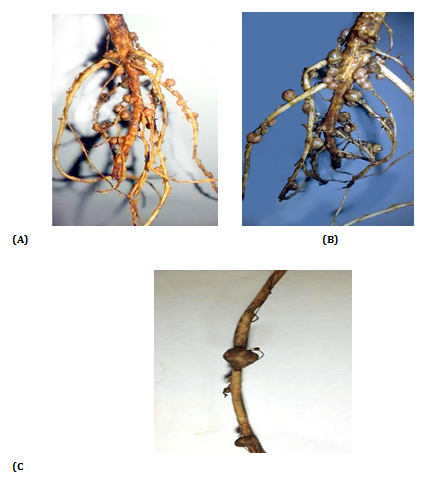
The characteristic pink coloured root nodules were recorded in the plants collected from Krishna district soils. Brown coloured nodules with white stripes were recorded in the nodules collected from Vizag, East and west Godavari and Prakhasam districts. Brown coloured nodules were observed in the soils of Nizamabad, Guntur, Anatapur, later the colour of the nodule changed from brown to pink. Nodules were mostly brown or pink indicating their effectiveness in nitrogen fixation. In all district plants, nodule size ranges from 1mm to 5 mm in diameter. In the districts of Nellore, Prakhasam, Krishna district nodules shows maximum size of 5 mm, where as in the districts of Anantapuram, Warangal, and Hyderabad nodule size is 3mm in diameter.
Prakhasam districts, and the lowest in dry weight of 0.5 mg in the nodules of Krishna district. The leg haemoglobin content of the nodules gradually increased with age of the plant from 30 DAS and reached maximum of 520 µg/g was observed in soils of Krishna district soil. Increased leghaemoglobin content of the nodules reached at 90 DAS. Similar type f positive correlation was also reported by Sindhu, et al. [6] in 6 legumes and Subba rao and Chopra [7] in Soybean, Raghava, et al. [8] (Table 1).
- Fresh weight of the each nodule was maximum with 0.59 mg in Nellore district soil and lowest fresh weight was 0.18 mg in East Godavari district soils nodule. The dry weight of each nodule was maximum of 0.31 mg in Nellore and
- Number of Nodules/ plants at 90 DAS
- Size
- Shape
- Colour
- Weight of the nodule(mg)
- Tap
- Root
- Lateral
- Roots
- Total
- Fresh dry
- S.No
- Name of the
- District leghaemoglobin
- 1
- Srikakulam
- 342
- 49
- 76
- 125
- 4-Jan
- Round
- Brown
- 0.19
- 0.09
- 2
- Viziayanagaram
- 389
- 36
- 94
- 130
- 4-Jan
- Globose
- Pink
- 0.21
- 0.09
- 3
- Visakhapatnam
- 380
- 26
- 102
- 132
- 4-Jan
- Round
- Brown colour with white stripes
- 0.29
- 0.12
- 4
- East Godavari
- 312
- 40
- 65
- 105
- 3-Jan
- Round
- Brown colour with white stripes
- 0.18
- 0.09
- 5
- West Godavari
- 408
- 35
- 70
- 105
- 4-Jan
- Globose
- Brown colour with white stripes
- 0.19
- 0.1
- 6
- Krishna
- 521
- 25
- 73
- 98
- 4-Jan
- Globose
- Pink
- 0.21
- 0.05
- 7
- Guntur
- 409
- 30
- 175
- 205
- 4-Jan
- Globose
- Brown to pink
- 0.57
- 0.15
- 8
- Prakasam
- 312
- 59
- 143
- 202
- 5-Jan
- Round
- Brown colour with white stripes
- 0.57
- 0.31
- 9
- Nellore
- 428
- 43
- 210
- 253
- 5-Jan
- Round
- Pink
- 0.59
- 0.31
- 10
- Chittoor
- 467
- 50
- 127
- 177
- 4-Jan
- Round
- Brown colour with white stripes
- 0.49
- 0.28
- 11
- Kadapa
- 420
- 29
- 110
- 139
- 4-Jan
- Globose
- Cream
- 0.45
- 0.23
- 12
- Kurnool
- 456
- 32
- 110
- 142
- 4-Jan Elongated
- Pink
- 0.4
- 0.23
- 13
- Anantapuram
- 468
- 35
- 93
- 128
- 3-Jan
- Round
- Brown to pink
- 0.39
- 0.15
- 14
- Medak
- 368
- 30
- 85
- 115
- 4-Jan
- Round
- Light green white stripes
- 0.35
- 0.18
- 15
- Ranga Reddy
- 392
- 33
- 73
- 106
- 4-Jan
- Round
- Brown
- 0.25
- 0.1
- 16
- Warangal
- 332
- 30
- 71
- 101
- 3-Jan
- Round
- Brown
- 0.24
- 0.13
- 17
- Khammam
- 332
- 35
- 70
- 105
- 4-Jan
- Round
- Brown to pink
- 0.29
- 0.12
- 18
- Nizamabad
- 444
- 40
- 93
- 133
- 4-Jan Irregular
- Brown to Pink
- 0.39
- 0.14
- 19
- Mehaboob Nagar
- 469
- 41
- 70
- 111
- 4-Jan
- Round
- Brown to pink
- 0.42
- 0.28
- 20
- Nalgonda
- 481
- 31
- 76
- 107
- 4-Jan
- Round
- Brown
- 0.31
- 0.18
- 21
- Acharya Nagarjuna
- University
- 401
- 26
- 72
- 98
- 3-Jan
- Round
- Brown colour with white stripes
- 0.35
- 0.15
- 22
- Hyderabad
- 407
- 19
- 71
- 90
- 3-Jan
- Round
- Brown
- 0.34
- 0.18
- 23
- Karim Nagar
- 403
- 21
- 83
- 104
- 4-Jan
- Round
- Brown
- 0.39
- 0.18
- 24
- Khammam
- 520
- 52
- 181
- 233
- 5-Jan
- Round
- Brown
- 0.57
- 0.15
- 25
- Adilabad
- 412
- 20
- 80
- 100
- 4-Jan Irregular
- Brown
- 0.39
- 0.15
Table 1: Comparative account on Root Nodule characters of Vigna trilobata plants raised in all districts soils of Andhra Pradesh.
Discussion
The nodulation characteristics of Vigna trilobata cultivars including number, distribution of nodules, size, shape, color, fresh weight and dry weight of nodule were recorded at regular intervals from 40 to 90 days after sowing. All the 25 cultivars of V. trilobata showed much variation in nodulation characteristics. The nodules were distributed both on tap root and lateral roots. In general more number of nodules was present on taproot Kahn, while many more nodules were formed on “secondary roots” of cowpea. There is a evidence in our research the largest nodules from the cultivars, the isolated rhizobia produced maximum amount of exopolysaccharides and phosphate solubilizers Kumar GK and Ram MR [9, 10].
The root nodules of V. trilobata are round to oval type at the early stage but become elongated with increase in age. Among the cultivars studied the average of nodules/plant was more (253 nodules/plant) at 90 DAS, was recorded in cultivars. The number of nodules per plant was 98 and 90 in the cultivars from Krishna and Hyderabad soils respectively. However, much low number of nodules per plant in the range of 22 - 47 was reported in V. trilobata when inoculated with different Australian Rhizobial strains [11]. Sharma, et al. [12] studied the nodulation and fresh weight of nodules/plant in V. radiate [13, 14].
Conclusion
The present study reveals that the nodulation characteristics like number of nodules, size, colour and shape of the nodules were varied from cultivar to cultivar. Maximum number and size of the nodules were represented for further studies like isolation of rhizobium and its characterization.
Acknowledgments
The authors are thankful to Maris Stella College for providing necessary facilities to complete this research work.
References
-
Allen ON, Allen EK (1981) The Leguminoseae. A source of characteristics, uses and nodulation. In: Vandebroek I (Ed.), Economic Botany. University of Wisconsin Press, Madison, pp: 812.
-
Wills JC (1958) A dictionary of the flowering plants and ferns. 4th (Edn.), Cambridge University Press, UK.
-
Tu JC, Ford RE, Garu CR (1970) Some factors affecting the nodulation and nodule efficiency in soybean infected by soybean mosaic virus. Phytopathology 60: 1653-1656.
-
Anegbah PO, Tachoundjeu Z, Amakiri MA (2003) Characteristics of Nodules of agroforestry tree legumes for sustainable production in Niger Delta Region, Nigeria. Improvement and culture of Nitrogen fixing trees 3(1): 2-3
-
Arya MPS, Singh R (1996) Effect of N, P and K, on the nodulation, growth and yield characters of horse gram (Macrotyloma uniflorum (Lam) Verdc.). Legume Research 19: 65-69.
-
Sindhu GS, Singh N, Singh R (1967) Symbiotic nitrogen fixation by some summer (kharif) legumes of Punjab. 1. Role of leghaemoglobin in nitrogen fixation. J Res Punjab Agric University 4(2): 244-248.
-
Subba NSR, Chopra CL (1967) Leghaemoglobin and its role in symbiotic nitrogen fixation. J Sci Ind Res 26: 329- 332.
-
Raghava N, Raghava RP, Kumar P (1993) Protein and leghaemoglobin content in nodules in relation to flowering and pod formation in Vigna unguiculcta L. Walp. Indian J Plant Physiology 36: 67-68.
-
Kumar K, Ram MR (2014) Effect of carbon and nitrogen sources on exopolysacharide production by rhizobial isolates from root nodules of Vigna trilobata. Afr J Microbiol Res 8(22): 2255-2260.
-
Kumar GK, Ram MR (2014) Phosphate solubilizing rhizobia isolated from Vigna trilobata. Am J Microbiol Res 2(3): 105-109.
-
Zaroung MG, Munnus DN (1980) Screening strains of Rhizobium for the tropical legumes Clitoria ternate and Vigna trilobata in soils of different pH. Zaroug and Munns--Rhizobium for Clitoria and Vigna 14(1): 28-33.
-
Ramani S, Shaikh MS, Joshua DC (1990) Nodulation, biomass and nitrogen content in Sesbania species. Plant and Soil 128: 221-223.
-
Sadasivam S, Manickam A (1992) Biochemical methods. New age international (P) Ltd., Agricultural University, Coimbatore, Tamil Nadu, India, pp: 256.
-
Vincent JM (1970) A manual for the practical study of Root Nodule Bacteria. IBP Handbook No. 51, Blackwell Scientific Publications, Oxford, pp: 164.
- Antifungal Activity of New Acetophenone Derivatives
- Interconnected Microbiomes Human Health Within an Environmental Framework
- Silkworm-Based Vaccine Production for H5N1: A One Health Approach to Pandemic Preparedness
- Microbial Diversity and Lipolytic Activity of Bacteria and Fungi from Oil-Contaminated Sites in Makurdi Metroplois
- Antibiotic Resistance Profile of Bacteria Isolated at the Central Laboratory of the National Hospital Center of Nouakchott
- Epidemiology and Sensitivity to Antibiotics of Germs Isolated from Blood Cultures in the Laboratory of the National Hospital Center of Nouakchott-Mauritania