
Anthropogenic Changes in Land Use Impact the Emergence and Transmission of Infectious Diseases
Human interventions in natural landscapes have promoted rapid and profound transformations in the environment, generating great impacts at different levels, including on human and animal health. Actions such as deforestation for logging, intensive agriculture, construction of large hydroelectric dams, pastures for cattle, mining, and construction of roads that favor human access to remote areas have promoted habitat destruction, changes in trophic chains due to nutritional factors, loss of biodiversity, changes in the natural balance of vectors, mammals, hosts and pathogen reservoirs, and closer human contact with wildlife. Another important impact related to changes in land use is forest and habitat fragmentation. According to different investigations, anthropogenic actions causing changes in land use are potential inducers of emergence/reemergence and increased transmission of infectious diseases in the world, including those with pandemic potential. Most of these diseases are classified as zoonoses and many are arboviruses. Deforestation and agricultural intensification seem to be the events that most influence the incidence of zoonoses. Changes in land use may also favor a species jump to a zoonotic pathogen, making it a potential threat to humanity if it acquires an efficient capacity for inter-human transmission. Here, we summarize important evidence on how anthropogenic changes in land use influence the emergence and transmission of infectious diseases to humans.
Introduction
The ongoing models of economic production, changes in land use, and industrial development have disturbed the planet’s homeostasis and generated alarming signals in different environmental spheres. Examples of such processes are the increase in global temperature, losses in biodiversity, imbalances in food chains, rising ocean levels, depletion of natural resources, and chemical contamination of water, soil and food. As for anthropogenic changes in land use, one of the consequences is the emergence and re-emergence of several infectious diseases. The term land use change refers to a process by which human activities transform the natural landscape, in particular the way land has been used, generally emphasizing its functional role for economic activities [1]. These transformations promote changes in biodiversity, and in addition to representing loss of genetic heritage, they may increase the risk of communicable diseases, as they involve important interactions between species [2]. Among other factors, most emerging infectious diseases have as a key event a change in ecology involving parasites and hosts. Such changes may lead to pathogen evolutionary processes that allow increased transmission between individual hosts, increased contact with new populations or host species, and selective processes that make certain strains of pathogens adapt to new dominant environmental conditions [3]. This mini review aims to present an overview of the main types of anthropogenic changes in land use and their effects on increasing the risk of transmission, emergence and re- emergence of important zoonotic diseases.
Main Types of Land Use Change that Impact Infectious Diseases and the Mechanisms Involved in It
Actions such as deforestation, intensive agriculture, urbanization, expansion of agricultural frontiers to regions with highly complex biomes, replacement of native forests for pastures, mining, and large-scale irrigation processes promote profound changes in the biophysical environment, destruction of habitats, disorganization of ecosystems, disturbances in the structure of aquatic and soil microbial communities, and changes at multiple levels of equilibrium relationships involving parasites, vectors, reservoir animals, and susceptible hosts. Such changes largely influence the risk of diseases for humans, especially those of a zoonotic nature, since the diversity of zoonotic hosts increases in ecosystems dominated by humans [4]. According to the World Health Organization, more than 200 communicable diseases are characterized as zoonoses [5]. Such diseases account for almost two-thirds of emerging infectious diseases and more than 70% of them originate from wildlife [6]. The encroachment of humans into wild environments may result in human infection by zoonotic viral pathogens through two phenomena: spillover and species jumps. According to Flanagan, et al. [7], in a spillover event the susceptible individual is infected but is rarely exposed to the zoonotic viral agent, which may lead to incidental human outbreaks but without a sustained inter-human transmission. In species jumps, genetic changes occurring in the virus ensure an efficient inter-human transmission/spreading.
Among the events of anthropogenic land use change, deforestation and agricultural intensification stand out for exerting a strong influence on the incidence of zoonoses as they promote destruction or a drastic modification of natural habitats and home ranges of different species. Furthermore, such anthropogenic actions alter the behavior of many pathogen hosts, forcing them to live closer to humans.
Tropical forests, with high mammal diversity, which are exposed to land use change pose a higher risk as for the emergence of zoonotic diseases [8]. In the case of large- scale deforestation, the implications for emerging infectious diseases seem to be a most immediate event [9]. For example, Burkett-Cadena [10] showed an association of 87 mosquito species from different countries with deforested habitats amounting to 52.9%; of these favored species, 56.5% are confirmed vectors of human pathogens compared to only 27.5% of species negatively impacted by deforestation.
A probable link between anthropogenic changes in land use and the recent Covid-19 pandemic – a virus that appears to have emerged from bats as the primary reservoir and pangolins as intermediate hosts – illustrates the urgent need to understand how human action impacting natural environments may affect the risk of transmission of zoonotic diseases. Bats are hosts to a wide range of microorganisms and more than 200 viruses have been associated with them, many of which are considered emerging human pathogens [11]. By affecting bat populations and communities, deforestation may have major impacts on the emergence and circulation of infectious diseases [12]. For example, the clearing of forests to establish cattle pastures may reduce the populations of wild prey on vampire bats, resulting in outbreaks of bovine rabies and increasing the contact of the rabies virus with humans [13]. Furthermore, if the flock is suddenly moved to other regions, the scarcity of food available to bats may make these animals seek food from residents of the region and thus result in outbreaks of human rabies.
In addition to the installation of pastures in wild areas for extensive livestock farming, industrial farming systems with a large number of animals confined in a small physical space, often interconnected with residential areas, facilitate the transmission of pathogens, with particularly high risks for workers and neighbors. Also, a potential consequence for public health is that the frequent use of antibiotics in livestock farming for therapeutic or prophylactic purposes may result in the emergence of bacterial pathogens resistant to different types of antimicrobials, which can be transmitted to the human population [14]. Pig farming is a special source of concern and there is a stronger need for surveillance as pigs are frequently intermediate hosts in the transmission of the Influenza A virus. Wild birds are the primary reservoirs of Influenza A, whose segmented RNA genome facilitates genetic reassortment when two different viral subtypes infect the same cell. Avian influenza viruses have difficulty replicating in humans due to the lack of cellular receptors for viral binding. However, pigs have cellular receptors for both aviary and human Influenza, which may result in the emergence of pandemic strains with a capacity for an efficient inter-human transmission and a high lethality [15].
Agriculture based on irrigation and flooding of large areas, such as those for rice production, is another factor that consistently exacerbates risks for infectious diseases. For example, the changes introduced into the environment by this method of cultivation may expand the reproduction habitats of vectors such as Culex, favoring the occurrence of outbreaks of arboviruses, such as Japanese encephalitis [16]. Gilbert, et al. [17] hypothesized that changes in land use in northeastern China, which had vast areas planted with rice fields between 2000 and 2005, affected the spatial distribution of wild aquatic birds, their home ranges, and the domestic-wild interface, thus changing the transmission dynamics of the H5N1 virus on a regional and intercontinental scale. Also, the construction of large dams creates a new watery landscape, potentially modifying the transmission of diseases transmitted by mosquito vectors, such as the Rift Valley Fever [18].
The impacts of activities such as intensive agriculture are relatively well characterized in some sectors, such as those related to accounting for carbon emissions and biodiversity loss. However, its effects on human health are less known. Based on this premise, Shah, et al. [19] investigated the relationship between intensive agriculture and infectious diseases in Southeast Asia and concluded that people residing or working on agricultural lands are almost twice as likely to be infected with a pathogen as the unexposed control group. Effects are more pronounced in certain forestry monocultures and livestock farming.
According to the comprehensive review of Gottdenker, et al. [20], in addition to deforestation and agriculture/livestock, forest and habitat fragmentation are events related to land use changes that most commonly affect the transmission of infectious diseases in the world. In their study, around 60% of the publications investigated documented an increase in the abundance and/or transmission of pathogens in response to changes in the environment. Changes to the niches of the vector, host or pathogen, changes in community structure (for example, in diversity or species composition), and changes in behavior, movement and spatial distribution of vectors and/or hosts were identified as mechanisms that affect the transmission of infectious diseases [20]. However, conversely, in some cases, decreases in the transmission of certain infectious diseases may occur in response to changes in land use, for example if such change negatively affects the abundance of reservoir mammals. Similarly, this may occur if a non-human food source is made available to a vector. For example, the introduction of livestock into agricultural areas may have a zoo prophylactic effect on the transmission of malaria by Anopheles arabiensis [20, 21]. On the other hand, Shah, et al. [19] found consistent positive associations between livestock farming and differing disease classes, whereby exposure to livestock may result in two to four times the risk of being infected with vector-borne, bacterial or zoonotic diseases. These contradictory results probably reflect the complexity and particularities inherent to interactions involving different types of vectors, pathogens, reservoirs, hosts, and transformations in natural landscapes.
Fragmentation of Forests, Loss of Biodiversity and Infectious Diseases
The forest fragmentation event mentioned above refers to a process of change at the landscape level over time. It is characterized by a decrease in the size of forest patches combined with an increase in the number of patches and the formation of other forest edges [22]. Fragmentation results from anthropogenic actions of land use change, and deforestation is its main cause [23]. Fragmented areas result from the division of a continuous habitat, which begins to present different conditions in their surroundings and may become more or less isolated. Forest fragmentation is considered one of the main drivers of global biodiversity loss and ecosystem degradation [22]. Such changes affect the structure of communities of hosts, reservoirs, and vectors that reside in the area and represent an important cause of biodiversity loss, a factor that increases the risk of zoonotic diseases.
The decrease in biodiversity in a fragmented area of forest may favor the isolation and increase in the density of a certain reservoir animal (such as monkeys in relation to the Sylvatic yellow fever virus), as well as the vector that preferentially feeds on this animal, thus facilitating greater circulation of the pathogen. For example, studies have shown an increase in the incidence of Lyme disease in an area of forest fragmentation in North America [24] and of Brazilian spotted fever in an area of decrease in wild vertebrates due to deforestation/fragmentation of the Atlantic Forest in São Paulo [25]. Both are diseases transmitted by ticks; the first is caused by the bacteria Borrelia burgdorferi and the second by Rickettsia rickettsia.
Another scenario that favors the local expansion of epidemic zoonotic diseases is the edges of preserved vegetation fragments. These regions, markedly influenced by the modified surrounding environment, are often ecologically different from the interior of the fragment, generating the so- called “edge effect.” Such changes in the remaining habitat are an important cause of changes in biological communities and biodiversity. Populations residing close to the edges of deforested forests are at greater risk of acquiring zoonotic diseases due to greater contact with vectors and reduced biodiversity in these habitats [26]. The spread of pathogens across fragmented landscapes can be influenced by the degree of connectivity between them. Wilk-da-Silva, et al. [27] showed that areas with more fragmented landscapes and greater edge density, but with a high degree of connectivity between forest patches, favor the spread of the yellow fever virus.
Events that promote loss of biodiversity also include the illegal trade of animals and the creation of road networks into areas that are more difficult to access, increasing hunting pressure on wildlife populations [28]. Despite much evidence of an association between loss of biodiversity due to anthropogenic changes in the landscape and a consequent increase in the risk of zoonotic infectious diseases [29], there are also hypotheses that link greater biodiversity to a greater risk of emerging infectious diseases, considering that a greater diversity of hosts such as mammals is correlated with a greater diversity of pathogens [6, 30]. However, as reviewed by Hosseini, et al. [31] this relationship is indirect and should not be disconnected from the impacts resulting from anthropogenic actions critical to the emergence of infectious diseases in human and livestock populations.
Regarding the mechanisms of the correlation between greater biodiversity and lower risk for transmission of infectious diseases, an interesting model called “dilution effect” postulates that host diversity is a factor that may inhibit the abundance of the pathogen [29]. In other words, contrary to what occurs with loss of biodiversity, a high diversity of species tends to dilute the interactions between host-pathogen-environment and vectors, thus reducing the risk of pathogen transmission for established and emerging diseases.
To better understand the dilution effect on disease transmission, let us take as an example a habitat with high biodiversity where a vector can feed both on an animal considered a good host for a given viral pathogen and on various animals that are not competent to maintain it. When feeding on the latter, the vector will not be infected or will have a viral load so low that it will prevent the transmission of the virus when this vector feeds on humans. Greater biodiversity may also result in the occurrence of animals that are less permissive towards a vector, removing or eliminating it when it tries to feed and thus reducing the pathogen’s circulation dynamics. It is also necessary to consider that certain primary hosts for some pathogens are more ecologically resilient and increase in abundance when biodiversity is lost [2].
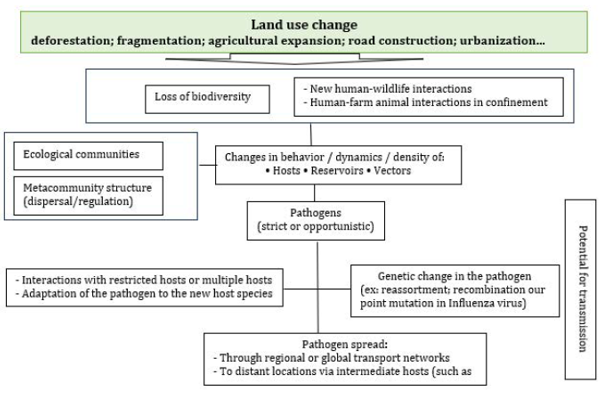
Gibb, et al. [4] showed how zoonotic host diversity increases in human-dominated ecosystems and how land use has global and systematic effects on local zoonotic host communities. Based on ecological modeling and database investigations spanning thousands of the world’s ecological communities and hundreds of host species, the authors concluded that wild hosts of human-shared pathogens and parasites predominate in locations subjected to substantial anthropogenic impact, such as secondary and agricultural ecosystems, compared to nearby undisturbed habitats. The magnitude of this effect has taxonomic variations but is stronger in zoonotic host species of rodents, bats and birds, suggesting that this is a factor that supports the global importance of these taxa as zoonotic reservoirs. According to the authors, the global expansion of agricultural and urban land predicted in the coming decades could create increasingly dangerous interfaces for exposure to zoonotic pathogens. Figure 1 illustrates the main factors and systems associated with changes in land use and the transmission of zoonotic disease.
Conclusion
Many studies have consistently associated the influence of different types of anthropogenic land use changes with the emergence and spread of infectious diseases and described transmission chains with the main pathogens/ hosts/vectors and their interactions. However, the number of experimental investigations carried out with the purpose of unveiling the specific mechanisms related to land use that determine the emergence/transmission of infectious diseases is scarce compared to the number of observational, review or conceptual studies [20]. It is also important to expand studies on the prevalence of infection at a local and regional level, regarding anthropogenic changes in the environmental landscape, using a metacommunity approach. Metacommunities are sets of communities connected through the dispersal of multiple potentially interactive species [32], encompassing sets of hosts and non-hosts that interact and affect the dissemination and transmission of pathogens [33]. Suzán, et al. [33] argue that the metacommunity represents an integrative framework for understanding disease ecology since the distribution, dynamics, persistence, prevalence, and outbreaks of infectious diseases of wildlife depend on the ecological and phylogenetic diversity in a set of interconnected communities.
Better understanding the mechanisms by which such changes influence and predispose to a greater risk of disease is a major challenge that does not seem capable of being resolved if it falls under the responsibility of a single scientific discipline. This path will certainly be followed more consistently if it also combines experimental studies with modeling analyses and uses a multidisciplinary approach, involving strategies and research projects constructed jointly by microbiologists, epidemiologists, molecular biologists, ecologists, social scientists, and other researches.
Conflicts of Interests
The author declares that there is no conflict of interests.
References
-
Paul BK, Rashid H (2017) Land use change and coastal management. In: Paul BK, Rashid H (Eds.), Climatic Hazards in Coastal Bangladesh. 1st(Edn.), Elsiever, Amsterdam, Netherlands, pp: 183-207.
-
Keesing F, Belden LK, Daszak P, Dobson A, Harvell CD, et al. (2010) Impacts of biodiversity on the emergence and transmission of infectious diseases. Nature 468(7324): 647-652.
-
Daszak P, Cunningham AA, Hyatt AD (2001) Anthropogenic environmental change and the emergence of infectious diseases in wildlife. Acta Trop 78(2): 103-116.
-
Gibb R, Redding DW, Chin KQ, Donnelly CA, Blackburn TM, et al. (2020) Zoonotic host diversity increases in human-dominated ecosystems. Nature 584(7821): 398- 402.
-
WHO (2020) Zoonoses.
-
Jones KE, Patel NG, Levy MA, Storeygard A, Balk D, et al. (2008) Global trends in emerging infectious diseases. Nature 451(7181): 990-993.
-
Flanagan ML, Parrish CR, Cobey S, Glass GE, Bush RM, et al. (2012) Anticipating the species jump: surveillance for emerging viral threats. Zoonoses Public Health 59(3): 155-163.
-
Allen T, Murray KA, Zambrana-Torrelio C, Morse SS, Rondinini C, et al. (2017) Global hotspots and correlates of emerging zoonotic diseases. Nat Commun 8(1): 1124.
-
Sehgal RNM (2010) Deforestation and avian infectious diseases. J Exp Biol 213(6): 955-960.
-
Burkett-Cadena ND, Vittor AY (2018) Deforestation and vector-borne disease: Forest conversion favors important mosquito vectors of human pathogens. Basic Appl Ecol 26: 101-110.
-
Allocati N, Petrucci AG, Giovanni PD, Masulli M, Ilio CD, et al. (2016) Bat-man disease transmission: zoonotic pathogens from wildlife reservoirs to human populations. Cell Death Discov 2: 16048.
-
Willig MR, Presley SJ, Plante JL, Bloch CP, Solari S, et al. (2019) Guild-level responses of bats to habitat conversion in a lowland Amazonian rainforest: species composition and biodiversity. J Mammal 100(1): 223- 238.
-
Andrade EA, Monteiro FDO, Solori MR, Raia VA, Xavier DA, et al. (2020) Livestock rabies in Para state, Brazil: a descriptive study (2004 to 2013). Pesq Vet Bras 40(4): 234-241.
-
Smit LAM, Heederik D (2017) Impacts of Intensive Livestock Production on Human Health in Densely Populated Regions. Geohealth 1(7): 272-277.
-
Zhou NN, Senne DA, Landgraf JS, Swenson SL, Erickson G, et al. (1999) Genetic reassortment of avian, swine, and human influenza A viruses in American pigs. J Virol 73(10): 8851-8856.
-
Keiser J, Maltese MF, Erlanger TE, Bos R, Tanner M, et al. (2005) Effect of irrigated rice agriculture on Japanese encephalitis, including challenges and opportunities for integrated vector management. Acta Trop 95(1): 40-57.
-
Gilbert M, Prosser DJ, Zhang G, Artois J, Dhingra MS, et al. (2017) Could Changes in the Agricultural Landscape of Northeastern China Have Influenced the Long-Distance Transmission of Highly Pathogenic Avian Influenza H5Nx Viruses? Front Vet Sci 4: 225.
-
Dzingirai V, Bukachi S, Leach M, Mangwanya L, Scoones I, et al. (2017) Structural drivers of vulnerability to zoonotic disease in Africa. Philos Trans R Soc Lond B Biol Sci 372(1725): 20160169.
-
Shah HA, Huxley P, Elmes J, Murray KA (2019) Agricultural land-uses consistently exacerbate infectious disease risks in Southeast Asia. Nature Communications 10: 4299.
-
Gottdenker NL, Streicker DG, Faust CL, Carroll CR (2014) Anthropogenic land use change and infectious diseases: a review of the evidence. Ecohealth 11(4): 619-632.
-
Mutero CM, Kabutha C, Kimani V, Kabuage L, Gitau G, et al. (2004) A transdisciplinary perspective on the links between malaria and agroecosystems in Kenya. Acta Trop 89(2): 171-186.
-
Ma J, Li J, Wu W, Liu J (2023) Global forest fragmentation change from 2000 to 2020. Nat Commun 14(1): 3752.
-
Fischer R, Taubert F, Müller MS, Groeneveld J, Lehmann S, et al. (2021) Accelerated forest fragmentation leads to critical increase in tropical forest edge area. Sci Adv 7(37): eabg7012.
-
Killilea ME, Swei A, Lane RS, Briggs CJ, Ostfeld RS (2008) Spatial dynamics of lyme disease: a review. Ecohealth 5(2): 167-195.
-
Scinachi CA, Takeda GACG, Mucci LF, Pinter A (2017) Association of the occurrence of Brazilian spotted fever and Atlantic rain forest fragmentation in the São Paulo metropolitan region, Brazil. Acta Trop 166: 225-233.
-
Gottwalt A (2013) Impacts of Deforestation on Vector- borne Disease Incidence. The Columbia University Journal of Global Health 3(2): 16-19.
-
Wilk-da-Silva R, Prist PR, Medeiros-Sousa AR, Laporta GZ, Mucci LF, et al. (2023) The role of forest fragmentation in yellow fever virus dispersal. Acta Trop 245: 106983.
-
Terraube J, Fernández-Llamazares Á (2020) Strengthening protected areas to halt biodiversity loss and mitigate pandemic risks. Curr Opin Environ Sustain 46: 35-38.
-
Ostfeld RS, Keesing F (2012) Effects of host diversity on infectious disease. Annu Rev Ecol Evol Syst 43: 157-182.
-
Wood CL, Lafferty KD, DeLeo G, Young HS, Hudson PJ, et al. (2014) Does biodiversity protect humans against infectious disease? Ecology 95(4): 817-832.
-
Hosseini PR, Mills JN, Prieur-Richard AH, Ezenwa VO, Bailly X, et al. (2017) Does the impact of biodiversity differ between emerging and endemic pathogens? The need to separate the concepts of hazard and risk. Philos Trans R Soc Lond B Biol Sci 372(1722): 20160129.
-
Wilson DS (1992) Complex interactions in metacommunities, with implications for biodiversity and higher levels of selection. Ecology 73(6): 1984-2000.
-
Suzán G, García-Peña GE, Castro-Arellano I, Rico O, Rubio AV, et al. (2015) Metacommunity and phylogenetic structure determine wildlife and zoonotic infectious disease patterns in time and space. Ecol Evol 5(4): 865- 873.
- Antifungal Activity of New Acetophenone Derivatives
- Interconnected Microbiomes Human Health Within an Environmental Framework
- Silkworm-Based Vaccine Production for H5N1: A One Health Approach to Pandemic Preparedness
- Microbial Diversity and Lipolytic Activity of Bacteria and Fungi from Oil-Contaminated Sites in Makurdi Metroplois
- Antibiotic Resistance Profile of Bacteria Isolated at the Central Laboratory of the National Hospital Center of Nouakchott
- Epidemiology and Sensitivity to Antibiotics of Germs Isolated from Blood Cultures in the Laboratory of the National Hospital Center of Nouakchott-Mauritania