
Retrospective Study on the Efficacy of Homoeopathic Medicines in the Treatment of Acute Rhinitis
Acute Rhinitis is estimated to affect more than 200 million people worldwide. Approximately 30% of adults and 40% of the children are affected with Rhinitis. The 30 cases diagnosed with Acute rhinitis were taken from the OPD of Sarada Krishna Homoeopathic Medical college and Hospital. Analysis of cases was based on the Acute totality and medicines were selected accordingly. 19 to 40 age groups are mostly affected. Females are most commonly affected. Bryonia alba was the most indicated medicine for Acute rhinitis. The 200th potency was the most prescribed potency. Duration of the treatment was minimum 1 day and maximum of 2 weeks. Most of the cases selected for the study shows significant improvement. Thus, Homoeopathic medicines are very much effective in the treatment of Acute Rhinitis.
Introduction
Acute Rhinitis is estimated to affect more than 200 million people worldwide. Approximately 30% of adults and 40% of the children are affected with Rhinitis. Acute rhinitis presents with sneezing, nasal congestion, watery nasal discharge. The purpose of this retrospective study was to find the efficacy of homoeopathic medicines in the treatment of acute rhinitis [1].
Rhinitis is a reaction that happens in the eyes, nose, and throat when allergens in the air trigger histamine to be released in the body. Some of the most common causes of rhinitis are pollen, dust mites, mold, cockroach waste, animal dander, fumes and odors, hormonal changes, and smoke. Symptoms of rhinitis include: sneezing, stuffy, runny, and itchy nose, and itchy throat, eyes, and ears, nosebleeds, clear drainage from the nose, ear infections that keep coming back, snoring, breathing through the mouth, and tiredness [2].
Rhinitis is typically triggered by environmental allergens such as pollen, pet hair, dust, or mold. Inherited genetics and environmental exposures contribute to the development of allergies. Growing up on a farm and having multiple siblings decreases this risk. The underlying mechanism involves IgE antibodies that attach to an allergen, and subsequently result in the release of inflammatory chemicals such as histamine from mast cells. It causes mucous membranes in the nose, eyes and throat to become inflamed and itchy as they work to eject the allergen [3].
Diagnosis is typically based on a combination of symptoms and a skin prick test or blood tests for allergen- specific IgE antibodies. These tests, however, can be falsely positive [4]. The current study deals with the effectiveness of homoeopathic medicines in the treatment of acute rhinitis.
Materials and Methods
A sample of 30 cases of Acute rhinitis were taken from the OPD of Sarada Krishna Homoeopathic Medical college and Hospital. Cases were analyzed and the improvements were assessed. Assessments of the symptomatology of each case were done before and after the treatment using Rhinitis Symptom severity assessment score.
Inclusion Criteria
Patients aged 4 to 80 years of age of both sexes and of all socio-economic groups were included.
Exclusion Criteria
Patients below 4 years and above 80 years were excluded.
Data Collection
The 30 cases were collected based on the pre structured Sarada Krishna Homoeopathic Medical college and Hospital case format. The changes in the symptoms were noted based on the Rhintis assessment score.
Results and Discussion
From the 30 cases selected for the study, 19 to 40 age groups are mostly affected. Females are most commonly affected. Bryonia alba was the most indicated medicine for Acute rhinitis. The 200th potency was the most prescribed potency. Duration of the treatment was minimum 1 day and maximum of 2 weeks.
Age
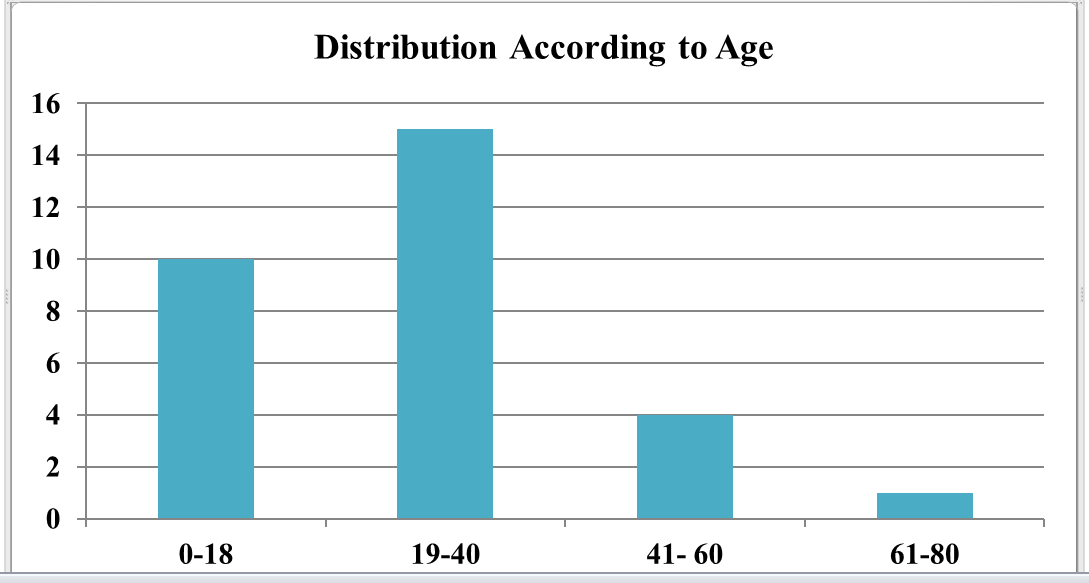
Analysis of the 30 cases shows that 19-40 is the age group mostly affected with Acute rhinitis. 15 out of 30 cases (50%) cases are affected (Figure 1).
Sex
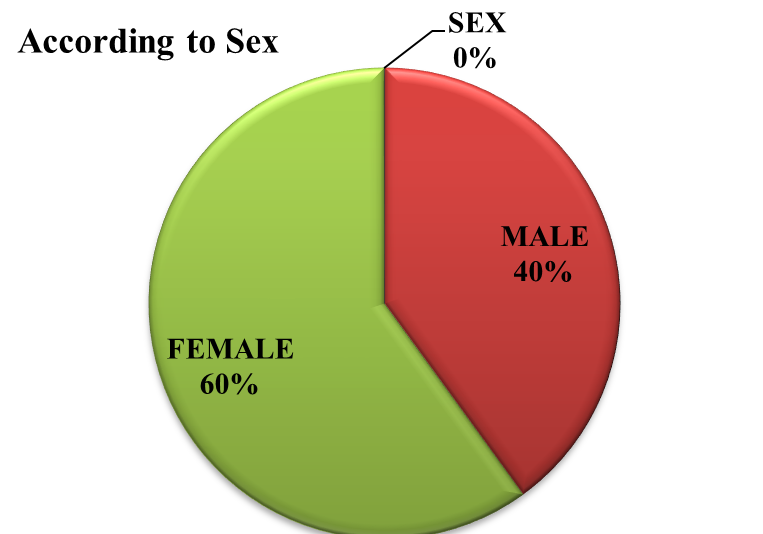
The complete analysis of the study with 30 samples shows the female predominance by 20%. Totally 60% of the samples contains females according to the study (Figure 3). This is compared with the study of E Hak and MM Rovers on the incidence GP of URTI with age, gender. Females had slightly higher incidence rates of URTI (relative risk 1.4, 95% CI 1.35–1.45) [5].
Duration of Complaint
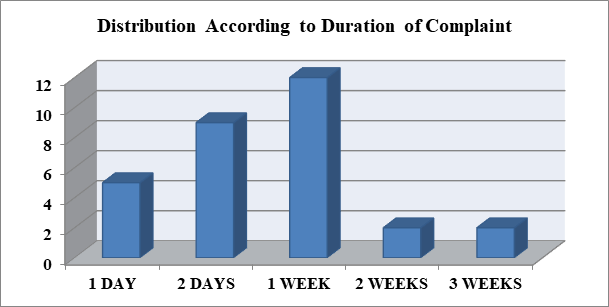
The analysis shows more spike duration of complaint as 1 week (Figure 2). The maximum of 12 cases had 1 week duration (Table1). This is compared with the result of a retrospective study of non-specific rhinitis in 22 cats and the value of nasal cytology and histopathology by Michel and M Day. Mucosal biopsy specimens were obtained in 20 cases. Despite clinical signs of more than 4 weeks duration, histopathology indicated acute inflammation in four cases [6].
Improvement
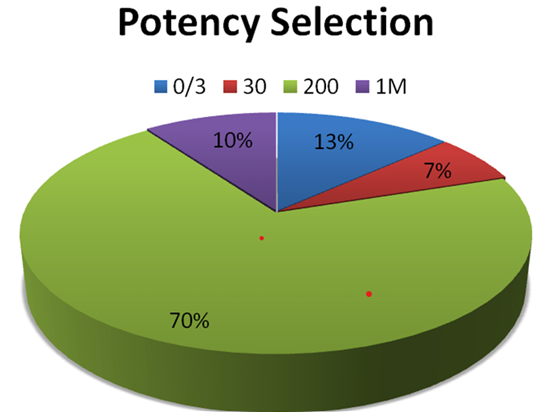
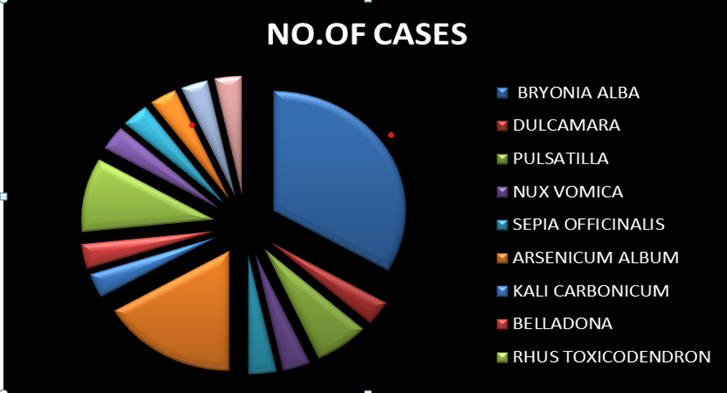
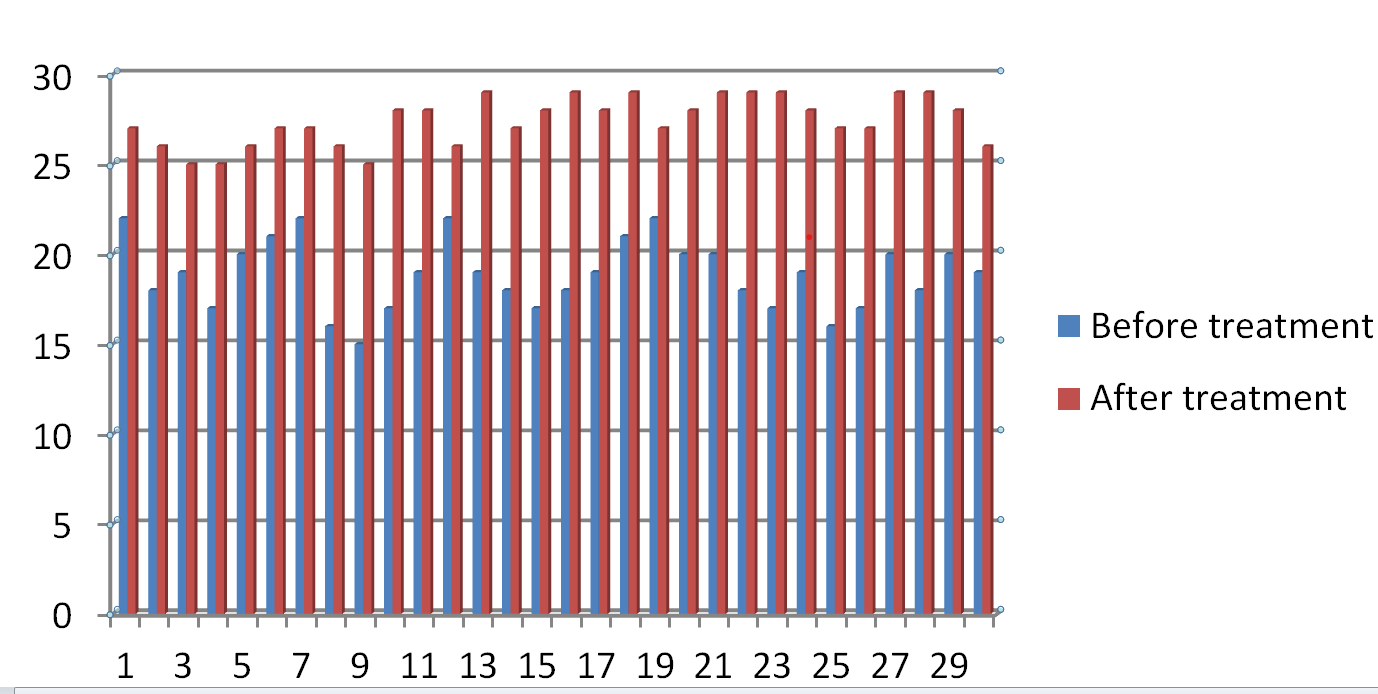
According to the study, most of the cases were indicated with Bryonia alba (Figure 5; Table 2). The 200th potency is most frequently administered (Figure 4; Table 3). This is compared with the study of Homoeopathic medicines for the Upper respiratory infection in children done by Nita M. Chandran. The results of the study indicated statistically significant differences (p < 0.001%, t-test and Wilcoxon non- parametric test) in the two data sets in favour of homoeopathic treated cases [7]. The improvement assessment was done with Rhinitis assessment score. The Figure 6; Table 4 shows the significant improvement of the cases.
| Duration | Number of Cases |
|---|---|
| 1 day | 5 |
| 2 days | 9 |
| 1 week | 12 |
| 2 weeks | 2 |
| 3 weeks | 2 |
Table 1: Showing the Duration of affection of the Complaint.
| Potency | No of Cases in Percentage |
|---|---|
| 0/3 | 13 |
| 30 | 7 |
| 200 | 70 |
| 1M | 10 |
Table 2: Showing the most commonly used Potency in Acute Cases.
| Remedies | Number of Cases |
|---|---|
| Bryonia alba | 11 |
| Dulcamara | 1 |
| Pulsatilla | 4 |
| Nux vomica | 1 |
| Sepia officinalis | 1 |
| Arsenicum album | 7 |
| Kaliumcarbonicum | 1 |
| Belladonna | 1 |
| Rhustoxicodendron | 3 |
Table 3: Showing the most commonly used Homoeopathic Remedies for Acute Rhinitis.
| Before Treatment | After Treatment |
|---|---|
| 22 | 27 |
| 18 | 26 |
| 19 | 25 |
| 17 | 25 |
| 20 | 26 |
| 21 | 27 |
| 22 | 27 |
| 16 | 26 |
| 15 | 25 |
| 17 | 28 |
| 19 | 28 |
| 22 | 26 |
| 19 | 29 |
| 18 | 27 |
| 17 | 28 |
| 18 | 29 |
| 19 | 28 |
| 21 | 29 |
| 22 | 27 |
| 20 | 28 |
| 20 | 29 |
| 18 | 29 |
| 17 | 29 |
| 19 | 28 |
| 16 | 27 |
| 17 | 27 |
| 20 | 29 |
| 18 | 29 |
| 20 | 28 |
| 19 | 26 |
Table 4: Showing the improvement score of the cases.
Conclusion
The 30 cases diagnosed with Acute rhinitis were taken from the OPD of Sarada Krishna Homoeopathic Medical college and Hospital. Analysis of cases was based on the Acute totality and medicines were selected accordingly. From the study, 19 to 40 was the most affected age group with Acute rhinitis. Females were affected. Bryonia alba was the most frequently used medicine and 200C is the potency used frequently. Most of the cases selected for the study shows significant improvement. Thus, from this study Homoeopathic medicines are very much effective in the treatment of Acute Rhinitis.
Acknowledgment
I would like to express my sincere gratitude and appreciation to the management of Sarada Krishna Homoeopathic Medical College and Hospital (www.skhmc. org) in Kulasekharam for their invaluable support throughout the entire study. Their unwavering commitment to promoting research and academic excellence has been instrumental in the successful completion of this manuscript. I would also like to extend my heartfelt thanks to the faculty members and staff of Sarada Krishna Homoeopathic Medical College for their guidance, expertise, and assistance throughout the study. Their valuable insights and contributions have greatly enriched the quality of our research. Lastly, I would like to express my deepest appreciation to all the individuals who were directly or indirectly involved in this project. Your dedication, support, and collaboration have been vital in the successful completion of this manuscript.
References
-
Das Krishna KV (2017) Textbook of Medicine. In: 6th (Edn.), Jaypee Brothers Medical Publishers (P) Ltd, Kerala, India, pp: 975-998.
-
(2022) Rhinitis. Johns Hopkins Medicine.
-
Quillen DM, Feller DB (2006) Diagnosing rhinitis: allergic vs nonallergic. American family physician 73(9):1583- 1590.
-
Walker BR, Colledge NR, Ralston SH, Penman ID (2014) Davidson’s principles & Practice of Medicine. In: 22nd (Edn.), Elsevier, pp: 1372.
-
Hak E, Rovers MM, Kuyvenhoven MM, Schellevis FG, Verheij TJ (2006) Incidence of GP-diagnosed respiratory tract infections according to age, gender and high-risk co-morbidity: the Second Dutch National Survey of General Practice. Family practice 23(3): 291-294.
-
Michiels L, Day MJ, Snaps F, Hansen P, Clercx C (2003) A retrospective study of non-specific rhinitis in 22 cats and the value of nasal cytology and histopathology. Journal of Feline Medicine and Surgery 5(5): 279-285.
-
Ramchandani NM (2010) Homoeopathic treatment of upper respiratory tract infections in children: evaluation of thirty case series. Complementary Therapies in Clinical Practice 16(2): 101-118.
- Bedside Pulmonary Rehabilitation – Mandatory and Cost- Effective Tools
- The Role of Chest Radiology in Traumatic Injuries: A Comprehensive Narrative Review
- Pseudosepsis in Acute Inflammation of the Lung
- An Overview of Lung Injury in Covid-19: Evaluating the Impact of Re-Exposure and Emerging Variants
- Fibreoptic Bronchoscopy-its Role in Pulmonary Medicine-Current Trends in Intensive Care Unit
- Humoral and Cellular Immune Response among Kidney Transplant Recipients after COVID-19 Vaccination: A Systematic Review and Meta-Analysis