
Bedside Pulmonary Rehabilitation – Mandatory and Cost- Effective Tools
Pulmonary rehabilitation has been advocated by a wide range of surgeries. Many studies show the clinical values of pulmonary rehabilitation, which could be applied before surgery and also in the period of post-surgery. Appropriate pulmonary rehabilitation can improve individuals› exercise tolerance, hospital admission period, and overall medical stability. Those who received pulmonary rehabilitation after major surgery were shown to gain increase in walking endurance and peak exercise capacity, and also decrease in dyspnoea and fatigue. We imply that pulmonary rehabilitation must be applied during hospitalization. Spirometric maneuvers like IRV, VC, and PEFR and their measurement has become an easier and more efficient tool in preventing postoperative lung complications in patients undergoing anesthesia.
Introduction
The diaphragm and chest wall compliance comes down as a result of the respiratory effects of general anesthesia, which significantly reduces the thoracic volume and functional residual capacity (FRC). Even though the lung volume which has decreased is typically clinically minor, it promotes atelectasis. Atelectasis develops in the dependent lung regions, as a result of this decreased compliance, diminished regional ventilation, and retained airway secretions, and it lasts longer than 24 hours in 50% of patients. As a result, higher shunt fraction and V/ Q mismatching may cause arterial hypoxemia. Because atelectasis reduces lung volume, inspiration-expiration cycles start at a lower FRC, which increases the work of breathing. Clearing mucus plugs and secretions with a good cough can encourage the recruitment of collapsing alveoli [1, 2]. However, the reduction in lung volume can affect one’s ability to breathe deeply and cough strongly, as indicated by vital capacity (VC).
Low-flow anesthesia is chosen over high-flow for many reasons, including being more affordable and lowering theatre pollution. It has also been shown to be effective in reducing mucus blockage and the subsequent collapse of alveoli. The first second of expiration’s forced expiratory volume (FEV1) and forced vital capacity (FVC) which were lower in high-flow anesthetic groups, were used to demonstrate this effect earlier [3]. To prevent respiratory difficulties in the immediate postoperative period, maximum sustained inspiration (MSI) with a respirometer is advised. However, the execution of this maneuver depends on VC, which can be compromised by atelectasis that already exists.
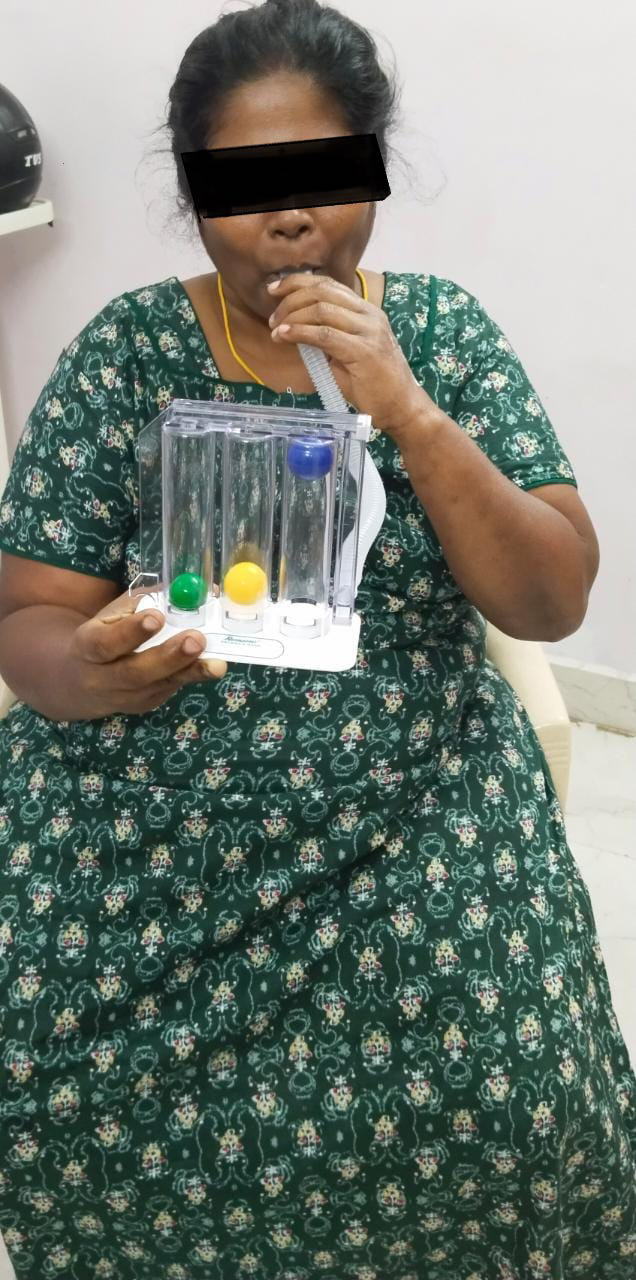
Vital capacity (VC) and inspiratory reserve volume (IRV) measurement is a quick and easy way to keep track of pulmonary functions following surgery. Numerous studies on the effects of high-flow and low-flow on pulmonary functions produced contradictory or ambiguous results [3, 4]. Spirometry has been proven to be a reliable method for measuring FVC and FEV1 measurements of lung function. Even with atelectasis present, the spo2 was maintained between the high-flow and low-flow groups, demonstrating that the Alveolar exchange currently available is sufficient to maintain oxygenation. [4] Since tidal volumes tend to decrease following abdominal procedures, incentive spirometry (IS) (Figure 1) encourages patients to breathe for longer periods in order to cause the lungs to expand. Consequently, IS can be used as an easy way to track lung function, in particular IRV, during spontaneous breathing after surgery. Peak expiratory flow meters (PEFR) are used to identify atelectasis-related obstructions and patients’ maximum effort during forceful exhalation. It serves as a gauge of adequate lung function in the immediate aftermath of surgery. Few studies have been conducted on the effects of anesthesia and atelectasis on Vital Capacity.
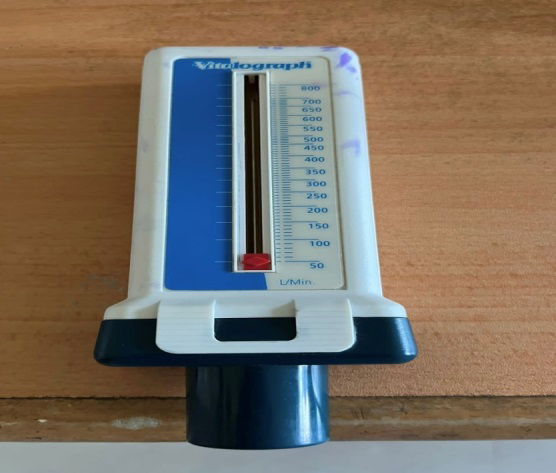
The maximum flow rate produced during a forceful exhalation, beginning with full lung inflation, is known as the peak expiratory flow rate (PEFR). PEFR depicts significant airway flow and depends on the patient’s willpower and physical prowess. It has been shown that the PEFR and the forced expiratory volume over 1s correlate well (FEV1). Spirometric maneuvers like IRV, VC, and PEFR and its measurement become easier and more efficient tools in preventing postoperative lung complications in patients undergoing anaesthesia [5]. In a hospital setting like the preoperative assessment room, surgical/ medical ward, and postoperative ward, we recommend Inspiratory spirometry and a Peak flow meter (Figure 2) to be available. They are cost-effective and easily usable. It doesn’t need a skilled medical professional to describe the performance. Several methods of respiratory physiotherapy include inspiratory muscle training and preoperative spirometric exercises.
Conclusion
It is recommended that simple incentive spirometry and peak flow meter are valuable tools to prepare a patient’s pulmonary functions and to prevent further pulmonary complications. It reduces hospital stays when started preoperatively. It prevents oxygen consumption in the immediate post-operative period. Oxygen requirement was predominantly less when used judiciously.
References
-
Aquino LM, Branco JN, Bernardelli GF, Gregorini C, Cipriano G (2010) Short–duration transcutaneous electrical nerve stimulation in the postoperative period of cardiac surgery. Arq Bras Cardiol 94(3): 325331.
-
Ray K, Bodenham A, Paramasivam E (2014) Pulmonary atelectasis in anesthesia and critical care. CEACCP 14(5): 236-245.
-
Bigli M, Goksu S, Mizrak A, Cevik C, Gul R, et al. (2011) Effects of low flow and high flow inhalational anesthesia with nitrous oxide and desflurane on mucociliary activity and pulmonary function tests. Eur J Anesthesiology 28: 279283.
-
Doger C, Kahveci K, Ornek D, But A, Aksoy M, et al. (2016) Effects of Low flow sevoflurane anesthesia on pulmonary functions in patients undergoing Laparoscopic Abdominal surgery. Biomed Res Int 2016: 3068467.
-
Prasad TK, Gnanasekar N, Priyadharsini KS, Chacko RS (2020) Randomized double-blind trial comparing effects of low-flow vs high-flow anesthesia on postoperative lung functions using respirometer. J Anaesthesiol Clin Pharmacol 36(4): 535-540.
- The Role of Chest Radiology in Traumatic Injuries: A Comprehensive Narrative Review
- Pseudosepsis in Acute Inflammation of the Lung
- An Overview of Lung Injury in Covid-19: Evaluating the Impact of Re-Exposure and Emerging Variants
- Fibreoptic Bronchoscopy-its Role in Pulmonary Medicine-Current Trends in Intensive Care Unit
- Retrospective Study on the Efficacy of Homoeopathic Medicines in the Treatment of Acute Rhinitis
- Humoral and Cellular Immune Response among Kidney Transplant Recipients after COVID-19 Vaccination: A Systematic Review and Meta-Analysis