
Ferroptosis Mechanisms Involved in on Pump Cardiac Surgery Related Acute Kidney Injury
Opinion
Acute kidney injury (AKI) is a frequent complication of on pump cardiac surgery with no definitive or specific treatment. Therefore, the molecular mechanisms of AKI must be elicited to develop novel treatments. Extracorporeal circulation of blood during cardiopulmonary bypass surgery expose cells to non-physiological surface and shear stress, which lead to release of free hemoglobin and non-heme iron [1, 2]. Ferroptosis is an iron-dependent form of regulated cell death [3]. Many diseases have been demonstrated to be associated with ferroptosis, such as Alzheimer’s disease [4, 5], carcinogenesis [6], intracerebral hemorrhage [7], traumatic brain injury [8], stroke [9], cardiac injury [10, 11], and lung injury [12]. In addition, the relationship between ferroptosis and kidney injury or other kidney diseases has been investigated by some groups recently [13, 14, 15, 16]. However, the role of ferroptosis in on pump cardiac surgery induced AKI has yet to be elucidated. We aimed to investigate whether ferroptosis is induced in the kidney after on pump cardiac surgery.
Opinion
The human proximal tubular epithelial cell line HK-2 was purchased from the American Type Culture Collection (ATCC). The Cells were treated with heme in 30℃ oxygen- glucose deprivation (30℃ OGD) condition to induce a tubular cells model. Ferrostatin 1 (Fer-1), Z-VAD-FMK (zVAD) and Necrostatin-1 (Ner-1) were used to inhibit ferroptosis, apoptosis and necroptosis. The cytotoxic potential was assessed by the measurement of LDH. The levels of malondialdehyde (MDA), iron, and GSH/GSSH ratio, as well as, the protein level of glutathione peroxidase 4 (GPX4), were measured. Additionally, the therapeutic action of Fer-1, zVAD, and Ner-1 were compared.
To further confirm the in vitro results, cardiopulmonary bypass (CPB) and deep hypothermic circulatory arrest (DHCA) model were performed on wild type adult male Sprague- Dawley (SD) rats weighing 400 to 450 g. The experimental protocol was approved by the Care of Experimental Animals Committee of the Chinese Academy of Medical Sciences and Peking Union Medical College. The animals were randomly allocated to 3 groups (n= 5, each group): sham group, CPB group, and DHCA group. Briefly, rats were anesthetized with 1.5% sevoflurane after orotracheal intubation with a 16-gauge cannula (Insyte BD Medical, Sandy, Utah), and mechanically ventilated at 75 breaths per minute with 8 mL/kg tidal volume (Harvard Apparatus, Holliston, Mass). A 24-gauge catheter was cannulated in the left femoral artery for arterial blood pressure monitoring. CPB was established via the caudal artery (cannulated using a 20-gauge catheter) and right external jugular vein–right atrium (cannulated using a homemade multiorificed catheter).
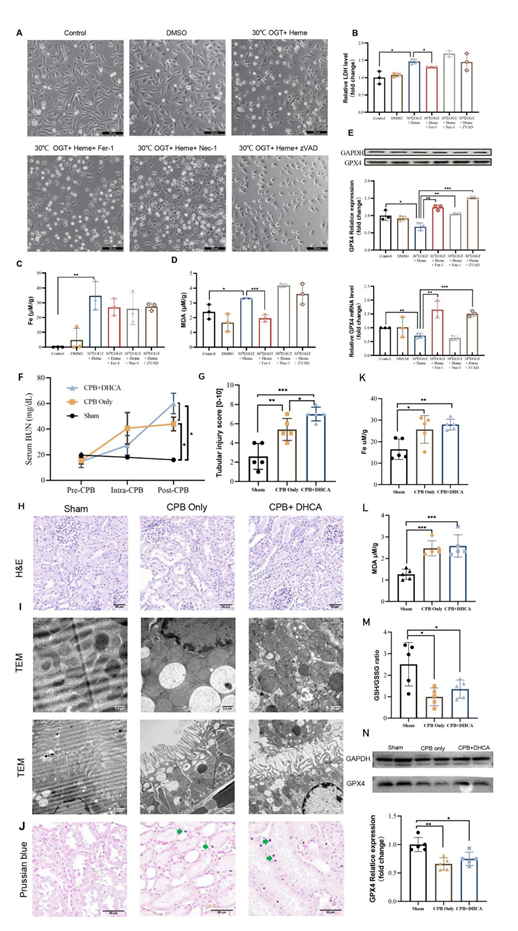
Figure 1: (A) Cellular morphology under a phase contrast microscope. Levels of (B) medium LDH content, (C) intracellular iron and (D) MDA in HK-2 cells of different groups showed that Fer-1 treatment down-regulated the LDH and MDA content, whereas iron levels were not reduced. (E) The protein and mRNA levels of GPX4 in HK-2 cells of different groups showed that Fer-1 treatment greatly increased the expression of GPX4 expression. (F) BUN of rats during surgery and (G) HE staining showed that renal injury was induced by CPB/DHCA; scale bar: 50 μm. (H) The renal tubular injury score was calculated. (I) Representative images of transmission electron microscope for mitochondria in rat kidney showed mitochondria distortedness and shrink was induced by CPB/DHCA; scale bar: 50 μm. (J) Prussian blue staining for iron showed that on-pump cardiac surgery increased the level of ferric iron; the green arrows indicate deposition of iron; scale bar: 50 μm. (K-M) Levels of iron, MDA and GSH/GSSG in the kidney tissues showed that iron and MDA were significantly upregulated, whereas GSH/GSSG was down-regulated in CPB/DHCA groups compared with sham group. (N) Representative results of Western blotting showed that the protein levels of GPX4 were significantly decreased in the kidneys of CPB/DHCA rats; the images are quantified using Image J.
The entire circuit was primed with 12 mL 6% hydroxyethyl starch (Hextend; Hospira Inc, Lake Forest, Ill), 1 mL of heparin (250 IU/kg), 0.5ml 5% sodium bicarbonate, and 1 mL furosemidum. Blood was pumped from a venous reservoir through a custom-designed small-volume oxygenator (Kewei, Beijing, China) using a twin-roller pump (St€ockert, Munich, German). Mechanical ventilation was terminated immediately after CPB starting. In sham group, rats were anesthetized and cannulated, but did not undergo CPB. In CPB, flow rate was maintained at more than 120 mL/ kg/min during CPB, rectal temperature was cooled to 30- 32℃ and maintained CPB for 2 hour. In the DHCA group, after 30 minutes cooling and reaching target temperature of 18℃, the animals were subjected to DHCA for another 60 minutes. The intraoperative levels of blood urea nitrogen (BUN) were measured. And H&E staining was used to assess renal histological changes. We also determined the biochemical and morphological changes associated with ferroptosis in renal tissue.
The LDH content in 30℃ OGD and heme treated cells was significantly increased, together with the levels of MDA, and total iron, while the levels of anti-ferroptosis markers GSH/GSSH and GPX4 were decrease. Treatment with fer- 1 decreased LDH content in 30℃ OGD and heme treated HK-2 cells, whereas no beneficial effects were observed with the zVAD or Ner-1 treated cells. The results of the in vivo experiment indicated that on-pump cardiac surgery remarkably increased the levels of BUN and aggravated renal histological damage. Prussian blue staining showed that on-pump cardiac surgery increased the level of ferric iron, suggesting that Fenton reaction could be activated by on-pump cardiac surgery. Furthermore, on-pump cardiac surgery induced AKI were followed by typical mitochondria distortedness and shrink, iron accumulation and alteration of redox balance (increased lipid peroxidation and decreased antioxidant defenses) (Figure 1). In conclusion, our results indicated that ferroptosis played an important role in a rat model of on pump cardiac surgery induced AKI, and Fer-1 alleviated cell injury in heme and oxygen- glucose deprivation-stimulated tubular cells via regulating ferroptosis. Therefore, our study demonstrated that a novel form of regulated cell death, ferroptosis, occurred in on pump cardiac surgery-induced AKI, and holds the potential to become a novel therapeutic target in postcardiac surgery AKI.
References
-
Mumby S, Chaturvedi RR, Brierley J, Lincoln C, Petros A, et al. (2000) Iron overload in paediatrics undergoing cardiopulmonary bypass. Biochimica et Biophysica Acta (BBA) - Molecular Basis of Disease, 1500(3): 342-348.
-
Pepper JR, Mumby S, Gutteridge JM (1994) Transient iron-overload with bleomycin-detectable iron present during cardiopulmonary bypass surgery. Free Radic Res 21(2): 53-58.
-
Dixon SJ, Lemberg KM, Lamprecht MR, Skouta R, Zaitsev EM, et al. (2012) Ferroptosis: An iron-dependent form of nonapoptotic cell death. Cell 149(5): 1060-1072.
-
Jakaria M, Belaidi AA, Bush AI, Ayton S (2021) Ferroptosis as a mechanism of neurodegeneration in Alzheimer’s disease. Journal of Neurochemistry 159(5): 804-825.
-
Chen K, Jiang X, Wu M, Cao X, Bao W, et al. (2001) Ferroptosis, a potential therapeutic target in alzheimer’s disease. Front Cell Dev Biol 9: 704298.
-
Yao X, Li W, Fang D, Xiao C, Wu X, et al. (2021) Emerging roles of energy metabolism in ferroptosis regulation of tumor cells. Adv Sci (Weinh) 8(22): e2100997.
-
Chen B, Chen Z, Liu M, Gao X, Cheng Y, et al. (2019) Inhibition of neuronal ferroptosis in the acute phase of intracerebral hemorrhage shows long-term cerebroprotective effects. Brain Research Bulletin 153: 122-132.
-
Kenny EM, Fidan E, Yang Q, Anthonymuthu TS, New LA, et al. (2019) Ferroptosis contributes to neuronal death and functional outcome after traumaticbrain injury. Critical Care Medicine 47(3): 410-418.
-
Zhang Y, Lu X, Tai B, Li W, Li T (2021) Ferroptosis and its multifaceted roles in cerebral stroke. Frontiers in Cellular Neuroscience 15: 615372.
-
Li N, Wang W, Zhou H, Wu Q, Duan M, et al. (2020) Ferritinophagy-mediated ferroptosis is involved in sepsis-induced cardiac injury. Free Radic Biol Med 160: 303-318.
-
Guerrero-Hue M, Garcia-Caballero C, Palomino-Antolin A, Rubio-Navarro A, Vázquez-Carballo C, et al. (2019) Curcumin reduces renal damage associated with rhabdomyolysis by decreasing ferroptosis-mediated cell death. Faseb Journal 33(8): 8961-8975.
-
Liu P, Feng Y, Li H, Chen X, Wang G, et al. (2020) Ferrostatin-1 alleviates lipopolysaccharide-induced acute lung injury via inhibiting ferroptosis. Cellular & Molecular Biology Letters 25: 10.
-
Ma D, Li C, Jiang P, Jiang Y, Wang J, et al. (2020) Inhibition of ferroptosis attenuates acute kidney injury in rats with severe acute pancreatitis. Dig Dis Sci 66: 483-492.
-
Su L, Jiang X, Yang C, ZhangJ, ChenB, et al. (2019) Pannexin 1 mediates ferroptosis that contributes to renal ischemia/reperfusion injury. Journal of Biological Chemistry 294(50): 19395-19404.
-
Li D, Liu B, Fan Y, Liu M, Han B, et al. (2021) Nuciferine protects against folic acid-induced acute kidney injury by inhibiting ferroptosis. Br J Pharmacol 178(5): 1182- 1199.
-
Yang Y, Cai F, Zhou N, Liu S, Wang P, et al. (2021) Dimethyl fumarate prevents ferroptosis to attenuate acute kidney injury by acting on NRF2. Clinical and translational medicine 11(4): e382.
- Results of 6-Month Follow-Up of Patients After B-Turp and Thulep
- The Effect of Drinking Water with a High Content of Antimony and Arsenic on the Dynamics of their Distribution in the Kidneys and the Renal Excretory Function in Rats
- Effectiveness and Safety of Tansurethral Thulium Laser Enucleation of the Prostate in the Treatment of BPH: Review
- A Systematic Review on Molecular Pathophysiology Involved in Chronic Kidney Disease and the Role of Animal Models in Drug Discovery to Manage in Chronic Kidney Disease - An Update
- Functional Development of Kidneys in Human Ontogenesis
- Testicular Metastasis: Uncommon Prostate Cancer Case Report