
Functional Development of Kidneys in Human Ontogenesis
Based on our own and literary results, the process of kidney functions formation in human ontogenesis from the stage of newborn to adulthood is considered. It has been shown that in conditions of relative rest of the body in the morning on an empty stomach, all the main manifestations of kidney functions correspond to the level of adults by 4-5 years old, and only the glomerular filtration rate and tubular reabsorption of fluid increase to 10-11 years of age. A complex analysis of the morphological and functional characteristics of the kidneys as an integral organ reveals their rapid growth up to 4-5 years, the second period of active growth is noted at 10-11 years and the completion of the process formation occurs by the age of 21-22. During periods of intensive growth of the whole organism – 7-8 and 13-15 years, a decrease in the rate of development of the kidneys structure and functions is manifested, which allows us to call these age periods as critical stages of kidney development. The presented results can be used as normative indicators of kidney function in healthy children of different ages.
Introduction
The kidney is not only the main organ of excretion, but also the main organ of regulation of water-mineral homeostasis. Therefore, the study of kidney function in human ontogenesis is of great theoretical and practical importance [1, 2, 3]. However, information on the development of homeostatic kidney functions in children relates mainly to the period of early childhood and very little work has been done on their functioning in juvenile and adolescence [4, 5, 6].
In this work, the aim is set on the basis of literature data and own materials to give a comprehensive assessment of age-related transformations of human kidney functions.
The kidneys begin to function as early as the 9-th week of embryonic development [7]. Ultrasound determination of their function in the fetus showed that from the 22nd to the 41st week of pregnancy, urine production progressively increases from 2.2 to 26.7 ml/h, glomerular filtration rate (GFR) increases to 2.66 ml/min and fluid reabsorption from 72.5 to 78.2% [8, 9].
The regulation of homeostasis in the embryo is carried out mainly through the placenta. Urine, which is released into the amniotic fluid, is exchanged with the maternal extracellular space [2]. Therefore, children with underdeveloped kidneys are born clinically healthy.
Partial kidney functions develop at different time depending on the morphological maturation of the organ. They have been studied in most detail in newborns and children of the first year of life [10, 11, 12, 13, 14, 15, 16, 17]. The glomerular filtration rate in children in the first weeks after birth is 3-4 times lower than in adults [18, 19, 20], depends on the degree of maturity of newborns [21], and at the turn of the first to second year of life it reaches a level corresponding to an adult organism [10, 18, 22, 23]. However, there are no enough convincing facts about an increase in GFR during the entire period of ontogenesis until adolescence [24, 25, 26, 27, 28]. These differences are probably due to the method of determining GFR and the test substances used (creatinine, inulin, urea, radioisotopes 51Cr-EDTA, iohexol, etc.) [22, 29]. It is believed that the assessment of clearance against the background of preliminary hydration of the body gives overestimated values, especially in young children [1, 58]. This is due to either the inclusion of “reserve” nephrons, or an increase in the filtration level in functioning nephrons, as well as possibly both reasons [30, 31].
In parallel, GFR increases the effective renal plasma flow and blood flow up to 13-15 years, and the volume of tubular fluid reabsorption increases to a lesser extent — from 96- 97% to 99% [32, 33, 34, 35].
Another important indicator of the functional development of nephrons is the ability of the proximal tubules to reabsorption and secretion of substances. Comparison of glucose reabsorption intensity (TmGl) in fetuses and young children, compared with adults, it was shown that TmGl increases in ontogenesis up to 5-6.5 years, but these indicators remain below adult values [36, 37]. However, when calculating the maximum glucose reabsorption per 1 ml of glomerular filtrate, it turned out that this ratio is equal to or even slightly higher than in adults [33, 36, 37].
Thus, by the time of birth, children already have an effective glucose reabsorption system corresponding to the level of development of their filtration processes. At the same time, the reabsorption of amino acids is reduced, which leads to aminoaciduria [23, 38]. The loss of proline, oxyproline, and glycine is especially pronounced during the first months of life. This is associated with the insufficient development of the system of regulation of amino acid transport in cells [33]. It is only by the age of 11-14 that the level of amino acid excretion approaches the level of adults [38].
The maturation time of the secretory ability of the kidneys is estimated in different ways. Some authors believe that the level of this function reaches adult values by 2.5 years of life [39], others believe that this function becomes mature by 7 years [27], others note that only by 8.3 years it reaches 50% of the adult norm [39], and its maturation is completed by 14 years [33, 40].
The water and ion excretion function of the kidneys has been studied in sufficient detail. It has been shown that already in the period of newborn and the first year of life, children are able to excrete fluid efficiently enough after optimal water loads and diuretics, which is due to inhibition of its reabsorption in the distal segment of the nephron [10, 11, 12, 13, 28, 30, 41, 42, 43, 44, 45].
The excretion of sodium, potassium and chlorides in the first year of life is reduced [17, 41, 46]. This is due to both lower filtrations loading of the nephron and, mainly, increased ion reabsorption in the tubules of the nephron under the influence of high activity of the renin-angiotensin- aldosterone system (RAAS) [1, 47, 48]. Therefore, sodium purification, for example, is only 1/5 of the adult norm [11], which requires reducing sodium intake from food in children.
After salt loads, electrolyte excretion is significantly reduced compared to adults. Many authors believe that this is due to insufficient inhibition of RAAS [47, 48, 49], however, the role of other intra- and extrarenal factors (insufficient number of functioning nephrons [7, 8, 31], underdevelopment of transport processes in them [4], low secretion of neurohypophysial hormones [50], etc. cannot be excluded.
Evidence of the leading role of endocrine factors in the restructuring of ionuretic function can be provided by data from studies of transport processes in the kidneys. When studying the effect of various diuretics on the renal transport of water and salts, it was found that the main systems of ion reabsorption and secretion reach maturity by the end of the first year of life [3, 33, 51, 52]. This allows us to conclude that the main renal processes already in the first years of life reach a level of development that is necessary to perform homeostatic kidney function in optimal conditions of vital activity of the body and corresponds to the degree of security of these processes from other functional systems.
A comparison of the main parameters of kidney function in children of different ages and adults (all subjects were male) under conditions of spontaneous urination in the morning on an empty stomach showed the absence of pronounced age differences, and only in the process of ontogenesis the volume of filtration and reabsorption processes increased (Table 1).
| Parameters of renal function | Age, years | ||||||
|---|---|---|---|---|---|---|---|
| Newborn (n=15) | 2 - 3 (n=37) | 4 - 5 (n=73) | 7 - 8 (n=118) | 10 - 11 (n=113) | 13 - 15 (n=129) | 18 - 25 (n=80) | |
| V, ml/min.m2 | 0,7±0,15 | 0,6±0,08 | 0,5±0,04 | 0,7±0,07* | 0,5±0,04 | 0,5±0,03 | 0,5±0,04 |
| F, ml/min.m2 | 22±6* | 37±3* | 39±1* | 50±2* | 56±3* | 60±2* | 73±3 |
| %RH O 2 | 97,5±0,40* | 98,4±0,08* | 98,6±0,07 | 98,4±0,08* | 99,1±0,06 | 99,0±0,08* | 99,3±0,04 |
| U ·V, Na mcmol min·m2 | 9,7±2,4* | 83,4±12,2 | 72,6±11,8 | 105,0±9,3 | 86,2±5,5 | 79,4±3,6 | 82,6±6,4 |
| U ·V, K mcmol min·m2 | 5,6±1,5* | 53,3±7,6* | 43,7±1,8* | 47,7±3,3* | 37,1±2,9 | 35,5±1,4 | 33,7±2,4 |
| EF Na, % | 0,4±0,06* | 1,6±0,18* | 2,0±0,14* | 1,7±0,12* | 1,2±0,08* | 1,1±0,07 | 0,9±0,10 |
| EF , % K | 7,3±0,90* | 38,0±6,61* | 29,7±1,17* | 21,1±0,74* | 16,4±0,59* | 19,6±1,00* | 11,0±0,67 |
| C , ml/ Na min.1m2 | 0,1±0,02* | 0,6±0,09 | 0,6±0,09 | 0,8±0,08* | 0,6±0,04 | 0,6±0,03 | 0,6±0,04 |
| U , osm mosm/l | 146±13* | 788±38* | 810±18* | 883±21 | 890±27 | 798±25* | 894±23 |
| U /P osm osm | 0,5±0,05* | 2,8±0,09* | 2,8±0,05* | 3,2±0,08 | 3,2±0,07 | 2,7±0,06* | 3,2±0,08 |
Notes: *significant differences compare to adults. The number of examined persons is given in brackets. All subjects were male. Legend: V – diuresis; F – glomerular filtration rate; %RH2O – relative fluid reabsorption; V and V – renal excretion of sodium and potassium; EFNa и EFK – fractional excretion of sodium and potassium; СNa – sodium clearance; Uosm – urine osmolality; Uosm/Posm – osmotic concentration index Тable 1: Background parameters of renal function in children of different ages and adults (M±m).
At the same time, the kidneys as a whole, as the main effector in the system of regulation of water-salt metabolism, under the control of the neuro-hormonal system, continue to develop until adolescence [24, 32, 53, 54]. This is confirmed by the integral morphofunctional characteristic of the kidney at each stage of ontogenesis.
For an integral assessment of the degree of kidney development in ontogenesis, numerical indicators characterizing the structure and functions of the organ based on the method of morpho-kinetic synthesis were combined [55]. When calculating the structural characteristics, the following parameters were taken into account: the diameter of the lumens and the thickness of the walls of the renal artery and vein; the specific volume of tubules and renal bodies; the diameter of peripheral and juxtamedullary renal bodies; the specific volume and diameter of the lumen of the arc and interlobular arteries; the specific volume of capillaries [40, 56]. Kidney function was assessed in practically healthy children in conditions of relative rest, by collecting a morning sample of urine in 1-2 hours with spontaneous urination with straining (Table 1). During the same time period, a blood sample was taken to determine the main parameters of water-electrolyte homeostasis. All partial renal functions were calculated by conventional methods on 1m2 of the body surface [11, 57, 58]. This indicator for children correlates well with the extracellular space, where the main homeostatic reactions are carried out, and therefore can serve as a benchmark for comparing the functional capabilities of the kidneys [13, 28]. The integral morpho-functional characteristic of the organ expressed as a coefficient of correlation of parameters (CCP) in %, revealed the age dynamics of maturation (Figure 1).
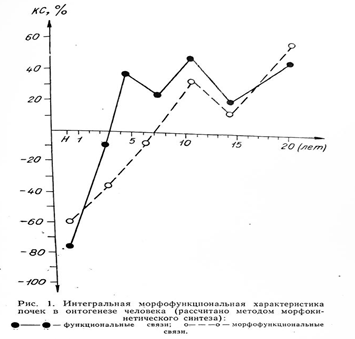
As can be seen from Figure, the greatest intensity of the development of renal functions is observed from the first days of a child’s life to 4-5 years (the coefficient of correlation of parameters reflecting the change in the integral renal functions increases from -70% to +35%). The next development leap manifests itself at the age of 10-11, and the final stabilization of renal functions occurs in adolescence. In the periods of 7-8 and 13-15 years, there is a decrease in the rate of functional development, which probably reflects critical stages in the maturation of the kidneys and the mechanisms of regulation of its activity. In general, in terms of the sum of morphological and functional parameters, the kidneys in conditions of relative rest of the body approach the level of adults by the age of 10-11. In adolescence, there is a decrease in the rate of development and disintegration between different parameters of structure and function.
One of the main criteria determining the maturity of the kidneys as a homeostatic organ is the characteristic of its response to water-salt loads, when the reserve and adaptive capabilities of kidney functions and extrarenal mechanisms of its regulation are evaluated [1, 4, 59, 60, 61, 62, 63, 64]. It demands the special study for the future issue.
References
-
Agusta VE, Orr WA, Howards SS, Gillenwater JY (1973) Increased glomerular filtration rate in hydrated children. J Urology 110(1): 113-118.
-
Aizman PI (1984) Morpho-functional development of kidneys and water-salt metabolism in human ontogenesis. Ontogenesis of the kidney, Novosibirsk, Russia, pp: 73-99.
-
Aizman RI (1981) Some methodological approaches to the study of kidney function in human ontogenesis. Age- related features of morphology and physiology of human kidneys, Novosibirsk, Russia, pp: 17-35.
-
Aizman RI (1983) Age-related features of the body’s reaction to de- and hyperhydration. Human physiology 9(3): 454-460.
-
Aizman RI (1982) Age-related features of the integration of mechanisms of regulation of water-salt homeostasis in human ontogenesis. New studies in age physiology. Pedagogy 2(19): 62-68.
-
Aizman RI (2000) Formation of kidney function and water-salt metabolism in ontogenesis. Physiology of child development. Publishing House of RAO, pp: 186- 200.
-
Aizman RI, Pronina TS (1986) The content of aldosterone in human blood in ontogenesis. Human Physiology 12: 331-332.
-
Aizman RI, Velikanova LK (1988) Features of kidney functions. Physiology of adolescents. Pedagogy, pp: 140- 157.
-
Antonov AG (1968) Kidney function in early human ontogenesis. Pediatrics 2: 78-84.
-
Aperia A, Broberger O, Thodenius K, Zetterström R (1975) Development of renal control of salt and fluid homeostasis during the first year of life. Acta Paediat Scand 64(3): 393-398.
-
Aperia A, Broberger O, Thodenius K, Zetterström R (1972) Renal response to an oral sodium load in newborn full-term infants. Acta Paediat Scand 61(6): 670-678.
-
Bayko SV, Kulakova EN, Aksenova ME, Shumikhina MV, Nastausheva TL (2024) Determination of glomerular filtration rate in children and adolescents: theoretical and practical aspects. Nephrology and dialysis 26(2): 186-203.
-
Berkhin EB (1979) Pharmacology of the kidneys and its physiological foundations, pp: 5-70.
-
Bosch JP (1995) Renal reserve: a functional view of glomerular filtration rate. Seminars in Nephrology 15(5): 381-385.
-
Brodehl J, Franken A, Gellissen K (1972) Maximal tubular reabsorption of glucose in infants and children. Acta Paediat Scand 61(4): 413-420.
-
Chwalbinska-Monetà I, Trzebinski A (1977) Plasma antidiuretic activity in children. Acta Physiol Poland 25(5): 411-416.
-
Leo TD, Francesco LD (1959) Research on aminoaciduria of normal infants. Pediatria (Napoli) 67(2): 239-257.
-
Dlouga G, Krshechek I, Natochin Yu (1981) Ontogenesis of the kidney, pp: 184.
-
Edelmann CM, Spitzer A (1969) The maturing kidney. The Journal of Pediatrics 75(3): 509-519.
-
Fawer L, Torrado A, Guignard JP (1979) Maturation of renal function in full-term and premature neonates. Helvetica Paediatrica Acta 34(1): 11-12.
-
Fiselier T, Monnens L, Munster PV, Jansen M, Peer P, et al. (1984) The renin-angiotensin-aldosterone system in infancy and childhood in basal conditions and after stimulation. Eur J Pediatr 143(1): 18-24.
-
Gekle D, Janovský M, Slechtová R, Martinek J (1967) Effect of glomerular filtration rate on the tubular absorption of glucose in children. Klin Wochenschr 45(8): 416-419.
-
Ginetsinsky AG (1952) Kidney function in the early postnatal period. Successes of modern biology 33(2): 233-259.
-
Ginetsinsky AG (1963) Physiological mechanisms of water-salt equilibrium. L Nauka, pp: 354-378.
-
Godard G, Vallotton MB, Favre L (1982) Urinary prostaglandins, vasopressin and kallikrein excretion in healthy children from birth to adolescence. The Journal of Pediatrics 100(6): 898-902.
-
Gorbachevsky PR, Paramonova NS, Yuraga TM, Gres NA (2017) Normal values of the excretion of the amino acids cystine, lysine and arginine in healthy children and in patients with dysmetabolic nephropathy. Nephrology 21(3): 81-86.
-
Guignard JP, Torrado A, Cunha OD, Gautier E (1975) Glomerular filtration rate in the first three weeks of life. The Journal of Pediatrics 87(2): 268-272.
-
Ignatova MS, Veltischev YE (1978) Hereditary and congenital nephropathies in children. Medicine, pp: 256.
-
Inchina VI (1956) Reaction to water stress and water starvation in the early postnatal period: dis...cand. med. sciences. Novosibirsk, pp: 214.
-
Jährig K (1981) The development of kidney function in young children. Age-related features of human kidney morphology and physiology, Novosibirsk, Russia, pp: 52- 62.
-
Jančič SG, Močnik M, Varda NM (2022) Glomerular Filtration Rate Assessment in Children. Children 9(12): 1995.
-
Kosheleva LH, Lavrova EA, Natochin YV, et al. (1979) Age-related features of the kidney response to diuretics. Issues of maternity and childhood protection 24(9): 15- 19.
-
Kowarski A, Katz H, Miglon CJ (1974) Plasma aldosterone concentration in normal subjects from infant to adulthood. J Clin Endocrinol Metab 38(3): 489-491.
-
Kurjak A, Kirkinen P, Latin V, Ivankovic D (1981) Ultrasonic assessment of fetal kidney function in normal and complicated pregnancies. Am J Obstet Gynecol 141(3): 266-270.
-
Lebedev VP, Delin VF, Varvantseva MP (1980) The state of kidney function in newborns in the early adaptation period. Proceedings of the 2nd Moscow Med. in-ta 156(31): 24-28.
-
Matveev MP, Sagalovich MB (1980) Effective renal blood flow and other partial renal functions in children with chronic tonsillitis. Pediatrics 2: 55-56.
-
Cance RAM (1980) The development of osmolar, electrolyte and volume control. In: Bahlmann J, et al. (Eds.), Disturbances of Water and Electrolyte Metabolism. Contribto Nephrology 21: 28-32.
-
Mian AN, Schwartz GJ (2017) Measurement and estimation of glomerular filtration rate in children Adv Chronic Kidney Dis 24(6): 348-356.
-
Momper JD, Yang J, Gockenbach M, Vaida F, Nigam SK (2019) Dynamics of organic anion transporter-mediated tubular secretion during postnatal human kidney development and maturation. Clin J Am Nephrol 14(4): 540-548.
-
Natochin Yu V (2011) Kidney development and problems of pediatric nephrology. Clinical nephrology 2011(4): 4-8.
-
Pechkurov DV, Polkanova VA, Voronina EN, Poretskova GY (2022) Early diagnosis of chronic kidney disease in children: problems and solutions. Practical medicine 20(1): 14-20.
-
Peresheina LP (1975) Features of kidney functions and the effect of diuretics in children of the first year of life: abstract of the thesis. Candidate of Medical Sciences 17.
-
Rozyhodjaeva GA, Abraev BU, Abdurakhmanov DA, Rozyhodjaeva FA (2016) Assessment of renal hemodynamics in healthy children. The Russian Electronic Journal of Radiation Diagnostics 6(2): 5-6.
-
Rubin MI, Brush E (1949) Rapoport M. Maturation of renal function in childhood: clearance studies. J Clin Invest 28: 1144-1151.
-
Shteyngart KM (1951) Evolution of kidney function in children in ontogenesis: Message 3. Physiological Journal of the USSR 37: 86-92.
-
Shteyngart KM (1949) Evolution of kidney function in ontogenesis: Message 1. Age–related features of kidney function in children. Physiological Journal of the USSR 35(3): 330-337.
-
Shteyngart KM (1949) Evolution of kidney function in ontogenesis: Message 2. Age–related features of kidney function in the excretion of chlorides in infants. Physiological Journal of the USSR 35: 709-715.
-
Smirnov AV, Natochin Yu V (2019) Nephrology: fundamental and clinical. Nephrology 23(4): 9-26.
-
Smith H (1951) Renal function in infancy and childhood. In: The Kidney: Sructure and Function in Health and Disease. Oxford University Press, NY, pp: 492-519.
-
Spitzer A (1982) The role of the kidney in sodium homeostasis during maturation. Kidney Int 21(4): 539- 545.
-
Stefanov SB (1974) Measurements of morpho-functional unity: The method and some results. Pushchino 64.
-
Sulyok E, Varga F, Györy E (1980) On the mechanism of renal sodium handling in newborn infants. Biol Neonate 37(2): 75-79.
-
Thodenius K (1974) Renal control of sodium homeostasis in infancy. Acta Pediat Scand 253: 1-28.
-
Tylkidzhi Yu A (1974) Development of water-releasing kidney function in newborns of various degrees of maturity: In: 4th All-Union Conference on water-salt metabolism and kidney function. Chernivtsi, Urkarine, pp: 76-77.
-
Velikanova LK, Aizman RI (1983) Age-related transformations of kidney functions. Physiology of child development. Pedagogika 177-195.
-
Velikanova LK, Aizman RI, Abaskalova NP (1997) Reserve capabilities of kidney functions and water-salt homeostasis. Publishing House of NGPU, Novosibirsk, Russia, pp: 165.
-
Veltischev Yu E (1967) Water-salt metabolism of a child. Medicine 304.
-
Veltischev Yu E, Yuryeva EA (1979) Investigation of kidney function. Handbook of functional diagnostics in pediatrics, pp: 381-428.
-
Vernier RL, Birch-Andersen A (1962) Studies of the human foetal kidney 1 Development of the glomerulus. J Pediat 60(5): 754-768.
-
West GR, Smith HW, Chasis H (1948) Glomerular filtration rate, effective renal blood flow and maximal tubular excretory capacity in infancy. J Pediat 32(1): 10- 18.
-
Wladimiroff JW, Van Otterlo LC, Wallenburg HC, Drogendijk AC (1976) Combined ultrasonic and biochemical study of fetal renal function in the term fetus. Eur J Obstet Gynecol Reprod Biol 6(3): 103-108.
-
Zaks MG (1975) Age-related features of kidney function. Age physiology 313-329.
-
Zaryanova EA (1952) Osmoregulatory function of the kidney in the first year of a child’s life.Bulletin of experimental biology and medicin 34(5): 15-17.
-
Zufarov KA, Gontmacher VM (1984) Structural and functional characteristics of kidneys in postnatal ontogenesis. Ontogenesis of the kidney. Novosibirsk, Russia, pp: 14-25.
- Results of 6-Month Follow-Up of Patients After B-Turp and Thulep
- The Effect of Drinking Water with a High Content of Antimony and Arsenic on the Dynamics of their Distribution in the Kidneys and the Renal Excretory Function in Rats
- Effectiveness and Safety of Tansurethral Thulium Laser Enucleation of the Prostate in the Treatment of BPH: Review
- A Systematic Review on Molecular Pathophysiology Involved in Chronic Kidney Disease and the Role of Animal Models in Drug Discovery to Manage in Chronic Kidney Disease - An Update
- Testicular Metastasis: Uncommon Prostate Cancer Case Report
- Ischemic Gangrene of the Penis: A Rare Case Report