
Ischemic Gangrene of the Penis: A Rare Case Report
Penile gangrene is a rare but serious pathology. The etiologies are diverse, mainly diabetes and immunosuppression. We report the case of a 61-year-old patient, diabetic and chronic smoker, who presented with penile necrosis and had benefited from conservative treatment after two surgical necrosectomy procedures. The evolution was favorable with resumption of urinary and genital function after healing.
Introduction
Penile gangrene is a rare entity that often reflects severe peripheral arterial disease and can pose difficulties in management. It occurs mainly in diabetic, arteritic or chronic renal failure patients. Although the penis and distal glans have abundant arterial vascularization with several anastomotic networks, arterial occlusion can cause distal necrosis similar to ischemic gangrene often noted in the extremities of the limbs. Medical imaging, mainly MRI, allows to clearly define the limits of the necrotic area. Treatment is mainly surgical. We report a case of penile necrosis, treated by necrosectomy with resumption of urinary and genital function [1, 2].
Case Report
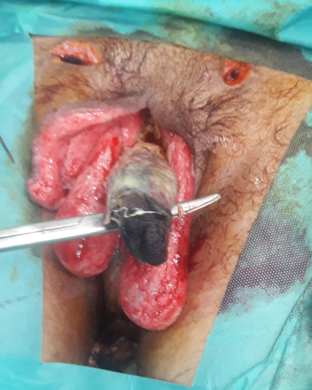
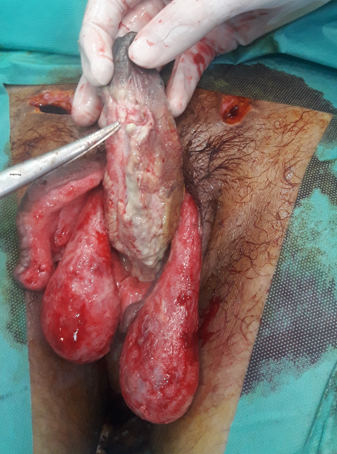
A 61-year-old man, chronic smoker, type 2 diabetes, discovered 5 years ago, on oral antidiabetic drugs and insulin, poorly controlled. He presented to the emergency room for blackish discoloration of the glans that appeared four days earlier. On clinical examination, the patient was hemodynamically stable, apyretic. Examination of the external genitalia revealed necrosis of the glans and skin of the scrotum (Figure 1). No urinary signs. Labstix: glycosuria without ketonuria. The biological assessment showed hyperglycemia at 3.3 g/l, hyperleukocytosis at 15,000/ml. Sterile urine culture. The patient was hospitalized and put on antibiotics ceftrixone 2 g per day and gentamicin 320 mg per day for 5 days and heparin with balancing of diabetes by insulin therapy. He underwent emergency necrosectomy limited to the penis and scrotum, followed by local care, and surgical revision on day 2 with a second necrosectomy (Figure 2). The outcome was favorable with resumption of urinary and genital function after healing.
Discussion
Ischemic gangrene of the penis is a rare urological emergency that can present in two forms with different treatments. Wet gangrene or infectious necrosis of the penis presents significant morbidity and mortality due to the significant risk of septicemia that accompanies it [3]. Its management consists of emergency necrosectomy. As for dry gangrene, two therapeutic attitudes are possible: surgery (partial or total penectomy and penile revascularization) and conservative treatment. However, conservative treatment is generally followed by surgery because the evolution of dry gangrene often leads to infection, liquefaction or progression [4]. This conservative treatment is offered to inoperable or terminally ill patients and to those with very circumscribed ischemia lesions. Ischemic gangrene of the penis is a rare urological emergency that can present in two forms with different treatments. Wet gangrene or infectious necrosis of the penis presents significant morbidity and mortality due to the significant risk of septicemia that accompanies it [3]. Its management consists of emergency necrosectomy. As for dry gangrene, two therapeutic attitudes are possible: surgery (partial or total penectomy and penile revascularization) and conservative treatment. However, conservative treatment is generally followed by surgery because the evolution of dry gangrene often leads to infection, liquefaction or progression [4]. This conservative treatment is offered to inoperable or terminally ill patients and to those with very circumscribed ischemia lesions.
The main etiologies incriminated are diabetes mellitus and accumulation of calcium deposits due to end-stage chronic renal failure [5]. Other causes have been reported [5], including tourniquet effect, thromboembolic diseases, coagulation disorders secondary to neoplastic disease, trauma and infection. In our case, diabetic arteriopathy would probably be the factor incriminated in the onset of gangrene. The clinical differentiation between dry gangrene due to ischemic disease and wet gangrene with infection is decisive for the choice of the appropriate treatment [6]. In case of dry gangrene, the two treatment strategies include conservative treatment, often associated with circumcision, and partial or total penectomy [6]. The indication for conservative treatment usually involves small circumscribed lesions or high-risk patients. However, conservative treatment is often followed by surgical intervention for disease progression or liquefaction and development of infection. Expected management should be reserved for critically ill or terminally ill patients. It has been recommended that circumcision be performed in cases of conservative management to facilitate observation and allow dry healing [7].
Conclusion
Ischemic gangrene of the penis is a rare urological emergency with a poor prognosis. It should be sought in diabetic patients, especially when they are poorly monitored and therefore poorly balanced with renal failure, particularly terminal. MRI is the best examination to define the limits of necrosis. It allows to better define the level of partial or total amputation of the penis, which often remains poorly tolerated by patients.
Conflict of Interest
No conflicts of interests are to be declared by the authors.
Sources of Funding
No sources of funding are to be declared.
Patient Consent
Written informed consent was obtained from the patient for publication of this case report and any accompanying images.
Refrences
1. Karpman E, Das S, Kurzaock EA (2003) Penile calciphylaxis: analysis of risk factors and mortality. J Urol 169: 2206-2209.
2. Harris FC, Mydlo HJ (2003) Ischemia and gangrene of the penis. The journal of urology 169(5): 1795.
3. Liao HW, Lin KH, Chen TH, Wang CC, Sue YM (2005) Penile gangrene in a chronic dialysis patient. Nephrol Dial Transplant 20: 1503-1504.
4. Ohta A, Ohomori S, Mizukami T, Obi R, Tanaka Y (2007) Penile necrosis by calciphylaxis in a diabetic patient with chronic renal failure. Intern Med 46: 985-990.
5. Vijayan P (2209) Gangrene of the penis in a diabetic male with multiple amputations and follow-up. Indian J Urol 25(1): 123-125.
6. Chien JCW, Hsieh SC, Chen CY, Fang CL, Chanet WP, et al. (2007) Penile gangrene in a patient on renal dialysis: ct findings. Computerized medical imaging and graphics 31(2): 103-105.
7. David, Lowe FC (1996) Surgical management of ischemic penile gangrene in diabetics with stage atherosclerosis. American Urological Association 155(3): 926-929.
- Results of 6-Month Follow-Up of Patients After B-Turp and Thulep
- The Effect of Drinking Water with a High Content of Antimony and Arsenic on the Dynamics of their Distribution in the Kidneys and the Renal Excretory Function in Rats
- Effectiveness and Safety of Tansurethral Thulium Laser Enucleation of the Prostate in the Treatment of BPH: Review
- A Systematic Review on Molecular Pathophysiology Involved in Chronic Kidney Disease and the Role of Animal Models in Drug Discovery to Manage in Chronic Kidney Disease - An Update
- Functional Development of Kidneys in Human Ontogenesis
- Testicular Metastasis: Uncommon Prostate Cancer Case Report