
Enlarged Cervical Lymph Nodes as a First Presentation of Metastatic CA Prostate
Prostate cancer is one of the common cancers in the world. It often metastasizes to the regional lymph nodes, bones, lungs, pleura, liver, and adrenal glands but metastasis to supraclavicular lymph nodes is very uncommon. Cervical lymph node metastasis as the first clinical manifestation of the prostate carcinoma has been reported only a few times till date. We present an unusual case of a 70- year old male who presented with enlarged swellings on the left side of his neck and was diagnosed with carcinoma prostate.
Badar Murtaza1, Sadia Ibrar2, Musab Umair Khalid1* and Mishal Imran1
Keywords: Prostate Cancer; Cervical Lymphadenopathy; Metastasis
Introduction
Carcinoma Prostate has been ranked among one of the top ten cancers in the world by World Health Organization (WHO) with 7.3% new cases and 3.8% new deaths of all the cancers [1]. According to Globocan 2020 by World Health Organization, Pakistan has had 4550 new prostate cancer cases throughout the year 2020 and 2188 deaths, 5-year prevalence being 7617 [2]. The established risk factors for prostate carcinoma are family history, race, aging, oxidative stress, hormones, fat, environmental agents, and occupational factors.
The treatment options for prostate cancer depend upon the stage, extent, life expectancy, and patient preference. For localized cancers, the options are radical prostatectomy, radiation therapy (EBRT or Brachytherapy) along with close monitoring. For advanced disease the treatment is mainly palliative, including hormone ablation, chemotherapy, medical and surgical castration. Cryoablation or high- intensity focused ultrasound (HIFU) treatment may be considered for treating very small prostate cancers when surgery is not doable or advanced prostate cancers if alternative treatments, like Radiation therapy, were not helpful.
In July 2020, a 70-year-old married male presented to our outpatient urology clinic with the complaints of increased urinary frequency (4/2 hours), nocturia (4-5/night) and urine straining for the last six months; and enlarged swellings on the left side of his neck for last one month. He is known hypertensive for last two years. Surgical history, family history, and personal history were unremarkable. He was a non-addict, non-smoker. Physical examination revealed bilateral cervical and abdominal lymphadenopathy. On Digital rectal Examination, a hard nodule was found at the lower end of right lobe, median sulcus of prostate was found to be obliterated, and upper limit of prostate was not reachable.
All the hematological investigations were within normal limits except serum alkaline phosphatase that was slightly raised (275 IU/L) and prostate specific antigen was markedly raised (739 ng/ml). Multiparametric MRI Prostate showed a hypoechoic lesion in right peripheral lobe of prostate. Bone scan revealed ill-defined sclerotic lesions and degenerative changes along the dorsolumbar spine. MRI lumbar Spine discovered altered T2WI/STIR signals involving multiple dorsolumbar vertebrae indicating presumably metastasis, and circumferential disc bulge at the levels LV4-LV5 and LV5- SV1 inflicting compression of the respective nerve roots.
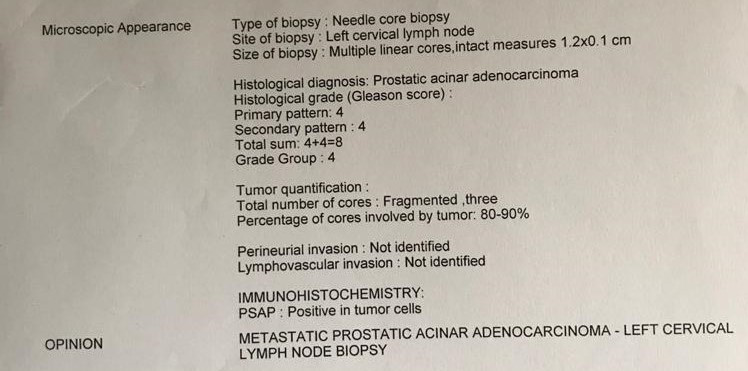
The Imaging guided needle core biopsy of left cervical lymph node revealed metastatic prostatic acinar adenocarcinoma (Gleason score 4+4=8) (Figure 1) while the Trans rectal ultrasound (TRUS) guided biopsy of prostate revealed the same diagnosis.
Discussion
Prostate Carcinoma usually spreads locally either by direct invasion or to the regional lymph nodes. Although lymph nodes are the most common metastatic site for carcinoma of the prostate, the ones most frequently involved are those of the pelvis and retroperitoneum. Other common sites of metastasis of Carcinoma Prostate include bones, lungs, pleura, liver, and adrenal glands. Any lymphadenopathy that occurs outside the abdomen and pelvis, like cervical lymphadenopathy, is considered atypical and is very uncommon. Only a few cases of Prostate carcinoma first presenting with enlarged cervical lymph nodes have been reported. The left supraclavicular fossa is the most common site of extra skeletal non-regional lymphatic spread [3].
Therefore, a complete physical examination should always be carried out in patients with enlarged prostate on digital rectal examination (DRE) and those with high prostate specific antigen (PSA) levels to rule out cervical metastasis. Similarly, prostate carcinoma should always be considered as a differential diagnosis in case of elderly men with cervical lymphadenopathy, regardless of the presence or absence of lower urinary tract symptoms. Further evaluation can be carried out through Ultrasound, MRI or Biopsy to ascertain a diagnosis and bone scan, computerized tomography (CT) scan, magnetic resonance imaging (MRI), positron emission tomography (PET) scan to rule out metastasis. Once the diagnosis is established, hormone treatment has proved to be of benefit even in patients with the advanced stages of the disease.
Conclusion
Prostate cancer should be considered as one of the differential diagnoses of generalized lymphadenopathy in males with adenocarcinoma of undetermined origin, even in the absence of lower urinary tract symptoms.
References
-
Sung H, Ferlay J, Siegel RL, Laversanne M, Soerjomataram I, et al. (2021) Global cancer statistics 2020: GLOBOCAN estimates of incidence and mortality worldwide for 36 cancers in 185 countries. CA: A Cancer Journal for Clinicians 71(3): 209-249.
-
WHO (2020) Globocan.
-
Wang HJ, Chiang PH, Peng JP, Yu TJ (2004) Presentation of prostate carcinoma with cervical lymphadenopathy: report of three cases. Chang Gung Med J 27(11): 840- 844.
- Results of 6-Month Follow-Up of Patients After B-Turp and Thulep
- The Effect of Drinking Water with a High Content of Antimony and Arsenic on the Dynamics of their Distribution in the Kidneys and the Renal Excretory Function in Rats
- Effectiveness and Safety of Tansurethral Thulium Laser Enucleation of the Prostate in the Treatment of BPH: Review
- A Systematic Review on Molecular Pathophysiology Involved in Chronic Kidney Disease and the Role of Animal Models in Drug Discovery to Manage in Chronic Kidney Disease - An Update
- Functional Development of Kidneys in Human Ontogenesis
- Testicular Metastasis: Uncommon Prostate Cancer Case Report