
Implementation of Total Quality Management and its Effect on Employees’ Performance in a Teaching Hospital in Oyo State, Nigeria
Total Quality Management (TQM), a core strategic management approach is designed for quality of any organization (healthcare) based on the employer and employees’ participation for customers’ satisfaction, organization’s effectiveness, competitiveness and flexibility. The study aimed at evaluating the implementation of TQM and its impact on employees’ performance in a tertiary-level teaching hospital in Oyo State, Nigeria. A descriptive cross-sectional study design was adopted, with designed questionnaires circulated to hospital staff using a random sampling method. A total of 106 healthcare workers completed the questionnaires. The data were collected using a structured questionnaire, which were statistically analyzed using SPSS version 17. The results of the study revealed that the implementation of the principles of TQM practices ranges from leadership to employees’ satisfaction. Financial and political pressure were found to be important external factors affecting employees’ performance in the particular hospital. These findings could give better understanding on the improvement and promotion of total quality management practices and its impact on employees’ performance in the healthcare organizations, improve effectiveness, productivity, profitability and flexibility of the hospital facilities and services provided to patients/clients.
Macide Artac Ozdal1* and Bamise Faith Oyebamiji2
Turkey
Keywords: Employees’ performance; External factors; Total Quality Management; Leadership
Introduction
Quality is the key component and success factor to any organization to increase organizational performance, productivity and improve employees’ performance [1]. Due to the growing global competition in quality management principles, active quality management becomes highly important for leadership and management of the entire organization, where meeting customers’ needs is the important key to organizational success [2].
Healthcare industry, which includes public and private hospitals, basic healthcare units or centers, maternity and child healthcare units, and dispensaries is a major source for healthcare provider that serves the society in delivering services for healthiness and contribute in the national development. Quality management has become an important issue with increasing attention in hospitals due to hospital management initiatives, influence of clients or patients, insurance companies, public pressure, stakeholders or management and government [3]. One of the important quality management programme is Total Quality Management (TQM), which is a designed and established organizational effort to manage quality based on participation at every level, aiming to improve customer satisfaction and performance of staff [4, 5, 6]. For any successful total quality management implementation, elements such as leadership, trust, ethics, communication, integrity, training and education, teamwork, recognition, customer focus, information analysis, employee empowerment, human resource development and management policies and strategy are required [7, 8, 9, 10]. In healthcare systems, TQM is a designed and efficient process that creates participation of entire organization in planning and implementation of continuous improvement in quality [4]. Several attempts to implement TQM across various sectors, including health care services, have been made but the success record of TQM has been dismal, which could be attributed to faulty implementation process, such as functional hierarchical, bureaucratic and authoritarian organizational structure, lack of consensus, unchallengeable leadership style, internal requirement domination and manpower shortfall [11, 12, 13].
In healthcare settings, customers/clients/patients urge for quality in services have been increasing [13]. In Nigeria, the implementation of health care management is limited by various factors, such as weak institutional and human capacity building, poor funding, disjointedness between health policy initiatives, reforms and programs of different regimes, inefficient and ineffective human resources management [14]. Developing countries, particularly Nigeria, is still lagging behind in the continuous implementation of TQM as a strategic tool and its relatedness to employees’ performance. Hospital quality management in Nigeria is one of the most important, but overlooked tool with regard to its service quality implementation and delivery, resulting in low employees’ performance and inadequate customers’ satisfaction [15]. Quality and performance management in healthcare settings becomes more demanding due to lack of effective methods for enhancing performance, leadership, accountability, managerial skills and poor strategic planning [16, 17]. This, therefore, warrants effective quality management approach, such as TQM is implemented, assessed or monitored appropriately to improve competitiveness, effectiveness and flexibility [18]. This study aims evaluation of the implementation of TQM and its impact on employees’ performance in a tertiary-level teaching hospital in Oyo State, Nigeria.
Methods
Study Design
A descriptive, cross-sectional research was employed for this research study, which aimed at evaluating the implementation of TQM and its impact on employees’ performance in a teaching hospital in Oyo State, Nigeria. Data were collected from healthcare workers in the tertiary care hospital, which was purposively chosen to represent the quality management activities in the particular health sector.
Study Settings
The tertiary-level teaching hospital, which was targeted as the study setting for the collection of data is called the University College Hospital. Ibadan. The University College Hospital, Ibadan, established in the year 1957, is a federal university teaching hospital governed by University of Ibadan, Oyo State, Nigeria. It is an 850-bedded hospital, with 163 examination couches and about 60 departments. The hospital also has appendages to community-based outreach activities, which offers primary and secondary healthcare services. The hospital provides advanced residency training programs in areas of surgery, internal medicine, pediatrics, obstetrics and gynecology, laboratory medicine, ophthalmology, otorhinolaryngology, community medicine, radiotherapy, radiology, general medicine practices and dentistry.
Research instrument
A structured questionnaire was used in the collection of data on the relationship between TQM and employees’ performance in the University College Hospital, in Oyo State, Nigeria. This was set up to collect employee’s sociodemographic information and measure total quality management practices with respect to employee’s perception on leadership, training and education, involvement, communication, teamwork and incentives or reward system. A five (5)-point Likert scale from “strongly disagree” (1) to “strongly agree” (5) revised from the studies of Alsughayir and Al-Shdaifat was used [19, 20].
Study Sample
Among a total of approximately 2434 administrative and medical services staff, a sample size of 93, when accounting for 95% confidence interval and 10% confidence interval, was determined. Hospital staff were sent with questionnaires via google docs link based on a simple random sampling technique and 106 hospital staff responded to questionnaires between April and May 2017.
Reliability Analysis
In this study, the research instrument (questionnaire) developed consisted of 9 scales including 28 items. The 9 scales were empirically tried and validated by assessing the reliability of the instrument using internal consistency method (a measure of how producible the data are). The reliability was measured by generating Cronbach’s coefficient alpha on Statistical Package for Social Sciences (SPSS) 17 version software (SPSS Inc., Chicago, IL, USA).
Data Analysis
The data collected were statistically analyzed using SPSS version 17. Descriptive statistics were used to depict respondents’ sociodemographic characteristics and the implementation of TQM components. Chi-square (χ2) test of independence was used to test the research hypotheses. Multiple Regression analysis was used to determine the influence of demographic characteristics of respondents on TQM implementation. Pearson correlation analysis was employed to evaluate the relationship between of TQM on employees’ performance and customers’ satisfaction.
Ethical Consideration
The procedure and questionnaire was approved by the Ethical Committee of Cyprus International University and the Research and Ethical Committee, University College Hospital, Nigeria. During the collection of data, the respondents were guaranteed utmost confidentiality.
Results
The Cronbach’s alpha values of the scales ranging from Leadership to Employees’ satisfaction were between 0.65 and 0.89 (Table 1). This indicates that all the TQM constructs had acceptable reliabilities, with all values close or greater than 0.70 Cronbach alpha coefficient). The demographic characteristics (gender, level of education, age, job designation and number of years in service) of the respondents were examined (Table 2). A total number of 106 questionnaires were filled, with a predominant gender as female (51.9%). The distribution according to age shows that the most of the respondents were within the age of 21 to 30 years old (45.3%), whilst the distribution of the respondents’ educational background shows that most of the respondents were polytechnic or university graduate (83.0%). A large
| Number | C | ronbach’ | s | |||||||||
| S/N | Scale | |||||||||||
| of Items | Alpha | |||||||||||
| 1. | Leadership | 4 | 0.73 | |||||||||
| 2. | Continuous Improvement | 2 | 0.87 | |||||||||
| 3. | Training and Education | 4 | 0.65 | |||||||||
| 4. | Reward and Recognition | 2 | 0.86 | |||||||||
| 5. | Communication | 2 | 0.72 | |||||||||
| 6. | Team Work | 3 | 0.68 | |||||||||
| 7. | Customers’ satisfaction | 5 | 0.76 | |||||||||
| 8. | Employees’ participation | 2 | 0.89 | |||||||||
| 9. | Employees’ satisfaction | 4 | 0.87 |
Table 1: Reliability analysis of items for TQM practices.
| Items | Category | Frequency | ||||||
|---|---|---|---|---|---|---|---|---|
| Gender | Male | 51 (48.1%) | ||||||
| Female | 55 (51.9%) | |||||||
| Age | Less than 20 | 2 (1.9%) | ||||||
| 21-30 | 48 (45.3%) | |||||||
| 31-40 | 40 (37.7%) | |||||||
| 41-50 | 14 (13.2%) | |||||||
| 51 and above | 2 (1.9%) | |||||||
| Educational background | Diploma | 9 (8.5%) | ||||||
| Polytechnic/ University/Degree | 88 (83.0%) | |||||||
| Other | 9 (8.5%) | |||||||
| Job Title | Administrative officer | 37 (34.9%) | ||||||
| Analyst | 9 (8.5%) | |||||||
| Clerical officer | 3 (2.8%) | |||||||
| Technician | 7 (6.6%) | |||||||
| Nurse/Nursing officer | 31 (29.2%) | |||||||
| Doctor | 18 (17.0%) | |||||||
| Years in service | Less than 1 year | 10 (9.4%) | ||||||
| 1-5 years | 50 (47.2%) | |||||||
| 6-10 years | 25 (23.6%) | |||||||
| 11-20 years | 16 (15.1%) | |||||||
| Above 21 years | 5 (4.7%) |
Table 2: Socio-demographic characteristics of respondents.
The assessment of the implementation of the principles of total quality management in the hospital of interest gives a conceptual analysis of the principles of TQM under the context of leadership, continuous improvement, training and education, reward and recognition, communication, customer focus, team work, employees’ participation and satisfaction. The range of the implementation of TQM practices in the hospital depicts from leadership to employee satisfaction. From the study, the best of the critical factors of TQM implemented was Reward and recognition (mean=2.98±0.045; x2= 0.207, p-value<0.05), while the least factor was employee satisfaction (mean=2.68±0,089; x2=0,089, p-value<0.05) Table 3.
| Standard | |||||||||||||||
|---|---|---|---|---|---|---|---|---|---|---|---|---|---|---|---|
| S/N | Item | M | ea | n | χ2 | ||||||||||
| Deviation | |||||||||||||||
| 1. | Leadership | Management demonstrates commitment to work and quality improvement in service. | 2.85 | 0.184 | 10.18 | ||||||||||
| The quest for quality is the top management’s responsibility | |||||||||||||||
| Organization commitment is a determinant for my performance at work | |||||||||||||||
| I have full confidence and trust in the hospital management | |||||||||||||||
| 2 | Continuous Improvement | The management of the hospital undertake self-assessment of its quality | 2.78 | 0.032 | 0.078 | ||||||||||
| Best effort is demanded by the management | |||||||||||||||
| 3 | Training and Education | Management provides training and development programmes on job participation and handling of job challenges | 2.72 | 0.152 | 10.136 | ||||||||||
| Training programme received have good positive impact on my work effectiveness | |||||||||||||||
| I have access to the required information about job performance | |||||||||||||||
| There is an available system for me to share task-relevant information | |||||||||||||||
| 1. | Reward and Recognition | Employees’ effort, creativity and support are recognized and rewarded by the management | 2.98 | 0.045 | 0.207 | ||||||||||
| Increment in my salary determines my performance in the hospital | |||||||||||||||
| 2. | Communication | There is effective communication among employees and management in the hospital | 2.78 | 0.126 | 1.91 | ||||||||||
| Management performs routine contact with clients/patients and employees | |||||||||||||||
| 3. | Customer Focus | Clients’/patients’ satisfaction is a paramount issue in the hospital | 2.85 | 0.507 | 86.349 | ||||||||||
| Quality of the organization is directed towards job performance and customer satisfaction | |||||||||||||||
| Customer feedbacks are used to improve service quality | |||||||||||||||
| Is there reduction of clients/patients in the hospital? | |||||||||||||||
| Are there lots of complaints made by clients/patients? | |||||||||||||||
| 4. | Team work | Teamwork influences my participation and performance at work | 2.78 | 0.1 | 2.068 | ||||||||||
| Management insists on teamwork for better quality | |||||||||||||||
| Are employees willing to share their expertise with each other? | |||||||||||||||
| 5. | Employee participation | Employees are involved in decision making on quality of the service | 2.84 | 0.155 | 2.351 | ||||||||||
| Employees are empowered to take direct and useful action, which affect service quality | |||||||||||||||
| 6. | Employee Satisfaction | Management provides adequate resources for quality job to be done | 2.68 | 0.089 | 2.935 | ||||||||||
| Is there accountability and transparency in managerial process? | |||||||||||||||
| Does external factors affect employees and their job performance? |
Table 3: Analysis of TQM implementation constructs.
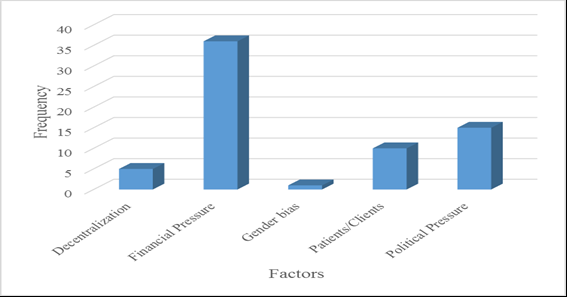
According to the findings, salary increment (mean=3.21±1.177; x2=35.132, p-value<0.05) was the major determinant factor for employees’ performance and generally, the respondents agreed that there is relationship between TQM practices and employees’ satisfaction and the result was statistically significant (Table 4). From the findings, majority of the respondents (64.2%) indicated that external factors affect their performance in the hospital while 35.8% indicated that no external factor influences their performance. Out of the external factors that influences employees’ performance, financial pressure had the highest response followed by political pressure and the least as gender bias (Figure 1).
| Standard | |||||||||||||||||
|---|---|---|---|---|---|---|---|---|---|---|---|---|---|---|---|---|---|
| S/N | Items | Mean | χ2 | p | -valu | e | |||||||||||
| Deviation | |||||||||||||||||
| 1. | Management provides adequate resources for quality job to be done | 2.78 | 1.113 | 104.66 | |||||||||||||
| 2. | Training programme received have good positive impact on my work effectiveness | 2.98 | 1.331 | 133.245 | |||||||||||||
| 3. | Quality of the organization is directed towards job performance and customer satisfaction | 2.7 | 1.172 | 151.453 | |||||||||||||
| 4. | Increment in my salary determines my performance in the hospital | 3.21 | 1.177 | 35.132 | |||||||||||||
| 5. | Organization commitment is a determinant for my performance at work | 2.8 | 1.108 | 100.226 | |||||||||||||
| 6. | Teamwork influences my participation and performance at work | 2.75 | 1.172 | 128.623 | p>0.05 | ||||||||||||
| 7. | My knowledge on total quality of the organization has increased my efforts in improving work performance | 2.68 | 1.134 | 163.811 | |||||||||||||
| 8. | Does external factors affect employees and their job performance? | 2.63 | 0.504 | 63.642 |
Table 4: Effect of TQM practices on Employee satisfaction.
Discussion
In this study, nine important factors were identified as leadership, continuous improvement, training and education, reward and recognition, communication, customer satisfaction, team work, employee participation and employees’ satisfaction. Reward and recognition was the most implemented principle, while employees’ satisfaction was the least implemented. The study also revealed that there is a general approval that the level of TQM implementation was above average (moderate). This suggests that there is awareness from the top (executive) management to adapt the TQM concept as important directive for competition. This is in agreement with previous research that identified customer focus, training and development, recognition and rewards, as the critical factors in TQM implementation [21, 22, 23]. The success of quality efforts of an organization depends largely on concentrating on the objectives and communication between management, employees and customers/patients.
Implementing TQM requires additional skills training, which is vital to its success and it provides an opportunity to empower and motivate employees. Service quality can be increased by rewards and recognition through implementation of employee empowerment and involvement initiatives. In healthcare organization, leadership is one of the major factors for implementing TQM, which involves the integration of quality improvement into planning process throughout the entire organization [24]. In this study, executive management was shown as having positive impact on the successful implementation of TQM and is one of the determinants (second highest in TQM plan), mostly in the organizational and employee performance to achieve greater quality service. This is similar to the report by Rad MA, who investigated on the success of TQM and its barriers to the successful implementation in healthcare organization in Iran [25]. Customer focus is essential in any organization for delivering a superior quality customer experience [26]. According to the study, customer focus (mean 2.85 out of 5.0) also plays important role in the TQM implementation as all activities, from the outpatient to marketing, treatment and care services are built around the customer/patient. This is in accordance to the study by Garcia Herrero, et al. who identified customer focus as one of the highest implemented principle of TQM [27]. Training and education are important in achieving a successful adoption of TQM. Improper implementation of TQM may be attributed to the inadequate knowledge about the importance of its principles and practices through training programs for improving healthcare services and customers’ satisfaction as seen in the study, training and education being one of the least implemented TQM practices (mean 2.72). This is similar with the findings of Al-Shdaifat, who explored the extent at which TQM practices such as continuous improvement, teamwork, top manager commitment, customer focus and training are implemented in Jordanian hospitals among which training falls as one of the least implemented practice in Jordanian government hospital [19], but inconsistent with the findings of Ramseook-Munhurrun, et al. who reported a high perception for training as one of the TQM practices implemented in Mauritian public hospital [28]. Employees are the initiators of the organization’s visions and strategies through delivering value for customer needs and expectations therefore, reward, which is an effective concept for describing the progressive value an individual or employee attributes to an object, behavioral act, or internal physical state or job is a regular review of employees’ performance.
Increment in salary serves as a motivation for employees’ performance as reported in the findings. Appropriate reward and recognition systems are important strategy to impact employees’ attitudes toward successful quality of their work. This is similar to the work by Hamidi Y & Eivazi Z who reported that healthcare workers are motivated by increased salaries, on-time payment, financial rewards, promotion and improved working conditions [29]. The goal of any healthcare organization is that employees’ performance and behaviour contribute to the organizational growth and performance [30]. Employees’ performance can be affected by external factors such as competition, financial pressure, gender bias, political pressure, pressure from clients and decentralization. In the present study, most of the participants were affected by mostly financial and political pressure in the hospital, which could in turn affect the customers’ satisfaction.
Conclusion
TQM is an operational system for incorporating organization’s quality development, maintenance and improvement efforts of different aspects to enable products and/or services at most reasonable level and achieve full satisfaction. It has gained increasing attractiveness as an approach to lead transformational change in an organization’s managerial philosophy and operational efficiency. Proper implementation of TQM can be a very effective alternative or solution in improving the health care service quality, growing employees’ performance and customers’ or patients’ satisfaction in University College Hospital, Oyo State, Nigeria. The present study identified nine important factors in implementation of TQM practices, which include leadership, continuous improvement, training and education, reward and recognition, communication, customer satisfaction, teamwork, employee participation and employees’ satisfaction. From the evaluation, it can be concluded that leadership, customer focus, reward and recognition are the most important determining factors in enhancing employees’ performance and satisfaction. It is not unexpected that most TQM ideologies and practices presented in this study are important basic to the success of any healthcare organization, which can be implemented to different circumstances. Therefore, executive healthcare managers can use the validated instrument for evaluating the effectiveness of TQM implementation in their organizations. It, likewise, can serve as a model for healthcare organizations, who aim at better healthcare quality.
Competing Interests
All authors declare that there is no competing interest.
Acknowledgement
The authors acknowledge the support of the Department of Healthcare Organizations Management, Cyprus International University, Northern Cyprus and the entire Staff of the University College Hospital (UCH) Ibadan, Oyo state, Nigeria).
References
-
Ooi KB, Baker NA, Arumugan V, Vellapan L, Loke AKY (2007) Does TQM influence employees' job satisfaction? An empirical case analysis. International Journal of Quality and Reliability Management 24(1): 62-77.
-
Faloudah AA, Qasim S, Bahumayd M (2015) Total Quality Management in Healthcare. International Journal of Computer Applications 120(12): 22-24.
-
Gupta KS, Rokade V (2016) Importance of Quality in Health Care Sector: A Review. Journal of Health Management 18(1): 84-94.
-
Sadikoglu E, Olcay H (2014) The effects of total quality management practices on performance and the reasons of and the barriers to TQM practices in Turkey. Advances in Decision Sciences pp: 17.
-
Dale BG, Wu PY, Zairi M, Williams ART, van der Wiele T (2001) Total quality management and quality: An exploratory study of contribution. Total Quality Management 12(4): 439-449.
-
Chang C, Chiu C, Chen C (2010) The effect of TQM practices on employee satisfaction and loyalty in government. The TQM Magazine 21(12): 1299-1314.
-
Talib F, Rahman Z, Azam M (2010) Total Quality Management Implementation in the Healthcare Industry: A Proposed Framework. Proceedings of Second International Conference on Production and Industrial Engineering (CPIE-2010) organized by Department of Industrial and Production Engineering 1361-1368.
-
Chin K, Saudah S (2011) The impact of human capital and total quality management on corporate performance. J Contemp Res Bus 3: 1091-1100.
-
Arumugam VC, Mojtahedzadeh R, Malarvizhi CA (2011) Critical success factors of Total Quality Management and their impact on performance of Iranian automotive industry: A theoretical approach. European Journal of Economics, Finance and Administrative Sciences 33: 25-41.
-
Abbas NA (2013) Applying a SERVQUAL model to measure the impact of service quality on customer loyalty among local Saudi banks in Riyadh. American Journal of Industrial and Business Management 3: 700-707
-
Emad AA (2015) Implementation of total quality management in hospitals. Journal of Taibah University Medical Sciences 10(4): 461-466.
-
Balasubramanian M (2016) Total Quality Management [TQM] in the Healthcare Industry– Challenges, Barriers and Implementation Developing a Framework for TQM Implementation in a Healthcare Setup. Science Journal of Public Health 4(4): 271-278.
-
Talib F, Qureshi MN, Rahman Z (2012) Total Quality Management in service sector: a literature review. International Journal of Business Innovation and Research. 6(3): 259-299.
-
Ogbonna BO, Okafor CE, Ejim EC, Samuel UU, Grace EN, et al. (2016) Health care quality management in Nigeria public sector; Issues and Prospect. European Journal of Pharmaceutical and Medical Research 3(4): 77-81.
-
Ladhari R (2009) A review of twenty years of SERVQUAL research. International Journal of Quality and Service Sciences 1(2): 172-98.
-
Porter ME (2010) What is value in health care? New England Journal of Medicine 363(26): 2477-2481.
-
Mosadeghrad AM (2014) Factors influencing healthcare service quality. International Journal of Policy Management 3(2): 77-89.
-
Bon AT, Mustafa E (2013) Impact of total quality management on innovation in service organizations: Literature review and new conceptual framework. Procedia Engineering, 53(1): 516-529.
-
Al-Shdaifat EA (2015) Implementation of total quality management in hospitals. Journal of Taibah University Medical Sciences. 10(4): 461-466.
-
Alsughayir A (2014) Does practicing total quality management affect employee job satisfaction in Saudi Arabian organizations? European Journal of Business and Management 6 (3): 169-175.
-
Goetsch DL, Davis SB (2010) Quality Management for organizational excellence: Introduction to Total Quality Management. 7th (Edn.), Pearson: UK.
-
Kalra N, Pant A (2013) Critical success factors of total quality management in the Indian automotive industry (NCR). International Journal of Economy Management and Social Sciences 2(8): 620-625.
-
Salaheldin IS, Fathi S, Shawaheen MS (2015) Critical success factors for total quality management implementation in Jordanian Healthcare sector. European Scientific Journal 11(13): 153-162.
-
Claver E, Molina TEJ (2003) Critical factors and results of quality management: an empirical study. Total Quality Management 14(1): 91-118.
-
Rad MA (2005) A survey of total quality management in Iran, barriers to successful implementation in health care organization. Leadership Health Service 18(4-5): xxii-xxxiv.
-
Ya S, Noor SM, Nasirun N (2016) Role of management and employees in customer focused organizations. In: Abdullah M (Eds.), Regional Conference on Science, Technology and Social Sciences (RCSTSS 2014). Springer, Singapore, pp: 237-248.
-
Garcia HS, Mariscal SMA, Manzanedo CMA, Ritzel DO (2002) From the traditional concept of safety management to safety integrated with quality. Journal of Safety Research 33(1): 1-20.
-
Ramseook-Munhurrun P, Munhurrun V, Panchoo A (2011) Total quality management adoption in a public hospital: Evidence from Mauritius. Global Journal of Business Research 5(3): 67-77.
-
Hamidi Y, Eivazi Z (2010) The relationships among employees’ job stress, job satisfaction, and the organizational performance of Hamadan urban health centers. Social Behavior and Personality: An International Journal 38: 963-968.
-
Lundstrom T, Pugliese G, Bartley J, Cox J, Guither C (2002) Organizational and environmental factors that affect workers’ health and safety and patient outcomes. American Journal of Infection Control 30(2): 93-106.
- Measuring What Matters: Data Gaps, Certificate of Need Reform, and Pediatric Psychiatric Inpatient Capacity in North Carolina
- Intersecting Epidemics and Climate Vulnerabilities in Conflict- Driven Displacement: Epidemiology, Systemic Challenges, and One Health Gaps in South Sudan
- Advancing Domestic Health Financing for Community Health System Sustainability in South Sudan: The Boma Health Initiative Model (2025–2035)
- Prevalence and Correlates of Post-Exposure Prophylaxis Uptake among Men Who Have Sex with Men in Kisumu County, Kenya
- Medical, Ethical, and Legal Conflicts Surrounding Euthanasia in Argentina. Its Global Implications
- Knowledge and Attitude on Menstrual Hygiene among Adolescent Girls Studying in Secondary Level in Public Schools of Chitwan District, Nepal