
Knowledge, Attitude and Awareness of Hand Hygiene Practices amongst Dental Professionals of Central Vidarbha Region of Maharashtra, India
Aim: To study the knowledge, attitude and awareness about Hand hygiene practices amongst dental professionals of central vidarbha region of Maharashtra India. Material & Methods: A questionnaire based survey was carried out on 150 dental professionals in which 20 questions about knowledge, attitude and awareness about Hand hygiene was asked and data was interpreted. Results: Number of health care professionals included in the study was 150. In the present study the knowledge on hand hygiene was moderate (41.38%). It was observed that the average awareness regarding the positive indications of hand hygiene was 49.1% and only 38.33% practices the hand hygiene protocol. Conclusion: Our study highlights the urgent need for introducing measures in order to increase the knowledge, attitudes, practices Teaching Hospital, which may play a very important role in hand hygiene compliance among the staff and reducing cross transmission of infections among patients.
Aim
To study the knowledge, attitude and awareness about Hand hygiene practices amongst dental professionals.
Introduction
Dentistry has a responsibility to adhere to scientifically accepted and evidence based principles of infection control. This responsibility is now enforced by an increasing requirement of quality expressed by patients. Hand hygiene (HH) in dental practice is one of the most important parts of the infection control process and is the single most important activity performed to reduce the risk of transmitting microorganisms from provider to patient [1, 2]. It has been suggested that the optimal duration of hand washing is between 30 seconds and one minute as a minimum and a maximum range respectively. The recommendation on hand hygiene has been updated, and hand washing has been replaced by hand-rub as the standard of care [3].
In the wake of the growing burden of health care associated the infections, increasing severity of illness and complexity of treatment, superimposed by multiple drug resistant pathogenic infections, health care practitioners are reversing back to the basics of infection prevention by simple methods like hand hygiene [4]. Complete guidelines on hand hygiene is given by World Health Organization (WHO)
and Centre for Disease Control (CDC) [5, 6]. To improve the compliance of hand hygiene, in this study the assessment of Knowledge, Attitude and practices of Hand Hygiene in Dental Teaching Institute was done.
Material and Methods
A questionnaire based survey was carried out on 150 dental professionals in which 20 questions about knowledge, attitude and awareness about Hand hygiene was asked and data was interpreted.
Results
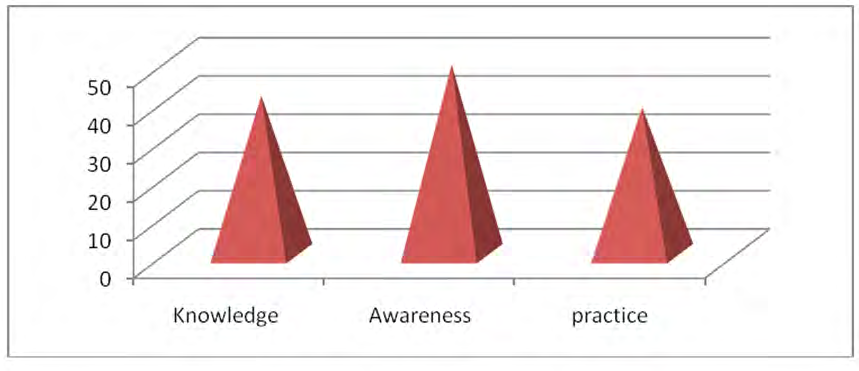
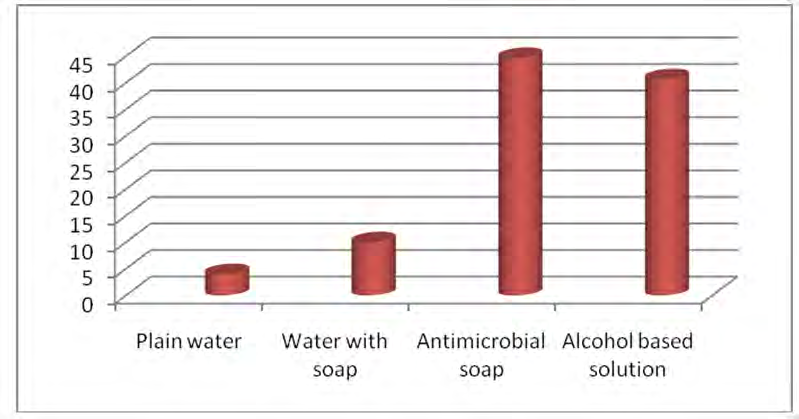
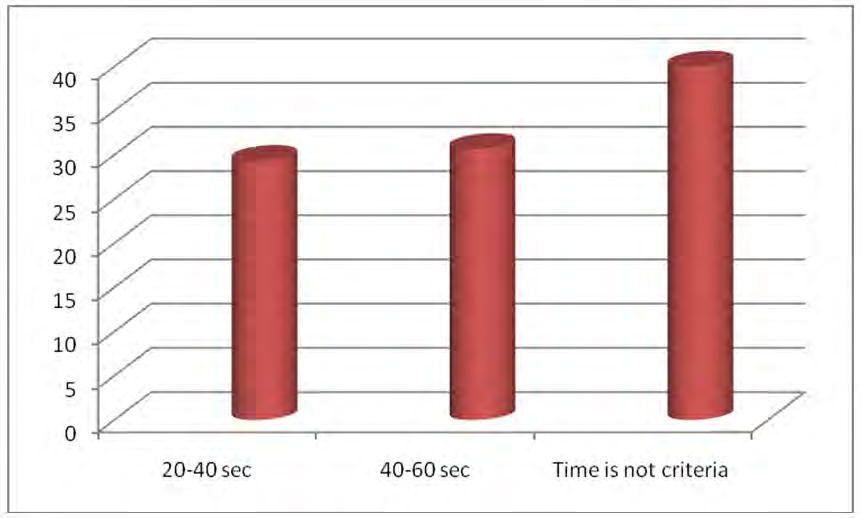
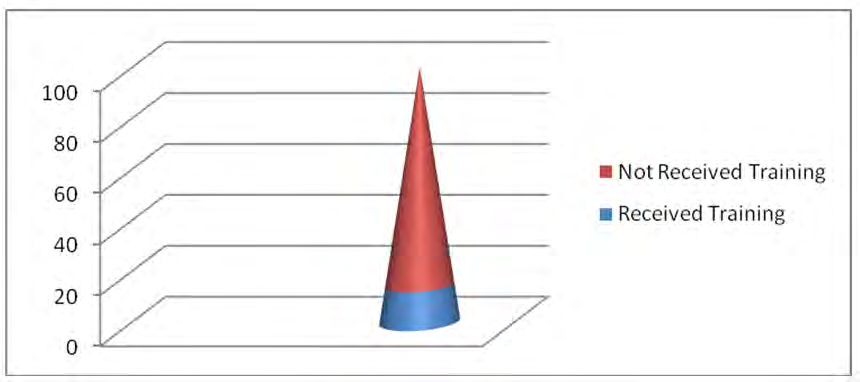
Number of health care professionals included in the study was 150. In the present study the knowledge on hand hygiene was moderate (41.38%). It was observed that the average awareness regarding the positive indications of hand hygiene was 49.1% and only 38.33% practices the hand hygiene protocol of the 150, 22 (14.67%) declared that they had not been received any training regarding HH (Figures 1-4).
Discussion
This study was carried out to test the knowledge, attitude and awareness about Hand hygiene practices amongst dental professionals. To author’s knowledge, this is the unique study that provides a comprehensive assessment of the HH practices and beliefs of dental health workers.
In the present study the knowledge on hand hygiene was moderate (41.38%). Earlier study from Riyadh, Saudi Arabia by Basurrah M, et al. [3]; among health care workers (HCWs), adherence to hand hygiene was seen among 70% among medical students, 69.2% among interns, 18.8% among nurses, 12.5% among residents and 9.1% among consultants.
In our study awareness was 49.1% but there was lack of proper practices with this knowledge. Kadi, et al_._ at Saudi Arabia observed that the average awareness regarding the positive indications of hand hygiene was 56% among medical students [3] indeed; a recent review WHO, et al. [5] reported an average Hand Hygiene compliance of 38.7% with a baseline ranging from 5% to 89%. These results are inferior to many studies conducted for dental healthcare workers in countries such as Africa (25% before glowing and 47% after), Italy (55.5%), Canada (76%), USA (75%), and Khartoum state (44%), United Kingdom (26-63%). Moreover, it is important to distinguish between studies undertaken in teaching and nonteaching centers, when comparing results.
Different causes of compliance could explain health care professional attitudes toward HH. Interruption in care is an important cause of compliance and this frequent situation occurs during treatment sessions. Environmental and personal barriers could explain these iterative breaks. In particular, organization with central dispensing station of all sterile devices enhances the number of persons moving around the clinic and increases the risk of not following the correct HH protocol [2]. When there was compliance with HH, the results showed a correlation between knowledge note and quality of HH in our study.
This importance of increasing knowledge about infection control scientific data and about protocols for better compliance was demonstrated by surveys of Cheng, et al. in Taiwan, Cleveland, et al. in US and Hubner, et al. in Germany.
Conclusion
Our study highlights the urgent need for introducing measures in order to increase the knowledge, attitudes, practices in Teaching institutes & Hospital, which may play a very important role in hand hygiene compliance among the staff and reducing cross transmission of infections among patients.
References
-
Ahmed EE (2011) Improving hand hygiene compliance among dental health workers in 3 dental clinics in Khartoum. Thesis Royal College of Surgeons in Ireland, pp: 1-77.
-
Thivichon PB, Barsotti O, Girard R, Morrier JJ (2014) Hand hygiene practices in a dental teaching center: Measures and improve. Eur J Dent 8(4): 481-486.
-
Mausumi B (2015) Scholars Journal of Applied Medical Sciences 3(6C): 2334-2339.
-
Mohesh G, Dandapani A (2014) Knowledge, attitude and practice of hand hygiene among medical students -A questionnaire based survey. Unique Journal of medical and dental sciences 2(3): 127-131.
-
WHO (2009) WHO guidelines on hand hygiene in health care. World Health Organization, pp: 262.
-
(2020) Hand Hygiene Guidance: Hand Hygiene in Healthcare Settings. Center for disease control and Prevention.
- Intersecting Epidemics and Climate Vulnerabilities in Conflict- Driven Displacement: Epidemiology, Systemic Challenges, and One Health Gaps in South Sudan
- Advancing Domestic Health Financing for Community Health System Sustainability in South Sudan: The Boma Health Initiative Model (2025–2035)
- Prevalence and Correlates of Post-Exposure Prophylaxis Uptake among Men Who Have Sex with Men in Kisumu County, Kenya
- Medical, Ethical, and Legal Conflicts Surrounding Euthanasia in Argentina. Its Global Implications
- Knowledge and Attitude on Menstrual Hygiene among Adolescent Girls Studying in Secondary Level in Public Schools of Chitwan District, Nepal
- Biological Efficacy of an Adulticide Mixture (clothianidin + deltamethrin) as an Indoor Residual Spray against Adult Anopheles flavirostris in Palawan, the Philippines