
Dengue Behavior in The Face of the Covid-19 Pandemic in Minas Gerais, Brazil
This study analyzes, describes, and differentiates between the measurement of Dengue in Minas Gerais, Brazil, between January 2018 and April 2021, and Covid-19 data reported between March 2020 and April 2021. An epidemiological, observational, retrospective, descriptive, and analytical study was carried out to assess correlations between combat and coping measures in the public health sector for each disease. For sample collection, the DATASUS and TABNET platforms were used, along with secondary data on reported cases of Dengue and Covid-19, from 2018 to 2021 in the state of Minas Gerais. For storage, tabulation, statistical analysis of data and graphic construction, Excel version 2021 and Google spreadsheet software were used. Dengue incidence from 2018 to 2021 was compared with the years 2019 to 2020 against the backdrop of the emergence and incidence of Covid-19. Our study reveals a sharp drop in the epidemic curve for Dengue cases in 2020 compared to the previous year, while cases of SARS-CoV-2 infection grew exponentially. After accounting for seasonal factors of Dengue increase and impact, such as precipitation, we conclude that for the state of Minas Gerais, Brazil, the hypothesis of overlap between cases of Dengue and Covid-19 is consistent for the years studied. However, research on the subject in other countries over a longer timeframe would be relevant to verify such an occurrence.
Introduction
Emerging in late 2019, the pathology caused by the new coronavirus has acquired alarming proportions by infecting more than 193 million people, worldwide by July of 2021 (Johns Hopkins University 2021). The new pathogen was identified as SARS-Cov-2 (Severe Acute Respiratory Syndrome Virus), causing “Covid-19” - a disease classified by the World Health Organization as a global pandemic as of March, 2020 and already confirmed in Brazil one month earlier [1]. The WHO (2021) had already confirmed almost 130 million global cases over the first year of the pandemic, with more than 2.8 million deaths at the end of March, 2021.
Brazil has been one of the countries that the Covid-19 pandemic hit hardest, with some of the most widespread transmission and death. In Brazil, according to the Health Surveillance Secretariat (2021), over 19 million cases were confirmed in the month of July 2021, resulting in about 556,370 deaths. This translates to a fatality rate of 2.8% and a mortality rate close to 265/100,000 inhabitants. Covid-19 has overwhelmed the public health systems of most countries, even the wealthiest and most capable, due to its rapid spread and requirement for intensive care focused on the deteriorating clinical conditions of many patients. Thus, for [2], this demand is reminiscent of the control of vector-borne endemic diseases, such as Dengue, especially in tropical countries. Dengue is a viral disease caused by four distinct serotypes (DENV) and transmitted by the Aedes aegypti mosquito. Already present in many countries, it occurs mainly in tropical and subtropical climates because abiotic factors, such as rainfall and temperature, influence the dynamics of its vector and therefore, the seasonality of its peak transmission each year [3]. Dengue is recurrent in Brazil between December and April and varies little between regions.
The most common Dengue symptoms are cough, muscle pain, fatigue and fever, and even rashes and petechiae (spots on the skin). These symptoms are very similar to those of SARS-Cov-2 infection, which makes clinical distinction challenging due to the overlap between the two diseases [4]. This overlap extends beyond symptoms to serological similarities: [5] describe cases of Dengue confirmed through rapid tests for antigen (NS1) and IgM and IgG antibodies that were later determined to be SARS-Cov-2 and identified as false-positives for the DENV virus by the RT-PCR technique. Thus, the most common antigen and antibody tests for Sars- Cov-2 can result in false positives for Dengue and vice-versa. In turn, the uncertainty in specificity between the two diseases generates public health implications, especially regarding the care of infected patients and the proper isolation procedures for Covid-19, due to its airborne transmissibility. The lack of specificity is not limited to Brazilian variants of Covid-19 or Dengue. According to Masyeni S, et al. [6] there is also evidence of cross-reactivity in screening tests for Covid-19 and Dengue antibodies observed in Thailand and Indonesia. Similar to the Brazilian case, this was demonstrated by false- positive results in which antibodies to DENV were detected by the test for SARS-Cov-2 and vice-versa. Furthermore, the occurrence of co-infection by the two diseases, reported in Singapore and Thailand, raises the alert for other endemic countries, such as Brazil. In view of this non-specificity, there are questions as to the epidemiological characterization of each disease [7], what constitutes adequate treatment, and when that treatment should be adopted, especially at the beginning of the infection.
Brazil, and many countries where Dengue is endemic, remain in a public health emergency caused by the Covid-19 pandemic, in which the death toll has reached catastrophic proportions and where considerable local variation demonstrates a great need for subnational analysis, especially in Brazil [8, 9]. In view of Covid-19’s association with the presence of seasonal Dengue epidemics in Brazil, it is urgent to clarify epidemiologic data on the real incidence of both diseases to better understand the DENV virus propagation profile during the pandemic period and, from this, help the health system to better distinguish and address both diseases. Therefore, this study describes and differentiates between reported data on Dengue in Minas Gerais, Brazil between January, 2018 and April, 2021, together with Covid-19 data reported between March, 2020 and April, 2021. Based on these profiles, we identify a discrepancy in the reported numbers of Dengue cases, possible reasons for the discrepancy, and also evaluate differences in the reported rates across the macro-regions of the State.
Materials and Methods
This research is an epidemiological, observational, retrospective, analytical study, with the purpose of collecting data, describing patterns surrounding Dengue in Minas Gerais, and evaluating their relationship with Covid-19. The state of Minas Gerais is the 4th largest state in the country, with a territory of 586, 521.123 km² and the second largest state in Brazil in population with 21,292,666 inhabitants according to the Brazilian Institute of Geography and Statistics (IBGE) in 2020 (IBGE, 2020). Minas Gerais also has considerable health infrastructure and strong capacity for testing, reporting, and treatment. For data collection, the platforms DATASUS (Department of Informatics of the Unified Health System), TABNET and SINAN (Sistema de Informacao de Agravos de Notificacoes) were used. The secondary epidemiological data referring to Dengue is reported from January, 2018 to April, 2021 in the state of Minas Gerais, classified by health macro-regions in the state. For Covid-19, the data begins in March 2020, with the first recorded cases, and ends in April 2021. Temporally, monthly data was used. The analyzed periods of data for Covid-19 and Dengue are thus not the same; the concomitant period of analysis is relatively short, which offers suggestive evidence but is not sufficient to infer a longer-term trend. The software Microsoft Office Excel®, version 2021, and Google Spreadsheet were used for storage, tabulation, statistical analysis of the data, and graphical construction.
Results
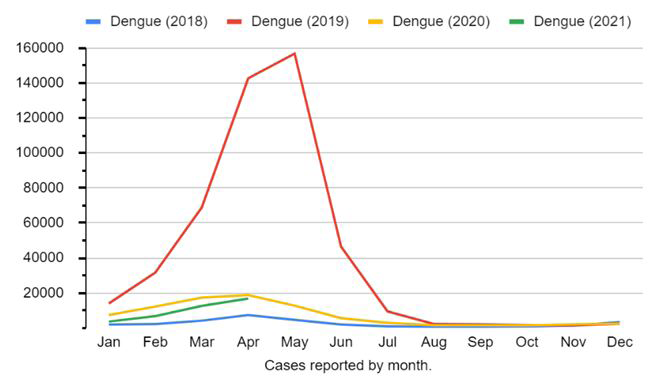
Non-cumulative cases in monthly Dengue reports for Minas Gerais were analyzed from January 2018 to April 2021 (Figure 1). The data show an annual total of 29,361 cases (2018), 478,898 cases (2019), 85,356 cases (2020) and
39,616 cases (2021). These totals translate to the following monthly means and standard deviations (sd): 2,446.75 ± 1,963.98 (2018), 39,908.16 ± 53,208.28 (2019), 7,113 ± 6,182.46 (2020) and 3,301.33 ± 8,353.77 (2021) Figure 1.
The data for the present study is subdivided into 11 health macro-regions, where data are compiled. Therefore, note a discrepancy in the incidence of Dengue cases in the state’s Central macro-region in relation to the others, since 53.5% of the cases notified in the period (2018-2020) were in this region (Table 1).
| 2018 | 2019 | 2020 | Total | |
|---|---|---|---|---|
| South | 951 | 17.253 | 7.747 | 25.942 |
| Center | 2.96 | 297.072 | 17.729 | 317.77 |
| North | 4.229 | 34.062 | 3.022 | 41.313 |
| West | 2.581 | 26.195 | 11.791 | 40.568 |
| East | 521 | 5.619 | 8.401 | 14.541 |
| Southeast | 4.039 | 15.861 | 4.827 | 24.729 |
| Northwest | 1.985 | 21.227 | 5.342 | 28.556 |
| Northeast | 283 | 2.192 | 7.299 | 9.774 |
| Triangle | 4.83 | 52.791 | 10.353 | 67.98 |
| Steel Valley | 6.888 | 2.945 | 5.872 | 15.706 |
| Jequintinhonha | 104 | 3.681 | 2.973 | 6.761 |
| Total | 29.361 | 478.898 | 85.356 | 593.64 |
Table 1: Dengue cases by health macro-regions in the period of 2018-2021 in Minas Gerais, Brazil. Source: Ministry of Health/Svs
When analyzing the Dengue epidemic curve in Minas Gerais, there is a great decline in the number of cases reported between 2019 and 2020, especially between February and June 2020 (Figure 2). However, with the advent of the Covid-19 pandemic in 2020, May 2020 saw an increase in the incidence of Covid-19 cases and a drastic reduction in Dengue case reports (Figure 2).
![Figure 2: Overlay of the epidemic curve between Covid-19 (2020) and Dengue (2019-2020). Source: Datasus/Tabnet There are several potential reasons for the sharp decline in reported Dengue cases, including misdiagnosis in a purely clinical setting. There are many similarities in the clinical signs and symptoms of Dengue and Covid-19. For example, both infections present fever, headache, and pharyngitis (Table 2). Both diseases produce similar changes in blood parameters as well. This relationship, combined with the nonspecificity of some laboratory blood parameters that both diseases produce changes in these parameters, such as thrombocytopenia (decrease in platelets) and elevation of liver enzymes AST (aspartate aminotransferase) and ALT (alanine aminotransferase), possibly as a result of Hepatic cytotoxicity makes diagnoses even more difficult [10]. These diseases can easily be confused at the time of diagnosis as Table 2 shows.](/fulltextimages/8823/fig_2.png)
Figure 2: Overlay of the epidemic curve between Covid-19 (2020) and Dengue (2019-2020). Source: Datasus/Tabnet There are several potential reasons for the sharp decline in reported Dengue cases, including misdiagnosis in a purely clinical setting. There are many similarities in the clinical signs and symptoms of Dengue and Covid-19. For example, both infections present fever, headache, and pharyngitis (Table 2). Both diseases produce similar changes in blood parameters as well. This relationship, combined with the nonspecificity of some laboratory blood parameters that both diseases produce changes in these parameters, such as thrombocytopenia (decrease in platelets) and elevation of liver enzymes AST (aspartate aminotransferase) and ALT (alanine aminotransferase), possibly as a result of Hepatic cytotoxicity makes diagnoses even more difficult [10]. These diseases can easily be confused at the time of diagnosis as Table 2 shows.
| Covid-19 | Dengue | |
|---|---|---|
| Fever | +++ | +++ |
| Headache | ++ | +++ |
| Asthenia | + | ++ |
| Skin irritation | + | ++ |
| Cough | +++ | + |
| Pharyngitis | ++ | ++ |
| Anosmia and Ageusia | +++ | +/- |
| Diarrhea | + | + |
| Nausea/vomiting | + | + |
Table 2: Comparison of clinical symptoms of Covid-19 and Dengue. Source: Adapted By Nacher M, et al. [11].
Discussion
The period from 2018 to 2020 featured a total of 593,640 cases of Dengue in Minas Gerais. 2019 demonstrated an increase in the epidemiological curve (Figure 1), representing 80.67% of all cases in the period. It is noteworthy that in 2021 only three months were analyzed, hence the number of cases is much lower for the year. The state of Minas Gerais is one of the largest states in the country in terms of territory and population. There are a far greater number of Dengue cases in the central health macro-region of Minas Gerais, which can be explained by the greater population density in relation to other macro-regions of the sate (Table 1). This trend occurs due to the reproduction characteristics of the Aedes aegypti mosquito, where population density and the relationship with anthropic activities are classified as prerequisites for its dissemination. Given the above, areas with high population density demonstrate a higher rate of disease transmission, which is therefore closely related to environmental, spatial and socioeconomic factors.
According to Leandro, et al. the years 2017-2018 featured a large decrease in Dengue cases that interrupted the historical pattern evident through 2015 and 2016. However, the year 2019 was more typical historically, with a sharp growth in the number of cases, which even after falling in 2020, still remained higher than the 2017-2018 biennium. The monthly agro-climatological bulletin, released by the National Institute of Meteorology (INMET) in 2019, showed an above-average rainfall forecast for southeastern Brazil, for the time interval between November 2019 and January 2020. Regular occurrence of rainfall and total precipitation above historical averages, mainly in the central region of the state, was confirmed in the technical report on hydrometeorological management of the Minas Gerais Water Management Institute (IGAM), covering the months of October 2019 to March 2020.
Data demonstrate a higher incidence of Dengue in the first half of each year, as identified by Viana DV, et al [3]; Silva FG, et al. [12] explain this seasonality in the microregion of Montes Claros, MG, where the development interval for the larval stage of the transmitter vector is initially preceded by the rainy season and serves as an important determinant for the epidemiology of Dengue. According to the study by Mascarenhas MDM, et al. [13] the seasonal increase in Dengue cases each year would occur from the increase in previous rainfall rates combined with possible failures to combat the vector. Potential failures to combat the vector reflect the view of the federal recommendations to the Endemic Control Agents (ACE), limiting their access only to the peri-domestic area, according to note No. 08/2020 of the Ministry of Health, where containers such as refrigerator defrosting trays and bathroom drains serve as potential neglected breeding grounds.
According to IGAM (2019) rainfall and precipitation for the year 2020 were higher than historical averages, thus resulting in a forecast for an increase in the Dengue epidemic curve. The forecast and confirmed precipitation totals would therefore normally have led to a forecast for greater Dengue incidence in 2020, not lesser incidence. However, the information observed was contrary (Figure 2), there was a sharp drop in Dengue compared to the 2019-2020 biennium. Rainfall can therefore be excluded as a possible determinant of the change noted in the epidemic curve for Dengue in 2020 [3]. Instead, the result is highly likely a failure to report the actual incidence of Dengue due to the extraordinary focus on combating Covid-19 and its harmful consequences to health systems Leandro, et al. For Lorenz C, et al. [14] there are several possible justifications for such a discrepancy in the incidence of Dengue in the pandemic scenario: 1) a noted underreporting of cases, a consequence of the efforts directed by the health system to combat Covid-19, the clinical similarity of the two diseases, and the possible false-negative results for Dengue in rapid testing, as reported in studies by Yan G, et al. [5]; Masyeni S, et al. [6]. An alternative hypothesis could also potentially account for the decline in cases through 2) reduced mobility by social isolation measures as a positive factor for the decrease in Dengue rates, as also pointed out by Nacher M, et al. [11]
Figure 1 demonstrates that early 2021 already exhibit a resumption of growth in reported Dengue cases, according to the slope for the state of Minas Gerais. This shift likely reflects the greater attention the health system is now paying to Dengue cases and, above all, occurs as a consequence of the decrease in the control of the disease in this pandemic period. Thus, these recent data reinforce the hypothesis of underreporting of Dengue cases during the period studied. It is important to note that the results in this case are suggestive, not definitive, as the data are secondary and serology could not be directly studied. The measures to control Dengue should be resumed and strengthened, including re-instituting mechanisms for individual and collective protection, as well as epidemiological surveillance with more accurate reporting to identify the real incidence of the disease in each urban area. Moreover, health systems have a clear need for rapid tests with greater specificity to distinguish the two diseases. Finally, it is urgent to promote greater public awareness and social mobilization against Dengue. These measures are more feasible at this point in the Covid-19 pandemic and will prevent the incidence and prolongation of future epidemics of Dengue fever [15, 16, 17, 18].
Conclusions
This study concludes that the hypothesis that Dengue cases were underreported during the period 2019-2020, in Minas Gerais, Brazil, during the SARS-CoV-2 pandemic finds support in our data. Complementary studies will be important for verifying whether such an occurrence could be considered a trend, especially in countries with a high incidence of Dengue cases. The chaos that Covid-19 caused within the health system potentially exacerbated an endemic disease that causes countless deaths every year, especially in countries with hot, humid climates. Health systems must pay special attention to the diagnosis of these diseases to avoid false-positive results for Dengue in patients infected with the new coronavirus [5]. These conclusions also serve as a warning for the transmission of other arboviruses, such as Zika and Chikungunya, which were not analyzed in this study. Thus, for the state of Minas Gerais, but also for Brazil as a whole, there is concern about the overlap of Dengue and Covid-19, the difficulty in distinguishing the two diseases from one another, and the resulting risk of even greater damage to public health in terms of morbidity and mortality.
Conflicts of Interest
We have no conflicts of interest to report.
Acknowledgements
We thank Dr. Felicia Knaul, Ph. D., Director of the University of Miami’s Institute for Advanced Study of the Americas, and Professor of Public Health at the University of Miami’s Miller School of Medicine for supporting this research.
Funding
The University of Miami Institute for Advanced Study of the Americas supported this research.
References
-
Souza CDFD, Leal TC, Santos LG (2020) Doencas do Aparelho Circulatorio em Individuos com COVID-19: Descricao do Perfil Clinico e Epidemiologico de 197 obitos. Arquivos Brasileiros de Cardiologia 115(2): 281- 283.
-
Smith AW, Tissera H, Ooi EE, Coloma J, Scott TW, et al. (2020) Preventing dengue epidemics during the COVID-19 pandemic. The American journal of tropical medicine and hygiene 103(2): 570-571.
-
Viana DV, Ignotti E (2013) A ocorrencia da dengue e variacoes meteorologicas no Brasil: revisao sistematica. Revista Brasileira de Epidemiologia 16(2): 240-256.
-
Harapan H, Ryan M, Yohan B, Abidin RS, Nainu F, et al. (2021) Covid‐19 and dengue: double punches for dengue‐endemic countries in Asia. Reviews in medical virology 31(2): e2161.
-
Yan G, Lee CK, Lam LT, Yan B, Chua YX, et al. (2020) Covert COVID-19 and false-positive dengue serology in Singapore. The Lancet Infectious Diseases 20(5): 536.
-
Masyeni S, Santoso MS, Widyaningsih PD, Asmara DW, Nainu F, et al. (2021) Serological cross-reaction and coinfection of dengue and COVID-19 in Asia: Experience from Indonesia. International Journal of Infectious Diseases 102: 152-154.
-
Wu D, Lu J, Liu Q, Ma X, He W (2020) To alert coinfection of COVID-19 and dengue virus in developing countries in the dengue-endemic area. Infection Control & Hospital Epidemiology 41(12): 1482.
-
Touchton M, Knaul FM, Ornelas HA, Porteny T, Sánchez M, et al. (2021) A partisan pandemic: state government public health policies to combat COVID-19 in Brazil. BMJ global health 6(6): e005223.
-
Knaul FM, Touchton M, Arreola-Ornelas H, Atun R, Anyosa RJC, et al. (2021) Punt Politics as Failure of Health System Stewardship: Evidence from the COVID-19 Pandemic Response in Brazil and Mexico. The Lancet Regional Health-Americas 4: 100086.
-
Verduyn M, Allou N, Gazaille V, Andre M, Desroche T, et al. (2020) Co-infection of dengue and COVID-19: A case report. PLoS Negl Trop Dis 14(8): e0008476.
-
Nacher M, Douine M, Gaillet M, Flamand C, Rousset D, et al. (2020) Simultaneous dengue and COVID-19 epidemics: Difficult days ahead?. PLoS neglected tropical diseases 14(8): e0008426.
-
Silva FG, Magalhães SCM (2017) Correlacao entre fatores climaticos, socioambientais e a dengue na microrregiao Montes Claros/MG. Caminhos de Geografia 18(61): 231- 244.
-
Mascarenhas MDM, Batista FMDA, Rodrigues MTP, Barbosa ODAA, Barros VC (2020) Ocorrencia simultanea de COVID-19 e dengue: o que os dados revelam?. Cadernos de Saude Publica 36(6).
-
Lorenz C, Bocewicz ACD, Marques CCDA, Santana LMR, Neto FC, et al. (2020) Have measures against COVID-19 helped to reduce dengue cases in Brazil?. Travel medicine and infectious disease 37: 101827.
-
Ahn DG, Shin HJ, Kim MH, Lee S, Kim HS, et al. (2020) Current status of epidemiology, diagnosis, therapeutics, and vaccines for novel coronavirus disease 2019 (COVID-19). J Microbiol Biotechnol 30(3): 313-324.
-
Olive MM, Baldet T, Devillers J, Fite J, Paty MC, et al. (2020) The COVID-19 pandemic should not jeopardize dengue control. PLoS neglected tropical diseases 14(9): e0008716.
-
WHO (2020) WHO Coronavirus Disease (COVID-19) First Report. World Health Organization.
-
Zhu N, Zhang D, Wang W, Li X, Yang B, et al. (2020) A novel coronavirus from patients with pneumonia in China, 2019. New England journal of medicine 382(8): 727-733.
- Intersecting Epidemics and Climate Vulnerabilities in Conflict- Driven Displacement: Epidemiology, Systemic Challenges, and One Health Gaps in South Sudan
- Advancing Domestic Health Financing for Community Health System Sustainability in South Sudan: The Boma Health Initiative Model (2025–2035)
- Prevalence and Correlates of Post-Exposure Prophylaxis Uptake among Men Who Have Sex with Men in Kisumu County, Kenya
- Medical, Ethical, and Legal Conflicts Surrounding Euthanasia in Argentina. Its Global Implications
- Knowledge and Attitude on Menstrual Hygiene among Adolescent Girls Studying in Secondary Level in Public Schools of Chitwan District, Nepal
- Biological Efficacy of an Adulticide Mixture (clothianidin + deltamethrin) as an Indoor Residual Spray against Adult Anopheles flavirostris in Palawan, the Philippines