
Distribution and Abundance of Dengue Vector(S) Mosquito and Their Breeding Preferences in Five Selected Administrative Wards of Dhaka North City Corporation, Bangladesh
Dengue fever (DF) and Dengue haemorrhagic fever (DHF) is the most significant arising arboviral disease which is spread from dengue virus infection. Aedes aegypti and Aedes albopictus are the known vectors of dengue virus worldwide. A house based entomological survey was conducted to identify the distribution, abundance of dengue vector(s) mosquitoes and their preferable breeding sites in five selected wards at Dhaka North City Corporation, during July to December 2019. Stegomyia indices were calculated using the exact binomial test. Association between climatic factors and Aedes species abundance were also studied. The highest prevalence of Aedes mosquitoes were found in July. We did not found any Ae.albopictus during the study period. The overall house index (HI), container index, and Breteau index were found 20, 2 and 31 respectively, during the survey period. The present study did not find any significant association (p > 0.05) with meteorological factors (mean temperature, lag rainfall & relative humidity) and the density of Aedes mosquitoes. It is not possible to get an exact idea of the dengue outbreak through a short-term Aedes mosquito survey. So, this study suggests year-long mosquito surveillance program to acquire more conception of dengue transmission and how dengue vector(s) species abundance playing the role.
Introduction
Dengue is one of the severe; painful and fast emerging mosquitos borne disease which is liable for over 100 million infections a year throughout tropical and subtropical regions of the world [1]. The World Health Organization (WHO) has determined that the real figure may be more like 390 million [2, 3]. In Bangladesh; a major dengue outbreak took place in 2000 by a countrywide epidemic involving 5; 551 infection cases and 93 deaths were occurred. Recently dengue fever (DF) and dengue haemorrhagic fever (DHF) has become the foremost emerging diseases and genuine public health problems in all major cities in Bangladesh. More than 90% of all dengue cases were accounted in Dhaka; and therefore; this capital was distinguished as the most endemic metropolitan territory for dengue in the country [4, 5, 6, 7]. The dengue virus is transmitted to humans through the bite of infectious female Aedes mosquitoes [8]. Aedes aegypti and Aedes albopictus are the known vector species of dengue fever (DF) and dengue hemorrhagic fever (DHF). These vectors are deeply sensitive to the environmental factors as temperature; humidity; rainfall etc. and are also capable to breed in a small amount of water such as a tablespoons of water; especially in urban conditions [9, 10]. The main producers of Aedes larvae known as “Key Containers” are the principal source of adult Aedes mosquitoes [11]. Aedes aegypti is considered to be the predominant indoor breeder; while Aedes albopictus is considered for outdoor breeder [12].
Mosquito surveillance is essential for an effective mosquito control program that provides information on adult and larval population density and species composition which is very useful in preventing a serious outbreak of dengue fever [13]. It is acknowledged that national dengue surveillance is done in such a small range which depends on only 41 hospitals in Dhaka and the rest of all other hospitals situated in other districts of Bangladesh; are remain as unexposed in reporting dengue outbreak [14]. More than 100; 000 infection cases were occurred and 179 people died by dengue fever in 2019 which were confirmed by the Health Emergency Operations Center and Control Unit; DGHS; Bangladesh [15]. According to this data; we can assume that the most serious dengue outbreak occurred in the year 2019; which has broken all previous records of dengue outbreaks in Bangladesh. Since March 2020; all surveys on dengue vector(s) mosquito species have been postponed due to the COVID-19 pandemic. This led to an increase in the dengue epidemic throughout the country; especially in the city of Dhaka. According to a report by the Bangladesh Directorate-General for Health Services (DGHS); more than 28; 229 patients with dengue fever were admitted to hospital throughout the year of 2021; of which more than 105 were died. So; it is very necessary to conduct regular surveillance on dengue vector(s) mosquitoes in the city of Dhaka and throughout the country for taking precautionary activities to prevent the severe outbreak of dengue fever. Considering the importance of surveillance in the mosquito control program; the current study was conducted in five selected administrative wards of Dhaka North City Corporation (DNCC).
Methods and Materials
Study Area
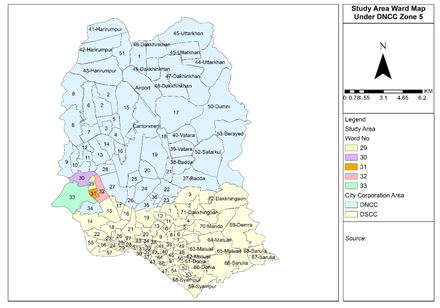
Dhaka; the capital of Bangladesh; is located between 23°45̍50 ̎ north latitude and 90°23̍20 ̎ E longitude; is densely populated by 21 million individuals living in a space of about 360 km²; which is divided in some administrative units known as “wards” [12]. This place is extremely known for the spread of diseases caused by mosquitoes [16]. There are 92 wards (the smallest administrative unit) in the Dhaka City Corporation (DCC); which are divided into two parts of the city. One is the Dhaka North City Corporation (DNCC) and the other is the Dhaka South City Corporation (DSCC) [17]. The study was carried out in selected five administrative wards of zone 5 of Dhaka North City Corporation (Figure 1). The administrative wards were randomly selected to detect the larval density of Aedes mosquito in those areas.
Entomological Survey and Study Period
The entomological surveillance was conducted in five selected administrative wards (ward no-29; 30; 31; 32 and 33) of zone 05 at North City Corporation in Dhaka city from July to December 2019; to reduce the severe situation of the DF (Dengue Fever) epidemic. The main objective of this study was to anticipate further transmission of dengue by identifying the regions with a large thickness of Aedes mosquitoes. For this field survey; 20 houses were selected of which 8 were multi-storied houses; 3 were independent houses; 2 were vacant places; 3 were construction sites; 3 were semi-permanent houses and a slum house. Although in a strict sense casual sampling could not be done with available resources; we tried to minimize the preference in selecting houses. Households are selected on the basis of: (1) frequency distribution of different house types; (2) spatial distribution of the households in the geographical area of DNCC. The houses were named per their development [12]. The houses were named according to their structural construction. This field survey was carried out in all three locations of each house; i.e. indoors; outdoors; and in the roof.
Collection; Transportation of Larvae
All selected places were physically marked on the map; and their addresses were saved on both field data sheets and GPS units. Among every type of selected houses; all containers were checked for immature mosquitoes in the inside and outsides of the houses. If; any containers that have stored water for more than 3 days it is considered as a “wet container”. Water which is stored in any external containers; without any nearby water source; during the monsoon season is considered as “rainwater”. The number and type of “dry container” (those that retain water for less than 3 days) were also recorded to calculate the container index (CI). All wet containers were observed for finding mosquito larvae; especially for detecting Aedes larvae or pupae. The containers were then divided into different groups: pots; plastic bowls; clay pots; coconut shells; cans and bottles; etc. The mosquito larvae had been collected by a standard method with dipper; whereas the dipper had been gently lowered in an angle of 45˚ just below the water surface. Larvae were collected by ladle spoon; pipette; dipper and dropper from different spot.
Identification of Larval Mosquito Species
Mosquito larvae were collected from different locations and kept in labeled plastic vials; then they were kept in vials with formalin (CH2O) to be identified in the laboratory of the Entomology at Jahangirnagar University. The larvae were identified by a simple method and by the preparation of permanent slides. Mosquito larvae were identified using the keys of Barraud, et al., Bram, et al., Puri, et al. [18, 19, 20].
Collection of Meteorological Data
Meteorological data including rainfall; temperature and relative humidity for monsoon (July-December; 2019) was collected from Bangladesh Meteorological Department (BMD).
Data Analysis
Stegomyia indices including; the house index (HI); the percentage of houses infected with larvae; container index (CI); the percentage of containers infected with mosquito larvae; BI; the percentage of positive containers with the total houses inspected; has been calculated according to the WHO’s guidelines. These four indices were calculated based on the number of wet containers infested with Aedes larvae. Wet containers with any number of larvae were considered as “positive containers” (PC). Houses that found with positive containers were considered as “positive premises”. The parameters below were used to obtain the entomology indices for all the surveyed localities:
100 Numberof positivehouses HI Numberof housesinspected = ×
100 Numberof Positivecontainers CI Numberof containersinspected = ×
100 Numberof Positivecontainers BI Numberof housesinspected = ×
Prevalence of container infested by Aedes larvae were calculated by dividing all containers (dry & wet) with the number of wet and infested containers. Pearson correlation analysis was also utilized to identify the connection between the mosquito larval density and meteorological factors such as mean temperature; relative humidity & lag rainfall. Data were analyzed by using Microsoft Excel 2013 and IBM stat 2020. All maps were designed through ArcGIS (Pro 10.8.1 version) software.
Results
Monthly Prevalence of Dengue Vector(S) Mosquito Species
A total of 120 houses were inspected (20 houses per month); among them only 24 houses (20%) were found positive for Aedes larvae during the study period (July- December; 2019). The present survey found the highest prevalence of Aedes mosquito in July. The overall house index (HI); container index; and Breteau index were found 20; 2 and 31 respectively; during the survey period (Table 1).
| Month | No. of House inspected | No. of WC | No. of PWC | No. of (+ve) House | HI | CI | BI |
|---|---|---|---|---|---|---|---|
| July | 20 | 486 | 15 | 7 | 35 | 3 | 75 |
| August | 20 | 240 | 6 | 5 | 25 | 3 | 30 |
| September | 20 | 252 | 0 | 0 | 0 | 0 | 0 |
| October | 20 | 313 | 8 | 5 | 25 | 3 | 40 |
| November | 20 | 293 | 5 | 4 | 20 | 2 | 25 |
| December | 20 | 302 | 3 | 3 | 15 | 1 | 15 |
| Total | 120 | 1886 | 37 | 24 | 20 | 2 | 31 |
Table 1: The calculated house; container and Breteau Index (HI; CI & BI) in study area during July-December 2019. NB: WC= Wet Con
Stegomyia Indices Based on Household Types and Selected Wards of Study Area
Six types of houses (Multistoried buildings; independent houses; construction sites; semi-pacca houses; vacant places and slum houses.) were inspected during the study period. A total of 37 houses (20%) were found positive for Aedes larvae. The highest BI were found in Multistoried buildings (48) followed by semi-pacca (33); slum houses (33); independent houses (28); vacant places (8) and construction sites (0). However; the highest CI were found in slum (3) followed by semi-pacca houses; multistoried buildings and vacant places (2); independent houses (1) and construction sites (0). The highest HI were found both in independent and semi-pacca houses (28) followed by multistoried buildings (25); slum houses (17); vacant places (8) and construction site (0) (Table 2). In around five selected wards of study area; the highest HI; CI & BI were found in ward no.30 (50; 4 & 67) followed by ward no.31 (42; 2 & 42). There is no Aedes mosquitoes were found in ward no.32 (BI; CI; HI=0) (Table 3).
| House Type | No.of House inspected | No. of WC | No.of PWC | No.of (+ve) House | HI | CI | BI |
|---|---|---|---|---|---|---|---|
| Multistoried Building | 48 | 950 | 23 | 12 | 25 | 2 | 48 |
| Independent House | 18 | 342 | 5 | 5 | 28 | 1 | 28 |
| Semi-pacca House | 18 | 256 | 6 | 5 | 28 | 2 | 33 |
| Construction site | 18 | 215 | 0 | 0 | 0 | 0 | 0 |
| Vacant place | 12 | 56 | 1 | 1 | 8 | 2 | 8 |
| Slum House | 6 | 67 | 2 | 1 | 17 | 3 | 33 |
| Total | 120 | 1886 | 37 | 24 | 20 | 2 | 31 |
Table 2: The house; container and Breteau Index calculated in various types of houses during the study period. NB: WC= Wet Contai
| Ward No. | No.of House inspected | No. of WC | No.of PWC | No.of (+ve) House | HI | CI | BI |
|---|---|---|---|---|---|---|---|
| 29 | 6 | 80 | 1 | 1 | 17 | 1 | 17 |
| 30 | 18 | 281 | 12 | 9 | 50 | 4 | 67 |
| 31 | 12 | 201 | 5 | 5 | 42 | 2 | 42 |
| 32 | 18 | 225 | 0 | 0 | 0 | 0 | 0 |
| 33 | 66 | 1099 | 19 | 9 | 14 | 2 | 29 |
| Total | 120 | 1886 | 37 | 24 | 20 | 2 | 31 |
Table 3: The House; Container and Breteau Index calculated in different wards during July-December; 2019 in study area. NB: WC= W
Container Frequency; Positive Container Frequency & Productivity
A total of 1886 wet containers were inspected and among them container frequency were found highest in water tanks (22%); followed by plastic mugs (15.85%); flower tub/trays (15.54%); water jars (15.06%); plastic bottles (9.01%); plastic drum (7.21%); plastic bucket (5.57%); money plants tub (3.98%); glass bottles (2.97%); clay pots (1.86%); cement pots (0.42%) and in earthen jars & tires (0.27%) (Table 4). A total 13 type of different wet containers were found which was positive for Aedes larval abundance during surveillance period; in which the highest positive container frequency were found in plastic buckets (51.35%) followed by earthen jars (18.92%); clay pots (13.51%); plastic bottles (10.81%); tires (2.70%) and the rest of the other were found 0% for positive container frequency as they were not infested with Aedes larvae. In these positive containers there were about a total of 1049 Aedes larvae were to be found or estimated which showed a total of 3.53% of container productivity based on breeding sources of Aedes larvae.
| Container type | MS | IH | SP | CS | VP | SH | Total | Container Frequency |
|---|---|---|---|---|---|---|---|---|
| Water Tank | 180 | 76 | 66 | 68 | 13 | 12 | 415 | 22 |
| Cement pot | 0 | 4 | 0 | 4 | 0 | 0 | 8 | 0.42 |
| Clay pot | 16 | 12 | 0 | 2 | 3 | 2 | 35 | 1.86 |
| Glass bottle | 28 | 15 | 10 | 3 | 0 | 0 | 56 | 2.97 |
| Plastic bottle | 91 | 18 | 25 | 19 | 6 | 11 | 170 | 9.01 |
| Plastic mug | 146 | 49 | 45 | 33 | 10 | 16 | 299 | 15.85 |
| Plastic bucket | 50 | 14 | 17 | 21 | 3 | 0 | 105 | 5.57 |
| Plastic Drum | 53 | 23 | 19 | 16 | 17 | 8 | 136 | 7.21 |
| Money plants tub | 51 | 10 | 9 | 4 | 0 | 1 | 75 | 3.98 |
| Flower tub & tray | 204 | 61 | 20 | 8 | 0 | 0 | 293 | 15.54 |
| Tires | 0 | 5 | 0 | 0 | 0 | 0 | 5 | 0.27 |
| Water jar | 131 | 54 | 44 | 37 | 4 | 14 | 284 | 15.06 |
| Earthen jar | 0 | 1 | 1 | 0 | 0 | 3 | 5 | 0.27 |
| Total | 950 | 342 | 256 | 215 | 56 | 67 | 1886 | 100 |
Table 4: The number and frequency of Aedes breeding wet container recorded in different types of houses during the study period (
| Container | No. of Wet Container | No. of Positive Wet Container | Positive Container Frequency | Number of Larvae | Container Productivity |
|---|---|---|---|---|---|
| type | (%) | (%) | |||
| Water Tank | 415 | 0 | 0 | 0 | 0 |
| Cement pot | 8 | 0 | 0 | 0 | 0 |
| Clay pot | 35 | 5 | 13.51 | 163 | 3.07 |
| Glass bottle | 56 | 1 | 2.7 | 30 | 3.33 |
| Plastic bottle | 170 | 4 | 10.81 | 55 | 7.27 |
| Plastic mug | 299 | 0 | 0 | 0 | 0 |
| Plastic bucket | 105 | 19 | 51.35 | 647 | 2.94 |
| Plastic Drum | 136 | 0 | 0 | 0 | 0 |
| Money plants tub | 75 | 0 | 0 | 0 | 0 |
| Flower tub & tray | 293 | 0 | 0 | 0 | 0 |
| Tires | 5 | 1 | 2.7 | 30 | 3.33 |
| Water jar | 284 | 0 | 0 | 0 | 0 |
| Earthen jar | 5 | 7 | 18.92 | 124 | 5.65 |
| Total | 1886 | 37 | 100 | 1049 | 3.53 |
Table 5: Aedes positive container frequency and productivity found in the study areas during survey period (July-December; 2019).
However; the highest container productivity were found in plastic bottles (7.27%) followed by earthen jars (5.65%); tires & glass bottles (3.33%); clay pots (3.07%); plastic buckets (2.94%) and the rest of other containers were found with 0% container productivity because they were not infesting with Aedes larvae (Table 5).
Dengue Vector(S) Aedes Mosquito Species
Collected Aedes mosquito larvae were identified as Aedes aegypti species which are the most known prominent mosquito species for spreading dengue virus in human population especially in urban areas just as like the selected study area. We did not find any Ae. albopictus in our study.
Association between Environmental Variables and the Occurrence of Mosquito Larvae
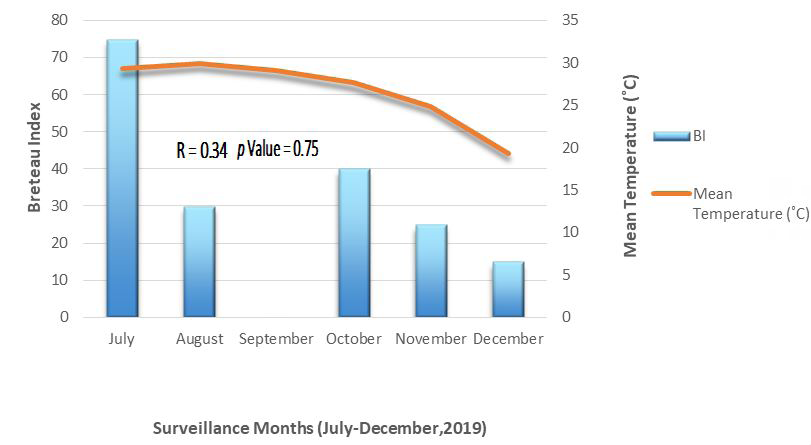
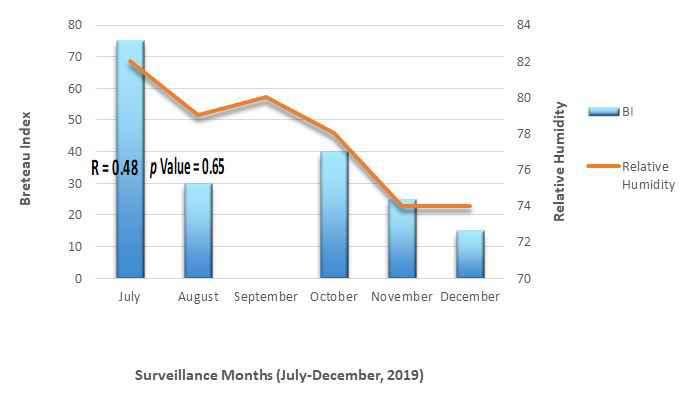
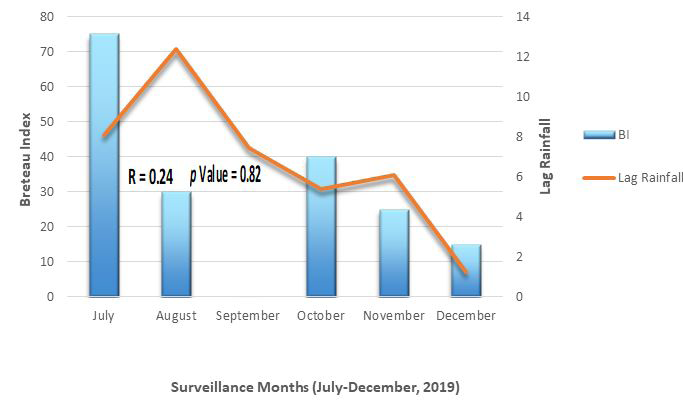
The highest percentage of Aedes mosquito larvae (36.13%) were found in July. But there is no significant relationship has been found between these climatic parameters and the percentages of Aedes larvae after calculating the overall study during July to December; 2019. Pearson correlation analysis had done to find out the connection between the mosquito larval density and meteorological factors such as mean temperature; relative humidity & lag rainfall. We did not find any significant (p > 0.05) association of Aedes larval density with the mean temperature (r = 0.34; p = 0.75); relative humidity (r = 0.23; p = 0.85) and lag rainfall (r = 0.24; p = 0.82) (Figures 2-4).
Discussions
The present study recorded the highest HI; CI and BI in July; likewise [21]. They found highest density of Aedes mosquito species (Ae.Aegypti & Ae.albopictus) in Dhaka city in July month. The present study also showed a moderate HI; CI and BI in August; October and November month; whereas it was very low in December month and was totally zero in September month of 2019. Though in a previous study showed the higher rates of Stegomyia indices such as HI; CI & BI during monsoon seasons (July-October) in Dhaka; Bangladesh [22, 23, 24]; but this study observed a different situation in September month for the prevalence of dengue mosquito species (Table 1). In excess of 100 thousand dengue cases and 179 affirmed deaths in 2019 were noted by Health Emergency Operation Center and Control Room; DGHS; in Bangladesh. For this severe dengue transmission during the July & August month in 2019; Government Republics of Bangladesh has taken a national awareness program. For that reason; the normal larval density has been reached a lowest level during the month of September; 2019. But in October; 2019 after reducing the influences of this disease there was a moderate rate of HI; CI and BI which has been found in present study followed by in November; 2019 also. But for being dry season in December; 2019 the lowest rates of HI; CI and BI was found (Table 1); correspondingly in a previous study showed that during the dry season it might be occurred due to the effects of lower environmental temperature; very low rainfall; lower relative humidity; which may cause the gradual decreases of mosquito larval abundance [25, 26]. In the case of Stegomyia indices (HI; CI & BI) among the six selected different type of houses; multistoried buildings were showed in the highest position for the values of HI; CI and BI; while a previous study also indicated that multistoried buildings are highly infested with Aedes mosquito larvae [12].
The present study has found a total of 13 types of wet containers but among them Aedes larva were found in only six types of positive wet containers. Though in these six types of wet containers plastic bucket has showed the highest container productivity. During this study water tank and drums didn’t show any productivity for Aedes larvae (Table 4&5) although a previous study revealed that these type of wet containers were also can be positive for larval density of Aedes mosquitoes. Nevertheless; that previous study predicted if the ugly or oftentimes cleaned containers are present in enormous numbers; they may be indicated as the possible breeding sources for a huge bit of the Aedes populace. Our present analysis exposed that most common productive containers for Aedes mosquito breeding sources were plastic buckets which were found both as dry and wet but mostly as uncleansed; just similar as that previous prediction in which a dry or wet container could be positive for Aedes breeding sources if they remained uncleansed [12].
The present study didn’t find any covered container infested with Aedes larvae even if they were dried or wet. Similarly a previous study in Rio de Janerio revealed that open-mouthed and large containers are more suitable for larval production rather than covered containers [27]. Size or volume; exposure to daylight; presence of lessen; cover status; and filling strategies for the containers were considered by an earlier study to decide the container efficiency for Aedes larvae and pupae; while the present study don’t have point by point data for these container parameters [27, 28]. There is no any significant relationship has been found between the climatic parameters and the percentages of Aedes larvae.
A prior study stated that the population of dengue vector mosquito species is extremely related to environmental changes such as temperature; humidity and rainfall [10, 29, 30]. The present study has also collected the climatic variables related data in accordance with survey schedule (July-December; 2019) from Bangladesh Meteorological Department (BMD) and analyzed these climatic variables with the estimated larvae number which was recorded during surveillance. An earlier study indicated that the successful hatching temperature for Ae.aegypti is above 17ºC [31, 32, 33]. The present study was done when the mean temperature of every month varied from 19 ºC to 29 ºC; but during most of the time of this survey period (July- November; 2019) the mean temperature was varied from 29 ºC to 24 ºC. So; this present study was done in those peak hours when Aedes larval density is in a high condition mostly in Dhaka city. The highest larval density of Aedes mosquitoes was found in July month when the temperature was also high than rest of the other months of the surveillance period (Figure 2). A previous study also predicted that during the monsoon surveys; mean temperature changed somewhere in the range of 28 and 30˚C [34].
The larval density of Aedes mosquitoes was found highest in July; 2019 while the average relative humidity was also higher than the other months of that year. The present study also found the lowest larval density of Aedes mosquitoes in December; 2019 while the average relative humidity was also lower than the other months of this year (Figure 3). It was expected by a past investigations that a higher relative humidity is related to an increment in hatching of Aedes eggs; which is stimulating the expanded wealth of youthful mosquitoes [35, 36]. Though the mean temperature and relative humidity showed an effective relation in abundance of Aedes larvae in some of previous studies [10, 29, 30] and the lag rainfall too; but our study couldn’t show any significant relations between these climatic parameters with the larval distribution of Aedes mosquitoes (Figure 3,4& 5); whereas a previous study predicted that the most noteworthy rainfall demonstrated the most noteworthy larval populace [16]. This study couldn’t show any significant relation between larval density and lag rainfall but it agree that mean temperature; humidity and lag rainfall does also matters for the distribution and abundance of Aedes larvae as almost all positive containers were found as wet or water holding container and also found the seasonal variation among the survey data of larval density from July-December; 2019.
Conclusion & Recommendations
The present study inspected and uncovered the degree and elements of the abundance of Aedes mosquitoes in various wards of Dhaka North City Corporation and recognized the key containers liable for holding onto Aedes immatures. These containers are essentially created and moved by the city tenants and produce sizeable populaces of grown-up female mosquitoes which build the danger of pathogen transmission. This precautionary information about distributions and abundance about dengue vector(s) species (Aedes sp.) had informed and alerted among those residents which were selected during this study after found the survey results. Appropriate use; removal and reusing of the containers by the city dwellers are very necessary to bring a controllable situation in Aedes mosquito species breeding. Local area training with respect to the biology of Aedes mosquitoes; the need to clean premises including transforming/disposing of unused containers in suitable ways is expected to expand the take-up of these straightforward yet viable mediation methodologies. Since; the customary vector lists are not solid indicators of dengue virus outbreaks; yearly mosquito surveillance is important to acquire a superior comprehension of how vector populations change after some time and how this identifies with hazard of pathogens that are communicated by Aedes mosquitoes in Bangladesh. The present study results recommends that; regular cleaning of water stockpiling containers and tires may diminish the Aedes larval population significantly. Native area based instructive projects expecting to prepare householders to utilize water containers appropriately; like fixing of containers with tops or nets; cleaning indoor water stockpiling containers consistently; and disposing of unused containers; would be an ideal intercession program to decrease the larval breeding habitats. It is not possible to get an exact idea of the dengue outbreak through a short-term Aedes mosquito survey. So; this study suggests year-long mosquito surveillance program to acquire more conception of dengue transmission and how dengue vector(s) species abundance playing the role.
Acknowledgment
We would like to thank the city dwellers of Dhaka north and south city corporation to cooperate with us. Heartiest thanks are due for our friends and the people who helped directly or indirectly to carry out the study. Also; very much grateful to Dr. Ayesha Akter; in charge of the Health Emergency Operation Centre and Control and assistant director; DGHS; to provide the dengue data. Thanks to Bangladesh Meteorological Department for providing us meteorological data including temperature; humidity and lag rainfall. Thanks to the DSCC and DNCC for provided us with demographic data. A special thanks to Afroja Binte Toma; for her cordial support in making of geographical map of this study.
Authors Contribution
KB designed the study. MAP has done the fieldwork. KB and MAP computed data entry and analysis. MAP enters the GIS data and produces the maps. KB; MAP and FI collaborated to write the manuscript. All authors read and approved the final manuscript.
Conflict of Interest
Authors declare no conflict of interest.
Funding
One of our corresponding authors has achieved NST FELLOWSHIP; 2019 for running this study and the study expenses were fully met by the corresponding author Mahbuba Akter Priyanka.
References
-
Paul KK, Chowdhury DP, Haque EC, Amin MHA, Goswami RD, et al. (2018) Risk Factors for the Presence of Dengue Vector Mosquitoes; and Determinants of their Prevalence and Larval Site Selection in Dhaka; Bangladesh. PLoS One 13(6): e0199457.
-
Bhatt S, Gething PW, Brady OJ, Messina JP, Farlow AW, et al. (2013) The global distribution and burden of dengue. Nature 496(7446): 504-507.
-
Brady OJ, Gething PW, Bhatt S, Messina JP, Brownstein JS, et al. (2012) Refining the global spatial limits of dengue virus transmission by evidence-based consensus. PLoS Negl Trop Dis 6(8): e1760.
-
Bang DYH, Shah DNK (1987) Review of DHF Situation and Control of Aedes aegypti in South-East Asia.
-
Yunus EB, Bangali AM, Mahmood M, Rahman MM, Chowdhury AR, et al. (2001)Dengue Outbreak 2000 in Bangladesh: From Speculation to Reality and Exercises.
-
Hossain MA, Khatun M, Arjumand F, Nisaluk A, Breiman RF, et al. (2003) Serologic evidence of dengue infection before onset of epidemic, Bangladesh. Emerge Infect Dis 9(11): 1411-1414.
-
Sharmin S, Viennet E, Glass K, Harley D (2015) The emergence of dengue in Bangladesh: epidemiology, challenges and future disease risk. Trans R Soc Trop Med Hyg 109(10): 619-627.
-
Centers for Disease Control and Prevention. Entomology and Ecology. Dengue and the Aedes aegypti mosquito.
-
Farjana T, Ahmed SM, Khanom FT, Alam N, Begum N (2015) Surveillance of Mosquitoes Larva at Selected Areas of Mymensingh District in Bangladesh. Bangla J Vet Med 13(1): 79-88.
-
Mutstuddy P, Jhora TS, Shamsuzzaman MKA, Kaisar GMS, Khan AN, et al. (2019) Dengue Situation in Bangladesh: An Epidemiological Shift in terms of Morbidity and Mortality. Canadian Journal of Infectious Diseases and Medical Microbiology 2019: 12.
-
LIoyed LS (2003) Best Practices for Dengue Prevention and Control in the Americas.Environmental Health Project. Strategic report-7, pp: 106.
-
Ferdousi F, Yoshimatso S, Enbo MA, Sohel N, Wagatsuma Y, et al. (2015)Identification of Essential Containers for Aedes Larval Breeding to Control Dengue in Dhaka, Bangladesh. Trop Med Health 43(4): 253-264.
-
Senior-White R (1926) Physical factors in mosquito ecology. Bulletin of Entomological Research 16: 187-248.
-
Dike N, Onwujekwe O, Ojukwu J, Ikeme A, Uzochukwu B, et al. (2006) Influence of education and knowledge on perceptions and practices to control malaria in Southeast Nigeria. Soc Sci Med 63(1): 103-106,
-
Bashar K, Mahmud S, Assaduzzaman, Tusty AE, Zaman BA, et al. (2020) Knowledge and Beliefs of the City Dwellers Regarding dengue Transmission and their Relationship with Prevention Practices in Dhaka city, Bangladesh. Public Health in Practices 1: 100051.
-
Ahmed UT, Rahman SMG, Bashar K, Shamsuzzaman M, Samajpati S, et al. (2007) Seasonal Prevalence of Dengue Vector Mosquitoes in Dhaka city, Bangladesh. Bangladesh Journal of Zoology 35(2): 205-212.
-
Roni R, JIA P (2020) An Optimal Population Modelling Approach Using Geographically Weighted Regression Based on High Resolution Remote Sensing Data: A Case Study in Dhaka city, Bangladesh. Remote Sens 12(7): 1184.
-
Barraud PJ (1933) The Fauna of British India, Including Ceylon and Burma, Diptera: Family- Culicidae, Tribes- Megarhinni and Culicini. Taylor and Francis, London, pp: 463.
-
Bram RA (1967) Contribution to the Mosquito Fauna to South-East Asia, the Genus: Culex in Thailand (Diptera: Culicidae). Contrib Amer Ent Inst 2(1): 1-296.
-
Puri IM (1931) Larvae of Anopheline Mosquitoes with Full Description of those of the Indian Species. Department of Parasitology, John Hopkins University 21: 228.
-
Toma TS, Sakamoto S, Miyagi I (1982) The seasonal appearance of Aedes albopictus in Okinawajima, the Ryukyu archipelago, Japan. Mosq News 42(2): 179-183.
-
Jeefoo P, Tripathi N, Souris M (2010)Spatio-temporal diffusion pattern and hotspot detection of dengue in Chachoengsao Province, Thailand**.** Int J Environ Res Public Health 8(1): 51-74.
-
Martinez-Vega RA, Danis-Lozano R, Velasco-Hernandez J, Diaz-Quijano FA, Gonzalez-Fernandez M, et al. (2012) A prospective cohort study to evaluate perdomestic infection as a determinant of dengue transmission: Protocol**.** BMC Public Health 12**:** 262.
-
Nakhapakorn K, Tripathi N (2005) An information value based analysis of physical and climatic factors affecting dengue fever and dengue haemorrhagic fever incidence**.** Int J Health Geogr 4:13.
-
Anosike JC, Nwoke BEB, Okere A, Oku E, Asor JE, et al. (2007) Epidemiology of tree-hole breeding mosquitoes in the tropical rainforest of Imo State, south-east Nigeria. Ann Agric Environ Med: 14(1): 31-38.
-
Service MW (2009) The ecology of the mosquitos of the Northern Guinea Savannah of Nigeria. Bull Entomological Res 54(3): 601-632.
-
David RM, Lourenco-de-Oliveira R, Freitas DMR (2009) Container productivity, daily survival rates and dispersal of Aedes aegypti mosquitoes in a high income dengue epidemic neighborhood of Rio de Janeiro: presumed influence of differential urban structure on mosquito biology. Mem Inst Oswaldo Cruz Rio de Janeiro 104(6): 927-932.
-
Koenraadt CJ, Jones JW, Sithiprasasna R, Scott TW (2007) Standardizing Container Classification for Immature Aedes aegypti Surveillance in Kamphaeng Phet, Thailand. J Med Entomol 44(6): 938-944.
-
Karim NM, Munshi SU, Anwar N, Alam SM (2012) Climate factors influencing Dengue cases in Dhaka City: a model for dengue prediction. Indian J Med Res 136(1): 32-39.
-
Morales I, Salie H, Saha S, Garle ES (2016) Seasonal distribution and climatic correlates of dengue disease in Dhaka, Bangladesh. Am J Trop Med Hyg 94(6): 1359- 1361.
-
Christopher SR (1960) Aedes aegypti (L.) the Yellow Fever Mosquito: Its Life History, Bionomics and Structure. Cambridge University Press, New York, pp: 1-750.
-
Campos RE, Macia A (1996) Observaciones Biologicas De Una Problacion Natural De Aedes aegypti (Diptera: Culicidae) En La Provincial De Buenos Aires, Argentina. Rev Soc Entomol Argent 55: 67-72.
-
Micieli VM, Campos ER (2003) Oviposition Activity and Seasonal Pattern of a Population of Aedes (Stegomyia) aegypti (L.) (Diptera: Culicidae) in Subtropical Argentina. Mem Inst Oswaldo Cruz 98(5): 659-663.
-
Sarfraz SM, Tripathi KN, Tipecho T, Thongbou T, Kerdthong P, et al. (2012) Analyzing the Spatio-Temporal Relationship between Vector Larval Density and Land- Use Using Factor Analyzing and Spatial Ring Mapping. BMC Public Health 12: 853.
-
Dickerson CZ (2007) The effects of temperature and humidity on the eggs of aedes aegypti (l.) and aedes albopictus (skuse) in texas. Texas A&M University, pp: 119.
-
Waldock JCNL, Lelieveld J, Proestos Y, Michael E, Christophides G, et al. (2013) The Role of Environmental Variables on Aedes albopictus Biology and Chikungunya Epidemiology. Patholog Glob Health 107(5): 224-241.
- Intersecting Epidemics and Climate Vulnerabilities in Conflict- Driven Displacement: Epidemiology, Systemic Challenges, and One Health Gaps in South Sudan
- Advancing Domestic Health Financing for Community Health System Sustainability in South Sudan: The Boma Health Initiative Model (2025–2035)
- Prevalence and Correlates of Post-Exposure Prophylaxis Uptake among Men Who Have Sex with Men in Kisumu County, Kenya
- Medical, Ethical, and Legal Conflicts Surrounding Euthanasia in Argentina. Its Global Implications
- Knowledge and Attitude on Menstrual Hygiene among Adolescent Girls Studying in Secondary Level in Public Schools of Chitwan District, Nepal
- Biological Efficacy of an Adulticide Mixture (clothianidin + deltamethrin) as an Indoor Residual Spray against Adult Anopheles flavirostris in Palawan, the Philippines