
What is the Impact of COVID-19 on Foreign Tourist Arrivals (FTAS) in India from Top Fifteen Source Countries during 2019 & 2020- A Cross Sectional Study?
Due to novel disease, poor management and stringent steps taken by the government as well as sudden increase in admissions at emergency department of hospitals the mortality rate had increased significantly due to COVID-19. Such a catastrophic situation might have reduced the foreign tourist arrivals in India due to several factors like fear, lack of transportation etc. In this modern era geographical knowledge of pattern of distribution of disease is essential while detecting, surveillance, monitoring and responding to any communicable infectious disease outbreak or NCD (non-communicable diseases) or any pandemic situations. Geospatial data of COVID-19 infections per million population reported by countries, territories and areas are under surveillance by national and international agencies such as World Health Organization in various countries. This paper is to find out the impact of COVID-19 on Foreign Tourist Arrivals (FTAs) in India from top 15 Source Countries during 2019 &2020 with aim to assess the impact of COVID-19 pandemic era (2020 as discussed above) by comparing it with pre-pandemic era of 2019. To assess the impact of COVID-19 on Foreign Tourist Arrivals number and percentage share of tourists coming to India during pandemic era-2020 and pre-pandemic era 2019 were compared. The total numbers of FTAs in India during 2019 from all source countries were 10930355 which reduced to 2744766 during COVID-19 PANDEMIC ERA in 2020; a massive decline by 8185589 numbers of tourists and 25.11percent compared to pre-pandemic era of 2019. On the other hand the total numbers of FTAs in India during 2019 from Total Top 15 Countries were 8340551 which decreased to 2061161 during COVID-19 PANDEMIC ERA in 2020; a huge decline by 6279390 numbers of tourists and 24.71percent compared to pre-pandemic era of 2019 while FTAs in India during 2019 from Other Countries were 2589804 reduced to 683605 during Covid-era 2020 (26.40% decrease). Tourism is one of the significant resources to generate foreign revenue for India. COVID-19 pandemic era, have affected the tourism sector negatively and this novel research study revealed that the national and international FTAs and revenue income are adversely affected detrimental for Tourism industry. The COVID-19 induced lockdown had resulted in closure of hotels; resorts etc., as well as ships, cruises, flights had been halted to check the spread of the COVID-19 pandemic which has resulted in revenue loss of 1.25 trillion rupees for the Indian tourism industry by 2020.
Introduction
Background/Rationale
The Coronavirus disease -COVID-19 is a hazardous infection caused by recently revealed SARS-CoV-2 [1]. The first case was reported from China (Wuhan city) [2]. COVID-19 infection is highly contagious and spreads predominantly by droplets from the nose; saliva of an infected person sneezes or coughs [3]. The WHO, World Health Organization declared this outbreak a Worldwide Pandemic on the 11th of March 2020 [4]. Several countries, including India, have responded to this pandemic through a lockdown/shut-down of national/ international transportations-tourism, socio-economic, educational and cultural institutions, except few sectors associated with essential services such as health sector [5]. There are geographical variations in the distribution pattern/ mortality of COVID-19 cases in India [6]. In this modern era geographical knowledge of pattern of distribution of disease is essential while detecting, surveillance, monitoring and responding to any communicable infectious disease outbreak or NCD (non-communicable diseases) or any pandemic situations. Geospatial data of COVID-19 infections per million population reported by countries, territories and areas are under surveillance by national and international agencies such as World Health Organization in various countries [7]. Geospatial data of COVID-19 infections offer a scope for the improvement of tourism by application of this knowledge to identify hotspot of infections for declarations of restricted zone for tourists. The first case of COVID-19 in India was documented in January 2020 which continued to increase day by day by leap and bounds disrupting socio-economic conditions with increased violence against women and even slowed down essential health services, hence period from January 2020 onwards is counted as the pandemic era which is still going on [8, 9, 10]. The government of India ordered nationwide lockdown starting on 25/03/2020 and ending on 31/05/2020 to stop the chain of the proliferation of COVID-19; which had a massive impact on transportation as well as even essential services such as OPD (out-patient department) were significantly affected [11].
Due to novel disease, poor management and stringent steps taken by the government as well as sudden increase in admissions at emergency department of hospitals the mortality rate had increased significantly due to COVID-19 [12]. Such a catastrophic situation might have reduced the foreign tourist arrivals in India due to several factors like fear, lack of transportation etc.
Objectives
In the light of above mentioned situation the key objectives of this paper is to find out the impact of COVID-19 on Foreign Tourist Arrivals (FTAs) in India from top fifteen Source Countries during 2019 & 2020 with aim to assess the impact of COVID-19 pandemic era (2020 as discussed above) by comparing it with pre-pandemic era of 2019.
Methods
Study Design
This is a cross-sectional research study to assess the impact on Foreign Tourist Arrivals (FTAs) in India from top fifteen Source Countries during 2019 and 2020.
Setting
To assess the impact of COVID-19 on Foreign Tourist Arrivals number and percentage share of tourists coming to India during pandemic era-2020 and pre-pandemic era 2019 were compared.
Participants
The participants were top fifteen Source Countries in number of foreign tourist’s arrivals in India see Table 2.
Variables
The variables are mentioned in Table 2. Data sources/measurement The data sources for this study are listed below with links in Table 1.
1. https://tourism.gov.in/sites/default/files/2020-04/ India%20Tourism%20Statistics%202019.pdf
2. https://data.gov.in/apis/6c0a9e43-360f-460b-91a1- 02837d827f3a
3. Title : Top fifteen Source Countries for Foreign Tourist Arrivals (FTAs) in India during 2019 &2020
4. https://data.gov.in/resource/top-fifteen-source- countries-foreign-tourist-arrivals-ftas-india- during-2019-2020
5. https://visualize.data.gov.in/?inst=6c0a9e43-360f- 460b-91a1-02837d827f3a Table1: Data source.
Bias: Only pre-pandemic year 2019 is taken for comparisons in this version one of study. Study Size: This study had covered all the 36 states and union territories of India. Quantitative Variables: Please see Table 2 where all the
Results
quantitative variables are listed. Statistical methods: Microsoft office and stata software was used for statistical analysis.
| Country-2019 | FTAs in India in 2019 | %Share in 2019 | Country-2020 | FTAs in India in 2020 | %Share in 2020 | Decrease in number FTAs in 2020 | Decrease percent in 2020 |
|---|---|---|---|---|---|---|---|
| Bangladesh | 2577727 | 23.6 | Bangladesh | 549273 | 20 | 2028454 | 21.30842 |
| United States | 1512032 | 13.8 | United States | 394092 | 14.4 | 1117940 | 26.06373 |
| United Kingdom | 1000292 | 9.2 | United Kingdom | 291874 | 10.6 | 708418 | 29.17888 |
| Australia | 367241 | 3.4 | Canada | 122868 | 4.5 | 244373 | 33.45705 |
| Canada | 351859 | 3.2 | Russian Federation | 102166 | 3.7 | 249693 | 29.03606 |
| China | 339442 | 3.1 | Australia | 86758 | 3.2 | 252684 | 25.55901 |
| Malaysia | 334579 | 3.1 | France | 74243 | 2.7 | 260336 | 22.18998 |
| Sri Lanka | 330861 | 3 | Germany | 72558 | 2.6 | 258303 | 21.93006 |
| Germany | 264973 | 2.4 | Malaysia | 69897 | 2.5 | 195076 | 26.37891 |
| Russian Federation | 251319 | 2.3 | Sri Lanka | 68646 | 2.5 | 182673 | 27.31429 |
| France | 247238 | 2.3 | Thailand | 52626 | 1.9 | 194612 | 21.28556 |
| Japan | 238903 | 2.2 | Japan | 48191 | 1.8 | 190712 | 20.17179 |
| Thailand | 169956 | 1.6 | Nepal | 40822 | 1.5 | 129134 | 24.01916 |
| Nepal | 164040 | 1.5 | China | 39586 | 1.4 | 124454 | 24.13192 |
| Total Top fifteen Countries | 8340551 | 76.3 | Total Top fifteen Countries | 2061161 | 75.1 | 6279390 | 24.71253 |
| Other Countries | 2589804 | 23.7 | Other Countries | 683605 | 24.9 | 1906199 | 26.39601 |
| Grand Total | 10930355 | 100 | Grand Total | 2744766 | 100 | 8185589 | 25.11141 |
| SINGAPORE | 190089 | 1.7 | AFGHANISTAN | 47561 | 1.7 |
Table 1: Descriptive data-FTAs in 2019 and 2020 in India.
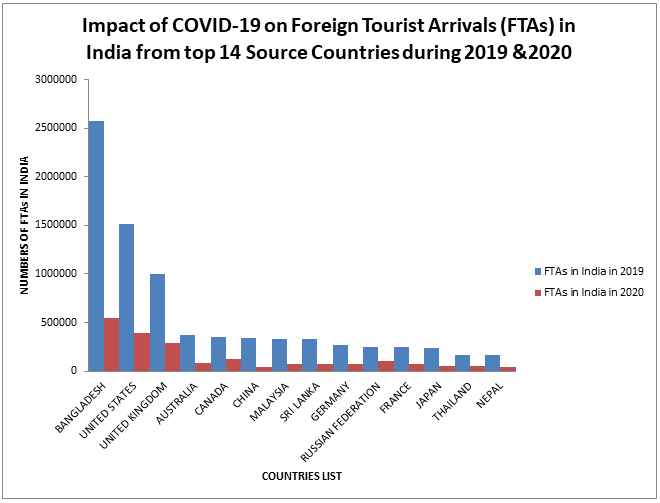
The participant countries were selected according to number of tourist arrivals and percentage share were calculated and mentioned below as descriptive data Table 2. The total numbers of FTAs in India during 2019 from all source countries were 10930355 which reduced to 2744766 during COVID-19 PANDEMIC ERA in 2020; a massive decline by 8185589 numbers of tourists and 25.11percent compared to pre-pandemic era of 2019. On the other hand the total numbers of FTAs in India during 2019 from Total Top fifteen Countries were 8340551 which decreased to 2061161 during COVID-19 PANDEMIC ERA in 2020; a huge decline by 6279390 numbers of tourists and 24.71percent compared to pre-pandemic era of 2019 while FTAs in India during 2019 from Other Countries were 2589804 reduced to 683605 during Covid-era 2020 (26.40% decrease).
Country wise statistics are shown in Table 2 and Figure 1. The important point is that Singapore was in top fifteen countries list of FTAs in India which was replaced by Afghanistan during 2020 Covid-19 era. Bangladesh, United States and United Kingdom were top three source countries in terms of FTAs during the period of study accounting for 23.6%, 13.8%, and 9.2% of total share of FTAs during 2019 and 20%, 14.4% and 10.6% during 2020 respectively. The FTAs from these top three reduced in 2020 by 2028454 (21.3%), 117940 (26.06%) and 708418(29.18%) during 2020 for Bangladesh, United States and United Kingdom respectively. Australia registered largest decrease in FTAs in India with a decline of 33.46% while Singapore was in top fifteen countries list of FTAs in India which was replaced by Afghanistan during 2020 Covid-19 era see Table 2 and Figure 1.
Discussion
Tourism industry is a major provider of employment growth and a key source of foreign revenue generation for the country [13]. This sector offers livelihoods for people working in various other sectors such as aviation sector, tourist guides, travel agencies, automobile sector, hotel sector, hospitality, and even health sector as commercial medical tourism, etc [14]. The Foreign Exchange Earnings in India from Tourism in INR terms during 2019 (1 crores = 10 million) was 1, 94,881 crores with annual Growth Rate of 9.6%; in US$ terms US$ 28.59 billion and annual Growth Rate 4.7% [15]. Foreign Tourist Arrivals (FTAs) during 2021(COVID-19 ERA) were 1.41 million (Jan-Dec) with a negative growth of 48.6% over same period of the previous year with Foreign Exchange Earnings (FEEs) during this period from Jan 2020 – Dec 2020 were Rs.50,136 crores (Provisional estimates) with a negative growth of 76.3% compared to same period of previous year; FEEs during this period during Jan 2020 – Dec 2020 in US$ were 6.958 billion with a negative growth of 76.9% over same period of previous year [16]. Foreign Tourist Arrivals (FTAs) during 2020 were 24.62 million (Jan-Nov) with a negative growth of -74.6% compared to same period of the previous year. During 2020, a total of 8.38 million (Jan-Nov) foreign tourists arrived on e-Tourist Visa registering a negative growth of -67.2%. Foreign Exchange Earnings (FEEs) during the period during Jan 2020 – March 2020 were Rs.44, 203 crores with a negative growth of -15.6% over same period of previous year; FEEs during the period during Jan 2020 – March 2020 in US$ were 6.159 billion with a negative growth of -17.1% over same period of previous year [17]. Foreign Tourist Arrivals (FTAs) during 2019 were 10.89 million with a growth of 3.2% over same period of the previous year; During 2019, a total of 2.93 million foreign tourists arrived on e-Tourist Visa registering a growth of 23.6%; Foreign Exchange Earnings (FEEs) FEEs during the period during Jan 2019 – Dec 2019 were Rs.2, 10,981 crores with a growth of 8.3% over same period of previous year. FEEs during the period during 2019 were US$29.962 billion with a growth of 4.8% over same period of previous year [18].Tourism is one of the significant resources to generate foreign revenue for India. COVID-19 pandemic era, have affected the tourism sector negatively and this novel research study revealed that the national and international FTAs and revenue income are adversely affected detrimental for Tourism industry. The COVID-19 induced lockdown had resulted in closure of hotels, resorts etc., as well as ships, cruises, flights had been halted to check the spread of the COVID-19 pandemic which has resulted in revenue loss of 1.25 trillion rupees for the Indian tourism industry by 2020 [19].
Conclusions
The ongoing COVID-19 pandemic is the major menace which global nations had ever faced, as this pandemic era has affected several sectors negatively including travel and tourism industry. This Coronavirus pandemic have an intensive global attack on security, life and livelihoods in India as well as global nations; pushing several nations into a weaker economy, hunger, violence, depression, slowdown with an uncalled crisis. The leadership of global major economy and global agencies like UN, WHO etc., including those directly involved in globalization should develop a robust framework to safeguards nations and citizens from such disasters.
Limitations
This novel cross-sectional study is first of its kind discussing the impact of COVID-19 on Foreign Tourist Arrivals (FTAs) in India from top 15 Source Countries during 2019 &2020. The key limitation is data and more description about impacts. This limitation will be reduced to a great in next version of this research study.
Other Information
Funding
The author declares that no funds are taken from any individual or agency-institution for this study.
Acknowledgements
I am thankful to Advocate Anupama my wife and daughters Aathmika-Atheeva for cooperation.
References
-
WHO, World Health Organization. Coronavirus Disease (Covid-19) Outbreak: Rights, Roles and Responsibilities of Health Workers, Including Key Considerations for Occupational Safety and Health, pp: 1-3.
-
Piyush K (2022) What Impacts Have Geographical Locations On The Cases And Deaths From Covid-19/ SarsCov-2 Pandemic In 36 States And Union Territories Of India:-Observational Analysis In India. J Mari Scie Res Ocean 5(1): 1-7.
-
WHO, World Health Organization (2020) Q&A: How is COVID-19 transmitted?.
-
Piyush K (2022) What is the impact of Covid-19 on the Antenatal Care Services Utilization in Public-Private- Rural-Urban Hospitals of India during the COVID-19 Pandemic Period of 2020-2021 compared to pre- pandemic era 2018-2019?. Modern Applied Medical Research 2(2): 1-10.
-
Piyush K, Habib HF (2022) what is the Impact of Covid-19 Pandemic on the RCH (Reproductive and Child Health) Programme in Rajasthan, because of nationwide lockdown (April 2020 to June 2020)?. J Cli Ped Chi Res 3(1): 26-41.
-
Kumar P (2022) What Impacts have Geographical Locations on the Cases and Deaths from COVID-19/ SARS-CoV-2 Pandemic in 36 States and Union Territories of India? Observational Analysis in India-V2. J Trop Dis 10: 310.
-
WHO, World Health Organization -Global epidemiological situation, Coronavirus disease (COVID-19).
-
Piyush K (2022) Impact of Covid-19 Pandemic era on Prevalence of Pregnant Women Sero-Positivity for Syphilis, Among Women Attending Antenatal Care in India and Babies Diagnosed with Congenital Syphilis-A Cross-Sectional Research Study. J Cli Ped Chi Res 3(1): 67-77.
-
Piyush K (2022) What Impact Have SARS-CoV-2/ Covid-19 Pandemic on Domestic Violence against Women in India across Different States and Union Territories from the Beginning of Lockdown Due To covid-19 pandemic in March 2020 till 20th September 2020?. J Cli Ped Chi Res 3(1): 78-83.
-
Piyush K (2022) what is the impact of covid-19 pandemic era on Pregnant Women sero-positivity for Syphilis among women attending antenatal care in India and number of babies diagnosed with Congenital Syphilis?. J Cli Ped Chi Res 3(1): 61-66.
-
Piyush K (2022) What Impact Have SARS-CoV-2/ Covid-19 Pandemic induced lockdown on the number of OPD patients of Diabetes, Hypertension, Stroke (CVA), Acute Heart Disease, Mental Illness, Epilepsy, Ophthalmic, Dental and oncology in India during the lockdown months (April-May-2020)–Observational Research Analysis?. Int J Cancer Res Ther 7(2): 51-62.
-
Piyush K (2022) Impact of COVID-19 pandemic on mortality count at the Emergency Ward of Hospitals in India: A Cross-sectional study from January 2019 to May 2021. Adn Envi Was Mana Rec 5(1): 62-73.
-
Rajender S, Godara, Durafshan JF, Azatullah N (2020) Contribution of Tourism Industry in Indian Economy: an Analysis. International Journal of Recent Technology and Engineering 8(6): 1-7.
-
CDC - Centre for Disease Control- Medical Tourism. Travel to Another Country for Medical Care.
-
(2019) India tourism statistics.
-
Annual Report (2021-2022) Foreign Tourist Arrivals (FTAs) Statistics, Surveys and Studies.
-
Annual Report (2020-2021) Foreign Tourist Arrivals (FTAs) Statistics, Surveys and Studies.
-
Annual Report (2019-2020) Statistics, Surveys and Studies
-
Rajeev SC, Shruti K, Suraj KS (2021) Impact of COVID-19 on tourism sector: a case study of Rajasthan. India J AIMS Geosciences 7(2): 224-243.
- Intersecting Epidemics and Climate Vulnerabilities in Conflict- Driven Displacement: Epidemiology, Systemic Challenges, and One Health Gaps in South Sudan
- Advancing Domestic Health Financing for Community Health System Sustainability in South Sudan: The Boma Health Initiative Model (2025–2035)
- Prevalence and Correlates of Post-Exposure Prophylaxis Uptake among Men Who Have Sex with Men in Kisumu County, Kenya
- Medical, Ethical, and Legal Conflicts Surrounding Euthanasia in Argentina. Its Global Implications
- Knowledge and Attitude on Menstrual Hygiene among Adolescent Girls Studying in Secondary Level in Public Schools of Chitwan District, Nepal
- Biological Efficacy of an Adulticide Mixture (clothianidin + deltamethrin) as an Indoor Residual Spray against Adult Anopheles flavirostris in Palawan, the Philippines