
Conflicts, COVID-19, and Climate Change: Challenges to Public Health in the Wake of Humanitarian Crises
Currently, humanity is facing a serious crisis. The worldwide economic contraction, acute fall in financial asset values, collapse in imports and exports, contractions of industrial output, increase in inflation, shrink in wages, rise in unemployed people, wreckage of social security caused by numerous natural catastrophes, human displacement due to epidemics, and ongoing rivalries tear down not only the economic sector but likewise the health sector. The ripple effects of war, pandemics and natural catastrophes began at a time when 1 in 16 people worldwide was just pushed into extreme poverty due to healthcare costs, 1 in 8 had already been denied access to basic medical care, and 1 in 4 lacked access to basic medications. And now, deaths due to climate shock are 30 times higher than they were 20 years ago, and hunger is killing a life every 4 seconds.
Editorial
Currently, humanity is facing a serious crisis. The worldwide economic contraction, acute fall in financial asset values, collapse in imports and exports, contractions of industrial output, increase in inflation, shrink in wages, rise in unemployed people, wreckage of social security caused by numerous natural catastrophes, human displacement due to epidemics, and ongoing rivalries tear down not only the economic sector but likewise the health sector. The ripple effects of war, pandemics and natural catastrophes began at a time when 1 in 16 people worldwide was just pushed into extreme poverty due to healthcare costs, 1 in 8 had already been denied access to basic medical care, and 1 in 4 lacked access to basic medications. And now, deaths due to climate shock are 30 times higher than they were 20 years ago, and hunger is killing a life every 4 seconds [1].
The inflation glitch included the fuel and food crises, currency devaluation, and stagflation in business, as well as 41-year highs in the US and UK; 40-year highs in Japan and Germany; 37-year highs in France and Italy; 30-year highs in India and New Zealand; and 24-year highs in South Korea, Thailand, and Turkey. Healthcare will be less concentrated if the food crisis, inflation, and economic stagflation prevail. Spending on medical and health care generally rises more quickly than overall inflation. In addition, rising inflation is associated with an increase in infant mortality; a compromise in child and maternal health; increased hospital labor expenses per patient; depression, anxiety, frustration, and stress; the cost burdens of chronic illnesses; less access to assisted-living and independent-living facilities for the elderly population; low-income households compromising food quality; a decline in insurance coverage; a worsening clinical labor shortage, a lack of potential educators, and high turnover; and lax health care delivery.
Conflict was responsible for more than 10 million deaths of children under the age of five between 1995 and 2015 worldwide. Conflicts also have an impact on 80% of all humanitarian needs. By 2030, up to two-thirds of the world’s extremely poor people will live in unstable and conflict- ridden regions. The 2018 World Innovation Summit for Health found that 60% of the world’s perpetually starving and malnourished people, including 75% of all children with growth retardation, reside in nations with active armed conflicts. Over 50 years, the Global Terrorism Database (GTD) discovered terrorist attacks in 61 different countries health facilities, with more than 50% of cases targeting medical personnel. According to the WHO, 70% of all assaults on medical facilities worldwide in 2018 happened in Syria [2]. The devastation of health facilities has also been reported, including 1,500 in Ethiopia’s Tigray conflict, close to 1,000 in the Russia-Ukraine conflict, at least 700 in the Nagorno- Karabakh conflict between Armenia and Azerbaijan, over 500 in Yemen by the Saudi-led coalition, and over 430 in Palestine by the occupiers. Additionally, Europe is at higher risk of COVID-19, drug-resistant TB, polio, Hepatitis B and C, parasitic stomach disorders, and HIV, which are more prevalent in European nations where refugees from Ukraine have sought asylum.
According to the UNHCR’s refugee data finder, there were more than 100 million people worldwide who were displaced for various reasons, and 32.5 million people who were refugees as of mid-2022. It’s also been reported that cholera is spreading among the displaced Yemeni people and Syrian refugees living in Jordan. Conflict elevated the likelihood of cholera in Nigeria by 3.6 times and in the Democratic Republic of the Congo by 2.6 times, according to a recent study funded by Imperial College London [3]. Millions are being pushed into Kenya as a result of conflict, the worst drought in Somalia in 40 years, and flooding in South Sudan. In Kenya’s refugee camps, cases of cholera, measles, and acute malnutrition have been documented [4]. Furthermore, half of Sub-Saharan Africa’s Hepatitis E outbreaks have occurred among refugees and displaced people living in humanitarian crisis settings.
On the other hand, Iranian patients who require medical care for thalassemia, hemophilia, cancer, epilepsy, and multiple sclerosis have been severely hampered. Iran has been unable to obtain essential medical supplies and life-saving medications for a long time due to various international sanctions. Bangladesh now hosts 1.2 million refugees as a result of conflict between the Myanmar Junta and its internal rebels. In Bangladesh’s Cox’s Bazar refugee camp, which is the largest in the world, nearly one in eight refugees live with disabilities [5].
A fluctuating power supply endangers the lives and wellbeing of hospital patients, disrupts the continuum of inpatient care, and reduces the capacity of emergency rooms and outpatient clinics. Uneven voltage can deteriorate thermo-sensitive supplies like vaccines, insulin, and blood transfusion products as well as biomedical machinery. According to data from Sub-Saharan Africa, power outages lasting more than 2 hours elevate mortality among inpatients above 40% [6].
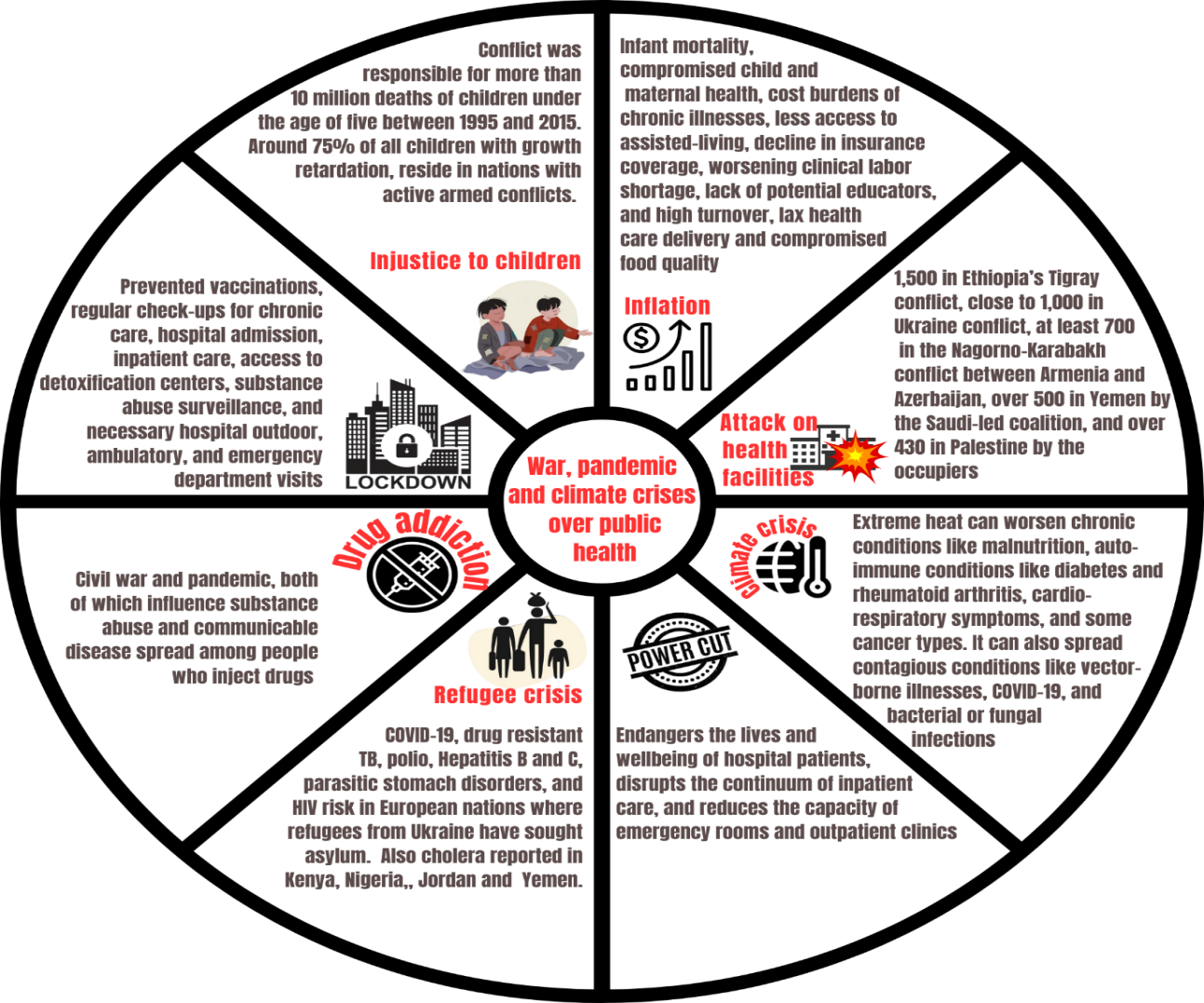
According to the World Bank, natural disasters and climate change could force more than a billion people to leave their dwellings by 2050. As a result of climate change, there are more allergenic air pollutants like mold and pollen because the warm seasons last longer. Heat waves, tropical cyclones, hurricanes, tropical storms, and flash flooding are frequent effects of extreme weather brought on by climate change. And with less precipitation, higher relative humidity, and warmer temperatures, the risk of forest fires and the ensuing air pollution will rise [7]. Extreme heat can worsen chronic conditions like malnutrition, auto-immune conditions like diabetes and rheumatoid arthritis, cardio- respiratory symptoms, and some cancer types. It can also spread contagious conditions like vector-borne illnesses, COVID-19, and bacterial or fungal infections. Agricultural workers have a 35-fold higher occupational heat-related mortality rate than workers in other industries [1]. Cyclones, floods, and storms have caused 9 out of 10 disasters worldwide and are to blame for 3 out of 4 deaths resulting from disasters [8].
More than 6.8 million people had died and 680 million had been impacted by COVID-19 as of March 7, 2023. Lockdown and the fear of being impacted have globally prevented numerous activities, including: vaccinations, regular check-ups for chronic care, hospital admission, inpatient care, access to detoxification centers, substance abuse surveillance, and necessary hospital outdoor, ambulatory, and emergency department visits. Delaying or forgoing medical care may raise the morbidity and mortality rates linked to both acute and chronic illnesses [9]. The COVID-19 pandemic alone, according to the WHO, causes a 25% increase in the prevalence of anxiety and depression worldwide [10]. Civil war and pandemic, both of which influence substance abuse and communicable disease spread among people who inject drugs (PWID). War, conflicts, climate change, and pandemics are all directly and indirectly contributing to the crisis’s escalation. Surprisingly, each of these issues is linked to the others. The coexistence of all of these issues may threaten humanity by resulting in the loss of many basic health services facilities such as health system access, vaccination, poison control, health insurance or co-payment policies, health vigilances, and surveillance, monitoring of adverse drug reactions, telemedicine assistance, patient education or awareness programs, newer drug inventions, and allied technological advances and innovations. Along with access to healthcare services, technology, and innovation, the security and safety of healthcare facilities, employees, and supply lines continue to be top priorities. Any of these facilities in nations or localities would take longer to develop in a stable socio- political environment and a sound economy and would require support from the government and other allied authorities, IT innovation and protocol advancements, and public conformity to the health system. The system is extremely delicate and at risk with the variety of crises the world is currently experiencing.
References
-
Mohiuddin AK (2023) Escalation of war and conflicts among the pandemic, natural disasters, food and economic crises: a global health concern. Synsto. ISBN: 978-81-960366-1-4.
-
World Health Organization (2018) Attacks on health care on the rise throughout Syria in first half of 2018, says WHO.
-
Charnley GEC, Jean K, Kelman I, Gaythorpe KAM, Murray KA (2022) Association between Conflict and Cholera in Nigeria and the Democratic Republic of the Congo. Emerg infect dis 28(12): 2472-2481.
-
Press Release (2022) 55 fold increase in cholera cases and an outbreak of measles in Kenya’s refugee camps strain health resources, warns IRC. The International Rescue Committee (IRC).
-
UNHCR (2022) Being disabled in the world’s largest refugee camp.
-
Tsagkaris C, Laubsher L, Matiashova L, Lin LC, Isayeva A (2023) The impact of energy shortages on health and healthcare in Europe. Health Sci Rep 6(2): e1075.
-
Neira M, Erguler K, Ahmady-Birgani H, Al-Hmoud ND, Fears R, et al. (2023) Climate change and human health in the Eastern Mediterranean and Middle East: Literature review, research priorities and policy suggestions. Environmental research 216(Pt2).
-
Ryan B, Franklin RC, Burkle FM, Aitken P, Smith E, et al. (2015) Identifying and describing the impact of cyclone, storm and flood related disasters on treatment management, care and exacerbations of non- communicable diseases and the implications for public health. PLoS Curr 7:ecurrents.dis.62e9286d152de0479 9644dcca47d9288.
-
Czeisler MÉ, Marynak K, Clarke KEN, Salah Z, Shakya I, et al. (2020) Delay or avoidance of medical care because of COVID-19–related concerns-United States, June 2020. Morbidity and Mortality Weekly Report, 69(36): 1250- 1257.
-
Brunier A, Drysdale C (2022) Covid-19 pandemic triggers 25% increase in prevalence of anxiety and depression worldwide. World Health Organization.
- Intersecting Epidemics and Climate Vulnerabilities in Conflict- Driven Displacement: Epidemiology, Systemic Challenges, and One Health Gaps in South Sudan
- Advancing Domestic Health Financing for Community Health System Sustainability in South Sudan: The Boma Health Initiative Model (2025–2035)
- Prevalence and Correlates of Post-Exposure Prophylaxis Uptake among Men Who Have Sex with Men in Kisumu County, Kenya
- Medical, Ethical, and Legal Conflicts Surrounding Euthanasia in Argentina. Its Global Implications
- Knowledge and Attitude on Menstrual Hygiene among Adolescent Girls Studying in Secondary Level in Public Schools of Chitwan District, Nepal
- Biological Efficacy of an Adulticide Mixture (clothianidin + deltamethrin) as an Indoor Residual Spray against Adult Anopheles flavirostris in Palawan, the Philippines