
Knowledge, Attitudes and Practices Regarding the Use of Traditional Medicine in the Treatment of Malaria among Households in the Buea Health District, Cameroon
Background: Traditional medicine (TM) has maintained its popularity in most developing countries. The use of TM in the treatment of illnesses such as malaria is a common practice that began in pre-historic times. Aim: This research sought to investigate the knowledge, attitudes and practices regarding the use of TM to treat malaria in the Buea Health District, Cameroon. Methods: The study employed a community based cross-sectional survey design. Purposive and systematic random sampling techniques were used to select the study site (four health areas) and enrolled participants to the study. The study participants were made up of heads (guardians) of households. Heads of households aged 19 years and above who were present at the time of study and met the inclusion criteria and gave their consent to participate in the study were included. Data was collected using a semi-structured questionnaire made up of both open and closed-ended questions. Data was collected on the knowledge, attitudes and practices regarding the use of TM to treat malaria. Data collected was analysed using IBM SPSS Statistics 25, the logistic regression statistical test was used to check for association between variables and confidence level was set at 95% confidence interval. Results: A total of 400 participants participated in this study. The study revealed that 212 (57%) [95%CI: 0.4798 - 0.5798] were females. Also, 270 (67.5%) [95% CI: 0.6267 - 0.7207] of the participants had good knowledge about malaria and TM. There was no significant association between socio-demographic factors and knowledge (p>0.05). Majority 328(82%) [95% CI: 0.7788 - 0.8564] of the participants had negative attitudes towards traditional medicine. This study further revealed that the participants demonstrated poor practices on the use of TM to treat malaria. However, a few used both TM and conventional medicine to treat malaria. Conclusion: The proportion of participants with good knowledge on TM and malaria was high, while the proportion of participants with positive attitudes as well as those with good practices towards the use of TM to treat malaria was low. However, participants who used both traditional and conventional medicines preferred to consult traditional healers first for remedy.
Introduction
The World Health Organisation (WHO) states that Traditional Medicine (TM) is the sum total of the knowledge, skill and practices based on theories, beliefs, and experiences indigenous to different cultures, whether explicable or not, used in the maintenance of health [1]. In addition, WHO stipulates that TM is used to prevent, diagnose, improve or treat physical and mental illnesses. The widespread use of TM has resulted in traditional healthcare becoming a lucrative multinational business. The global market of TM is estimated to about US$83 billion annually [2]. Billions of US dollars are spent annually on TM in many developed countries.
The World Health Organisation (WHO) reported that 80% of the world’s population relies on TM for therapy [2]. For instance, TM is used in Ghana, Mali, Nigeria and Zambia for the treatment of fever resulting from malaria. About one‑third of the population in developing countries lacks access to essential medicines [3]. In Cameroon, like in many other African countries, 80% of the population uses TM to improve on their state of health [4].
Traditional medicine (TM) also contributes to the development of pharmaceutical treatments. As much as one- third to half of pharmaceutical drugs are originally derived from plants; for instance, Digitalis, Morphine, Quinine, and Vinca Alkaloids among others were obtained from plant sources [5]. Plants typically contain mixtures of different phytochemicals, also known as secondary metabolites that may act individually, additively, or in synergy to improve health [6]. They contain many bitter substances that can help stimulate digestion. In addition, plants possess anti- inflammatory compounds that reduce swellings and pain, phenolic compounds that can act as antioxidants and venotonics, antibacterial and antifungal tannins that act as natural antibiotics. Also, they contain diuretic substances that enhance the elimination of waste products and toxins, as well as alkaloids that enhance mood and give a sense of well-being [6].
Countries in Africa, Asia and Latin America use TM to help meet some of their primary health care needs [7]. In Cameroon, the advent of economic crisis in the late 1980s created a shift towards consumption of medicinal plants as an increasing practice in herbal medicine [8]. In Africa, there is considerable interest in TM, particularly herbal medicines [9]. According to Mahomoodally, et al. [6], there are two reasons for sustained interest in TM; inadequate access to allopathic medicines and Western forms of treatments. A systematic review done by James, et al. [10], brought forth some of the socio-demographic factors associated with the use of TM. The use of TM was found to be more common among individuals with low socioeconomic status, individuals who were unemployed and unskilled. Also, persons living in rural areas and individuals aged 55years and above were more likely to use TM.
Malaria remains a public health threat in Sub-Saharan Africa; the prevalence of malaria in Cameroon was 24% in 2017 [11], and the situation is not yet under control. Despite the fact that a lot has been done to reduce the prevalence of malaria in Cameroon, a great number of health facilities still receive a high number of suspected cases of malaria yearly. Due to the generally high amount spent when using Conventional Medicine (CM), alternative sources of treatment tend to be used by the population [12]. Currently, very little information is known on the reasons why people use TM as a source of treatment for malaria. Many Cameroonians today, especially the rural people and the urban poor, rely on the use of herbal medicine when they are ill [13]. In fact, many rural communities in Africa still have areas where traditional herbal medicine is the major, and in some cases, the only source of health care available [14].
Although traditional medicine plays an important role in many African countries today, Cameroon inclusive, little is known about the knowledge, attitudes and practice of the people towards TM use. Hence, this study aimed at investigating the knowledge, attitudes and practices regarding the use of TM. Specifically, we sought to assess the knowledge and determine attitudes and practices towards the use of TM in the treatment of malaria among households in Buea Health District, South West Region of Cameroon. This study could provide important data which will enable the Ministry of Public Health to take appropriate measures regarding the quality and safety of such practices. In addition, it can provide baseline data for researchers to further investigate the determining factors of TM usage.
Materials and Methods
A community-based cross-sectional study was conducted from the 28th of October, 2017 to 30th of June, 2018 to investigate the knowledge, attitudes, and practices regarding the use of TM in treating malaria. Both qualitative and quantitative approaches were employed to collect and process data. A questionnaire made-up of both open and closed ended questions was used to collect data on participants’ knowledge, attitudes and practices regarding malaria and the use of TM. The target population was made up of parents (guardians) of households in four out of the seven Health Areas of the Buea Health District selected purposively. All parents aged 19 years and above and who had lived in Buea for at least six months prior to the study and gave consent to participate in the study were included. Buea Health District has a good number of health centers, a sub-divisional hospital and a regional hospital, as well as many private clinics. Buea has a mixture of the various ethnic groups in Cameroon, and a distinct biophysical environment with a variety of distinct plants and animal species_. The climate in Buea is suitable for the growth of _Prunus africana which is a rare plant species used in the treatment of malaria and many other diseases [15].
A sample of 400 parents (or guardians) from selected households participated in the study. The total sample size was shared between the four selected health areas according to population proportionate to size. Cluster sampling was used to divide the health areas in to various clusters. Systematic random sampling was done using Microsoft Excel 2010 to randomly select houses in the various Health Areas by using RANDBETWEEN (1,10) which helped to randomise the households we visited. The sampling began from the main road; the first house was chosen at random and from there, every 5th household was chosen until we got to the end of the street, after this we selected another cluster in the same Health Area until our target sample size was met.
Before administering the questionnaire, it was pre- tested by administering 20 copies to 20 representatives of households who were not part of the study population. Their responses confirmed the clarity and validity of the questions. Copies of the questionnaire were then administered to the study participants who completed the various sections of the questionnaire. The investigator read the questions for those who could not read and their responses were written down.
In order to collect data, ethical clearance was obtained from the Faculty of Health Sciences Institutional Review Board (FHS-IRB) (Ref: 2020/1167-03/UB/SG/IRB/FHS) and the Regional Delegation of Public Health (Ref. No. R11/ MINSANTE/SWR/RDPH/PS/569/797) and then from the heads of the various quarters. Before responding to the questionnaire each respondent gave written consent. Data was entered into Microsoft excel version 2010 and analysed using IBM SPSS Statistics 25. To assess knowledge, each correct answer was given 1 mark and 0 given for a wrong answer; the total questions on knowledge was 8, and a cutoff point of 70% was used to differentiate participants who had good knowledge from poor knowledge. To determine attitudes, a likert scale was used, the various responses were assigned numerical values (strongly agree = 5, agree=4, neutral=3, disagree=2, strongly disagree=1). Eight questions were used; a cutoff point of 70% was used to differentiate between participants with positive attitudes from those with negative attitudes towards using TM to treat malaria. Similarly, participants’ practice was evaluated using six questions, each correct answer was given a mark and any wrong answer was given a zero. Logistic regression was used to determine the statistical significance, where the dependent variable was the knowledge scores of the participants and the independent variables were the socio demographic factors. The cut-off for statistical significance was set at p ≤ 0.05.
Results
A total of 400 participants were enrolled into this study; 57% (212) [95%CI:0.4798 - 0.5798] were females. The age group 19-28, was the most represented 43.3% (173) [95%CI: 0.3834 to 0.4827], 32% (128) [95%CI:0.2745 - 0.3682] were students and 68.8% (275) [95%CI:0.6396 - 0.7326] earned greater than 50,000fcfa per month. Most 81.0% (324) [95%CI: 0.7681 - 0.8473] of the households had 4 to 9 members and 70.8% (283) [95%CI: 0.6602 - 0.7517] of the participants had attained tertiary level of education Tables 1a & 1b.
| No (%) | 95% Confidence interval | |
|---|---|---|
| Sex | ||
| Male | 188 (43.0) | 0.4202 - 0.5202 |
| Female | 212 (57.0) | 0.4798 - 0.5798 |
| Total Age group (years) | 400 (100) | |
| 19-28 | 173 (43.3) | 0.3834 - 0.4827 |
| 29-38 | 100 (25.0) | 0.2083 - 0.2954 |
| 39-48 | 72 (18.0) | 0.1436 - 0.2212 |
| 49-58 | 34 (8.5) | 0.0554 - 0.1111 |
| 59-68 | 13 (3.3) | 0.0174 - 0.0549 |
| More than 68 | 8 (2.0) | 0.0087 - 0.0390 |
| Total Marital status | 400 (100) | |
| Married | 207 (51.7) | 0.4673 - 0.5674 |
| Single | 168 (42.0) | 0.3711 - 0.4701 |
| Co-habiting | 20 (5.0) | 0.0308 - 0.0762 |
| Widowed | 5 (1.3) | 0.0041 - 0.0289 |
| Total Occupation | 400 (100) | |
| Student | 128 (32.0) | 0.2745 - 0.3682 |
| Business person | 69 (17.3) | 0.1368 - 0.2132 |
| Unemployed | 30 (7.5) | 0.0512 - 0.1053 |
| Driver | 24 (6.0) | 0.0388 - 0.0880 |
| Retired | 26 (6.5) | 0.0429 - 0.0938 |
| Teacher | 27 (6.8) | 0.0450 - 0.0967 |
| Farmer | 29 (7.2) | 0.0481 - 0.1025 |
| Other occupations | 67 (16.8) | 0.1322 - 0.2078 |
| Total | 400 (100) |
Table 1: Knowledge of the Participants on Malaria and Traditional Medicine.
| No (%) | 95% Confidence Interval | |
|---|---|---|
| Ethnicity | ||
| Bangwa | 46 (11.5) | 0.0854 - 0.1504 |
| Bakweri | 58 (14.5) | 0.1120 - 0.1834 |
| Bamileke | 39 (9.8) | 0.0703 - 0.1309 |
| Banyangi | 30 (7.5) | 0.0512 - 0.1053 |
| Bakossi | 21 (5.3) | 0.0328 - 0.0791 |
| Other tribes | 206 (51.5) | 0.4648 - 0.5650 |
| Total Family income per month | 400 (100) | |
| Less than 10,000fcfa | 9 (2.3) | 0.0103 - 0.0423 |
| 11,000fcfa to 50,000fcfa | 116 (29.0) | 0.2460 - 0.3372 |
| Greater than 50,000fcfa | 275 (68.8) | 0.6396 - 0.7326 |
| Total Family size | 400 (100) | |
| 1 to 4 | 62 (15.5) | 0.1209 - 0.1943 |
| 4 to 9 | 324 (81.0) | 0.7681 - 0.8473 |
| 10 to 14 | 14 (3.5) | 0.0193 - 0.0580 |
| Total Level of education | 400 (100) | |
| Primary | 23 (5.8) | 0.0368 - 0.0850 |
| Secondary | 76 (19.0) | 0.1527 - 0.2319 |
| Tertiary | 283 (70.8) | 0.6602 - 0.7517 |
| 18 (4.5) | 0.0269 - 0.0702 | |
| Total Religion | 400 (100) | |
| Christian | 396 (99.0) | 0.9746 - 0.9973 |
| Muslim | 2 (0.5) | 0.0006 - 0.0179 |
| 2 (0.5) | 0.0006 - 0.0179 | |
| Total | 400 (100) |
Table 2: Knowledge of the Participants on Malaria and Traditional Medicine.
Table 1b: Socio-demographic Characteristics of the Study Participants.
Almost all of the respondents had heard about malaria 99.5% (398) [95% CI: 0.9821 - 0.9994], and 85% (340) [95CI: 0.8112 - 0.8835] said malaria is transmitted by a mosquito bite. Concerning the symptoms of malaria; 39.5% (153) [95%CI: 0.3468 - 0.4448] reported fever and body weakness constituted 23.35% (93) [95% CI: 0.1920 - 0.2770]. When asked about the types of malaria, only 18% (72) [0.1436 - 0.2212] of the participants mentioned simple and severe malaria (complicated and uncomplicated malaria). All of the participants had heard about at least an aspect of TM. When asked about what TM is made of, 68.3% (273) [95% CI: 0.6344 - 0.7279] said plants (roots, stem, bark and flowers). On the category of whether the participants had previously used TM to treat malaria, 64.8% (259) [95%CI: 0.5985 - 0.6943] said yes Table 2.
| No (%) | Confidence interval | |
|---|---|---|
| Have ever heard of malaria: | ||
| Yes | 398 (99.5) | 0.9821 - 0.9994 |
| No | 2 (0.5) | 0.0006 - 0.0179 |
| TotalCan get infected with malaria by: | ||
| Mosquito bite | 340 (85) | 0.8112 - 0.8835 |
| Drinking dirty water | 3 (0.75) | 0.0015 - 0.0218 |
| Dirty surrounding | 55 (13.75) | 0.1053 - 0.1752 |
| Other | 2 (0.5) | 0.0006 - 0.0179 |
| TotalSymptoms & signs of malaria: | ||
| Fever | 158 (39.5) | 0.3468 - 0.4448 |
| Headache | 64 (16) | 0.1255 - 0.1997 |
| Vomiting | 31 (7.75) | 0.0533 - 0.1082 |
| Joint pains | 54 (13.5) | 0.1031 - 0.1724 |
| Body weakness | 93 (23.25) | 0.1920 - 0.2770 |
| TotalKnew types of malaria: | ||
| Yes | 72 (18) | 0.1436 - 0.2212 |
| No | 328 (82) | 0.7788 - 0.8564 |
| TotalHave heard of traditional medicine: | ||
| Yes | 400 (100) | 0.9908 - 1 |
| No | 0 (0.0) | 0.0000 - 0.0092 |
| TotalThis is used as traditional medicine: | ||
| Plants (roots, stem, bark, flowers) | 273 (68.25) | 0.6344 - 0.7279 |
| Animal bones | 2 (0.5) | 0.0006 - 0.0179 |
| Spiritual prayers | 2 (0.5) | 0.0006 - 0.0179 |
| Hypnotism | 1 (0.25) | 0.0001 - 0.0139 |
| All of the above | 121 (30.5) | 0.2578 - 0.3501 |
| TotalHave used traditional medicine to treat malaria | ||
| Yes | 259 (64.75) | 0.5985 - 0.6943 |
| No | 141 (35.25) | 0.3057 - 0.4015 |
| Total | 400 (100) |
Table 3: Knowledge of the Participants on Malaria and Traditional Medicine.
The responses of the participants were pooled together and a cutoff point of 70% was assigned to differentiate those with good knowledge from those with poor knowledge.
Majority 62.25% (271) [95%CI: 0.6293 - 0.7231] of them had a good knowledge of malaria and TM Figure 1.
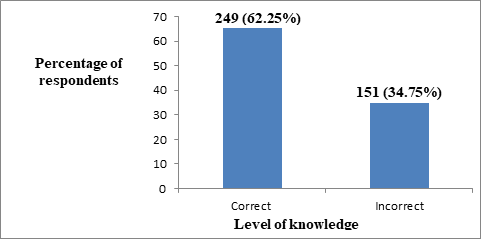
An assessment of the Means of the two groups of participants was done to see if there was a significant difference between the Means of participants with good knowledge and those with poor knowledge. There was a significant difference (p=0.013) between the two Means Table 3. The study revealed that there was no statistical significance between knowledge and the socio demographic characteristics of the participants.
| Sum of squares | df | Mean squares | F-value | p-value | |
|---|---|---|---|---|---|
| Between groups | 2415.362 | 1 | 2415.362 | 952.054 | 0.013 |
| Within groups | 1456.776 | 388 | 2.537 | ||
| Total | 3872.138 | 389 |
Table 4: Analysis of the Means of Participants with Good and Poor Knowledge.
More than half 59.8% (239) [95%CI: 0.5476 - 0.6459] of the participants agreed that TM can be dangerous in that it may prevent people from getting proper treatment. Less than half 41.5% (166) [95%CI: 0.3663 - 0.4650] of them stated neutral response as to whether TM should only be used as a last resort when conventional medicine does not work. About half 46% (184) [95%CI: 0.4104 - 0.5102] agreed that TM could be a supplement to Western medicine, and 40.3% (161),[95%CI: 0.3541 - 0.4524] of the respondents said that TM builds up the body’s defense system, leading to a permanent cure. Majority 37.8% (151) of the participants agreed that health education on risks and benefits of TM is important and 28.2% (113) [95%CI: 0.2389 - 0.3294] reported it is worthwhile to use TM before going to the medical professionals. A few 28% (112) [95%CI: 0.2365 - 0.3268] of the participants were neutral as to whether TM is more effective and safer than modern medicine and 25 (6.3%) [0.0409 - 0.0909] strongly agreed that TM is a threat to public health Table 4.
| Attitudes of the respondents towards traditional medicine (TM) | Response | ||||
|---|---|---|---|---|---|
| Strongly agree | Agree | Neutral | Disagree | Strongly disagree | |
| TM can be dangerous in that it may prevent people from getting proper treatment | 31 (7.8%) | 239 (59.8%) | 54 (13.5%) | 70 (17.5%) | 6 (1.5%) |
| TM should only be used as last resort when conventional medicine did not work | 31 (7.8%) | 126 (31.5%) | 166 (41.5%) | 71 (17.8%) | 6 (1.5%) |
| TM could be a supplement to western medicine | 23 (5.8%) | 184 (46.0%) | 95 (23.8%) | 87 (21.8%) | 11 (2.8%) |
| TM builds up the body’s own defenses, leading to a permanent cure | 29 (7.2%) | 161 (40.3%) | 119 (29.8%) | 72 (18.0%) | 19 (4.8%) |
| Health education about risks and benefits of TM is important | 80 (20.0%) | 151 (37.8%) | 123 (30.8%) | 40 (10.0%) | 6 (1.5%) |
| It is worthwhile to try TM before going to the medical professionals | 42 (10.5%) | 102 (25.5%) | 111 (27.8%) | 113 (28.2%) | 32 (8.0%) |
| TM are more effective and safer than modern health services | 39 (9.8%) | 110 (27.5) | 112 (28.0%) | 103 (25.8%) | 36 (9.0%) |
| TM is a threat to public health | 25 (6.3%) | 91 (22.8%) | 131 (32.8%) | 91 (22.8%) | 62 (15.5%) |
Table 5: Attitudes and Response of the Participants towards Traditional Medicine.
The Mean scores and standard deviations of the respondents’ attitudes regarding TM was computed; higher scores indicated positive attitudes towards the use of TM. The highest score was observed in the option ‘Health Education on risks and benefits of TM is important’ (3.64±0.96, Maximum score: 5). The lowest Mean score was observed for the statement ‘TM is a threat to public health’ (2.81±1.13). Further analysis showed that there was a positive correlation between the attitudes’ score and knowledge of the participants (ρ=0.325, p=0.000). A one-way ANOVA done between the knowledge score and attitudes’ score showed that the two were significantly associated (F=47.036, p=0.000) meaning that people who used TM had positive attitudes towards TM Table 5). In general, majority of the participants had negative attitudes towards traditional medicine 70.25% (281) [95%CI: 0.6551 to 0.7469]. There was a significant difference (p = 0.000) between the Means of participants with positive attitudes and those with negative attitudes Table 6. There was no statistical significance between knowledge and participants’ characteristics.
| Mean±SD | Chi square | p-value | |
|---|---|---|---|
| Traditional medicine can be dangerous in that it may prevent people from getting proper treatment | 3.56±0.919 | 4.388 | 0.356 |
| Traditional medicine should only be used as last resort when conventional medicine did not work | 3.26±0.89 | 2.8 | 0.592 |
| Traditional medicine could be a supplement to conventional medicine | 3.30±0.96 | 9.896 | 0.042 |
| Traditional medicine builds up the body’s own defenses, leading to a permanent cure | 3.27±0.99 | 10.399 | 0.034 |
| Health education about risks and benefits of traditional medicine is important | 3.64±0.96 | 0.328 | 0.988 |
| It is worthwhile to try traditional medicine before going to the medical professionals | 3.02±1.13 | 8.126 | 0.087 |
| Traditional medicines are more effective and safer than modern health services | 3.03±1.13 | 10.639 | 0.031 |
| Traditional medicine is a threat to public health | 2.81±1.13 | 6.101 | 0.192 |
Table 6: The Attitudes Scores of the Participants towards Traditional Medicine.
| Sum of squares | df | Mean square | F-value | p-value | |
|---|---|---|---|---|---|
| Between groups | 2026.575 | 1 | 2026.575 | 469.316 | 0 |
| Within groups | 1718.622 | 398 | 4.318 | ||
| Total | 3745.198 | 399 |
Table 7: Analysis of the Means of Participants with Positive and Negative Attitudes.
In aggregate, 243 (60.75%) [95%CI: 0.5577 - 0.6556] of the participants demonstrated poor practices regarding the use of TM to treat malaria; 263 (65.8%) [95%CI: 0.6087 to 0.7039] took CM first when they suspected malaria and 199 (49.8%) [95%CI: 0.4474 to 0.5476] said is because they are effective. When asked whether they had ever visited a traditional practitioner, 49 (12.3%) [95% CI: 0.0920 to 0.1587] said yes, and 172 (43%) [95%CI: 0.3809 to 0.4801]
said they used TM because they have trust in it. Majority 258 (64.5%) [95%CI: 0.5959 to 0.6919] of the participants said the method of ingestion is drinking Table 7. There was a significant difference between the Means of participants with good practices and those with poor practices (P=0.000). Only family size (95%CI: 4.015 (2.260 - 7.135) was significantly associated to practice (P=0.001).
| Practices carried out by the participants in using traditional medicine to treat malaria | N (%) o | Confidence interval (95%) |
|---|---|---|
| When you are sick and suspects malaria: | ||
| You take Traditional Medicine first | 85 (21.3) | 0.1734 to 0.2559 |
| You take Conventional Medicine first | 263 (65.8) | 0.6087 to 0.7039 |
| Both | 52 (13.0) | 0.0986 to 0.1670 |
| Total Reason for choice of treatment | 400 (100) | |
| Effectiveness | 199 (49.8) | 0.4474 to 0.5476 |
| Availability | 169 (42.3) | 0.3736 to 0.4726 |
| Affordability | 29 (7.2) | 0.0491 to 0.1025 |
| Other reasons | 2 (0.5) | 0.06 to 0.0179 |
| Total First choice of treatment for malaria: | 400 (100) | |
| Traditional medicine | 34 (65.4) | 0.5091 to 0.7803 |
| Conventional medicine | 18 (34.6) | 0.2197 to 0.4909 |
| Use them at the same time | 0 (0.0) | 0.000 to 0.0685 |
| Total Method of ingestion of traditional medicine to treat malaria | 52 (100) | |
| Drinking | 258 (64.5) | 0.5959 to 0.6919 |
| Chewing | 12 (3.0) | 0.0156 to 0.0518 |
| Rubbing | 4 (1.0) | 0.0027 to 0.0254 |
| Covering | 33 (8.3) | 0.0575 to 0.1139 |
| Bathing | 7 (1.8) | 0.0071 to 0.0357 |
| Other method | 3 (0.8) | 0.0015 to 0.0218 |
| Total Have ever visited a traditional practitioner: | 400 (100) | |
| Yes | 49 (12.3) | 0.0920 to 0.1587 |
| No | 351 (87.7) | 0.8413 to 0.9080 |
| Total Factors that influenced the use of traditional medicine to treat malaria: | 400 (100) | |
| Nearness to your resident | 106 (26.5) | 0.2224 to 0.3111 |
| Distance to the conventional hospital | 18 (4.5) | 0.0269 to 0.0702 |
| Trust in traditional medicine | 172 (43.0) | 0.3809 to 0.4801 |
| Cost of conventional medicine | 45 (11.3) | 0.0746 to 0.1365 |
| Long queues at the conventional hospital | 16 (4.0) | 0.0230 to 0.0641 |
| Bad experience at the conventional hospital | 7 (1.8) | 0.0071 to 0.0357 |
| Other reasons | 12 (3.0) | 0.0156 to 0.0518 |
| Total | 400 (100) |
Table 8: Participants’ Practices Regarding the Treatment of Malaria.
Discussion
This study aimed at investigating the knowledge, attitudes and practices regarding the use of TM in treating malaria. The findings of this study will add greatly to the already existing body of knowledge on the fight against malaria, considering that malaria is endemic to the Sub-Saharan Region of Africa. With the increased awareness of the types of medicines, it was important to find out the perceptions of people about health and treatment seeking behaviour and to assess the attitudes and practices of people with respect to using TM in the treatment of malaria. Thus, this study brings out the psychosocial factors that influence people when seeking treatment for malaria. Traditional medicine (TM) has long been an important part of the African tradition and is still very important today. Creating a link between conventional medicine and TM is what this study hopes to achieve.
According to the findings of this study, the age group 19 – 28 years was the most represented. This is consistent with a study carried out by Ohemu, et al. [16] in Nigeria and another study carried out in Jara Town, Ethiopia [17]. Malaria remains a major public health problem among youths as reported in Sub-Saharan Africa [11]. In Cameroon, malaria is the major cause of illness and is responsible for 40% of medical consultations [18], this confirms the fact that 99.5% of participants in our study had heard about malaria. Again, the findings of this study showed that more than half of the participants had good knowledge on malaria. This could probably be due to the fact that several educative health campaigns on the prevention of malaria are continuously presented in public and private media (radio and television channels), in Cameroon [19].
The anti-malarial campaign messages and slogans have been broadcasted in English, French and the local languages, giving the literate as well as illiterate members of the society the opportunity to understand. Such messages include the recognition of common signs and symptoms of malaria, protective and prophylactic measures. They also contain advice to seek prompt and appropriate diagnosis and treatment of malaria once signs and symptoms of the disease are suspected [19]. Our finding is similar to that of a study carried out in Ethiopia which reported that 61.5% of the participants were knowledgeable on malaria and TM [20]. Also, it was revealed in this study that the age of the participants was significantly associated to knowledge on TM. According to a study conducted in Indonesia, knowledge of traditional medicine still persisted among the elderly, and was increasingly lost among young people [21]. There was a high overall negative attitudes towards using TM to treat malaria in our study. This finding is contrary to the findings of a study carried out in Nigeria [22] in which 70.4% of the participants had a positive attitude towards future use of traditional medicine. The reason for the negative attitudes could be due to the type of health education and promotion strategies used by the government and other malaria programmes. The attitudes’ scores of the participants showed that the statement “health education about risks and benefits of TM is important” had the highest Mean SD. This indicates that participants want to be educated on the health benefits of TM as a possible treatment for malaria. Even though conventional drugs are expensive and relatively inaccessible to the poor rural areas, there is skepticism when it comes to using TM. Uzor [23] explained that there is still a paucity of clinical evidence to demonstrate that TMs are effective and safe for humans. Hence, there is need to make the public understand that botanical remedies are safe therapies. For these reasons, information about efficacy and safety of TMs is urgently required.
Concerning the respondents’ practices, majority of them took Conventional Medicine (CM) first when they suspected malaria, the reason being that they are effective. This finding could be due to the fact that majority of the participants were young people and majority had attained tertiary level of education. According to Suleman [24] the practice of TM is slowly being abandoned probably because of the expansion of the practice of modern medicine and the assumption of young people that the practice of TM is primitive. However, our study revealed that a small percentage of participants preferred to use both TM and conventional medicine. The percentage in our study is far less than what was gotten in a study carried out in Kenya [25] which reported that 38.3% of the participants preferred to use both TM and CM. It is interesting to state that for those who used both conventional and traditional medicines to treat malaria, the majority took TM first when they suspected malaria. According to Nsagha, et al. [13], many Cameroonians today, especially those in the rural areas and the urban poor, rely on the use of herbal medicine when they are ill. It is worth stating that there are several communities in Africa that rely solely on TM for their treatments.
Also, our study found that certain factors influenced the use of TM in the treatment of malaria; majority of the participants reported trust in TM and about one third mentioned accessibility. In many African countries, TM is indispensable as it is more accessible, cheaper and more holistic than the Western Medicine [26]. Thus, there is no uncertainty about the acceptability and efficacy of herbal remedy within the African society [27].
Finally, our study revealed that the route of ingestion of TM was mostly oral (by drinking) which is similar to the finding of a study carried out in Ethiopia [28].
Practical Implications
This study investigated the knowledge, attitudes and practices regarding the use of TM to treat malaria. The results indicated that most of the participants had good knowledge on TM and malaria, while few participants had positive attitudes and good practices towards the use of TM to treat malaria. Participants who used both traditional and conventional medicines preferred to consult traditional healers first for remedy. The findings of this study demonstrates that health education on the risks and benefits of TM with respect to treating malaria is of great importance in enhancing the community’s perception regarding TM. Hence, more research works need to be conducted in order to prove the safety and efficacy of TM regarding the treatment of malaria. An area for further research will be to test the efficacy and safety of some of the common herbal remedies that are used by the community, probably using a case-control study design. Also, there is need to put in place a referral system between conventional health facilities and traditional health practitioners because the traditional health practitioners are part of the community. This can go a long way to contribute in reducing the burden of malaria.
Conclusion
This study revealed that overall, the proportion of participants with good knowledge on Traditional Medicine (TM) and malaria was high, and the proportion of participants with positive attitudes towards the use of TM to treat malaria was low. Similarly, our study showed that the proportion of participants who had good practices with respect to TM and malaria treatment was low. However, it was found that some participants preferred traditional medicine because they have trust in it and that it is accessible. In addition, the study revealed that those who used both traditional and conventional medicines preferred to consult traditional healers first for remedy. Based on the findings of this study, it can be seen that there is a need to put in place referral systems between conventional health facilities and traditional health practitioners. This is because traditional health practitioners are closer to the community. This may go a long way to create awareness on the proper use of traditional medicine especially in treating malaria. This will in turn prevent inadequate practices in communities and reduce the burden of malaria.
Study Limitations
The sample size of 400 participants in this study was not sufficient enough to identify associated socio-demographic factors with knowledge and attitudes of the participants in using traditional medicine to treat malaria. Hence, further research should be conducted with a larger sample size to increase the validity of our study and findings generalised to other areas. In addition, this study used a questionnaire to collect data; the disadvantage is that it does not gather rich data; in this case participants’ views cannot be fully captured. To compensate for this limitation both open and closed ended questions were used and copies of the questionnaire were administered on a face-to-face basis. The data from both the close and open ended questions gave us a broad understanding of the participants’ knowledge, attitudes and practices.
Acknowledgements
The authors would like to thank all the participants of this study.
Authors’ Contribution
All authors participated in all steps of the study from its commencement to writing. That is, conception and design, acquisition of data, analysis and interpretation of data as well as drafting and revising as well as approving the final manuscript.
Conflicts of Interest
The authors declare that they have no conflicts of interest.
References
-
World Health Organization (2013) Enhancing the role of traditional medicine in health systems: a strategy for the African region. (AFR/RC63/6): 63rd Session of the Regional Committee for Africa pp: 1-13.
-
Robinson MM, Zhang X (2011) Traditional Medicines: Global Situation, Issues and Challenges. The World Medicines Situation. 3rd (Edn), World Health Organization pp: 14.
-
Chintamunnee V, Mahomoodally MF (2012) Herbal medicine commonly used against infectious diseases in the tropical island of Mauritius. Journal of Herbal Medicine 2(12): 113-125.
-
Njamen D, Mvondo MA, Djiogue S, Ketcha GJM, MagneNde CB, et al. (2013) Phytotherapy and women’s reproductive health: The Cameroonian perspective. Planta Medica 79 (7): 600-611.
-
E.d’Avigdor, Hans W, Zemede A, Tesfaye A (2014) The current status of knowledge of herbal medicine and medicinal plants in Fiche, Ethiopia. Journal of Ethnobiology and Ethnomedicine 10(38).
-
Mahomomoodally MF (2013) Traditional medicines in Africa: An Appraisal of Ten Potent African Medicinal Plants. Hindawi Publishing Corporation 2013: 617459.
-
Shohawon S, Mahomoodally MF (2013) Complementary and alternative medicine use among Mauritian women. Complementary Therapies in Clinical Practice 19(1): 36- 43.
-
Fokunang CN, Ndikum V, Tabi OY, Jiofack RB, Ngameni B, et al. (2011) Traditional medicine: past, present and future research and Development prospects and integration in the national health system of Cameroon. African Journal of Traditional Complementary and Alternative Medicine 8(3): 284-295.
-
Million E, Mulugeta T, Umeta B (2022) Traditional Medicine Practice and Its Role in the Management of Malaria in Jimma Town, Oromia, Ethiopia. Journal of Infection and Drug Resistance 15: 2187-2198.
-
James PB, Wardle J, Steel A, Adams J (2018) Traditional, complementary and alternative medicine use in Sub- Saharan Africa: a systematic review. BMJ Global Health 3(5): e000895.
-
WHO (2021) World Malaria Report. Geneva, World Health Organization.
-
Chali BU, Hasho A, Koricha NB, Mukudai Y (2021) Preference and practice of traditional medicine and associated factors in Jimma town, Southwest Ethiopia_._ Evid Based Complement Altern Med_._
-
Nsagha DS, Ayima CW, Njamen TN, Nguedia Assob JC (2020) The Role of Traditional, Complementary/ Alternative Medicine in Primary Healthcare, Adjunct to Universal Health Coverage in Cameroon: A Review of the Literature. American Journal of Epidemiology and Infectious Disease 8(1): 37-47.
-
Ozioma EO, Chinwe OA (2019) Herbal medicines in African traditional medicine. Herbal Med 30(10): 191- 214.
-
Ezekwesili Ofili JO, Okaka ANC (2019) Herbal Medicines in African Traditional Medicine. Herbal Medicine.
-
Ohemu TL, Sariem CN, Dafam DG, Ohemu BO (2021) Knowledge, Attitude and Practice of Traditional Medicine among People of Jos North Local Government Area of Plateau State, Nigeria_._ Journal of Pharmacy and Bioresources 18(2).
-
Ahmed YM, Muhammedawel K, Ashebir D (2016) Knowledge, Attitude and Practice of Community on Traditional Medicine in Jara Town, Bale Zone South East Ethiopia. Science Journal of Public Health. 4(**3**): 241-246.
-
Solange W, Youdom A, Chiabi KB (2019) Monitoring the Efficacy and Safety of Artemisinin‑Based Combination Therapies: A Review and Network Meta‑analysis of Antimalarial Therapeutic Efficacy Trials in Cameroon. Drugs in R&D 19(1): 1-14 .
-
Antonio-Nkondjio C, Ndo C, Njiokou F, Bigoga JD, Etang J, et al. (2019) Review of malaria situation in Cameroon: technical viewpoint on challenges and prospects for disease elimination. Parasites Vectors 12(1)**:** 501.
-
Birhanu Z, Abebe L, Sudhakar M, Dissanayake G, Yihdego YY, et al. (2016) Malaria related perceptions, care seeking after onset of fever and anti-malarial drug use in malaria endemic settings of Southwest Ethiopia. PLoS ONE 11(8): e0160234.
-
Maximus M, Bambang EW, Mangestuti A (2018) Plants used in traditional medicine for treatment of malaria by Tetunethnic people in West Timor Indonesia. Asian Pacific Journal of Tropical Medicine 11(11): 630-637.
-
Chukwuocha UM, Okpanma AC, Chukwuocha AN, Nwakwuo GC (2015) Social Determinants of Malaria Treatment Seeking Time by Mothers for Children (0-5 Years) in South Eastern Nigeria. Journal of Tropical Diseases & Public Health 3(1): 1-6.
-
Uzor PF (2020) Alkaloids from plants with antimalarial activity: a review of recent studies_._ Evid Based Complement Altern Med 2020: 8749083.
-
Suleman S, Tufa BT, Kebebe D, Belew S, Mekonnen Y, et al. (2018) Treatment of malaria and related symptoms using traditional herbal medicine in Ethiopia. J Ethnopharmacol 213: 262-279.
-
Ondicho J, Ochora J, Matu E, Mutai J (2015) Factors associated with use of herbal medicine among patients in herbal clinics in gucha district, Kenya. The 2015 JKUAT Scientific Conference pp: 1-14.
-
Jamshidi-Kia F, Lorigooini Z, Amini-Khoei H (2018) Medicinal plants_:_ past history and future perspective. J Herbmed Pharmacol 7(1): 1-7.
-
Tizifa TA, Kabaghe AN, McCann RS, Berg HVD, Van Vugt M, et al. (2018) Prevention Efforts for Malaria. Current Tropical Medicine Reports 5(1)**:** 41-50.
-
Samuel M, Leul L, Belaynew T, Laychiluh M (2015) Knowledge, Attitude, and Utilization of Traditional Medicine among the Communities of Merawi Town, Northwest Ethiopia: A Cross-Sectional Study. Evidence Based Complementary and Alternative Medicine 2015: 138073.
- Intersecting Epidemics and Climate Vulnerabilities in Conflict- Driven Displacement: Epidemiology, Systemic Challenges, and One Health Gaps in South Sudan
- Advancing Domestic Health Financing for Community Health System Sustainability in South Sudan: The Boma Health Initiative Model (2025–2035)
- Prevalence and Correlates of Post-Exposure Prophylaxis Uptake among Men Who Have Sex with Men in Kisumu County, Kenya
- Medical, Ethical, and Legal Conflicts Surrounding Euthanasia in Argentina. Its Global Implications
- Knowledge and Attitude on Menstrual Hygiene among Adolescent Girls Studying in Secondary Level in Public Schools of Chitwan District, Nepal
- Biological Efficacy of an Adulticide Mixture (clothianidin + deltamethrin) as an Indoor Residual Spray against Adult Anopheles flavirostris in Palawan, the Philippines