
Effect of Practicing Deep Breathing and Kegel Exercises on Menopausal Urinary Incontinence at Beni-Suef
Background: Urinary incontinence (UI) is one of the most common problems in menopausal women; it is defined by the International Continence Society (ICS) as the complaint of any involuntary loss of urine and its classification according to the presence of symptoms and pathophysiological mechanisms of occurrence. The Kegel Breathing technique combines breathing and pelvic floor contraction patterns to increase pelvic floor muscular strength while performing daily activities regularly. Normal breathing occurs when the pelvic floor muscles and the breathing muscle (diaphragm) move up and down in harmony manner. Aim of the study: The study aimed to evaluate menopausal women's urinary incontinence before and after practice of deep breathing and Kegel exercise. Design: A quasi-experimental study design was utilized in this study (one group pre and post-test). Sample: A purposive sample of 100 Menopausal women diagnosed with stress urinary incontinence. Setting: gynecological and urological outpatient clinics Beni-Suef university hospital. Tools: 1) a structure interviewing questionnaire schedule, 2) The International Consultation on Incontinence Modular Questionnaire 3) Pelvic floor muscles exercises checklist. Results: about 45% of the studied women reported that their frequency of urination is several times per day preprogram but it became only 19% post program implementation. Only 32% of the studied women can accurately detect the right muscle group at the 1st week of the 1st month. However, at the end of the 1st month; 82% of them can do. Moreover, at the end of the 2nd month; 90% can do. Additionally, at the end of the 3rd month; 93% of the studied women can accurately detect the right muscle group. Conclusion: Deep breathing and kegel exercise had positive effect on women's urinary incontinence. Recommendations: disseminate brochures and booklet about kegal and breathing exercise to enhance awareness program regarding stress urinary incontinence reliving measures for elderly women.
Introduction
Arnold Kegel firstly introduced pelvic floor exercises for women who presented with urinary incontinence in the late 1940s, that approach produced progressive contraction of the levator ani under strict supervision and introduced the concept of biofeedback, as well [1, 2, 3, 4, 5].
The pelvic floor muscle training exercise (PFMT) (kegel exercise) is defined as any program of voluntary pelvic floor muscle contractions taught by a health care professional. The objective of this exercise is to produce a strong, fast, well- timed contraction, which will clamp the urethra. Approximate the urethra to the back of the pubic bone. Prevent descent of the bladder neck and urethra with coughing, sneezing, etc. Enhance the pressure rise in the urethra, which, following a cough occurs approximately before that in the bladder. These aims can be achieved by regular voluntary contraction and relaxation of the pelvic floor muscles [6, 7, 8, 9, 10, 11].
Kegel exercise involves the repetitive contraction of the pelvic floor muscle, which builds strength and perineal support, and improves muscle tone. As the pelvic floor is entirely composed of striated muscle, the principles of strength training for striated muscle should be followed when attempting to tone and strengthen the pelvic floor. The movement is a voluntary inward and upward contraction or squeeze of the pelvic floor. The number of contractions recommended across studies ranges from 8 to 12 contractions three times a day, to 20 contractions four times a day, to as many as 200 contractions per day [12, 13, 14, 15, 16, 17].
Pelvic floor muscle may be activated together with the abdominal muscle. An increasing body of evidence suggests that active contraction of the transverse abdominal muscle is associated with co-activation of the pelvic floor muscle. This has been demonstrated by ultrasound, electromyography and magnetic resonance imaging studies. However, contraction of
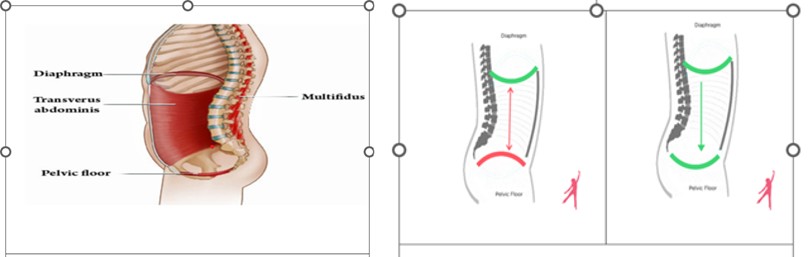
the transverse abdominal muscle does not appear to elevate the pelvic floor muscle all women and, when it does, it does not appear to be as effective as a direct contraction of the pelvic floor muscle itself [18, 19, 20, 21]. Kegel Breathing is a technique to incorporate breathing and pelvic floor contraction patterns to benefit pelvic floor muscle strength while engaging in normal daily routine activities. Normal breathing occurs when the breathing muscle (diaphragm) and the pelvic floor muscles move up and down together in the same direction in a coordinated manner) When performing the Kegel exercises and breathe in, the pelvic floor muscles lift upwards while the diaphragm moves down in the opposite direction[22, 23, 24, 25].
The abdominal cavity, which is shaped like a balloon, is composed of abdominal muscles at the front and right side, Para-spinal muscles at the back, the diaphragm in the upper abdomen, and the pelvic floor muscle the lower abdomen. Due to its structure, the pelvic floor muscle contracts in association with muscles around the abdominal area.
According to the previously mentioned physiological functional relationships, It was postulated that diaphragm muscle training (DMT) and abdominal muscle training (AMT) could have similar effects to direct PFM training (PFMT) on pelvic floor muscle strength (PFMS)and pelvic floor muscle endurance (PFME) [22]. The downward movement of the diaphragm creates pressure downwards onto the pelvic floor. This is the reason of feeing difficult in Kegel and breathing at the same time, especially when breathing in and the pelvic floor muscles are weak. This is the answer of why many people hold their breath during their Kegel exercises to try to overcome this problem [22].
Aim of the Study
To evaluate effect of deep breathing and kegel exercises on urinary incontinence among menopausal women through: 1. Evaluate menopausal women’s practices of deep breathing and Kegel exercise throughout the study phases. 2. Evaluate relationship between kegel exercises adherence and personal characteristics through the program phases.
Hypothesis
1. Menopausal women’s practices of deep breathing and Kegel exercise throughout the study phases will be improved and progressed throughout the phases of the study. 2. Deep breathing and kegel exercises adherence will be affected by personal characteristics of the menopausal women.
Subject and Methods
Study Design
The study followed a quasi-experimental one group (pre-post) test study design. Study Setting The study was conducted at gynecological and urological outpatient clinics at Beni-Suef University Hospital.
Sampling
A Purposive sample was used from the above-mentioned setting.
Sample Size
Total sample was 100 women who attended to the previous mentioned setting for a period of 9 months from the beginning of July 2021 until the end of March 2022 with average of three days per week.
Inclusion Criteria
- Age: women in menopausal age (perimenopause, menopause and late menopause).
- Menopausal women diagnosed with stress urinary incontinence.
- Free from any chronic disease that may aggravate the condition.
- Not consume any treatment for urinary incontinence (UI)
- Available phone number or whats practicing (whats app) for communication.
- Women should accept to participate in the study.
Exclusion Criteria
- Pelvic organ prolapsed (POP).
- Women having surgical/medical history that affect pelvic floor muscle tone as (Congenital Urological Disease, and Tumors of the Bladder).
Tools of Data Collection
Tool I: A structured questionnaire sheet was developed by the researcher in the Arabic language. It was included personal characteristics data of the studied women such as (age, height, weight, occupation, residence, marital status).
Tool II: The International Consultation on Incontinence Modular Questionnaire ICIQ-SF (sponsored by the World Health Organization (WHO) and organized by the International Consultation on Urological Diseases ICUD: The ICIQ is a self-reported survey a_nd screening tool for evaluating the frequency, severity of urinary incontinence. It_ consisted of 4 main items of 6 total ask for rating of symptoms in the past 4 weeks. Take sum score of items 3,4,5 (items 1 and 2 are demographic) for the actual score. The final item is a self-diagnostic item that is un-scored. The ICIQ-UI Short form provides a score ranging from 0-21; with a higher score indicating greater severity of symptoms; this assessment done before and after intervention.
Scoring System of the ICIQ-UI
- Mild when <25%
- Moderate when 25-50 %.
- Sever when >50%.
Tool III: Pelvic floor muscles exercises checklist: It included two sections,
- First part was follow up of exercise practicing, which contained number of weeks for exercise technique, number of exercise frequency per day, duration of each contraction and relaxation.
- Second part included check list for exercise technique.
- This check-list was adapted from Goda, et al. It contained 8 items to assess the accuracy of applying the Kegel and deep breathing exercise. This checklist contained step by step of deep breathing and Kegel exercises procedure [26].
Scoring of Pelvic Floor Muscles Exercises Checklist
The score zero (0) indicated not done, score (1) indicated done but not accurate, and score (2) indicated done and accurate. The total score was16 points: Poor practicing for deep breathing and Kegel exercise (<25%.) Fair practicing (25%-50%). Good practicing (51%-75%). Excellent practicing (26%-100%). Supportive Material instructional brochure developed by the researcher based on review of literatures contained data regarding Urinary incontinence (definition, causes, risk factors, symptoms, types, complications and management, Kegel exercise (benefits, technique, duration, frequency), and Deep breathing exercise (benefit, technique, duration, frequency).
Preparatory Phase
The researcher prepared the instructional booklet which included data about urinary incontinence (definition, causes, symptoms, complications, and management), Kegel exercise (benefits, technique, duration, frequency). Deep breathing exercise (benefit, technique, duration, frequency).
Field Work (Procedure)
The data was collected through a period of nine months, from the beginning of July 2021 until the end of March 2022. The researcher attended at the previous mentioned setting till all the pre-mentioned sample size collected. The data was collected through the following phases:
Assessment Phase
Firstly, the researcher introduced herself to the studied women and explained the aim of the study and explained the benefits of performing Kegel and deep breathing exercises on stress urinary incontinence to encourage them in the participation in the study and maintain their cooperation. Then the researcher started to fill the questionnaire to assess women’s personal characteristics, and urinary incontinence history. After that the researcher assessed the frequency, severity of urinary incontinence and its effect on physical and psychological women’s life by using the International Consultation on Incontinence Modular Questionnaire ICIQ-SF as a pretest assessment. These assessments took about 15 minutes for each studied woman.
Implementation Phase
The researcher provided the instructions to studied women about Kegel and breathing exercise through three months. At the beginning of the first month; that started immediately after assessment and included two instructional sessions.
The first instructional session, This session included information about urinary incontinence causes and risk factors, possible ways of management, what are the pelvic floor muscles and their functions, definition of Kegel exercise and its benefits on improving the strength and elasticity of pelvic floor muscles and reducing symptoms of stress urinary incontinence.
The 2nd session included instructions about how to detect the right muscle group for applying Kegel exercises by instructing the studied women to try to stop the urine flow in the middle of urination, and must experience a feeling of squeezing and lifting in the same time. If she could do this, she was using the right muscles; it took 20 minutes. Also, the researcher provided the instructions to women such as take deep breathing during the exercises; don’t try to move legs, buttock, or abdominal muscles during the exercises, also the researcher instructed the studied women to relax for a period equal to the period of holding [27].
The researcher instructed the studied women to contract the muscle as she is trying to stop the urine follow and count for 3 (3 seconds) and relax for another 3 seconds, contract and relax 5 times (the first exercise group) and repeat this exercise group 5 times per day (25contractions per day) these contractions increased frequently. Moreover, the researcher instructed the women that they can do these exercises at any position at any time also may be done during sexual intercourse. Also, each studied women received brochure about urinary incontinence, breathing exercise and Kegel exercises to remind them with the procedure at home. At the end of the first month: the researcher assessed the accuracy of practicing of deep breathing and Kegel exercises for the last four weeks by using check list tool. Then the researcher instructed the studied women to increase the number of contractions and the duration of holding to 6 seconds and increase the number of contractions and relaxations to 10 times (1st exercise group) and repeat this exercise group 5 times per day (50 contractions per day). At the end of 2nd month, the researcher assessed the accuracy of practicing of deep breathing and Kegel exercises for the last week by using check list tool. After that the researcher instructed the studied women to increase the number of contractions and the duration of holding to 9 seconds and increase the number of contractions and relaxations to 15 times (1st exercise group) and repeat this exercise group 5 times per day (75 contractions per day). At the end of the 3rd month the researcher assessed the accuracy of practicing of deep breathing and Kegel exercises for the last week by using check list tool. Then the researcher instructed the studied women to increase the number of contractions and the duration of holding to 12 seconds and increase the number of contractions and relaxations to 20 times (1st exercise group) and repeat this exercise group 5 times per day (100 contractions per day). Evaluation Phase The researcher evaluated effect of practicing deep breathing and Kegel exercises on stress urinary incontinence among elderly women as posttest by reassessing the frequency and severity of urinary incontinence and its effect
Results
on women’s physical and psychological conditions by using the same tool of pretest and evaluate whether the frequency and severity and the effect of urinary incontinence decreased or not through: i. Assess the severity of incontinence using tool one (pre and post intervention at what time immediately after the second educational session or at the end of the third month. ii. Assess the compliance or performance of exercises pre and post intervention at what times, immediately after education, at the end of the first, second- and third- month post education
Statistical Design
The collected data was revised, coded, tabulated and introduced to a computer using statistical package for social sciences (IBM SPSS .25.0). Data was presented and suitable analysis was done according to the type of data obtained for each parameter.
| Personal Characteristics | No | % |
|---|---|---|
| Age (in years) | ||
| 50-55 years | 49 | 49 |
| > 55-60 years | 38 | 38 |
| >60 years | 13 | 13 |
| Mean ±SD 54.23±2.87 | ||
| Residence | ||
| Rural | 71 | 71. 0 |
| Urban | 29 | 29 |
| Education | ||
| Illiterate | 49 | 49 |
| Primary education | 30 | 30 |
| Secondary education | 18 | 18 |
| University education | 3 | 3 |
| Marital status | ||
| Married | 87 | 87 |
| widow | 13 | 13 |
| Occupation | ||
| House wife | 48 | 48 |
| Working | 52 | 52 |
| Weight | ||
| Mean ±SD | 82.680±11.8815 | |
| Height | ||
| Mean ±SD | 160.420±2.8610 | |
| BMI | ||
| Mean ±SD | 32.1224±4.47973 |
Table 1: Distribution of studied sample according to personal characteristics (n=100).
Table 1 Displays the distribution of studied sample according to characteristics. It shows that 49% of the studied sample was aged 50-55 years old. The mean age of them was 54.23±2.87. Moreover, 71% were from rural areas. Also, 52% of them were working. Also, it reveals that mean weight of the studied sample was 82.680±11.8815, mean height was 160.420±2.8610, and mean of BMI was 32.1224±4.47973.
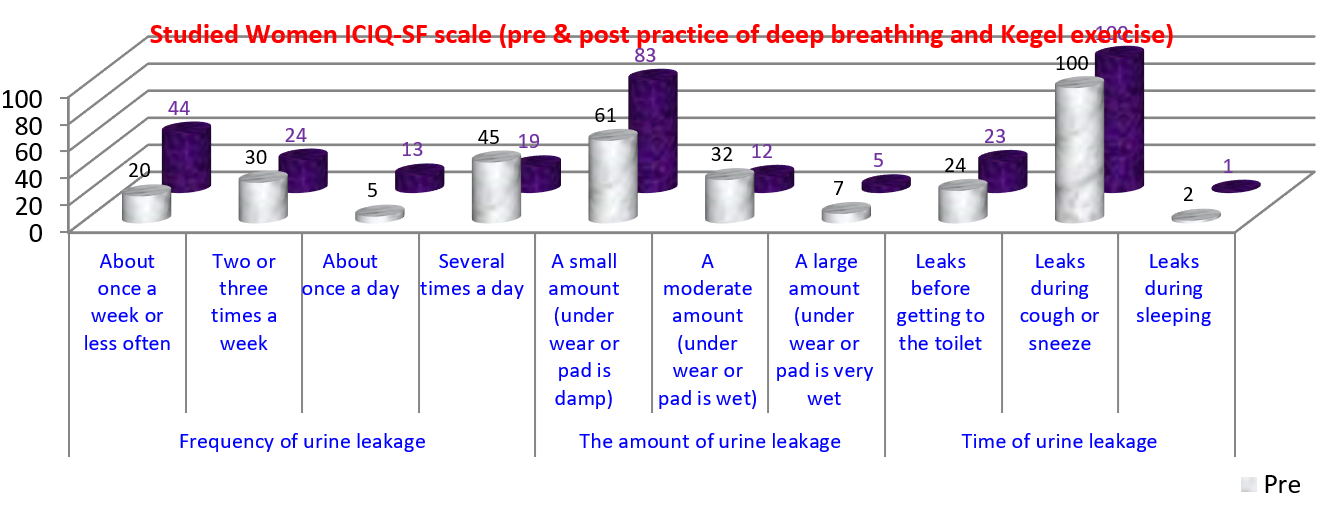
Figure 2 Portrays studied women according to International Consultation on Incontinence Modular Questionnaire ICIQ-SF (pre & post practice of deep breathing and Kegel exercise). It reveals that frequency of urine leakage decreased after implementation of the program as the following report; 45% of the studied women reported that their frequency of urination is several times per day preprogram but it became only 19% post program implementation.
| Characteristics | deep breathing and kegel exercises adherence | |||||||
|---|---|---|---|---|---|---|---|---|
| 1st week of the 1st month | At the end of the 1st month | At the end of the 2nd month | At the end of the 3rd month | |||||
| R | p-value | R | p-value | R | p-value | R | p-value | |
| Age | -0.43 | 0 | -0.68 | 0.000** | -0.53 | 0 | -0.41 | 0.000** |
| Education | 0.46 | 0 | 0.437 | 0.000** | 0.237 | 0.018 | 0.279 | 0.005 |
| Occupation | 0.28 | 0.005 | 0.303 | 0.002** | 0.306 | 0.002 | 0.364 | 0 |
| Residence | 0.189 | 0.06 | 0.058 | 0.568 | 0.179 | 0.075 | 0.133 | 0.188 |
| Marital status | 0.208 | 0.038* | 0.34 | 0.001** | 0.22 | 0.028* | 0.339 | 0.001** |
Table 2: Correlation between deep breathing and kegel exercises adherence and personal characteristics through the program phases
*Significant at p≤ 0.05 **highly significant at p≤0.01. Table 2: Correlation between deep breathing and kegel exercises adherence and personal characteristics through the program phases (N=100).
Table 2 Portrays the correlation between deep breathing and kegel exercises adherence and personal characteristics through the program phases. It reveals that there was negative correlation between age of the studied sample and their adherence to practicing deep breathing and Kegel exercises throughout the study.
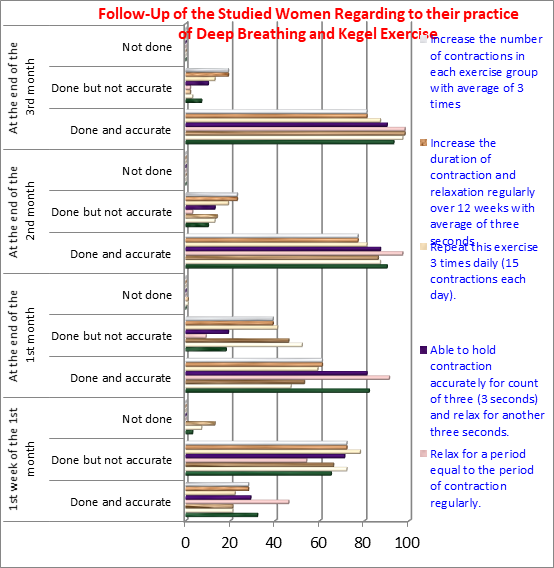
Figure 3 Presents the distribution of studied sample according to their practice of deep breathing and Kegel exercise throughout the time of the study. It reveals that only 32% of the studied women can accurately detect the right muscle group at the 1st week of the 1st month. However, at the end of the 1st month; 82% of them can do. Moreover, at the end of the 2nd month; 90% can do. Additionally, at the end of the 3rd month; 93% of the studied women can accurately detect the right muscle group.
Discussion
Daily pelvic floor muscle training is an effective treatment for stress or mixed urinary incontinence, compared with no treatment, over the short term. Other than occasional cases of pain or dis- comfort, no other adverse effects have been noted. This evidence is derived from several large randomized controlled trials and two systematic review published in the Cochrane library [28].
The objective of pelvic floor muscle exercise is to improve the timing of contractions, the strength of the pelvic floor muscles and the stiffness of the pelvic floor muscles. The mechanisms of action of pelvic floor exercises are threefold: strength training, counterbalancing, and indirect training of the pelvic floor muscle by contracting the transverse abdominal muscle [21]. Pelvic floor exercise works in treating stress urinary continence through the following mechanisms, first Strength training mechanism, the bladder neck is supported by the pelvic floor muscles, which limit the downward movement of the urethra during exertion and thereby prevent leakage of urine. Intensive training of any striated muscle will build muscle bulk; similarly, strength training of the pelvic floor muscles will build muscle bulk and thereby provide structural support to the pelvic floor by permanently elevating the levator muscle plate to a higher position in the pelvis. The support is further enhanced hypertro- phy and stiffness of the endopelvic fascia [29]. The results of the current study reveal enhancement of women’s condition after implementation of program. Regarding the amount of urine loss before intervention, the present study demonstrated that one third of the studied women had loss of urine so much that it wets their protection or cloths. After twelve weeks of intervention; it decreased from one third to tens. This was in the same line with Abd El-Aty, et al. who studied the Effect of Kegel Exercise Training Program on Improving Quality of Life among Women with Urinary Incontinence and reported that about one third of the study group and forty of the control group had loss of urine so much that it wets their protection or cloths [30].
After intervention; it decreased among the study group, while it remained the same among the control group. Concerning, frequency of involuntary loss of urine before practicing deep breathing and kegel exercises, the current study clarified that more than forty of the studied women had involuntary loss of urine several times per day specially in winter season, while one third of them had loss of urine from two to three times per week and twenty of them had loss of urine once a weak or less often. After twelve weeks of practicing deep breathing and Kegel exercises, it decreased to less than one quarter of them had loss of urine several times per day and one quarter of them had loss of urine from two to three times per day while slightly less than half of them had loss of urine once per week or less often after intervention.
This comes in agreement with Ismail, et al. who studied the Effect of Kegel’s Exercise on Severity of Urinary Incontinence and Quality of Life among Menopausal Women and reported that (more than half and slightly less than half) in the study and control groups respectively had loss of urine from more than once but less than three times a week. After twelve weeks of intervention, it decreased dramatically from more than half to five among the study group, while it remained the same among the control group [31].
Maternity nurses play а crucial role in the quality of care improvement, which provides menopause woman education and support. At the same time, the nurse can provide health promotion & psychosocial services include assessment, health education, counseling & appropriate referral [32, 33, 34, 35, 36, 37].
Regarding relationship between personal characteristics of the studied women and deep breathing and kegel exercises adherence the present study revealed that there was a negative significant correlation between age of the studied sample and their adherence to practicing deep breathing and Kegel exercises throughout the study. This may be as a result of deterioration of health status by aging. The current study women were in menopausal stages with their aging adverse effects necessarily occur. Edibe, et al. who studied age at the onset of menopause and its influencing factors in Turkish women in a rural area and supported the idea that age and menopausal state are attribution factors interfering with Kegel’s effect and added that age was statistically correlated to SUI [38]. This may be related to the older age; more the problem is confronted especially in menopausal women due to decreased levels of estrogen hormone which weaken pelvic floor muscles.
The present study clarified that slightly more than two thirds of the studied women were from rural areas. Residence surely affects many variables; rural dwellers marry in very young age which in turn effects on general condition of women and expose them to many health problems. This might be ascribable to the fact that day by day life enhances women’s experience and decline their knowledge. Early marriage could have a negative effect on the women’s education; this had exposed these women not only to ignorance of their condition but also to complications. Early marriage has hindered women to complete their education and to get an appropriate job and had become financially dependent on their kin. Therefore, teen women were more likely to live in poverty than women who were in delayed marriage age. Moreover, delaying age at marriage was a key to improving women’s status and may be a way of increasing their leverages in the decision-making process [39]. This in line witn Ng, et al. who studied the Risk factors and prevalence of urinary incontinence in mid-life Singaporean women all of them pointed that highest percentage of stress urinary incontinence among women especially those from a rural area [40]. Results of the presents study revealed highly improvement in women’s practices of kegal and breathing exercise throughout the time of program. It reveals that only 32% of the studied women can accurately detect the right muscle group at the 1st week of the 1st month, while at the end of the 3rd month; 93% of the studied women can accurately detect the right muscle group. This fast improvement after the implementation of the program indicated that there is an enhancement in women’s practices. Moreover, the progression of good women’s and regression of frequency of micturition, after the implementation of the guidelines compared to before. This improvement and progression were also maintained up to the follow-up test through the observed results. This improvement could be attributed to that all women of the sample were committed with the guidelines. Additionally, the attending of the guideline’s sessions and the lecture and positive reinforcement or the long-term retention of knowledge, as well as wide verities of used educational used methods [41, 42, 43, 44, 45, 46].
The results of the current study declare the women’s ICIQ- SF scale post practice of deep breathing and Kegel exercise was better than practice. After the implementation of the program, the results indicated that there is а improvement in women’s women’s ICIQ-SF scale post practice of deep breathing and Kegel. This improvement/progression was also maintained up to the follow-up test (3-month later) through the observed results. This improvement could be attributed to that all participated women of the sample were committed with the guidelines. Additionally, the attending of the guidelines sessions and the lecture and positive reinforcement or the long-term retention of knowledge, as well as wide verities of used educational used methods [47, 48].
The distributed Arabic booklets, also, played a crucial role in attaining and retain knowledge about kegal and breathing exercise. Booklets are best used when they are brief, written in plain language, full of good pictures and when they are used to back-up other forms of education. This is, in accordance, with Edgаr Dаle’s or the NTL’s Pyramid of Learning as cited by Masters as the pyramid illustrated that individuals can retain 10.0% of what he read and 20.0% of what he sees and hear (audiovisual). The same author added that ones can retain 50.0% of what he learned by a discussion [47, 48, 49].
Conclusion
Deep breathing and Kegel exercise had positive effect on women’s urinary incontinence. Hypothesis is accepted.
Recommendations
Disseminate brochures and booklet about kegal and breathing exercise to enhance awareness program regarding stress urinary incontinence reliving measures for elderly women. Deep breathing and kegel exercises adherence are affected by personal characteristics and body mass index for the elderly women through the intervention phases.
References
-
Trujillo CA (2018) The effectiveness of Pelvic Floor Muscle Training through Immersive Virtual Reality for the treatment of Stress Urinary Incontinence based on the impact on the quality of life in adult women elite athletes. A randomized controlled trial.
-
Hassan H, Said S, Hassanine Sh (2017) Disparities of Prevalence and Causes of Maternal Antenatal Anxiety among Primigravida Pregnant Women in Egypt. American Research Journal of Nursing 3(1): 1-15.
-
Mostafa H, Mostafa H, Tantawi H, Hassan H (2018) Developing and Validating an Evaluation Tool for Evaluating Nursing Faculty Staff Assistants’ Performance by the Students. International Journal of Novel Research in Healthcare and Nursing 6(1): 128-137.
-
Hassan H (2020) Self-Care Practices for Women with Gestational Diabetes. EC Nursing and Healthcare 2(12): 168-175.
-
Mohamed W, Hassan H (2019) Educational Program to Enhance Pregnant Women’s Knowledge about Dental Care and Periodontitis Outcomes. ARC Journal of Nursing and Healthcare 5(3): 23-33.
-
Freeman RM (2019) The role of pelvic floor muscle training in urinary incontinence. An International Journal of Obstetrics and Gynaecology 111(1): 37-40.
-
Farg D, Hassan H (2019) Surgical Repair versus Non- Surgical Management of Spontaneous Perineal Tears that Occur during Childbirth. American Journal of Nursing Research 7(5): 781-792.
-
Hassan H (2020) Fetal and neonatal complications of pregnancy induced hypertension. American Research Journal of Public Health 3(1): 1-3.
-
Hassan H (2020) Quality of Life with Gestational Diabetes. American Research Journal of Public Health 3(1): 1-4.
-
Hassan H (2020) Kegels Exercises: A crucial issue during woman’s lifespan. American Research Journal of Public Health 3(1): 1-5.
-
Mohamed S, Omran A, Hassan H, Abo Zied E (2023) Effect of Deep Breathing and Kegel Exercises on Urinary Incontinence among Elderly Women. Benha Journal of Applied Sciences 8(4): 81-89.
-
Ramadan E, Eldesokey A, Hassan H (2020) Effect of an Educational Package on Knowledge, Practices, and Attitude of Premenopausal Women Regarding Sexuality. American Journal of Nursing Research 8(5): 495-505.
-
Hassan H (2019) Integrative Nursing Science in Women’s Pre-conceptional Wellness. International Journal of Health and Biological Sciences 2(1): 17-18.
-
Hassan H, Mohamed S, Ramadan E, Omran A (2023) Urinary Incontinence among Menopausal Northern Upper Egyptian Women Impact of Deep Kegel and Breathing Exercises. New Medical Innovations and Research 4(9): 1-12.
-
Rodas MC, García-Perdomo HA (2018) From Kegel exercises to pelvic floor rehabilitation. A physiotherapeutic perspective. Rev Mex Urol 78(5): 402- 411.
-
Mohamed S, Hassan H, Omran A, Ramadan E (2024) Effect of Urinary Incontinence on Women’s Physical Condition. Journal of Community Medicine and Public Health Reports 5(2): 1-5.
-
Hassan H, Mohamed S, Ramadan E, Omran A (2023) Urinary Incontinence among Menopausal Northern Upper Egyptian Women Impact of Deep Kegel and Breathing Exercises. New Medical Innovations and Research 4(9): 1-12.
-
Radzimińska A, StrączyńskaA, Weber-Rajek M, Styczyńska H, StrojekK, et al. (2018) The impact of pelvic floor muscle training on the quality of life of women with urinary incontinence: a systematic literature review. Clinical Interventions in Aging 13: 957-965.
-
Ahmed M, Hassan H, Mohamed A, Saleh A (2024) Knowledge and Practice of Nurses toward Preventive Measures of Elderly Patients with Viral Hepatitis B and C in the Dialysis Unit. Nile journal for geriatric and gerontology 7(1): 70-92.
-
Farag D, Mohamed S, Malk R, Hassan H (2024) Effectiveness of Educational Intervention Program about Cervical Cancer on Working Women’s Knowledge, Attitude, and Practice at Beni-Suef University. Egyptian Journal of Health Care 15 (1): 1-16.
-
Hassan H (2019) The Impact of Evidence-Based Nursing as The Foundation for Professional Maternity Nursing Practices. Open Access Journal of Reproductive System and Sexual Disorder 2(2): 195-197.
-
Hwang U, Lee M, Jung S, Ahn S, Kwon OH (2021) Effect of pelvic floor electrical stimulation on diaphragm excursion and rib cage movement during tidal and forceful breathing and coughing in women with stress urinary incontinence. Medicine (Baltimore) 100(1): e24158.
-
Ghanem S, Mohammed A, Mohammed S, Hassan H (2024) Relationship between Nurses’ Practices Regarding Fall Prevention among Elderly Women and their personal Characteristics. Journal of Orthopaedic Science and Research 5(1):1-7.
-
Hassan H, Zedan H, Farag D (2024) Successful Vaginal Birth Subsequent to Cesarean Section. Mansoura Nursing Journal 11(1)
-
Hassan H, Mohammed R, Ramadan S, Masaud H (2021) Call for Alleviating Sexual Issues among Cervical Cancer Survivors’ Women in Northern Upper Egypt. Journal of Obstetrics Gynecology and Reproductive Sciences 5(3): 1-11.
-
Goda AA, Fawaz MA, Ghonem J, Mostafa MI, Metaweaa H (2015) Effect of Pelvic Floor Muscle Exercise Training Protocol For Pregnant Woman during 3rd Trimester on Labor Duration. Journal of Health. Medicine and Nursing 15: 1-11.
-
El-Deen AN, Eswi ASZ, El Hamed AAA (2020) Efeect of Kegel’s Exercises on First Degree Pelvic Organ Prolapse Among Women. Journal of Health, Medicine and Nursing 37: 1-13.
-
Uentes-Aparicio L, Balasch-Bernat M, López-Bueno L (2021) Add-on Effect of Postural Instructions to Abdominopelvic Exercise on Urinary Symptoms and Quality of Life in Climacteric Women with Stress Urinary Incontinence. A Pilot Randomized Controlled Trial. Int Journal Environ Res Public Health 18(3): 928.
-
Nygaard CC, Betschart C, Hafez A, Lewis E, Chasiotis I, et al. (2019) Impact of menopausal status on the outcome of pelvic floor physiotherapy in women with urinary incontinence. International Urogynecol Journal 24(12): 2071-2076.
-
Abd El-Aty EM, Hassan ME (2021) Effect of Kegel Exercise Training Program on Improving Quality of Life among Women with Urinary Incontinence. Egyptian Journal of Health Care 12(2): 946- 964.
-
Ismail N, Ibrahim H, Rady S, Habiba A (2019) Effect of Kegel’s Exercise on Severity of Urinary Incontinence and Quality of Life among Menopausal Women. International Journal of Novel Research in Healthcare and Nursing 6(3): 1288-1308.
-
Hassan H, Zahran K, Youness E, Nady F (2015) Pregnant Women’s Awareness, Intention and Compliance regarding Folic Acid Usage for Prevention of Neural Tube Defects According to Health Belief Model in Beni- Suef City. Pyrex Journal of Nursing and Midwifery 1(3): 13-26.
-
Hassan H, Nady F, Youns E, Zahran K (2016) Call for Change Level of Knowledge, Awareness and Attitude to Follow A High Folate Diet Among Pregnant Women. IOSR Journal of Nursing and Health Science 5(1): 93-100.
-
Farg D, Hassan H (2019) Study Hyperemesis Graviderum Requiring Hospital Admission during Pregnancy: Effect of Nursing Implication on Its Progress. American Journal of Nursing Research 7(3): 328-341.
-
Mostafa H, Yousef F, Hassan H (2018) Health Related Quality of Life Educational Interventions: Effect on Chronic Hepatitis C Patients. Saudi Journal of Nursing and Health Care 1(2): 56-67.
-
Said S, Hassan H, Sarhan A (2018) Effect of an Educational Intervention on Women’s Knowledge and Attitude Regarding Cervical Cancer. American Journal of Nursing Research 6(2): 59-66.
-
Atwa A, Hassan H, Ahmed S (2019) The impact of a hospital-based awareness program on the knowledge of patients about breast cancer and cancer cervix. International Journal of Studies in Nursing 4(1): 20-29.
-
Edibe P, Oguzoncul A, Rabia T (2019) Age at the onset of menopause and its influencing factors in Turkish women in a rural area. Journal of Women & Aging 28(3): 238- 246.
-
Hassan H (2016) Infertility profile, psychological ramifications and reproductive tract infection among infertile women, in northern Upper Egypt. Journal of Nursing Education and Practice 6(4): 92-108.
-
Ng KL, Ng KR, Thu WPP, Kramer MS, Logan S, et al. (2020) Risk factors and prevalence of urinary incontinence in mid-life Singaporean women: the integrated Women’s health program. International urogynecology journal 31(9): 1829-1837.
-
Hassan H (2016) Call for psychosocial well-being among pregnant women associated with medical disorder in Beni-Suef governorate. IOSR Journal of Nursing and Health Science 5(2): 81-94.
-
Masters K (2013) Edgar Dale’s Pyramid of Learning in medical education: A literature review. Medical Teacher 35(11): e1584-e1593.
-
Hassan H, Mohamady Sh, Abd El-Gawad N (2017) Protocol for improving nursing performance towards placental examination at labor units. Clinical Nursing Studies 5(2): 1-11.
-
Ahmed M, Hassan H, Mohamed A, Saleh A (2024) Knowledge and Practice of Nurses toward Preventive Measures of Elderly Patients with Viral Hepatitis B and C in the Dialysis Unit. Nile journal for geriatric and gerontology 7(1): 70-92.
-
Ghanim S, Mohamed S, Mohamed A, Hassan H (2024) Nurses’ Knowledge and Practice for Reducing Falls among Older Adult Women. Nile journal for geriatric and gerontology 7(1): 104-126.
-
Hassan H, Mohammed S, Mohammed A, Ghanem S (2024) Study Nurses’ Knowledge about Fall Prevention among Elderly Women. Journal of Orthopaedic Science and Research 5(1): 1-13.
-
Gamel W, Genedy A, Hassan H (2020) Impact of Puerperal Sepsis Self-Care Nursing Guideline on Women’s Knowledge and Practices. American Journal of Nursing Research 8(2): 132-141.
-
Hassan H, Nasr E (2017) Improving nurses’ knowledge and skills regarding tocolytics for inhibiting preterm labor. Clinical Nursing Studies 5(1): 1-12.
-
Nady F, Said M, Youness E, Hassan H (2017) Impact of Tailored Educational Program of Quality of Life Improvement on Women Undergoing Breast Cancer Treatment at El-Minia Region, Egypt. American Research Journal of Gynaecology 1(1): 1-17.
- Measuring What Matters: Data Gaps, Certificate of Need Reform, and Pediatric Psychiatric Inpatient Capacity in North Carolina
- Intersecting Epidemics and Climate Vulnerabilities in Conflict- Driven Displacement: Epidemiology, Systemic Challenges, and One Health Gaps in South Sudan
- Advancing Domestic Health Financing for Community Health System Sustainability in South Sudan: The Boma Health Initiative Model (2025–2035)
- Prevalence and Correlates of Post-Exposure Prophylaxis Uptake among Men Who Have Sex with Men in Kisumu County, Kenya
- Medical, Ethical, and Legal Conflicts Surrounding Euthanasia in Argentina. Its Global Implications
- Knowledge and Attitude on Menstrual Hygiene among Adolescent Girls Studying in Secondary Level in Public Schools of Chitwan District, Nepal