
Exploring the Sustainability and Equity of the Aging Economy
Population aging challenges the sustainability of fiscal and social security systems. Rising pension outlays to the increasing number of elders also raises a controversial issue of generational equity. This mini review briefly introduces overlapping generation model (OLG) and generational accounting (GA), presented in Auerbach and Kotlikoff (1987) and Auerbach, Gokhale, and Kotlikoff (1991), that are suitable for exploring the issues raised.
Introduction
Population aging is the phenomena of increasing share of older population due to declining fertility and increasing longevity of the elders. According to the United Nations, population aging is an unprecedented, pervasive, and enduring phenomenon that affects many aspects of human life [1, 2, 3]. The immediate impact of population aging is the shrinking working-age population and increasing elderly dependents. This demographic development will increase public spending on pensions, health care and long-term care services; meanwhile, public revenue from taxes and social security will be decreased due to shrinking working-age population. A major concern of this demographic transition is that the increasing demands for welfare and health care may threat the sustainability of fiscal and social security systems. Another concern is that the government’s role in allocating resources to meet the needs of the elders may burden the welfare of future generations. To investigate the impacts of this demographic transition on the economy, we need some methods that enable the researchers to project long-term impacts of population aging. This mini review introduces two of the frequently used methods, namely, overlapping generation model (OLG) and generational accounting (GA), presented in Auerbach and Kotlikoff (1987) and Auerbach, Gokhale, and Kotlikoff (1991). Both methods can be used to evaluate the fiscal sustainability and macroeconomic effects of population aging [1, 2].
Overlapping Generation Model (OLG)
Samuelson (1958) and Diamond (1965) presented the pioneered work on the OLG model, which became the canonical OLG model discussed in the graduate textbook. In the original OLG model is characterized as following: there are two generations, the young and the old, alive at any point in time. Population grows at an exogenous constant rate n. Households work only in the first period of life, earn income and save part of it to finance consumption when old. The assets (Kt) of the young at the end of period t are the source of the capital used for aggregate production in period t+1. The old receive interest on their capital, so their consumption after retirement will be Kt(1+r), where r is the interest rate. Households make work-leisure (income-consumption) decision each period of time and optimize their lifetime utility. Labor and capital markets are perfectly competitive and the aggregate production technology is constant return to scale [4].
In the Diamond (1956) OLG model there is no government and social security system. Auerbach and Kotlikoff (1987) extended the original OLG model (hereafter referred as AK-OLG) by introducing 55 overlapping generations of adults and the government institutions (the fiscal authority and the social security systems). The fiscal authority provides general public services and has the power to levy taxes of all sorts and to issue short-term debt. The social security system levies its own payroll taxes to finance its provision of retirement benefits. This model requires an assumption of intertemporal government budget balance to exclude economically infeasible policies of perpetual increases in the budget deficit.
Auerbach and Kotlikoff (1987) also introduced life cycle saving/consumption behavior of the adult households, which was first introduced by Modigliani and Brumberg (1954) and Ando and Modigliani (1963), into the model. The adult chooses a path of consumption and labor supply over his lifetime to optimize his intertemporal utility, given his preferences and lifetime budget constraint [5, 6]. The production sector is characterized by a representative firm that uses capital and labor in production. The firm, hires factors in the competitive factor market and sells its products in the competitive goods market, rationally maximizes its profit subject to technology and production costs constraint. Both households and firm have perfect foresight and make decisions based on correct expectations of future economic variables.
The extended AK-OLG model is a multi-generation, multi-sector, dynamic general equilibrium model. Auerbach and Kotlikoff (1987) used this model to simulate the effects of various types of fiscal policies, including deficit finance, changes in the level and timing of government spending, choices of the tax base, tax progressivity, tax and investment incentives, and social security reforms [1].
**Generational Accounting (GA)**
Auerbach, Gokhale, and Kotlikoff (1991) developed generational accounting (GA) to assess the sustainability of fiscal policy in the long-run and to measure the impact of fiscal policy on current and future generations. Generational accounting is based on a straightforward idea that, to keep the government intertemporal budget balance, all the government’s bills has to be paid for either by current or future generations [2].
Intertemporal government budget balance requires that, under the current year $t$, the present discounted value of the government expenditures ($PVG_t$) must be paid for out of current government net wealth ($NW_t$), the present discounted value of net tax payments by current generations ($PVC_t$), and the present discounted value of net tax payments by future newborn generations ($PVF_t$). So that, at any point in time, the government intertemporal budget constraint is:
$$PVC_t + PVF_t = PVG_t + NW_t$$ \hspace{1cm} (1)
Generation in GA refers to the cohort born at the same year in time or same period of time. Net tax payment of a generation is the net of tax payment minus transfer received from the government. Given $PVG_t$, $PVC_t$ and initial guess of government net wealth ($NW_t$), one can compute the collective present discounted value of payments required of future payment as a residual:
$$PVF_t = PVG_t - \left(NW_t + PVC_t\right)$$ \hspace{1cm} (2)
Per capita net tax burdens of the future generation is then compared with that of the current living generation. If per capita net tax burden of future generation exceeds that of the current generation, one concludes that the fiscal policy is transferring resources from future generation to benefit the current generation.
To produce generational accounts, one needs projection of population, taxes, transfers, and government expenditures. One also needs an initial guess of government net wealth and has to assign a value to the discount rate. In the computation of GA, government infrastructure investments are treated as other forms of purchases in the calculation and government’s wealth does not include the value of existing public infrastructure.
**Discussion and Conclusion**
Population aging signifies the increasing share of retirees and shrinking share of working-age population. This demographic transition challenges the sustainability of fiscal and social security systems. To assess the prospective impacts of this ongoing demographic development on the economy, one has to integrate the projected demographic scenarios into economic model. Both OLG and GA methodologies incorporate generations and demographic transition into the model and thus are capable of showing some potential effects of population aging on the economy. Moreover, both incorporate life cycle hypothesis in the households’ working/consumption behaviors to produce simulations for policy changes. These two methods have been widely adopted in academic researches and policy effects assessments. Though both incorporate “generations” in the study, these two methods are different in the production of policy simulation.
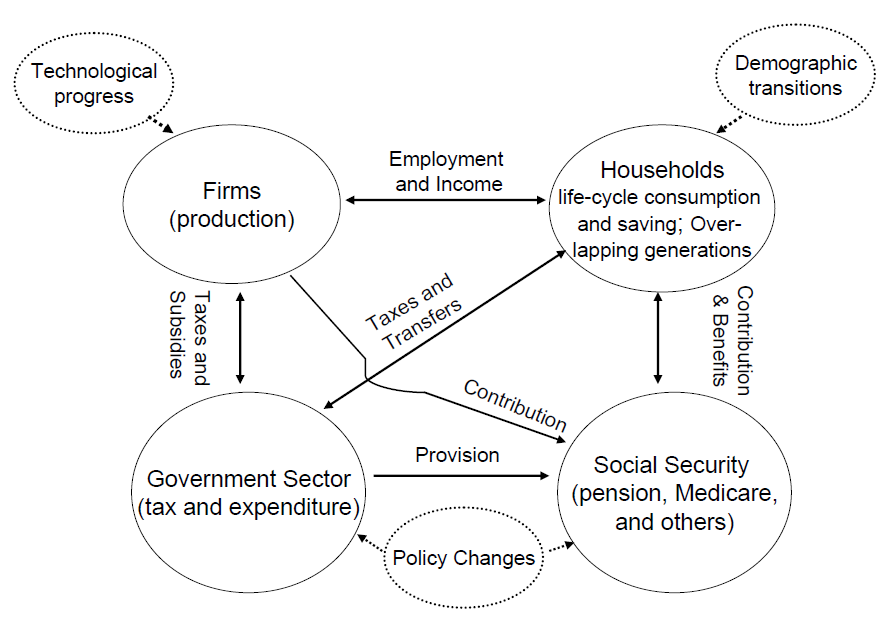
Figure 1 shows the structure of a standard OLG model. In the OLG model, demographic transition, technological progress, and government policy changes are exogenous to the households and firms. The impacts of population aging on the economy work through the life cycle behavior of the households and generational composition of the households. The demographic impacts are then transmitted through factor market, goods market, and fiscal and social security systems. Fiscal policy changes work via the impacts on the optimization decisions of households and firms which then feedback to the fiscal and social security system. Most authors applying OLG model do not specify firm’s obligation to pension contribution; Chang and Hsu (2017) modeled employers’ obliged contribution to national pension system [7].
The OLG model is a dynamic general equilibrium model per se which requires computational knowledge and software language in the intensive computation for solutions of policy changes. Computational algorithm is important in obtaining model solutions. As a result, the entrance costs for multi-generation OLG is quite high. The GA methodology is not so computational demanding, yet it requires the researchers to make arbitrary assumption on the discount rate in the computation of present values. One potential drawback of GA is that the conclusion of generational equity is sensitive to the choice of discount rate. Kotlikoff (1996) also noted that, since GA does not consider general equilibrium feedback to the fiscal system, it only provides an approximation to the true generational welfare effects of fiscal policy changes [8]. Both OLG and GA methods discussed in this mini review also suffer several common shortcomings. Firstly, they make no distinction between males and females of the household sector, so that they do not investigate gender equity/disparity issues. Moreover, they simply assume that each agent lives up to certain age and do not consider survival probability of the agents. This over- simplified assumption may exaggerate the social security outlays of the aging society because not everyone dies at the postulated age. Finally, they do not consider heterogeneity of lifetime productivity and earning capability of the individuals; neither do they discern the earning difference across individuals. Therefore, the computed budgetary stance of the government may not reflect the real transition path of the aging economy. Nevertheless, both OLG and GA are the most feasible conceptual frameworks for exploring the impacts of population aging on the macroeconomy and assessing the sustainability of fiscal and social security system in the aging economy. All these theoretical shortcomings mentioned can be improved with carefully theorizing of the model by the interested authors.
References
-
Auerbach AJ, Kotlikoff LJ (1987) Dynamic Fiscal Policy, Cambridge, UK: Cambridge University Press.
-
Auerbach AJJ, Gokhale, Kotlikoff LJ (1991) Generational Accounts: A Meaningful Alternative to Deficit Accounting. In Tax policy and the economy, Cambridge, Mass MIT Press 5: 55-110.
-
United Nations (2002) World Population Ageing: 1950-2050 Department of Economic and Social Affairs, United Nations.
-
Samuelson PA (1958) An Exact Consumption-Loan Model of Interest With or Without the Social Contrivance of Money Journal of Political Economy 66(6): 467-482.
-
Modigliani F, Brumberg R (1954) Utility Analysis and the Consumption Function: An interpretation of Cross-Section Data in Post-Keynesian Economics (editor KK Kurihara) New Brunswick NJ Rutgers University Press.
-
Ando A, Modigliani F (1963) The Life Cycle Hypothesis of Saving: Aggregate Implications and Tests. The American Economic Review 53(1): 55-84.
-
Chang NW, Hsu YH (2017) Social Security Reform in Aging Economy. International Journal of Humanities and Social Sciences (IJHSS) 6(3): 9-28.
-
Kotlikoff, Kotlikoff LJ (1996) Generational Accounting: in NBER Reporter, Winter 1995 6: 8-14.
- Occupational Stress and Mental Health Outcomes Among Police Officers: A Mini Review
- The Experience of Counterproductive Leadership on Mental Health and Impact on Retention in U.S. Marines: A Phenomenological Study
- Nomophobia in the Digital Age: A Study on College and University Students
- Emotional Regulation in Children with Autism and Learning Disabilities
- Antisemitism on American College Campuses and Its Impact on Jewish Students
- Exploring the Role of Empathy in the Associations of Family Functioning and Purpose in Life with Attitude towards Abortion among Undergraduates: A Moderation Analysis