
Teaching Children with Autism to Use Cell Phones to Seek Assistance when Lost
This study aimed to increase community safety skills of two children diagnosed with ASD. Participant 1 was taught to answer a mobile phone and follow the caregiver’s instructions to hand over the phone to a safe community figure. Training and testing of all component skills was conducted in the school setting and multiple probes were conducted in a community setting. This research demonstrates that it is possible to teach safety behavior in a school setting, in a way that generalizes to community settings.
Claire McDowell 1*, Nicola Hardy1 and Sinéad Smyth2
Coleraine, BT52 1SA, Northern Ireland, Tel: 02870123086; Email: ce.mcdowell@ulster.ac.uk that generalizes to community settings.
Introduction
Children encounter many threats to personal safety in their daily lives. Miltenberger and Gross (2011), categorized threats as those that occur frequently, providing ample opportunities for the child to practice safety behavior, (e.g., wearing seat belts, wearing cycling helmets, crossing the road) and those that occur less frequently, but are none the less life threatening. In these low frequency situations, (e.g. encountering poisonous substances, home fires, becoming lost, or attempted abduction) children may only have one opportunity to use safety skills successfully. While it is unlikely that most children will ever experience an abduction situation, there are serious consequences of becoming lost or being abducted, including risk of sexual abuse and/or death [1, 2]. Therefore teaching children about the risk of abduction, and associated safety behavior if lost is important. Ghezzi, Williams and Carr (1999), highlighted that for children with autistic spectrum disorder (ASD) there is ‘minimal or absence of social and self-help skills; toileting, dressing and avoiding danger’ (pg. 71). Therefore, for children with ASD, potential risks to safety are heightened. Elopement (attempts to leave an assigned area without consent) is prevalent among individuals with developmental disabilities including ASD [3, 4]. A survey by Anderson, Law, Daniels, Rice, Mandell, Hagopian, and Law (2012), found that approximately 49% of children with autism have attempted to elope from a safe environment at least once after age four. The increased risk of elopement paired with deficits in judgment and social skills, deficits in communication, lack of education regarding appropriate sexual behavior, and the inability to seek help or report abuse may result in an increased vulnerability for individuals with intellectual disabilities who become separated from their caregivers [5, 6, 7, 8]. Independent participation in community activities is an important goal for learners with autism, their families, and their teachers. However, concerns about safety for reasons outlined previously may prevent efforts to increase community independence [9, 10]. Several studies have focused on teaching safety skills to persons with disabilities, and showed that young children can learn abduction-prevention skills [11]. Taylor et al. (2004) taught young adults with ASD to respond to a vibrating pager and to hand over a card to persons in the community when separated from care givers. While the intervention was successful, the authors highlighted the potential for future research to utilize technological advances, such as cell phones and hand held devices, to increase safety and independence while participating in the community. A number of studies conducted since have utilized mobile technology and taught individuals with ASD to use devices to seek assistance when lost in public. This study aimed to add to the current literature by investigating the practicality of teaching children with ASD, who had very limited vocal skills how to use a mobile phone when lost or separated from their caregiver during community outings.
Method
Design
The study employed a multiple probe design. The dependant measure was the percentage of opportunities where the participant independently carried out all steps of the target behavior. Participants and Setting The participants, (Participant 1, male aged 9 and Participant 2, female aged 8), were both diagnosed with ASD and both exhibited significant deficits in receptive and expressive language, social skills, self-care skills and danger awareness. Both attended a school for children with ASD, 5 days a week. The first author and 2 other teaching staff who were familiar to the participants conducted training, assessment of target skills in various locations of the school on a daily basis. Baseline and retention probes where conducted in a small local grocery store, already familiar to both participants. The members of the community who participated in this study included the staff of the local store, who were familiar to the participants and 2 ‘strangers’ who were unknown to the participants but were in fact relations of members of the school staff involved in the study. A final generalization probe was conducted with Participant 1 in a similar sized store where he was unfamiliar with staff.
Materials
Materials used during training, baseline, retention and generalization probes included 2 black Nokia 1208 ©mobile phones and 2 black phone neck straps with swivel buckle. To eliminate any prompt dependency, the phone was randomly placed in different locations on the participants such as front and back pockets, school bags and shirt or jacket pockets.
Procedure
One initial baseline measure of participants’ responses to the phone ringing was conducted in the local store for each participant. Each participant was taken separately to the store on a shopping task, accompanied by the first author and two teaching staff. A few minutes after arrival, one member of teaching staff positioned themselves just outside the door of the store and out of view of the participant. The second member of staff positioned themselves just inside the door of the store, but out of view of the participant, and the first author positioned herself in the center aisle of the store where she was able to observe the participant but not be seen by him or her. Once all three staff members had moved out of site of the participant, the first author placed a call the participant’s phone and all three would observe how the participant responded. If the participant attempted to leave the store at any point, both staff members located at the door were able to prevent them leaving and ensure their safety. Following baseline, Participant 1 was randomly selected to receive intervention first, whilst Participant 2 remained in baseline. Phase 1 of the intervention was conducted in the school setting and consisted of teaching Participant 1, using verbal instructions, modeling correct responses, and gestural prompts, to press the call answer button and say hello when his phone rang. Once Participant 1 was able to respond independently across three consecutive trials, 10 further opportunities were presented, at various times, during various activities, with various members of staff, to assess his level of independence on the skill. Responses were recorded as correct, if Participant 1independantly retrieved his phone upon hearing it ring, pressed the call answer button and said ‘hello’. Responses were recorded as incorrect if he failed to carry out any of those steps. Following successful training and assessment of Phase 1skills, (indicated by 100% correct responding on all 10 opportunities across at least 3 days), a generalization probe was conducted in the store setting as described previously. The probe involved the same procedure as in the Baseline phase where 1 call was placed while the participant was in the store and staff had moved out of sight. Participant two’s responses were also probed again at this stage but during a separate visit. During Phase 2, Participant 1 was taught to answer the ringing phone, say hello, and follow a spoken instruction from the caller to hand the phone to an adult (teaching staff) and wait with them until she came to collect him. The participant was expected to wait no longer than 2 minutes. Again, following three independent correct responses, 10 further opportunities to assess independence were presented each day and responses were recorded as correct if Participant 1 completed all steps in the chain correctly, or incorrect if he failed to carry out any of those steps. A generalization probe was conducted in the store setting as described previously contingent upon 100% correct responding across at least 3 days. Participants two’s responses were also probed again at this point during a separate visit. During Phase 3 Participant 1 was taught to answer the ringing phone, say hello, follow a spoken instruction to hand the phone to an adult and wait with them. In these instances several friends and family of teaching staff who were unfamiliar to Participant 1 were recruited as volunteers. Calls to the participant were timed to occur when only these adults were in close proximity. Percentage of correct responses were recorded and contingent upon 100% correct responding across at least three days, a generalization probe was conducted in the store setting as described previously. Participant two ’s responses were also probed again at this point. Phase 4 involved teaching Participant 1 to answer the ringing phone and follow a verbal instruction from the caller to go and find an adult, hand them the phone, and wait with them. Calls were placed at contrived times when teaching staff were some distance across a room from the Participant or just outside the classroom door. A generalization probe was conducted in the store setting as described previously contingent upon 100% correct responding across at least three days. Participants Two’s responses were also probed again at this point. Following successful generalization of all skills to the store setting, further retention probes were conducted in the store setting following three weeks and six weeks of non-practice. At this stage, teaching of skills in phase 1 began with Participant 2 and 1 generalization probe was conducted in the store setting for her.
Results and Discussion
Figure 1 shows the percentage opportunities where all steps of the target behavior were performed correctly during each phase and in-situ probes for Participant 1 and Participant 2. The data in the top panel demonstrates that Participant 1 successfully learned all component behaviors targeted in each phase, and successfully executed them independently in the store setting during probes. In addition, he was able to perform the entire composite skill during the final in-situ probe (session 42) and in retention and generalization checks (sessions 43, 44 &45). Baseline probes conducted with Participant 2 (Figure 1, bottom panel) show that she was unable to execute any of the steps of the composite behavior when her performance was probed in-situ at the same points in time as Participant 1. Teaching began on Phase 1 skills for Participant 2 on Session 45. Data shows Participant 2 reached 100% accuracy on Phase 1 skills in 3 teaching sessions, and maintained 100% accuracy on all steps across 3 consecutive sessions conducted in the school setting. Accuracy was probed in the store setting on Session 50 and Participant 2 performed the target behavior accurately in this setting.
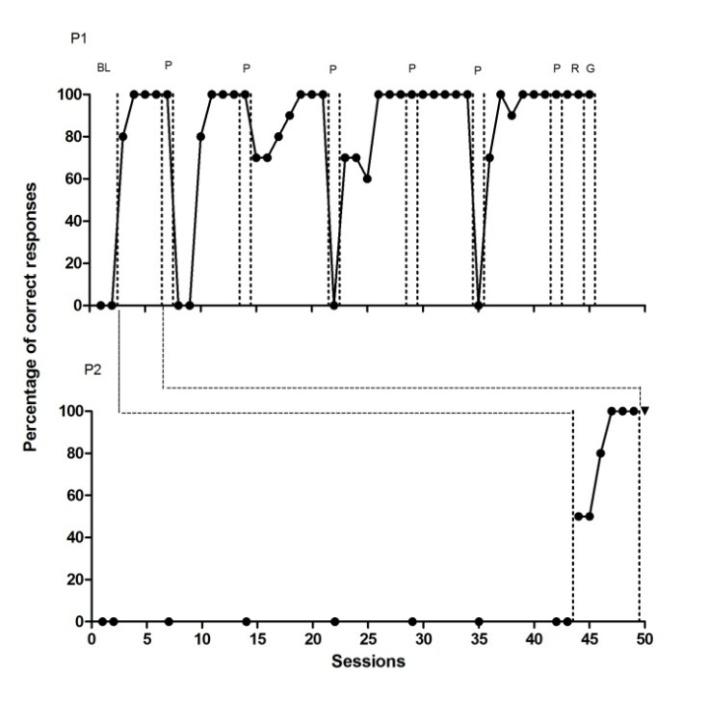
Figure 1: Percentage of correct responses demonstrated by Participant 1 (top panel) and Participant 2 (bottom panel) in training phases and probes As the complexity of the behavior chain increased, the number of teaching sessions required for Participant 1 to demonstrate 100% accuracy in the store setting increased, (e.g., Phase 1 required 4 sessions; Phase 2 required 6 sessions; Phase 3 required 13 sessions; Phase 4 required 11 sessions). However, once the entire chain had been mastered, Participant 1 was able to retain the skills taught and carry out the entire chain accurately during retention probes following 3 weeks and 6 weeks with no opportunity to practice, In addition, he was able to generalize the skills in an unfamiliar, store. Prior to training, Participant 2 was unable to perform any of the behavior chain accurately or independently during probes conducted in the store, demonstrating that familiarity with the setting, or exposure to being separated form caregivers was not sufficient to elicit the behavior. While there will always be inherent risks in increasing community activities for children with intellectual disabilities such as ASD, this study, adds to the current literature by demonstrating that children with intellectual disabilities such as ASD can be taught complex chains of behavior that may increase their safety during community activities and hence, increase their autonomy. Future research might explore using larger numbers of participants and varying the situations and people used to test generalization of skills. This study also adds to the growing body of literature exploring the use of technology for individuals with ASD. As well as offering a means of contacting and locating children who become lost, the skills necessary to operate a mobile phone are age appropriate for many clients who are engaging in more risky activities. In addition, carrying a mobile phone may be less stigmatizing than signs or communication devices, which may in fact highlight a child’s vulnerability. Anecdotally, Participant one’s parents report that he is now becoming more competent at operating a cellular phone, both making and receiving calls. They reported that this has lessened their apprehension concerning their son’s safety during activities outside the home or school environment. Training and assessment is ongoing for Participant 2.
References
-
Miltenberger RG, Gross A (2011) Teaching Safety Skills to Children in WW Fisher, CC Piazza, HS Roane (Eds). Handbook of applied behavior analysis. New York: Guilford.
-
Beck KV, Miltenberger RG (2009) Evaluation of a commercially available program and in situ training by parents to teach abduction-prevention skills to children. Journal of Applied Behavior Analysis 42(4): 761-772.
-
Ghezzi PM, Williams WL, Carr JE (1999) Autism: Behavior analytic perspectives. Reno, NV: Context Press.
-
Jacobson JW (1982) Problem behavior and psychiatric impairment within a developmentally disabled population II: behavior severity. Applied research in mental retardation 3(2): 369-381.
-
Watson, Janice D (1984) Talking about the best kept secret: Sexual abuse and children with disabilities. The Exceptional Parent 14: 15–20.
-
Sobsey D (1988) Sexual abuse and exploitation of people with severe handicaps. Paper presented at the annual conference of the Association for Persons with Severe Handicaps, Washington, DC.
-
Sobsey D, Varnhagen C (1988) Sexual abuse and exploitation of people with disabilities. Ottawa: Health and Welfare, Canada. Pp: 86.
-
Lang RA, Frenzel RR (1988) How sex offenders lure children. Sexual Abuse: A Journal of Research and Treatment 1(2): 303-317.
-
Bergstrom R, Najdowski AC, Tarbox J (2012) Teaching children with autism to seek help when lost in public. J Appl Behav Anal 45(1): 191-195.
-
Taylor BA, Hughes CE, Richard E, Hoch H, Coello AR (2004) Teaching teenagers with autism to seek assistance when lost. Journal of Applied Behavior Analysis 37(1): 79-82.
-
Poche C, Brouwer R, Swearingen M (1981) Teaching self‐protection to young children. J Appl Behavior Anal 14(2): 169-175.
-
Risley R, Cuvo AJ (1980) Training mentally retarded adults to make emergency telephone calls. Behavior Modification 4(4): 513-525.
-
Taber TA, Alberto PA, Hughes M, Seltzer A (2002) A strategy for students with moderate disabilities when lost in the community. Research and Practice for Persons with Severe Disabilities 27: 141–152.
-
Taber TA, Alberto PA, Seltzer A, Hughes M (2003) Obtaining assistance when lost in the community using cell phones. Research and Practice for Persons with Severe Disabilities 28: 105–116.
-
Anderson C, Law JK, Daniels A, Rice C, Mandell DS, et al. (2012) Occurrence and family impact of elopement in children with autism spectrum disorders. Pediatrics 130(5): 870-877.
- Occupational Stress and Mental Health Outcomes Among Police Officers: A Mini Review
- The Experience of Counterproductive Leadership on Mental Health and Impact on Retention in U.S. Marines: A Phenomenological Study
- Nomophobia in the Digital Age: A Study on College and University Students
- Emotional Regulation in Children with Autism and Learning Disabilities
- Antisemitism on American College Campuses and Its Impact on Jewish Students
- Exploring the Role of Empathy in the Associations of Family Functioning and Purpose in Life with Attitude towards Abortion among Undergraduates: A Moderation Analysis