
Prevalence and Forms of Intimate Partner Violence Perpetration and Victimization among In-Service University Students
Intimate Partner Violence (IPV) is a multi-faceted problem of global scope with a wide range of short- and long-term detrimental effects to the individuals involved in it and the larger public as well. The prime purpose of this study was to determine the prevalence and forms of IPV perpetration and victimization among in-service university students in Ethiopia. Four hundred and sixteen undergraduate and graduate summer in-service students (271 men and 145 women) provided the data through self-administered questionnaire. Percentage and chi-square test of independence were used to analyze and make meaning of the data. Results showed that IPV is highly prevalent in the current sample. About one-half of the participants (49.88%) and majority (71.74%) of them responded that they perpetrated at least one form of physical violence and psychological violence, respectively, against their current or former partner. Similarly, more than one-third (35.27%) and significantly greater than one-half (56.97%) of them admitted having been victims of physical violence and psychological violence perpetrated, respectively, by a current or former intimate partner. Several specific forms of physical and psychological violence were observed in the current sample. In aggregate, no significant gender differences were found in psychological violence perpetration, physical violence victimization and psychological violence victimization but physical violence perpetration was significantly more prevalent among men than among women. Both men and women are perpetrators and victims of IPV and, therefore, elimination of domestic violence requires integrated prevention strategies derived from family perspective that target both women and men.
Introduction
Intimate Partner Violence(IPV) is a multi-faceted problem of global scope with a wide range of short- and long-term detrimental effects to the individuals involved in it and the larger public as well [1]. Although it may vary in magnitude, nature, and severity, IPV occurs in all countries irrespective of social, economic, religious, or cultural group [2, 3]. IPV also is of a considerable economic, human rights, and public health concern of the contemporary world (National Centre for Injury Prevention and Control, 2003). In addition, it adversely affects children’s overall development and adjustment [4, 5]. Moreover, it is said to run across families and generations. The prime purpose of this study was to determine the prevalence and forms of IPV perpetration and victimization among in-service university students in Ethiopia. IPV is pervasive and widespread in Africa in general and in Ethiopia in particular. The available research has documented that Ethiopia has an extremely high prevalence of gender-based violence. Although estimates may vary, studies have consistently shown high prevalence of the problem. For example, in WHO’s multi- country study of domestic violence against women, Ethiopia stands first (71%) [3]. A community-based cross- sectional study that assessed the prevalence of gender- based violence among 1104 women in Gondar Zuria District, North-West Ethiopia, revealed that the prevalence of physical, sexual, and psychological violence were 32.2%, 19.2% and 35.7%, respectively [6]. The same study reported an overall prevalence of domestic violence as high as 50.8 per cent. Another similar study (Abeya, Afework&Yalew, 2011) in Western Ethiopia found about 73% of life time prevalence of IPV. The researchers also concluded that three out of four women experienced at least one incident of intimate partner violence in their lifetime [7]. Data from a nationally representative sample of women of reproductive age and men between 15 and 59 years old by Ethiopia Demographic and Health Survey (EDHS) in 2005 demonstrated that vast majority of the women (81%) tended to endorse beating a wife and slightly more than one-half of the men (52%) endorsed that beating a wife is justifiable. A recent report of EDHS 2011 by the Central Statistics Agency (CSA) has shown that approval of wife-beating among women is still high though declining. Overall, 68% of the women involved in the survey endorsed wife-beating with difference in endorsement between rural and urban women at 76% and 46%, respectively [8]. Men’s approval of wife beating has shown a decline between 2005 and 2011 but it is still significant with nearly about one-half of men (45%) who participated in the EDHS 2011 endorsing beating a wife [8]. As with women, men’s acceptance of wife beating varied as a function of place of residence-urban versus rural- the distribution of acceptance being 51% and 25% among rural dwellers and urban dwellers, respectively [8]. Generally, with the exception of Afar Region wife-beating is a common practice which many men and women accept as part of a normal family life in all regions of Ethiopia [9]. Deyessa, Kassaye, Demeke and Taffa (1998) assessed the magnitude and the type of acts of physical violence used by men against their wives and the seriousness of the resultant injuries incurred by women victims using a community-based sample of women from ‘Meskan’ and ‘Mareko’ district of Southern Ethiopia. The study found that lifetime and last three months’ prevalence of physical violence against married women were found to have been 45% and 10%, respectively [10]. The study further showed that hitting with a fist was the most commonly used act of physical violence with 229 (76%) and 39 (60%) of the women reporting lifetime and three months’ experiences of such act of physical violence respectively. The use of knife or gun was not as such common with only 4(1%) of the physically abused women reporting lifetime experience of such acts. As far as injuries incurred are concerned, the study revealed that among the 303 physically abused women, 161 (53%) reported minor and serious somatic injuries. The same study revealed that 109(46%) of the women had acquired minor lacerations or scars. Twenty two (7%) of them had reported to have had fracture or dislocation and 5 (2%) had lost their vision [10]. In addition to paucity, the available domestic empirical studies appear to suffer some apparent flaws. One of these flaws is that IPV is totally conceptualized as male- to-female phenomenon. Women’s perpetration of IPV and men’s victimization from it were dismissed. This in turn has negatively affected the contribution of these local studies to our understanding of the dynamics of IPV [3, 6, 7]. In fact, to the researcher’s best knowledge, empirical studies that investigated reciprocated IPV or female to male violence are entirely lacking in Ethiopia. The third flaw of prior domestic research of IPV is that they are limited to a specific geographical location and hence could not show the real picture of the issue. For instance, in WHO’s (2005) multi-country study of domestic violence, data were obtained from a sample of women of reproductive age drawn from only one province in Ethiopia and findings were generalized to Ethiopia. Similarly, Tegbar et al. (2004) research was limited to a single district [6]. Another related problem with prior studies is that they are limited to rural areas and less educated women and communities. It appears that urban dwellers and people with some education are exempt from IPV. In other words, it appears that local researchers tended to be blindly guided by feminist theory and gender politics which in turn led them to look for IPV victimization among disadvantaged and less privileged groups of women. The fourth downside of prior domestic studies is that violence in intimate and non-intimate relationships were confounded together. For instance, Deyessa, et al. (1998) investigated any violence enacted by men towards women regardless of the type of their relationship [10]. Furthermore, the studies conducted to date were guided by feminist perspectives and gender politics. In other words, they were conducted within advocacy framework. For example, gender asymmetry was assumed rather than demonstrated. In summary, they lacked objectivity. In connection to this, local studies of the prevalence of female-to- male violence and associated antecedents and consequences are lacking. But, this area of research has received a substantial attention internationally and some studies have already demonstrated that female-to-male violence in heterosexual relationships is as frequent as male-to- female one, or even more frequent than violence perpetrated against female [11, 12, 13, 14, 15, 16, 17]. In fact, research is not conclusive in this regard and there are three lines of conclusion. One line of conclusion is women are as aggressive as men in intimate relationship. For example, Langhinrichsen-Roling’s (2005) review of 10 most important recent studies in the field of IPV revealed that women’s perpetration of physical violence was as frequent as or perhaps more so than men’s perpetration [18]. A lot of studies supported the conclusion that women are as aggressive as their counterpart men in intimate relationships [19, 20, 21, 22, 23]. With ethnically diverse sample of university students, Prospero (2009) also found that males were much more likely to perpetrate physical violence towards their partners than females [24]. The second line of conclusion is men are more aggressive than women and women are more likely to be victims of IPV from their partners than perpetrating it [25, 26]. The third line of conclusion is women are more aggressive than men. For instance, Arriaga and Foshee (2004) concluded that girls were more likely than boys to perpetrate violence towards their dating partner and boys were more likely than girls to be victims of partner’s physical aggression [27]. Capaldi and Owen’s (2001) study of young couples showed that women perpetrated frequent physical aggression compared to men. Study of Polish college students (Doroszewic& Forbes, 2008) also showed that women were significantly more physically aggressive than men. With 85 dating couples, Jenkins and Aube (2002) found that women in active college dating relationships were more aggressive than men. Archer’s meta-analytic review of sex differences in aggression between heterosexual partners (Archer, 2000) indicated that women were more likely than men to use one or more acts of physical aggression and to use such acts more frequently. Similarly, Fiebert’s review of a large body of IPV research showed that women were as physically aggressive as, or more aggressive than, men in their relationships with their spouses [26, 27, 28, 29, 30]. In spite of the inconclusiveness of research, the bidirectional nature of violence within intimate partnership might represent a special and important area of inquiry since prior investigations have suggested that there are gender differences in the type of violence behaviours perpetrated, the severity of the violence and the harm or damage sustained from the violence. So as to address the research gaps and paucity mentioned earlier, the research at hand attempts to answer the following research questions:(1) How often and to what extent does IPV occur in heterosexually partnered undergraduate and graduate summer students?(2) To what extent is IPV perpetration and victimization differentially associated with gender? (3) What are the common forms of IPV among the sample/population under scrutiny?
Methods
Participants
Overall 416 participants provided the data used for this research. They came from different regions of Ethiopia including Addis Ababa (36.8%), Oromia (24.3%), South Nations, Nationalities, and Peoples Region (23.8%) and Amhara(7.7%). The rest (7.4 %) were from other regions such as Tgray, Dire Dawa City and Somalia Region. Of the 416 participants 271(65.1%) were men and women constituted for about 35 % (145) of the sample. The participants were mostly young adults (Mean age = 32.31, SD = 8.16). The sample consisted of 176(42.3%) students studying towards master’s degree and 240(57.7%) students studying towards a bachelor degree recruited from different fields of study in colleges of education and behavioural studies and social sciences. Two hundred thirty three (about 56%) of the sample came from the college of education and behavioural studies. Participants
recruited from the college of social sciences constituted about 44% of the whole sample. About 58 %( 240) and 26 %( 106) participants were in marital and dating relationships, respectively, at the time of data collection. The rest 70 participants (about 17%) were not in an active relationship at the time of data collection but they were in a relationship at some point in time prior to the survey. Average relationship span for those in a dating relationship was 2.657 years (SD = 1.955) while it was 10.254 years (SD =8.318) for those in marital relationship. Sample’s monthly salary ranged from 1200 to 11000 Ethiopian birr with mean monthly salary of 2725.261 Ethiopian birr (SD =1402.067).
Materials and Measures
IPV was assessed by items adapted from the Conflict Tactics Scales-Revised Version (CTS2) and other similar works [17, 31]. CTS2 is a standardized and widely used instrument in family violence research. It was used in more than 300 studies in different cultures (Hamel, 2007) and its cross-cultural validity and other psychometric adequacies have been established and documented [31, 32]. Items in the CTS2 ask the participants to report on their experiences of IPV acts from their former or current intimate partner and along their frequency and severity within lifetime or past 12 months (or both) frame of time. In this study participants were required to self-report the extent to which they have been perpetrating and/or receiving IPV (physical & psychological violence), along with its severity and frequency, in their lifetime relationships. Overall, a 31-item of five-point scale adapted from prior works was used to assess this variable; fifteen items assessed physical violence and 16 items assessed the psychological dimension. While the possible lower score is indicative of almost non- involvement in IPV either as perpetrator or recipient, higher score represents high IPV perpetration and victimization. In this study CTS2 was found to be reliable with alpha coefficient of the subscale measuring physical violence being 0.892 and that of the subscale measuring psychological violence 0.891.A form developed by the researcher was used to capture participants’ demographic information and civil status such as gender, region of residence and marital status.
Data Collection and Analysis
Lists of active students in the chosen colleges of Addis Ababa University were obtained from their respective registrar units and used as sampling frame. The lists contained the name, department/study program and identification number of the students. Using the lists as sampling frames, systematic sampling strategy was used to select the participants. When the participant selected was not in a class during the time of data collection the immediate next student in the list was substituted. Five hundred questionnaires were distributed to the students selected with help of class teachers and representatives. The questionnaires were administered to the participants in classrooms and they were allowed to take the questionnaires with them and were able to complete it in their own time and return it to the class teachers and group representatives. Of the 500 questionnaires distributed, 451 were collected back for analysis leading to a response rate of 90.2 percent. Of the 451 questionnaires collected 416 survived data edition and were entered into the SPSS for analysis leading to a response rate of 83.2%. As regards data exploration, cleaning and analysis the SPSS Version 21 for window was used. Based on the nature of the research hypotheses and/or questions addressed and levels of measurement employed various statistical techniques and procedures were used to summarize and make meaning of the data gathered. Accordingly, frequency count and percentage were used to compute the rates of prevalence of IPV perpetration and victimization and the types of IPV prevalent. Cross- tabulation was used to compare the prevalence of the phenomenon by gender. Chi-square test of independence was used to test the statistical significance of differences in prevalence across gender.
Ethical Considerations
Guidelines defined by WHO (2002) for domestic violence research and other recommendations in other WHO’s documents (e.g. WHO, 2010) and ethical principles for research with human subjects outlined by APA (APA, 2010) were followed and strictly adhered to. Moreover, participation in this study was completely voluntary and informed consent was obtained from all participants. They were assured of the anonymity and confidentiality of the information they provided. Objectives of the research as well as its potential benefits were made clear to the participants at the onset in the first page of the survey questionnaire packet. Participants were also informed that debriefing sessions would be held to address the pain, shame, guilt, regret, sadness or any other emotional responses that some items in the survey questionnaire might have evoked if any [33, 34, 35].
Results
Prevalence of IPV Perpetration and Victimization
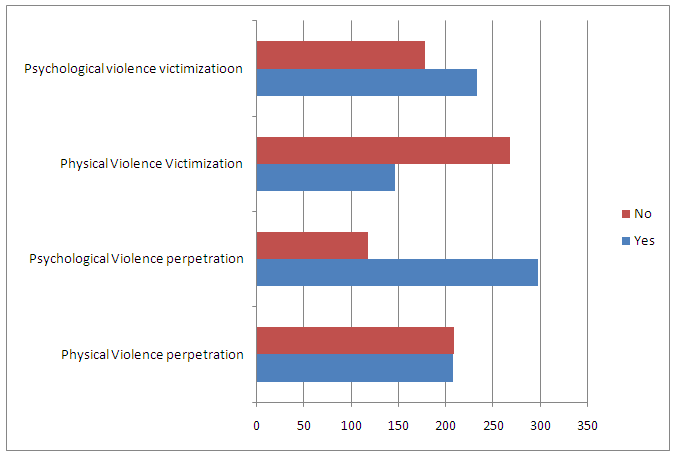
The first research question that this research set out to address was the prevalence of IPV perpetration and victimization in the target group, i.e. university students in summer undergraduate and graduate programs. Table 1 and figure 1 give the overall prevalence of IPV perpetration and victimization in the target group.
| Variable | Count (%) | ||||||||
|---|---|---|---|---|---|---|---|---|---|
| IPV Perpetration | Physical Violencea | Yes | 207(49.88) | ||||||
| No | 208(50.12) | ||||||||
| Psychological Violenceb | Yes | 297(71.74) | |||||||
| No | 117(28.26) | ||||||||
| IPV Victimization | Physical Violencec | Yes | 146(35.27) | ||||||
| No | 268(64.73) | ||||||||
| Psychological Violenced | Yes | 233(56.97) | |||||||
| No | 178(43.03) |
Table 1: Overall prevalence of IPV perpetration and victimization.
Note: Numbers in ( ) are percentages; a, b, c, & d indicate valid N’s (a= 415; b = 414; c = 414; d = 409) Table 1: Overall prevalence of IPV perpetration and victimization.
As Table 1 depicts, about half of the participants (49.88%) reported that they committed minor to moderate physical violence against their current or former partner with a frequency of ‘rarely’ to ‘often’. Nearly three-fourth of them (71.74%) said that they acted out a certain type of psychological aggression towards their current or former partner. As regards victimization from partner’s violence, about 35% of them reported that they suffered some type of physical violence from their current or most recent intimate partner. Being a victim of psychological violence from a current or most recent intimate partner was as high as 56.97 per cent in the whole sample. When physical violence and psychological violence are combined together, slightly more than three-fourth of the participants (76.5%) reported having committed violence against a current or former partner and about 61% reported having been a victim of violence from a current or former partner. What has been given by Table 1 was overall prevalence of all types of physical and psychological violence perpetrated and/or suffered. It is, however, important to draw attention to some specific commonly occurring acts of both physical and psychological violence. Tables 2 and 3 summarize these specific and common forms of physical and psychological violence perpetrated in relation to gender.
Specific Types of IPV by Gender
Table 2 reports commonly occurring physical violence. As can be seen from the table, slapping one’s partner was one of these acts of violence. Both men and women reported they ever committed this act of physical violence towards their partner. The cross tabulation showed that men were more likely to engage in this act than women and the gender difference observed was statistically significant, χ2 (1, 416) = 8.82, P = .002, Crammer’s V = .15. “Physically twisting a partner’s arm” was found to be another commonly occurring physical violence. Both men and women reported having engaged in this type of physical violence. But, the contingency table showed that men were more likely than women to enact such type of behaviour towards their intimate partner and this gender difference was statistically significant, χ2(1, 416) = 23.64, P < .001, V = .24. “Slamming or holding one’s partner against a wall” was reported by both men and women as an act of physical violence ever committed against one’s current or former partner with more men reporting this act of violence than women. The Ch-square test of independence performed also confirmed the gender difference observed, χ2 (1, 416) = 3.71, P = .04, V = .05. Both men and women said that ‘kicking’ was one of the physical violence they ever committed towards their current or former partner, with more men than women (11.81% versus 4.14%) reporting this form of violence act; and the gender difference observed was found to be statistically significant, χ2 (1, 416) = 6.7, P= .006. Bending a partner’s fingers was also ever used by both sexes; nearly equal number of men and women (4.06% & 3.45%, respectively) said that they bent their partner’s fingers (χ2 (1, 416) = .095, P = .494). About 5% of men and 11% of women reported that they ever bit their current or former partner indicating that ‘biting’ was one of the commonly occurring act of physical violence. As the contingency table herein indicates more women than men reported this act of violence(10.5% versus 4.42%) and the Chi-square test of independence performed showed that the difference observed between men and women was statistically significant, χ2 (1, 416) = 5.45, P = .019, V = .11.
Choking or attempt to ‘choke’ one’s partner was found to be among the commonly occurring physical violence in that significant number of men and women acknowledged that they ever performed this act of physical violence towards their current or former partner. The contingency table shows that more men(10.33%) than women(6.9%) reported this act of physical violence but the Chi-square test of independence performed did not support the gender difference observed in this regard, χ2 (1, 416) = 1.34, P = .164. Pushing, grabbing, or shoving was among the common physical violence occurring between intimate partners as reported by the current sample. This type of physical violence was not gender specific; slightly more than one- fourth of the men and 11% of the women reported having done this behavior against their current or former partner though more men (26.57%) than women (10.35%) reported it. To test for a statistical significance of the difference observed between men and women, Chi-square test of independence was performed. The result of the test run showed, the difference observed was statistically significant; that is men were more likely than women to push, grab, or shove their partners, χ2 (1, 416) = 5.34, P = .013, V = .11. ‘Throwing something at and hitting a partner’ was reported to have been performed by both genders and thus was one of the common physical violence in the current sample. As can be seen from the contingency table, slightly more men (22.51%) than women(20.69%) undertook this kind of violence but the gender difference was not statistically significant, χ2 (1, 416) = .183, P = .383.‘Forcing a partner to do something sexual that she/he did not want to do’ was reported by both men and women as one of the common acts of physical violence they ever committed with more men reporting this act of violence compared to women. Specifically, about 26% of men engaged in this form of physical violence compared to about 10% of the women and the gender difference observed in terms of percentages was statistically significant χ2 (1, 416) = 13.93, P < .001, V =.18.
| Sex | ||||||||||||||||||||
| Form of Violence | Response | χ2 | p | V | ||||||||||||||||
| Female | Male | |||||||||||||||||||
| Slapped her/him | Yes | 21(14.48) | 74(27.31) | 8.82 | .002 | .15 | ||||||||||||||
| No | 124(85.5) | 197(72.69) | ||||||||||||||||||
| Physically twisted her/his arm | Yes | 9(6.2) | 70(25.83) | 23.64 | .000 | .24 |
| No | 136(93.8) | 201(74.14) | ||||
|---|---|---|---|---|---|---|
| Slammed or held her/him against a wall | Yes | 4(2.76) | 20(7.38) | 3.71 | .04 | .05 |
| No | 141(97.24) | 251(92.62) | ||||
| Kicked her/ him | Yes | 6(4.41) | 32(11.81) | 6.7 | .006 | .13 |
| No | 139(95.86) | 239(88.19) | ||||
| Bent her/his fingers | Yes | 5(3.45) | 11(4.06) | .095 | .494 | -- |
| No | 140(96.55) | 260(95.94) | ||||
| Bit her/her | Yes | 15(10.5) | 12(4.42) | 5.45 | .019 | .11 |
| No | 130(89.65) | 259(95.58) | ||||
| Tried to choke her/ him | Yes | 10(6.9) | 28(10.33) | 1.34 | .164 | -- |
| No | 135(93.1) | 243(89.67) | ||||
| Pushed, grabbed or shoved her /him | Yes | 24(10.35) | 72(26.57) | 5.34 | .013 | .11 |
| No | 121(83.45) | 199(73.43) | ||||
| Threw something at and hit her/him | Yes | 30(20.69) | 61(22..51) | .183 | .383 | -- |
| No | 115(79.31) | 210(77.49) | ||||
| Forced her/him to do something sexual that she/he did not like to do | Yes | 15(10.35) | 70(25.83) | 13.93 | .000 | .18 |
| No | 130(89.65) | 201(74.17) | ||||
| Burned her/him | Yes | 9(6.21) | 15(5.54) | .078 | .468 | -- |
| No | 136(93.79) | 256(94.46) | ||||
| Hit her/him with fist | Yes | 8(5.52) | 26(9.63) | 2.12 | .100 | -- |
| No | 137(94.48) | 244(90.37) | ||||
| Hit her/him with a hard object in addition to fist | Yes | 6(4.14) | 18(6.64) | 1.09 | .207 | -- |
| No | 139(95.86) | 253(93.36) | ||||
| Beaten her/him | Yes | 8(5.52) | 42(15.50) | 8.90 | .002 | .15 |
| No | 137(94.48) | 229(84.50) | ||||
| Assaulted, or threatened to assault her/ him with knife, gun, etc. | Yes | 6(4.14) | 7(2.58) | .754 | .278 | - |
| No | 139(95.86) | 264(97.42) |
Table 3: Physical violence perpetration by gender.
Table 2: Physical violence perpetration by gender. Nearly equal number of men (5.54%) and women (6.21%) reported having burned their partner, χ2 (1, 416) = .078, P = .468. More men(9.63%) than women(5.52%) reported having hit their partner with fists but the gender difference did not reach statistical significance, χ2 (1, 415) = 2.12, P = .100. Similarly, slightly more men(6.64%) reported hitting their partner with a hard objects in addition to fists compared to 4.14% women; but the difference was not statistically significant, χ2 (1, 416) = 1.09, P = .207. Men were much more likely to have beaten their partner than women. About 16% of the men reported having beaten their partner. The corresponding figure for women was 5.52% and the gender difference observed was statistically significant, χ2 (1, 416) = 8.90, P = .002, V =.15. Finally, ‘assaulting or threatening a partner with knife, gun, or other weapon’ was another physical violence that participants of this study ever committed against their current or former partner. Both men and women reported having engaged in this act of violence, but it appears from the contingency table that more women(4.14%) engage in this behavior compared to men(2.58%) but the gender difference was not statistically significant, χ2 (1, 416) = .754, P= .278. As with physical violence, Table 3 gives the summary of relatively frequently occurred psychological violence in the current sample. As can be seen from the table (first row), equal percent of men (4.43%) and women (4.14%) reported that they ‘damaged something that belonged to their partner’ to influence their partner, χ2 (1, 416) = .019, P = .555. While about 26% of the women reported that they said ‘things to hurt their partner’s feelings on purpose’ the corresponding figure for men was slightly higher than that of women at about 29% .The figures suggest that men were much more likely than women to use this act of psychological violence towards their partners though the gender difference observed is not statistically significant, χ2 (1, 416) = .62, P = .251. About sixteen in hundred (16.3%) of the men responded that they ‘insulted their partner in front of others’ whereas the corresponding figure for women was about 14 in hundred (13.79%). The figures here (16.3 % versus 13.79 %) suggest that slightly more men than women used this act of psychological violence towards their partners but the difference was not statistically significant, χ2 (1, 415) = .453, P = .300. Again, while at least thirteen in hundred men (13.28%) responded that they ‘threw something at their partner that missed her’ the corresponding figure for women was also thirteen in hundred (13.1%). The figures suggest that men and women were equally likely to use this aggressive act towards their partner, χ2 (1, 416) = .003, P = .544. “Not letting one’s partner to do things with other people” was one of the psychological violence that were used by the participants of this study; both men and women responded that they had used this strategy against their current or former partner in that about fifteen in hundred men (15.13%) and ten in hundred women (10.34%) reported having done this type of psychological violence. Although the figures reported here (15.13% versus 10.34%) indicate that men were more likely than women to use this strategy, the difference did not reach statistical significance, χ2 (1, 416) = 1.856, P= .112. “Threatening one’s partner to start dating with someone else” was another psychological violence ever used by the current sample; about 10% of men and 12% of women reported having used this psychological violence. The contingency table indicates gender difference that slightly more women than men reported having used this psychological violence but the difference was not supported by the statistical test performed, χ2 (1, 416) = .126, P = .424. ‘Disallowing one’s partner to interact with persons of opposite sex’ was found to have been employed by both men and women participated in this study though men were by far more likely to prevent their partners not to interact with opposite sex compared to women (13.65% versus 6.21%). The Chi-square test of independence performed also confirmed this robust difference between men and women in using this kind of psychological violence, χ2 (1, 416) = 5.325, P = .04, V = .113.
| Sex | ||||||||||||||||||
|---|---|---|---|---|---|---|---|---|---|---|---|---|---|---|---|---|---|---|
| χ2 | p | V | ||||||||||||||||
| Female | Male | |||||||||||||||||
| I damaged something that belonged to him/her. | Yes No | 6(4.14) 139(95.86) | 12(4.43) 259(95.57) | .019 | .555 | -- | ||||||||||||
| I said things to hurt her/his feelings on purpose | Yes No | 37(25.52) 108(74.48) | 79(29.15) 192(70.85) | .62 | .251 | -- | ||||||||||||
| I insulted him/her in front of others. | Yes No | 20(13.79) 125(86.21) | 44(16.3) 226(83.7) | .453 | .300 | -- | ||||||||||||
| I threw something at her/ him that missed. | Yes No | 19(13.1) 126(86.9) | 36(13.28) 235(86.72) | .003 | .544 | -- | ||||||||||||
| I would not let her/him do things with other people. | Yes No | 15(10.34) 130(89.66) | 41(15.13) 230(84.87) | 1.856 | .112 | -- | ||||||||||||
| I threatened to start dating Someone else. | Yes No | 18(12.41) 127(87.59) | 37(13.65) 234(86.35) | .126 | .424 | -- | ||||||||||||
| I told her/him s/he could not talk to someone of the opposite sex. | Yes No | 9(6.21) 136(93.79) | 37(13.65) 234(86.65) | 5.325 | .04 | .113 |
| I did something just to make her/him jealous. | Yes No | 15(10.34) 130(89.66) | 52(19.19) 219(80.81) | 5.467 | .012 | .13 |
|---|---|---|---|---|---|---|
| I blamed her/him for bad things I did. | Yes No | 28(19.31) 117(80.69) | 41(15.13) 230(84.87) | 1.194 | .170 | -- |
| I threatened to hurt her/him. | Yes No | 18(12.41) 127(87.59) | 26(9.59) 245(90.41) | .794 | .233 | -- |
| I made her/him describe where she/he has been every minute of the day. | Yes No | 31(21.38) 114(78.62) | 71(26.2) 200(73.8) | 1.186 | .166 | -- |
| I brought up something from the past to hurt her/him. | Yes No | 27(18.62) 118(81.38) | 39(14.59) 232(85.61) | 1.266 | .162 | -- |
| I put down her/his looks or Appearance. | Yes No | 33(22.76) 112(77.24) | 49(18.08) 222(81.92) | 1.306 | .155 | -- |
| I sulked or refused to talk with her/him | Yes No | 95(65.52) 49(34.48) | 157(57.93) 114(42.07) | 2.548 | .068 | -- |
| I refused to eat with her/ him or refused to eat at home | Yes No | 27(18.62) 118(81.38) | 60(22.22) 210(77.78) | .739 | .233 | -- |
| I did what s/he dislikes annoying her/him on purpose. | Yes No | 27(18.62) 118(81.38) | 41(15.13) 230(84.87) | .842 | .217 | -- |
Table 5: Psychological violence perpetration by gender.
Note: degree of freedom (df) =1 for all Chi-square tests performed. Table 3: Psychological violence perpetration by gender. About 19% of men and 10% of women reported ‘doing something that makes their partner jealous’ and the noticeable gender difference observed between men and women(65.957% versus 47.619%) in using this kind of psychological violence was statistically significant, χ2 (1, 416) = 5.467, P = .012, V = .13. ‘Blaming one’s partner for bad things one has done’ was one of the widely used psychological strategies in couple dynamics- about 15% of men and 19% of women participated in this study admitted using this kind of psychological violence with their current or former partner. As can be seen from the percentages reported, women were more likely than men to use this strategy for controlling their partners though the difference did not reach statistical significance, χ2 (1, 416) = 1.194, P= .170. Likewise, about 10% of men and 12% of women responded that they ‘threatened to hurt their partner’. As can be seen from the percentages reported, women were slightly more likely to use this strategy than men. But, the gender difference observed was not statistically significant, χ2 (1, 416) = .794, P = .233.
Another psychological violence that was widely used by the participants of this study was ‘making one’s partner describe where she/he has been every minute of the day’. Slightly more than one- fourth of the men (26.2%) reported that they had used this behavior towards their current or former partners. The corresponding figure for women was 21.38%. The figures (26.2% versus 21.38%) suggest gender difference but it was not statistically significant, χ2 (1, 416) = 1.186, P = .166. ‘Bringing something from the past to hurt a partner’s feeling on purpose’ was ever used by both sexes-men and women. About 15% of men and 19% of women said that they brought something from the past to hurt their partner’s feeling on purpose. Although it appears that women were more likely to use this type of violence compared to their counterpart men, the difference did not reach statistical significance, χ2 (1, 416) = 1.266, P = .162. ‘ Putting down one’s partner’s looks or appearance’ was another psychological violence put in use by the participants of this study in that twenty two in hundred women(22.76%) and eighteen in hundred men(18.08%) reported having used this violence towards their current or former partner. The gender difference observed here (22.76 versus 18.08%) was not statistically significant, however, χ2 (1, 416) = 1.306, P= .155. A vast majority of women (65.52%) said that they ‘sulked or refused to talk with their partners’ and the corresponding percentage for men sub-group was found to be 57.93%. Ch-square test of independence was performed to confirm gender difference in percentage between men and women. The robust difference in percentage between women and men reported here (65.52% versus 57.93%) did not reach statistical significance, however, χ2 (1, 415) = 2.548, P= .068. Another psychological violence related to this that was ever used was ‘boycotting meals’. Both men and women reported having used ‘boycotting meals’; while a significant number of the men (about 22%) said that they used this tactic, nearly about one-fifth of the women(18.62%%) said they boycotted meals and the gender difference in using this type of behaviour was not statistically significant, χ2 (1, 415) = .739, = .233. Lastly, ‘doing what a partner dislikes to annoy him/her on purpose’ was found to be one of the psychological violence that the participants of this study ever used. While about 19% of the women reported having used this type of psychological violence, the corresponding figure for men was slightly lower at about 15%; but the difference was not statistically significant, χ2 (1, 416) = .842, P= .217. Another major hypothesis that this research sought to address concerns the relationships between gender and IPV. Specifically, the hypothesis is about whether or not there is interdependency between gender and IPV perpetration and victimization. To test this hypothesis, a series of Chi-square tests of independence were performed. The results of the Chi-square tests are summarized in table 4.
| Gender | ||||||||||||||||||
|---|---|---|---|---|---|---|---|---|---|---|---|---|---|---|---|---|---|---|
| χ2 | p | V | ||||||||||||||||
| Female | Male | |||||||||||||||||
| Physical Violence Perpetration | Yes No | 53(36.55) 92(63.45) | 154(57.04) 116(42.96) | 15.835 | .000 | .20 | ||||||||||||
| Psychological Violence Perpetration | Yes No | 107(73.79) 38(26.21) | 190(70.63) 79(29.37) | .464 | .287 | -- | ||||||||||||
| Physical Violence Victimization | Yes No | 51(35.42) 93(64.58) | 95(35.19) 175(64.81) | .002 | .523 | -- | ||||||||||||
| Psychological Violence Victimization | Yes No | 82(56.55) 63(43.45) | 151(56.57) 115(43.23) | .002 | .524 | -- |
Table 6: Aggregate IPV perpetration and victimization as function of gender.
Note: Figures in parentheses are percentages; V is Crammer’s V (an effect size of χ2 test) Table 4: Aggregate IPV perpetration and victimization as function of gender. Table 4 shows that only physical violence perpetration was found to be dependent on gender. Specifically, physical violence perpetration was associated with maleness in that significantly greater than half (57.04%) of men endorsed perpetrating at least one incident of physical violence against their partner and the corresponding figure for women was 36.55%. This gender difference in physical violence perpetration was confirmed by the Chi-square test of independence performed, χ2 (1, N = 415) = 15.835, P < .001 though the effect size is small (V= .20). Psychological violence perpetration, physical violence victimization and psychological violence victimization all were not related to the gender of the participants in the current sample. In other words, slightly more women than men (73.79% versus 70.63%) reported perpetration of psychological violence but the difference did not reach statistical significance (χ2 (1, N = 414) = .464, P = .287). Equal number of women (35.42%) and men (35.19%) reported having been victim of physical violence from a partner (χ2 (1, N = 414) = .002, P = .523). Similarly, equal number of women (56.55%) and men (56.57%) reported having been victim of psychological violence from a partner (χ2 (1, N = 411) = .002, P = .524).
Discussion
One of the research questions that this research addressed was the estimation of the prevalence of physical and psychological violence of both perpetration and victimization in the current sample. This hypothesis was supported in that analyses of the data obtained showed that about half of the participants(49.88%) reported that they committed at least one minor to moderate physical violence against their current or former partner with a frequency of ‘rarely’ to ‘often’ regardless of the gender of the participants. Likewise, majority of them (71.74%) said that they acted out a certain type of psychological aggression towards their current or former partner. As regards victimization from partner’s violence, about 35% of them reported that they suffered from some type of physical violence from their current or most recent intimate partner. Being a victim of psychological violence from a current or most recent intimate partner was as high as 56.97% in the whole sample. These findings are in directions hypothesized regarding the prevalence of IPV and echoed previous domestic and overseas empirical data. For example, World Health Organization (WHO) in 2002-2003 reported similar prevalence of victimization from a partner’s physical violence based on data elicited from rural women in Ethiopia. Similarly, the current prevalence of physical violence was in line with what was reported by Garcia-Moreno and associates (2006) [3]; they found the prevalence of about 71% physical violence, psychological violence, or both from a rural Ethiopia which was the highest of all the five sites studied. The prevalence of physical and psychological violence in the current sample were comparable to what have been reported by Tegbar, et al., (2004) from North-West Ethiopia and Abeya, Afework and Yalew (2011) from West Ethiopia. In concurrence with this study they reported the prevalence of domestic violence as high as 50.8% and 76.5%, respectively. Similarly, Deyessa, Kassaye, Demeke, and Taffa (1998) found a prevalence of physical violence of about 76% from a rural district of Southern Ethiopia. Abeya, Afework and Yalew (2011) also reported about 77% of overall prevalence of intimate partner violence against women based on data obtained from a community sample. The rates of IPV prevalence in the current study sample also appear to be consistent with overseas empirical data from university students as well though much higher in magnitude. So IPV prevalence found in this study was comparable to both local and international empirical data available [6, 7, 10]. The other research question that this research addressed was gender difference in IPV perpetration and victimization. In aggregate violence perpetration and victimization, significant gender difference was observed in only physical violence perpetration. Here, physical violence perpetration was found to be associated with maleness in that while significantly greater than half of the men (57.04%) admitted that they perpetrated at least one of the aggressive acts presented the corresponding figure for women was 36.55%. No significant gender differences were observed in psychological violence perpetration, physical violence victimization and psychological violence victimization. In other words, while men were more likely than women to perpetrate physical violence, both sexes were equally likely to perpetrate psychological violence and suffer from partner’s physical and psychological violence. These findings are partially consistent with foreign empirical findings. In contrast to the current result that men were more likely to physically assault their partners compared to women, many of the studies reviewed reveal that women were more likely than men or as likely as men to physically assault their partners. Overall, in contrary to the present finding a large body of foreign research shows that women are as likely as men or more likely than men to physically aggress towards their intimate partners. Consistent with this study only few foreign studies showed that men were more likely than women to physically aggress towards their partners. For example, in support of this study, with ethnically diverse sample of university students Prospero (2009) found that males were much more likely to perpetrate physical violence towards their partners than females [24]. Taken together, studies that found women are as physically aggressive as men or women are more physically aggressive than men outweigh studies that found men are more aggressive in perpetration of physical violence. Two possible explanations for this result can be suggested. First, physical violence by women towards men is socially not acceptable in this country. As a result, women might have underreported the phenomenon. In contrast, minor physical violence by men towards women is at least normal in this country which in turn might have led to over-reporting of the phenomenon among the men. Another possible explanation is socio- economic development such as GDP, human development index, and gender empowerment index might be at work here. Research shows that in countries with better GDP, human development index, and gender empowerment index women are as aggressive as men or more aggressive than men. In countries with low GDP, human development index and gender empowerment index men are more likely than women to perpetrate all types of IPV. Therefore, it is not surprising if perpetration of physical violence is associated with maleness in hierarchical societies like Ethiopia where women are expected to assume subordinate position. Concerning psychological violence perpetration, slightly more women than men (73.79% versus 70.63%) reported perpetration of at least one of the psychological aggressions posed to them; but the difference did not reach statistical significance. Thus it can be concluded that women were as likely as men to perpetrate psychological violence towards their partners. This is consistent with some of the findings of prior foreign studies. As with perpetration of physical violence, research is inconclusive regarding gender difference in perpetration of psychological violence. Some studies found that both women and men are equally likely to perpetrate psychological violence towards their intimate partner. As regards victimization from partner’s physical and psychological violence, no significant gender differences were observed between women and men in this study. In other words, nearly equal proportions of women (35.42%) and men (35.19%) ever experienced at least one episode of physical violence perpetrated by their intimate partners. Similarly, similar proportions of women (56.55%) and men (56.57) ever experienced at least one incident of psychological violence from their partner. These findings are consistent with a handful of previous similar works though research findings are inconsistent regarding gender differences in IPV victimizations. Apart from aggregate prevalence of IPV, rates and gender differences in specific acts of aggression have been considered in this study. Fifteen specific acts of physical aggressions were analysed for gender difference in prevalence. Significant differences between men and women were observed only in eight of them (Table 4). Among others, men were twice as likely as women to slap their partners and this is in contrast to Archer’s(2002) meta-analysis where he found that women were more likely than men to slap their partners(d = .18). This disparity can be attributed to differences in culture. In Ethiopia slapping a husband is not acceptable as evidenced in a common saying “wend lijbetifiiaymetam” which literally means “slapping a man is morally wrong” and this might have led to either underreporting of the phenomenon or actual lack of it among women. Men were also four times more likely to physically twist a partner’s arm than their women counterparts. Slamming or holding a partner against wall, kicking, pushing, grabbing or shoving, forcing a partner to do something sexual that she did not want to do, and beating partners were significantly higher among men compared to women. Women were more than twice as likely as men (10.5% versus 4.42%) to bite their partners. These findings are partially in line with previous empirical works. In concurrent with the present findings, Archer’s (2002) meta-analysis of 58 studies showed that men were more likely to push, grab, or shove, and beat up their partners and women were more likely than men to bite their partners. In contrary to the present findings, women were more likely than men to slap, kick, punch, and hit their partners with objects [12]. On the other hand, of the fifteen specific acts of psychological aggression analysed significant gender differences were found in only two of them. In these specific acts of psychological aggression where significant gender differences were observed, men were more likely than women to perform these acts of psychological aggression. More specifically, men were found to be twice as likely as women to disallow their partners to interact with someone of opposite sex and to do something that makes their partners jealous (Table 3). These findings regarding the use of psychological (or verbal) aggressions in a relationship challenge the commonly held societal view that use of psychological violence is a feminine character. These findings need to be substantiated by further study, however. When all acts of physical aggression are aggregated together, the gender differences observed in specific acts of physical aggression were repeated. That is, men were more likely than women to commit physical aggression against their partners. But, this was not the case for aggregate victimization from physical aggression. In other words, no significant gender difference was found in aggregate victimization from physical aggression. Both Psychological violence perpetration and psychological violence victimization were found to be significantly associated with neither with maleness nor with femaleness. These findings refuted previous studies from developed countries that reported significant association between physical and psychological violence perpetration and femaleness on the one hand and the association between violence victimization and femaleness in studies undertaken mostly in developing countries on the other hand. On the whole, the question ‘which gender is more violent’ has been a kernel of IPV research and it is still a controversial matter. The results of this study also showed that IPV is gender symmetry and gender asymmetry at the same time. Put another way, some aspects of IPV were found to incline towards maleness demonstrating gender asymmetry while others were distributed evenly in both gender demonstrating gender symmetry. As far as this matter is concerned, the findings of this study appear to be concurrent with overseas empirical data and at the same time challenged the existing societal views and beliefs that men are perpetrator of IPV and women are victim of it. There are several limitations of this study that should be acknowledged. First, the researcher must acknowledge the limitations related to the use of cross-sectional data. Using data from one point in time provides a limited understanding of intimate partner violence and the underlying risk- factors. Second, like most domestic violence research, this study used self-reports of intimate partner violence. Previous research has indicated that self-reports of intimate partner violence are linked to a social desirability bias (Anderson, 1997) and participants might have tended to underreport or over-report the phenomena and it cannot be assumed that the questionnaire captured the true levels of IPV that may exist in this population [36, 37, 38, 39]. Third to keep to the questionnaire used reasonably short, it contained only a limited number of questions addressing intimate partner violence. Therefore, the current analysis was based on a narrow definition of intimate partner violence and did not fully consider the context in which the violence occurs. The restricted definitions also limited my ability to distinguish between situational violence, intimate terrorism and other types of intimate partner violence. Another limitation of this study relates to the generalizability of its findings. All of the participants in the sample were teachers who were studying towards a bachelor or master’s degree and had an overrepresentation of people with better education. Despite these limitations, this study provides important insight into IPV perpetration and victimization among in-service university students in Ethiopia. While the findings of this study may be limited in their generalizability to larger population, they held invaluable implications that can be used as inputs for future IPV research and prevention efforts [40, 41, 42, 43, 44, 45]. Specifically, the study suggested that the viability of family perspective for guiding intervention of family aggression in general and IPV in particular. Findings of this study allude to the fact that gender-based violence interventions that are framed solely based on feminist perspective might loss the big- picture of IPV. Therefore, elimination of domestic violence requires integrated prevention strategies derived from family perspective that target both women and men though further research with community samples is desirable to substantiate the findings of this study.
References
-
Wittenberg E, Joshi M, Kristie KA, McCloskey LA (2007) Measuring the effect of intimate partner violence on health-related quality of life: a qualitative focus group study. Health and Quality of Life Outcomes **5**(67): 1-7.
-
Tjaden P, Thoennes N (2000) Extent, Nature, and Consequences of Intimate Partner Violence: Findings from the National Violence against Women Survey. Washington, DC: U.S. Department of Justice Office of Justice Programs.
-
Abramsky T, Watts CH, Garcia-Moreno C, Devries K, Kiss L, et al. (2011) What factors are associated with recent intimate partner violence? Findings from the WHO multi-country study on women’s health and domestic violence. BMC Public Health 11: 109.
-
Garcia Moreno C, Jansen HAFM, Ellsberg M, Heise L, Watts CH, et al. (2006) Prevalence of intimate partner violence: Findings from the WHO multi-country study on women’s health and domestic violence. Lancet 368(9543): 1260-1269.
-
Holt S, Buckley H, Whelan S (2008) The impact of exposure to domestic violence on children and young people: A review of the literature. Child Abuse & Neglect 32(8): 797-810.
-
Wondie Y, Yusuf OA (2008) Sexual abuse and its psychosocial effects on female children in Addis Ababa. Ethiopian Journal of Health and Biomedical Sciences 1(1): 31-39.
-
Tegbar Y, Anwar Y, Yigzaw K (2004) Domestic violence around Gondar in Northwest Ethiopia. Ethiop J Health Dev 18(3): 133-139.
-
Abeya SG, Afework MF, Yalew AW (2011) Intimate partner violence against women in western Ethiopia: Prevalence, paterns, and associated factors. BMC Public Health 11(913): 1471-2458.
-
CSA, ICF International (2011) Ethiopia Demographic and Survey 2011. Addis Ababa: CSA & ICF International.
-
Ethiopian Society of Population Studies (2008) Gender Inequality and Women’s Empowerment: In- depth Analysis of the Ethiopian Demographic and Health Survey 2005. UNFPA: Addis Ababa, October 2008.
-
Deyessa N, Kassaye M, Demeke B, Taffa N (1998) Magnitude, type and outcomes of physical violence against married women in Butajira, southern Ethiopia. Ethiop Med J 36(2): 83-92.
-
Archer J (2000) Sex differences in aggression between heterosexual partners: A Meta-analytic review. Psychol Bull 126(5): 651-680.
-
Archer J (2002) Sex differences in physically aggressive acts between heterosexual partners: A meta-analytic review. Aggression and Violent Behaviour 7(4): 313-351.
-
Archer J (2006) Cross-cultural differences in physical aggression between partners: A social-role analysis. Pers Soc Psychol Rev 10(2): 133-153.
-
Swan SC, Gambone LJ, Sullivan TP, Snow D (2007) A review of research on women’s use of violence with male intimate partners. Violence Vict 23(3): 301-314.
-
Straus MA (2008) Dominance and symmetry in partner violence by male and female university students in 32 nations. Children and Youth Services Review 30(3): 252-275.
-
Straus MA (1990) Physical violence in American families: Risk factors and adaptations to violence in 8,145 families. New Brunswick, NJ: Transaction. pp: 622.
-
Straus MA (1991) New theory and old canards about family violence research.Social Problems 38 (2): 180- 197.
-
Langhinrichsen Rolling J (2005) Top 10 Greatest ‘Hits’: Important Findings and Future Directions for Intimate Partner Violence Research. Journal of Interpersonal Violence 20 (1): 108-118.
-
Aizenman M, Kelley G (1988)The incidence of violence and acquaintance rape in dating relationships among college men and women. Journal of College Student Development 29(4): 305-331.
-
Dutton DG (2006) Rethinking Domestic Violence. Vancouver: UBC Press.
-
Dutton DG (2007) Female intimate partner violence and developmental trajectories of abusive families. International Journal of Men's Health 6(1): 54-71.
-
Ehrensaft MK, Cohen P, Brown J, Smailes E, Chen H, et al. (2003) Intergenerational Transmission of Partner Violence: A 20-Year Prospective Study. Journal of Consulting and Clinical Psychology 71(4): 741-753.
-
Jankey O, Prospero M, Fawson P (2011) Mutually violent attitudes: Effects on intimate partner violence and mental health symptoms among couples in Botswana, Africa. Journal of Aggression, Conflict and Peace Research 3(1): 4-11.
-
Próspero M (2007) Young Adolescent Boys and Dating Violence: The Beginning of Patriarchal Terrorism? Journal of Women and Social Work 22(3 ): 271-280.
-
Brown DW, Riley L, Butchart A, Meddings DR, Kann L, et al. (2009) Exposure to physical and sexual violence and adverse health behaviours in African children: Results from the Global based Student Health Survey. Bull World Health Organ 87: 447-455.
-
Doroszewicz K, Forbes GB (2008) Experiences with dating aggression and sexual coercion among Polish college students.Journal of Interpersonal Violence 23(1): 58-73.
-
Arriaga XB, Foshee VA (2004) Adolescent dating violence. Do adolescents follow in their friends' or their parents' footsteps? J Interpers Violence 19(2): 162-184.
-
Capaldi DM, Owen LD (2001) Physical aggression in a community sample of at-risk young couples:Gender comparisons for high frequency, injury, and fear. J Fam Psychol 15(3): 425-440.
-
Jenkins SS, Aube J (2002) Gender differences and gender related constructs in dating aggression. Personality and Social Psychology Bulletin 28(8): 1106-1118.
-
Fiebert MS (2011) References examining assaults by women on their spouses or male partners: An annotated bibliography Sexuality and Culture 14(1): 49-91.
-
Foshee VA, Benefield TS, Ennett ST, Bauman KE, Suchindran C (2004) Longitudinal predictors of serious physical and sexual dating violence victimization during adolescence. Prev Med 39(5): 1007-1016.
-
Hamel J (2007) Toward a gender-inclusive conception of intimate partner violence research and theory: Part 1-traditional perspectives. International Journal of Men's Health 6(1): 36-54.
-
WHO (2002) World report on violence and health. Geneva, Switzerland: WHO.
-
WHO (2010) Preventing intimate partner and sexual violence against women: Taking action and generating evidence. Geneva, Swizerland : World Health Organization.
-
APA (2010) Publication manual of the American Psychological Association (6theds.). Washington, DC: APA.
-
Anderson CA (1997) Effects of violent moviesand trait irritability on hostile feelings and aggressive thoughts. Aggress Behav 23: 161-178.
-
Anderson JF, Kras K (2007) Revisiting Albert Bandura's Social Learning Theory to better understand and assist victims of Intimate Personal Violence. Women & Criminal Justice 17(1): 99-124.
-
Anderson KL (2002) Perpetrator or victim? Relationships between intimate partner violence and well-being. Journal of Marriage and Family 64(4): 851-863.
-
Bookwala J (2002) The role of own and perceived partner attachment in relationship aggression. Journal of Interpersonal Violence 17(1): 84-100.
-
Carney M, Buttell F, Dutton DG (2007) Women who perpetrate intimate partner violence: A review of the literature with recommendations for treatment. Aggression and Violent Behaviour 12: 108-115.
-
Centers for Disease Control and Prevention (2009) School Connectedness: Strategies for Increasing Protective Factors among Youth. Atlanta, GA: U.S. Department of Health and Human Services.
-
CSA, ORC Macro (2005) Ethiopia Demographic and Survey 2005.Addis Ababa: CSA & ORC Macro.
-
Cui M, Durtschi JA, Donnellan MB, Lorenz FO, Conger RD (2010) Intergenerational transmission of relationship aggression: A prospective longitudinal study. J Fam Psychol 24(6): 688-697.
-
Edalati A, Redzuan M (2010) Women Physical Aggression (A Review). Report and Opinion 2(4): 1-6.
- Occupational Stress and Mental Health Outcomes Among Police Officers: A Mini Review
- The Experience of Counterproductive Leadership on Mental Health and Impact on Retention in U.S. Marines: A Phenomenological Study
- Nomophobia in the Digital Age: A Study on College and University Students
- Emotional Regulation in Children with Autism and Learning Disabilities
- Antisemitism on American College Campuses and Its Impact on Jewish Students
- Exploring the Role of Empathy in the Associations of Family Functioning and Purpose in Life with Attitude towards Abortion among Undergraduates: A Moderation Analysis