
Study of Behavioral Parameters in Vitamin D3 Deficiency Diet (VDD) Induced Animal Model: An Influence of Biofield Energy Healing Treatment
This present experimental behavioral study was evaluated the study the effect of Consciousness Energy Healing Treatment (the Trivedi Effect®) on a novel test formulation in male Sprague Dawley (SD) rats, fed with vitamin D3 deficiency diet (VDD) for the estimation of behavioral parameters using standard assay. A novel proprietary test formulation was formulated including minerals (magnesium, zinc, copper, calcium, selenium, and iron), vitamins (ascorbic acid, pyridoxine HCl, alpha tocopherol, cyanocobalamin, and cholecalciferol), Panax ginseng extract, β-carotene, and cannabidiol isolate. The each ingredient of the novel test formulation was divided into two parts; one part was defined as the untreated test formulation, while the other part of the test formulation and the animals were received Biofield Energy Healing Treatment by a renowned Biofield Energy Healer, Mr. Mahendra Kumar Trivedi. The Y-maze data suggested significant improved behavioral activity by 35% to 70% with respect to the time in start arm, time in explored arm, time in novel arm, entries in start arm, entries in novel arm, entries in explored arm, and entries in centre after treatment with the Biofield Energy Treated test formulation and Biofield Energy Treatment per se groups. The weight loaded force swim test (WL-FST) data reported with a significant increased the “swimming spent time†by 23.63%, 120.46% (p≤0.001), 58.19% (p≤0.001), 35.79%, and 29.79% in the G5, G6, G7, G8, and G9 groups, respectively as compared with the disease control (G2) group. Rotarod study showed an increased behavior (time spent) in the G6, G7, G8, and G9 groups by 16.2%, 11.8%, 25.1%, and 33.8%, respectively as compared to the G2 group. Locomotor activity was improved in the Biofield Energy Treated test formulation group (G5), G6, G7 (Biofield Energy Treated test formulation from day -15), and G8 groups with increased total number of counts using infrared actimeter by 40.82%, 42.80% (p≤0.01), 33.36%, 30.81%, and 19.73%, respectively, as compared with the G2. Knee joint pain measurement study showed improved activity in the G5, G6, and G7 groups, which showed significant increased the joint hypersensitivity in terms of gram force by 10.01%, 13.33%, and 9.17%, respectively as compared with the G4. Altogether, results envisaged that there was a significant improvement of behaviour parameters in the treatment groups. Therefore, the results showed the significant slowdown the disease progression and disease-related all other complications/symptoms in the preventive Biofield Energy Treatment group per se and/or Biofield Energy Treated Test formulation groups (viz. G6, G7, G8, and G9) comparatively with the disease control group.
Introduction
In recent years, the evaluation of cognitive function and any improvement after receiving different pharmaceutical formulations in laboratory animals could be done by using a large number of tests [1, 2]. Such tests could be considered under the behavioral tests that involved the use of behavioral models. It is common practice these days to use various behavioral tests during the development of neuro-pharmaceutical formulations that are based on improving the cognitive function; as such tests can help in determining the safety and efficacy of such formulations. Such tests in laboratory animals might help in understanding the complexity of the cognitive function in humans that involve multiple interconnected brain structures to function properly [3]. Such behavioral tasks involve the use of different processes like learning, attention, and memory, which further help in evaluating the cognitive function in laboratory animals. Besides, the learning and memory processes involve the associative spatial and non-spatial learning; and short-term and medium-term memory [4]. One such behavioral test is Y-maze spontaneous alternation test that is used for measuring the willingness of rodents to explore new environments. This test is based on the fact that rodents generally prefer to search a new arm of the maze rather than returning to the previously visited one. This task involves various parts of the brain such as, hippocampus, basal forebrain, septum, and prefrontal cortex. The Y Maze test is considered as a common test to analyze the memory function in rodents [5]. Another test is the forced swim test that is used in the evaluation of antidepressant efficacy of new compounds, antidepressant drugs, and any experimental manipulations that might be done with the objective of rendering or preventing depressive-like states [6]. Another behavioural test is the rotarod test that helps in analyzing the motor coordination in mice and rat. In this test, the animal is placed on a horizontal rod that rotates about its long axis; and the animal was supposed to walk forwards to remain upright and not fall off [7]. The other test is open field activity monitoring system that helps in assessing the locomotor and behavioral activity levels of mice. It is mainly useful in determining the locomotive impairment in animal models of neuromuscular disease; and it also helps in analyzing the efficacy of therapeutic drugs that may improve locomotion and/or muscle function [8]. Besides, chronic pain is considered the main symptom of osteoarthritis, and therefore, its evaluation in the animal model is necessary to determine the relevance as well as the utility of that animal model in translation research. The chronic pain could be measured in animals directly or indirectly. The indirect measures include static or dynamic weight-bearing, gait analysis, foot posture, and spontaneous movement. On the other hand, the direct measures involve hind limb withdrawal test to thermal/mechanical/cold stimulation, struggle threshold angle of knee extension, knee compression force, vocalizations after stimulation of the affected knee, brain imaging, and knee tissue edema [9].
In order to study the behavioral parameters of animal, a novel test formulation was designed that was the combination of different minerals (selenium, zinc, iron, calcium, copper, and magnesium), vitamins (cyanocobalamin, ascorbic acid, pyridoxine HCl, alpha tocopherol, and cholecalciferol), cannabidiol isolate, and panax ginseng extract. All the minerals and vitamins used in the test formulation have significant functional role to provide vital physiological role [10, 11, 12]. Besides, biological importance of cannabidiol has been widely reported [13, 14], while ginseng extract is regarded as the one of the best immune booster for overall immunity [15].
The novel formulation and the animals per se were studied for behavioral studies in male Sprague Dawley rats using standard assays after treated with Biofield Energy Healing Treatment by a renowned Biofield Energy Healer. Biofield Energy healing approach was reported to have significant outcomes without any adverse effects as compared with the conventional medicine approach in many disorders and it was accepted worldwide by more than 80% of the population as Complementary and Alternative Medicine (CAM) treatment [16, 17, 18]. National Center for Complementary/Alternative Medicine (NCCAM) recommended due to its more advantages as compared with the current preferred treatment approach [19]. National Center of Complementary and Integrative Health (NCCIH) recognized and recommended the use of Biofield Energy Healing as a CAM health care approach along with other therapies such as deep breathing, natural products, Tai Chi, yoga, therapeutic touch, Qi Gong, Johrei, Reiki, polarity therapy, pranic healing, chiropractic/osteopathic manipulation, meditation, massage, homeopathy, progressive relaxation, special diets, relaxation techniques, movement therapy, mindfulness, Ayurvedic medicine, traditional Chinese herbs and medicines in biological systems [20, 21]. The Trivedi Effect®-Consciousness Energy Healing have been accepted worldwide, which has been scientifically studies on various models in the materials science [22, 23], agriculture science [24], microbiology [25, 26], biotechnology [27], and improved bioavailability of various compounds [28, 29], skin health [30, 31], nutraceuticals [32], cancer research [33], bone health [34, 35], overall human health and wellness. The present study evaluated the animal behavioral parameters using standard animal model in presence of VDD diet, which was treated with Biofield Energy Treatment by a renowned Biofield Energy Healer.
Materials and Methods
Chemicals and Reagents
Pyridoxine hydrochloride (vitamin B6), calcitriol, zinc chloride, magnesium (II) gluconate, and β-carotene (retinol, provit A) were purchased from TCI, Japan. Copper chloride, cyanocobalamin (vitamin B12), calcium chloride, vitamin E (Alpha-Tocopherol), cholecalciferol (vitamin D3), iron (II) sulfate, and sodium carboxymethyl cellulose (Na-CMC) were procured from Sigma-Aldrich, USA. Ascorbic acid (vitamin C) and sodium selenate were obtained from Alfa Aesar, India.
Cannabidiol isolate and Panax ginseng extract were obtained from Panacea Phytoextracts, India and Standard Hemp Company, USA, respectively.
Maintenance of Animal
Randomly breed male Sprague Dawley (SD) rats with body weight ranges from 200 to 300 gm were used in this study. The animals were purchased from M/s. Vivo Bio Tech, Hyderabad, India. Animals were randomly divided into nine groups based on their body weights consist of 6 animals of each group. They were kept individually in sterilized polypropylene cages with stainless steel top grill having provision for holding pellet feed and drinking water bottle fitted with stainless steel sipper tube. The animals were maintained as per standard protocol throughout the experiment.
Consciousness Energy Healing Strategies
The novel test formulation was consisted of zinc chloride, iron (II) sulfate, copper chloride, vitamin B6, vitamin B12, vitamin D3, sodium selenate, calcium chloride, ascorbic acid, vitamin E, beta carotene, Panax ginseng extract, cannabidiol isolate and magnesium (II) gluconate. Each ingredient of the novel test formulation was divided into two parts. The test formulation was divided into two parts, one part of the test compound was not received any sort of treatment and were defined as the untreated or control sample. The second part of the test formulation was treated with the Biofield Energy by a renowned Biofield Energy Healer, Mr. Mahendra Kumar Trivedi under laboratory conditions for ~3 minutes. Besides, three group of animals were also received Biofield Treatment by Mr. Trivedi under similar laboratory conditions for ~3 minutes. The blessing/treatment was given to the test items/animals by his physical presence without touching in the laboratory of Dabur Research Foundation, near New Delhi, India. After that, the Biofield Energy Treated samples was kept in the similar sealed condition and used as per the study plan. In the same manner, the control test formulation group was subjected to “sham” healer for ~3 minutes energy treatment, under the same laboratory conditions. The “sham” healer did not have any knowledge about the Biofield Energy Treatment. The Biofield Energy Treated animals were also taken back to experimental room for further proceedings.
Experimental Procedure
Seven days after acclimatization, animals were randomized and grouped based on the body weight. Dosing for groups G7 and G8 were initiated on day -15 and continued till end of the experiment. However, G1 to G6 and G9 groups were dosed from day 1 till the end of experiment. All the animals except G1 group received vitamin D3 deficient diet (VDD) daily to the end of the experiment. Three weeks after the initiation of induction of VDD, all the groups were dose with the respective formulations.
Estimation of Behavioral parameter using Y-Maze Test
Impairment of spatial memory was evaluated using a Y-maze test paradigm. The Y-maze consisted of three equal- dimension arms with an angle of 120°. The arm closest to the experimenter was defined as the start arm in which rat was placed at the start of each trial. During trial 1 (5 minutes), the entrance to the novel arm was closed, limiting the animal to exploration of the start arm and the open arm. After a 30 minutes, animal was allowed to explore all three arms by having the entrance to the novel arm open. The animal exploratory behavior was assessed for 5 minutes and all the experimental sections were video recorded and were analyzed using SMART software to calculate novelty test, which included time spent in each arm and number of entries made in to each arm. Another test was spontaneous alteration, which included successive entry of the rat into the three arms in overlapping triplet sets. The percentage calculation included-= [Successive triplet sets / Total number of arm entries - 2] X 100 (Successive triplet set: Entries into three different arms consecutively)--1)
Estimation of Behavioral parameter using Weight Loaded Forced Swim Test (WLFST)
Before starting the WLFST, the animals were weight loaded with approx. 5% of their body weight attached to the tail. The animals were allowed to swim till exhausted in a plastic round tub of dimension, (63×49 cm), filled with water to a height of 35 cm. The temperature of the water will be maintained at 34 ± 1°C. The end of the swimming endurance time was considered when the rat drowns more than three times or exhaustion was determined by observing their loss of coordinated movements and failure to swim which is an indicator of muscle fatigue. The WLFST video was recorded and analyzed for the time spent for swimming. Estimation of Behavioral parameter using Rota Rod All animals were individually subjected to Rota Rod apparatus (Orchid Scientific, RR-01) for motor coordination, balance and motor learning. Rats were trained to walk on a rod rotating at a certain speed. After training animals were evaluated for their motor performance. Animals experiencing impaired motor coordination are unable to cope with the rotating rod and dropped off when the rotation speed exceeds their motor coordination capacity. When the animal drops from rod safely into its own lane, which was recorded as the fall latency time.
Estimation of Behavioral parameter using Locomotor activity
All animals were individually subjected to assess locomotor activity using infra-red actimeter (Orchid Scientific ACT-01). Animals were kept for free movement inside actimeter and the number of times it crosses the beam of light was displayed digitally. The number of counts animal crosses was recorded in each group.
Estimation of Behavioral Parameter using Knee Joint Pain Measurement
Pain in the knee joint was measured using a Pressure Application Meter (PAM, Ugo basile, Cat. No. 38500). The pressure was applied to both the knee joints of the animal by the PAM probe. Animal’s limb withdrawal threshold as a result of pain will be digitally recorded in the PAM instrument. All the experimental group animals were reported for the estimation of pain threshold (in gram force).
Statistical Analysis
The data were represented as mean ± standard error of mean (SEM) and subjected to statistical analysis using Sigma-Plot statistical software (Version 11.0). For multiple comparison One-way analysis of variance (ANOVA) followed by post-hoc analysis by Dunnett’s test and for between two groups comparison Student’s t-test was performed. The p≤0.05 was considered as statistically significant.
Results and Discussion
Effect of test formulation for behavior parameters using Y-maze test
Novelty test was used to study the time spent in each arm and number of entries made into each arm. Y-maze test is one of the standard test for the estimation of spatial working and reference memory [36].
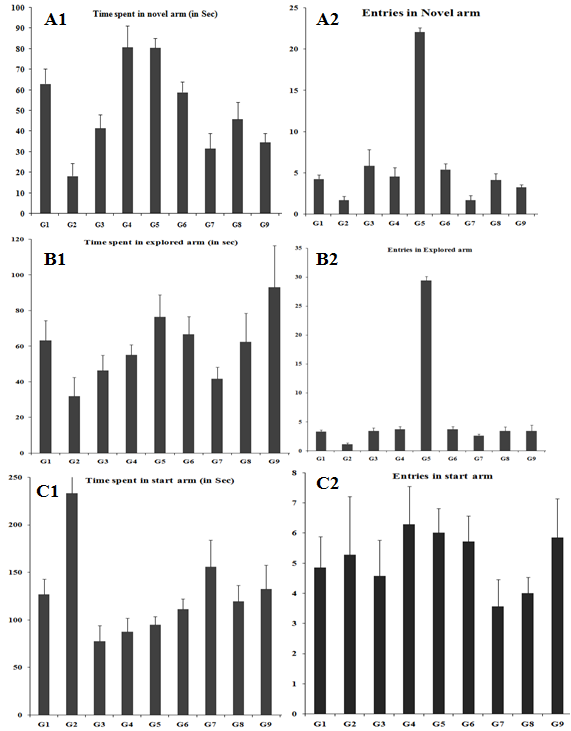
Figure 1: Effect of the test formulation for evaluation of impairment of spatial memory using a Y-maze test of Sprague Dawley rats. G: Group; G1: Normal control (0.5% CMC); G2: Disease control (VDD: Vitamin D3 deficient diet + 0.5% CMC); G3: Reference item (VDD + Calcitriol); G4: (VDD + untreated test formulation); G5: (VDD + Biofield Energy Treated test formulation); G6: (VDD + Biofield Energy Treatment per se to animals from day -15; G7: (VDD + Biofield Energy Treated test formulation from day -15); G8: (VDD + Biofield Energy Treatment per se plus Biofield Energy Treated test formulation from day -15), and G9: (VDD + Biofield Energy Treatment per se animals plus untreated test formulation). A1 and A2: Time and entries in Novel arms; B1 and B2: Time and entries in Explored arms; C1 and C2: Time and entries in Start arms. Values are presented as mean ± SEM (n=6).
The test results were represented in Figure 1 with respect to the different arms, number of time spent and number of entries by the animals. Start arm behavior represented the animals fed with vitamin D3 deficient diet (G2), showed significant increase time spent and number of entries in the start arm as 233.12 ± 17.90 and 5.29 ± 1.93, respectively; indicating cognitive impairment behavior as compared to the normal control (G1) (time spent 126.88 ± 16.24 seconds and number of entries 4.86 ± 1.03, respectively). However, other groups treated with the Biofield Energy Treated test formulation, reference compound, and different combinations of Biofield Energy Treatment per se and untreated test formulation to the Biofield Energy Treated groups showed decrease in time spent and number of entries in the start arm as compared to the G2 group. All the experimental test groups such as G5, G6, G7, and G8 showed reduction in start arm behavior as compared to the untreated test formulation (G2) group. Similarly, the explored arm behavior in G2 showed non-significant decrease in the time spent (seconds) in explored arm and number of entries in explored arm (32.08 ± 10.54, 1.14 ± 0.24, respectively) indicating cognitive impairment behavior as compared to normal control (G1) (63.31 ± 11.20, 3.29 ± 0.34, respectively). However, G4, G5, G6, and G9 groups showed significant increased in the time spent in explored arm and number of entries in explored arm except G7 and G8 as compared to the G2. However, G5, G6, G8, and G9 groups showed significant increase in the explored arm behavior as compared to the G4. Similarly, novel arm behavior in G2 group showed significant decrease in the time spent in novel arm and non-significant decrease in number of entries in novel arm (18.27 ± 6.16, 1.71 ± 0.44, respectively) indicating a cognitive impairment behavior as compared to the normal control (G1) (63.03 ± 7.20, 4.29 ± 0.49, respectively). However, G4, G5, and G6 showed significant increase in time spent in novel arm and number of entries in start arm except G7 and G8 as compared to the G2. Spontaneous alteration (%) of successive entry of animals in G2 group was 19.58 ± 7.87, which was significantly decreased by 70.56% as compared to the normal control (G1) which was 66.49 ± 19.78. Calcitriol treatment (G3) animals significantly increased the spontaneous alteration (%) of successive entry (43.11 ± 5.72) by 120.20% as compared to the G2, whereas treatment groups such as G5, G6, G7, G8 and G9 showed significant increased percentage values as compared to the G2. Effect of Behavior parameter using Weight Loaded Force Swim Test (WLFST) Weight Loaded Force Swim Test was used to study the time spent (seconds) for swimming of rats. This test is used to evaluate the behavioral analysis, neuroscience, neurobiology, mood disorder, depression, and many more behavioral activities [37]. The experiment was carried out in presence of Biofield Energy Treated Test Formulation and Biofield Energy Treatment per se, and the results are presented in Figure 2. Vitamin D3 deficient diet (G2) was reported with swim time, 67.0 ± 4.5, which was significantly (p≤0.001) decreased by 64.36% as compared to the normal control (G1, 188.0 ± 6.5). Calcitriol treatment (G3) showed significantly (p≤0.001) increased the time spent for swimming (124.9 ± 7.9) by 86.44% as compared to the G2. G4 group animals showed significantly increased the time spent for swimming (114.4 ± 7.4) by 70.85% as compared to the G2. However, G5, G6, G7, G8, and G9 groups were also reported with significant increased swimming spent time by 23.63%, 120.46% (p≤0.001), 58.19% (p≤0.001), 35.79%, and 29.79% respectively as compared with the G2. However, G6 group i.e. Biofield Energy Treatment per se to animals (preventive treatment approach) showed improved swimming spent time by 29.03% as compared with the untreated test group, G4. Overall, the data suggested that the Biofield Energy Treatment per se significantly improved the muscular strength and animal behavior of the animals in all the experimental groups along with the preventive treatment groups.
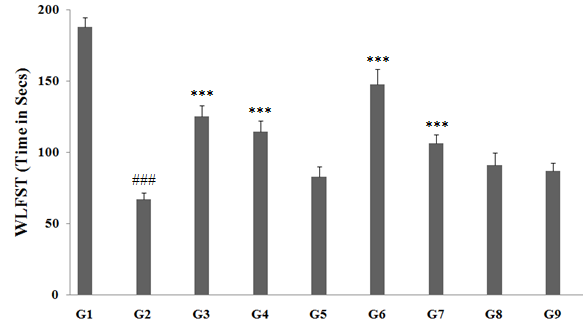
Figure 2: Effect of the test formulation for evaluation of Weight Loaded Force Swim Test (WLFST) of Sprague Dawley rats. G: Group; G1: Normal control (0.5% CMC); G2: Disease control (VDD: Vitamin D3 deficient diet + 0.5% CMC); G3: Reference item (VDD + Calcitriol); G4: (VDD + untreated test formulation); G5: (VDD + Biofield Energy Treated test formulation); G6: (VDD + Biofield Energy Treatment per se to animals from day -15; G7: (VDD + Biofield Energy Treated test formulation from day -15); G8: (VDD + Biofield Energy Treatment per se plus Biofield Energy Treated test formulation from day -15), and G9: (VDD + Biofield Energy Treatment per se animals plus untreated test formulation). ###p≤0.001 vs. G1 and ***p≤0.001 vs. G2.
Effect of Behavior parameter using Rotarod in Sprague Dawley Rats
Rotarod apparatus was used for the estimation of time spent (seconds) by rats after treatment. The rotarod test is one of the oldest and gold standard screening tests for estimation of the effects of the test formulation on animal behavior. It provides a rapid and simple first estimation, which reflects the effect on neuromuscular coordination [38]. The results in terms of time spent and rotation per minute was presented graphically in Figure 3. The experimental data suggested that vitamin D3 deficient diet (G2) animals groups reported time spent in seconds was 116.0 ± 8.0, which was by significantly (p≤0.05) decreased 27.7% as compared to normal control (G1, 160.4 ± 8.0). Calcitriol treatment (G3) significantly (p≤0.05) increased the time spent in the rotarod (178.6 ± 11.2) by 53.9% as compared to the G2. G4 group showed increased time spent in the rotarod (137.9 ± 7.4) by 18.9% as compared to the G2. G5, G6, G7, G8, and G9 groups were also reported with an increased swimming spent time by 7.9%, 16.2%, 11.8%, 25.1%, and 33.8% respectively, as compared with the G2. However, 15 days pre-treatment of Biofield Energy Treated test formulation to the Biofield Energy Treated rats (G8) and untreated test formulation to the Biofield Energy Treated rats (G9) (preventive treatment approach) showed increased the time spent in the rotarod by 5.3% and 12.5% respectively, as compared with the untreated test group, G4. Overall, the data suggested that the Biofield Energy Treatment per se significantly improved the neuromuscular coordination and animal behavior of the animals in all the experimental groups along with the preventive treatment groups.
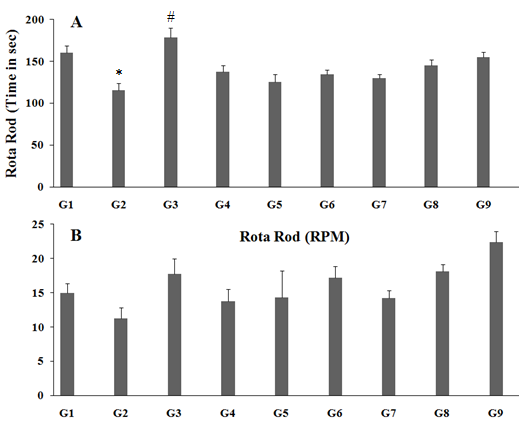
Figure 3: Effect of the test formulation for evaluation of behavioral parameter using rotarod in Sprague Dawley rats. A: Time spend in rotarod (in sec); B: Rotation per minute in rotarod; G: Group; G1: Normal control (0.5% CMC); G2: Disease control (VDD: Vitamin D3 deficient diet + 0.5% CMC); G3: Reference item (VDD + Calcitriol); G4: (VDD + untreated test formulation); G5: (VDD + Biofield Energy Treated test formulation); G6: (VDD + Biofield Energy Treatment per se to animals from day -15; G7: (VDD + Biofield Energy Treated test formulation from day -15); G8: (VDD + Biofield Energy Treatment per se plus Biofield Energy Treated test formulation from day -15), and G9: (VDD + Biofield Energy Treatment per se animals plus untreated test formulation). *p≤0.05 vs. G1 and #p≤0.05 vs. G2.
Effect of the Test Formulation on Locomotor Activity Using Actimeter
Actimeter was used for the estimation of total number of counts by rats after treatment [39]. The results in total number of counts in each groups was presented graphically in Figure 4. The data reported that total number of counts in infrared actimeter of rats fed with vitamin D3 deficient diet (G2) was 623.5 ± 59.0, which was significantly (p≤0.05) decreased by 33.6% as compared to the normal control (G1, 938.5 ± 83.4). Calcitriol treatment (G3) animals showed increased the total number of counts (755.0 ± 73.9) by 21.1% as compared to the G2. Other experimental groups such as G4, G5, G6, G7, G8, and G9 groups showed significant increased total number of counts by 24.72%, 40.82%, 42.80% (p≤0.01), 33.36%, 30.81%, and 19.73% respectively, as compared with the G2. However, G5, G6, G7, and G8 groups were reported with increased total number of counts in infrared actimeter by 12.91%, 14.50%, 6.93%, and 4.89% respectively, as compared with the untreated test formulation group, G4. Overall, the data suggested that the Biofield Energy Treatment per se significantly improved the locomotor activity of the animals in all the experimental groups along with the preventive treatment groups.
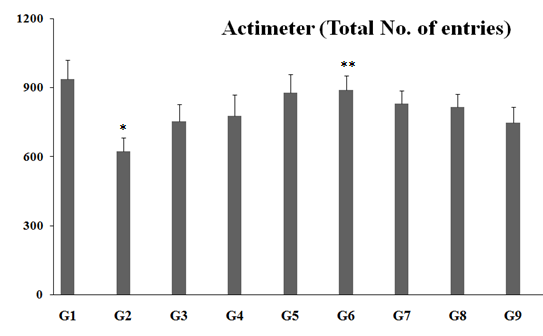
Figure 4: Effect of the test formulation for evaluation of locomotor activity using actimeter in Sprague Dawley rats. G: Group; G1: Normal control (0.5% CMC); G2: Disease control (VDD: Vitamin D3 deficient diet + 0.5% CMC); G3: Reference item (VDD + Calcitriol); G4: (VDD + untreated test formulation); G5: (VDD + Biofield Energy Treated test formulation); G6: (VDD + Biofield Energy Treatment per se to animals from day -15; G7: (VDD + Biofield Energy Treated test formulation from day -15); G8: (VDD + Biofield Energy Treatment per se plus Biofield Energy Treated test formulation from day -15), and G9: (VDD + Biofield Energy Treatment per se animals plus untreated test formulation). *p≤0.05 vs. G1 and **p≤0.05 vs. G2.
Effect of the Test formulation on the Measurement of Knee Joint Pain using Pressure Application Measurement (PAM) Technique
Pressure Application Measurement (PAM) was used for the estimation of knee joint pain in rats after treatment [40]. The results in terms of pressure application in terms of “gram force (GF)” in each groups was presented graphically in Figure 5. The data reported that joint hypersensitivity (gram force) of rats fed with vitamin D3 deficient diet (G2) was 580.6 ± 19.2 GF, which was significantly (p≤0.001) decreased by 31.1% as compared to normal control (G1, 842.2 ± 32.5 GF). Calcitriol treatment (G3) animals significantly (p≤0.05) increased the joint hypersensitivity (640.6 ± 16.4 GF) by 10.3% as compared to the G2. G4 groups showed increased the joint hypersensitivity (603.4 ± 21.7) by 3.9% as compared to the G2. However, G5, G6, G7, G8, and G9 groups showed an increased the joint hypersensitivity in terms of gram force by 10.01%, 13.33%, 9.17%, 5.55%, and 3.62%, respectively, as compared with the untreated test formulation, G4. Overall, the data suggested that the Biofield Energy Treatment per se significantly improved the knee joint pain comparatively in all the experimental groups along with the preventive treatment groups.
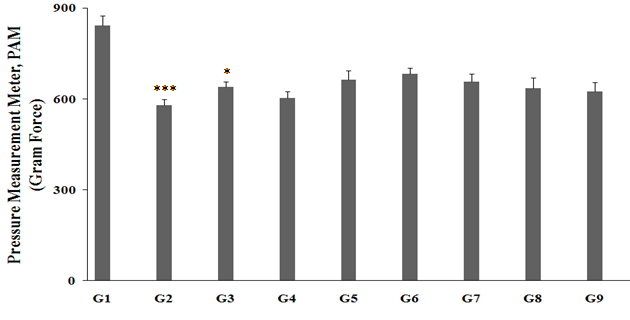
Figure 5: Effect of the test formulation for evaluation of knee joint pain measurement using pressure measurement meter (PAM) in terms of gram force in Sprague Dawley rats. G: Group; G1: Normal control (0.5% CMC); G2: Disease control (VDD: Vitamin D3 deficient diet + 0.5% CMC); G3: Reference item (VDD + Calcitriol); G4: (VDD + untreated test formulation); G5: (VDD + Biofield Energy Treated test formulation); G6: (VDD + Biofield Energy Treatment per se to animals from day -15; G7: (VDD + Biofield Energy Treated test formulation from day -15); G8: (VDD + Biofield Energy Treatment per se plus Biofield Energy Treated test formulation from day -15), and G9: (VDD + Biofield Energy Treatment per se animals plus untreated test formulation). *p≤0.05 vs. G2 and ***p≤0.001 vs. G1.
Thus, the present research plan defined four groups, which were considered as preventive maintenance groups viz. G6, G7, G8, and G9, where the Biofield Energy Treatment per se and/or Biofield Energy Treated Test formulation in combination was used as preventive maintenance group with respect to improved animal behavior in terms of locomotors activity, knee joint, and overall behavior with muscle coordination. Based on the overall data, it suggests that the Biofield Energy Healing Therapy was found to be most effective and benefited in order to prevent and protect from the occurrence of any type of bone-related diseases in rat model. It indicated that Biofield Energy Treatment can act as a preventive maintenance therapy to slowdown the disease progression and disease-related complications of the existing aliments that will ultimately improve the overall health and quality of life in human.
Conclusions
The present animal experimental study revealed the significance of Biofield Energy Treated test formulation and Biofield Energy per se on the animal behavior activity using various standard models in vitamin D3 deficient diet group compared with the other groups. The Y-maze test significantly revealed the improved behavioral parameters of animals with respect to the data of time in start arm, time in explored arm, time in novel arm, entries in start arm, entries in novel arm, entries in explored arm, and entries in centre. Start arm behavior showed reduction in start arm behavior in the test groups such as G5, G6, G7, and G8 groups as compared to G4, untreated test formulation, while G5, G6, G8, and G9 groups showed significant increase upto 70% in the explored arm behavior as compared to the G4. Similarly, an entry in central arm was improved upto 35% in the Biofield Energy Treatment per se groups as compared with the untreated test formulation G4 group. Thus, impairment of spatial memory was significantly improved in preventive treatment groups as compared with the normal groups. Weight loaded force swim test (WL-FST) data revealed that G5, G6, G7, G8, and G9 groups showed significant increased the “swimming time spent” by 23.63%, 120.46%, 58.19%, 35.79%, and 29.79%, respectively as compared with the G2 group. However, Biofield Energy Treatment per se to animals (preventive treatment approach, G6) showed improved swimming spent time by 29.03% as compared with the G4. Rotarod study showed an increased behavior (time spent) in the G6, G8, and G9 groups by 16.2%, 25.1%, and 33.8%, respectively as compared to the G2 group. Similarly, the locomotor activity was significantly improved in the G5, G6, G7, and G8 groups with increased total number of counts using infrared actimeter by 40.82%, 42.80%, 33.36%, and 30.81%, respectively, as compared with the G2. In addition, Knee Joint Pain Measurement study was performed which results in improved results in the G5 and G6 groups, which showed significant increased the joint hypersensitivity in terms of gram force by 10.01% and 13.33%, respectively, as compared with the G4 group. Overall, it can be concluded Biofield Energy Healing Treatment (the Trivedi Effect®) per se showed best results with respect to different behaviour parameters in the preventive treatment approach (-15 days) as compared to the other preventive maintenance groups (G7, G8, and G9) in rat model study. It also helped to slowdown the disease progression and disease-related complications of the overall animal’s health. The data suggested that Biofield Energy Treatment per se and/or Biofield Energy Treated Test formulation in combination would be the best treatment strategies in order to prevent and protect from the occurrence of any type of diseases. Therefore, the Biofield Energy Treatment might act as a preventive maintenance therapy in order to cure, or full restoration of health or improve the overall health and quality of life in human. This therapy might also reduce the severity of any type of acute/ chronic disease (auto-immune related and inflammatory disorders) progression rate and can be given in both before and after the manifestation of any disease symptoms in healthy, unhealthy, and ill peoples such as many thyroid disorders such hyperthyroidism, goiter, thyroid nodules, thyroid cancer, thyroid hormone resistance, Hashimoto’s thyroiditis, anaplastic thyroid cancer, hypothyroidism, De Quervain’s thyroiditis, medullary thyroid cancer, follicular thyroid cancer, papillary thyroid cancer, silent thyroiditis, Graves’ disease, thyroid cancer, Hurthle cell thyroid cancer, and thyroiditis. Overall, the data suggested the Biofield Energy Treated test formulation and Biofield Energy Treatment per se in showed significant action on thyroid gland with respect to biomarkers, as a Complementary and Alternative Medicine (CAM). This test formulation also can be used against fibromyalgia, Addison disease, multiple sclerosis, myasthenia gravis, aplastic anemia, psoriasis, rheumatoid arthritis, Crohn’s disease, vitiligo, chronic fatigue syndrome and alopecia areata, as well as various inflammatory disorders such as ulcerative colitis, dermatitis, hepatitis, diverticulitis, mental disorders, Parkinson’s and other movement disorders, stroke and transient ischemic attack (TIA), and in the improvement of overall health and quality of life.
Acknowledgements
The authors are grateful to Dabur Research Foundation, Trivedi Science, Trivedi Global, Inc., and Trivedi Master Wellness for the assistance and support during the work.
References
-
Wolf A, Bauer B, Abner EL, Anika M, Hartz S (2016) Comprehensive behavioral test battery to assess learning and memory in 129s6/ Tg2576 mice. PLoS ONE 11: 1-23.
-
Tanila H (2017) Testing cognitive functions in rodent disease models: Present pitfalls and future perspectives. Behav Brain Res 352: 23-27.
-
Dudchenko PA (2004) Overview of the tasks used to test working memory in rodents. Neurosci. Biobehav Rev 28(7): 699-709.
-
Garcia Y, Esquivel N (2018) Comparison of the Response of Male BALB/c and C57BL/6 Mice in Behavioral Tasks to Evaluate Cognitive Function. Behav Sci 8(1): 14.
-
Webster SJ, Bachstetter AD, Nelson PT (2014) Using mice to model Alzheimer’s dementia: An overview of the clinical disease and the preclinical behavioral changes in 10 mouse models. Front Genet 5: 1-23.
-
Can A, Dao DT, Arad M, Terrillion CE, Piantadosi SC, et al. (2012) The mouse forced swim test. J Vis Exp 59: e3638.
-
Deacon RM (2013) Measuring motor coordination in mice. J Vis Exp 75: e2609.
-
Tatem KS, Quinn JL, Phadke A, Yu Q, Gordish-Dressman H, et al. (2014) Behavioral and locomotor measurements using an open field activity monitoring system for skeletal muscle diseases. J Vis Exp 91: 51785.
-
Piel MJ, Kroin JS, Im HJ (2015) Assessment of knee joint pain in experimental rodent models of osteoarthritis. Methods Mol Biol 1226: 175-181.
-
Byrne JH, Voogt M, Turner KM, Eyles DW, McGrath JJ, et al. (2013) The impact of adult vitamin D deficiency on behaviour and brain function in male Sprague-Dawley rats. PLoS One 8(8): e71593.
-
Rayman MP (2000) The importance of selenium to human health. Lancet 356(9225): 233-241.
-
Beard JL, Connor JR (2003) Iron status and neural functioning. Ann Rev Nutr 23: 41-58.
-
Peres FF, Lima AC, Hallak JEC, Crippa JA, Silva RH, et al. (2018) Cannabidiol as a Promising Strategy to Treat and Prevent Movement Disorders? Front Pharmacol 9: 482.
-
Nagarkatti P, Pandey R, Rieder SA, Hegde VL, Nagarkatti M (2009) Cannabinoids as novel anti-inflammatory drugs. Future Med Chem 1(7): 1333-1349.
-
Kang S, Min H (2012) Ginseng, the ‘Immunity Boost’: The Effects of Panax ginseng on Immune System. J Ginseng Res 36(4): 354-368.
-
Maizes V, Rakel D, Niemiec C (2009) Integrative medicine and patient-centered care. Explore (NY) 5(5): 277-289.
-
Bischof M, Del Giudice E (2013) Communication and the emergence of collective behavior in living organisms: a quantum approach. Mol Biol Int 2013: 987549.
-
Cassidy CM (2004) What does it mean to practice an energy medicine? J Altern Complement Med 10(1): 79- 81.
-
Barnes PM, Bloom B, Nahin RL (2008) Complementary and alternative medicine use among adults and children: United States, 2007. Natl Health Stat Report 12: 1-23.
-
Fan K wai (2005) National Center for Complementary and Alternative Medicine Website. J Med Libr Assoc 93(3): 410-412.
-
Wisneski L, Anderson L (2009) The Scientific Basis of Integrative Medicine. Boca Raton, FL: CRC Press 205.
-
Trivedi MK, Tallapragada RM (2008) A transcendental to changing metal powder characteristics. Met Powder Rep 63(9): 22-28.
-
Trivedi MK, Nayak G, Patil S, Tallapragada RM, Latiyal O (2015) Studies of the atomic and crystalline characteristics of ceramic oxide nano powders after biofield treatment. IndEng Manage 4(3): 161.
-
Trivedi MK, Branton A, Trivedi D, Nayak G, Mondal SC, et al. (2015) Morphological characterization, quality, yield and DNA fingerprinting of biofield energy treated alphonso mango (Mangifera indica L.). Journal of Food and Nutrition Sciences 3(6): 245-250.
-
Trivedi MK, Branton A, Trivedi D, Nayak G, Charan S, et al. (2015) Phenotyping and 16S rDNA analysis after biofield treatment on Citrobacter braakii: A urinary pathogen. J Clin Med Genom 3: 129.
-
Trivedi MK, Patil S, Shettigar H, Mondal SC, Jana S (2015) Evaluation of biofield modality on viral load of Hepatitis B and C viruses. J Antivir Antiretrovir 7(3): 83-88.
-
Nayak G, Altekar N (2015) Effect of biofield treatment on plant growth and adaptation. J Environ Health Sci 1: 1-9.
-
Branton A, Jana S (2017) The influence of energy of consciousness healing treatment on low bioavailable resveratrol in male Sprague Dawley rats. International Journal of Clinical and Developmental Anatomy 3(3): 9-15.
-
Branton A, Jana S (2017) The use of novel and unique biofield energy healing treatment for the improvement of poorly bioavailable compound, berberine in male Sprague Dawley rats. American Journal of Clinical and Experimental Medicine 5(3): 138-144.
-
Kinney JP, Trivedi MK, Branton A, Trivedi D, Nayak G, et al. (2017) Overall skin health potential of the biofield energy healing based herbomineral formulation using various skin parameters. American Journal of Life Sciences 5(2): 65-74.
-
Singh J, Trivedi MK, Branton A, Trivedi D, Nayak G, et al. (2017) Consciousness energy healing treatment based herbomineral formulation: A safe and effective approach for skin health. American Journal of Pharmacology and Phytotherapy 2(1): 1-10.
-
Trivedi MK, Branton A, Trivedi D, Nayak G, Plikerd WD, et al. (2017) A systematic study of the biofield energy healing treatment on physicochemical, thermal, structural, and behavioral properties of magnesium gluconate. International Journal of Bioorganic Chemistry 2(3): 135-145.
-
Trivedi MK, Patil S, Shettigar H, Mondal SC, Jana S (2015) The potential impact of biofield treatment on human brain tumor cells: A time-lapse video microscopy. J Integr Oncol 4(3): 141.
-
Anagnos D, Trivedi K, Branton A, Trivedi D, Nayak G, et al. (2018) Influence of biofield treated vitamin D3 on proliferation, differentiation, and maturation of bone- related parameters in MG-63 cell-line. International Journal of Biomedical Engineering and Clinical Science 4(1): 6-14.
-
Lee AC, Trivedi K, Branton A, Trivedi D, Nayak G, et al. (2018) The potential benefits of biofield energy treated vitamin D3 on bone mineralization in human bone osteosarcoma cells (MG-63). International Journal of Nutrition and Food Sciences 7(1): 30-38.
-
Kraeuter AK, Guest PC, Sarnyai Z (2019) The Y-Maze for assessment of spatial working and reference memory in mice. Methods Mol Biol 1916: 105-111.
-
Can A, Dao DT, Arad M, Terrillion CE, Piantadosi SC, et al. (2012) The mouse forced swim test. J Vis Exp 59: e3638.
-
Deacon RM (2013) Measuring motor coordination in mice. J Vis Exp 75: e2609.
-
Lynch JJ, Castagné V, Moser PC, Mittelstadt SW (2011) Comparison of methods for the assessment of locomotor activity in rodent safety pharmacology studies. J Pharmacol Toxicol Methods 64(1): 74-80.
-
Barton NJ, Strickland IT, Bond SM, Brash HM, Bate ST, et al. (2007) Pressure application measurement (PAM): A novel behavioural technique for measuring hypersensitivity in a rat model of joint pain. J Neurosci Methods 163(1): 67-75.
- Occupational Stress and Mental Health Outcomes Among Police Officers: A Mini Review
- The Experience of Counterproductive Leadership on Mental Health and Impact on Retention in U.S. Marines: A Phenomenological Study
- Nomophobia in the Digital Age: A Study on College and University Students
- Emotional Regulation in Children with Autism and Learning Disabilities
- Antisemitism on American College Campuses and Its Impact on Jewish Students
- Exploring the Role of Empathy in the Associations of Family Functioning and Purpose in Life with Attitude towards Abortion among Undergraduates: A Moderation Analysis