
Psychology & Psychological Research International Journal
Research Article
1 min read
Interpersonal Conflict at Work. A Constructionist Approach to Complex Problems
* Corresponding author
Keywords
Conflict
Constructionism
Motivation
Narration
Frames
Perceived Interpersonal Conflicts Scale
Abstract
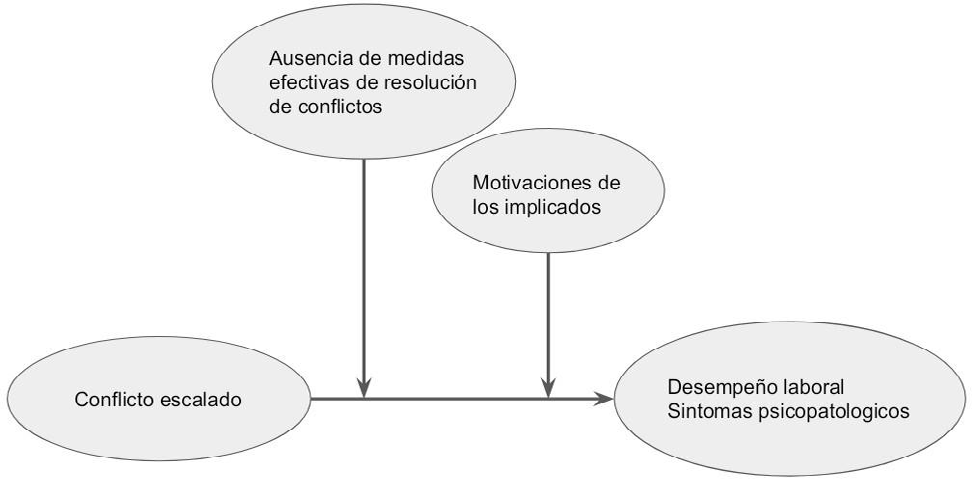
This article conceptually explores the possibility of addressing the complexity of interpersonal conflicts at work through a constructionist vision of them. It understands that the conflict is a situation in process in which the intervening performers have the possibility of modulating their behavior to escalate or de-escalate the conflict. And these behaviors are regulated by a series of contextual variables, the influence of the intervening subjects themselves and individual variables that guide and direct their behavior. To solve the need for understanding, a series of instruments are developed such as PICS (Perceived Interpersonal Conflicts Scale).
Figures
Click to enlarge
References
-
Munduate L, Medina F (2005) Conflict management, negotiation and mediation. Madrid: Piramide SA.
-
Sebastián ML, Chanquet Á, Almanzor FI (2020) Perceived Interpersonal Conflicts Scale (PICS). Scale for the evaluation of interpersonal conflicts in work situations. Notes of Psychology 37(3): 177-198.
-
Lakoff G (2004) Don’t Think of an Elephant! Know your values and frame the debate. White River Junction, Chelsea Green Publishing: Vermont, USA.
-
Cabruja T, Íñiguez L, Vázquez F (2000) How we build the world: relativism, spaces of relationship and narrativity. Analysis. Quaderns de Comunicació i Cultura 25: 61-94.
-
Sebastián ML (2014) Towards a constructionist perspective of Ergonomics: applications of the narrative in Ergonomics (prevention and design). Notes on Psychology 32 (3): 199-215.
-
Villarroya O (2019) We are what we tell ourselves. How stories build the world we live in. Barcelona: Ariel.
-
García Martínez J (2008) The conscience of the other: aggressors and victims from a constructivist perspective. Notes on Psychology 26 (2): 361-378.
-
Stover JB, Bruno FP, Uriel FE, Fernandez Liporace MM (2017) Self-Determination Theory: A Theoretical Review. Perspectives in Psychology 14 (2): 105-115.
-
Hayes AF (2017) Introduction to mediation, moderation, and conditional process analysis: A regression-based approach. Guilford publications.
-
Einarsen S, Johan Hauge L (2006) Background and consequences of mobbing at work: a literature review. Journal of Work and Organization Psychology 22(3): 251-273.
-
Sebastián ML, Jiménez R (2014) SATA 3.0. Conflict, harassment and violence in work environments. Seville: Official College of Psychology of Western Andalusia.
-
Gempp R, Chesta S (2007) Conditional Standard Errors of Measurement for the Metropolitan Norms of the Chilean Adaptation of the EPQ-R: Application of a Binomial Model to a Personality Test. Psychological Therapy 25(1): 51-62.
-
Montmollin M (1999) Introduction to Ergonomics. The Men-Machines systems. Mexico DF: Limusa.
← Previous Article
Correlation of Sleepiness with Risk of Traffic Accident in Sao Luis do Maranhao: Exposure Variables
Next Article →
The Impact of Attachment as an Actor of Resilience: In the Light
of the Comparative Analysis of Two Clinical Cases: A Chilean
Experience
More from this journal
- Occupational Stress and Mental Health Outcomes Among Police Officers: A Mini Review
- The Experience of Counterproductive Leadership on Mental Health and Impact on Retention in U.S. Marines: A Phenomenological Study
- Nomophobia in the Digital Age: A Study on College and University Students
- Emotional Regulation in Children with Autism and Learning Disabilities
- Antisemitism on American College Campuses and Its Impact on Jewish Students
- Exploring the Role of Empathy in the Associations of Family Functioning and Purpose in Life with Attitude towards Abortion among Undergraduates: A Moderation Analysis