
A Break in Motor Fluency Enhances Prospective Memory, Particularly for Older Adults
The discrepancy plus search mechanism is one of the explanatory mechanisms of the spontaneous recall of an action that one had to do. We have implemented this mechanism via a break in the motor simulations. Participants (young adults, middleage, older) showed images of objects that induced either a precision grip (i.e., grasping with two fingers) or a power grip (i.e., grasping with hall the hand). Two target images were choose, one inducing a precision grip (an egg cup) the other a power grip (a glass). It was telling to the participants to press a buzzer when these images appeared (the buzzer was in front or in the right of the participants). The presentation of these images was preceded either by two or three images inducing the same (no break in the simulations) or a different gesture (break in the simulations). Results show an effect of the main factors: age, break in the simulations, location of the buzzer. But, the interaction between location of the buzzer and break in the simulations is only present in the older. We discuss these results according to the surprise-attention hypothesis.
Introduction
Defined as the ability to remember to perform an action at a specific time in the future [1], prospective memory is considered the most useful dimension of memory because it is essential for managing and planning our daily activities [2, 3], such as thinking about taking medication. While prospective memory failures are most common in the daily life of any person [4], the elderly are particularly affected by these failures [5]. Indeed, one of the main characteristics of prospective memory tasks is that they require the subject to initiate the memory [6], and thus strongly solicit executive control processes that become increasingly complex to execute with aging [7]. Several theories have been put forward to account for prospective memory [8]: Preparatory Attentional and Memory Process; Multiprocess Theory; Delay Theory and it seems that two mechanisms could explain how spontaneous retrieval occurs: reflexive associative retrieval and discrepancy plus search.
The study we conducted is in line with the discrepancy plus search mechanism [9, 10, 11, 12]. The core idea is that, in a prospective memory task, individuals are confronted with both natural cues from the environment and cues associated with prospective memory. As the latter have been encoded with a view to future recall, they appear discrepant from the others and this discrepancy leads to a search for the cause: I must remember. This mechanism is supported by the SCAPE model which suggested that an inferential process hold a central place in the act of remembering [13, 14, 15]. Memory does not just depend on activation of past experiences, it emerges from the subjective evaluation of the quality of current processes regarding what is constructed (i.e., the mental model) and expected (i.e., the validity of previous mental models elaborated in similar situations). So, in a memory task, when a discrepancy is felt between what is expected and what is perceived, that leads unconsciously to a focus on the ongoing processes and to attribute the feeling felt to what is aware, the stimulus, which translates into a feeling of familiarity with it. This was particularly well highlighted in the works of Whittlesea and co-workers [16, 17, 18, 19] that propose the discrepancy attribution hypothesis, supported now by several studies [20, 21, 22, 23, 24].
Since the advent of the Embodied Cognition Theory [25], it is well established that when we see an object, or when we read a word, we simulate the action associated with, as we would do if we interact with in the real world [26, 27, 28, 29]. For example, seeing a “cherry” leads to a “precision grasp” with two fingers, since seeing an “eggplant” leads to a “power grasp” with the whole hand [30]. Moreover, it has been shown that action enhance memory, including in aging [31, 32, 33, 34] and it enacts our memories [35]. At last, it is now admitted that fluency, the ease with which a stimulus is processed, influences episodic memory judgement [36] and occurs at various levels, whether it be perceptual fluency [37], conceptual fluency [38] or motor fluency [39]. In addition, it appears in one hand, that individuals are sensitive to changes in processing fluency [40]; in other hand, that motor fluency discrepancy influences memory judgements [20].
In light of all these considerations, we hypothesized that a break in motor fluency should enhance prospective memory. To this end, we conducted an experiment that consisted in presenting to the participants (a group of young adults, a group of middle age and a group of older adults) images of objects, that had been verified in a pre-test, to induce either a precision grasp or a power grasp and that were easily identifiable and nameable. At the beginning of the experiment, two target images of objects were presented to participants, one corresponding to a precision grasp, an egg cup, and the other to a power grasp, a glass. The participants were told that when either image was presented, they should press the buzzer. For half of the participants the buzzer was placed in front of them, for the other half of the participants the buzzer was placed on their right. Indeed, classic studies [41], from aim- pointing tasks have already demonstrated that ipsilateral actions are carried out more easily and faster than contralateral actions (i.e., more fluently). The target images were preceded by either two or three images involving congruent grasping with the target image, or two or three images involving non-congruent grasping with the target image. For example, the image of the egg cup (precision grip) was preceded by the image of a plum, a strawberry and a radish (each image is associated with a precision grip) or the image of a zucchini, an eggplant, an orange (each image is associated with a power grip); the image of the glass (power grip) was preceded by the image of a book, a pencil case, a hammer (each image is associated with a power grip) or the image of a sugar, a thumbtack, a screw (each image is associated with a precision grip). The non-target images were counterbalanced between the target images.
We expected a main effect of age: the prospective memory performances will be higher for Young Adult than Middle-Age and for this one higher than Older. We expected that a break in motor simulation will induce better prospective memory performances than no-simulation break. At last, we expected that the location of the buzzer on the right will induce better prospective performances than the location of the buzzer in front. Moreover, we expected an interaction between the location of the buzzer and break. Particularly, we expected that the prospective memory performances to be optimal with a buzzer located on the right and with a break in motor simulation and to be lower with a buzzer located in front and with no-simulation break.
Method
Participants: To know the total sample size, we checked power analysis with G*Power software [42]. For: 6 independent groups, 2 dependent measurements, an effect size 0,25, a probability 0,05 and a power 0,80, G*Power indicates 60 participants. These 60 participants are divided into 3 groups: Group Young (20 participants, mean age: 22.8, SD: 3.8), Group Middle-age (20 participants, mean age: 52.2, SD: 4.9), Older (20 participants, mean age: 70.1, SD: 3.6). For each group, participants were randomly divided into two groups: buzzer in front, buzzer on right. All participants were native French speakers. Their vision was normal or corrected to normal. They were all right-hander. They gave their informed consent to take part in this experiment. Older had an MMSE score between 28 and 30. Material: 24 color images of objects, that had been verified in a pre-test, to induce either a precision grasp (mean percentage: 98.2%), 12 images: plum, strawberry, cherry, radish, egg cup, key, pen, eraser, pencil sharpener, bean, pea, sugar, pushpin, nail, screw) or a power grasp (mean percentage: 95.8%),12 images: hammer, trowel, screwdriver, apple, orange, pear, bell pepper, zucchini, eggplant, glass, book, bottle, pan, kit, racket). Each image was presented on a cardboard card (15cm x 15cm). Procedure Participants were received individually in a quiet room. They were seated facing the experimenter. They were asked to put their left hand on their thigh because they would only have to use their right hand to answer and to put their right hand on the edge of the table in front of them. For the “buzzer in front” group, the buzzer was located 20 cm from the edge of the table in the participant’s median axis. For the “buzzer on the right” group, the buzzer was placed 20cm from the edge of the table and 40cm from the participant’s median axis. The experimenter had in front of him the 56 cardboard cards containing the images. They were turned upside down so that the participants could not see the images and numbered to be able to note the answers. The experimenter recorded, with his left hand, on a sheet of paper the responses or non-responses of the participants (the numbers of the images were presented in a table) for the two target images. The target images (egg cup, glass) appeared 8 times each, either after 2 images or after 3 images (to avoid that the target image is anticipated). In total, participants saw 56 images. The non-target images were presented in random order for each occurrence of the target images and the target-non-target image sets were presented in random order across participants.
The instructions given to the participants were as follows: “We are going to present you with images one by one quickly (1 second per image). These pictures represent objects that can be grasped with two fingers or with a full hand (experimenter performed the gesture). For each image you will have to perform the corresponding gesture. When you will see the image of an “egg cup” or a “glass”, you must press the buzzer in front of you (on your right). Before we start, we’ll do a training session with 8 images that will not be part of the images you’ll see later. Are you ready?
After the experiment was completed, the MMSE was administered to the elderly participants [43].
Results
Statistics were carried out using JASP software [44, 45]. We performed a repeated measures ANOVA with the factors “group” and “buzzer” in inter- subjects and the factor “fluency” in intra-subject.
Statistical analysis show a main effect of the factor “group”, F(2, 54) = 81.48, p < .001, η²p = .75. Young-Adult perform better than the middle-age ones, t = 7.29, pholm < .001 and the older ones, t = 12.72, pholm < .001. Middle-age perform better than older, t = 5.42, pholm < .001. There is a main effect of the factor “buzzer”, F(1, 54) = 24.40, p < .001, η²p = .30. When the buzzer is on the right, performances are better than when it is in front. There is also a main effect of the factor “break”, F(1, 54) = 27.87, p < .001, η²p = .33. After a break in simulation, performances are better than when there is no-fluency break. The interaction between fluency and group is significant, F(2,54) = 3.90, p < .05, η²p = .12. The decomposition of the interaction show that all comparisons are significant except for Young Adult between break and no- Break, t = .85, pholm = .79, and between Middle-Age for no- fluency break and Older for fluency break, t = 0.43, pholm = .79. So, in one hand, Young Adult are not sensible to a break in simulations; on the other hand, when there is a break in simulations Older perform as well as Middle-Age when there is no- break in simulations. The interaction between buzzer and simulations is also significant, F(2,54) = 4.35, p < .05, η²p = .07. The decomposition of the interaction show that all comparisons are significant except for the location front between break and no-break, t = 2.20, pholm = .09, and between the location front with break and the location right with no-break, t = 0.35, pholm = .72. So, in one hand, for the location front, simulations do not influence performance; in other hand, when there is a break in simulations with a location in front, performances are similar to those with no- break in simulations and for a location right. However, the interaction between group and buzzer is not significant, F(2,54) = 0.04, p = .95, η²p = .002; as well as the double interaction Group*Buzzer*Fluency, F(2, 54) = .46, p = .62, η²p= .01. As this double interaction is not significant we analyzed the results for each group separately.
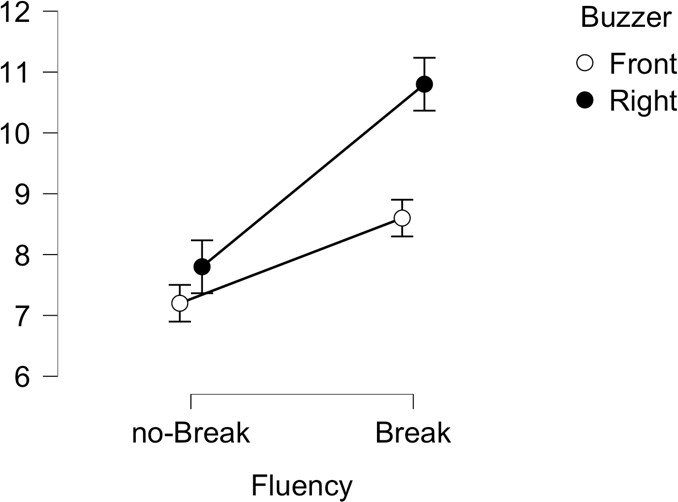
Group Young-Adult: Statistical analysis show a main effect of the factor “buzzer”, F(1,18) = 5.18, p < .05, η²p = .22. Young- Adults perform better when the buzzer is on the right than on the front. There is no main effect of the factor simulations, F(1,18) = .57, p = .45, η²p =.03. Young-Adults perform as well when there is a break in simulations than no-break in simulations. The interaction between these two factors is not significant, F(1,18) = .14, p = .78, η²p = .003.
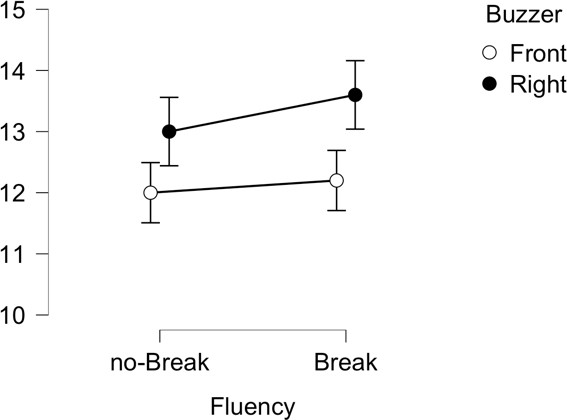
Group Middle-Age: Statistical analysis show a main effect of the factor “buzzer”, F(1,18) = 12.57, p < .005, η²p = .42. Middle-Age performs better when the buzzer is on the right than on the front. There is a main effect of the factor simulations, F(1,18) = 11.76, p < .005, η²p= .39. Middle-Age performs better when there is a break in simulations than no-break. The interaction between these two factors is not significant, F(1,18) = 1.99, p = .17, η²p = .10.
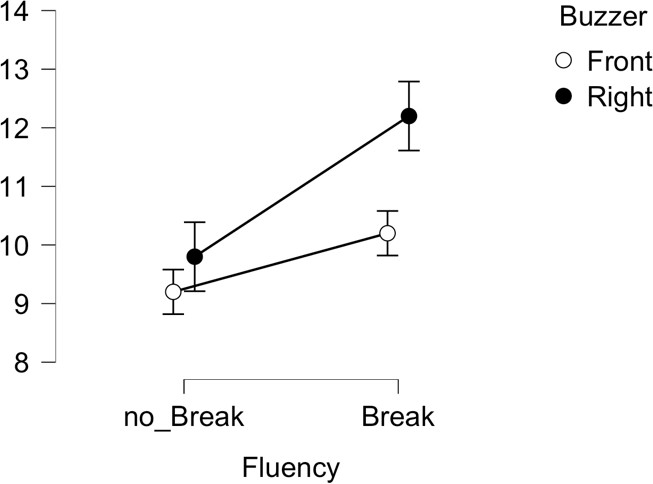
Group Older: Statistical analysis show a main effect of the factor “buzzer”, F(1,18) = 9.28, p < .005, η²p = .34. Older perform better when the buzzer is on the right than on the front. There is a main effect of the factor simulations, F(1,18) = 34.57, p < .001, η²p = .65. Older perform better when there is a break in simulations than no-break. The interaction between these two factors is significant, F(1,18) = 4.57, p < .05, η²p = .20. The decomposition of the interaction shows that when there is no-break in simulations, there is no difference between the locations of the buzzer (front or right), t = 1.01, pholm = .37. But when there is a break in simulations Older perform better when the buzzer is located on the right than on the front, t = 3.71, pholm < .005. Whatever the location of the buzzer, on the front or on the right, Older perform better after a break in simulations than no-break, respectively: t = 2.64, pholm < .05; t = 5.66, pholm < .001.
Discussion
In the field of prospective memory, several mechanisms have been proposed to explain how people can remember that they have to remember what to do. In other words, how the recovery of an event occurs at a specific time while my attention is not focused on that event. For example, I am writing the discussion of this article and suddenly I remember that I have to pick up my wife at the station!
In this work we focused on the discrepancy plus search mechanism [9]. The core idea is that, in a prospective memory task, individuals are confronted with several cues, among which prospective cues. As these ones have been encoded with a specific goal they appear discrepant for the other ones. When this discrepancy is perceived, participants search it’s cause and remember that they have to remember what to do.
According to embodied cognition and particularly to the simulation process (i.e., when we see an object we simulate the action associated), we have hypothesis that a break in motor simulation should enhance prospective memory. In our experiment, participants showed images of objects that induced either a precision grip (i.e., grasping with two fingers) or a power grip (i.e., grasping with hall the hand). Two target images were choosing, one inducing a precision grip (an egg cup) the other a power grip (a glass). It was telling to the participants to press a buzzer when these images appeared (the buzzer was in front or in the right). The presentation of these images was preceded either by two or three images inducing the same or a different gesture. We predicted that participants will better remember to press the buzzer when the target images are not preceded by images inducing a different gesture from them (i.e., a felt of motor discrepancy). We also predicted that participants will better remember to press the buzzer when its location requested a gesture on the right than on the front (i.e., motor fluency). Moreover, we expected that the combination of the two factors should result in better recall of having to press. At last, we expected a main effect of age: the prospective memory performances will be higher for Young Adult than Middle-Age and for this one higher than Older.
Results are in line of our predictions for the main effects: a) young adult perform better than middle-age who perform better than older, b) location of the buzzer on the right induce better performances than location in front), c) break in simulation induces better performance than no-break. But, results highlighted an interaction between location of the buzzer and break in simulation only for older.
The findings of this experiment are interesting for three reasons. First, they support the explanation of the recovery of an action in prospective memory in terms of discrepancy plus search mechanism, but using a discrepancy in motor fluency (break in simulation). Secondly, while supporting work showing that performing an action in one’s ipsilateral space is easier than in another space, it shows that prospective memory performance is not independent of the motor fluency associated with the response space. Finally, it highlights the importance of attention for older in prospective memory tasks. In this regard, it should be reminding that is well established that age-related declines in attentional abilities put older adults in failures in prospective memory tasks [46]. We consider that the procedure we have used enhances attention via the rupture of motor fluency associated to the simulations. Indeed, according to the surprise–attention hypothesis it is predicted that discrepancy detection focuses attention with the surprise stimulus [47]. Moreover, if the surprise associated to the stimulus is brought by a range of pre-attentive feature, as be seen here, attention is automatically guided toward the surprising stimulus. But, our results show that if surprise draws attention to the analysis of the surprise event, this one is related to the action associated to the surprising event that activates automatically the action to be performed (pressing the buzzer) as illustrated by the effect of the ipsilateral space on performance.
In conclusion, we believe that it is through a break in motor fluency that the ability to remember to do something should be maintained. In this respect, putting your watch on an unusual wrist allows you to remember in the morning that you have to do something (visual fluency break)!
References
-
Brandimonte MA, Einstein GO, McDaniel MA (Eds.), (1996) Prospective memory: Theory and applications. New York, Laurence Erlbaum.
-
Meacham JA (1982) A note on remembering to execute planned actions. Journal of Applied Developmental Psychology 3(2): 121-133.
-
Morris PE (1992) Prospective memory: Remembering to do things. In: Gruneberg J, Morris P (Eds.), Aspects of Memory, Londres, Routledge, 196-222.
-
Kliegel M, Martin M (2003) Prospective memory research: Why is it relevant?. International journal of psychology 38(4): 193-194.
-
Kliegel M, Ballhausen N, Hering A, Ihle A, Schnitzspahn KM, et al. (2016) Prospective memory in older adults: Where we are now and what is next. Gerontology 62(4): 459-466.
-
Craik FI (1986) A functional account of age differences in memory. In: Klix F, Hagendorf H (Eds.), Human memory and cognitive capabilities: Mechanisms and performances, Amsterdam, Elsevier, 409-422.
-
Azzopardi B (2013) Aging of prospective memory: underlying cognitive mechanisms and possibilities for cognitive intervention. Doctoral dissertation, Rennes 2 University.
-
Anderson FT, McDaniel MA, Einstein GO (2017) Remembering to remember: An examination of the cognitive processes underlying prospective memory. Learning and memory: A comprehensive reference, Elsevier 2: 451-463.
-
McDaniel MA, Guynn MJ, Einstein GO, Breneiser JE (2004) Cue focused and automatic-associative processes in prospective memory. Journal of Experimental Psychology: Learning, Memory, and Cognition 30: 605- 614.
-
Breneiser J, McDaniel MA (2006) Discrepancy processes in prospective memory retrieval. Psychonomic Bulletin & Review 13: 837-841.
-
Hae Lee J, McDaniel MA (2013) Discrepancy-plus-search processes in prospective memory retrieval. Memory & cognition 41(3): 443-451.
-
Rummel J, Meiser T (2016) Spontaneous prospective- memory processing: Unexpected fluency experiences trigger erroneous intention executions. Memory & cognition 44(1): 89-103.
-
Whittlesea BWA (1997) Production, evaluation, and preservation of experiences: Constructive processing in remembering and performance tasks. In: Medin DL (Ed.), The psychology of learning and motivation: Advances in research and theory, Academic Press 37: 211-264.
-
Whittlesea BW (2002) Two routes to remembering (and another to remembering not). Journal of Experimental Psychology: General 131(3): 325.
-
Whittlesea BW (2004) The perception of integrality: remembering through the validation of expectation. Journal of Experimental Psychology: Learning, Memory, and Cognition 30(4): 891.
-
Whittlesea BW, Williams LD (1998) Why do strangers feel familiar, but friends don’t? A discrepancy-attribution account of feelings of familiarity. Acta psychologica 98(2- 3): 141-165.
-
Whittlesea BW, Williams LD (2000) The source of feelings of familiarity: the discrepancy-attribution hypothesis. Journal of Experimental Psychology: Learning, Memory, and Cognition 26(3): 547-565.
-
Whittlesea BW, Williams LD (2001a) The discrepancy- attribution hypothesis: I. The heuristic basis of feelings and familiarity. Journal of Experimental Psychology: Learning, Memory, and Cognition 27(1): 3.
-
Whittlesea BW, Williams LD (2001b) The discrepancy- attribution hypothesis: II. Expectation, uncertainty, surprise, and feelings of familiarity. Journal of Experimental Psychology: Learning, Memory, and Cognition 27(1): 14-33.
-
Brouillet D, Milhau A, Brouillet T, Servajean P (2017) Effect of an unrelated fluent action on word recognition: A case of motor discrepancy. Psychonomic bulletin & review 24(3): 894-900.
-
Goldinger SD, Hansen WA (2005) Remembering by the seat of your pants. Psychological Science 16(7): 525-529.
-
Hansen J, Wänke M (2013) Fluency in context: Discrepancy makes processing experiences informative. In: Unkelbach C, Greifender R (Eds.), The experience of thinking: How the fluency of mental processes influences cognition and behaviour Psychology Press, pp: 70-84.
-
Thomas M, Lindsey C, Lakshmanan A (2010) “Why Does Familiarity Affect Distance Judgments? the Discrepancy Attribution Hypothesis. In: Campbell C, et al. (Eds.), Advances in Consumer Research Duluth, MN: Association for Consumer Research” 37: 227-231.
-
Wilbert J, Haider H (2012) The subjective experience of committed errors and the Discrepancy-Attribution hypothesis. Acta Psychologica 139(2): 370-381.
-
Varela FJ, Thompson E, and Rosch E (1991) The embodied mind: Cognitive science and human experience. Cambridge, MA: MIT Press.
-
Borghi AM, Pecher D (2011) Introduction to the special topic embodied and grounded cognition. Frontiers in Psychology 2: 187.
-
Pecher D, Zwaan RA (2005) Grounding cognition: The role of perception and action in memory, language, and thinking. Cambridge University Press.
-
Versace R, Brouillet D, Vallet G (2018) Embodied cognition: A situated and projected cognition. Bruxelles, Mardaga.
-
Barsalou LW (2020) Challenges and opportunities for grounding cognition. Journal of Cognition, 3(1): 1-24.
-
Tucker M, Ellis R (2001) The potentiation of grasp types during visual object categorization. Visual cognition 8(6): 769-800.
-
Engelkamp J (1998) Memory for actions. London, Psychology Press/Taylor & Francis.
-
Reifegerste J, Meyer AS, Zwitserlood P, Ullman MT (2021) Aging affects steaks more than knives: Evidence that the processing of words related to motor skills is relatively spared in aging. Brain and Language 218: 104941.
-
Vallet GT (2015) Embodied cognition of aging. Frontiers in psychology 6: 463.
-
Zimmer HD, Cohen RL, Guynn MJ, Engelkamp J, Kormi- Nouri R, et al. (2001) Memory for action: A distinct form of episodic memory?. New York: Oxford University Press.
-
Brouillet D (2020) Enactive Memory. Frontiers in Psychology 11:114.
-
Jacoby LL, Kelley CM, Dywan J (1989) Memory attributions. In: Roediger HL, Craik FIM (Eds.), Varieties of memory and consciousness: Essays in honour of Endel Tulving, New York, Laurence Erlbaum, 391-422.
-
Jacoby LL, Dallas M (1981) On the relationship between autobiographical memory and perceptual learning. Journal of Experimental Psychology: General 110(3): 306-340.
-
Whittlesea BWA (1993) Illusions of familiariy. Journal of Experimental Psychology: Learning, Memory, and Cognition 19: 1235-1253.
-
Yang SJ, Gallo DA, Beilock SL (2009) Embodied memory judgments: A case of motor fluency. Journal of Experimental Psychology: Learning, Memory, and Cognition 35 (5): 1359-1365.
-
Regenberg NF, Häfner M, Semin GR (2012) The groove move. Experimental psychology 59: 30-37.
-
Fisk JD, Goodale MA (1985) The organization of eye and limb movements during unrestricted reaching to targets in contralateral and ipsilateral visual space. Experimental brain research 60(1), 159-178.
-
Faul F, Erdfelder E, Lang AG, Buchner A (2007) G* Power 3: A flexible statistical power analysis program for the social, behavioral, and biomedical sciences. Behavior research methods 39(2): 175-191.
-
Kalafat M, Hugonot-Diener L, Poitrenaud J (2003) French standardization and calibration of the “Mini Mental State” (MMS) GRECO version. Neuro psychology journal 13(2): 209-236.
-
Wagenmakers EJ, Love J, Marsman M, Jamil T, Ly A, et al. (2018a) Bayesian inference for psychology. Part II : Example applications with JASP. Psychonomic Bulletin and Review 25(1): 58-76.
-
Wagenmakers EJ, Marsman M, Jamil T, Ly A, Verhagen J, et al. (2018b) Bayesian inference for psychology. Part I: Theoretical advantages and practical ramifications. Psychonomic Bulletin and Review 25(1): 35-57.
-
Ball H, Vogel A, Brewer GA (2019) Individual differences in prospective memory. In: Rummel BJ and McDaniel MA, Prospective Memory, London, Routledge, 116-134.
-
Horstmann G (2015) The surprise–attention link: a review. Annals of the New York Academy of Sciences 1339(1): 106-115.
- Occupational Stress and Mental Health Outcomes Among Police Officers: A Mini Review
- The Experience of Counterproductive Leadership on Mental Health and Impact on Retention in U.S. Marines: A Phenomenological Study
- Nomophobia in the Digital Age: A Study on College and University Students
- Emotional Regulation in Children with Autism and Learning Disabilities
- Antisemitism on American College Campuses and Its Impact on Jewish Students
- Exploring the Role of Empathy in the Associations of Family Functioning and Purpose in Life with Attitude towards Abortion among Undergraduates: A Moderation Analysis