
Gender Inequality, Career Success and the ‘Quality’ of Organizational Policies
The results of a study aimed at finding a relationship between manifestations of gender inequality and the resources available for development in the workplace and with women’s career success are described. А socio-psychological model of success factors of working women was developed, which includes both organizational context and personal career resources. The study was conducted in two stages in 2020-2021 using an online survey. The sample consisted of women working in organizations in various fields. At the first stage, the relationship between particular constructs of the model was tested; at the second stage, the theoretical-empirical model and its alternatives were tested by the structural equation modeling (SEM). The results of the study confirm the relationship of women’s career success with the availability of organization resources, with the possibility of implementing networking behavior and the perceptions of organizational politics, the negative relationship with structural and normative gender inequality is less pronounced. The results of testing the socio-psychological model and alternatives using the structural equation modeling method show that gender inequality has a negative effect on a woman’s career success, but the main contribution to the limitation of a woman’s career resources and a decrease in career success is made by nontransparent organizational politics.
Introduction
The popularity of gender studies in the organizational context persists today due to the persistence of gender inequalities in organizations and society. However, the nature of this inequality, and the circumstances of it, have changed [1]. This persistence of gender inequality, its persistence Conceptual Paper despite changes in organizational contexts and policies, has been called the phenomenon of “stunted progress” [2], exemplified by the persistence of status and income inequalities, with a significant increase in the proportion of working women participating in the economy [3, 4]. The discovery of the phenomenon of “stunted progress” points to the importance of socio-psychological mechanisms in the reproduction of gender inequality. Numerous studies show [5, 6] that women can form the career capital necessary for professional success; women are actively searching for and analyzing social and professional strategies that help them realize themselves. The purpose of this study is to determine the relationship of gender inequalities with career success of women; to develop and test a socio-psychological model of career success factors of working women. The research draws on the methodological approach of “gendered organization” [7], which views organizations as “gender factories” or “regimes of inequality” that are made up of many processes that allow relationships to be constructed on the basis of gender or race. The review article [8] shows that most work in the field of career success factors research is based on a multidimensional approach, where multilevel factors are included in the analysis as rank-and-file independent variables. In the study of women’s careers, studies with this design also dominate [9]. Within this approach, a variety of factors are studied, including human capital [10]; extra work social status and roles: family and parental status [11]; personal characteristics [12]; attitudes towards career, active position or cognitive constraints [13, 14]; characteristics of the social and working environment of the organization, the interaction of individual characteristics with them, the gender mode of the organization [15], career resources [16, 17, 18]. The authors of the review note the shortage of studies that would set out not only to discover the links of factors with success, but also to determine the modelling relationships of variables and mediating variables. The problem of studying the mechanisms of the impact of gender inequality on the career success of working women is relevant. Let us consider in more detail how gender inequality is related to career success and what mechanisms may be responsible for this relationship.
Gender Inequality, Career Success and the ‘Quality’ of Organizational Policies
There are different ways and mechanisms through which gender inequality manifests itself in the organization: through informal norms and shared perceptions, as well as through structural barriers [18]. Structural gender barriers manifest themselves as gender asymmetries in the organization as a whole and in individual status positions, and are denoted by metaphors of “glass” phenomena [19]. A number of studies show a negative association of women’s career success with perceived gender inequalities [15, 20]. In turn, according to a meta-analytic study, perceived gender discrimination in organizations is negatively related to the opacity of organizational policies [15]. Political behavior in organizations can be seen as attempts of social influence directed towards those who can provide opportunities to promote and protect the subject’s personal interests [21]. Two kinds of uncertainty contribute to the emergence of political behavior in the organization: 1) Situational uncertainty, which is related to how employees should behave in a given situation and which manifests itself in a lack of norms, guidelines and rules, allowing employees to act as they see fit, often in selfish interests. 2) Informational uncertainty, related to the uncertainty of both the decision-making situation and the acute lack of information, which increases the probability that decisions will be taken or perceived as access to resources and formal authority in an organization makes a significant contribution to career success [22], and limited resources and the need to compete for the positions and statuses in the firm that give access to them produce this kind of political behavior in virtually every organization [23]. It can be assumed that a lack of transparency in organizational policies and informal practices of resource allocation create conditions in the organization that facilitate all forms of discrimination, including gender inequality. Based on this research position, the following hypotheses were formulated: Hypothesis 1: Implemented organizational policies are positively related to perceived gender inequalities in the organization. Hypothesis 2: Perceived organizational policies are negatively related to career success.
Gender Inequality, Career Success and Access to Organizational Resources
A number of studies have shown that gender discrimination affects women’s career resources: for example. a 2016 study [24] shows that gender discrimination is negatively related to organizational work resources, with male predominance (which may be a sign of structural gender barriers) and in the organization, with gender balance. Career success is related to the availability of resources such as individual fit with organizational culture, psychological safety, developmental mentoring, and accessibility to promotion [25]. The results of a cross-sectional study conducted in 2017 on a sample of employees in a number of hospitals in China, using structural modelling, showed that employees’ perceptions of structural empowerment in the organization, that is, opportunities for growth and achievement of work goals provided by the professional environment, were positively related to career success, with innovative behavior being the mediator of this relationship [22]. Another study on a sample of hospitality industry employees showed a link between job satisfaction and opportunities to influence decisions, realize one’s potential and express one’s opinion in the organization [26]. Lack of access to organizational resources reduces employees’ career success [27, 28, 29, 30]. Thus, it can be assumed that gender inequalities in norms and organizational structure affect the resources provided by the organization to female employees, resulting in lower job satisfaction and subjective career success. Based on this research position, the following hypotheses were formulated: Hypothesis 3: The availability of resources and opportunities provided by the organization to the employee is positively related to the career success of women. Hypothesis 4: Normative and structural gender inequalities in the organization are negatively related to the availability of organizational resources.
Socio-Psychological Model of Career Success Factors for Women
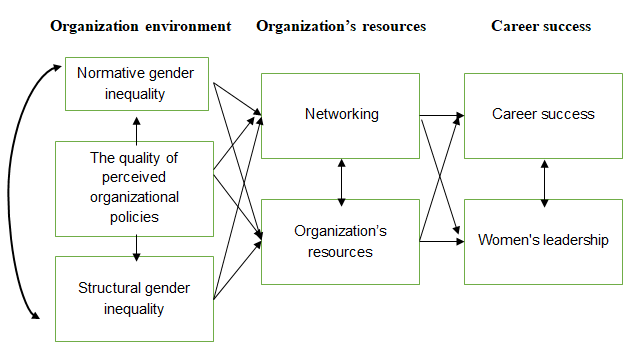
Given the links of career success with various constructs identified in empirical studies, we propose the following socio-psychological model of career success factors for women (Figure 1). The model includes three blocks:
- Organizational environment: gender inequality in the organization, manifested at the normative and structural levels, and perceived organizational policies
- Career resources: availability of organizational resources and the opportunity to implement networking behavior.
- Career success, including commitment to a proactive strategy and subjective career success.
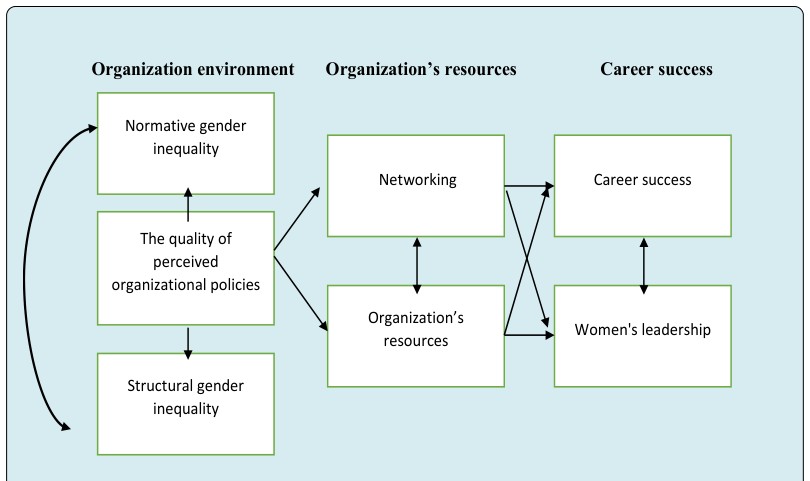
The hypothesized socio-psychological model aims to answer the question of how gender inequality in an organization relates to the career success of a woman who works there. Other success factors are beyond the scope of the model, as it is not the objective of the study to capture and compare the contribution of all relevant factors to a woman’s subjective success. The hypothesized model is based on the fact that organizations that form complex environments for women’s development are collectives that lack transparent and formalized power and resource allocation policies. It is this environment that can facilitate the manifestation of gender inequalities, both in the form of gender discrimination in norms, rules and procedures for treating the employee, and in the form of ‘glass ceiling’ phenomena that make it difficult for women to advance within the organization. Once an organization starts to respond to gender, seeing it as a characteristic linked to the employee’s performance and perspective, a specific gender mode emerges, which manifests itself in different availability of resources needed to build a successful career, in different availability of networking resources [31]. All these factors influence women’s choice of compensatory career strategies and the corresponding level of subjective career success. The construction of the socio-psychological model raises the question of the role of gender inequality in the formation of women’s career resources and its relationship with the quality of organizational policies [32, 33, 34, 35]. To answer this question, alternative models can be built, differing in complexity and structure of the links between the block “organizational environment” and the block “career resources”. The second model (Figure 2) was constructed by excluding the links of gender inequality components to career resources and networking opportunities, its testing and comparison with the first model allows to answer the question of whether gender inequality is a significant factor influencing the formative career resources or whether it contributes, rather through a link to the quality of organizational policies [36, 37, 38, 39, 40].
The study was conducted in two stages: in the first stage, a correlation analysis of the relationships of the individual components of the model was carried out, and private regularities were tested in accordance with the hypotheses. In the second stage, a confirmatory cross-sectional analysis of women’s career success factors was conducted in order to test the constructed model and its alternatives by structural modelling (SEM).
Sample
In the first phase, the sample was formed by the snowball method with the participation of 10 assemblers. The sample of the first study (2020): 206 women aged between 19 and 62 (median age 35). In the second phase (autumn-winter 2021), the required number of female respondents was added to the 2020 sample; data was collected, including through mass recruitment services, rather than only through collectors as in the first phase. A total of 575 women took part in the 2021 study. aged between 19 and 82 (median age 35). Employees from different organizations were invited to participate in the study according to the principle: one organization - one respondent. In order to verify the constructed model of career success factors for women by structural modelling, a pooled sample was formed: 2020 and 2021, resulting in the responses of 781 female respondents. Those respondents who were under 18 years old (4 observations), those respondents who answered the research questions “not relevant / not interesting at all” (8 observations), as well as those respondents who spent less than 25 minutes on the survey were excluded from the data set. The final analysis included 756 observations.
To measure the constructs proposed in the model, methods were used:
To measure the constructs proposed in the model, methods were used: 1. Russian-language modified version of the Perceptions of Political Behavior in Organizations questionnaire (The Perceptions of Politics Scale, POPS) proposed by Kakmar and Ferris [41], authors of the modification L.V. Mararitsa, T.V. Kazantseva, E.M. Aleksandrova, S.D. Gurieva [42] which was used to assess the quality of perceived organizational policies. For the Russian- language version, one point was added to the shortest scale to increase its reliability. For the Russian version, the structure of the questionnaire was confirmed, and the reliability index (Cronbach’s alpha) for the questionnaire as a whole was 0.94 for the scales included in it: “General Political Behavior” (4 items) - 0.83; “Pay and Promotion Policy” (5 items) - 0.80 and “Pragmatic Agreeableness” (7 items) - 0.93. 2. The scale of norms supporting gender inequality (authors S.D. Gurieva, L.V. Mararitsa [42]) was used to assess the normative level of gender inequality. The reliability of the scale (Cronbach’s alpha) was 0.76. 3. Methodology for assessing structural gender barriers in the organization (authors S.D. Gurieva, T.V. Kazantseva, L.V. Mararitza, O.E. Gundelakh [42]) was used to assess the structural component of gender inequality, the perception of gender barriers in the organization - “glass” phenomena. The methodology showed good agreement on Cronbach’s Alpha coefficient of 0.95 as a whole and on subscales: “Glass ceiling” - 0.85; “Sticky floor” - 0.90; “Glass walls” - 0.74; “Glass escalator” - 0.75; “Glass cliff” - 0.77 and “Glass box” - 0.83. The questionnaire has been shown to reproduce a given factor structure. 4. Questionnaire “Resources of career development in the organisation” (by L.V. Mararitsa, T.V. Kazantseva, S.D. Gurieva [42]). The questionnaire is based on the model of perceived intraorganizational facilitators and barriers to career advancement proposed by C. Lyness and D. Thompson [43]. The technique showed good agreement by Cronbach’s alpha coefficient - 0.92, reliability of subscales was (Cronbach’s alpha): “Fit with organizational culture” - 0.77; “Psychological safety” - 0.82; “Developing mentorship” - 0.82; “Accessibility of promotion” - 0.79. The factor structure of the questionnaire was confirmed. 5. “Subjective Career Success Inventory” - translation of the method “Subjective Career Success Inventory (SCSI)” by K. Shockley [44], authors of the Russian version L.V. Mararitsa, T.V. Kazantseva, E.M. Aleksandrova, S.D. Gurieva [42]. The reliability of the methodology according to Cronbach’s alpha coefficient was 0.93. Reliability of the subscales: “Public recognition” - 0.61; “Quality work” - 0.73; “Meaningful work” - 0.82; “Authority” - 0.70; “Identity with work” - 0.78; “Personal life” - 0.61; “Encouragement” - 0.88. The “Personal Life” subscale was not only insufficiently consistent, but also related to the resulting scale at the mean-weak level of r=0.32, which was the basis for its exclusion. The methodology reproduces the given factor structure. 6. Networking Behaviour Scale, Russian-language version by L.V. Mararitsa [45] based on the J. Ferris et al. [46]). The stated consistency of the scale by Cronbach’s alpha coefficient is 0.83.
Procedure
The study was conducted online and the survey form was generated using the Online Test Pad service. The survey was anonymous and approved by the Ethics Committee. The methodologies were presented in the following order: first, questions about gender inequalities, then career-related questions for the women’s sample, and for all: questions about organisational characteristics, work experience and nature of work and socio-demographic questions. The questions within each methodology were presented in a random order in order to eliminate the influence of the sequence in which they were presented. A five-point Likert scale was offered for all questions, and an opt-out option was also provided.
Data Processing Methods
Data processing and analysis were carried out using the R programming language (version 3.3.2) in the RStudio environment (version 1.1.350).
Data processing in the first stage was carried out using correlation analysis, using Pearson correlation coefficient with correction for multiple Bonferroni hypothesis testing.
Second stage structural modelling was performed using the Lavaan package (version 0.5-23.1097); maximum likelihood method was used to construct the models. Thresholds for model acceptance were set at CFI > 0.90, RMSEA < 0.08, and SRMR < 0.08. [47]. Factor models were compared using a likelihood ratio test (LRT test). Multicollinearity testing of the data was performed using the multiple correlation coefficient square (SMC) method as part of the model construction and validation for confirmatory factor analysis.
Results
Table 1 lists the variables included in the analysis, their short designations, and the blocks of the structural model to which they belong.
| Variable | Brief description | Unit of the model |
|---|---|---|
| Quality of perceived organizational policies | POPS | Organizational environment |
| Normative gender inequality | GNORM | The environment of the organization |
| Structural gender inequality | GLASS | Environment |
| Resources provided by organization | RSRCS | Career resources |
| Networking | NET | Career Resources |
| Subjective career success | SUCCESS | Career success |
| Women’s Leadership | STR_LEAD | Career Success |
Table 1: Variables included in the analysis.
Phase 1 results: testing hypotheses about the relationship between perceived gender inequalities in the workplace and women’s career success and career resources. The correlation analysis of the links of the constructs that make up the blocks of the hypothesized socio-psychological model of the factors of subjective career success of women showed the following results (Table 2).
| SUCCESS | GLASS | GNORM | POPS | RSCRS | STR_LEAD | NET | |
|---|---|---|---|---|---|---|---|
| SUCCESS | 1 | -0,24* | -0,20* | -0,38** | 0,56** | 0,49** | 0,56** |
| GLASS | -0,24* | 1 | 0,77** | 0,55** | -0,35** | -0,0038 | -0,057 |
| GNORM | -0,20* | 0,77** | 1 | 0,44** | -0,34** | -0,16* | -0,14 |
| POPS | -0,38** | 0,55** | 0,44** | 1 | -0,66** | -0,25** | -0,20* |
| RSCRS | 0,56** | -0,35** | -0,34** | -0,66** | 1 | 0,45** | 0,48** |
| STR_LEAD | 0,49** | -0,0038 | -0,16* | -0,25** | 0,45** | 1 | 0,55** |
| NET | 0,56** | -0,057 | -0,14 | -0,20* | 0,48** | 0,55** | 1 |
Table 2: Matrix of correlations of variables of the model of factors of career success (significance level: * - p<0,05; ** - p<0,
The Perceptions of Organizational Policies scale was associated at an average level with the Norms Supporting Gender Inequality scale (r=0.44) and with the structural component of gender inequality (r=0.55). Both components of gender inequality, normative and structural, were expectedly related (r=0.77). There was a statistically significant negative relationship of the scale “Perception of organizational policies” with subjective career success (r=-0.38), to a lesser extent - with commitment to a proactive career strategy (r=- 0.25). A medium level positive relationship of organization resource availability was found with subjective career success (r=0.56) and with proactive career strategy (r=0.45). Also, organizational resource availability was negatively related to both components of gender inequality: structural (r=-0.35) and normative (r=-0.34). Networking opportunities, as well as the availability of organizational resources, at the average level are associated with subjective career success (r=0.56) and with proactive career strategy (r=0.55), but the links of networking opportunities with components of gender inequality were statistically insignificant. Both components of the career resource block (networking opportunities and the availability of resources provided by the organization) were statistically significantly associated with each other (r=0.48). Commitment to the strategy of “developing a female leader” was positively related to subjective career success (r=0.49). This strategy was also found to be related to the availability of organizational resources (r=0.45) and the ability to implement networking behavior (r=0.55).
Discussion of Results and Conclusion
The results of the relationship analysis of the components of the socio-psychological model conducted in the first stage of the study confirm the relationship of women’s career success with such factors as the availability of organizational resources, the ability to implement networking behavior and the quality of perceived organizational policies. The negative association of gender inequality with subjective career success was also statistically significant, but less pronounced. The fact that the first stage of the study did not find an association between the use of a women’s leadership development strategy and the structural component of gender inequality, and the negative association with normative gender inequality was weak, suggests that the use of a proactive career strategy allows one to go beyond the traditional career path within the organization and realize one’s potential outside of it. Arguably, new forms of careers offer career development opportunities for women even when there are gender barriers in organizations. The results of the correlation analysis carried out in the first stage of the study support the assumption that various forms of gender discrimination are possible in organizations with informal and non-transparent policies on promotion and resource allocation. The fact that we were unable to find meaningful links between networking opportunities and structural and normative gender inequalities suggests that gender inequalities contribute to career resource constraints through links to opaque organizational policies.
The statistically insignificant links between the components of gender inequality and career resources, found when testing the basic socio-psychological model by structural modelling, and the absence of statistically significant differences in the quality indicators of the model including these links and excluding, supports the assumption that the main contribution to limiting the career resources of women and reducing career success is made by opaque organizational policies. Nevertheless, the satisfactory quality scores obtained when testing the structural model, in which the organizational environment was represented only by structural and normative gender inequalities and the perceived organizational policies component was absent, suggest that gender inequalities nevertheless have a negative effect on women’s career success. This result is important from a practical point of view: it can be assumed that the focus of remedial work should be on shadowing procedures and practices in the company, ensuring transparency of any employee’s contribution regardless of their gender, weakening the influence of coalitions, informal structures in the organization. Such interventions can have a positive and systemic effect on both women’s career development. As another limitation of the study, the way in which respondents were recruited (one organization - one respondent) should be noted, which allowed for a subjective assessment by the respondent of the organization, but not an expert opinion. Thus, results were obtained to test a socio-psychological model reflecting the relationship of perceived gender inequalities to perceived organizational policies, available career resources and women’s career success.
Acknowledgement
The publication was supported by Grant No 22-18- 00452 «Psychosocial design of the workspace as a factor in the employee subjective well-being and the innovative potential of the organization» from the Russian Scientific Foundation.
References
-
Calás MB, Smircich L, Halving E (2014) Theorizing Gender-and-Organization: Changing Times… Changing Theories? In: Kumra S, Simpson R, Burke RJ (Eds.), The Oxford Handbook of Gender in Organizations. Oxford: Oxford University Press, pp: 17-52.
-
Cohen PN, Huffman ML, Knauer S (2009) Stalled Progress? Gender Segregation and Wage Inequality Among Managers, 1980–2000. Work and Occupations 36(4): 318-342.
-
Blau FD, Kahn LM (2000) Gender differences in pay. Journal of Economic Perspectives 14(4): 75-99.
-
World Economic Forum (2020) The Global Gender Gap Report 2020.
-
Duberley J, Cohen L (2010) Gendering career capital: An investigation of scientific careers. Journal of Vocational Behavior 76(2): 187-197.
-
Terjesen S (2005) Senior women manager’s transition to entrepreneurship: Leveraging embedded career capital. Career Development International 10(3): 246-259.
-
Acker J (1990) Hierarchies, jobs, bodies: A theory of gendered organizations. Gender & Society 4(2): 139-
-
Spurk D, Hirschi A, Dries N (2019) Antecedents and Outcomes of Objective Versus Subjective Career Success: Competing Perspectives and Future Directions. Journal of Management 45(1): 35-69.
-
Francis V (2017) What influences professional women’s career advancement in construction? Construction Management and Economics 35(5): 254-275.
-
Toor SUR, Ofori G (2008) Developing construction professionals of the 21st century: Renewed vision for leadership. Journal of Professional Issues in Engineering Education and Practice 134(3): 279-286.
-
Chen Zh, Powell GN (2012) No pain, no gain? A resource- based model of work-to-family enrichment and conflict, Journal of Vocational Behavior 81(1): 89-98.
-
Zhang Z, Arvey RD (2009) Effects of personality on individual earnings: Leadership role occupancy as a mediator. Journal of Business and Psychology 24(3): 271-280.
-
Eby LT, Butts M, Lockwood A (2003) Predictors of success in the era of the boundaryless career. Journal of Organizational Behavior 24(6): 689-708.
-
Spurk D, Abele AE (2014) Synchronous and time-lagged effects between occupational self-efficacy and objective and subjective career success: Findings from a four- wave and 9-year longitudinal study. Journal of Vocational Behavior 84(2): 119-132.
-
Triana MDC, Jayasinghe M, Pieper JR, Delgado DM, Li M (2019) Perceived Workplace Gender Discrimination and Employee Consequences: A Meta-Analysis and Complementary Studies Considering Country Context. Journal of Management 45(6): 2419-2447.
-
Dubbelt L, Rispens S, Demerouti E (2016) Gender discrimination and job characteristics. Career Development International 21(3): 230-245.
-
Park SG, Kang HJA, Lee HR, Kim SJ (2017) The effects of LMX on gender discrimination and subjective career success. Asia Pacific Journal of Human Resources 55(1): 127-148.
-
Kasantseva TV, Gurieva SD, Mararitsa LV. (2020) Sub”ektivnoe perezhivanie gendernogo neravenstva rabotayushchimi zhenshchinami [Subjective Experience of Gender Inequality among Working Women]. Peterburgskij psihologicheskij zhurnal 30: 35-52.
-
Grangeiro RR, Silva LEN, Esnard C (2021) Scientific Metaphors and Female Representativeness in Leadership Positions: a Bibliometric Analysis. Revista Psicologia: Organizações e Trabalho 21(1): 1307-1316.
-
Herrbach O, Mignonac K (2012) Perceived gender discrimination and women’s subjective career success: The moderating role of career anchors. Relations Industrielles/Industrial Relations 67(1): 25-50.
-
Russell S Cropanzano (1995) Organizational politics, justice, and support: managing the social climate of the workplace. Michele Kacmar K (Ed.). Westport, Conn: Quorum Books, pp: 240.
-
Dan X, Xu S, Liu J, Hou R, Liu Y, et al. (2018) Relationships among structural empowerment, innovative behaviour, self-efficacy, and career success in nursing field in mainland China. International Journal of Nursing Practice 24(5): e12674.
-
Al Jisr SA, Beydoun AR, Mostapha N (2020) A model of perceptions of politics: antecedents and outcomes. Journal of Management Development 39(9-10): 1013- 1028.
-
Dubbelt L, Rispens S, Demerouti E (2016) Gender discrimination and job characteristics. Career Development International 21(3): 230-245.
-
Hirschi A, Nagy N, Baumeler F, Johnston CS, Spurk D (2018) Assessing Key Predictors of Career Success: Development and Validation of the Career Resources Questionnaire. Journal of Career Assessment 26(2): 338- 358.
-
Muskat, B. Reitsamer (2019) Quality of work life and Generation Y: How gender and organizational type moderate job satisfaction. Personnel Review 49(1): 265- 283.
-
Singh R, Ragins BP, Tharenou P (2009) What matters most? The relative role of mentoring and career capital in career success. Journal of Vocational Behavior 75(1): 56-67.
-
(1996) Women in Organizations: Challenging Gender Politics. Ledwith S, Colgan SF (Eds.), London: MacMillan business, pp: 341.
-
Kirton G, Greene A (2016) The dynamics of managing diversity: a critical approach. 4th (Edn.), Abingdon; New York: Routledge, pp: 332.
-
Benschop Y (2009) The micro-politics of gendering in networking. Gender, Work & Organization 16(2): 217- 237.
-
Forret ML, Dougherty TW (2004) Networking behaviors and career outcomes: differences for men and women? Journal of Organizational Behavior 25(3): 419-437.
-
Kumra S, Vinnicombe S (2010) Impressing for success: A gendered analysis of a key social capital accumulation strategy. Gender, Work & Organization 17(5): 521–546.
-
Ng TWH, Feldman DC (2014) Subjective career success: A meta-analytic review. Journal of Vocational Behavior 85: 169-179.
-
Siebert SE, Kraimer ML, Crant JM (2006) What do proactive people do? A longitudinal model linking proactive personality and career success. Personnel Psychology 54(4): 845-874.
-
Smale A, Bagdadli S, Cotton R, Dello Russo S, Dickmann M, et al. (2019) Proactive career behaviors and subjective career success: The moderating role of national culture. Journal of Organizational Behavior 40(1): 105-122.
-
Gurieva SD, Udavikhina UA (2020) Osobennosti primeneniya gendernyh strategij pri postroenii kar’ery zhenshchinami v Rossii [Gender strategies applied by women in their career in Russia]. Gercenovskie chteniya: psihologicheskie issledovaniya v obrazovanii 3: 270-273.
-
Aguinis H, Bradley KJ (2014) Best Practice Recommendations for Designing and Implementing Experimental Vignette Methodology Studies. Organizational Research Methods 17(4): 351-371.
-
Broadbridge A, Simpson R (2011) 25 Years On: Reflecting on the Past and Looking to the Future in Gender and Management Research. British Journal of Management 22(3): 470–483.
-
Castilla EJ (2012) Gender, race, and the new (merit- based) employment relationship. Industrial Relations: A Journal of Economy and Society 51: 528–562.
-
Cloninger S (2017) Exploring the Lives of Women Who Lead: dissertation.
-
Kacmar KM, Ferris GR (1991) Perceptions of Organizational Politics Scale (POPS): Development and Construct Validation. Educational and Psychological Measurement 51(1): 193-205.
-
Gurieva SD, Kazantseva TV, Mararitsa LV, Gundelakh OE (2021) Methodology for assessing structural gender barriers in an organization. Workshop on methods of social psychology, St. Petersburg.
-
Lyness KA, Thompson DE (2000) Climbing the corporate ladder: do female and male executives follow the same route? Journal of applied psychology 85(1): 86-101.
-
Shockley KM, Ureksoy H, Rodopman OB, Poteat LF, Dullaghan TR (2016) Development of a new scale to measure subjective career success: A mixed-methods study. Journal of Organizational Behavior 37(1): 128- 153.
-
Mararitsa LV (2014) Netvorking: opredelenie fenomena i metody izmereniya [Networking ability and behavior: understanding the phenomenon and its assessment]. Peterburgskij psihologicheskij zhurnal 9: 1-26.
-
Ferris GR, Treadway DC, Kolodinsky RW, Hochwarter WA, Kacmar CJ, et al. (2005) Development and Validation of the Political Skill Inventory. Journal of Management 31(1): 126-152.
-
Hooper D, Coughlan J, Mullen MR (2008) Structural equation modelling: Guidelines for determining model fit. Electronic Journal of Business Research Methods 6(1): 53-60.
- Occupational Stress and Mental Health Outcomes Among Police Officers: A Mini Review
- The Experience of Counterproductive Leadership on Mental Health and Impact on Retention in U.S. Marines: A Phenomenological Study
- Nomophobia in the Digital Age: A Study on College and University Students
- Emotional Regulation in Children with Autism and Learning Disabilities
- Antisemitism on American College Campuses and Its Impact on Jewish Students
- Exploring the Role of Empathy in the Associations of Family Functioning and Purpose in Life with Attitude towards Abortion among Undergraduates: A Moderation Analysis