
Music Self-Concept: Structure, Correlates, and Differences across Grade-Level, Gender, and Musical Activity Groups
In this brief article, we describe how global and domain-specific components of music self-concept fit into the Shavelson, Hubner, and Stanton model of self-concept, how those components intercorrelate with each other, how they relate to other desirable outcomes and beneficial aspects of psychological functioning, and how those perceptions vary across grade-level, gender, and musical activity groups. We further offer suggestions for how to enhance music self-concept and related skills.
Introduction
Self-concept is one of the most heavily researched constructs in the social sciences. From a global perspective, it encompasses all perceptions of self and is often described as the answer to the basic question of “Who am I?” [1, 2]. Over the years, many theories have been posited to describe the nature, structure, and components of self-concept, with most current evidence supporting its multifaceted and sometimes hierarchical structure [3]. One of the most prominent and enduring conceptualizations of self-concept is the hierarchical model proposed by Shavelson, et al. [4]. Within this hierarchy, global self-concept is at the highest level and divided into broad and conceptually distinct domains (academic, social, emotional, physical) at the next level. Each general self-domain is then further subdivided into more specific subareas at the subsequent level (e.g., math, literacy, social studies, natural sciences, etc. under academic self- concept), and these subareas in turn are further fine-tuned into specific behaviors at the next level.
Artistic and Music Self-Concepts
Artistic areas of accomplishment (dance, visual arts, dramatic arts, music) were omitted from the original Shavelson, et al. [4] model but later incorporated into that model by Vispoel [5, 6, 7, 8, 9]. In this extended model, general artistic self-concept is represented at the same level as academic, social, emotional, and physical self-domains. Extensions of the Shavelson, et al. [4] model into artistic areas were greatly facilitated by the creation of the Arts Self-Perception Inventories (ASPIs; Vispoel [10, 11], also see [3]) that included subscales to measure perceptions of self within the domains of dance, visual arts, dramatic arts, and music. When using subscales from the ASPIs and other instruments that access self-perceptions of music-related skills at a global level (see, e.g., [10, 11, 12, 13]), researchers have found positive linkages between such perceptions and (a) inclinations to practice music [14, 15, 16], (b) interest in music as a school subject [10, 11, 17, 18, 19], (c) facilitative attributions for success and failure in music and other motivational beliefs [12, 20, 21, 22, 23, 24], (d) self-reported and actual school grades in music [10, 11, 17, 19, 25, 26], (e) practical music competencies [12, 26, 27, 29, 30, 31, 32, 33], (f) participation in music-related activities within and outside of school [10, 11, 24, 25, 26, 35, 36], (g) career aspirations [35, 36], and (h) overall self-esteem [8, 9, 37].
The Music Self-Perception Inventories (MUSPIs)
To provide greater insights into the nature of music self- concept and further define its subcomponents within the general framework of the Shavelson, et al. [4] model, Vispoel [6, 7, 8, 9] (also see, [3, 25, 26]) subsequently developed the Music Self-Perception Inventories (MUSPIs) that all included a subscale to measure music self-concept at a global level as well as separate subscales to measure self-perceptions within six music-related subdomains: instrument playing, reading music, listening, composing, singing, and moving/dancing to music. More recently, an additional subscale measuring perceptions of rhythmic skill was added to various forms of the MUSPI (see, e.g., [38]).
In a practical sense, expanding music self-concept into subareas allows for diagnosis of strengths and weaknesses in components of music proficiency at both individual and group levels and monitoring of possible changes in such perceptions over time. In the context of the Shavelson, et al. [4] model, research using the ASPI and MUSPI instruments has supported the multifaceted nature of self-concept at various levels but also pinpointed places where hierarchies within the model vary in strength. Perceptions within the subdomains of dance, dramatic arts, visual arts, and music fall under the general umbrella of artistic self-concept but the hierarchical structure of those subdomains is weak in the sense that they are more distinct from each other than similar [5, 6, 7, 8, 9, 10, 11]. In contrast, the opposite is true with most subcomponents of music self-concept (e.g., instrument playing, reading music, sense of rhythm, listening, and composing), which are highly intercorrelated and form a much stronger hierarchy [6, 7, 8, 9, 38].
Three Recent Studies Using the Music Self- Perception Inventories
For the remainder of this article, we will share results from three recent studies involving the MUSPI instruments [17, 25, 38]. Across these studies, scores from all MUSPI subscales and forms displayed strong psychometric properties, with omega reliability estimates no lower than 0.91 for any subscale, excellent fits to the data from confirmatory factor analyses, and verification of expected patterns of convergent and discriminant validity with other measures. However, when reviewing the results, we emphasize that they are based on self-reported perceptions of skill in the targeted areas using samples of respondents accessible to the researchers rather than ones randomly selected from the general populations of interest. The findings also are limited to adolescent or adult students from the United States or Germany [17, 25, 38].
In the first study, Morin, et al. [25] assembled a shortened version of the adolescent form (MUSPI-S) from the original MUSPI using four rather than twelve items for each subscale to facilitate greater use of the instrument in practical and research settings. They administered the full- length MUSPI and related measures to 7th and 8th grade students from two junior high schools in the United States (ns =304 & 208). Despite omission of 75% of the original items, results revealed that the psychometric properties of the shortened form were remarkably in line with those from the full-length instrument in relation to reliability (Mean omega reliability estimate = 0.93 for MUSPI-S subscales vs 0.97 for MUSPI subscales); factor model fits; magnitude and patterns of factor loadings and factor intercorrelations among subscales; and correlations between subscale scores and external criterion measures. Morin et al.’s hypothesized confirmatory seven correlated factor measurement model underlying responses to the MUSPI-S provided an excellent fit to the data and was invariant across calibration and cross- validation samples, 7th and 8th grade groups, and male and female gender groups, with factor scores for global music self-concept, instrument playing, reading music, listening, and composing being more highly intercorrelated with each other than with singing or moving/singing to music. No statistically significant differences were found in latent factor subscale means between 7th and 8th grade students but were found favoring females over males for overall music self-concept, moving/dancing to music, singing, instrument playing, and reading music.
In the second study, Fiedler, et al. [17] translated the adolescent form of the MUSPI-S into German and administered it along with measures of interest in the school subject music and self-reported course grades to 444 secondary school students in Germany spanning grades 7 through 9. In keeping with Morin, et al. [25], they derived omega reliability estimates and evaluated the fit of a confirmatory seven correlated factor model and its invariance across grade level and gender groups, but further extended the invariance analyses to contrast groups of musically active versus musically non-active students. Omega coefficients for MUSPI-S subscale scores were somewhat higher than those reported by Morin et al., ranging from 0.93 to 0.98 (Mean = 0.95). Their baseline hypothesized confirmatory seven correlated factor measurement model yielded an excellent fit to the data, with factor scores for global music self-concept, instrument playing, reading music, listening, and composing again being more highly intercorrelated with each other than with singing or moving/dancing to music. Strict factor model measurement invariance was supported across grade- level, gender, and musical activity groups, with statistically significant latent factor subscale mean differences found for gender and musical activity but not for grade-level groups. Differences in latent means again favored females over males for global music concept, instrument playing, singing, and moving/dancing to music and favored musically active over musically non-active students in all areas except moving/ dancing to music. Interest in the school subject music was significantly correlated with factor scores for all MUSPI-S subscales, but less so for moving/dancing to music than for the other areas. Finally, and as expected, global music self- concept scores were more strongly correlated with self- reported course grades in music than with grades in any other school subject.
The third and final study discussed here was recently conducted by Vispoel, et al. [38] to examine the structure of MUSPI-S subscale scores from several varying factor analytic perspectives. The researchers administered the adult form of the MUSPI-S that included the new rhythm subscale to 289 American college students. Five confirmatory factor models were tested using the seven domain-specific MUSPI-S subscales: instrument playing, reading music, rhythm, listening, composing, singing, and moving/dancing to music. As in the two previous studies, omega reliability estimates were uniformly high, ranging from 0.93 to 0.97 (Mean = 0.95). Models representing MUSPI-S item scores as seven- correlated, bifactor, and second-order hierarchical factor models fit the data well, whereas single factor and seven uncorrelated factor models did not. In keeping with our earlier discussion of the Shavelson, et al. [4] model, we depict the hierarchical model from Vispoel, et al. [38] in Figure 1. Overall music self-concept is represented as the second- order or superordinate factor in the model and linked to the seven first-order or subordinate factors representing the seven domain-specific MUSPI-S subscales. The numbers embedded within the lines between the first- and second- order factors are standardized factor loadings that are equivalent to correlation coefficients between constructs in this context. Consistent with intercorrelations among MUSPI-S subscale scores previously discussed, singing and particularly moving/dancing to music are less strongly correlated with overall music self-concept than are the other facets of music self-concept represented, with the strongest linkages observed for sense of rhythm, instrument playing, and reading music.
Summary, Conclusions and Future Directions
Our purpose in this brief article was to provide a snapshot into research findings related to perceptions of musical ability that are often overlooked within mainstream psychological research. Results from these studies demonstrate that overall music self-concept within the context of the Shavelson, et al. [4] model is a part of general artistic self-concept, which, in turn, can be further subdivided into distinguishable subcomponents (instrument playing, reading music, sense of rhythm, listening, composing, singing, and moving/ dancing to music). These subcomponents are correlated to different degrees with overall self-perceptions of musical ability and with each other. Results from studies summarized here indicate that self-perceptions of overall musical ability are most strongly linked to perceived skills in instrument playing, reading music, and rhythmic aspects of music; and least strongly linked to perceived skills in moving/dancing to music. General self-perceptions of skill in music are also correlated with a wide variety of desirable outcomes and beneficial aspects of psychological functioning.
Research findings to date have not provided compelling evidence of grade, gender, or musical activity related differences in the structure of music self-concept but have revealed strong differences in mean scores favoring musically active individuals and females in most areas of music-related proficiency. Higher levels of music self-concept for individuals actively involved and progressively improving their music- related skills is not surprising. However, consistent gender differences favoring females may seem less intuitively obvious given that a greater proportion of males than females have high profile careers in music [39]. Although more research is needed into the sources of such gender differences, reasons offered to explain such discrepancies have included history and tradition, societal attitudes, greater participation of females than males in school-based versus professional music ensembles, preferences for certain instruments and musical genres, physical demands for playing some instruments, stereotyped messages conveyed by music teachers and/or parents, socioeconomic factors, and differences in family and child caring responsibilities later in life (see, e.g., [40, 41, 42, 43, 44, 45]).
Additional and more in-depth future investigations of music self-concept also are needed into possible cultural differences in such perceptions, the timeframes in which individuals first generate and differentiate beliefs about their musical abilities, how such perceptions vary across the lifespan, and identification of the most effective ways to nurture facilitative beliefs about and development of music- based skills. Suggestions for possible ways to enhance music self-concept and related skills have included using evaluation procedures within instructional settings than focus on task performance and strategies for incremental improvement rather than comparisons among students coupled with appropriate constructive feedback, reinforcement, and praise; setting clearly defined and realistic goals for practice and performance; structuring practice around challenging but doable tasks; listening to music actively, analyzing it, and understanding its form and structure; participating in music-related communities with like-minded individuals for support, inspiration, and learning opportunities; cultivating growth mindsets and positive self-talk; practicing mentally away from musical instruments; and making physical and mental well-being a priority via healthy diets, exercise, yoga, and meditation/mindfulness techniques (see, e.g., [16,20,46-
52]). Further information about research into music self- concept can be found in the numerous studies cited here, and copies of the MUSPI and ASPI instruments can be obtained from the authors upon request.
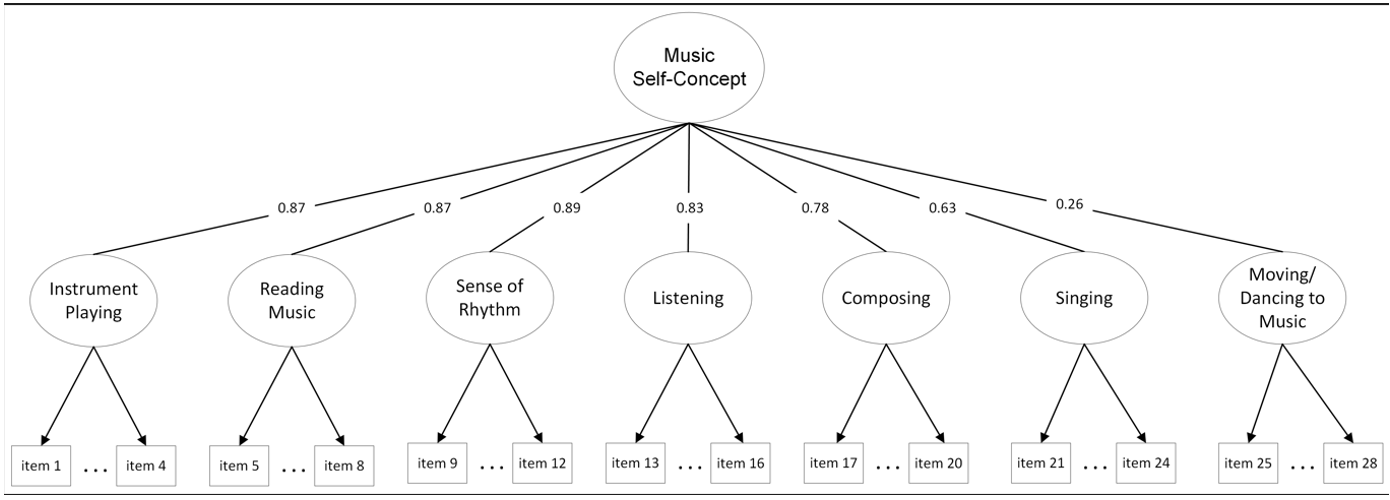
Note: Indices embedded in the lines between constructs are equivalent to correlation coefficients. In conventional representations of such models, arrows would typically appear from second- to first-order factors because first- order factors serve as indicators of the second-order factor. Such arrows are excluded here because the actual causal connection between the represented constructs could go either or both ways, and the model shown does not unambiguously distinguish the directionality of these relationships.
References
-
Myers David G (2009) Social psychology. In: 10th (Edn.), McGraw-Hill Higher Education.
-
Vispoel WP (2023) Self-concept inventories measure more than just psychological traits. Psychology Journal Research Open 5(6): 1-3.
-
Byrne BM (1996) Measuring self-concept across the life span: Issues and instrumentation. American Psychological Association.
-
Shavelson RJ, Hubner JJ, Stanton GC (1976) Self-concept: Validation of construct interpretations. Review of Educational Research 46(3): 407-441.
-
Vispoel WP (1995) Self-concept in artistic domains: An extension of the Shavelson, Hubner, and Stanton (1976) model. Journal of Educational Psychology 87(1): 134- 153.
-
Vispoel WP (1994) Integrating self-perceptions of music skill into contemporary models of self-concept. Quarterly Journal of Music Teaching and Learning 5(4): 42-57.
-
Vispoel WP (2021) Integrating self-perceptions of music skill into contemporary models of self-concept. Visions of Research in Music Education 16(33): 1-17.
-
Vispoel WP (2000) Music self-concept: Instrumentation, structure, and theoretical linkages. In: Craven RG, Marsh HW (Eds.), Self-concept theory, research and practice: Advances for the new millennium. Self-Concept Enhancement and Learning Facilitation Research Centre, Sydney, Australia, pp: 100-107.
-
Vispoel WP (2003) Measuring and understanding self- perceptions of musical ability. In: Marsh HW, Craven RG, McInerney D (Eds.), International advances in self research. Information Age Press, pp: 151-179.
-
Vispoel WP (1993) The development and validation of the Arts Self-Perception Inventory for Adolescents. Educational and Psychological Measurement 53: 1023- 1033.
-
Vispoel WP (1996) The development and validation of the Arts Self-Perception Inventory for Adults. Educational and Psychological Measurement 56(4): 731-757.
-
Schmidt MCJ (1979) Development and validation of a measure of self-esteem of musical ability. Doctoral Dissertation, University of Illinois at Urban-Champaign.
-
Svengalis JN (1978) Music attitude and the preadolescent male. Doctoral Dissertation, University of Iowa.
-
Schmidt CP (2005) Relations among motivation, performance achievement, and music experience variables in secondary instrumental music students. Journal of Research in Music Education 53(2): 134-147.
-
Schnare B, MacIntyre P, Doucette J (2012) Possible selves as a source of motivation for musicians. Psychology of Music 40(1): 94-111.
-
West C (2013) Motivating music students: A review of the literature. Update: Applications of Research in Music Education 31(2): 11-19.
-
Fiedler D, Hasselhorn J, Katrin Arens A, Frenzel AC, Vispoel WP (2024) Validation of scores from the short form of the Music Self-Perception Inventory (MUSPI-S) with German students from grades 7 to 9. Psychology of Music (Manuscript submitted for publication).
-
Fiedler D, Spychiger M (2017) Measuring “musical self-concept” throughout the years of adolescence with MUSCI_youth: Validation and adjustment of the Musical Self-Concept Inquiry (MUSCI) by investigating samples of students at secondary education schools. Psychomusicology Music Mind and Brain 27(3): 167- 179.
-
Fiedler D, Hasselhorn J (2020) The relationship between musical self-concept and motivation in music education: An empirical cross-sectional study of students from seventh to eleventh grades at secondary education schools in Baden-Württemberg and North Rhine- Westphalia. Beiträge Empirischer Musikpädagogik 11: 1-34.
-
Austin JR, Vispoel WP (1998) How American adolescents interpret success and failure in classroom music: Relationships among attributional beliefs, self-concept, and achievement. Psychology of Music 26(1): 26-45.
-
Sanders PD (2000) Music self-concept, music aptitude, and music background of non-music majors. Contributions to Music Education 27(2): 9-21.
-
Sanders PD, Browne LA (1998) Music self-concept of non-music majors. Contributions to Music Education 25(1): 74-86.
-
Schmidt CP, Zdzinski SF, Ballard DL (2006) Motivation orientations, academic achievement, and career goals of undergraduate music education majors. Journal of Research in Music Education, 54(2): 138-153.
-
Sichivitsa VO (2004) Music motivation: A study of fourth, fifth, and sixth graders’ intentions to persist in music. Contributions to Music Education 31(2): 27-41.
-
Morin AJ, Scalas LF, Vispoel WP, Marsh HW, Wen Z (2016) The Music Self-Perception Inventory: Development of a short form. Psychology of Music 44(5): 915-934.
-
Morin AJ, Scalas LF, Vispoel W (2017) The Music Self- Perception Inventory: Development of parallel forms A and B. Psychology of Music 45(4): 530-549.
-
Albert DJ (2017) Affirmation, validation, and empowerment: Influences of a composition competition on students’ self-concepts as musicians. Research Studies in Music Education 39(1): 91-107.
-
Austin JR (1988) The effect of music contest format on self-concept, motivation, achievement, and attitude of elementary band students. Journal of Research in Music Education 36(2): 95-107.
-
Demorest SM, Kelley J, Pfordresher PQ (2017) Singing ability, musical self-concept, and future music participation. Journal of Research in Music Education 64(4): 405-420.
-
Hedden SK (1982) Prediction of music achievement in the elementary school. Journal of Research in Music Education 30(1): 61-68.
-
Johnson EA (2011) The effect of peer-based instruction on rhythm reading achievement. Contributions to Music Education 38(2): 43-60.
-
Lill FS, Hasselhorn J, Lehmann AC (2019) The relationship between musical self-concept and practical music competencies in secondary education. In: Weidner V, Rolle C (Eds.), Praxen und diskurse aus sicht musikpädagogischer forschung, Waxmann, pp: 171-187.
-
Lill FS, Hasselhorn J, Lehmann AC (2020) Examining heterogeneity in practical music competencies in the music classroom. How does heterogeneity in 5th to 10th grade students compare to a 9th grade sample. In: Brophy TS (Eds.), Advancing music education through assessment: Honoring culture, diversity, and practice, GIA Publications pp: 137-154.
-
Austin JR (1990) The relationship of music self-esteem to degree of participation in school and out-of-school music activities among upper-elementary students. Contributions to Music Education 17: 20-31.
-
McClellan ER (2011) Relationships among parental influences, selected demographic factors, adolescent self-concept as a future music educator, and the decision to major in music education. Bulletin of the Council for Research in Music Education 187: 49-64.
-
Sichivitsa VO (2007) The influence of parents, teachers, peers, and other factors on students’ motivation in music. Research Studies in Music Education 29(1): 55-68.
-
Scalas LF, Marsh HW, Vispoel WP, Wen Z, Morin AJS (2017) Music self-concept and self-esteem formation. A comparison between individual and normative models of importance within a latent framework. Psychology of Music 45(6): 763-780.
-
Vispoel WP, Lee H, Austin JR (2023) Understanding the structure of music self-concept from multiple analytical perspectives. Paper presented at the annual meeting of the American Psychological Association.
-
Sergeant DC, Himonides E (2019) Orchestrated sex: The representation of male and female musicians in world- class symphony orchestras. Frontiers in Psychology, 10:1760.
-
Abeles HF, Porter SY (1978) The sex-stereotyping of musical instruments. Journal of Research in Music Education 26(2): 65-75.
-
Alwin DF, Braun M, Scott J (1992) The separation of work and the family: Attitudes towards women’s labour-force participation in Germany, Great Britain, and the United States. European Sociological. Review. 8(1): 13-37.
-
Hargreaves DJ, Comber C, Colley A (1995) Effects of age, gender and training on musical preferences of British secondary school students. Journal of Research in Music Education 43(3): 242-250.
-
Maidlow S, Bruce R (1999) The role of psychology research in understanding the sex/gender paradox in music—plus Ca change. Psychology of Music 27(2): 147-
-
O’Neill SA (1997) Gender and music. In: Hargreaves DJ, et al. (Eds.), The social psychology of music. Oxford University Press, pp: 46-63.
-
Walker MJ (2004) Influences of gender and sex- stereotyping of middle school student’s perception and selection of musical instruments: A review of the literature. Visions of Research in Music Education 4(1).
-
Dweck CS (2016) Mindset: The new psychology of success. In: 2nd (Edn.), Ballantine Books.
-
Ericsson KA, Krampe RT, Tesch RC (1993) The role of deliberate practice in the acquisition of expert performance. Psychological Review 100(3): 363-406.
-
Kabat ZJ (1994) Wherever you go, there you are: Mindfulness meditation in everyday life, Hyperion.
-
Kabat ZJ (2013) Full catastrophe living: Using the wisdom of your body and mind to face stress, pain, and illness. In: 2nd (Edn.), Bantam Books.
-
McCormick J, McPherson G (2003) The role of self- efficacy in a musical performance examination: An exploratory structural equation analysis. Psychology of Music 31(1): 37-51.
-
Vispoel WP, Austin JR (1995) Success and failure in junior high school: A critical incident approach to understanding students attributional beliefs. American Educational Research Journal 32(2): 377-412.
-
Zander MF, Voltmer E, Spahn C (2010) Health promotion and prevention in higher music education: Results of a longitudinal study. Medical Problems of Performing Artists 25(2): 54-65.
- Occupational Stress and Mental Health Outcomes Among Police Officers: A Mini Review
- The Experience of Counterproductive Leadership on Mental Health and Impact on Retention in U.S. Marines: A Phenomenological Study
- Nomophobia in the Digital Age: A Study on College and University Students
- Emotional Regulation in Children with Autism and Learning Disabilities
- Antisemitism on American College Campuses and Its Impact on Jewish Students
- Exploring the Role of Empathy in the Associations of Family Functioning and Purpose in Life with Attitude towards Abortion among Undergraduates: A Moderation Analysis