
Prevalence of Depression, Anxiety and Stress and its Correlation with Professional Help-Seeking Behaviour among Undergraduate University Students: A Cross-Sectional Study
Background: Detecting potential anxiety, stress, and depression among students is essential, as these conditions can result in decreased productivity, a lower quality of life, and even suicidal thoughts. Therefore, the objective of this study was to assess the prevalence of depression, anxiety, and stress among undergraduate university students. Additionally, the study aimed to determine whether these mental health issues are linked to students' professional help-seeking behaviors. Methods: A total of 880 undergraduate university students participated in the study. The age of the study sample ranged between 18 and 24 years with the mean (SD) of 19.55 (±1.19) years. The students completed the Depression Anxiety Stress Scale 21 (DASS-21). Those who were diagnosed with any of the mental disorders on DASS-21 were asked to fill the Attitude Towards Seeking Professional Help (ATSPPH-SF). Result: Among 880 students, 590 (67.04%) were suffering from either depression, anxiety and stress. The overall prevalence of depression, anxiety and stress were 43%, 55.5% and 31.8% respectively. Pearson correlation coefficient test showed that stress has a negative correlation with attitude towards seeking professional help (r=-0.100, p=0.015). Thus, we can state that attitude toward seeking professional help was inversely related to the level of stress. It implies that the higher the level of stress, the lesser the willingness to seek professional help. Conclusion: It is concluded from the present study that there is a considerable prevalence of symptoms of depression, anxiety and stress among undergraduate university students highlighting the need for clinical evaluation. Professional help-seeking behaviour of students were influenced by the level of stress. Hence, it is recommended to implement educational interventions focused on promoting mental health.
Abbreviations
WHO: World Health Organization; ATSPPH: Attitude towards Seeking Professional Help Scale; DASS: Depression, Anxiety, Stress Scale.
Introduction
Stress and anxiety are closely related, as anxiety often arises as a response to stress during threatening situations. Anxiety refers to a natural feeling that people experience when confronted with a threat, danger, or stressful circumstances [1, 2]. On the other hand, depression is characterized by a loss of interest or pleasure, persistent sadness, feelings of guilt or low self-esteem, disrupted sleep or appetite, extreme fatigue, and difficulty concentrating. It is the most prevalent mental health condition among the general population. In its most severe form, depression can lead to suicidal thoughts and an increased risk of death [3].
According to the World Health Organization (WHO), depression is the leading cause of ill health and disability globally. Depression and anxiety are widespread issues in universities across the country [1]. India, a recent systematic review found that the prevalence of depression among medical students was 39.2%, while anxiety affected 34.5% of this population [4]. Experiencing occasional anxiety is a normal part of life, but when stress escalates, it can trigger feelings of helplessness and anxiety, contributing to stress- related disorders that negatively impact both academic and non-academic performance [5].
Mental health issues are on the rise among college students. Research shows that nearly half of university students experience moderate levels of stress-related mental health concerns, such as anxiety and depression [6]. While stress is an unavoidable aspect of life, it is particularly common and increasing among university students [7]. Evidence indicates that university students are especially susceptible to mental health problems, raising public concern in Western societies. Numerous studies have reported high levels of psychological distress, especially depression and anxiety, among university students worldwide [8].
The latest estimates from the World Health Organization (WHO) indicate that over 300 million people worldwide are currently living with depression. Additionally, it is estimated that 10% to 30% of students experience academic-related stress, which negatively impacts their academic performance. College students face significant stress from adapting to new environments, managing exams, assignments, and tight schedules [9]. The pressure of academic performance, lack of free time, and limited feedback contribute to anxiety and depression [10]. Additionally, adjusting to new lifestyles, relationships, and cultural exposure can increase their vulnerability to mental health issues [1]. Negative body image perceptions also elevate the risk of depression, anxiety, and low self-esteem, which can impair social, academic, and occupational functioning [11, 12].
University students are in a transitional phase, navigating the shift from childhood to adulthood, which involves identity formation, social value adaptation, and social maturity. Research shows moderate to high levels of depression, anxiety, and stress among undergraduates globally. Early detection and management of these mental health issues can improve outcomes, impacting academic performance, social relationships, and overall well-being [13, 14]. Identifying students at higher risk and encouraging them to seek professional psychological support early is crucial for better mental health and quality of life [1].
Stigma around mental illness remains a significant barrier to seeking help, with many believing that mental health issues will resolve on their own. In Indian societies, discussing mental health is often discouraged. Although universities now offer counseling services to support students’ personal and academic challenges, research indicates that many students are reluctant to use these resources. While guidance services have shown positive effects, there is still limited understanding of students’ attitudes toward help-seeking. More research is needed to explore the prevalence of mental health issues and help- seeking behaviors among undergraduate students [15].
This study aims to assess the prevalence of depression, anxiety, and stress among students and their correlation with attitudes toward seeking professional help. Early detection is critical as these issues can impact productivity, quality of life, and even lead to suicidal ideation. Understanding the relationship between mental health symptoms and help-seeking behavior will highlight whether students experiencing these challenges feel comfortable discussing mental health. By addressing this gap, universities can better promote mental well-being, which is essential for students’ academic success and overall quality of life.
Materials and Methods
This cross-sectional observational study was conducted at Uka Tarsadia University, located at, Surat, Gujarat. The study population comprised undergraduate students enrolled at the university. A total of 880 participants were recruited using a convenient sampling method. This sampling approach was chosen due to its feasibility in accessing a large number of students within a limited timeframe. The study aimed to gather diverse data representative of the university’s undergraduate population, encompassing various disciplines and years of study. Data collection took place within the university premises to ensure accessibility and maximize student participation. The inclusion criteria required participants to be undergraduate students between the ages of 18 and 24 years. Individuals were excluded from the study if they were unwilling to participate, enrolled in a postgraduate program, or lacked proficiency in the English language, as the assessment tools used were available only in English.
The primary outcome measures for this study included psychological and attitudinal assessments using two standardized scales. The first measure was the Depression, Anxiety, and Stress Scale (DASS-21) [16, 17, 18], which is a self-reported instrument designed to assess the emotional states of depression, anxiety, and stress over the past week. ). Respondents must rate the extent to which each statement applies during the past week on a 4-point Likert scale ranging from 0 (did not apply to me at all) to 3 (applied to me very much). Because the DASS-21 is a short-form version of the DASS (42 items), the final score for each sub- scale is multiplied by two and evaluated according to its severity rating index. Depression, anxiety and stress scores are calculated by adding up the scores of the items in each separate subscale. The results are interpreted as follows: DASS-A (>19 = extremely severe depression; 19–15 = severe anxiety; 14–10 = moderate anxiety; 9–8 = mild anxiety; 7–0 = no anxiety/normal), DASS-D (>27 = extremely severe depression; 27–21 = severe depression; 20–14 = moderate depression; 13–10 = mild depression; 9–0 = no depression/ normal), DASS-S (>33 = extremely severe stress; 33–26 = severe stress; 25–19 = moderate stress; 18–15 = mild stress; 14–0 = no stress/normal). The DASS-21 is the short-form version of the original self-reported 42-item questionnaire and has demonstrated good to excellent internal consistency, [19] adequate reliability and construct validity [20].
The second measure was the Attitude Towards Seeking Professional Help Scale - Short Form (ATSPPH-SF) [21], which evaluates attitudes toward seeking professional psychological support. These validated tools were chosen to assess the mental health status and help-seeking behavior among the undergraduate student population, providing insights into their psychological well-being and openness to seeking mental health assistance. The ATSPPH-SF is a 10-item measure used to assess ATSPPH on a 4-point Likert scale, ranging from 0 to 3. Higher total score indicates more positive ATSPPH and is associated with lower levels of stigma against mental illness.
Procedure
Undergraduate students from Uka Tarsadia University were recruited for this study after being provided with a brief explanation of its purpose. Written consent was obtained, and participants were assured of their right to withdraw at any time, as well as the confidentiality of their responses. Each participant completed a demographics section, followed by the (DASS-21). Investigators reviewed the DASS-21 scores, and those scoring above 9 for depression, 7 for anxiety, or 14 for stress were subsequently asked to complete the ATSPPH-SF. The entire process took around 10 minutes, with instructions emphasizing that there were no right or wrong answers.
Results
The data was analysed for its normality, and we found that the data was normally distributed. Prevalence of depression, anxiety and stress was obtained in percentage. The study also aimed to find out the relation of depression, anxiety and stress with attitude toward seeking professional help. For that purpose, Pearson’s correlation coefficient test was used.
A total of 880 undergraduate university students participated in the study. The age of the study sample ranged between 18 and 24 years with the mean (SD) of 19.55 (±1.19) years. In the present study, most respondents were female (50.09%), while 40.9% were male respondents. Descriptive statistics of Depression Anxiety and Stress Scale (DASS- 21) and Attitude towards seeking professional help scale (ATSPH) are presented in Table 1.
| Outcome measures | Mean±SD | |
|---|---|---|
| DASS-21 | Depression | 9.77±8.22 |
| DASS-21 | Anxiety | 10.33±8.03 |
| DASS-21 | Stress | 11.22±8.15 |
| ATSPH | 15.49±4.16 | |
Table 1: Illustrates the Mean ± SD of DASS-21 and ATSPH.
Prevalence of Depression, Anxiety and Stress
Table 2 shows the prevalence of depression, anxiety and stress among 880 undergraduate university students. Among 880 students, 590 (67.04%) were suffering from either depression, anxiety and stress. The overall prevalence of depression, anxiety and stress were 43%, 55.5% and 31.8% respectively.
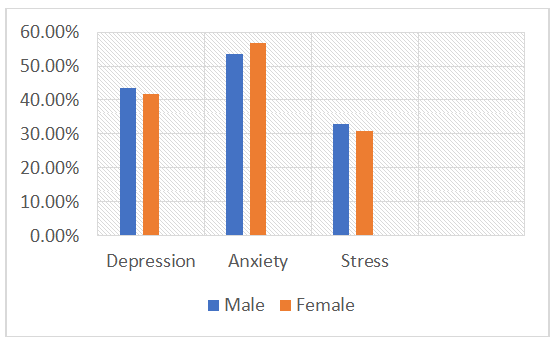
| Categories | Total (n=880) | Male (n=360) | Women (n=520) | |
|---|---|---|---|---|
| Depression | No Depression | 506 (57%) | 203 (56.38%) | 303 (58.26%) |
| Depression | Mild | 113 (15.1%) | 49 (13.61%) | 84 (16.15%) |
| Depression | Moderate | 148 (16.8%) | 72 (20%) | 76 (14.61%) |
| Depression | Severe | 53 (6%) | 24 (6.66%) | 29 (5.57%) |
| Depression | Extremely severe | 40 (4.5%) | 12 (3.33%) | 28 (5.38%) |
| Anxiety | No anxiety | 392 (44.5%) | 167 (46.38%) | 225 (43.2%) |
| Anxiety | Mild | 82 (9.3%) | 25 (6.9%) | 57 (10.9%) |
| Anxiety | Moderate | 199 (22.6%) | 83 (23.05%) | 116 (22.30%) |
| Anxiety | Severe | 84 (9.5%) | 36 (10%) | 48 (9.23%) |
| Anxiety | Extremely severe | 123 (14%) | 49 (13.61%) | 74 (14.23%) |
| Stress | No stress | 600 (68.2%) | 241 (66.94%) | 359 (69.03) |
| Stress | Mild | 96 (10.9%) | 44 (12.22%) | 52 (10%) |
| Stress | Moderate | 116 (13.2%) | 50 (13.88%) | 66 (12.69%) |
| Stress | Severe | 60 (6.8%) | 23 (6.38%) | 37 (7.11%) |
| Stress | Extremely severe | 8 (0.9%) | 2 (0.55%) | 6 (1.15) |
Table 2: Illustrates the prevalence of depression, anxiety, and stress.
Correlation of Depression Anxiety and Stress with Attitude towards Seeking Professional Help
The results showed that stress has small negative correlation with attitude towards seeking professional help (r=-0.100, p=0.015) Table 3. Thus, we can state that attitude toward seeking professional help was inversely related to the level of stress. It implies that the highest the level of stress, the lesser the willingness to seek professional help. However, we did not find any kind of significant relationship between depression, anxiety and professional help-seeking behavior i.e., the level of depression and anxiety was not directly related to willingness to seek professional help. The result of the present study also showed that depression, anxiety and stress are significantly correlated with each other (p=0.000), which implies that the more the level of stress and anxiety, the more will be depression level and vice versa.
| Attitude toward seeking professional help | Depression | Anxiety | Stress | |
|---|---|---|---|---|
| Attitude toward seeking professional help | 1 | -0.062 | -0.055 | -0.100* |
| (p=0.135) | -0.184 | (p= 0.015) | ||
| Depression | 1 | 0.590** | 0.617** | |
| (p=0.000) | (p=0.000) | |||
| Anxiety | 1 | 0.564** | ||
| (p=0.000) | ||||
| Stress | 1 |
Table 3: Illustrates Pearson’s Correlation between depression, anxiety, stress, and attitude toward seeking professional help.
*. Correlation is significant at the 0.05 level **. Correlation is significant at the 0.01 level Table 3: Illustrates Pearson’s Correlation between depression, anxiety, stress, and attitude toward seeking professional help.
Discussion
This study examined the prevalence of depression, anxiety, and stress among 880 undergraduate university students, aged 18 to 24 years. The results showed that most students experienced mild to moderate levels of stress, anxiety, and depression. Specifically, the prevalence of depression, anxiety, and stress among the participants was 43%, 55.5%, and 31.8%, respectively. These findings are similar to those reported by Siddhart et al., who conducted a systematic review on depression, anxiety, and stress among medical students in India. Contributing factors may include parental pressure, high expectations, poor time management, low self-esteem, academic difficulties, peer competition, and younger age. In contrast, the study by Mehta P et al. reported lower prevalence rates, with 10% of students depressed, 23% anxious, and 5% stressed, possibly due to differences in the screening tools used.
There is significant variation in the reported prevalence of psychological distress among college students worldwide. A systematic review of 24 studies found an average depression prevalence of 30.5%, with figures ranging from 10.4% to 80.5% [22, 23, 24]. Similar variation was observed in studies using the DASS questionnaire to assess psychological distress. These differences may be attributed to variations in selection criteria, as well as external factors such as the participants’ environment, which can influence both their subjective perception and the expression of psychological symptoms. External factors, including geographical location and sociocultural context, likely play a significant role in determining the prevalence of psychological distress in this population.
Our findings also revealed that 67.04% of the 880 undergraduate students exhibited symptoms of two or more psychological disorders. The co-occurrence of these disorders has been observed both in the general population and among college students [25, 26]. Long, et al. [27] explained that there is a bidirectional and systematic relationship between the development of depressive and anxiety disorders in young adults [27]. Furthermore, previous studies have highlighted similarities in the neurobiology and genetic makeup of depression and anxiety [28, 29, 30]. However, the underlying cause of this association between these psychological conditions remains unclear.
In the present study, most respondents were female (50.09%), while 40.9% were male respondents. We found that male students presented with a higher prevalence of symptoms of depression and stress compared to female students. Whereas, the prevalence of symptoms of anxiety was more in female students as compared to male students. These results were congruent with the previous study conducted by Gao W, et al. [6, 31] which also reported a higher prevalence of anxiety among females. The further worsening of depression among male students may be partly due to their negative attitude toward emotional expression.
The present study also intended to find the correlation between depression, anxiety, and stress and the help-seeking behavior of students. Pearson’s Correlation Coefficient test revealed that stress was significantly and negatively correlated with attitude toward seeking professional help. This can be interpreted that the higher the level of stress, the lesser will be the willingness of students to seek professional help. To the best of our knowledge, this study is the first that has evaluated such a correlation. Thus, there is a lack of evidence that supports the finding of the present study. While we are beginning to understand some of the individual and social factors that influence help-seeking behavior among college students, we found no correlation between depression, anxiety, and students’ willingness to seek help. These results are contrary to the results of Chibueze Anosike, et al. [32] who examined the prevalence of depression and anxiety, as well as attitudes toward seeking help, among first- year pharmacy, medical, and nursing students at a university in Nigeria. The reason for this could be cultural differences among the countries.
Our study also found that symptoms of depression, anxiety, and stress, as measured by the DASS-21, were significantly and positively correlated. One possible explanation for this association is that depression, anxiety, and stress share many common risk factors and symptoms [13]. However, there is currently insufficient evidence to fully explain this relationship.
While this study has several strengths, including a high response rate, random sampling, and a straightforward, concise testing tool, it also has some limitations. Firstly, the results have not been correlated with any clinical diagnoses. The cross-sectional design does not enable the assessment of changes in psychological status over time. Additionally, the study participants were limited to undergraduate students. As the study relied on a self-administered questionnaire, response bias may be present, as students might have underreported their negative emotions or overstated their academic performance.
Conclusions
The present study concludes that there is a significant prevalence of symptoms of depression, anxiety, and stress among undergraduate university students, highlighting the need for clinical evaluation. Student’s attitude toward seeking professional help was influenced by the level of stress. Thus, it is recommended to implement educational interventions aimed at promoting mental health. References
1. Gautam D, Aryal SC, Fernando TA, Afza T, Deepak TR, et al. (2020) Prevalence of Depression, Anxiety & Stress among First Year Students in Physiotherapy Colleges at Bangalore, India. Indian Journal of Physiotherapy & Occupational Therapy Print-(ISSN 0973-5666) and Electronic-(ISSN 0973-5674). 14(1): 78-82.
2. Melaku L, Bulcha G, Worku D (2021) Stress, Anxiety, and Depression among Medical Undergraduate Students and Their Coping Strategies. Education Research International.
3. Lim GY, Tam WW, Lu Y, Ho CS, Zhang MW, et al. (2018) Prevalence of depression in the community from 30 countries between 1994 and 2014. Scientific reports 8(1): 1-10.
4. Arun P, Ramamurthy P, Thilakan P (2022) Indian medical students with depression, anxiety, and suicidal behavior: why do they not seek treatment?. Indian journal of psychological medicine 44(1): 10-16.
5. Syed A, Ali SS, Khan M (2018) Frequency of depression, anxiety and stress among the undergraduate physiotherapy students. Pakistan journal of medical sciences 34(2): 468-471.
6. Gao W, Ping S, Liu X (2020) Gender differences in depression, anxiety, and stress among college students: a longitudinal study from China. Journal of affective disorders 263: 292-300.
7. Beiter R, Nash R, McCrady M, Rhoades D, Linscomb M, et al. (2015) The prevalence and correlates of depression, anxiety, and stress in a sample of college students. Journal of affective disorders 173: 90-96.
8. Bayram N, Bilgel N (2008) The prevalence and socio- demographic correlations of depression, anxiety and stress among a group of university students. Social psychiatry and psychiatric epidemiology. 43(8): 667-72.
9. Walsh JM, Feeney C, Hussey J, Donnellan C (2010) Sources of stress and psychological morbidity among undergraduate physiotherapy students. Physiotherapy 96(3): 206-212.
10. Sharma B, Wavare R (2013) Academic stress due to depression among medical and para-medical students in an indian medical college: Health initiatives cross sectional study. Journal of Health Sciences 3(5): 029-038.
11. Kumaraswamy N (2013) Academic stress, anxiety and depression among college students- a brief review. Int Rev Soc Sci Humanit 5: 135-143.
12. Goswami S, Sachdeva R, Sachdeva S (2012) Body image satisfaction among female college students. Ind Psychiatry J 21(2): 168-172.
13. Ramón-Arbués E, Gea-Caballero V, Granada-López JM, Juárez-Vela R, Pellicer-García B, et al. (2020) The prevalence of depression, anxiety and stress and their associated factors in college students. International Journal of Environmental Research and Public Health
17(19): 7001.
14. Hunt J, Eisenberg D (2010) Mental health problems and help-seeking behavior among college students. Journal of adolescent health 46(1): 3-10.
15. Anosike C, Anene-Okeke CG, Ayogu EE, Oshigbo MC (2022) Prevalence of depression and anxiety, and attitudes toward seeking help among first-year pharmacy, medical, and nursing students at a Nigerian university. Currents in Pharmacy Teaching and Learning 14(6): 720-728.
16. Lovibond PF, Lovibond SH (1995) The structure of negative emotional states: comparison of the Depression Anxiety Stress Scales (DASS) with the Beck Depression and Anxiety Inventories. Behav Res Ther 33(3): 335-343.
17. Nieuwenhuijsen K, de Boer AG, Verbeek JH, Blonk RW, van Dijk FJ (2003) The Depression Anxiety Stress Scales (DASS): detecting anxiety disorder and depression in employees absent from work because of mental health problems. Occup Environ Med 60(S1): i77-i82.
18. Lovibond PF, Lovibond SH (1995) Manual for the Depression Anxiety Stress Scales (2nd Edn.), Psychology Foundation, Sydney.
19. Gloster AT, Rhoades HM, Novy D, Klotsche J, Senior A, et al. (2008) Psychometric properties of the Depression Anxiety and Stress Scale-21 in older primary care patients. J Affect Disord 110(3): 248-259.
20. Henry JD, Crawford JR (2005) The short-form version of the Depression Anxiety Stress Scales (DASS-21): construct validity and normative data in a large non- clinical sample. Br J Clin Psychol 44(2): 227-239.
21. Fisher EH, Farina A (1995) Attitudes Toward Seeking Professional Psychological Help: A shortened form and considerations of research. Journal of College Student Development 36: 368-373.
22. Sarkar S, Gupta R, Menon V (2017) A systematic review of depression, anxiety, and stress among medical students in India. Journal of Mental Health and Human Behaviour 22(2): 88-96.
23. Mehta P, Thekdi K, Rokad M, Patel K, Bhadu A, et al. (2013) Exploratory study to access anxiety, depression and stress among medical students, freshly starting their medical education in a medical college. Scholars J Applied Med Sci 1(6): 819-822.
24. Ibrahim AK, Kelly SJ, Adams CE, Glazebrook CA (2013) systematic review of studies of depression prevalence in university students. J Psychiatry Res 47(3): 391-400.
25. Kessler RC, Sampson NA, Berglund P, Gruber MJ, Al- Hamzawi A, et al. (2015) Anxious and non-anxious major depressive disorder in the World Health Organization World Mental Health Surveys. Epidemiol Psychiatry Sci 24(3): 210-226.
26. Lun KW, Chan CK, Ip PK, Ma SY, Tsai WW, et al. (2018) Depression and anxiety among university students in Hong Kong. Hong Kong Med J 24(5): 466-472.
27. Long EE, Young JF, Hankin BL (2018) Temporal dynamics and longitudinal co-occurrence of depression and different anxiety syndromes in youth: Evidence for reciprocal patterns in a 3-year prospective study. J Affect Disord 234: 20-27.
28. Liu JJ, Galfalvy HC, Cooper TB, Oquendo MA, Grunebaum MF, et al. (2013) Omega-3 Polyunsaturated Fatty Acid Status in Major Depression with Comorbid Anxiety Disorders. J Clin Psychiatry 74(7): 732-738.
29. Li Y, Wang W, Liu T, Ren L, Zhou Y, et al. (2015) Source
analysis of P3a and P3b components to investigate interaction of depression and anxiety in attentional systems. Sci Rep 5:17138.
30. Hamaideh SH (2018) Alexithymia among Jordanian university students: Its prevalence and correlates with depression, anxiety, stress, and demographics. Perspect Psychiatry Care 54(2): 274-280.
31. Gao W, Ping S, Liu X (2020) Gender differences in depression, anxiety, and stress among college students: a longitudinal study from China. Journal of affective disorders 263: 292-300.
32. Anosike C, Anene-Okeke CG, Ayogu EE, Oshigbo MC (2022) Prevalence of depression and anxiety, and attitudes toward seeking help among first-year pharmacy, medical, and nursing students at a Nigerian university. Currents in Pharmacy Teaching and Learning 14(6): 720-728.
- Occupational Stress and Mental Health Outcomes Among Police Officers: A Mini Review
- The Experience of Counterproductive Leadership on Mental Health and Impact on Retention in U.S. Marines: A Phenomenological Study
- Nomophobia in the Digital Age: A Study on College and University Students
- Emotional Regulation in Children with Autism and Learning Disabilities
- Antisemitism on American College Campuses and Its Impact on Jewish Students
- Exploring the Role of Empathy in the Associations of Family Functioning and Purpose in Life with Attitude towards Abortion among Undergraduates: A Moderation Analysis