
Unplug to Thrive: A PERMA-based Intervention Program for Reducing Smartphone Addiction
Smartphone addiction is recognized as a behavioural pattern characterized by compulsive, excessive, and problematic smartphone use. It has been associated with mood dysregulation, impaired engagement, weakened social relationships, diminished meaning in life, reduced self-regulation, and lower achievement. In response to these challenges, this study proposes the Unplug to Thrive program, a six-week intervention program grounded in Seligman’s (2011) PERMA model of well-being. The program adopts a positive prevention approach that emphasizes substitution over eradication by guiding individuals to cultivate positive real-life experiences across PERMA domains. The intervention consists of one 50-minute session per week, with each session structured into three stages: self-assessment, PERMA real-life creation, and evaluation of life satisfaction. The program aims to cultivate positive real-life experiences as a means of gradually reducing individuals’ attachment to smartphone use. This study contributes to the field of mental health by reframing smartphone addiction as an opportunity to promote well-being and flourishing through engagement in fulfilling experiences beyond the smartphone.
Introduction
Understanding Smartphone Addiction
In modern society, people increasingly rely on smartphones for a variety of activities, including work, leisure, online shopping, and social interactions. Smartphones are not only becoming more popular but also providing numerous benefits in information exchange, education, entertainment, and communication with others regardless of location or time [1]. People who utilize smartphones primarily for essential tasks and social interactions, without displaying addictive behaviours, are less likely to experience adverse effects on their well-being or daily functioning [2, 3].
However, the development of the internet and the popularity of smartphones have become a reality. Excessive or maladaptive smartphone use has become a growing concern, contributing to various psychological and behavioural issues. For instance, compulsive smartphone use can result in dependency and, in some cases, addiction. It resembles a form of behavioural addiction. Behavioural addiction is often described as an excessive desire to continually engage in particular activities that bring pleasure, comfort, satisfaction, or the possibility of alleviating some suffering, despite the perception that the conduct may have negative repercussions [4].
Indeed, smartphone addiction is defined as the uncontrolled and compulsive use of these devices, leading to various behavioural, emotional, and social consequences [5]. It is also characterized by excessive and problematic smartphone use that negatively affects an individual’s psychological, social, and occupational well-being [6].
Specifically, a growing body of research has identified key characteristics of Smartphone addiction, including rapid mood fluctuations associated with smartphone use (i.e., mood modification), persistent preoccupation with the device (i.e., salience), prolonged usage to achieve the same level of satisfaction (i.e., tolerance), discomfort or anxiety when unable to use the phone (i.e., withdrawal), repeated unsuccessful attempts to reduce usage (i.e., relapse), and significant disruptions in academic, professional, and familial domains (i.e., conflict) [7, 8].
These defining characteristics highlight that Smartphone addiction refers to uncontrolled, compulsive, excessive and problematic use smartphones that disrupt multiple aspects of life.
Negative Affect and Digital Escapism as Affective Pathways to Smartphone Addiction
In a rapidly changing society, individuals face various daily stressors. As individuals experience increased psychological distress, they may find it difficult to manage daily negative life events, making them more susceptible to maladaptive behaviours, such as excessive smartphone use, as a means of emotional escape [9].
Paradoxically, individuals use smartphones to escape real-life stress while simultaneously fearing social exclusion, leading them to repeatedly check their smartphones to stay updated on social media activity.
FoMO (Fear of Missing Out) is broadly defined as a persistent concern that others may be engaging in rewarding experiences from which one is excluded, leading to heightened social anxiety and emotional distress [10].
This psychological phenomenon has been found to mediate the relationship between social media use and negative emotional states, such as depression and anxiety, further reinforcing the detrimental impact of excessive smartphone engagement [11].
When overwhelmed by life stressors, individuals often turn to smartphones as a means of escaping negative emotions; however, the constant scrolling and checking to stay updated with all information can, in turn, generate negative emotional outcomes such as depression and anxiety.
From the perspective of positive prevention, if individuals cultivate richer and more fulfilling positive emotions in life beyond smartphone use, it may help alleviate the negative emotions associated with problematic smartphone behaviour.
How Self-Esteem and Self-Efficacy Foster Engagement Amid Smartphone Use
Landa-Blanco, et al. [12] investigated social media addiction among university students in Honduras, incorporating self-esteem, depression, and anxiety as mediators.
The findings showed social media addiction did not directly affect academic engagement, and it significantly influenced it through increased depression and decreased self-esteem. Apart from depression, experiencing low self- esteem increases the risk of social media addiction, which in turn negatively impacts attention and engagement.
A recent study in China, Meng, et al. [13] adapted self- determination theory to examine how smartphone addiction affects engagement. Surveying 4,562 college students, the study identified three key mediators: physical activity, academic self-efficacy, and their combined effects. The result proposed that smartphone addiction negatively impacts student engagement by reducing academic self-efficacy.
As indicated above, social media addiction or smartphone addiction may influence an individual’s focused engagement through mechanisms such as self-esteem and self-efficacy. Drawing on the tenets of positive prevention, individuals enhance their internal positive states, such as self-esteem and self-efficacy, and it may help reduce their reliance on smartphones and, in turn, promote greater levels of engagement.
Excessive Smartphone Use and the Erosion of Social Connection
Alotaibi, et al. [14] and Smith [15] observed that people increasingly turn to smartphones and social media platforms to fulfil their needs for acceptance and relationships.
But excessive smartphone use fosters social isolation and weakens support networks. Yang, et al. [16] demonstrated that a decrease in direct social engagement is detrimental to self-regulation, making individuals more vulnerable to compulsive smartphone use.
Reduced social engagement weakens self-regulation, making individuals more vulnerable to compulsive smartphone use and dependency. This issue became particularly pronounced during periods of social distancing when students significantly increased their smartphone usage, leading to a rise in smartphone addiction [17, 18].
Hawi, et al. [19] found that smartphone addiction can lead to the deterioration of real-life relationships, ultimately reducing the availability and effectiveness of social support. Accordingly, excessive smartphone use often stems from the need for social connection, yet it can reduce face-to-face interactions and increase loneliness.
Online communication tends to be fragmented, offering limited social support. Within the framework of positive prevention, building stable, meaningful relationships in real life is crucial for fulfilling psychological needs and can effectively reduce reliance on smartphones.
Smartphone Addiction, Self-Regulation, and the Pursuit of Meaningful Living
A meaningful life entails utilizing one’s signature strengths in the service of something greater than oneself, thereby cultivating a sense of purpose and coherence [20]. The overuse of smartphones can impair individuals’ ability to derive meaning from authentic, real-world experiences.
Such overuse may not only diminish one’s pursuit of meaning in real life but may also thwart the satisfaction of fundamental psychological needs, such as a sense of belonging within them. Kesici [21] proposed that the internet, social media, and smartphones are among the primary spaces where people seek a sense of belonging. However, this sense of belonging, detached from real-life experiences, is inherently unstable.
Smartphone addiction can be seen as a manifestation of self-regulation failure, as a situation in which individuals are unable to effectively manage their smartphone usage, leading to negative outcomes [22].
Kim, et al. [23] investigated the impact of smartphone addiction and self-regulation failure on academic life satisfaction among 950 university students. This study identified a significant relationship between smartphone addiction and self-regulation failures, which in turn increased mind wandering and cognitive failures. This decline in self- regulation caused by smartphone addiction undermines individuals’ autonomy in pursuing authentic life experiences.
Guided by the positive prevention approach, if individuals can use smartphones with greater self-regulation and intentionality, they may be able to allocate more cognitive and emotional resources toward pursuing important aspects of life, such as a sense of belonging in real-world relationships. This shift may facilitate the development of a more meaningful and purposeful life.
Disrupting the Cycle of Smartphone Addiction through Academic Purpose and Achievement
Smartphone addiction has been increasingly linked to lower academic achievement. A meta-analysis further supports this relationship, demonstrating that smartphone addiction has a significant negative effect on academic success by increasing exhaustion and reducing motivation [24]. Smartphone addiction disrupts essential academic tasks by fostering distraction and reducing focus on coursework [25].
Zhang, et al. [26] examined how academic anxiety and academic control mediate the relationship between smartphone addiction and academic achievement in college students.
They analysed data from 2,097 participants, they found a significant negative correlation between smartphone addiction and academic achievement. Similarly, prior research has consistently shown that smartphone addiction negatively impacts academic outcomes by increasing stress and reducing motivation.
The research indicates that excessive smartphone use can lead to school burnout, which may contribute to declining academic performance over time [27]. Another similar finding, Tian, et al. [28] conducted a cross-sectional study examining how demographic factors influence smartphone addiction, academic procrastination, and achievement among medical students.
The findings suggest that excessive smartphone use may undermine academic engagement and success. Smartphone addiction has a clear negative impact on academic achievement by increasing exhaustion, reducing motivation, and impairing cognitive functioning.
Based on the above, smartphone addiction can lead to distraction, school burnout, and reduced motivation, ultimately impairing academic performance and creating a negative cycle.
However, by enhancing a sense of accomplishment in various aspects of real life both concrete and abstract individuals may become more engaged with intentions, thereby reducing their dependence on smartphones.
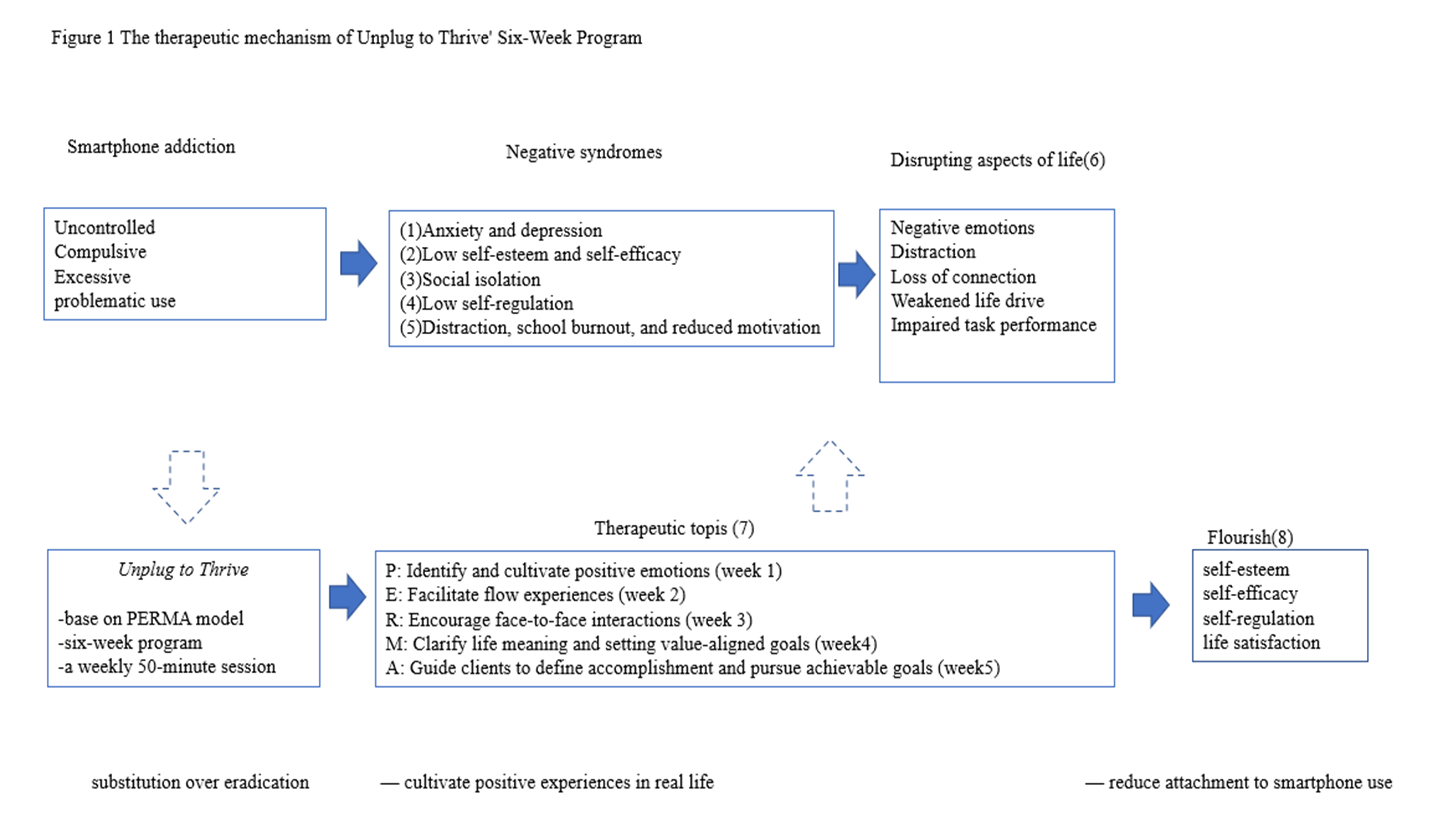
The Unplug to Thrive Program for Reducing Smartphone Addiction
As previously discussed, and shown in Figure 1, while this behaviour may offer temporary relief, constant scrolling and compulsive checking to stay updated often exacerbate negative emotional states, contributing to increased levels of depression and anxiety: (a). Smartphone addiction has also been shown to impair focused engagement, potentially through psychological mechanisms such as diminished self- esteem and reduced self-efficacy (2). Furthermore, online communication tends to social isolation (3) and lacks the depth of real-world interactions, thereby offering limited social support. Smartphone addiction also impairs self- regulation (4), thereby diminishing individuals’ ability to autonomously engage in meaningful real-world experiences. Ultimately, maladaptive smartphone uses leads to greater distraction, school burnout, and reduced motivation (5), all of which contribute to a reduced sense of accomplishment. Accordingly, negative emotions, persistent distraction, a loss of meaningful social connection, weakened intrinsic motivation, and impaired task performance collectively contribute to disrupting various aspects of daily life (6), undermining personal positive functions.
In psychotherapy, the traditional focus of disability is on disorders, suffering, and treatment [29]. Highlighting negativity, functional limitations, and deficits in the portrayals of disability may cause people with disabilities to become the object of pity and prejudice [30]. However, the innovative perspective of this study lies in the proposition that when individuals actively create and experience sources of well-being beyond the smartphone, they may realize many profound and impressive experiences cannot be replicated through smartphones.
This study proposes an intervention program titled Unplug to Thrive, designed to reduce smartphone addiction by integrating the PERMA model of well-being. Grounded in the principle of substitution over eradication, the program aims to cultivate positive real-life experiences as a means of gradually reducing individuals’ attachment to smartphone use. The PERMA model, proposed by Seligman [20], outlines five key components essential for individuals to flourish: Positive Emotion (P), Engagement (E), Relationships (R), Meaning (M), and Accomplishment (A). Specifically, the elements of the PERMA model are systematically incorporated into the design of the Unplug to Thrive program, as Figure 1 of therapeutic topics [7].
The Unplug to Thrive program is designed as a six- week intervention, consisting of one 50-minute session per week. Positive Emotions (P, week 1): Such as joy, pleasant, humour, gratitude, confident, love, hope, and contentment. These emotions serve not only as indicators of momentary happiness but also as building blocks for enduring resilience, enhanced creativity, and overall life satisfaction. This part guided clients to recognize and intentionally generate positive emotions in real-life contexts outside of smartphone use, allowing them to emotionally engage with daily experiences in a more fulfilling way. Engagement (E, week 2): Engagement is marked by existing in a state of flow or experiencing intense interest in an activity [31]. Often conceptualized as a state of “flow,” engagement occurs when individuals are fully immersed in tasks that challenge and utilize their personal strengths and skills. Engagement refers to a deep psychological involvement in activities that capture one’s full attention, interest, and concentration. In this session, therapists invite clients to immerse themselves in a highly focused, skill-based activity to facilitate a state of flow, and reflected on similar experiences from their daily lives. Relationships (R, week 3): Positive relationships are defined as the experience of being cared for, valued, and genuinely connected to others. These relationships provide a sense of psychological safety, foster emotional intimacy, and reinforce a stable sense of self. The presence of supportive social connections with family, friends, and the broader community has been consistently associated with greater life satisfaction and overall well-being. Therapists encourage clients to explore how they maintain interpersonal relationships without relying on smartphones, and to develop a plan for engaging in face-to-face social interaction to implement in daily life. Meaning (M, week 4): Meaning refers to having a sense of purpose that goes beyond the self. It plays a vital role in well-being, as individuals who engage in meaningful activities such as pursuing goals, supporting a cause, or living by their values—tend to experience greater fulfilment. Meaning highlights the importance of purpose in promoting psychological health and life satisfaction. In this part, therapists help clients to clarify what constitutes a meaningful life for them, identify concrete goals aligned with that meaning, and explore ways to reduce smartphone use in order to pursue those goals more intentionally. Accomplishment (A, week 5): Accomplishment refers to the ongoing effort to pursue and attain personal goals, leading to a sense of achievement and progress in life. Reaching goals whether in personal or professional domains—fosters feelings of competence, self- efficacy, and motivation. In this part, Therapists invite clients to recall what accomplishment means to them from personal, familial, and societal perspectives. Therefore, clients could identify an important and achievable goal currently and explored how to adjust smartphone use to stay focused on its pursuit. As shown in Figure 1 of flourish (8), the intervention moves into an integration (week 6), guiding clients to enhance the five dimensions of the PERMA model through real-life experiences. By strengthening positive emotion, engagement, relationships, meaning, and accomplishment, individuals develop greater self-esteem and self-efficacy, become more mindful and intentional in their smartphone use (self-regulation), and ultimately experience increased life satisfaction.
Each session (50 minutes) was structured into three stages. The first stage (10 minutes) involved a self- assessment of smartphone use, encouraging clients to reflect on the frequency, context, and emotional triggers associated with their usage. The second stage (30 minutes) focused on exploring clients’ real-life experiences through the lens of the PERMA model, with each week dedicated to a different element. This stage aimed to raise awareness of the intrinsic sources of well-being that exist beyond smartphone engagement. The final stage (10 minutes) included an evaluation of weekly life satisfaction, especially changes in their real-life experiences over the course of the program. The weekly content of the program is summarized in Table 1.
| Week | PERMA | Therapeutic Goal | Smartphone Addiction Relief |
|---|---|---|---|
| 1 | Positive Emotions | Help clients identify and cultivate positive emotions in daily life beyond smartphone use | Alleviating smartphone-induced emotional distress through the intentional creation of positive emotional states in real-world contexts. |
| 2 | Engagement | Facilitate flow experiences through focused, skill-based activities. | Deep engagement enhanced self-efficacy and replaced smartphone-induced distraction with focused attention. |
| 3 | Relationships | Encourage face-to-face interactions and non-digital relationship building | experiencing a renewed sense of social connection, helping to alleviate the feelings of isolation associated with smartphone use. |
| 4 | Meaning | Support clients in clarifying life meaning | Shift focuses from digital gratification to purposeful goal pursuit. |
| 5 | Accomplishment | Guide clients to define accomplishment and pursue achievable goals | Focusing on personal accomplishments helps clients redirect their energy away from purposeless smartphone use. |
| 6 | Life Satisfaction (Review) | Evaluate life satisfaction and flourish | recognizing positive outcomes beyond smartphone use. |
Table1: The Unplug to Thrive six-week program.
How does the Unplug to Thrive Program Compare to Cognitive-behavioural Therapy
• Another influential therapeutic approach, Cognitive Behavioural Therapy (CBT), has also been widely applied in the treatment of addictive behaviours. It is a form of psychotherapeutic treatment that aims to help individuals identify and modify maladaptive thought patterns that negatively influence emotions and behaviours [32]. According to the American Psychological Association (2017) [33], CBT is grounded in several core principles: (a) psychological problems are partly rooted in distorted or unhelpful patterns of thinking; (b) such problems are also influenced by learned patterns of maladaptive behaviour; and (c) individuals can acquire more adaptive coping strategies, which in turn can alleviate symptoms and enhance overall functioning.
Taking alcohol and substance use disorders for examples, CBT typically incorporates two central components: functional analysis and skills training [34]. Functional analysis involves examining the antecedents and consequences of substance use, helping clients gain insight into the emotional and cognitive triggers that contribute to their behaviour. For instance, therapists may explore the client’s thoughts, feelings, and situational context prior to episodes of substance use. This process enables clients to better understand the internal and external factors that maintain their addictive behaviours. The second component, skills training, focuses on helping clients unlearn maladaptive coping strategies and acquire more effective behavioural responses. In summary, clients are taught alternative ways to manage high-risk situations and distressing emotions that previously led to substance use.
While CBT has been widely applied in addiction treatment, including behavioural addictions such as problematic smartphone use, it often conceptualizes addiction primarily as a clinical problem to be treated. This problem-oriented approach may have limitations, particularly when it does not consider a client’s intrinsic motivation for change. Without a sense that real life holds meaningful, rewarding experiences worth pursuing, clients may lack the motivation to reduce their addictive behaviours. In other words, when clients discover sources of meaning, authentic relationships, and emotionally rich moments in their real-life, their dependence on smartphones may decrease naturally—not because they are attempting to “treat” an addiction, but because they come to recognize the richness and depth that life beyond the screen has to offer.
The Unplug to Thrive program adopts a different philosophical stance. It does not frame smartphone overuse as a pathology to be cured, but rather as a continuum of behavioural engagement shaped by modern life. The program emphasizes the importance of cultivating positive emotions, engagement, relationships, meaning and accomplishments in real life. In doing so, it encourages clients to reassess the role of smartphones in their lives and promotes healthier, more intentional patterns of use. This preventive approach suggests that as people experience greater well-being in the real world, the relative appeal of excessive smartphone use diminishes.
Furthermore, while CBT may effectively reduce problematic smartphone behaviours, it does not necessarily contribute to a more fulfilling life. In contrast, the Unplug to Thrive program seeks not only to alleviate dependence on smartphones but also to enhance the quality of life and flourishing.
Limitations
The Unplug to Thrive program aims to help clients develop awareness of and actively construct a meaningful and authentic positive life as a substitute for the smartphone- dominated world. By fostering the recognition that many forms of well-being are uniquely derived from real-life experiences—beyond what smartphones engagement can offer—the program seeks to reduce clients’ attachment to smartphone use. However, the program presents several limitations. First, it does not directly address the underlying issues associated with excessive smartphone use, such as the causes of smartphone addiction, the negative emotions that may arise from smartphone use, or the tendency to use smartphones as a means of escaping life’s difficulties and stressors. Second, the program relies on the clients’ capacity for awareness of real-life experiences. For clients who have been deeply immersed in the digital world, this capacity to notice and appreciate the subtle positive aspects of daily life may be significantly diminished. Third, the program does not explicitly focus on reducing the maladaptive behavioural patterns associated with smartphone addiction. Fourth, in terms of target population, individuals with mental health disorders may experience diminished psychological and physiological functioning, leading to a weakened sense of reality. As a result, they may struggle to engage in the awareness and construction of a positive life, thereby limiting the effectiveness of the intervention for this group.
Conclusion
This study offers a novel contribution to the field of mental health and preventive intervention by reframing smartphone addiction not merely as a deficit-based disorder, but as a condition that can be addressed through the cultivation of positive real-life experiences. The Unplug to Thrive program emphasizes substitution over eradication by encouraging individuals to redirect their attention from compulsive smartphone use toward a more meaningful and fulfilling life. Smartphone addiction should not be seen solely as a problem, but as a signal—an invitation to unplug and move more consciously toward thriving and flourishing.
Reference
1. Singh MKK, Samah NA (2018) Impact of smartphone: A review on positive and negative effects on students. Asian Social Science 14(11): 83-89.
2. Elhai JD, Gallinari EF, Rozgonjuk D, Yang H (2020) Depression, anxiety and fear of missing out as correlates of social, non-social and problematic smartphone use. Addictive Behaviors 105: 106335.
3. Horwood S, Anglim J (2019) Problematic smartphone usage and subjective and psychological well-being. Computers in Human Behavior 97: 44-50.
4. Yadav A, Deshwal S, Kumar P (2021) Behavioural addiction: An understanding. International Journal of Indian Psychology 9(3): 527-535.
5. Billieux J (2012) Problematic use of the mobile phone: A literature review and a pathways model. Current Psychiatry Reviews 8(4): 299-307.
6. Wang C, Lee MKO (2020) Why we cannot resist our smartphones: Investigating compulsive use of mobile SNS from a stimulus-response-reinforcement perspective. Journal of the Association for Information Systems 21(1): 4.
7. Bianchi A, Phillips JG (2005) Psychological predictors of problem mobile phone use. Cyberpsychology & Behavior 8(1): 39-51.
8. Griffiths M (2005) A ‘components’ model of addiction within a biopsychosocial framework. Journal of Substance Use 10(4): 191-197.
9. Sun J, Liu Q, Yu S (2019) Child neglect, psychological abuse and smartphone addiction among Chinese adolescents: The roles of emotional intelligence and coping style. Computers in Human Behavior 90: 74-83.
10. Przybylski AK, Murayama K, DeHaan CR, Gladwell
V (2013) Motivational, emotional, and behavioral correlates of fear of missing out. Computers in Human Behavior 29(4): 1841-1848.
11. Fabris MA, Marengo D, Longobardi C, Settanni M (2020)
Investigating the links between fear of missing out, social media addiction, and emotional symptoms in adolescence: The role of stress associated with neglect and negative reactions on social media. Addictive Behaviors 106: 106364.
12. Landa-Blanco M, Garcia YR, Landa-Blanco AL, Cortés-
Ramos A, Paz-Maldonado E (2024) Social media addiction relationship with academic engagement in university students: The mediator role of self-esteem, depression, and anxiety. Heliyon 10(2): e24384.
13. Meng S, Qi K, Shen P, Zhang M, Zhang Y, et al. (2025)
The effects of mobile phone addiction on learning engagement of Chinese college students – the mediating role of physical activity and academic self-efficacy. BMC Public Health 25: 110.
14. Alotaibi MS, Fox M, Coman R, Ratan ZA, Hosseinzadeh
H (2022) Perspectives and experiences of smartphone overuse among university students in Umm Al-Qura University (UQU), Saudi Arabia: A qualitative analysis. International Journal of Environmental Research and Public Health 19(7): 4397.
15. Smith T (2023) An exploratory analysis of the relationship of problematic Facebook use with loneliness and self-esteem: The mediating roles of extraversion and self-presentation. Current Psychology 42: 24410-24424.
16. Yang Z, Asbury K, Griffiths MD (2019) An exploration of problematic smartphone use among Chinese university students: Associations with academic anxiety, academic procrastination, self-regulation and subjective wellbeing. International Journal of Mental Health and Addiction 17(3): 596-614.
17. Saadeh H, Al Fayez RQ, Al Refaei A, Shewaikani N,
Khawaldah H, et al. (2021) Smartphone use among university students during COVID-19 quarantine: An ethical trigger. Frontiers in Public Health 9: 600134.
18. Jiang W, Luo J, Guan H, Jiang F, Tang YL (2021) Problematic
mobile phone use and life satisfaction among university students during the COVID-19 pandemic in Shanghai, China. Frontiers in Public Health, 9, Article 805529.
19. Hawi NS, Samaha M (2017) Relationships among smartphone addiction, anxiety, and family relations. Behaviour & Information Technology 36(10): 1046- 1052.
20. Seligman MEP (2011) Flourish: A visionary new understanding of happiness and well-being. Free Press.
21. Kesici S (2015) Psychological needs as predictors of human values in high school students. The Anthropologist 19(2): 499-506.
22. Kim B, Ha G (2024) Effects of extracurricular activities and academic helplessness on smartphone addiction: A multi-level analysis of a South Korean sample. Educational Psychology 44(5): 513-529.
23. van Deursen AJAM, Bolle CL, Hegner SM, Kommers PAM
(2015) Modeling habitual and addictive smartphone behavior. Computers in Human Behavior 45: 411-420.
24. Li S, Xu M, Zhang Y, Wang X (2023) The more academic burnout students got, the more problematic mobile phone use they suffered? A meta-analysis of mainland Chinese adolescents and young adults. Frontiers in Psychology 13: 1084424.
25. Troll ES, Friese M, Loschelder DD (2021) How students’ self-control and smartphone use explain their academic performance. Computers in Human Behavior 117: 106624.
26. Zhang J, Zeng Y (2024) Effect of college students’ smartphone addiction on academic achievement: The mediating role of academic anxiety and moderating role of sense of academic control. Psychology Research and Behavior Management 17: 933-944.
27. Tian J, Zhao JY, Xu JM, Li QL, Sun T, et al. (2021) Mobile
phone addiction and academic procrastination negatively impact academic achievement among Chinese medical students. Frontiers in Psychology 12: 758303.
28. Tomaszek K, Muchacka-Cymerman A (2022) Face the burnout! Link between academic burnout, Facebook use motives and importance, and Facebook intrusion: A longitudinal study. Roczniki Psychologiczne 25(3): 251- 270.
29. Dunn DS, Dougherty SB (2005) Prospects for a positive psychology of rehabilitation. Rehabilitation Psychology 50(3): 305-311.
30. Dunn DS, Uswatte G, Elliott TR (2009) Happiness,
resilience, and positive growth following physical disability: Issues for understanding, research, and therapeutic intervention. In: Lopez SJ, Snyder CR (Eds.), The Oxford Handbook of Positive Psychology, Oxford University Press, pp: 650-664.
31. Nakamura J, Csikszentmihalyi M (2014) The concept of flow. In: Seligman M, Csikszentmihalyi M (Eds.), Flow and the Foundations of Positive Psychology, Springer pp: 239-263.
32. Hofmann SG, Asnaani A, Vonk IJ, Sawyer AT, Fang A (2012)
The efficacy of cognitive behavioral therapy: A review of meta-analyses. Cognitive Therapy and Research 36(5): 427-440.
33. American Psychological Association (2017) What is cognitive behavioral therapy?
34. Longabaugh R, Donovan DM, Karno MP, McCrady
BS, Morgenstern J, et al. (2005) Active ingredients: How and why evidence-based alcohol behavioral treatment interventions work. Alcoholism: Clinical and Experimental Research 29(2): 235-247.
References
-
Singh MKK, Samah NA (2018) Impact of smartphone: A review on positive and negative effects on students. Asian Social Science 14(11): 83-89.
-
Elhai JD, Gallinari EF, Rozgonjuk D, Yang H (2020) Depression, anxiety and fear of missing out as correlates of social, non-social and problematic smartphone use. Addictive Behaviors 105: 106335.
-
Horwood S, Anglim J (2019) Problematic smartphone usage and subjective and psychological well-being. Computers in Human Behavior 97: 44-50.
-
Yadav A, Deshwal S, Kumar P (2021) Behavioural addiction: An understanding. International Journal of Indian Psychology 9(3): 527-535.
-
Billieux J (2012) Problematic use of the mobile phone: A literature review and a pathways model. Current Psychiatry Reviews 8(4): 299-307.
-
Wang C, Lee MKO (2020) Why we cannot resist our smartphones: Investigating compulsive use of mobile SNS from a stimulus-response-reinforcement perspective. Journal of the Association for Information Systems 21(1): 4.
-
Bianchi A, Phillips JG (2005) Psychological predictors of problem mobile phone use. Cyberpsychology & Behavior 8(1): 39-51.
-
Griffiths M (2005) A ‘components’ model of addiction within a biopsychosocial framework. Journal of Substance Use 10(4): 191-197.
-
Sun J, Liu Q, Yu S (2019) Child neglect, psychological abuse and smartphone addiction among Chinese adolescents: The roles of emotional intelligence and coping style. Computers in Human Behavior 90: 74-83.
-
Przybylski AK, Murayama K, DeHaan CR, Gladwell V (2013) Motivational, emotional, and behavioral correlates of fear of missing out. Computers in Human Behavior 29(4): 1841-1848.
-
Fabris MA, Marengo D, Longobardi C, Settanni M (2020) Investigating the links between fear of missing out, social media addiction, and emotional symptoms in adolescence: The role of stress associated with neglect and negative reactions on social media. Addictive Behaviors 106: 106364.
-
Landa-Blanco M, Garcia YR, Landa-Blanco AL, Cortés- Ramos A, Paz-Maldonado E (2024) Social media addiction relationship with academic engagement in university students: The mediator role of self-esteem, depression, and anxiety. Heliyon 10(2): e24384.
-
Meng S, Qi K, Shen P, Zhang M, Zhang Y, et al. (2025) The effects of mobile phone addiction on learning engagement of Chinese college students – the mediating role of physical activity and academic self-efficacy. BMC Public Health 25: 110.
-
Alotaibi MS, Fox M, Coman R, Ratan ZA, Hosseinzadeh H (2022) Perspectives and experiences of smartphone overuse among university students in Umm Al-Qura University (UQU), Saudi Arabia: A qualitative analysis. International Journal of Environmental Research and Public Health 19(7): 4397.
-
Smith T (2023) An exploratory analysis of the relationship of problematic Facebook use with loneliness and self-esteem: The mediating roles of extraversion and self-presentation. Current Psychology 42: 24410-24424.
-
Yang Z, Asbury K, Griffiths MD (2019) An exploration of problematic smartphone use among Chinese university students: Associations with academic anxiety, academic procrastination, self-regulation and subjective wellbeing. International Journal of Mental Health and Addiction 17(3): 596-614.
-
Saadeh H, Al Fayez RQ, Al Refaei A, Shewaikani N, Khawaldah H, et al. (2021) Smartphone use among university students during COVID-19 quarantine: An ethical trigger. Frontiers in Public Health 9: 600134.
-
Jiang W, Luo J, Guan H, Jiang F, Tang YL (2021) Problematic mobile phone use and life satisfaction among university students during the COVID-19 pandemic in Shanghai, China. Frontiers in Public Health, 9, Article 805529.
-
Hawi NS, Samaha M (2017) Relationships among smartphone addiction, anxiety, and family relations. Behaviour & Information Technology 36(10): 1046- 1052.
-
Seligman MEP (2011) Flourish: A visionary new understanding of happiness and well-being. Free Press.
-
Kesici S (2015) Psychological needs as predictors of human values in high school students. The Anthropologist 19(2): 499-506.
-
Kim B, Ha G (2024) Effects of extracurricular activities and academic helplessness on smartphone addiction: A multi-level analysis of a South Korean sample. Educational Psychology 44(5): 513-529.
-
van Deursen AJAM, Bolle CL, Hegner SM, Kommers PAM (2015) Modeling habitual and addictive smartphone behavior. Computers in Human Behavior 45: 411-420.
-
Li S, Xu M, Zhang Y, Wang X (2023) The more academic burnout students got, the more problematic mobile phone use they suffered? A meta-analysis of mainland Chinese adolescents and young adults. Frontiers in Psychology 13: 1084424.
-
Troll ES, Friese M, Loschelder DD (2021) How students’ self-control and smartphone use explain their academic performance. Computers in Human Behavior 117: 106624.
-
Zhang J, Zeng Y (2024) Effect of college students’ smartphone addiction on academic achievement: The mediating role of academic anxiety and moderating role of sense of academic control. Psychology Research and Behavior Management 17: 933-944.
-
Tian J, Zhao JY, Xu JM, Li QL, Sun T, et al. (2021) Mobile phone addiction and academic procrastination negatively impact academic achievement among Chinese medical students. Frontiers in Psychology 12: 758303.
-
Tomaszek K, Muchacka-Cymerman A (2022) Face the burnout! Link between academic burnout, Facebook use motives and importance, and Facebook intrusion: A longitudinal study. Roczniki Psychologiczne 25(3): 251- 270.
-
Dunn DS, Dougherty SB (2005) Prospects for a positive psychology of rehabilitation. Rehabilitation Psychology 50(3): 305-311.
-
Dunn DS, Uswatte G, Elliott TR (2009) Happiness, resilience, and positive growth following physical disability: Issues for understanding, research, and therapeutic intervention. In: Lopez SJ, Snyder CR (Eds.), The Oxford Handbook of Positive Psychology, Oxford University Press, pp: 650-664.
-
Nakamura J, Csikszentmihalyi M (2014) The concept of flow. In: Seligman M, Csikszentmihalyi M (Eds.), Flow and the Foundations of Positive Psychology, Springer pp: 239-263.
-
Hofmann SG, Asnaani A, Vonk IJ, Sawyer AT, Fang A (2012) The efficacy of cognitive behavioral therapy: A review of meta-analyses. Cognitive Therapy and Research 36(5): 427-440.
-
American Psychological Association (2017) What is cognitive behavioral therapy?
-
Longabaugh R, Donovan DM, Karno MP, McCrady BS, Morgenstern J, et al. (2005) Active ingredients: How and why evidence-based alcohol behavioral treatment interventions work. Alcoholism: Clinical and Experimental Research 29(2): 235-247.
- Occupational Stress and Mental Health Outcomes Among Police Officers: A Mini Review
- The Experience of Counterproductive Leadership on Mental Health and Impact on Retention in U.S. Marines: A Phenomenological Study
- Nomophobia in the Digital Age: A Study on College and University Students
- Emotional Regulation in Children with Autism and Learning Disabilities
- Antisemitism on American College Campuses and Its Impact on Jewish Students
- Exploring the Role of Empathy in the Associations of Family Functioning and Purpose in Life with Attitude towards Abortion among Undergraduates: A Moderation Analysis