
The Law of Mass Growth of Baryon Bodies due to the Absorption of Dark Matter from the Surrounding Space. The Physical Nature of Universal Gravitation I. Newton
Objects of ordinary baryonic matter (for example, elementary particles, solids, liquids, gases, planets, stars and galaxies) exist in the ocean of moving dark matter and are special mobile forms of dark matter. It was called dark because it is invisible, has no smell, no taste. Its physical parameters cannot be measured. All baryons constantly absorb dark matter. On the surface of elementary particles there is a phase transformation of gaseous dark matter into liquid and solid substance. This leads to a constant increase in the mass of baryonic matter. The law of mass growth of baryonic bodies due to the absorption of dark matter from the surrounding space was obtained. From these assumptions also follows the law of universal gravitation.
Introduction
The article assumes that the universe is filled with moving gaseous dark matter. The dark matter evenly fills the entire Universe, and it cannot be identified with any observable cosmic bodies. The objects of ordinary baryonic matter (for example, elementary particles, solids, liquids, gases, planets, stars and galaxies) exist in the ocean of dark matter and are special mobile forms of dark matter.
All baryons constantly absorb dark matter. On the surface of elementary particles there is a phase transformation of gaseous dark matter into liquid or solid substance. This leads to a constant increase in the mass of baryonic matter. From these assumptions also follows the law of universal gravitation. All the main parameters of a The Law of Mass Growth of Baryon Bodies due to the Absorption of Dark Matter from the Surrounding Space. The Physical Nature of Universal Gravitation I. Newton gaseous dark matter, namely, a density, a pressure, a speed, etc. are determined using the laws of continuum mechanics and available observational data.
The phase transitions of dark and baryonic matter are the missing a link in understanding the universe. These transitions allow us to understand that the Universe is eternal, that along with the phenomenon of energy dissipation (Clausius hypothesis of thermal death), powerful creation processes exist in the Universe. A dark matter and a dark energy (an energy of dark matter) are suppliers and regulators of the perpetual circulation of substances and energy. Dark matter is primary, and the baryonic bodies and their properties are secondary.
These statements have something in common with A. Einstein's ideas that all fundamental interactions are Phy Sci & Biophy J
derived from a certain Unified Field. We believe that it is the dark matter of the cosmos that is the material Unified Field, uniting all fundamental interactions, and also including the energy cycle between baryonic and dark matter and affecting the laws of light propagation in space between distant luminaries.
The Interaction of Baryonic and Dark Matter
In this paper, we follow the concept of gaseous dark matter filling the space between material bodies (objects of baryonic matter). The process of absorption of dark matter from the surrounding space is a necessary condition for the existence of baryonic matter. If this condition is violated, then the particles of baryons are split into atoms of dark matter. For a baryonic particle, the absorption rate of dark matter is characterized by the specific consumption rate:
$$q = \frac{dm_e}{dt} \tag{1}$$
In this formula the mass of gas of dark matter $dm_e$, which is absorbed over time $dt$. For simplicity, suppose that a baryonic object has a spherical boundary. Due to the continuity and central symmetry of the flow, we can conclude that only the radial velocity is not equal to zero and that the mass flow of gas through a spherical surface of radius $[5, 6]$ is expressed by the formula
$$q = -4\pi r^2 \rho_e V_{re} \tag{2}$$
where $\rho_e$ is the density of the gas dark matter. Here the density is considered constant, because the radial flow velocity is much less than the propagation velocity of weak perturbations in a gaseous dark matter (close to the speed of light in vacuum). From equation (2) follows the expression for the radial velocity of jets of a gaseous dark matter
$$V_{re} = -q / 4\pi \rho_e r^2 \tag{3}$$
Here minus means that the speed is directed to the center of the particle of baryonic matter. We assume that the mass flow rate during absorption is proportional to the mass of the baryon body absorbing a gaseous dark matter:
$$q = \frac{dm_e}{dt} = \alpha m \tag{4}$$
where $\alpha \left[1/s\right]$ is the mass flow coefficient of a gaseous dark matter through the surface of the baryon body. This is a constant. Its value does not depend on the chemical composition and physical state of the baryons. With the absorption of dark matter, the mass of baryonic matter increases. We suppose that the mass absorption rate, regardless of the chemical nature of baryonic matter and regardless of its physical state, is proportional to the rate of formation of a new mass:
$$\frac{dm_e}{dt} = k \frac{dm}{dt} \tag{5}$$
where $k$ is the mass formation rate coefficient. We replace the left side of this equation with (4) in mind $\alpha m$
$$\frac{dm}{dt} = \frac{\alpha}{k} m \tag{6}$$
After integrating this expression, we get a very important law of nature. He shows how the masses of baryons throughout the universe increase over time due to the absorption of dark matter. All baryons, namely, the elementary particles, atoms, molecules to planets and stars obey this law:
$$m = m_0 e^{\frac{\alpha}{k} t} \tag{7}$$
The value represents body weight at the initial time $t=0$. From given the equations (3) and (4) the radial velocity to the center of the body can be found as
$$V_{re} = \alpha m / 4\pi \rho_e r^2 \tag{8}$$
Gravity
Based on the above ideas about the interaction of dark and baryonic matter, a theoretical solution to the problem of gravitation can be obtained. We let us consider the flows of dark matter near two baryons with masses $M$ and $m$. Let the absorption flows have mass costs $Q$ and $q$, accordingly (Figure 1). Let this $r$ is the distance between the bodies.
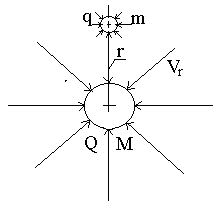
Figure 1: The mass cost of big body – Q, The mass cost of little body – q, The mass of big body – M, The mass of little body – m, Radius (distans) between the bodys -r the rate at which gaseous dark matter enters into the body – Vr The adsorption flows satisfy the principle of superposition, because the speeds are negligible compared to the speed of light and a dark matter has no viscosity. The mass qdt is the mass of dark matter absorbed by a small body over time dt. This mass has lost its speed 1 Vre in flow to a large body $$ V _ {r e 1} = Q / 4 \pi \rho_ {e} r ^ {2} \tag {9} $$ The loss of momentum 1 Vre qdt occurs due to the action of the force
$$ F d t = V _ {r e 1} q d t $$
with which the absorption flux to the body with mass M acts on the body with mass m. Therefore, this force is determined by the following formula:
Qq F $$ r = \frac {Q q}{4 \pi \rho_ {e} r ^ {2}} (1 0) $$
2 4 From (4) we have q
$$ u = \alpha m, Q = \alpha M. $$
. Substituting these
values in (10), we obtain:
2 α Mm F πρ = (11)
2 4 r e The same arguments with the same result can be used with respect to the absorption flux in relation to the body with mass m and its action on the body with mass M, because for potential flows the principle of superposition of flows is valid. Thus, equation (11) determines the force with which each of the bodies through the intermediate medium of dark matter acts on another body. The conclusion is valid for any number of baryons. We will by compare this formula with Newton’s law of gravity
2 Mm F f $$ = f \frac {M m}{r ^ {2}} (1 2) $$
$$ \mathrm {w h e r e} f = 6. 7 \times 1 0 ^ {- 1 1} \left[ N m ^ {2} / k g ^ {2} \right] $$
is the constant of
gravity [6]. We conclude that $$ f = \alpha^ {2} / 4 \pi \rho_ {e} (1 3) $$ From formulas (9), (10) and (11) we find that the acceleration of gravity is determined by the velocity of the jets of dark matter and the density of dark matter
2 $$ v = \alpha V _ {r e} = \frac {\alpha^ {2}}{4 \pi \rho_ {e}} \frac {M}{r ^ {2}} = f \frac {M}{r ^ {2}} \tag {14} $$ M M g V f re r r e
2 2 4 Taking into account (14) for gravity we can write $$ F _ {g} = m g = m \alpha V _ {r e} \tag {15} $$ in which g - acceleration in the SI system. Formula (15) establishes a bridge between the parameters of baryonic matter and dark matter. A dark matter is the primary matter - “material”, from which the baryonic matter of the universe around us is created; Vre −speed of jets of dark matter; dF −force is directed in the direction of speed. The density of dark matter in a gaseous state we find from (13) $$ \rho_ {e} = \alpha^ {2} / 4 \pi f \tag {16} $$ A star absorbs dark gas. Therefore, the photons of light emitted by a star must overcome the incoming stream of dark gas in all radial directions. It is like swimming down the river against the current. If the swimmer’s speed is not greater than the speed of the water, he can swim as long as he wants, but not move forward against the stream. With these considerations in mind, we conclude that a star ceases to be visible when the radial velocity of a gaseous dark matter on its surface becomes equal to the speed of light. Such a star will turn into a "black hole" and disappear from sight. This condition can be written using expressions (8) and (13) for the radial velocity on the surface of any star in the form:
$$V_{re0} = \frac{fm}{\alpha r_0^2} = C \quad (17)$$
where $f = \alpha^2 / 4\pi\rho_e = 6.7 \times 10^{-11} [Nm/kg^2]$ is the gravitational constant.
We use this formula to calculate the mass flow coefficient of gaseous dark matter through a surface of baryons $\alpha \left[1/s\right]$. From formula (17), we see that the highest radial velocity of gaseous dark matter on the surface of a star can be expected for about very dense stars with a large mass and small size. White dwarf stars are suitable for this purpose, including the densest star Wolf-457 with mass $m = 1.01 \times 10^{30} [kg]$ and radius $r_0 = 0.7 \times 10^6 [m]$. This star is about the same size as Earth. But its mass is a million times greater than the mass of the Earth, but only two times less than the mass of the Sun.
For the Wolf-457 Star, according to equation (17), the coefficient $\alpha = 0.46 \left[s^{-1}\right]$. Since this star is visible, it is clear that the coefficient $\alpha$ is somewhat larger. It is possible that there are more dense visible stars in the universe that are not yet found. Therefore, we take as the coefficient of mass flow of gaseous dark matter through the surface of all baryon bodies of the Universe
$$\alpha = 1 \left[s^{-1}\right] \quad (18)$$
If $\alpha$ is equal to unity, the speed of a dark gas jet on the surface of a Wolf-457 star is approximately equal to half the speed of light $V_{re0} = \frac{fm}{\alpha r_0^2} = 1.36 \times 10^8 m/s$. Today, the astronomers do not detect the denser stars [8]. Apparently, they became "black holes" and became invisible. The value $\alpha = 1 \left[s^{-1}\right]$ allows you to calculate the density value of calm dark gas (gaseous dark matter) using (13).
$$\rho_e = \alpha^2 / 4\pi f = 1.19 \times 10^9 [\kappa_2 / m^3] \quad (19)$$
We note that formulas (13) and (19) describe the physical nature of the Newtonian gravitational constant. This constant is inversely proportional to the density of gaseous dark matter, i.e. uniquely associated with the properties of dark matter.
Next, we evaluate the gas pressure of dark matter $p_e$. Dark matter gas is an ideal monatomic gas. It is characterized by the density $p_e$ and has the propagation velocity of small perturbations $C_{a0} = 3 \cdot 10^8 [m/s]$ (it is equal to the speed of light in vacuum). Then, in accordance with the laws of gas dynamics [5, 6] for pressure, we obtain
$$p_e = \frac{\rho_e \cdot C_{a0}^2}{\chi} = 6.426 \cdot 10^{25} [Nu/m^2] \quad (20)$$
where $\chi = \frac{i+2}{i} = \frac{5}{3} = 1.67$ is the adiabatic exponent, $i = 3$ is the number of degrees of freedom of an atom gaseous dark.
The observational astronomy has convincingly shown [5, 6] that a dark matter interacts with the molecules of a interstellar gas (CN-cyan radical) with temperature and with the a cosmic background radiation
$$T_e = 2.75 [K] \quad (21)$$
We take this temperature as the temperature of the gaseous of dark matter. Thus, we now have approximate values of the main parameters of the dark matter gas: density, pressure and temperature. The increase in mass cannot be understood as a purely mechanical addition of the absorbed mass of dark gas to the mass of the absorbing body. There is a physical process by which the absorbed large masses of dark gas are in turn converted into a very small baryon mass of bodies, thereby increasing their ability to absorb dark gas from the surrounding space. It is necessary to further study the relationship between the consumption of dark gas absorbed by baryons $\frac{dm_e}{dt}$ and the low rate of formation of a new baryon mass per unit time $\frac{dm}{dt}$.
For definition the coefficient rate of mass formation k, we turn to the phenomenon of secular acceleration of the Moon. It is known [9] that among many celestial movements that are fully consistent with celestial mechanics, there are several cases of inconsistencies between the observed and calculated movements of celestial bodies. One of these inexplicable phenomena is phenomenon of the centennial acceleration of the moon. A comparison of ancient observations of the eclipses of the Sun with new observations showed that the Moon is currently moving a little faster than before. Every 100 years, the moon goes forward against the calculated position at 10'' or at a distance of about 18.6 km. Only part of this acceleration, about 6 '', is explained by the theory of gravity, and the remaining 4'' are present due to an unknown reason [9]:
$$ \Delta S _ {1 0 0} = 7. 4 5 [ \mathrm {k m} ] = 0, 7 4 5 \times 1 0 ^ {4} [ m ] (2 2) $$ The moon accelerates due to the increase in the mass of the Earth in time. We show it. Assuming that the orbit of the moon has a circular shape, we write down the equality of forces acting on the moon (gravity and centrifugal force):
$$ m V ^ {2} / r _ {o p b i t} = f m M / r _ {o p b i t} ^ {2} \tag {23} $$
Where m and M- the masses of the moon and the earth, ropbit is the radius of the orbit of the moon, f is the gravitational constant. From this equation we find the orbital velocity of the moon:
$$ V = \sqrt {f M / r _ {o p b i t}} $$
. Given the increase in the mass of the Earth (formula (7)), we obtain the law of increasing speed in time:
$$ r = \sqrt {\frac {f M _ {0}}{r _ {o p b i t}}} e ^ {\frac {\alpha t}{2 k}} \approx \sqrt {\frac {f M _ {0}}{r _ {o p b i t}}} \left(1 + \frac {\alpha}{2 k} t\right) $$ t fM fM k V e t r r k opbit opbit
0 0 2 1 (24)
2 where 0 M is the mass of the earth at the initial moment 0 t = . This relationship means that over time, the orbital velocity must increase in order to keep the moon in its orbit. From (24) the additional increment of the Moon’s path due to its orbital acceleration can be written in the form:
- $\Delta S=\frac{1}{4}\frac{\alpha}{k}\sqrt{\frac{fM_{0}}{r_{opbit}}} t^{2}$
Table 1: The results of calculations of the ratios of baryon masses _m_ at the considered time to mass at the initial time in the
$$ \mathrm {F o r} M _ {0} = 5. 9 8 \times 1 0 ^ {2 4} [ k g ], r _ {o p b i t} = 3. 8 4 4 \times 1 0 ^ {8} [ m ], $$
9 100 [years] 0 [ 3.15 1 ] t s = = × we get $$ \Delta S _ {1 0 0} = 2. 5 2 \times 1 0 ^ {2 1} \alpha / k [ m ] \tag {26} $$ Due to the proximity of the moon to the earth in its motion, such deviations can be seen. But such deviations cannot be detected in observations of more distant astronomical objects. Given the reliability of the data on the motion of the moon, we use equations (22, 26) to determine the ratio / k α and the rate of mass formation k :
$$ \begin{array}{l} \alpha / k = 2. 9 7 \times 1 0 ^ {- 1 8} [ 1 / c ] (2 7) \\ k = 3. 3 6 \times 1 0 ^ {1 7} (2 8) \\ \end{array} $$ The values of the coefficients 1 1[ ] s α − = and 17 3.36 10 k = × allow us to return to the law (7) of the increase in the mass of baryons in the Universe as a function of time. Table 1 shows the results of calculations of the ratios of baryon masses m at the considered time to mass o m at the initial time in the range from 1 billion years to 20 billion years. All elementary particles, atoms, molecules, as well as planets and stars, including our Earth, obey this law.
| Time(billion years) | 1,0 | 2,0 | 3,0 | 3,5 | 5 | 10 | 15 | 20 |
|---|---|---|---|---|---|---|---|---|
| m/m_{0}=e^{\frac{\alpha}{k}t}$ | 1,1 | 1,2 | 1,33 | 1,38 | 1,61 | 2,59 | 4,17 | 6,62 |
Table 2: The results of calculations of the ratios of baryon masses _m_ at the considered time to mass at the initial time in the
the ratios of baryon masses – $m/m_0$.
$(e=2,71828)$,
the Hubble constant $\frac{\alpha}{k}$ $(\alpha/k = 2.97 \times 10^{-18} [1/s])$,
time $t$
We recall that the baryonic bodies absorb a gaseous dark matter from the surrounding space in accordance with equation (5). From the equation (5) it follows that the rate of absorption of the mass of gaseous dark matter is many times greater than the rate of formation of the baryon mass. Over time, a large mass of dark matter gaseous creates a very small amount of baryonic mass. We obtain the relationship between these masses by integrating equation (5) and setting the integration constant to zero
$$m = \frac{m_e}{k} (29)$$
The density value (19) is expressed in units of the primary of matter. At the boundary of elementary particles a phase transition of the huge volumes of dark matter (the primary of matter) transformed into insignificant volumes of baryonic matter. This is equivalent the fact the density of gaseous dark matter in units of baryonic matter is reduced compared to (19) in accordance with (29) in $k$ times:
$$\rho_e^* = \rho_e / k = 3.54 \times 10^{-12} [g/sm^3] = 3.54 \times 10^{-9} [kg/m^3]$$
Such is the average density of gaseous dark matter in the Universe, recorded in units of the density of baryonic matter (Sl). It becomes like this upon a phase transition from a gaseous state a dark matter to a liquid state. The formula (30) is a bridge between a dark matter and a baryonic matter.
References
-
Burago SG (2014) Gravity, dark matter and dark energy balance. The General Science Journal pp: 20.
-
Burago SG (2016) The Experimental evidence for the dark matter of the universe. J Phys Math 7: 166.
-
Burago SG (2018) About the Big Bang Theory and the Heat Death of the Universe. Journal Actual problems of modern science 6(103).
-
Burago SG (2009) Aetherodynamics-the key to the mysteries of the Universe. Moscow BookHouse, Librokom, pp: 232.
-
Kochin NE, Roze NV, Kibel IA (1963) Theoretical hydromechanics. John Wiley & Sons, Ltd, pp: 583.
-
Frisch SE, Timofeeva AV (1961) General physics course.
-
Bronsten VA (1974) Hypotheses about the stars and the Universe. Nauka, Moscow.
-
Agekyan TA (1981) Stars, galaxies, metagalaxy. Nauka, Moscow.
-
Whipple F (1948) The Earth, The Moon, and The Planets. Gostekhtheorizd, Moscow.
- Sense, Gravity, Parity & Chirality in Mathematical Physics
- Quantum Lattice Simulations PHYSICS: Microcircuit Particle Formation and Observable Macroscopic Irreversible Time - A Discrete Lagrangian with Cellular Automata Framework
- Quantum Biology from Biomacromolecule to Cell, and Central Dogma Described by Quantum Theory
- Focus, Agility, Speed and Technology (FAST) for Sustainability and Growth
- Square Root Metric Geometry and Pati-Salam Model in Curved Space-Time
- A Simple System Demonstrating the Mpemba Effect in Classical Mechanics