
Variant Mass for a Particle which Emits Gravitational Energy for a Particle Orbiting a Large Planet or Sun and for a Binary Star and Variant Frequency for the Light Passing Close a Gravitational Field from a Massive Object (Sun): The Physics and Emission of the Gravitational Energy
The Fundament of the Mass and the new theory and formula of the Variant Mass for a particle in Gravitation is presented at this research. Albert Einstein wrote in a research article: “Does the inertia of a body depend on its energy content?” (Ist die Trägheit eines Körpers von seimen Energienhalt abhängig?): “If a body emits energy E in the form of radiation, its mass decreases by E/ c2. The fact that the energy that leaves from the body is converted into radiation energy makes no difference, so the more general conclusion is reached that the mass of a body is a measure of the content of its energy ... It is not impossible that with bodies whose content of energy is highly variable (for example radio salts) the theory can be successfully tested. If the theory corresponds to the fact, radiation conducts inertia between the bodies that emit and absorb it”. Thus, Maxwell’s theory shows that electromagnetic waves are radiated (Maxwell Radiation) whenever charges accelerate as for example for the electron. Then, this electromagnetic radiation (photons) produces decreases in the mass of the electron which is given by the formula of the Variant Mass for an Accelerated Charged Particle which was demonstrated by me at this research: Variant Mass for an Accelerated Charged Particle. For other hand, at the atom, the electron only radiates this energy when it jumps from one orbit to another orbit at the atom. It is in accordance with the experimental results from the spectral lines of the atom. The difference is that in a gravitational field the particle or a planet around the sun can take any position at the space and any radius. But, the electron at the atom only can take restricted positions which are explained by quantum mechanics, and the electrons don´t emit radiation when they orbit around the nucleus. The discovery formula for the variant mass of the electron at the atom which describe exactly the variant mass of a charged particle at the atom which emits electromagnetic energy from one stationary level to other was demonstrated by myself a the research: The Fundament of the Mass: The Variant Mass for the electron at the atom.
A Particle Orbiting an Almost Static Massive Planet or Sun
The mass of the particle is m and the mass of the massive planet or Sun is M. The particle moves around the planet in a circular motion with radius R. If the planet moves around the Sun, the exact motion is an ellipse as Kepler has established (Figure 1).
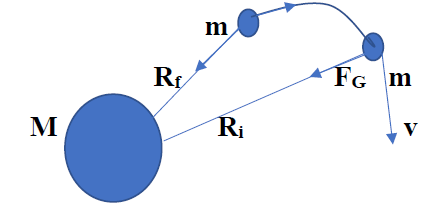
The gravitational force between the particle and the planet gives out the Gravitational Potential Energy. Besides, the particle emits gravitational energy due the presence of a massive planet near the particle. Then, the mass of the particle decreases due the emission of the gravitational energy. As result of it, the particle changes a little it’s trajectory by decreasing a little the distance R with the planet. Then, the particle starts to move in a circular or elliptical motion (rotational motion) around the massive planet due the initial velocity of the particle. It is the case of the planetary system moving or orbiting around its massive star. The effect of the little change of the trajectory is possible to measure at the motion of Mercury (Perihelion Precession).
Formula Development of the Total Mass and Energy of the Particle In a Gravitational Field
$$ c ^ {2} d m = \frac {d p}{d t} d s + \frac {G M m}{r ^ {2}} d r $$
$$ c ^ {2} d m = m v d v + v ^ {2} d m + \frac {G M m}{r ^ {2}} d r $$
$$ c ^ {2} d m - v ^ {2} d m = m v d v + \frac {G M m}{r ^ {2}} d r $$
2 $$ \frac {G M m}{r ^ {2}} = m \frac {v ^ {2}}{r} $$
$$ \frac {G M}{r} = v ^ {2} $$
$$ - \frac {G M}{2 r ^ {2}} d r = v d v $$
$$ c ^ {2} d m - \frac {G M}{r} d m = - \frac {G M m}{2 r ^ {2}} d r + \frac {G M m}{r ^ {2}} d r $$ $$ \left(c ^ {2} - \frac {G M}{r}\right) d m = \frac {G M m}{2 r ^ {2}} / d r $$
2 2 ( ) / 2
2 2 GM dm r dr m GM c r
2 = −
$$ n \left(\frac {m}{m _ {o}}\right) = \frac {1}{2} \ln \left(\frac {\left(c ^ {2} - \frac {G M}{r}\right)}{\left(c ^ {2} - \frac {G M}{r _ {o}}\right)}\right) $$ GM c m r ln ln m GM c r
2 ( ) 1 2 ( ) o m=mo ro=∞
2 o $$ m = m _ {o} \sqrt {\left(1 - \frac {G M}{r c ^ {2}}\right)} \frac {G M}{r} = v ^ {2} $$
2 $$ \mathrm {m} = \mathrm {m} _ {\mathrm {o}} \sqrt {\left(1 - \frac {v ^ {2}}{c ^ {2}}\right)} $$ mass for a particle in a gravitational field Δm=mo-m $$ n = m _ {o} \left(1 - \sqrt {\left(1 - \frac {G M}{r c ^ {2}}\right)}\right) $$
2 1 (1 GM rc
o Äm m total lost mass of the particle GM/r<<c2
$$ i = m _ {o} \left(1 - \frac {G M}{2 r c ^ {2}}\right) $$
2 1 2 o GM m m rc $$ m c ^ {2} = m _ {o} c ^ {2} - \frac {G M m _ {o}}{2 r} $$
2 2 2
$$ \ddot {A} m = m _ {o} c ^ {2} - m c ^ {2} = \left(\frac {G M m _ {o}}{2 R}\right) $$
as the total mass decreasing of
2 2 o o the particle in a gravitational field for the classic approach The formula for the mass given by the Relativity Theory [1] is as follows:
2 1
2
| GM 1− rc2 |
|---|
o GM/r<<c2
2 2 1 2 1 GM GM
$$ 1 - 2 \frac {G M}{r c ^ {2}} \approx 1 - \frac {G M}{r c ^ {2}} $$
$$ \left(1 - \frac {G M}{r c ^ {2}}\right) ^ {- 1 / 2} \approx 1 + \frac {1}{2} $$
1/2 GM GM
2 2 1 1 2 rc rc $$ n = m _ {o} \left(1 - \frac {G M}{2 r c ^ {2}}\right) $$
(as the classic approach).
2 1 2 o GM m m rc $$ m c ^ {2} = m _ {o} c ^ {2} + E E = m c ^ {2} - m _ {o} c ^ {2} $$ $$ E = - \frac {G M m _ {o}}{2 r} $$ r (as the classic approach).
= − −
2 / 1 1 GM rc o Äm m Development mass formula − ∆ = − − GM rc m m GM rc
1 2 / 1
2 o General Relativity formula
1
2
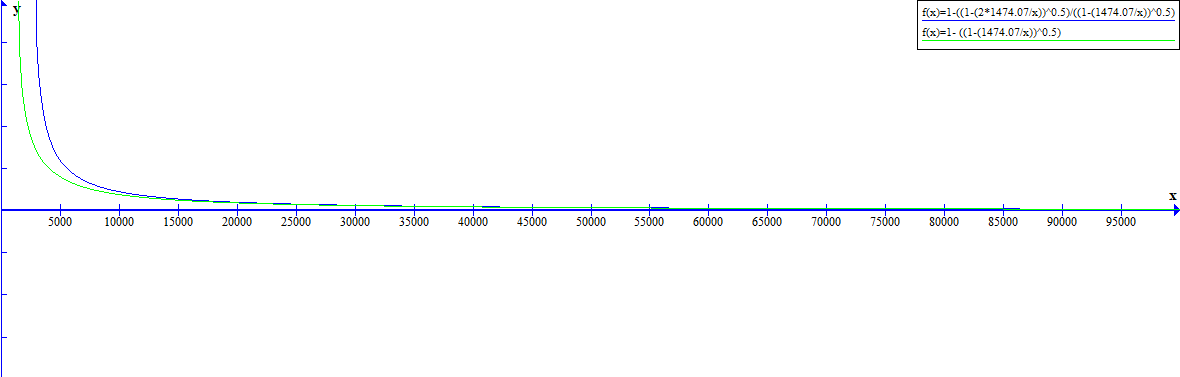
Both formulas for the total mass decreasing of the particle agree at distances very far from the massive object and also at distances very near to the massive object with high accuracy. Then, both models: the Newton Approach with a gravitational field interaction and the Relativity Theory with a curvature of the space time are in agreement at the results for the total mass decreasing of the particle in a gravitational field.
For the total energy of the particle, it is obtained:
$$ E = m c ^ {2} - m _ {o} c ^ {2} $$
$$ ' = m _ {o} c ^ {2} \left(\sqrt {\left(1 - \frac {G M}{r c ^ {2}} - 1\right)}\right) $$ GM E m c rc energy for a particle in a o gravitational field GM/r<<c2 $$ E = - \frac {G M m _ {o}}{2 r} $$ r (as the classic approach) The total mass energy lost is given by the formula demonstrated and it is equal in absolute value to the total bond energy of the system which is emitted as gravitational energy when the particle goes from one orbit to another orbit with fewer radiuses. The emission of the total gravitational energy E produces a lost mass of the particle m=E/c2.
$$ \Delta E = E _ {f} - E _ {i} = \left(- \frac {G M m}{2 R _ {f}}\right) - \left(- \frac {G M m}{2 R _ {i}}\right) $$ GMm GMm E E E R R If Rf<Ri 2 2 f i f i is negative, it is given out energy which means that the particle losses mass, the particle increases the kinetic energy and the velocity but decreases the gravitational potential energy (more negative). Part of the losses energy (gravitational energy emission) is given out by decreasing the potential energy and part by increasing the kinetic energy [2].
If Rf>Ri ΔE is positive, which means that additional energy is given to the particle or additional work is done on the system, the particle decreases the kinetic energy and the velocity but increases the potential energy (less negative). Part of the work or additional energy is used to increase the potential energy and part to diminish the kinetic energy [2].
Binary Stars
If the particle and the planet have comparable and similar masses, then they start to move around each other and orbiting around their common barycenter (rotational motion) [3, 4].
Case m1≠m2
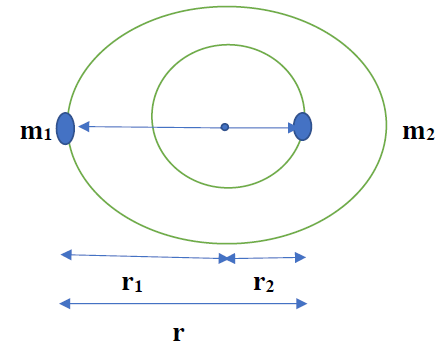
It occurs in binary stars for example. Also, they emit gravitational energy and as a consequence, there is a decrease in their masses and the distance between them due this energy emission.
By considering the center of mass in r=0, it is obtained: m1r1=m2r2 r1=m2r2/m1 r=r1+r2 r= (m2r2/m1)+r2 r=(m1+m2)r2/m1 r2=(m1)r/ (m1+m2) r2=m1r1/m2 r=r1+r2 r=r1+ m1r1/m2 r=(m1+m2)r1/m2 r1=(m2)r/ (m1+m2) $$ K _ {1} = \frac {1}{2} m _ {1} v _ {1} ^ {2} $$
v1=w1 r1 w1= v1/r1
2 1 2 1 1 2 1
$$ G \frac {m _ {1} m _ {2}}{r ^ {2}} = m _ {1} \frac {v _ {1} ^ {2}}{r _ {1}} $$
2 2 2 1 1 2) (
$$ G \frac {m _ {2} ^ {2}}{r \left(m _ {1} + m _ {2}\right)} = v _ {1} ^ {2} $$
$$ G \frac {m _ {2} r _ {1}}{r ^ {2}} = v _ {1} ^ {2} $$
+ =
1 2) 2 1 3 (m m w G r
2 2 1 2 1 2 2 1 1
$$ w _ {1} ^ {2} = \frac {v _ {1} ^ {2}}{r _ {1} ^ {2}} = G \frac {m _ {2}}{r ^ {2} r _ {1}} $$ m r m m r K m v m G G r r = = =
2 2 1 1 2 1 1 1 1 1 2 2 1 1 1 2 2 2
r1=(m2)r/ (m1+m2)
$$K_1 = \frac{1}{2} G \frac{m_1 m_2}{r} \frac{m_2}{(m_1 + m_2)} \text{ kinetic energy for } m_1$$
$$K_2 = \frac{1}{2} m_2 v_2^2 v_2 = w_2 r_2 w_2 = v_2/r_2$$
$$G \frac{m_1 m_2}{r^2} = m_2 \frac{v_2^2}{r^2}$$
$$G \frac{m_1 r_2}{r^2} = v_2^2 G \frac{m_1^2}{r(m_1 + m_2)} = v_2^2$$
$$w_2^2 = \frac{v_2^2}{r^2} = G \frac{m_1}{r^2 r_2} w_2^2 = G \frac{(m_1 + m_2)}{r^3}$$
$$K_2 = \frac{1}{2} m_2 v_2^2 = \frac{1}{2} m_2 G \frac{m_1 r_2}{r^2} = \frac{1}{2} G \frac{m_1 m_2 r_2}{r^2}$$
$$r_2 = (m_1) r / (m_1 + m_2)$$
$$K_2 = \frac{1}{2} G \frac{m_1 m_2}{r} \frac{m_1}{(m_1 + m_2)} \text{ kinetic energy for } m_2$$
$m_1$ and $m_2$ have different kinetic energies
$$K_T = K_1 + K_2 = \frac{1}{2} G \frac{m_1 m_2}{r} \frac{m_2}{(m_1 + m_2)} + \frac{1}{2} G \frac{m_1 m_2}{r} \frac{m_1}{(m_1 + m_2)}$$
$$K_T = \frac{1}{2} G \frac{m_1 m_2}{r}$$
$$U = -G \frac{m_1 m_2}{r}$$
Therefore, the total mechanical energy of the system of the binary stars which is given as emission of gravitational energy is:
$$E = K_T + U = \frac{1}{2} G \frac{m_1 m_2}{r} - G \frac{m_1 m_2}{r}$$
$$E = -G \frac{m_1 m_2}{2r}$$
It is the same total energy formula of a particle orbiting an almost static massive object. Each mass $m$ has equal angular velocity, equal angular frequency and different kinetic energy with different linear velocities.
The mass of each star is as follows:
$$m_1 = m_{o1} \sqrt{(1 - \frac{v_1^2}{c^2})} G \frac{m_{o2}^2}{r(m_{o1} + m_{o2})} = v_1^2$$
Then, each star has different lost mass given by $\Delta m = m_{o1} c^2 - m_1 c^2$. Also, each star has different gravitational energy emission corresponding to the lost mass of the respective star. It is possible to obtain the total energy at the classic approach:
$$m_1 = m_{o1} \left(1 - \frac{v_1^2}{c^2}\right) E_1 = m_1 c^2 - m_{o1} c^2 = -\frac{v_1^2}{2} m_{o1}$$
$$m_2 = m_{o2} \left(1 - \frac{v_2^2}{c^2}\right) E_2 = m_2 c^2 - m_{o2} c^2 = -\frac{v_2^2}{2} m_{o2}$$
$$E = E_1 + E_2 = -G \frac{m_{o2}^2}{r(m_{o1} + m_{o2})} \frac{m_{o1}}{2} - G \frac{m_{o1}^2}{r(m_{o1} + m_{o2})} \frac{m_{o2}}{2}$$
$$E = -G \frac{m_{o1} m_{o2}}{2r}$$
**Case $m_1 = m_2 = m$:**
$$mr_1 = mr_2 r_1 = r_2$$
Each mass $m$ orbits the same circle of radius $r_1 = r_2$
$$r = r_1 + r_2$$
$$r = 2r_1 r = 2r_2 r_1 = r/2 r_2 = r/2$$
For $m_1$, it is obtained:
$$G \frac{mm}{r^2} = m \frac{v_1^2}{r_1} G \frac{mr_1}{r^2} = v_1^2 G \frac{m}{r^2} = v_1^2 r_1 = r/2$$
$$w_1^2 = \frac{v_1^2}{r_1^2} = G \frac{m}{r^2 r_1} = G \frac{2m}{r^3}$$
$$K_1 = \frac{1}{2} m v_1^2$$
$$K_1 = \frac{1}{2} m v_1^2 = \frac{1}{2} m G \frac{m}{2r} = G \frac{m^2}{4r}$$
For $m_2$, it is obtained:
$$G \frac{mm}{r^2} = m \frac{v_2^2}{r_2} G \frac{mr_2}{r^2} = v_2^2 G \frac{m}{r^2} = v_2^2 r_2 = r/2$$
$$w_2^2 = \frac{v_2^2}{r_2^2} = G \frac{m}{r^2 r_2} = G \frac{2m}{r^3}$$
$$K_2 = \frac{1}{2} m v_2^2$$
Alcocer G. Variant Mass for a Particle which Emits Gravitational Energy for a Particle Orbiting a Large Planet or Sun and for a Binary Star and Variant Frequency for the Light Passing Close a Gravitational Field from a Massive Object (Sun): The Physics and Emission of the Gravitational Energy. Phys Sci & Biophys J 2021, 5(2): 000193.
$$ K _ {2} = \frac {1}{2} m v _ {2} ^ {2} = \frac {1}{2} m G \frac {m}{2 r} = G \frac {m ^ {2}}{4 r} $$ It is possible to obtain the same result, if we replace m1=m2 in the formula:
2 m m m K G r m m $$ = \frac {1}{2} G \frac {m _ {1} m _ {2}}{r} \frac {m _ {2}}{\left(m _ {1} + m _ {2}\right)} $$ $$ K _ {1} = G \frac {m ^ {2}}{4 r} \mathrm {m} _ {1} = \mathrm {m} _ {2} = \mathrm {m} $$
1 2 2 1 1 2
2 m m m K G r m m $$ _ {2} = \frac {1}{2} G \frac {m _ {1} m _ {2}}{r} \frac {m _ {1}}{\left(m _ {1} + m _ {2}\right)} $$ $$ K _ {2} = G \frac {m ^ {2}}{4 r} $$
1 2 1 2 1 2
2 $$ K _ {T} = K _ {1} + K _ {2} = 2 G \frac {m ^ {2}}{4 r} $$
2 $$ U = - G \frac {m ^ {2}}{r} $$
$$ K _ {T} = G \frac {m ^ {2}}{2 r} $$
Each mass m has equal angular velocity, equal angular frequency, equal energy emission, equal linear velocity and equal kinetic energy. Thus, the total mechanical energy of the system of the binary stars is:
2 2 $$ E = K _ {T} + U = G \frac {m ^ {2}}{2 r} - G \frac {m ^ {2}}{r} $$
2 $$ E = - G \frac {m ^ {2}}{2 r} $$
It is possible to obtain the total energy of the system from the formula:
m m m m m m K K K G G r m m r m m $$ K _ {T} = K _ {1} + K _ {2} = \frac {1}{2} G \frac {m _ {1} m _ {2}}{r} \frac {m _ {2}}{\left(m _ {1} + m _ {2}\right)} + \frac {1}{2} G \frac {m _ {1} m _ {2}}{r} \frac {m _ {1}}{\left(m _ {1} + m _ {2}\right)} $$
1 2 2 1 2 1 1 2 1 2 1 2
$$ U = - G \frac {m _ {1} m _ {2}}{r} $$
For m1=m2=m and r1=r2=r/2 r=r1+r2 $$ E = K _ {T} + U = 2 G \frac {m ^ {2}}{4 r} - G \frac {m ^ {2}}{r} $$
2 $$ E = - G \frac {m ^ {2}}{2 r} $$
The mass of each star is as follows:
$$ m _ {1} = m _ {o 1} \sqrt {\left(1 - \frac {v _ {1} ^ {2}}{c ^ {2}}\right)} $$ v m m c $$ G \frac {m _ {o}}{2 r} = v _ {1} ^ {2} m _ {o 1} = m _ {o 2} = m _ {o} $$ $$ m _ {2} = m _ {o 2} \sqrt {\left(1 - \frac {v _ {2} ^ {2}}{c ^ {2}}\right)} $$ v m m c $$ G \frac {m _ {o}}{2 r} = v _ {2} ^ {2} $$ Then, each star has equal lost mass given by Δm= moc2- mc2. Also, each star has equal gravitational energy emission. It is possible to obtain for the total energy at the classic approach:
$$ = m _ {o 1} \left(1 - \frac {V _ {1} ^ {2}}{2 c ^ {2}}\right) $$
2 1 1 1 2 1 2 o v m m c $$ E _ {1} = m _ {1} c ^ {2} - m _ {o 1} c ^ {2} = - \frac {v _ {1} ^ {2}}{2} m _ {o 1} $$ $$ = m _ {o 2} \left(1 - \frac {V _ {2} ^ {2}}{2 c ^ {2}}\right) $$
2 2 2 2 2 1 2 o v m m c $$ E _ {2} = m _ {2} c ^ {2} - m _ {o 2} c ^ {2} = - \frac {v _ {2} ^ {2}}{2} m _ {o 2} $$ $$ E = E _ {1} + E _ {2} = - G \frac {m _ {o}}{2 r} \frac {m _ {o}}{2} - G \frac {m _ {o}}{2 r} \frac {m _ {o}}{2} \mathrm {m} _ {\mathrm {o} 1} = \mathrm {m} _ {\mathrm {o} 2} = \mathrm {m} _ {\mathrm {o}} $$
1 2 2 2 2 2
2 $$ E = - G \frac {m _ {o} ^ {2}}{2 r} $$
r as the classic result
Thought Experiment (Gedanken Experiment)
Thought Experiment 1
Gravitational Red Shift and Effects of the Gravitation on the time measure, frequency, wavelength and on the light velocity: A uniform gravitational field g is directed downward in K, with the photon emitted by an atom A falling a distance d through this field before it is absorbed by the detector D [5]. The system K’ is accelerated uniformly upwards with respect to K with a = g (Figure 4).
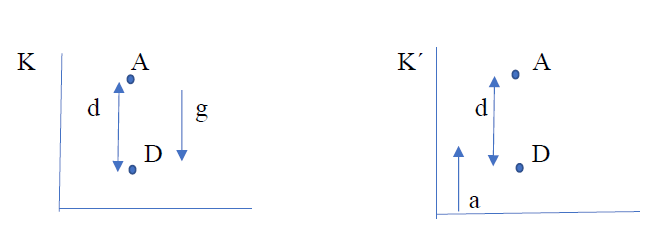
When the photon is emitted in the system K´, it has some velocity u in this system. The velocity of the detector when the photon reaches is u + at, where t is the photon’s flight time: t is approximately d/c and a = g.
The velocity of the detector absorbing it is u + gd /c. If it is introduced the unaccelerated reference system Ko, with respect to which at the instant of light emission, K ‘ has not velocity, then D, at the instant of arrival of the radiation at D has the velocity gd v c = with respect to Ko [6]. Indeed, the detector has an approximation velocity with respect to the emitter of $v = \frac{gd}{c}$, independent of $u$.
Therefore the received frequency $f'$ at the detector is greater than the emitted one $f$. It is giving by the formula of the Doppler effect:
$$\frac{f'}{f} = \sqrt{\frac{c + v}{c - v}} = \sqrt{\frac{c + \frac{gd}{c}}{c - \frac{gd}{c}}} \frac{f'}{f} = \sqrt{\frac{1 + \frac{gd}{c^2}}{1 - \frac{gd}{c^2}}}$$
$$\left(1 + \frac{gd}{c^2}\right)^{1/2} \cong 1 + \frac{gd}{2c^2} \quad gd << c^2$$
$$\left(1 - \frac{gd}{c^2}\right)^{-1/2} \cong 1 + \frac{gd}{2c^2} \quad gd << c^2$$
$$\left(1 + \frac{gd}{c^2}\right)^{1/2} \left(1 - \frac{gd}{c^2}\right)^{-1/2} = \left(1 + \frac{gd}{2c^2}\right) \left(1 + \frac{gd}{2c^2}\right) \left(\frac{gd}{2c^2}\right)^2 \approx 0 \text{ for } gd << c^2$$
$$\frac{f'}{f} \cong 1 + \frac{gd}{c^2} \quad f' \cong f \left(1 + \frac{gd}{c^2}\right) \text{ for system } K'$$
$$f' \cong f \left(1 + \frac{v}{c}\right) \text{ where } v = \frac{gd}{c}$$
It is possible to obtain the same formula with the equivalence principle for the system $K$ as follows: Let’s consider that $A$ and $D$ are at rest and there is no Doppler effect which explains the increase in frequency. But, there is a gravitational field and this field acts on the photon [5].
Then, it is possible to obtain the same formula with the equivalence principle for the system $K$ where there is a gravitational field ($A$ and $D$ are at rest). It is given to the photon a gravitational mass equal to its inertial mass $E/c^2$.
When falling a distance $d$, the photon gains an energy $(E/c^2)gd$. In quantum theory, the relationship for $E$ is $E = hf$. It can be shown that $E$ is proportional to $f$ and that from the relativistic transformation of energy and momentum. Thus, it is obtained: $\Delta m = E/c^2 = hf/c^2$.
The energy of the photon being absorbed at $D$ is its initial emission energy plus the energy gained by falling from $A$. This absorption energy in $D$ is:
$$E' = E + (E/c^2)gd \quad E' = E \left(1 + \frac{gd}{c^2}\right) \quad E' = hf$$
Therefore, it is necessary to add to the energy $E$ the potential energy due to the gravity. It probes also that the increase/decrease of the inertial mass in the accelerated system $K'$ corresponds to the increase/decrease of the gravitational mass in the gravitational system $K$.
Thus, when light falls in a gravitational field at the same direction of the gravity acceleration, the light acquires greater energy and frequency, its wavelength decreases and it is said to deviate towards the blue. If the emitter and detector had been reversed and light rises in opposite direction to the gravity acceleration, it is concluded that the energy and frequency of the light decrease, its wavelength increases and it is said to drift towards the red. Thus, if the photon instead of descending from $A$ to $D$ in the accelerated system, it ascends from $D$ to $A$, the formula is:
$$f' \cong f \left(1 - \frac{gd}{c^2}\right) \text{ light rises in opposite direction to the gravitational field}$$
The value of the gravitational potential is replaced and it is obtained:
$$E' = E \left(1 + \frac{\Phi}{c^2}\right)$$
$$U = m_0 gd \quad U = -\frac{GMm_0}{R}$$
$$\frac{GMm_0}{R} = m_0 \dot{g} \quad \frac{GM}{R} = gd$$
$$f' \cong f \left(1 - \frac{GM}{Rc^2}\right) \text{ gravitational redshift for the light}$$
where $M$ is the mass of the planet or Sun and $R$ is the respective radius. The minus sign is because the photon losses energy to pass near the gravitational field of the Sun or the Planet. This is known as gravitational red shift, because light in the visible part of the spectrum will be shifted toward the red end [5].
By using the variant Mass due the Gravitational Potential Energy, it is obtained:
The gravitational potential energy is equal to the negative work done by the gravitational force because it is necessary to give energy or to do work on the system to separate the particle m.
$$c^2 dm = dU$$
$$c^2 dm = G \frac{Mm}{R^2} dR$$
$$\frac{dm}{m} = \frac{GM}{c^2} \frac{dR}{R^2}$$
$$\ln \frac{m}{m_o} = -\frac{GM}{c^2} \left( \frac{1}{R} - \frac{1}{R_o} \right)$$
The reference point is arbitrary for the gravitational potential energy. It is chosen the point where the force is 0 at $R_o = \infty$.
$$m = m_o e^{-\frac{GM}{c^2} \left( \frac{1}{R} \right)}$$
(Variant Mass due the Gravitational Potential Energy)
$$\frac{GMm}{R^2} = m \frac{v^2}{R} \frac{GM}{R} = v^2$$
$$GM \left( \frac{1}{R} \right) = c^2 v^2 << c^2 v << c$$
$$e^{-\frac{GM}{c^2} \left( \frac{1}{R} \right)} = 1 - \frac{GM}{c^2} \left( \frac{1}{R} \right) + \frac{1}{2} \left[ \frac{GM}{c^2} \left( \frac{1}{R} \right) \right]^2 + \dots$$
$$m = m_o \left[ 1 - \frac{GM}{c^2} \left( \frac{1}{R} \right) \right]$$
$$mc^2 = m_o c^2 \left[ 1 - \frac{GM}{c^2} \left( \frac{1}{R} \right) \right]$$
For the light, it is necessary to replace $mc^2 = hf$:
$$f' \cong f \left( 1 - \frac{GM}{Rc^2} \right) \text{ gravitational redshift for the light}$$
It is possible to have the next question due the gravitational redshift: if there is constant transmission of light from A to D, how can any other number of periods per second other than that emitted at A reach D? The answer is because we cannot consider f or f' simply as frequencies (as the number of periods per second) since we have not yet determined the time in the system K. What f denotes is the number of periods per second with reference to the unit of time of the clock U in A, while f' denotes the number of periods per second with reference to the identical clock in D [6].
Nothing forces us to suppose that U-clocks at different gravitational potentials must be considered to be running at the same rate. On the contrary, we must certainly define the time in the gravitational system K in such a way that the number of wave crests and valleys between A and D is independent of the absolute value of time. Thus, the two clocks at A and D measures the time at the same rate. It means that If we measure the time in D with the clock U, then we must measure the time in A with a clock running $\left( 1 - \frac{GM}{Rc^2} \right)$ times slower than the clock U:
$$t_A = t_D \left( 1 - \frac{GM}{Rc^2} \right)$$
when compared to U in D and in the same place [1]. Then, the relation of the both times is as follows:
$$t_D = t_A / \left( 1 - \frac{GM}{Rc^2} \right) t' = t / \left( 1 - \frac{GM}{Rc^2} \right)$$
Then, when we measure by this clock, the frequency of the light ray in its emission at A is equal to:
$$f \left( 1 - \frac{GM}{Rc^2} \right) \text{ (less count of number of wave crests and valleys due the time dilation measures in A), and therefore it is equal to the frequency f' of the same light ray upon arrival at the detector D.}$$
Thus, it is necessary to use U clocks of different constitution to measure time in places of different gravitational potential. If we want to measure time in a place that, with respect to the origin of coordinates, has the gravitational potential $\Phi$, it is necessary to use a clock that (when brought to the origin of coordinates) runs $\left( 1 - \frac{GM}{Rc^2} \right)$ times slower than the clock used to measure time at the origin of coordinates.
Also, the formula for the decreased distance $d$ of a particle orbiting a Planet due the gravitational energy emission is as follows:
$$d' = d \left( 1 - \frac{GM}{Rc^2} \right)$$
The wavelength is given by the next formula:
$$\tilde{e} = \frac{-\frac{GM}{Rc^2}}{\lambda_c} : \text{increased wavelength due to gravitational potential.}$$
The light velocity $v' = \lambda' f'$ is obtained by replacing the respective formula $\lambda'$ and $f'$ or $v' = \frac{d'}{t'}$:
$$v' = v_o \left( 1 - \frac{GM}{Rc^2} \right)^2$$
$$v' \cong v_o \left( 1 - \frac{GM}{Rc^2} \right) \text{ light velocity in a gravitational field } \Phi$$
It is also known as the refraction index for the light [1].
The variation velocity is because the different gravitational potential between different places. It is consequence of the time dilation of the place with gravitational field. The light has lower velocity in a place with gravitational velocity than in a place without the gravitational field [6].
This seems to contradict the principle of constancy of the speed of light. But there is no contradiction, because this light velocity variation is due to the gravitational field. The light velocity remains constant at the place where there is the same gravitational potential but with different value in relation with other location where there is other gravitational potential.
In resume, in a gravitational field, the light has lower velocity, lower rates of the clock-time (less time measured) than the light in a place without gravitational field. Then, the light passing near the Sun for example experiments the gravitational redshift when the light is observed the Earth (less frequency measured, deviation to the red), more wavelength, because of the time clock measure and the real lost energy.
**Thought Experiment 2**
Inertial Mass=Gravitational Mass: It is considered the following sequences from the previous thought experiment [6]:
1. The energy $E$ measured in $A$ is emitted in the form of radiation from $A$ towards $D$, where by the result just obtained, the energy absorbed and measured in $D$ is:
$$E' = E \left( 1 + \frac{gd}{c^2} \right)$$
2. An object of mass $M$ is lowered from $A$ to $D$, doing work $W$ in the process.
3. The energy $E$ is transferred from $D$ to the object of mass $M$ while it is in $D$. The mass $M$ is now $M'$ due to this addition of the energy.
4. The object is raised again to $A$, doing work in this process.
5. Let the energy $E$ transferred back from the object to $A$.
6. The effect of this cycle is simply that $D$ has experienced the increase in energy $E \frac{gd}{c^2}$ of the pulse emitted in $A$ and that the amount of energy $M'gd-Mgd$ has been transmitted to the system in the form of mechanical work. By the principle of energy, we must have:
$$E \frac{gd}{c^2} = M'gd - Mgd$$
Thus, the increase in gravitational mass is equal to $E/c^2$ and equal to the increase in inert mass which is established by the theory of relativity. This result is in accordance with the equivalence principle.
**Experimental Test**
**Gravitational Redshift**
The predicted fractional change in frequency from the thought experiment 4.1 is:
$$f' \cong f \left( 1 + \frac{gd}{c^2} \right) \frac{f'-f}{f} = \frac{\Delta f}{f} = \frac{gd}{c^2}$$
If we consider the distance $d$ from sea level to the highest mountain on Earth, its value is approximately only $10^{-12}$. In 1960, Pound and Rebka were able to confirm the prediction using the Jefferson Tower at Harvard with a height of 22,5 m [5]:
$$\frac{f'-f}{f} = \frac{\Delta f}{f} = \frac{gd}{c^2} = \frac{(9,8)(22,5)}{(3 \times 10^8)^2} = 2,45 \times 10^{-15}$$
Using the Mossbauer Effect (which allows a very sensitive measurement of frequency variations) with a gamma ray source and taking great care to control the variables, Pound
and Rebka observed this gravitational effect on photons and confirmed the quantitative prediction [5]. Then, Pound and Snider in a subsequent experiment found the same result with more accuracy [5].
The result can be generalized to photons emitted from the surface of stars and observed on Earth. It is assumed that the gravitational field does not need to be uniform and that the result depends only on the potential difference between the source and the observer. The formula for the gravitational redshif was calculated at the thought experiment 4.1:
$$ \prime \cong F \left(1 - \frac {G M}{R c ^ {2}}\right) $$
2 ´ 1 GM f f Rc
It is possible to explain with the next example: f represents the number of vibrations of an elemental light generator measured by a delicate relay in the same place. This is done on the surface of the Sun where A is located as the thought experiment 4.1. A portion of the light that is emitted from the Sun reaches the Earth (detector D) where we measure the frequency of the light that arrives with a clock U [5]. The measured frequency in D is given by the demonstrated formula:
$$ \prime \cong f \left(1 - \frac {G M}{R c ^ {2}}\right) $$
2 ´ 1 GM f f Rc
$$ \Phi = \frac {G M}{R} = \mathrm {g d} $$
In this case, M is the mass of the Sun and R is the radius of the Sun and Φ is the gravitational potential of the Sun. Thus, the spectral lines of sunlight must be somewhat redshifted which is the gravitational redshift, compared to the corresponding spectral lines of terrestrial light sources by the approximate amount:
$$ \frac {f - f ^ {\prime}}{f} = \frac {G M}{R c ^ {2}} \approx 2, 1 1 x 1 0 ^ {- 6} $$
6 2 ´ 2,11 10 f f GM x f Rc
This shift of the spectral lines of sunlight can be measured, but due to other influences (pressure, temperature) that affect the position of the centers of the spectral lines, it is difficult to measure this spectral shift [1].
Light Deflection
Einstein calculated that the light from the stars should be deflected by approximately 1.75 arc seconds when passing close to the sun. Stars that appear near the Sun can only be visible in a total solar eclipse. In 1919, the Royal Society of London organized an expedition to Africa and another to Brazil to observe an eclipse of the sun. The observations showed with great accuracy that the apparent deviation of the position of the stars near the Sun corresponded to that predicted by Einstein [7] (Figures 5 & 6).
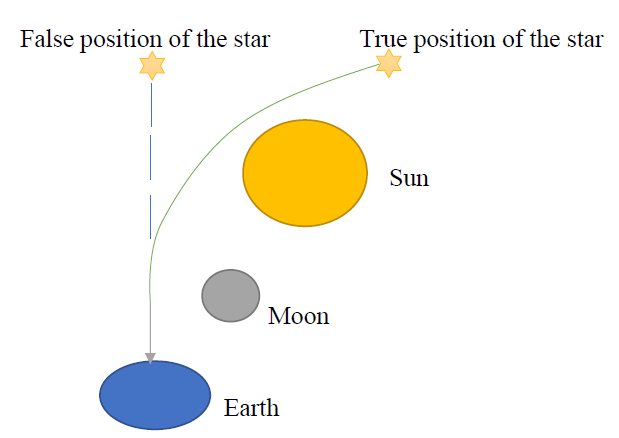
Light Deflection by using the velocity formula for the light The light velocity is given by the next formula (from 4.1):
$$ ^ {\prime} \cong v _ {o} \left(1 - 2 \frac {G M}{R c ^ {2}}\right) $$
2 ´ 1 2 o GM v v Rc
$$ d v ^ {\prime} = 2 \frac {v _ {o} G M}{c ^ {2} r ^ {2}} d r \frac {d v ^ {\prime}}{d t} = 2 \frac {v _ {o} G M}{c ^ {2} r ^ {2}} \frac {d r}{d t} \frac {d r}{d t} = v ^ {\prime} $$ $$ d v ^ {\prime} = 2 \frac {v _ {o} G M}{c ^ {2} r ^ {2}} v ^ {\prime} d t \frac {d v ^ {\prime}}{v ^ {\prime}} = 2 \frac {v _ {o} G M}{c ^ {2} r ^ {2}} $$ o v GM dv dt v c r = dz dt c ≅ (photon time) $$ \frac {d v ^ {\prime}}{v ^ {\prime}} = 2 \frac {v _ {o} G M}{c ^ {2} r ^ {2}} \frac {d z}{c} \frac {d v ^ {\prime}}{v ^ {\prime}} = 2 \frac {G M}{c ^ {2} r ^ {2}} d z v _ {o} = c $$
2 2 ´ 2 ´ $$ d \theta = 2 \frac {d v ^ {\prime} \cos \varphi}{v ^ {\prime}} $$
$$ d \theta = 2 \frac {G M}{c ^ {2} r ^ {2}} d z \cos \varphi \cos \varphi = \frac {R}{r} $$
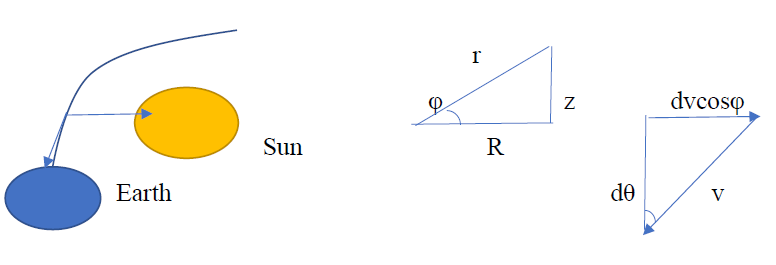
$$d\theta = 2 \frac{GM}{c^2} r^2 dz \frac{R}{r} d\theta = 2 \frac{GMR}{c^2} \frac{dz}{\left(R^2 + z^2\right)^{3/2}} r = \sqrt{\left(R^2 + z^2\right)}$$
$$\theta = 2 \frac{GMR}{c^2} \int_{-R}^{+R} \frac{dz}{\left(R^2 + z^2\right)^{3/2}}$$
$$\theta = 2 \frac{GMR}{c^2} \frac{1}{R^2} \int_{-R}^{+R} \frac{Rsec^2 \theta}{sec^2 \theta} d\theta$$
$$\theta \approx \frac{4GM}{Rc^2}$$
If we replace the values of the mass and radius of the Sun and the light velocity, we obtain:
$$\dot{e} = 1.75 \text{ arc seconds of light deflection}$$
Light Deflection by using Relativity Theory
The four dimensional space time $ds$ in flat space according to spatial relativity is given by the next equation (1), [8]:
$$ds^2 = c^2 dt^2 - dl^2$$
In this case, light follows straight paths which are expressed by the relation:
$$ds^2 = 0$$
Therefore, we obtain:
$$c^2 dt^2 - dl^2 = 0 \quad c = \frac{dl}{dt} \text{ (constant velocity)}$$
But our world is no flat, then it is necessary to do some corrections due to the curvature of the space time. Therefore, we consider a spherical distribution of mass $M$ and the four dimensional space time is given by the next expression (1), [8]:
$$ds^2 = \left(1 - \frac{2GM}{rc^2}\right) c^2 dt^2 - \left(1 + \frac{2GM}{rc^2}\right) dl^2$$
We can solve the equation by using power series [8]:
$$0 = \left(1 - \frac{2GM}{rc^2}\right) c^2 dt^2 - \left(1 + \frac{2GM}{rc^2}\right) dl^2$$
$$\frac{dl}{cdt} = \frac{\sqrt{\left(1 - \frac{2GM}{rc^2}\right)}}{\sqrt{\left(1 + \frac{2GM}{rc^2}\right)}} \left(1 - \frac{2GM}{rc^2}\right)^{1/2} \approx 1 - \frac{GM}{rc^2} \text{ for } \frac{GM}{r} \quad c^2$$
$$\left(1 + \frac{2GM}{rc^2}\right)^{-1/2} \approx 1 - \frac{GM}{rc^2} \text{ for } \frac{GM}{r} \quad c^2$$
$$\frac{dl}{cdt} \approx 1 - \frac{2GM}{rc^2} \text{ for } \left(\frac{GM}{rc^2}\right)^2 \text{ is neglected for } \frac{GM}{r} \quad c^2$$
$$dl = cdt \left(1 - \frac{2GM}{rc^2}\right)$$
If we divide by $dt$, we obtain:
$$v' = v_o \left(1 - \frac{2GM}{rc^2}\right) \text{ where } v_o = c$$
By applying the same procedure of before, it is possible to obtain:
$$\theta \approx \frac{4GM}{Rc^2} \dot{e} = 1.75 \text{ arc seconds of light deflection}$$
**Perihelion Precession of Mercury**
The perihelion or the ellipse of Mercury has a small rotation and changes a small angle $\theta$ after every turn around the Sun [1]. A prediction of the Einstein Theory is that the Perihelion Precession of Mercury must differ of the classic prediction for about 43 arc seconds by century [6].
It is possible to obtain by using the formula demonstrated from 4.1:
$$d' = d \left(1 - \frac{GM}{ac^2}\right) r = a \text{ for an ellipse}$$
where $M$ is the mass of the Sun, $d$ is the perihelion and $c$ is the light velocity: $M = 1.989 \times 10^{30} \text{ kg}$, $d = 45926524600 \text{ m}$, $c = 3 \times 10^8 \text{ m/s}$
a: semi major axis of the ellipse $= 57894348600 \text{ m}$
The formula for the period of every Planet is given by Keple Law [2]:
$$T^2 = \frac{4\pi^2}{GM_s} a^3 \quad T = 7598971,805 \text{ s for circular motion a=r radius of the orbit}$$
$d = r$ perihelion distance $d'$: the decrease perihelion distance $d' = 45926523431 \text{ m} \quad \Delta d = d - d' = 1169,352684 \text{ m}$
$a'$: the decrease semi mayor axis of the ellipse $= a - \Delta d = 57894347431 \text{ m}$ $$T' = \frac{4\pi^2}{GM_s} a'^3$$
$$T' = 7598971,575 \text{ s}$$
Because of the different time measured in a gravitational field, it is used the formula:
$$t = t' \left( 1 - \frac{GM}{Rc^2} \right) t' = T' t = T'' : \text{time in the gravitational field}$$
$$T'' = 7598971,381 \text{ s}$$
The perihelion of Mercury has moved an angle $\theta'$:
$$\theta' = \frac{2\pi T''}{T} \left( 1 - \frac{GM}{ac^2} \right) \theta' = 6,28319949 \text{ Rad}$$
The factor $(1 - \frac{GM}{ac^2})$ is because the value of $\frac{\text{Perimeter of Circumference}}{\text{radius}}$ in a euclidean geometry is $2\pi$, but it has an increase value due the decrease of the radius because of the gravitational field.
$$\Delta\theta = 2\pi - \theta'$$
$$\Delta\theta = 5,1032 \times 10^{-7} \text{ Rad/rev}$$
$$1 \text{ arcsecond} = 4,844 \times 10^{-6} \text{ Rad}$$
$$T_{\text{mer}} = 0,241 T_{\text{Earth}} \text{ (relation between periods of Mercury and Earth)}$$
$$1 \text{ century} = 100 \text{ years}$$
By applying the factors of arcsecond, $T_{\text{mer}}$ and century, it is obtained:
$$\Delta\theta = 43,75 \text{ arcseconds/century}. \text{This value is in agreement with prediction of the value of General Relativity Theory of 43 arcseconds.}$$
The value by using General Relativity Theory is obtained by using the formula [1]:
$$\Delta\theta = \frac{24\pi^3 a^2}{T^2 c^2 \left( 1 - e^2 \right)} \text{ (Rad/Rev)} \text{ where } e = 0,2056, \text{ r is the perihelion of Mercury and } M_s \text{ is the mass of the Sun and by applying the factors of before, it is obtained:}$$
$$\Delta\theta = 43 \text{ arcseconds/century}$$
**Conclusions**
The mass of the particle after the emission of the gravitational energy in a gravitational field (particle orbiting a Planet or Sun) is:
$$m = m_o \sqrt{\left( 1 - \frac{v^2}{c^2} \right)} \text{ mass for a particle in a gravitational field}$$
$$\Delta m = m_o \left( 1 - \sqrt{\left( 1 - \frac{GM}{rc^2} \right)} \right) \Delta m = m_o \text{ m: total lost mass of the particle}$$
It is in agreement with the total mass decreasing of the particle in a gravitational field for the classic approach:
$$\Delta m = m_o c^2 - mc^2 = \left( \frac{GM m_o}{2R} \right) GM/r << c^2$$
Also, the mass for the particle in a gravitational field which uses a Newton Approach agrees with the formula for the mass from General Relativity at distances very far from the massive object (Sun for example) and also at distances very near to the massive object with high accuracy [7]. Then, both models: the Newton Approach with a gravitational field interaction and gravitation force and the Relativity Theory with a curvature of the space time are in agreement at the results for the mass of the particle in a gravitational field with high accuracy.
Besides, it is possible to have the next thought experiment: If a mass $M_o$ is suspended from a spring balance in the K' accelerated system with acceleration $g$, the balance will indicate the apparent weight $M_o g$ due to the inertia of $M_o$ (the balance transmits the acceleration to the mass $M_o$) [6]. If the amount of energy $E$ is transferred to $M_o$, the spring balance, by the law of the inertia of the energy (equivalence of mass and energy $E/c^2 = m$), will indicate $M_o g + \frac{E}{c^2} g$.
Exactly, this should happen when the experiment is repeated in the gravitational system $K$ where the balance transmits the gravity acceleration of the Earth to the mass $M_o$. It happens also at the light deflection when passing close the Sun. The light does not have mass but light has energy and as consequence, it experiments the interaction with the gravitational field by using a Newton Approach [6].
The total energy for a particle in a gravitational field is as follows:
$$E = mc^2 - m_o c^2$$
$$E = m_o c^2 \sqrt{\left( 1 - \frac{GM}{rc^2} \right)} - 1 \text{ energy for a particle in a gravitational field}$$ $$E = -\frac{GMm_o}{2r} \text{ (total energy at the classic approach)} GM/r << c^2$$
The total mass energy lost is given by the formula demonstrated and it is equal in absolute value to the total bond energy of the system (particle orbiting a Planet or Sun) which is emitted as gravitational energy when the particle goes from one orbit to another orbit with less radius. The emission of the total gravitational energy $E$ produces a lost mass of the particle $m = E/c^2$.
For a Binary Star, the formula for the decrease mass is as follows:
$$m_1 = m_{o1} \sqrt{\left(1 - \frac{v_1^2}{c^2}\right)} G \frac{m_{o2}^2}{r(m_{o1} + m_{o2})} = v_1^2$$
$$m_2 = m_{o2} \sqrt{\left(1 - \frac{v_2^2}{c^2}\right)} G \frac{m_{o1}^2}{r(m_{o1} + m_{o2})} = v_2^2$$
Then, each star has different lost mass given by $\Delta m = m_o^2 - mc^2$. Also, each star has different gravitational energy emission corresponding to the lost mass of the respective star.
The total energy for each particle is as follows:
$$E_1 = m_1 c^2 - m_{o1} c^2 m_1 = m_{o1} \sqrt{\left(1 - \frac{v_1^2}{c^2}\right)} G \frac{m_{o2}^2}{r(m_{o1} + m_{o2})} = v_1^2$$
$$E_2 = m_2 c^2 - m_{o2} c^2 m_2 = m_{o2} \sqrt{\left(1 - \frac{v_2^2}{c^2}\right)} G \frac{m_{o1}^2}{r(m_{o1} + m_{o2})} = v_2^2$$
Therefore, it is possible to obtain for the total energy at the classic approach:
$$m_1 = m_{o1} \left(1 - \frac{v_1^2}{2c^2}\right) E_1 = m_1 c^2 - m_{o1} c^2 = -\frac{v_1^2}{2} m_{o1}$$
$$m_2 = m_{o2} \left(1 - \frac{v_2^2}{2c^2}\right) E_2 = m_2 c^2 - m_{o2} c^2 = -\frac{v_2^2}{2} m_{o2}$$
The total energy of the system is:
$$E = -G \frac{m_{o1} m_{o2}}{2r}$$
For the light, the formula obtained for the gravitational redshift frequency, wavelength, time measurement, decrease distance and light velocity are:
$$f' \approx f \left(1 - \frac{GM}{Rc^2}\right) \text{ gravitational redshift for the light}$$
where $M$ is the mass of the planet or Sun and $R$ is the respective radius.
It is possible to obtain this formula by using the variant mass due to the gravitational Potential Energy:
$$m = m_o e^{-\frac{GM}{Rc^2}} \left(1/R\right) \text{ (Variant Mass due the Gravitational Potential Energy)}$$
By replacing for the light $mc^2 = hf$ and $GM/r << c^2$, it is obtained:
$$f' \approx f \left(1 - \frac{GM}{Rc^2}\right) \text{ gravitational redshift for the light}$$
The wavelength is given by the next formula:
$$\tilde{e} \approx \left(1 - \frac{GM}{Rc^2}\right) \lambda_v \text{ increased wavelength}$$
The formula for the time in a gravitational field is:
$$t' = t / \left(1 - \frac{GM}{Rc^2}\right) t \text{ clock time with the gravitational field}$$
Also, the formula for the decrease distance $d$ of a particle orbiting a Planet due to the gravitational energy emission is as follows:
$$d' = d \left(1 - \frac{GM}{Rc^2}\right) \text{ decrease distance due the gravitational energy emission}$$
The light velocity $v' = \lambda' f'$ is obtained by replacing the respective formulas $\lambda'$ and $f'$ or $v' = \frac{d'}{t'}$:
$$v' \approx v_o \left(1 - \frac{GM}{Rc^2}\right) \text{ light velocity in a gravitational field $\Phi$}$$
In resume, in a gravitational field, the light has lower velocity, lower rates of the clock-time (less time measured) than the light in a place without gravitational field. Then, the light passing near the Sun for example experiments the gravitational redshift when the light is observed the Earth (less frequency measured, deviation to the red), more wavelength, because of the time clock measured and the real lost energy.
By using the formula for the light velocity, the value of the light deflection is:
$$\theta \approx \frac{4GM}{Rc^2}$$
$\tilde{e} = 1.75$ arc seconds of light deflection. It is in agreement with the result of the General Relativity Theory. Also, the formula for time dilation and decrease distance are used to calculate the Perihelion Precession of Mercury. The result Δθ=43,75 arcoseconds/century is in agreement with the experiment result and with the Relativity Theory with high accuracy.
This research is relevant for an unification theory. Photons and particles are used indistinctly at this research (for example the formula of the gravitational redshift frequency for the light is obtained from the formula of the variant mass due the gravitational potential). Besides, it is used the energy E=hf for the photon energy at the demonstration of the gravitational redshift formula (at the thought experiment 4.1).
It can be concluded from this research that gravitational and electromagnetic energy are radiation of the same kind but with different frequency in the spectrum electromagnetic. This research has profound relation and insignia of the results for quantum mechanics as for example with the Atom of Bohr and it constitutes an important step for an unification theory.
The same process occurs in the atom for the electron when jump from one orbit. The particle decreases its radio and the velocity v increases with emission of electromagnetic energy (photon) at the jump of the electron from one orbit to another with less radius. Besides, the electron losses mass as result of this emission. It is established at the article Variant Mass for an Accelerated Charged Particle [9, 10, 11, 12]. It is possible to appreciate the symmetry of the physics and the nature by comparing what happen at the atom (microscopic scale) and at the planetary system or space (macroscopic scale).
References
-
Yarman T, Kholmetskii A, Arik (2014) Bending of light caused by gravitation: the same relsult via totally different philosophies. General Physics, arXiv, pp: 13.
-
Serway RA (1993) Física. Mc Graw Hill, México.
-
Hilborn RC (2019) Gravitational waves from orbiting binaries without general relativity: A tutorial. Am J Phys 86(3): 186-197.
-
Alcocer G (2020) The Fundament of the Mass and Effects of the Gravitation on a Particle and Light in the Mass, Time, Distance, Velocity, Frequency, Wavelength: Variant Mass for a Particle which emits Gravitational Energy for a Particle Orbiting a large Planet or Sun and for a Binary Star and Variant Frequency for the Light Passing Close a Gravitational Field from a Massive Object (Sun). Mediterranean Journal of Basic and Applied Sciences (MJBAS) 4(3): 42-69.
-
Resnick R (1981) Introducción a la Teoría Especial de la Relatividad. Editorial Limusa, México.
-
Hawking S (2009) La Gran Ilusión: Las Grandes Obras de Albert Einstein. Editorial Crítica, Barcelona, España.
-
Torres M (1981) Física Moderna. Editorial Limusa, México.
-
Coles P (2001) Einstein, Eddington and the 1919 Eclipse. Astrophysics, arXiv, pp: 21.
-
Alcocer G (2020) Variant Mass for an accelerated charged particle. Asian Journal of Basic Science & Research 2(3): 43-59.
-
Wilson (2003) Física Quinta Edición. Prentice Hall, México.
-
Real Sociedad Española de Física R.S.E.F., El Experimento de Cavendish, Universidad de Alicante.
-
Alcocer G (2020) The Fundament of the Mass: The Variant Mass of Electron at Atom, Meditteranean Journal of Basic and Applied Sciences (MJBAS) 4(4): 18-113.
- Sense, Gravity, Parity & Chirality in Mathematical Physics
- Quantum Lattice Simulations PHYSICS: Microcircuit Particle Formation and Observable Macroscopic Irreversible Time - A Discrete Lagrangian with Cellular Automata Framework
- Quantum Biology from Biomacromolecule to Cell, and Central Dogma Described by Quantum Theory
- Focus, Agility, Speed and Technology (FAST) for Sustainability and Growth
- Square Root Metric Geometry and Pati-Salam Model in Curved Space-Time
- A Simple System Demonstrating the Mpemba Effect in Classical Mechanics