
Time-Dependent Quantum Dynamics Study of the Interaction between Helium Atom and Synchrotron Radiation
For the first time, excitation and ionization of helium atom (He) induced by synchrotron radiation(SR) is simulated in the present work. It is found that electrons can tunnel through the ground state of helium atom and leave from the atomic region caused by subsequent SR field. Therefore, the ionization of He atom can happen. Additionally, some electrons can be captured by a higher electronic state, which leads to the tunneling excitation from the ground state to a specific excited state.
Introduction
Synchrotron radiation is a type of electromagnetic radiation, which is created by accelerating charges moving along kilometer-long circular paths [1]. Synchrotron radiation (SR) is particularly useful because it can produce radiation with a wide range of wavelength, as well as many outstanding advantages. Thus, SR has become an important tool for applications in many subjects, including physics and chemistry [2, 3, 4].
Simulation
In this work, the excitation and ionization of helium atom (He) induced by synchrotron radiation (SR) pulses are simulated theoretically. Particular emphasis is placed on the excitation phenomenon and mechanism of helium atom in the tunneling ionization region. The interaction between SR pulses and helium atom is simulated based on one- dimensional time-dependent wave packet method. Making use of the electric dipole-moment approximation, the one- dimensional atomic motion induced by SR obeys:
2 1 , ( ) , 2 a i x t V x E t x x t t x ∂ ∂ Ψ = − + + Ψ ∂ ∂
2 ( ) ( ) ( )
( ) x −∞< < +∞
Where ( ) a V x is atomic potential, which has the functional
1 2 2 ( ) , , a q V x V a q x x a = = +
form ( ) ( ) . In this formula, q and a are special parameters, which are used to mediate the depth of potential well and remove the singularity of potential function at x=0.
E(t)x is the interaction potential between electron and SR field. ( ) ,x t Ψ denotes the wave function of the investigated system at time t. The split-operate method [5] is adopted to execute the wave packet propagation. Additionally, it is necessary to employ the absorption potential so that the time-dependent wave function can eschew boundary reflections [6].
Quantum mechanical tunneling effects have already been confirmed to happen through penetrating into the classically inaccessible potential energy barrier [7]. There are two known ionization mechanisms of atoms, that is, strong-field tunneling ionization and weak-field multi-photon ionization [8]. In the tunneling ionization region, some electrons can be ionized through tunneling the barrier created by the atomic Coulomb potential and SR field, whereas some electrons merely excite, with transitions to some excited states.
Results
The excitation of helium atom, due to interaction with the short pulses of SR, is particularly interesting and informative. It has been shown in Figure 1 that the excitation probability of helium atom is one order smaller than the ionization probability, and both the excitation probability and ionization probability of He enlarge with the increase of SR intensity.
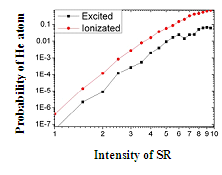
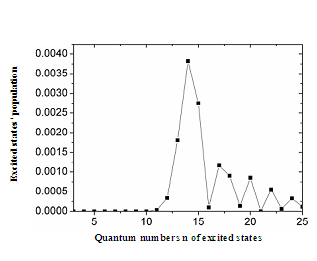
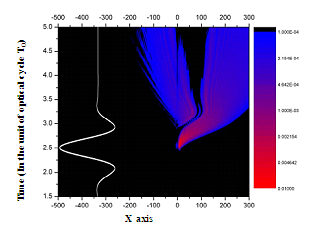
Figure 2 demonstrates the excited states’ population of helium atom after radiation of SR with 800nm wavelength and 1.3fs pulse. The excited states’ population of helium atom has a single peak at n=14, under the impact of such a short SR pulse. The evolutions of ionized and excited wave packets of helium atom have been shown in Figure 3 & 4, with the SR denoted in white line. Firstly, let us have a look at the wave packet evolution of ionized electrons in Figure 3. The barrier created by the SR field and atomic Coulomb potential becomes the lowest when the SR field reaches the peak at t=2.5T0, in which T0 stands for the optical cycle of SR.
Therefore, electrons can tunnel through the ground state of helium atom and leave from the atomic region induced by subsequent SR field. Thus, the ionization of helium atom do happen eventually. However, there are also some electrons, which are trapped by the He nucleus, undergoing the excitation process instead of ionization.
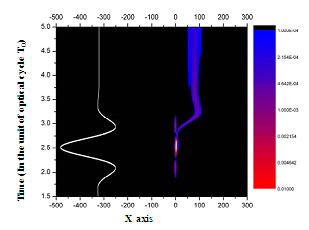
Now let us talk about the wave packet evolution of excited state, as is illustrated in Figure 4. The velocity of electrons, which tunnel the barrier along the positive side of x axis, is reduced near t=2.8T0 due to the negative force of the electric field. The wave packet velocity of excited state is 0 when the SR field becomes zero at t=3.2T0, which means that electrons cannot penetrate into the potential barrier.
Since there are no tunneling electrons through the barrier when the SR pulse is over, the wave packet of excited state stay still at the neighborhood of x=80. Meanwhile, these electrons can be captured by a highly electronic state, which thus accomplishes the tunneling excitation from the ground state to a specific excited state.
Conclusion
Based on these scenarios discussed above, we can have a clear understanding of the excitation mechanism of helium atom irradiated by synchrotron radiation (SR) pulses. The reason why there is a single peak for the population of excited states in Figure 2, which dominates at n=14 under the impact of intense synchrotron radiation with short pulses, can thus be explained fairly well.
Acknowledgements
Support of this work by the National Natural Science Foundation of China is gratefully acknowledged.
Conflict of Interest
The author declares no conflict of interest.
Data statement
Original data are available from the corresponding author upon request.
References
-
Dattoli G, Doria A, Sabia E, Artioli M (2017) Charged Beam Dynamics, Particle Accelerators and Free-electron Lasers. IOP Publishing Ltd, pp: 417.
-
Dyke JM (2019) Photoionization studies of reactive intermediates using synchrotron radiation. Phys Chem Chem Phys 21: 9106-9136.
-
Catlow CRA, Wells P, Gianolio D (2020) Synchrotron radiation techniques in catalytic science. Phys Chem Chem Phys 22: 18745-18746.
-
Meirer F, Weckhuysen BM (2018) Spatial and temporal exploration of heterogeneous catalysts with synchrotron radiation. Nature Reviews Materials 3: 324-340.
-
Yang BH, Tang BY, Yin HM, Han KL (2000) Quantum dynamics study of the Cl+D2Cl+D2 reaction: Time- dependent wave packet calculations. Chem Phys 113(17): 7182-7187.
-
Neuhauser D, Baer M, Kouri DJ (1990) The application of optical potentials for reactive scattering: A case study. J Chem Phys 93: 2499.
-
Wu F, Ren Y, Bian W (2016) The hydrogen tunneling splitting in malonaldehyde: A full-dimensional time- independent quantum mechanical method. J Chem Phys 145(7): 074309.
-
Klaiber M, Briggs JS (2016) Crossover from tunneling to multiphoton ionization of atoms. Phys Rev A 94(5): 053405.
- Sense, Gravity, Parity & Chirality in Mathematical Physics
- Quantum Lattice Simulations PHYSICS: Microcircuit Particle Formation and Observable Macroscopic Irreversible Time - A Discrete Lagrangian with Cellular Automata Framework
- Quantum Biology from Biomacromolecule to Cell, and Central Dogma Described by Quantum Theory
- Focus, Agility, Speed and Technology (FAST) for Sustainability and Growth
- Square Root Metric Geometry and Pati-Salam Model in Curved Space-Time
- A Simple System Demonstrating the Mpemba Effect in Classical Mechanics