
Mechanism of Hydroquinone Oxidation by Hot Plasma Pulsed Radiation
The degradation of hydroquinone in interactions with OH•, HO2 • radicals, nitrous and peroxynitrous acids has been studied. Active species were generated using a corona electric discharge and pulsed radiation from hot plasma of a spark electric discharge. When interacting with hydroxyl radicals, hydroquinone breaks down into low molecular weight products. When interacting with species formed under the action of hot plasma radiation, chain oxidation of hydroquinone to benzoquinone occurs. This process is environmentally friendly and does not require the use of additional catalysts. Products formed under the action of radiation decompose over time.
Introduction
Hot plasma, upon contact with the processed object, damages it, therefore, it is possible to act only remotely, through radiation. Under the action of pulsed hot plasma radiation, active species are generated in an aqueous solution, which initiate and maintain chemical transformations of dissolved substances [1].
Phenol and tyrosine studied by us earlier, under the action of pulsed radiation of a spark discharge undergo nitration and turn into 4-nitrophenol and 3-nitrotyrosine [2, 3]. It is known that hydroquinone enters only into the oxidation reaction, turning into benzoquinone, and does not undergo nitration even in reactions with nitro compounds. Therefore, it is of interest to study the mechanism of reactions of hydroquinone with nitro compounds formed in water under the action of hot plasma pulsed radiation.
Materials and Methods
The spark discharge generator SD10 served as a source of pulsed hot plasma radiation [1, 3]. The radiation dose rate was 0.59 J/s at a distance of 3 cm from the discharge zone. Pulse duration 100 µs, pulse repetition rate 10 Hz. Liquid samples were processed in a Petri dish 4 cm in diameter, sample volume 10 ml. Active species formed in a liquid under the action of hot plasma pulsed radiation are HO2 • radicals, nitrous acid, and complex …ONOOH/ONOO−… [1].
For comparison, a generator of cold plasma of a corona electrical discharge was used [3]. The volume of the treated liquid is 50 ml, the dose rate is 1 J/s per 10 ml of solution. The active species were hydroxyl radicals, hydrogen peroxide and ozone. The concentration of the products was determined from the absorption spectra. Hydroquinone (H2Q): λ = 288 nm, ε = 3453 L(mol cm)−1; benzoquinone (BQ): λ=244 nm, ε=19204 L(mol cm)−1; Fe3+: λ=304nm, ε= 2100 L(mol cm)−1.
The absorption spectra of solutions were measured with an spectrophotometer SF-102 Akvilon Firm, Russia. We used chemically pure reagents and distilled water pH = 6.5.
Results of Experiment
Oxidation of Hydroquinone by Species Formed in an Aqueous Solution Under the Action of Hot Plasma Pulsed Radiation
The composition of active species formed in an aqueous solution under the action of pulsed hot plasma radiation includes short-lived HO2
- radicals, which can interact with chemicals dissolved in water only at the moment of exposure to radiation, and long-lived compounds. The long-lived ones include: nitrous acid, the lifetime of which is about two days, and complex …ONOOH/ONOO−,,, , decomposing for up to 14 days into peroxynitrite and peroxynitrous acid [4]. About 80 – 90% of the complex decomposes in two days, so the absorption spectra of solutions were measured 2 days after treatment. To evaluate the role of HO2
- radicals in reactions with hydroquinone, measurements of the absorption spectrum of the hydroquinone solution treated with pulsed radiation were carried out immediately after treatment. The spectra are presented in Figure 1. It can be seen that at high doses of irradiation there are changes in the spectrum, but they are relatively small. Part of the hydroquinone is converted to benzoquinone.
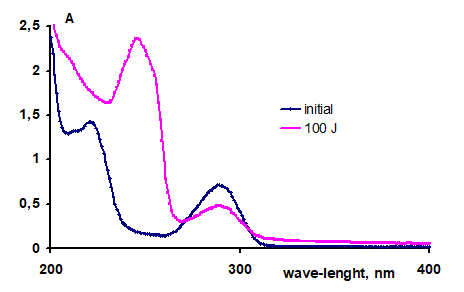
The spectrum of the solution two days after treatment with a dose of 100 J is presented in Figure 2. The concentration of hydroquinone decreases; hydroquinone is oxidized, turning into benzoquinone. Estimation of concentrations based on the absorbance of the peaks shows that all the decomposed hydroquinone is converted to benzoquinone.
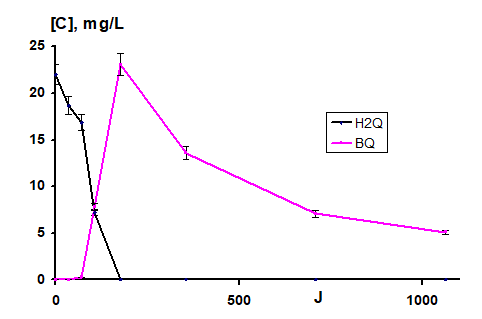
The kinetics of changes in the concentration of products in a hydroquinone solution under the action of pulsed hot plasma radiation, depending on the dose, is shown in Figure 3.
![Figure 3: Concentration [C], mg/L, of hyqroquinone (H2Q, black) and bensoquinone (BQ, red) after treatment the initial hydroquinone solution 22 mg/L by pulsed radiation of SD10 generator, dose up to 1100 J. Data on the second day after treatment. It can be seen that all hydroquinone is oxidized to benzoquinone at a dose D ~ 180 J. As the dose increased, benzoquinone is destroyed with the formation of low molecular weight products that contribute to the absorption spectrum at λ < 230 nm.](/fulltextimages/9680/fig_3.png)
Figure 3: Concentration [C], mg/L, of hyqroquinone (H2Q, black) and bensoquinone (BQ, red) after treatment the initial hydroquinone solution 22 mg/L by pulsed radiation of SD10 generator, dose up to 1100 J. Data on the second day after treatment. It can be seen that all hydroquinone is oxidized to benzoquinone at a dose D ~ 180 J. As the dose increased, benzoquinone is destroyed with the formation of low molecular weight products that contribute to the absorption spectrum at λ < 230 nm.
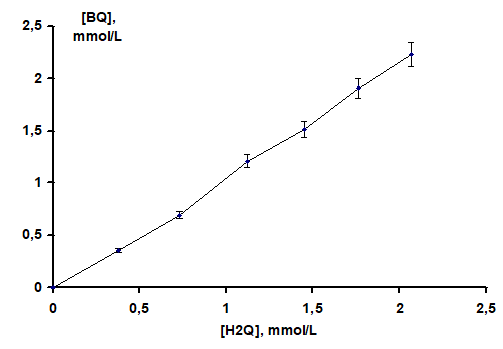
Next, an experiment was performed to evaluate the contribution of the chain reaction to the oxidation of hydroquinone. The dependence of the concentration of the resulting benzoquinone on the concentration of the initial hydroquinone in solution was studied at a constant radiation dose of 350 J. At this dose, the concentration of formed active species is 1 mmol./L [3]. The results are presented in Figure 4.
![Figure 4: Concentration of bensoquinone ([BQ], mmol/L) depending on concentration of hydroquinone ([H2Q], mmol/L) for the same dose of irradiation by SD10 generator, D = 350 J. The concentration of active species in solution, generated by SD10, was 1 mmol/L.](/fulltextimages/9680/fig_4.png)
It can be seen that [BQ] increases linearly with the concentration of [H2Q] and over the entire range [BQ] = [H2Q]. At a concentration of [H2Q] > 1 mmol/L (greater than the concentration of active species), more than one H2Q oxidation occurs per one active species. This indicates a chain reaction.
Degradation of Hydroquinone by Cold Plasma of A Corona Electrical Discharge
Hydroquinone is destroyed under the action of a cold plasma of a corona electric discharge, in which the main active species are hydroxyl radicals, hydrogen peroxide and ozone. The results of processing the hydroquinone solution with a corona electrical discharge are shown in Figure 5. It can be seen that hydroquinone is destroyed with the formation of low molecular weight products, benzoquinone is not formed. All changes in the spectrum occur immediately after treatment; when the solutions are kept for two days or more, no changes are observed.
Oxidation of Hydroquinone with Nitrous acid
A NaNO2 solution with a concentration of (5.8 ± 0.2) 10−4 mol/L was mixed with a hydroquinone solution: 10 ml NaNO2 + 10 ml H2Q. Hydroquinone concentrations are shown in Table 1. After mixing, 1 ml of 0.4M sulfuric acid was added to the solution. Nitrous acid was formed in the reaction:
$$ \mathrm {N a N O} _ {2} + \mathrm {H} _ {2} \mathrm {S O} _ {4} \rightarrow \mathrm {H N O} _ {2} + \mathrm {N a} _ {2} \mathrm {S O} _ {4} \tag {1} $$ Figure 6 shows the spectrum of an H2Q + NaNO2 + H2SO4 solution two days after mixing the reagents. The molar concentrations of H2Q and NaNO2 were equal.
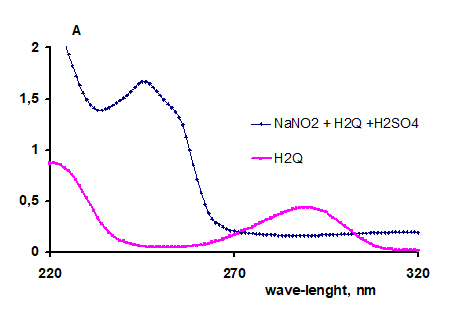
It can be seen that upon interaction with nitrous acid, hydroquinone was completely converted into benzoquinone.
The ratios between the concentrations of the initial reagents (nitrous acid and hydroquinone) and the reaction product, benzoquinone, are presented in Table 1.
| Reagents concentrations, mol/L | |||
|---|---|---|---|
| Case | HNO , 2 | Initial H2Q | Product BQ |
| 1) | (2.9 ± 0.2) 10−4 | (1.94 ± 0.05) 10−4 | (1.89 ± 0.05) 10−4 |
| 2) | (2.9 ± 0.2) 10−4 | (2.61 ± 0.05) 10−3 | (2.76 ± 0.05) 10−3 |
Table 1: Concentrations of reagents in reaction NaNO2(HNO2) + H2Q BQ.
Table 1 shows the concentrations of nitrous acid and hydroquinone in the mixture, taking into account dilution, as well as the concentration of the resulting benzoquinone. There are two cases.
Case 1): concentration of nitrous acid, i.e. active species that initiate the reaction, more than the concentration of hydroquinone. The concentration of the resulting product (BQ) is equal to the concentration of the initial substance (H2Q) within the error limits. All active species are spent on the oxidation of hydroquinone. Case 2): the concentration of nitrous acid is less than the concentration of hydroquinone. The concentration of the resulting product (BQ) is also equal to the concentration of the initial substance (H2Q). In this case, a chain reaction take place. One active species initiates approximately 10 acts of the H2Q BQ reaction.
Discussion
Possibility of Hydroquinone Oxidation by Hydroxyl Radicals
A characteristic reaction of the hydroxyl radical is H-abstraction (the abstraction of a hydrogen atom):
$$ \mathrm {R H} + \mathrm {O H} ^ {\bullet} \rightarrow \mathrm {R} ^ {\bullet} + \mathrm {H} _ {2} \mathrm {O} \tag {2} $$ The energy released in the reaction 2, which equals to 115 kcal/mol, is spent on the detachment of a hydrogen atom from the target compound [5]. In the case of hydroquinone, this energy is enough to remove a hydrogen atom from any position in the benzene ring, When detached from the –OH group, oxidation to benzoquinone is possible; when detached from other position, degradation of hydroquinone to the level of low molecular weight compounds will occur.
In the first case, the hydrogen radical abstracts a hydrogen atom:
$$ \mathrm {H 2 Q} + 2 \mathrm {O H} ^ {\cdot} \rightarrow 2 \mathrm {H} _ {2} \mathrm {O} + \mathrm {O} ^ {\cdot} - \mathrm {Q} - \mathrm {O} ^ {\cdot} \tag {3} $$ The resulting biradical O•−Q−O• can turn into benzoquinone if it donates two electrons. If there is nowhere to donate electrons, the biradical will again interact with the hydroxyl radical:
$$ \mathrm {O} ^ {\bullet} - \mathrm {Q} - \mathrm {O} ^ {\bullet} + 2 \mathrm {O H} ^ {\bullet} \rightarrow \mathrm {H} 2 \mathrm {Q} + \mathrm {O} _ {2} \tag {4} $$ Hydroquinone is re-formed. Those, if there is no substace in the solution that can accept electrons, the oxidation H2Q BQ is impossible. The destruction of the benzene ring will occure, and the peak at 288 nm associated with hydroquinone disappears, low molecular weight compounds apper that absorb in the region of λ < 230 nm (see. Figure 5).
During the oxidation of hydroquinone by hydroxyl radicals formed in the Fenton reaction $$ \mathrm {F e} ^ {2 +} + \mathrm {H} _ {2} \mathrm {O} _ {2} \rightarrow \mathrm {F e} ^ {3 +} + \mathrm {O H} ^ {\bullet} + \mathrm {O H} ^ {-} \tag {5} $$ the resulting ferric iron, upon interaction with the biradical,
will accept an electron, being reduced to Fe2+.
$$ \mathrm {F e} ^ {3 +} + \mathrm {e} \rightarrow \mathrm {F e} ^ {2 +} \tag {6} $$ In the Fenton reaction, as the concentration of H2Q increases, the concentration of the remaining Fe3- decreases. This phenomenon has been observed experimentally. Trivalent iron in this process plays the role of a catalyst. Thus, the oxidation of hydroquinone by hydroxyl radicals to the level of benzoquinone is possible only if there is a catalyst capable of accepting electrons.
Oxidation of Hydroquinone with Nitrous Acid
For nitrous acid in an aqueous solution, there is an equilibrium:
$$ 2 \mathrm {H N O} _ {2} \leftrightarrow \mathrm {N O} ^ {\bullet} + \mathrm {N O} _ {2} ^ {\bullet} + \mathrm {H} _ {2} \mathrm {O} \tag {7} $$ The NO2 • radical can interact with hydroquinone:
$$ \mathrm {H 2 Q} + \mathrm {N O} _ {2} ^ {\bullet} \rightarrow \mathrm {H Q} ^ {\bullet} + \mathrm {H N O} _ {2} \tag {8} $$ $$ \mathrm {H Q} ^ {\bullet} + \mathrm {N O} _ {2} ^ {\bullet} \rightarrow {} ^ {\bullet} \mathrm {Q} ^ {\bullet} + \mathrm {H N O} _ {2} \tag {9} $$ In this process, nitrous acid is regenerated and a biradical
- Q
- is formed. In order to complete the oxidation H2Q BQ, biradical
- Q
- must donate two electrons. The NO
- radical can accept electrons:
$$4NO^* + 2e \rightarrow 2N_2O + O_2$$ (10)
Since nitrous acid is regenerated (reactions 8, 9), the process of hydroquinone oxidation to benzoquinone is chain. The chain nature of the reaction is confirmed by experiment, see Table 1 and Figure 4.
In the case of the formation of a complex ...ONOOH/ONOO^-..., when it decomposes in an acidic environment, which is created in an aqueous solution during the action of radiation, peroxynitrous acid is formed. When it decomposes, nitrogen dioxide and nitrous acid are formed [6]:
$$ONOOH + H^+ + e \rightarrow NO_2^* + H_2O$$ (11)
$$ONOOH + 2H^+ + 2e \rightarrow HNO_2 + H_2O$$ (12)
Therefore, the mechanism discussed above (reactions 8–11) will also operate for peroxynitrous acid.
In general, it will be applicable to species, formed under the action of hot plasma pulsed radiation in aqueous solution.
Thus, the oxidation of hydroquinone to benzoquinone with nitrous acid is possible, and this process is a chain reaction. In the case of treatment by pulse radiation of hot plasma, the use of an additional catalyst is not required. This process is environmentally friendly as it does not require the use of other chemicals. Nitrous acid itself is generated by hot plasma radiation and decays over time. A slight decrease in acidity can be easily compensated by alkali.
**Conclusion**
- The oxidation reaction H2Q $\rightarrow$ BQ with species formed in an aqueous solution under the action of pulsed hot plasma radiation is slow and lasts two days.
- The oxidation H2Q $\rightarrow$ BQ by hydroxyl radicals is possible only in the presence of an electron-accepting catalyst, the role of which in the case of generation of radicals in the Fenton reaction can be played by ferric iron.
- The oxidation H2Q $\rightarrow$ BQ with nitrous acid is a chain reaction. Nitrous acid is formed in an aqueous solution directly under the action of hot plasma pulsed radiation, as well as during the decay of peroxynitrous acid.
- The technological process of oxidation H2Q $\rightarrow$ BQ with nitrous acid, generated by pulsed hot plasma radiation, is environmentally friendly, since nitrous acid decomposes with the release of gaseous products over time.
- Benzoquinone under the action of pulsed hot plasma radiation is destroyed into low molecular weight products.
**References**
1. Piskarev IM, Ivanova IP (2019) Effect of spark electric discharge between solid electrodes in water. Plasma Source Sci Technol 28(8).
2. Ivanova IP, Piskarev IM (2022) Nitration mechanism of hot plasma pulsed radiation for electric spark discharge. IEEE Transactions on Plasma Science 50(11): 4667-4674.
3. Ivanova IP, Piskarev IM (2022) Nitration of tyrosine by the action of pulsed radiation. High Energy Chemistry 56(5): 339-343.
4. Piskarev IM (2019) Water activated by air spark plasma radiation. High Energy Chemistry 53(1): 82-86.
5. Ivanova IP, Piskarev IM, Trofimova SV (2013) Initial stage of lipid Peroxidation with HO$_2^*$ radicals. American Journal of Physical Chemistry 2(2): 44-51.
6. Lobachev VL, Rudakov ES (2006) Chemistry of peroxynitrite. Kinetics and reaction mechanism. Russ Chem Rev 75(5): 375-443.
References
-
Piskarev IM, Ivanova IP (2019) Effect of spark electric discharge between solid electrodes in water. Plasma Source Sci Technol 28(8).
-
Ivanova IP, Piskarev IM (2022) Nitration mechanism of hot plasma pulsed radiation for electric spark discharge. IEEE Transactions on Plasma Science 50(11): 4667-4674.
-
Ivanova IP, Piskarev IM (2022) Nitration of tyrosine by the action of pulsed radiation. High Energy Chemistry 56(5): 339-343.
-
Piskarev IM (2019) Water activated by air spark plasma radiation. High Energy Chemistry 53(1): 82-86.
-
Ivanova IP, Piskarev IM, Trofimova SV (2013) Initial stage of lipid Peroxidation with HO$_2^*$ radicals. American Journal of Physical Chemistry 2(2): 44-51.
-
Lobachev VL, Rudakov ES (2006) Chemistry of peroxynitrite. Kinetics and reaction mechanism. Russ Chem Rev 75(5): 375-443.
- Sense, Gravity, Parity & Chirality in Mathematical Physics
- Quantum Lattice Simulations PHYSICS: Microcircuit Particle Formation and Observable Macroscopic Irreversible Time - A Discrete Lagrangian with Cellular Automata Framework
- Quantum Biology from Biomacromolecule to Cell, and Central Dogma Described by Quantum Theory
- Focus, Agility, Speed and Technology (FAST) for Sustainability and Growth
- Square Root Metric Geometry and Pati-Salam Model in Curved Space-Time
- A Simple System Demonstrating the Mpemba Effect in Classical Mechanics