
Kinetic and Equilibrium Studies of Methylene Blue Adsorption on Alstonia Scholaris Plant Leaf Powder
In the current work the methylene blue removal using leaf powder of Alstonia Scholaris was investigated. Pseudo first order, second order and Elovic model ware applied, it has been observed that the adsorption follows second order kinetic model. The isotherm study was done by using Langmuir, Temkin and Freundlich isotherm, the Freundlich isotherm was best suited for present investigation. The maximum adsorption was observed at pH 7.5.
Introduction
Dyes are extensively used as coloring materials in various industries like paper, pulp, textile, leather, etc. [1]. The industrial wastewater containing residual dye content causes serious damage [2]. Cationic dye, methylene blue is mostly used to color cotton, silk, paper, etc [3]. It causes some serious health issues to human as well as animals [4]. There are various methods available for removal of dye from effluent water but adsorption is the most simple and economic method [5]. The most commonly used adsorbent is activated charcoal which is expensive, some paper report the use of activated charcoal prepared from various waste material like bamboo [6], Jute Fiber [7] etc. Safe, efficient, economic and environment friendly adsorbent is a need, some of the adsorbent derived from waste materials such as cellulosic olive stone [8], spent coffee ground [9, 10], Coffee husk [11], neem leaf powder [12], agro industrial waste [13], Vilayati tulsi, [14] etc. In the present study the adsorption of methylene blue on the Alstonia Scholaris leaf powder was investigated. Alstonia Scholaris is also known as saptaparni.
Experimental
Preparation of Adsorbent
Leaves of Alstonia Scholaris Plant were collected and dried under shade. The dried leaves were grinded in domestic grinder to get powder. The powder was washed with distilled water for two times followed by washing with 0.01 M NaOH. The excess of alkali was removed by washing with distilled water. The leaf powder was dried at 800C in hot air oven, placed in air tight container for further use.
Preparation of Dye Solution
Methylene Blue (CI-52015) supplied by Loba Chem Pvt. LTD was used. The maximum absorbance was observed at 665 nm. A stock solution of 1000 mg/L was prepared in double distilled water, by dilution, desired experimental solutions were prepared.
Adsorption Studies
Standard curve was prepared at 665 nm using 1 to 10 mg/L solution (Elico double beam spectrophotometer SL- 210). The batch adsorption studies were performed by taking 50 mL dye solution of desired concentration and pH in 250 mL stopper flask. 0.1g of leaf powder was added and the mixture was stirred at 1000rpm. The absorbance of supernatant liquid was measured to determine the concentration. The pH was adjusted by using 0.5 M HCl and 0.5 M NaOH. The effect of adsorbent dose, dye concentration and pH was studied. The solid phase dye concentration at a particular time was determined using following equation [15].
( ) 0 t t C C V q W
− = (1) Where qt is adsorption amount at time t, Co and Ct are dye concentration initial and at time t in mg L-1 respectively, V is volume of solution in L and W is weight of adsorbent in g. Langmuir and Freundlich isotherm was used to determine the adsorption capacity of adsorbent.
Results and Discussion
Effect of pH
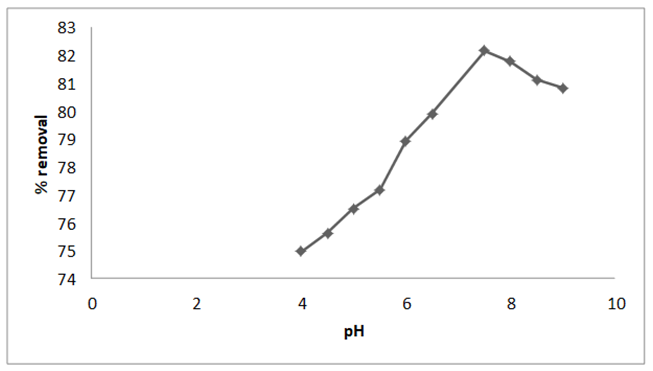
The effect of pH was studied by stirring 50mL dye solution of concentration 40mg/L with 0.1 g leaf powder for 90 min. Initially with increase in pH, the adsorption of Methylene blue increases up to 7.5, further increase in pH decreases the adsorption (Figure 1).
Effect of Adsorbent Dose
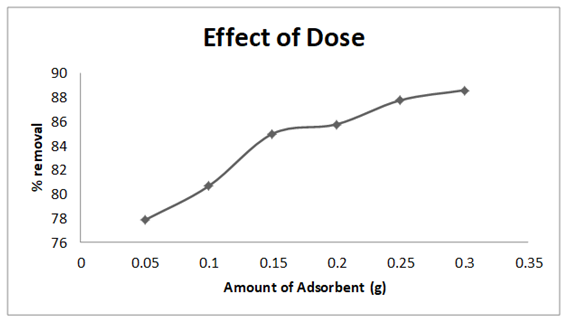
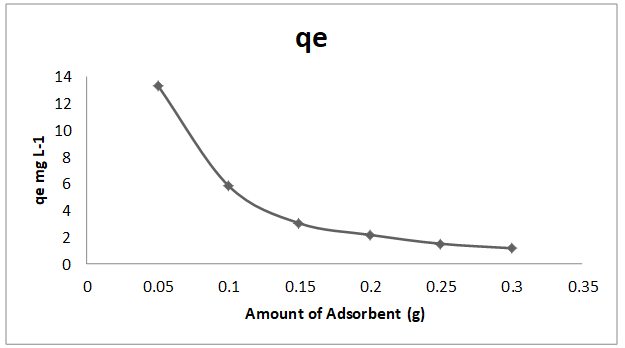
The effect of adsorbent dose was evaluated by stirring 50 mL 60 mg/L Methylene blue at optimum pH with adsorbent amount (0.05 to 0.3 g) for 60 min. The result was represented in Figure 2. Though the % removal increases with increase in adsorbent dose but the dye adsorbed per gram of adsorbent is decreases as shown in Figure 3.
Effect of Dye Concentration
The effect of Methylene blue concentration was investigated by stirring 0.1 g adsorbent at optimum pH with 50 mL dye solution (20 mg/L to 100 mg/L).
Adsorption Dynamics
The adsorption dynamics was studied by applying pseudo first order kinetic model, pseudo second order kinetic model and Elovic model.
The Pseudo First Order Kinetic Model
Lagergren expression for pseudo first order kinetic model is as follows [16].
1 log log 2.303 e t e k t q q q − = − (2)
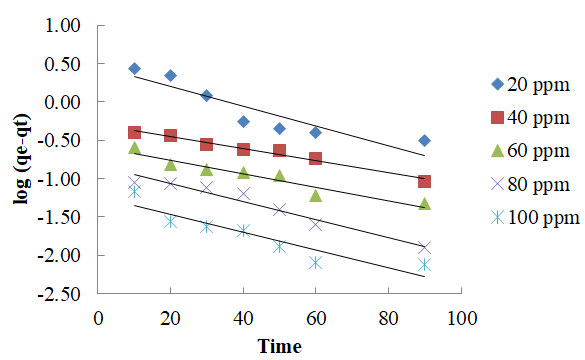
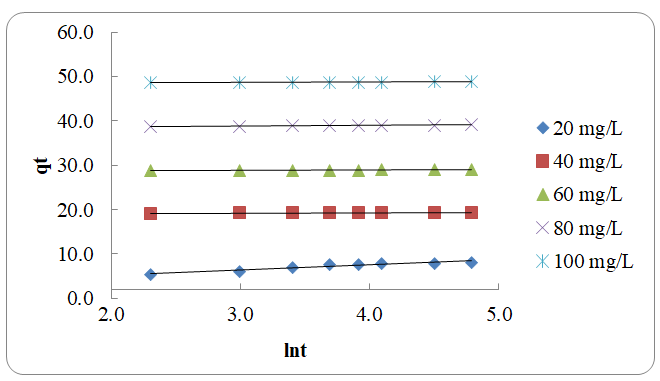
( ) Where qt dye adsorbed at time t, qe dye adsorbed at equilibrium and k1 is the rate constant. The pseudo first order plot is represented by Figure 4. The values of k1 and qe are represented in Table 1. From the values of regression coefficient it has been observed that the present data does not follows the pseudo first order kinetic model.
Elovic Model
The Elovic equation represented as follows was used [17].
$$ q _ {t} = \frac {1}{\beta} \ln (\alpha \beta) + \frac {1}{\beta} \ln (t) \tag {3} $$ Where β represent the number of available sites for adsorption and α represent the initial adsorption rate, the data represented in Table 1 show that present study does not follow Elovic mode.
The Second Order Kinetic Model
Lagergren equation for the second order is expressed as follows [18].
1 $$ \frac {t}{q _ {t}} = \frac {1}{q _ {e} ^ {2} k _ {2}} + \frac {t}{q _ {t}} \tag {4} $$
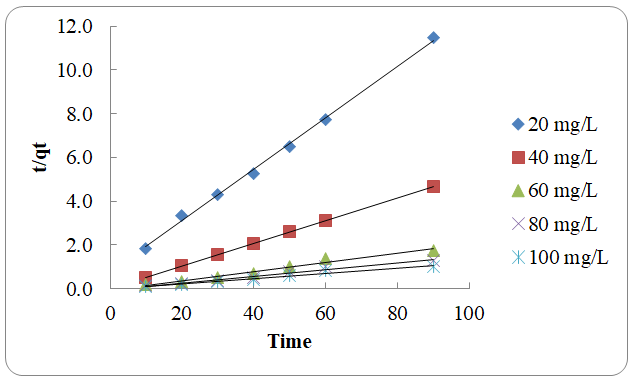
2 2 t t e Figure 5 & 6 represents the plot of t/qt versus t. The values of equilibrium adsorption capacity (qe) and second order rate constant (k2) were represented in Table 1. It can be observed that the pseudo second order kinetic model is followed by present study
| Dye Conc. | First order | Second order | Elovich model | ||||||||
|---|---|---|---|---|---|---|---|---|---|---|---|
| (mg L-1) | K 1 (min-1) | q (exp) e (mg g-1) | q (cal) e (mg g-1) | R2 | K 2 (min-1) | q (exp) e (mg g-1) | q (cal) e (mg g-1) | R2 | β (mg g-1) | α (mg g/-1 min-1) | R2 |
| 20 | 0.0295 | 8.1549 | 2.8685 | 0.837 | 0.019 | 8.1549 | 8.4794 | 0.9948 | 0.8651 | 0.4239 | 0.9082 |
| 40 | 0.0202 | 19.3895 | 0.2605 | 0.9211 | 0.3166 | 19.3895 | 19.3707 | 1 | 10.6964 | 0.0343 | 0.961 |
| 60 | 0.0265 | 28.938 | 0.0575 | 0.8522 | 2.4204 | 28.938 | 28.9416 | 1 | 40.7798 | 0.009 | 0.8788 |
| 80 | 0.0179 | 39.155 | 0.5023 | 0.9787 | 0.2232 | 39.155 | 39.1649 | 1 | 6.3313 | 0.0579 | 0.9344 |
| 100 | 0.0065 | 48.8309 | 0.0941 | 0.9507 | 0.9687 | 48.8309 | 48.8186 | 1 | 34.27 | 0.0107 | 0.6982 |
Table 1: Rate constants for pseudo first-order, pseudo second-order adsorption and Elovic model.
Adsorption Equilibrium Study
Three isotherm, Temkin isotherm, Langmuir isotherm and Freundlich isotherm were applied for present study Langmuir isotherm is represented by following equation [19, 20].
C C q q bq = + (5)
1 e e e m m
Where qm is Langmuir constant in mg g-1 and b is Langmuir
constant in L mg-1, qe is the amount adsorbed at equilibrium in mg g-1 and Ce is the equilibrium dye solution concentration in mg L-1. The parameters are represented in the Table 2. Freundlich isotherm is represented by following equation [21, 22].
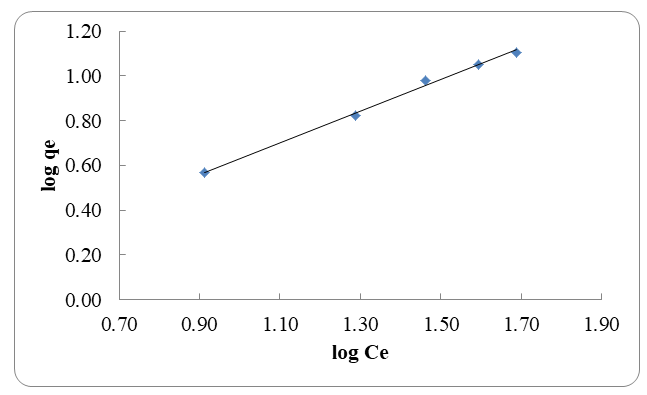
$$ \log q _ {e} = \left(\frac {1}{n}\right) \log C _ {e} + \log k _ {f} \tag {6} $$ The Figure 7 represents the plot of log qe versus log Ce and the parameters are represented in Table 2.
Temkin isotherm is represented by [23, 24].
$$ q _ {e} = B \ln A + B \ln C _ {e} \tag {7} $$
Where A and B are constant, values are calculated from plot and represented in Table 2.
| Langmuir Isotherm | Freundlich Isotherm | Temkin Isotherm | ||||||
|---|---|---|---|---|---|---|---|---|
| Ka (L mg-1) | Q 0 (mg g-1) | R2 | n | Kf(mg g-1) | R2 | A (L mg-1) | B (J mole-1) | R2 |
| -0.0388 | -50.994 | 0.9281 | 0.7082 | 1.2928 | 0.9961 | 3.7924 | 30.7653 | 0.9191 |
Table 2: Langmuir, Freundlich and Temkin isotherm parameter.
Conclusion
Leaf powder prepared from Alstonia Scholaris Plant was investigated for adsorptive removal of methylene blue. The data shows that the adsorption follows the second order kinetics and Freundlich Isotherm. The maximum adsorption conditions were optimized. The leaf powder can be used as economical adsorbent.
Acknowledgements
Authors are thankful the Principal, V. P. Mahavidyalaya, Vaijapur for providing laboratory facilities.
Conflict of Interest
The authors declare that they have no conflict of interest.
References
-
Jawad AH, Abdulhameed AS, Mastuli MS (2020) Acid- factionalized biomass material for methylene blue dye removal: a comprehensive adsorption and mechanism study. Journal of Taibah University for Science 14(1): 305-313.
-
Patawat C, Silakate K, Udom SC, Supanchaiyamat N, Hunt AJ, et al. (2020) Preparation of activated carbon from Dipterocarpus alatus fruit and its application for methylene blue adsorption. RSC Adv 10(36): 21082- 21091.
-
Li Z, Hanafy H, Zhang L, Sellaoui L, Netto MS, et al. (2020) Adsorption of congo red and methylene blue on an ashitaba waste and walnut shell based activated carbon from aqueous solution: experiments, characterization and physical interpretation. Chemical Engineering Journal 388: 124263.
-
Rafatullah M, Suliman O, Hashim R, Ahmad A (2010) Adsorption of methylene blue on low cost adsorbent: A review. Journal of Hazardous Material 177(1-3): 70-80.
-
Jawad AH, Abdulhameed AS, Wilson LD, Shatir S, Hassan S, et al. (2021) High surface area and mesoporous activated carbon from KOH-activated dragon fruit peels for methylene blue adsorption: optimization and mechanism study. Chinese Journal of Chemical Engineering 32: 281-290.
-
Hameed BH, Din ATM, Ahmad AL (2007) Adsorption of methylene blue onto bamboo-based activated carbon: Kinetic and equilibrium studies. J Hazard Mater 141(3): 819-825.
-
Senthilkumar S, Varadrajan PR, Porkodi K, Subbhuraam CV (2005) Adsorption of methylene blue onto jute fiber carbon: kinetic and equilibrium studies. J Colloid Interf Sci 284(1): 78-82.
-
Al-Ghouti MA, Al-Absi RS (2020) Mechanistic understanding of the adsorption and thermodynamic aspects of cationic mehthylene blue dye onto cellulosic olive stones biomass from waste water. Sci Rep 10(1): 15928.
-
Taleb F, Ammar M, Mosbah MB, Salem RB, Moussaoui Y (2020) Chemically modification of lignin derived from spent coffee grounds for methylene blue adsorption. Sci Rep 10(1).
-
Franca AS, Oliveira LS, Fereira ME (2009) Kinetics and equilibrium studies of methylene blue adsorption by spent coffee grounds. Desalination 249(1): 267-272.
-
Thi HT, Hoang AL, Huu TP, Dinh TN, Chang SW, et al. (2020) Adsorption isotherm and kinetic modelling of methylene blue dye onto carbonaceous hydrochar adsorbent derived from coffee husk waste. Science of the Total Environment 725: 138325.
-
Bhattacharyya KG, Sharma A (2005) Kinetics and thermodynamics of Methylene blue adsorption on neem (Azadirachta indica) leaf powder. Dyes and Pigments 65(1): 51-59.
-
Meili L, Lins PVS, Costa MT, Almeida RL, Abud AKS, et al. (2019) Adsorption of methylene blue on agroindustrial wastes: Experimental investigation and phenomenological modeling. Progress in Biophysics and Molecular Biology 141: 60-71.
-
Pardeshi SD, Sonar JP, Zine AM, Thore SN (2013) Kinetic and thermodynamic study of Adsorption of methylene blue and rhodamine B on adsorbent prepared from Hyptis suaveolens (Vilayti Tulsi). Journal of the Iranian Chemical Society 10(6): 1159-1166.
-
Kuang Y, Zhang X, Zhou S (2020) Adsorption of methylene blue in water onto activated carbon by surface modification. Water 12(2): 587.
-
Yagmur HK, Kaya I (2021) Synthesis and characterization of magnetic ZnCl2- activated carbon produced from coconut shell for the adsorption of methylene blue. Journal of Molecular Structure 1232: 130071.
-
Zine AM, Thore SN, Pawar RP, Pardeshi SD, Lingde NM, et al. (2019) Kinetic and isotherm model for the adsorption of acid red from aqueous solution by Parthenium hysterophorus L. Current Pharma Research 422: 176- 187.
-
Pardeshi S, Sonar J, Ashok Z, Salunke A, Marmat BM, et al. (2021)Adsorptive removal of Malachite green from aqueous solution using low cost adsorbent. International Journal of Chemical and Physical Science 10(4): 1-7.
-
Langmuir I (1918) The adsorption of gases on plane surfaces of glass, mica and platinum. J Am Chem Soc 40(9): 1361-1403.
-
Gund MN, Pardeshi SD, Sonar JP, Ashok Z, Salunke MA, et al. (2021) Removal of rhodamine 6G from aqueous solution by adsorption on Bioadsorbent prepared from Hyptis Suaveolens (vilayti tulsi): Kinetic, equilibrium and thermodynamic study. International Journal of Chemical and Physical Science 10(2): 1-9.
-
Freundlich HMF (1906) Over the Adsorption in Solution. J Phys Chem 57: 385-471.
-
Salunke AS, Gund NN, Marmat BM, Sonar JP, Dokhe SA, et al. (2020) Adsorptive removal of Amido black from aqueous solution using economical adsorbent: Kinetic and isotherm study. International Journal of Chemical and Physical Science 9(5): 1-7.
-
Tempkin MI, Pyzhev V (1940) Kinetics of ammonia synthesis on promoted iron catalyst. Acta Phys Chim USSR 12: 327-356.
-
Zine AM, Thore SN, Pawar RP, Pardeshi SD, Ligde NM, et al. (2018) Adsorption studies of acid red 73 on parthenium hysterophorous L. International Journal of Chemical and Physical Science 7: 4.
- Sense, Gravity, Parity & Chirality in Mathematical Physics
- Quantum Lattice Simulations PHYSICS: Microcircuit Particle Formation and Observable Macroscopic Irreversible Time - A Discrete Lagrangian with Cellular Automata Framework
- Quantum Biology from Biomacromolecule to Cell, and Central Dogma Described by Quantum Theory
- Focus, Agility, Speed and Technology (FAST) for Sustainability and Growth
- Square Root Metric Geometry and Pati-Salam Model in Curved Space-Time
- A Simple System Demonstrating the Mpemba Effect in Classical Mechanics