
Quantum Gravity Time Rank-N Tensor Collapsing Expanding Scalar Sense Time Space Matrix Signal/Noise Physics Wavefunction Operator
This paper introduces abstract, logical, and mathematical algebraic tensor operations for quantifying the temporal properties of physical systems, including energy, momentum, and angular momentum. We explore the concept of a “black box” time matrix that commutes with the gravity matrix, resulting in metrics analogous to Schwarzschild metrics. Depending on context and notation, time tensors can exhibit different ranks. Our formalism focuses on a rank-4 tensor representing the time matrix—a fundamental quantity that abstracts informational observables across various domains of reality. We delve into arithmetic and algebraic time representations, highlighting scalar mesoscopic time clocks and vector time characteristics relevant to quantum and astrophysical domains. These conserved tensorization fields play a crucial role in understanding real transformations within different reality domains. Arithmetic and Algebraic Time Representations of Rank-4 tensor time matrix highlights scalar mesoscopic time clocks as well as vector time characterizing quantum and astrophysical domains that are conserved tensorization proved action fields. Per group theoretical analysis, 4x4 time matrix has been extended to rank 6 tensor times capable of interactively coupling to gravitational gradient metrics. Rank-6 tensor time matrix can be used to quantify physical phenomena of geodesical gravitational interactive coupling within regions of quantum space, mesoscopic environment, and astrophysical fields, while describing environmental real matter transformations of rotational parameters in different domains of reality. Some aspects with evaluating constitutive equations underlying signal/noise ratio, critical observable measurable quantitative parameters to evaluate “quantum foam” universal electromagnetism and “vacuum bath” gravitational geodesics active by local curvature of spacetime quantifications will help to algorithmically explain how origin, genesis and evolution with real universe form from superluminal phases to star systems and life-forms with interplanetary quantum ASTROPHYSICS!.
Introduction
The author has quantified the quantum nature of gravity in the previous works, revealing the “black box” nature of the universe, extracting 4x4 time matrix that describes proper, real, global, and local four-vector time tensors. These tensors are amenable to operational gauge time fields, providing insights into the quantum behavior of gravity. We investigate how this time matrix may interact with the gravity matrix, leading to metrics akin to Schwarzschild metrics. By solving Einstein’s General Relativity field equations, we explore how masses curve spacetime, ultimately creating gravity. Our focus lies on the time tensor operator, which characterizes the temporal properties of physical systems. Here, in the pursuit of understanding the fundamental nature of the universe, we delve into the intricate interplay between quantum gravity and time. Previous work has quantified the elusive quantum aspects of gravity, revealing its “black box” character. In this study, we explore the time matrix—a 4x4 structure that captures the temporal properties of physical systems. This matrix, composed of proper, real, global, and local four- vector time tensors, interacts with the gravitational field, potentially yielding metrics akin to Schwarzschild solutions from Einstein’s general relativity [1, 2, 3, 4, 5, 6, 7, 8, 9, 10, 11, 12, 13, 14, 15, 16, 17, 18, 19, 20].
The rank of a time tensor operator signifies the number of indices required to specify an element within it. For instance:
- A scalar operator has rank 0.
- A vector operator has rank 1.
- A matrix operator has rank 2.
In the realm of special relativity, the energy-momentum four-vector serves as a rank-1 time tensor operator, while the energy-momentum-stress tensor corresponds to rank 2. However, our formalism extends beyond these ranks. We employ a rank-4 tensor to represent the time matrix, a fundamental abstraction of informational observables across various reality domains. This tensorization approach reveals scalar mesoscopic time clocks and vector time representations, bridging quantum and astrophysical domains. Furthermore, by group-theoretical analysis, we extend the 4x4 time matrix to a rank-6 tensor. This higher- rank tensor captures geodesical gravitational interactions, quantum spacetime phenomena, mesoscopic environments, and astrophysical fields. It also describes real transformations of rotational parameters across different reality domains. Our investigation yields profound insights. Constitutive equations, signal-to-noise ratios, and critical observable parameters emerge, shedding light on the origin, evolution, and formation of star systems and life-forms. We touch upon intriguing concepts like the “quantum foam,” universally electromagnetic, and the “vacuum bath,” locally curving spacetime to produce gravitational geodesics.
The paper unfolds as follows: Section 2 Methods: Giving specific procedures, procedures, designs, and analyses. Section 3: Presents Results and Discussions time matrix and gravity intriguing interplay showing with analogy to Schwarzschild metrics, the rank-4 tensor time matrix derivation process, and the extension to rank-6 tensor coupling with gravitational gradients. We also delve into graphical representations, matrix models, and the gaging of rank-6-time-tensors. Quantitative algebra geometry algorithm graphics of identity to signal/noise analysis as well as keynote on “quantum foam” electromagnetism and the “vacuum bath” gravitational locality with quantified mathematical processes have been addressed as well. Section 4 Summaries: conclude the paper and suggests some directions for future research.
Methods
We employ an ansatz derivation to quantify the time tensor within our rank-4 tensor framework. This approach allows us to capture physical quantities such as the stress- energy tensor, electromagnetic tensor, and Riemann curvature tensor. Our formalism provides a powerful tool for abstracting informational observables across diverse reality domains. Further, in this section, we outline the procedures, designs, and analyses employed in our study. Our approach combines quantitative algebra, geometry, and algorithmic graphics to investigate the interplay of time and gravity. Specifically, we focus on collapsing and expanding scalar senses within the time-space matrix using rank-n tensors [10, 12, 13, 19, 21, 22, 23].
Time Matrix and Gravity Interaction
We begin by constructing a “black box” time matrix that commutes with the gravity matrix, drawing an analogy to Schwarzschild metrics. Our normalization process involves unitarization of a 4x4 matrix. Leveraging the mathematical framework of “bra” and “ket” representations for time tensors in four-vector format, we explore the gravity gradient in quaternion-type notations. By configuring inner and outer products, we derive metrics such as the scalar arrow of time and an expanded 4x4 gravity matrix akin to Schwarzschild’s metrics.
Extending to Rank-6 Time Tensor
Building upon the rank-4 tensor analysis, we extend our investigation to rank-6-time-tensors. These higher- order tensors interactively couple with the gravity gradient, providing deeper insights into the interplay between time and space. We delve into gaging aspects, exploring how the rank-6 tensor influences gravitational phenomena.
Results and Discussions
The rank-4 tensor time matrix extends naturally to a rank-6 tensor time, enabling interactive coupling with gravitational gradient metrics. This rank-6 tensor time matrix plays a crucial role in quantifying geodesical gravitational interactions, quantum space phenomena, mesoscopic environments, and astrophysical fields. Furthermore, it describes real transformations of rotational parameters across different reality domains. Notably, our analysis reveals profound aspects related to signal-to-noise ratios and critical observable parameters, shedding light on the origin, genesis, and evolution of the universe. Additionally, we discuss the intriguing concepts of “quantum foam” (universally electromagnetic) and the “vacuum bath” (local spacetime curvature) that contribute to gravitational geodesics [10, 11, 12, 15, 21, 22, 23, 24, 25, 26, 27, 28, 29, 30, 31, 32, 33, 34, 35, 36, 37, 38, 39, 40].
“Blackbox” Time Matrix Commutes with Gravity Matrix Analogous to Schwarzschild Metrics
In our investigation, we explore the intriguing concept that the universe operates akin to a “black box,” as revealed by the graphical general transform equation. This holistic perspective prompts us to consider the fundamental nature of time and its interaction with gravity.
Mathematical Transformations: We begin by mathematically inverting equation [15, 19] in the form [Y] = gfts [X], yielding a four-vector matrix time tensor:
µν
ˆ ˆ ˆ ˆ
t t t t = [ ] 1 1 GR fts ifts f /g (|| || ) g g ε − − = [transforms], ,
pr g µν µν µν ,
r l , ˆpr µν t : proper time, ˆr
µν t real time, ˆg µν t : global time, where:
and ,ˆl µν t : locally time.
Within this framework, we encounter the following time components: Proper Time ( , ˆpr µν t ) which represents intrinsic temporal properties; Real Time ( ˆr µν t ) that describes time as experienced in our physical reality; Global Time ( ˆg µν t ) which reflects a universal time reference; and the Local Time ( ,ˆl µν t ) that pertains to localized temporal variations.
Commutation with Gravity Matrix: The time matrix, derived from the inverse transformation of the “black box” algorithm, exhibits intriguing behavior. It commutes with the gravity matrix, analogous to Schwarzschild metrics. Specifically, we observe inner and outer “bra-ket” products: • <tq||Gw> = (Gt) • Here, <tq| represents the four-vector time matrix [tl tr tg tp] generated from inverse transform of “black box” algorithm.
G G G G
i • |Gw> = corresponds to gravitational gradient j k
1 within the quaternion 4D-like space, extending from Minkowski spacetime. • The scalar arrow of time, t, is associated with the unitary factor G.
Expanded Gravity Time Matrix: Upon density configuration, |Gw><tq|| = Gij, having (i, j = 1, 2, 3), the expanded gravity time matrix, [Gij] assumes a 4x4 format:
G G G G
11 12 13 14 G G G G
21 22 23 24 G G G G
31 32 33 34 G G G G
41 42 43 44 Key Criteria for Interactive Coupling: To satisfy the criteria for interactive coupling, we emphasize: Coupling: The gravitational gradient must couple with the time tensor (either with or without). Interaction: As a result, the time tensor will curl inwards, producing interactive gravity on all objects within spacetime of coupled action matrix scalar fields of environment. This interplay between gravity and time holds profound implications for our understanding of the fabric of the cosmos. After normalization with unitarization, Gij matrix is analogous to Schwarzschild’s metrics:
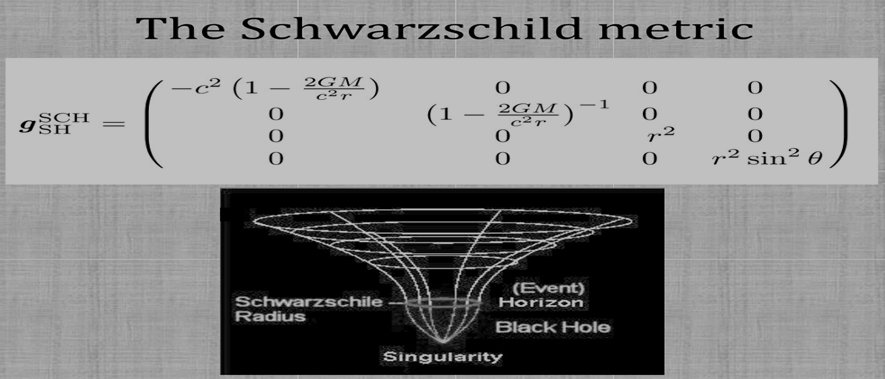
Schwartzchild metric matrix format: https://www.bing.com/images/ search?view=detailV2 &ccid=99TdCqqo&id=F574F8FE F814ED394FF7317A253199FFC0F19C72&thid=OIP.99TdCqqoIgxfCR5d4Nh1VQHaFj&mediaurl=https%3A%2F%2Fimage3. slideserve.com%2F7054870%2Fthe-schwarzschild-metricl.jpg&cdnurl=https%3A%2F%2Fth.bing.com%2Fth%2Fid% 2FR. f7d4dd0aaaa8220c5f091e5de0d87555%3Frik%3DcpzxwP%252bZMSV6MQ%26pid%3DImgRaw%26r%3D0&exph=768& expw=1024&q=Schwartzchild+metric+matrix+format&simid=608054940512253894&form=IRPRST&ck=F6EB3F1334EA2 B69DB6EA6CCFD3A91FF&selectedindex=1&itb=0&ajaxhist=0&ajaxserp=0&vt=0&sim=11.
Rank-4 Tensor Time Matrix: Physics with Ansatz Derivation elsewhere
In our exploration of quantum gravity, we focus on the rank-4 tensor time matrix, which plays a pivotal role in quantifying physical quantities of stress-energy tensor, the electromagnetic tensor, and the Riemann curvature tensor. Let’s delve into the formalism and its implications [29].
Formalism of the Time Matrix: This formalism is the first step to account for multifarious physical phenomena, such as spin, rotation, revolution, and angular gauge momentum, and provide correlative proofs from quantum, mesoscopic, and astrophysical domains. Translational coordinates within time domain {t (x), t (y), t (z)} and a rotational coordinate {t (θ)} may thus constitute Rank 4 tensor, , xyzθ t generally written as: µναβ T . We can hence µναβ T define time matrix to be:
4 4 ν α β µ α β µναβ µναβ µναβ µ ν ∂ ∂ = = ∂ ∂ ∂ ∂ ∂ ∂ ∂ ∂ S H T g g p p p p x x x x With unitarization process
4 µναβ µ β ν α ∂ =∂ ∂ ∂ ∂ S T x x x x
µναβ g =1. Hence,
Here:
- metric µναβ g converts action and Hamiltonian deriv- atives to appropriate domain of time.
- (S) represents the action.
- x’s denote the space-time coordinates.
- Indices (μ, ν, α, β) take values from 0 to 3.
- S = ∫Ldt = ∫pdq-Hdt, having L: Lagrangian, p: momentum, q: position, and H: Hamiltonian, having The Legendre transformation applied to the action in the space-time manifolds. We decompose the time matrix into four sub-matrices, each corresponding to a different domain of reality:
T T T T T µναβ =
00 0 kl jkl
0 i kl ijkl
- Where (i,j,k,l = 0,1, 2, 3). The sub-matrix T00kl repre- sents the quantum domain, where the action is minimal, and the time is reversible. The sub-matrix T0jkl repre- sents the mesoscopic domain, where the action is inter- mediate, and the time is asymmetric. The sub-matrix Ti0kl represents the astrophysical domain, where the action is maximal, and the time is hidden. The sub-ma- trix Tijkl represents the superluminal domain, where the action is infinite, and the time is imaginary.” Properties and Interpretations 1. Action Properties:
- The nature of time within this formalism encompasses real and imaginary aspects.
- Reversibility and symmetry play essential roles.
- Sense-activated time and space fields emerge across quantum, mesoscopic, astrophysical, and superluminal domains.
Mathematical Links:
- We mathematically connect Legendre and Hamiltonian formalisms.
- Position (P), curvature, action, energy (E), angular momentum (L), and entropy (S) find a compact representation using the Kronecker delta and Levi-Civita symbol: $$T_{\muva\beta} = gE\delta_{\mu\nu}\delta_{\alpha\beta}E + gL \in_{\muva\beta} L + gP\delta_{\mu\alpha}\delta_{\nu\beta}P + gS\delta_{\mu\beta}\delta_{\nu\alpha}S$$ where accompanying metrics $\{g's\}$ convert $E, L, P,$ & $S$ terms to time domain appropriately to characterize the physical quantifiability of any system ins any domain of reality. With unitarization process, $\{g's\} = 1$. Hence, $$T_{\muva\beta} = \delta_{\mu\nu}\delta_{\alpha\beta}E + \in_{\muva\beta} L + \delta_{\mu\alpha}\delta_{\nu\beta}P + \delta_{\mu\beta}\delta_{\nu\alpha}S.$$
2. Arithmetic Time:
- Expressed as the scalar (t), arithmetic time aligns with conventional measurements.
- It flows uniformly and linearly from the past to the future.
- Suitable for macroscopic and classical phenomena (e.g., planetary motion, pendulum oscillation, radioactive decay).
3. Algebraic Time:
- Denoted as $(T = \int T_{\muva\beta} dx^a dx^b dx^θ)$.
- The rank-4-time-tensor $(T_{\muva\beta})$ quantitatively describes microscopic and the quantum phenomena.
- It accounts for effects such as the uncertainty principle, wave-particle duality, entanglement, curvature, interference, and superpositions.
- These effects extend beyond what arithmetic time representations capture.
- Generalization and Conservation Laws
- This formalism also extends to equations of motion and conservation laws. Both Lagrangian as well as Hamiltonian formulations benefit from the insights provided by the rank-4-time-tensor.
Extending to Rank-6 Tensor Time Matrix: Interactively Coupling Gravity Gradient and Sense of Time-Space
In our ongoing exploration of quantum gravity, we delve into the fascinating realm of rank-6 tensor time matrices. These matrices allow us to model intricate phenomena involving four-dimensional rotations across different realities. Let's explore the implications and mathematical details.
Symmetry Group Theoretical Matrix Analysis
Symmetry Group Theoretical Matrix Analysis
1. Calabi-Yau 6D Space Quintic Manifold:
• We draw inspiration from the Calabi-Yau 6D space quintic manifold, which links alongside iSpace topology.
• This manifold provides a rich geometric structure that informs our understanding of higher-dimensional spaces.
2. Extending the 4x4 Time Matrix:
- Our goal is to extend the rank-4 tensor time matrix (previously discussed) to a rank-6 tensor time matrix.
- This extension involves interactively coupling with the gravitational gradient, denoted as $(\hat{G}_w)$.
3. Symmetry Considerations:
- Symmetry analysis demands that $(\hat{G}_w)$ matches the rank-6 tensor time matrix in matrix and the rank equivalence.
- Ongoing research explores the expansion topology of sense-time space, potentially revealing a multiverse wavefunction matrix with embedded rank-6 tensor time.
The "Mobius Strip" and 4D-Like Toroidal Space
The "Mobius Strip" and 4D-Like Toroidal Space
1. Clockwise vs. Anticlockwise Rotations:
• In the context of a "Mobius strip," the sense of rotations (typically denoted by $(\theta), (\phi),$ and $(\eta)$) does not cancel out.
• This manifests itself as a 4D-like toroidal space, adding complexity to our understanding of time and space interactions.
Rank-6 Tensor Time Matrix Equations:
“Rank4 time tensor is extended to Rank6 time tensor to quantify complex phenomena that involve translational domain $\{t$ (x), $t$ (y), $t$ (z)] and spherical rotations $\{t$ ($\theta$), $t$ ($\varphi$), $t$ ($\gamma$)] as well as boosts, Euler rotations, and/or chirality in different realities, such as quantum entanglement, wormholes, and parallel universes. Rank 6 $t_{\text{sysho}}$ in Equation (6) notation, $T_{\text{ijklm}}$ in suggestive physics notation may be written as: $T_{\text{abcdef}}$ or $t_{\text{abcdef}}$. The rank-6 tensor time matrix $t_{\text{abcdef}}$ captures the interplay of rotational parameters and time coordinates.
• This we may write starting symbolically
$$T_{\text{ijklm}} = g_{\text{ijklm}} \frac{\partial \theta_i}{\partial t_j} \frac{\partial \phi_k}{\partial t_l} \frac{\partial \psi_m}{\partial t_n} \frac{\partial \chi_n}{\partial t_p}$$
• metric $g_{\text{ijklm}}$ converts angular velocity to appropriate time domain of reality.
- $(\theta_i), (\phi_i), (\psi_m)$ and $(\chi_p)$ represent Euler angles of rotation in different domains of reality.
- $(t_1), (t_2), (t_n)$ correspond to time coordinates in those domains.
- With 64 components (representing all possible combinations of indices), these equations unlock the secrets of our "black box" universe.
With unitarization process, $g_{ijklmn} = 1$. Hence, $T_{ijklmn} = \frac{\partial \theta_i}{\partial t_j} \frac{\partial \phi_k}{\partial t_i} \frac{\partial \psi_m}{\partial t_n} \frac{\partial \chi_m}{\partial t_p}$. We will henceforth use this equation to explain further PHYSICS within this paper article. However, in subsequent publications metric associated equations will be utilized to analyze gravity and time effects."
Physical Phenomena Explored by Rank-6 Tensor Time Matrix
- 1. Quantum Space:
- In the domain where space fields conceal time, the rank-6 tensor time matrix reveals nonlocality aspects.
- Quantum entanglement phenomena come into play, connecting distant points in spacetime.
- 2. Mesoscopic Environment:
- Here, time coexists with entropic matter space fields.
- Neutrino oscillations and gravitational lensing demonstrate the influence of cosmic gravity.
- 3. Astrophysical Field:
- In this domain, time curves alongside space.
- Infinite vacuum and Hawking radiation reflect quantum and thermal effects of black holes, with the intriguing causality of negative energy.
Our ongoing research project continues to explore these complexities, including the relationships among force, torque, and energy. In future articles, we look forward to sharing further insights.
Graphical Representation of 8x8 Group Operations Using Rank-6 Tensor Time Matrix
The rank-6 tensor time matrix opens intriguing possibilities for both scalar arithmetic and the vector algebraic aspects. In this section, we explore how graphical representations can enhance our understanding of time-space interactions.
Gaging Rank and Matrix Equivalence
Gaging Rank
1. The gaging rank of a rank-6 tensor time matrix is the minimum number of rank-1 tensors required to construct the given tensor.
2. A rank-1 tensor can be expressed as the outer product of six vectors—one for each index.
3. For instance, consider the rank-1 tensor $u_1 \otimes u_2 \otimes u_3 \otimes u_4 \otimes u_5 \otimes u_6$. Its components are given by:
4. $(u_1 \otimes u_2 \otimes u_3 \otimes u_4 \otimes u_5 \otimes u_6)_{ijklmn} = u_1 u_2 u_3 u_4 u_5 u_6$ are vectors.
Matrix Equivalence
The gaging rank of a rank-6-time-tensor matrix is also equal to the rank of the matrix obtained by flattening the tensor along any two modes, that is, by arranging the components of the tensor into a matrix with rows and columns corresponding to two indices, and the remaining indices fixed. The gaging rank of a rank-6-time-tensor matrix is useful for studying the complexity of matrix multiplication, as it is related to the subrank and the border subrank of the tensor of matrix multiplication. The subrank of a tensor is the minimum number of rank-1 tensors that can be added together to obtain a tensor that is equal to the given tensor on a Zariski open subset of the ambient space, or arbitrarily close to the given tensor in the Euclidean norm. The subrank and the border subrank of the tensor of matrix multiplication are upper bounds on the exponent of matrix multiplication, which is the smallest real number $(\Omega)$ such that two $(n)$ matrices can be multiplied using $(0 \ (n^2 \ \Omega))$ arithmetic operations. The gaging rank of a rank-6-time-tensor matrix is an upper bound on the subrank and the border subrank of the tensor of matrix multiplication, as shown by Kopparty, Moshkovitz, and Zuiddam.
Matrix equivalence gaging, for example, involves arranging tensor components into an 8x8 matrix, where rows and columns correspond to two indices, while the remaining indices remain fixed overall.
Graphical Representation Using "Umbrella" Topology
- 1. Unfolded Umbrella (Stick Down)
- Imagine an unfolded umbrella placed on its "stick."
- This configuration resembles a "dome" in rigid time manifolds.
- 2. Unfolded Umbrella (Stick Up)
- Now envision the unfolded umbrella with the "stick" pointing upward.
- This arrangement resembles a "chandelier" in rigid time manifolds.
3. Combining Umbrellas
- When we put these unfolded umbrellas together, they represent a "quark" time like entity.
• The dot product of "ket" and "bra" matrices yields a measurable scalar time.
4. Wavefunction Pointers
- Graphically collapsed tensor time can be represented by a folded "umbrella."
- These umbrellas point in specific directions—either to a local scalar clock or a global scalar clock.
- Using a 2x2 matrix with two pointer vectors and two scalar clocks, we can map "time-loop" sequences.
- For example, one vector may point to the Earth-timeline (e.g., the 1960s), while the other vector may point to the global-timeline (e.g., a supermassive black hole).
- Euler angles can represent the relative orientations of these pointer vectors.
5. Dynamic Scenarios
• Vibrations or perturbations of these "umbrellas" (e.g., caused by Haley's comet) alter Euler orientation vectors, transforming the "time-loop" trajectory.
6. Our exploration continues, unraveling the intricate interplay of time, space, and graphical representations within the rank-6 tensor framework.
Gaging Matrix Model: Bridging Global and Local Parameters
The gaging matrix model serves as a mathematical bridge, connecting global and local parameters of gravity and inertia across different scales of reality. Let's define it more precisely:
Definition of the Gaging Matrix
The gaging matrix, denoted as $(G_{ijklmn})$, is defined as:
$$G_{ijklmn} = \frac{\partial g_i}{\partial m_j} \frac{\partial I_k}{\partial m_i} \frac{\partial F_m}{\partial m_n},$$
where:
- $(g_i)$ represents the gravitational mass in the i-th scale of reality.
- $(m_i)$ corresponds to the inertial mass in the j-th scale of reality.
- $(I_k)$ denotes inertia in the k-th scale of reality.
- $(m_i)$ corresponds to the inertial mass in the l-th scale of reality.
- $(F_m)$ represents force in the m-th scale of reality.
- $(m_n)$ refers to the inertial mass in the n-th scale of reality.
Properties of the Gaging Matrix Model
- Symmetry:
- The gaging matrix is symmetric with respect to the exchange of any pair of indices: $$G_{ijklmn} = G_{ijklmn} = G_{ijklmn} = G_{ijklmn} = G_{ijklmn}$$
- Invariance:
- It remains invariant under changes of reference frame within any scale of reality: $[G_{ijklmn} = G'_{ijklmn}]$ where $(G')$ is the gaging matrix in the transformed reference frame.
- Conservation:
- The gaging matrix is conserved in any closed system: $\frac{d}{dt} G_{ijklmn} = 0$, where $(t)$ is the time coordinate in the observer's scale of reality.
Applications Across Scales
The gaging matrix model finds relevance in describing unified physics across different scales of reality:
Quantum Scale:
Here, gravitational mass dominates, and inertial mass is weak.
Quantum effects play a significant role.
Mesoscopic Scale:
Gravitational mass and inertial mass are balanced.
Classical effects dominate physics.
Astrophysical Scale:
Gravitational mass is weak, and inertial mass is strong.
Relativistic effects come to the forefront.
Interpreting Centers of Gravity and Inertia
- The gaging matrix model sheds light on the centers of gravity and inertia.
- These points represent where global and local parameters of gravity and inertia are equal.
- Linked by the gaging matrix, they form a four-vector:
- The scalar component represents the energy magnitude of the system.
- The vector component aligns with the system's momentum.
Our exploration continues, unraveling the intricate interplay of gaging matrices and their implications for understanding the fabric of reality. While direct evidence for the gaging matrix may be limited, there are related theories and mathematical models that indirectly support its concepts, referring many listed at the end. Here are a few examples:
1. Matrix Models in Gauge Theories:
Matrix models have been studied in the context of gauge theories and quantum field theory.
Eguchi-Yang-type matrix models, for instance, describe instanton contributions to deformed partition functions in supersymmetric gauge theories.
Although not identical to the gaging matrix, these models demonstrate the relevance of matrix-based approaches in understanding physical systems.
2. Quantum Integrable Systems and Conformal Blocks:
Nekrasov functions, which arise in supersymmetric gauge theories, have connections to Teichmüller spaces and quantum integrable systems.
Representation of Nekrasov functions using conformal blocks or Whittaker vectors provides nontrivial relations to these mathematical structures.
3. Unified Physics and Formalism Proposals:
The gaging matrix aims to integrate and generalize existing theories, providing a more comprehensive description of reality.
While not directly supported by other theories, this pursuit aligns with the quest for a unified framework that transcends individual models.
4. Seiberg-Witten Theory and Random Partitions:
Seiberg-Witten theory, which relates to supersymmetric gauge theories, has connections to random partitions and matrix models.
Although distinct, these areas of study share mathematical insights relevant to physical quantifiability.
In summary, while no theory directly mirrors the gaging matrix, given related concepts and mathematical structures provide indirect support and highlight the importance of further exploring unified physics formalisms across different scales of reality.
Rank-6 Tensor Time Matrix Properties
The rank-6 tensor time matrix plays a crucial role in describing complex and diverse transformations of rotational parameters across different domains of reality. Let’s delve into its properties:
Tensor Train Rank:
- The tensor train rank characterizes the global correlation of tensors using a well-balanced matrizization scheme.
- For a rank-$n$ tensor time matrix, the tensor train rank is given by: $$\text{rank}_u(T) = \left( \text{rank}(T_1) \right) \dots \text{rank}(T_{5})$$
- where $(T_{k})$ is the matrix obtained by unfolding the tensor along the $(k)$-th mode.
- This measure helps towards understanding complexity and sparsity of the rank-6 tensor time matrix and aids in designing efficient algorithms for its computations as well as approximations.
Example of a Rank-6 Tensor Time Matrix:
Consider the following rank-6 tensor time matrix: $T_{ijkmn}$
Interpretation of Components:
- Each component represents the rate of change of a Euler angle in one domain of reality with respect to a time coordinate in another domain.
- For example, $T_{111111}$ represents the rate of change of $\theta_1$ in the first domain with respect to $t_1$ in the first domain (which is zero in this example).
- Similarly, $T_{222222}$ represents the rate of change of $\theta_2$ in the second domain with respect to $t_2$ in the second domain (which is one in this example), and so on.
Fifth-Dimensional Entities and Mobius Strip:
- The rank-6 tensor time matrix can also be used to interpret fifth-dimensional entities.
- These entities manifest as timelines intersecting worldlines.
- They are connected topologically by gravitational Lagrange points, conveying information to mesoscopic event sequences.
Complex Geometry and Precession:
- The geometry of these entities resembles a Mobius strip with a complex saddle-kite toroidal shape.
- Rotations centered at Lagrange points generate complex-like cones on the very top of a Calabi-Yau 6-dimensional manifold topology.
- These rotations yield both fermions (with $4\pi$ symmetry) and bosons (with $2\pi$ symmetry).
- Precession effects play a crucial role in these dynamics.
Physical Phenomena Pointed by Rank-6 Time Tensor Matrix
Quantum Tunneling:
- Quantum tunneling is a phenomenon where a particle can pass through a potential barrier that is higher than its energy.
- In quantum space, the rank-6 tensor time matrix has the form: $T_{111111} = \frac{\partial \theta_1}{\partial t_1} \frac{\partial \phi_1}{\partial t_1} \frac{\partial \psi_1}{\partial t_1} \frac{\partial \chi_1}{\partial t_1}$. Here, $\theta_1$, $\phi_1$, $\psi_1$, and $\chi_1$ are the Euler angles of rotation in quantum space, and $(t_1)$ is the time coordinate in quantum space.
- The rank-6 tensor time matrix in quantum space describes the probability amplitude of the particle’s wave function, which is a complex number with both real and imaginary parts.
- The real part represents the kinetic energy of the particle, conserved in quantum space.
- The imaginary part represents the potential energy of the particle, concealed by space fields in quantum space.
- When the particle encounters a potential barrier, the rank-6 tensor time matrix in quantum space becomes complex, and the imaginary part becomes negative, indicating a decrease in potential energy.
- This decrease allows the particle to tunnel through the barrier, while the rank-6 tensor time matrix in quantum space remains conserved.
• The tunneling probability of the particle is given by the modulus of the rank-6 tensor time matrix in quantum space, proportional to the exponential of the negative imaginary part.
Cosmic Microwave Background Radiation (CMBR):
- CMBR is the electromagnetic radiation that fills the universe, a remnant of the Big Bang.
- In mesoscopic environment, the rank-6 tensor time $$ T _ {2 2 2 2 2 2} = \frac {\partial \theta_ {2}}{\partial t _ {2}} \frac {\partial \phi_ {2}}{\partial t _ {2}} \frac {\partial \psi_ {2}}{\partial t _ {2}} \frac {\partial \chi_ {2}}{\partial t _ {2}}. \mathrm {H e r e}, $$ matrix has the form: 2 2 2 2 222222 2 2 2 2 θ2, ϕ2, ψ2, and 2 χ are the Euler angles of rotation in mesoscopic environment, and t2 is the time coordinate in mesoscopic environment.
- The rank-6 tensor time matrix in mesoscopic environment describes the intensity and polarization of the CMBR, functions of the frequency and direction of the radiation.
- The intensity represents the temperature fluctuations of the CMBR, caused by density and velocity perturbations in the early universe.
$$ \mathrm {p l o t} \quad \xi = \frac {\Gamma}{\Gamma + 1} \quad \Gamma = 0 \mathrm {t o} 1 $$
- The polarization represents the anisotropy of the CMBR, caused by Thomson scattering of radiation by free electrons in the last scattering surface.
- The rank-6 tensor time matrix in mesoscopic environment can be decomposed into scalar, vector, and tensor modes, corresponding to different types of perturbations in the early universe (density, vorticity, and gravitational waves).
- It can be used to test various cosmological models and parameters, such as inflation, dark matter, dark energy, and neutrino masses.
Quantitative Algebra Geometry Algorithm Graphics of Identity to Signal/Noise Analysis
Consider the following problem-solving steps related to signal and noise: Unitarization Process:
- Let (a) represent the signal and (b) represent the noise.
- We have the unitarization condition: (a + b = 1).
Signal-to-Noise Ratio (SNR): Define the signal-to-noise ratio as Γ.
Algebraic Identity:
- We start with the algebraic identity: (a + b)2 = a2 + 2ab + b2
- Solving for (a + b), we get: (a + b) = 2 2 2 a ab b ± + + (1) Similarly:
We obtain: (a - b) =
$$ \pm \sqrt {a ^ {2} - 2 a b + b ^ {2}} \tag {2} $$ Combining Equations (1) and (2):
- Adding Equations (1) and (2), we get: 2a = $$ \pm \sqrt {a ^ {2} + 2 a b + b ^ {2}} \pm \sqrt {a ^ {2} - 2 a b + b ^ {2}} $$
- Simplifying, we write:
$$ a = \frac {1}{2} \left(\pm \sqrt {a ^ {2} + 2 a b + b ^ {2}} \pm \sqrt {a ^ {2} - 2 a b + b ^ {2}}\right) $$ Signal, ξ, applying unitarization condition a + b =1:
- We define the signal, ξ as: = a = a/(a + b) = Γ/(Γ+1) (3) Graphical Solution:
- The solutions for ξ can be computed graphically using the relationship in Equation (3), using the given unitarizing condition of a + b = 1, with Γ = a/b, which on manipulation gives relationship: Γ/(Γ+1) = a/(a + b) = a = signal, ξ.
- Exploring the plot of ξ = Γ/(Γ+1) from 0 to 1 here.
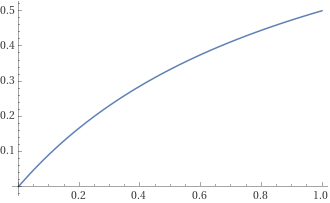
Arc length of curve
$$ \int_ {0} ^ {1} \sqrt {1 + \frac {1}{(1 + \Gamma) ^ {4}}} d \Gamma = 2 _ {2} F _ {1} \left(- \frac {1}{2}, - \frac {1}{4}; \frac {3}{4}; - \frac {1}{1 6}\right) - \frac {\sqrt {2 \pi} \Gamma \left(\frac {3}{4}\right)}{\Gamma \left(\frac {1}{4}\right)} \approx 1. 1 3 2 1 $$ Γ(x) is the gamma function 2F1(a,b;c;x) is the hypergeometric function $$ \begin{array}{l} + \% C E \% B E + \% 3 D + \% C E \% 9 3 \% 2 F \% 2 8 \% C E \% 9 3 \% 2 B \\ 1 \% 2 9 \% 2 C + f r o m + 0 + t o + 1. \\ \end{array} $$ In summary, this analysis provides a quantitative understanding of the signal-to-noise ratio and its relationship to the given unitarization condition. The graphical solutions illustrate the behavior of ξ as Γ varies. Signal/noise aspects may modify the rank-6, 8x8, 64 elements vector time matrix to augment 8 element bra matrix that multiplicatively links 8 element “ket“ matrix wavefunction quantity. The “ket” matrix and bra matrix will have 6 vector time elements, and two scalar time elements, typically global and local clocking measurable time-value.
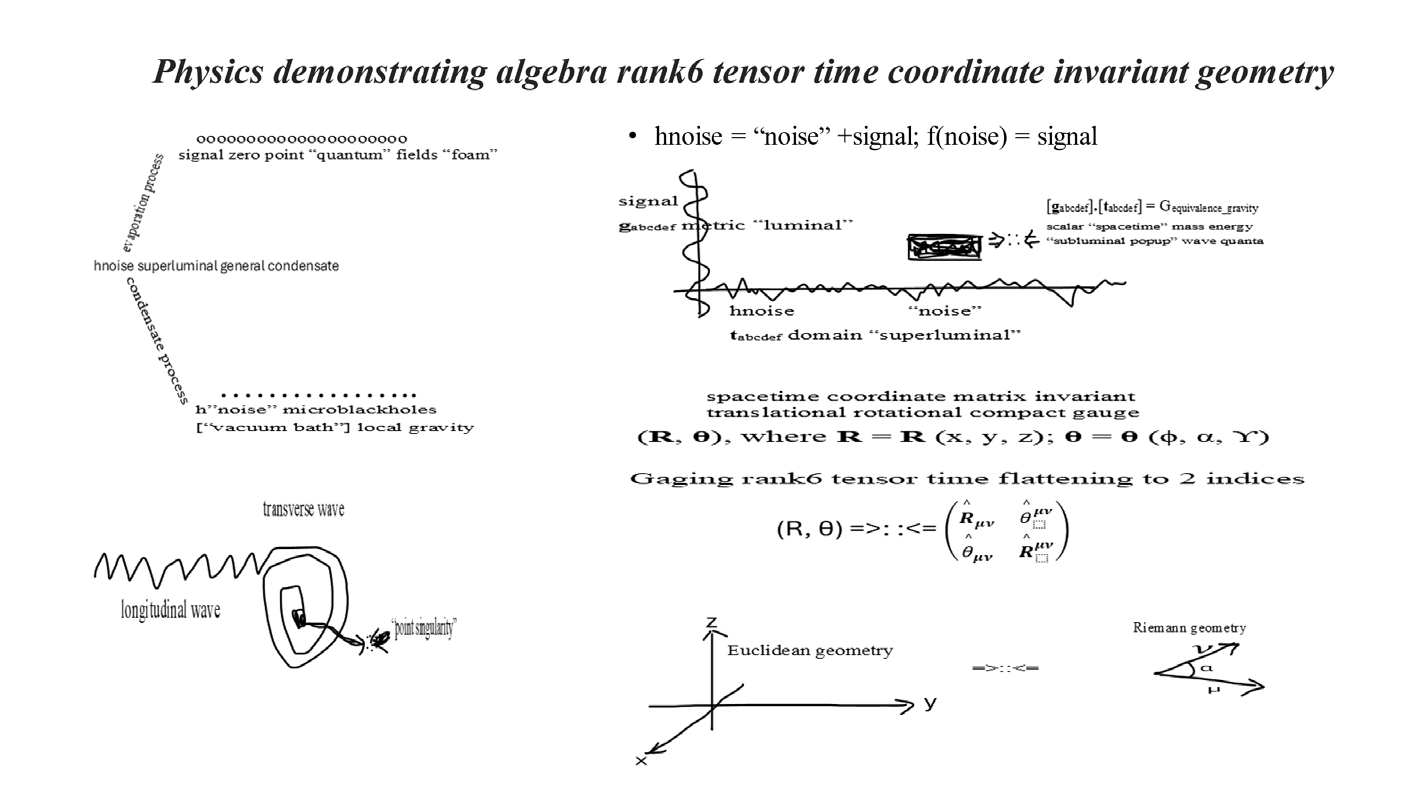
“Keynote: The following physics conjectures will be useful to advance gravitational electromagnetism towards grand unification field theoretically [26, 37, 38, 39, 40].
*Electromagnetism without gravitational effect =>: :<= “quantum foam” or “Planck space” **Gravity without electromagnetic effect =>: :<= “vacuum bath” or “Higgs bath” “Quantum foam” quantification: Ψuniverse via [(∯∯)4Dspace] (𝒕̂𝒂𝒃𝒄𝒅𝒆𝒇.𝝈̂𝝁𝝂) = h (𝝆̂𝒒𝒎) nonlocal global electromagnetism network...Cosmic Microwave Background Radiation (CMBR) experimental measurements, analyzing evaluating wavefunction of the universe, Ψuniverse, linking to integral over the 4D space, (∯∯)4Dspace, the rank 2 stress tensor, 𝝈̂𝝁𝝂, commuting with rank-6-time-tensor, 𝒕̂𝒂𝒃𝒄𝒅𝒆𝒇, to give Planck scale matrix quantum density foam, h (𝝆̂𝒒𝒎).
“Vacuum bath” quantification: |Gw><tq| & SUP (n, N) = nN asymmetry universal matrix versus Nn symmetry universal matrix group theory, where SUP ≡ Suprema Universes Permutability; n: representing spatially characteristic number of cells with domains; N: Spatial Hyperdimension exponentiated by time tensor rank of gravity locality…… Gravitational waves experimental measurements will help to verify interactive coupling of gravity-time.
Summaries
Gaging Rank-6 Time Tensor Matrix:
- The rank-6-time-tensor matrix plays a crucial role in describing complex transformations of rotational parameters across different domains of reality.
- Its properties, including the tensor train rank, allow us to characterize its complexity and sparsity.
Quantitative Algebra Geometry Algorithm:
- By considering the signal-to-noise ratio (SNR) and unitarization conditions, we derive a quantitative relationship for the signal.
- The graphical solutions illustrate how signal varies with SNR, providing insights into signal and noise analysis.
Physical Phenomena Pointed by Rank-6 Time Tensor Matrix:
- Quantum tunneling and cosmic microwave background radiation (CMBR) are phenomena influenced by the rank-6-time-tensor matrix.
- The tensor’s geometry and precession effects contribute to our understanding of these phenomena.
- In summary, this paper sheds light on the intricate interplay of tensors, quantum effects, and gravitational phenomena, providing valuable insights into the fabric of reality. Unified Framework:
- The rank-6 tensor time matrix bridges global and local parameters, offers a unified framework that transcends individual theories.
- By integrating quantum effects, gravity, and rotational dynamics, it provides a more comprehensive description of reality.
Quantum Tunneling:
- Understanding quantum tunneling, facilitated by the tensor matrix, sheds light on how particles can pass through potential barriers.
- This phenomenon has implications for particle behavior, energy levels, and the fabric of spacetime.
Cosmic Microwave Background Radiation (CMBR): • The tensor matrix helps interpret CMBR intensity and polarization.
• Insights into temperature fluctuations and anisotropy enhance our knowledge of the early universe.
Algorithmic Insights:
- The quantitative algebraic approach yields practical algorithms for signal-to-noise analysis.
- These insights can impact data processing, communication, and noise reduction techniques.
Beyond Standard Models:
- The tensor matrix extends our understanding beyond standard models, inviting exploration of new physics.
- It hints at deeper connections between electromagnetism, gravity, as well as the fabric of spacetime.
In summary, this research contributes to a richer, more interconnected view of the cosmos, bridging gaps existing between fundamental forces and phenomena. Practically:
- Quantum Computing and Communication: • Understanding quantum tunneling, as influenced by the tensor matrix, can impact quantum computing algorithms. • Quantum tunneling phenomena play a role in qubit behavior and gate operations. • Noise reduction techniques based on tensor properties can enhance quantum communication channels.
- Signal Processing and Noise Reduction: • The algebraic algorithm for signal-to-noise analysis provides insights into noise reduction. • Engineers can apply these principles to enhance data transmission, image processing, and audio quality.
- Cosmological Models and Observations: • Insights from the tensor matrix can inform cosmological models and simulations. • Researchers studying cosmic microwave background radiation (CMBR) can refine their analyses using tensor- based approaches.
- Beyond Standard Model Physics: • The tensor matrix hints at connections beyond the standard model of particle physics. • Engineers working on high-energy experiments or particle accelerators may also find novel applicable insights.
- Materials Science and Nanotechnology: • Tensor-based approaches can enhance material property predictions. • Understanding rotational dynamics and energy transformations can guide material design and optimization.
- Sensor Calibration and Precision Measurements: • The tensor matrix’s role in rotational transformations can impact sensor calibration. • Engineers can use these principles to improve precision measurements in various fields.
In summary, this research opens avenues for practical applications across disciplines, from quantum technologies to cosmology and materials engineering.
Acknowledgments
Engineering Inc. International Operational Teknet Earth Global has provided a platform to launch ongoing wonderful projects that will be most useful to future human progress. Scientists worldwide specifically have contributed to the success of RESEARCHGATE forums as well as Virtual Google Meetings posted on YouTube as well per TEKNET EARTH GLOBAL SYMPOSIA (TEGS) website: https://www.youtube.com/channel/UCdU- nenH0oEFiSxivgVqLYw that has successfully promoted peer- reviewed publications with ongoing project work. It is with great honor and gratitude that the author would be liking to thank collaborative international physicists ‘scientists starting with Dr. Emmanouil Markoulakis, Experimental Physicist with Hellenic Mediterranean University, Greece in mutually coauthored peer publications of many ansatz breakthrough sciences to explore and successfully pursue quantum astrophysics. The author would too like to thank and be always grateful to Mr. Christopher O’Neill, IT Physicist with Cataphysics Group, Ireland for peer coauthored papers publications, professional graphics, and expert comments with collaborative evaluator feedback on the key contents, especially with TEKNET conference sessions discussing concepts and the graphics suggestions appreciatively exceptionally mutual project workouts ongoing. With highly engaging fruitful debates as well as discussions, the author extends profoundly high appreciation to project collaboratively engaging physicists Drs. Manuel Malaver, John Hodge, Emory Taylor, Wenzhong Zhang, Andreas Gimsa, Christian Wolf, Gerd Pommerenke, and other participating scientists. The author would be always indebted to many upcoming progressive outstanding journals who have promoted publications with excellent peer-reviews of our papers’ articles.
Conflict of Interest
The author declares that there is no conflict of interest regarding the publication of this article.
Funding Source
The author declares that the funding is done by self only.
References
-
Foot CJ (2024) Atomic Physics. Oxford University Press. UK.
-
Iyer R (2021) Proof formalism general quantum density commutator matrix physics. Physical Sciences and Biophysics Journal 5(2): 000185.
-
Hossenfelder S (2023) Existential Physics: A Scientist’s Guide to Life’s Biggest Questions. Atlantic Books. UK.
-
Griffiths DJ (2004) Introduction to Quantum Mechanics. 2nd(Edn.), Reed College , Prentice Hall, Upper Saddle River, New Jersey, USA.
-
Iyer R, Markoulakis E (2021) Theory of a superluminous vacuum quantum as the fabric of Space. Physics & Astronomy International Journal 5(2): 43-53.
-
Iyer R, O’Neill C, Malaver M, Hodge J, Zhang W, et al. (2022) Modeling of Gage Discontinuity Dissipative Physics. Canadian Journal of Pure and Applied Sciences 16(1): 5367-5377.
-
Weller-Davies Z (2024) Quantum gravity with dynamical wave-function collapse via a classical scalar field. arXiv preprint.
-
Andrews LC (1997) Special functions of mathematics for engineers. 2nd (Edn.), SPIE Press.
-
Randall L (2012) Higgs Discovery: The Power of Empty Space. Life and Physics Higgs boson, The Guardian News, USA.
-
Singh A (2022) Quantum space, quantum time, and relativistic quantum mechanics. Quantum Stud Math 9: 35-53.
-
Rovelli C (2018) Space and Time in Loop Quantum Gravity. General Relativity and Quantum Cosmology.
-
Joshi PS (2008) Gravitational Collapse and Spacetime Singularities. Cambridge University Press, UK.
-
Iyer R (2000) Absolute Genesis Fire Fifth Dimension Mathematical Physics. Engineeringinc International Corporation, pp: 63.
-
Gurau R, Rivasseau V (2024) Quantum Gravity and Random Tensors. High Energy Physics - Theory.
-
Iyer R (2022) Quantum Physical Observables with Conjectural Modeling: Paradigm shifting Formalisms II: A Review. Oriental Journal of Physical Sciences 7(2).
-
Obster D (2022) Tensors and Algebras: An algebraic spacetime interpretation for tensor models. General Relativity and Quantum Cosmology.
-
Rivasseau V (2011) Quantum Gravity and Renormalization: The Tensor Track. High Energy Physics - Theory.
-
Gambini R, Pullin J (2008) Black Holes in Loop Quantum Gravity: The Complete Space-Time. Physical Review Letter 101: 161301.
-
Iyer R, Malaver M, Taylor E (2023) Theoretical to Experimental Design Observables General Conjectural Modeling Transforms Measurement Instrumented Physics Compendiu. Research Journal of Modern Physics 2(1): 1-14.
-
Penrose R (1965) Gravitational Collapse and Space-Time Singularities. Physical Review Letters 14(3): 57-59.
-
Bassi A, Lochan K, Satin S, Singh TP, Ulbricht H (2013) Models of Wave-function Collapse, Underlying Theories, and Experimental Tests. Reviews of Modern Physics 85(2): 471-527.
-
Zhang X (2023) Loop Quantum Black Hole. Universe 9(7): 313.
-
Boas ML (2006) Mathematical Methods in the Physical Sciences. 3rd (Edn.), Kaye Pace.
-
Carroll SM (1997) Lecture notes on general relativity, Institute for Theoretical Physics, University of California, USA.
-
Einstein A (1914-1917) The collected papers of albert einstein. 6: 146-200.
-
Rham CD (2024) Solving the Secrets of Gravity. Imperial College, London, UK.
-
Einstein A (1920) Relativity: The Special and General Theory. Henry Holt and Company, USA.
-
Shears T (2015) Antimatter: Why the anti-world matters. nustem.
-
Iyer R (2023) Algorithm it Quantitative Physics Coding Quantum Astrospace Timeline. Oriental Journal of Physical Sciences 8(2).
-
Randall L (2019) The Boundaries of KKLT. Fortschr. Phys 68.
-
Hartle J B (2003) Gravity: An Introduction to Einstein’s General Relativity. Addison Wesley.
-
Oas G (2023) Full derivation of the schwarzchild solution.
-
Hawking SW, Ellis GFR (1973) The large scale structure of space-time. Cambridge Monographs on Mathematical Physics. Cambridge University Press.
-
Blinn C (2017) Schwarzschild Solution to Einstein’s General Relativity.
-
Ghez AM (1993) The Multiplicity of T Tauri Stars in the Star Forming Regions Taurus-Auriga and Ophiuchus- Scorpius: A 2.2μm Speckle Imaging Survey (PhD thesis). California Institute of Technology. USA.
-
Hossenfelder S (2006) Interpretation of Quantum Field Theories with a Minimal Length Scale. High Energy Physics - Theory 73: 105013.
-
Iyer R (2024) Electromagnetism Quantum PHYSICS Conservation Laws Tensor Unveiling Nonlinear Characteristics of Time. Publication Chapter 5 (in progress) within Electromagnetic Theory: New Research and Developments, Nova Science Publishers, Inc., New York, USA.
-
Sheehy S (2017) Particle Accelerators Reimagined - with Suzie Sheehy.
-
Anderson J, Watzke M (2015) NASA Telescopes Set Limits on Space-time Quantum “Foam”.
-
Iyer R (2024) Rank-n Tensor PHYSICS Arithmetic Scalar Algebraic Vector Time Algorithm Matrix. Presented orally virtually July 10, 2024 at ICFAS2024 SPECIAL SESSION with 11th International Congress on Fundamental and Applied Sciences.
- Sense, Gravity, Parity & Chirality in Mathematical Physics
- Quantum Lattice Simulations PHYSICS: Microcircuit Particle Formation and Observable Macroscopic Irreversible Time - A Discrete Lagrangian with Cellular Automata Framework
- Quantum Biology from Biomacromolecule to Cell, and Central Dogma Described by Quantum Theory
- Focus, Agility, Speed and Technology (FAST) for Sustainability and Growth
- Square Root Metric Geometry and Pati-Salam Model in Curved Space-Time
- A Simple System Demonstrating the Mpemba Effect in Classical Mechanics