
Signals/Noise Measurable Observables Limiting Temporal Spatial Domains of Reality Defining Physics
This paper presents a novel exploration of the fundamental nature of signal observables within space-time, focusing on quantifying observables of unknown signals within relation to the various domains of reality. From this ansatz modelling, abstract to the real measurables, powerful inferences PHYSICS have been advanced here of the universal properties characterizing interplay limiting states between high infinite temperatures and absolute zero temperatures. Through Ansatz signal analysis, we demonstrate that the universe tends towards a vacuum state at high infinite temperatures and a superconductive state at absolute zero. The connecting factor between these states is time, which we propose as a critical coordinate in defining physical phenomena. This study also examines the implications of microsymmetry and macrosymmetry in quantum and crystal structures, respectively, and introduces the concept of M-branes theory to describe the evolution of physical states, that will have dependence on pattern parity.
Abbreviations
CMBR: Cosmic Microwave Background Radiation; GW: Gravitational Wave; W/Hz: Watts Per Hertz; PDS: Power Density Spectrum; FFT: Fast Fourier Transform.
Introduction
The author’s earlier studies brought out the principle of time conservation playing a key role in conserving quantum energy [1]. What we observe ultimately from quantum astrophysics measured through the lens of the observable signals within spacetime essentially is energy in terms of temperature. We explore the behavior of the universe at extreme temperatures, revealing a transition from vacuum to superconductive states. Additionally, we examine the symmetry affecting properties at quantum as well as at macroscopic levels and introduce M-branes theory to describe the evolution of physical states from the flat to curved and the curled-up branes.
Most fundamental physical observations within quantum astrophysics will have signals that are either easily measurable or may manifest as noise. Hence, analyzing signal/noise would be key physics that will characterize measurable observables that the author derived out from abstract theoretical physics towards experimental instrumental design as well as potential mesoscopic observations with evidential proofing. Reference Listing [1, 2, 3, 4, 5, 6, 7, 8, 9, 10, 11, 12, 13, 14, 15, 16, 17, 18, 19, 20, 21, 22, 23, 24, 25, 26, 27, 28, 29, 30, 31, 32, 33, 34, 35, 36, 37, 38, 39, 40, 41, 42, 43, 44, 45, 46, 47, 48, 49, 50, 51, 52, 53] provides physics literature that will have extensive specific details on the mathematical physics theoretical derivations, modelling with experimental instrumental designs, evidential observations, measurement physics mathematical analysis, programmable algorithms, as well as equations which give theoretical proofs processes of the hypothesis and concepts that have been advanced here.
Methodology & Experimental Techniques
To investigate signal observables within spacetime and its implications for physical states, we employ the following methodologies with reference also [1]: Ansatz Signal Analysis: This technique allows us to analyze the fundamental nature of signal observables within many worlds spacetime domains of reality and their behavior at extreme temperatures. M-Branes Theory linking Signal/noise Equivalence of the Energy-temperature: Mathematical algorithm theory advances to equations configurationally formulated to theoretically characterize signal/noise behavior of varying domains of spacetime reality. We extend the concept of Planck Boltzmann branes separated by discontinuum length, DL to describe the evolution of diffused quantum states ensembles physical states, including open strings (CMBR longitudinal waves) and closed strings (gravitational transverse waves) on curved or curled up dimensional branes. Then we transform signal variance to temperature variance on a global general systems universal basis. Such general mathematical formulation predicts limiting end ensemble existent states of matter quantum phenomena. Plotting obtained per graphics [https://www.graphreader.com/v2] [2].
Results & Ongoing Discussions
Analysis Discussing the Results Figures 1 to 4
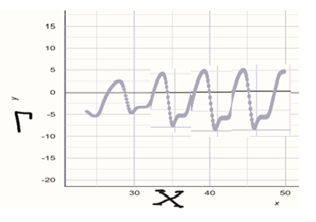
In Figure 1, the depiction of typical signals that we encounter at any domain of reality, is represented by general code axialities. Typically, an observable world produces such signals that we may measure with an oscilloscope or any type of signal detecting devices; note these are sometimes sensed by our brains or active minds as well. These provide prime information on what is going on global dynamically. However, they are hard to resolve as to what it means. This is why an abstract theoretically quantifiable approach is adopted by analytical graphing techniques (Figures 2-4). We know via enormous signal processing theoretical and experimental works available in literature [3, 4, 5, 6, 7, 8, 9, 10, 11, 12, 13, 14, 15] that these can be interpreted or made sense getting proper norm value by adapting domains of reality with differential forms of sensible signal/noise spectra. That is exactly performed by analytical graphing plot in Figure 2 as a function of domain of temporal spatial reality potentially characteristically manifesting thermodynamic measures, including energy equations, heat capacity, and spatial parameters of a distribution function related to energy. Note that Γ: signal/ noise. and X: code axis of Figure 1 is vector characteristic $$ s \left\{\frac {\partial^ {n m} \Gamma}{\partial X ^ {n} \partial t ^ {m}} \dots \right\}: $$ nm graphing. Whereas ....
: differential function of Γ
(signal/noise) with respect to {Xn, tm}: the domain of spatial and temporal reality is a quantifiable measurable observable. Within physics literature, these are also known as tangential plot, since differentials provide algebraic geometry slope of a function. We know absolute values aren’t measurable, however, differentials or the gauge values will be measurable, provided appropriate reference frames are available and used; the author gives more thesis on this within an upcoming publication [16]. Figures 3 and 4 represent situations when these signals aren’t continuous or harmonically smooth, and that will be more realistic as our DisContinuum PHYSICS theories point out [17, 18, 19, 20, 21]. We may also highlight these signal plots at different domains of reality as manifesting potentially well understood cosmic microwave background radiation (CMBR) like carrier wave in general and gravitational wave (GW) like modulating wave. Within all these figures, prominent harmonic curves may represent indirectly vacuum flat M branes separated by typically discontinuum length, DL, and the broken curve may represent indirectly curved M branes action with gravity that creates probability of local field distortion originating particle vortex, that ongoing research suggests them to represent in terms of the flat and curved branes within vacuum. We will be expanding these aspects more in models of M Branes Theories, where M is originally supposed to be grand unifying the five different string theories. M Branes Theories are expected potentially to extend further to represent mosaic matrix structure of zero points that intercalate with micro-blackholes; we may note zero points and the microblackholes primarily the basis of the original Iyer-Markoulakis point PHYSICS Helmholtz Hamiltonian mechanics metrics formalism [22, 23, 24, 25, 26, 27, 28, 29].
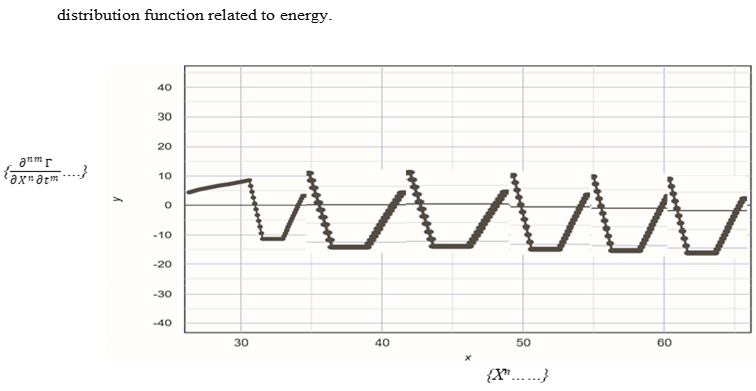
$$ : \left\{\frac {\partial^ {n m} \Gamma}{\partial X ^ {n} \partial t ^ {m}} \dots \right\}. $$ nm of signal/noise, Γ (in Figure 1) versus {tm, Xn……}, the domain of temporal spatial reality potentially characteristically manifesting thermodynamic measure, including energy equations, heat capacity, and spatial parameters of a distribution function related to energy.
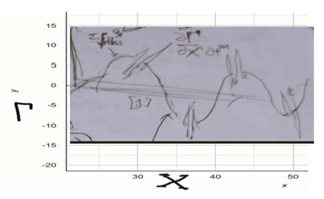
Figure 3: Analogous to Figure 1 schematic signal/noise, Γ plot in code axis, X to manifest carrier wave {like the cosmic microwave background radiation (CMBR) and typically modulating wave {like gravitational wave}. Smooth curves may represent indirectly vacuum flat M branes separated typically by characteristically discontinuum length, DL, and the serrated curve may represent indirectly curved M branes action with gravity that may create the curled-up dimensions having local- field distortion creating particle vortex.
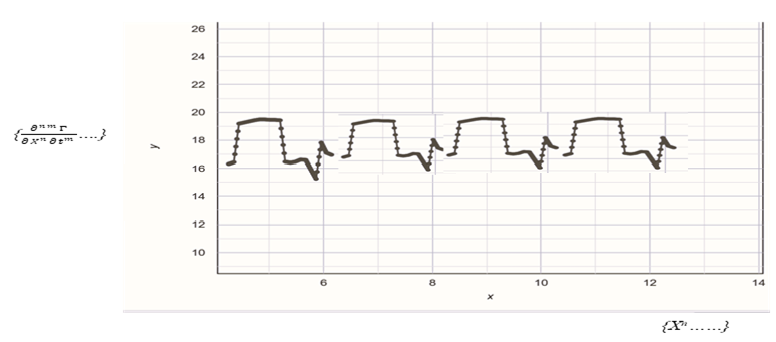
nm Figure 4: Analogous to Figure 2, tangent plane plot ....
of temporal spatial reality manifesting potentially carrier wave {like the cosmic microwave background radiation (CMBR)} and modulating wave {like gravitational wave}. Prominent harmonic curves may represent indirectly vacuum flat M branes separated by typically discontinuum length, DL, and the broken curve may represent indirectly curved M branes action with gravity that creates probability of local field distortion originating particle vortex.
Experimental Design Proofing Signal/Noise Algorithm
The author has earlier shown theoretically derived experimental design schemes. So, theoretical to Experimental Proof Design Engineering Techniques to explore viable measurements of light and sound observed signal/noise versus domains of spatial-temporal reality appear elsewhere [19, 30, 31]. Alongside many ongoing rich PHYSICS literatures, this author also extensively contributed theoretically to quantify observable signal spectra at quantum, mesoscopic, as well as astrophysical levels [32].
A reproduction with details of prototype measurement instrumentations with adequately feasible designs having experimental flowchart given elsewhere [19, 30, 31] are discussed briefly here, showing an experimentally feasible system measurement instruments, that we hope to develop and/or promote to appropriate laboratories that are already existing. Inputs onto these measurement systems will be the signals and their tangent algorithm graphically schematized as well as discussed above, i.e., Figures 1 to 4. Possibly machine learning Artificial Intelligence with Quantum $$ \therefore \left\{\frac {\partial^ {n m} \Gamma}{\partial X ^ {n} \partial t ^ {m}} \dots \right\} $$
of signal/noise, Γ in Figure 3 versus {
m t , n X
……}, the domain Computing might apply to process data streams with real time analysis with interpretive PHYSICS showing what the signal spectra represent precisely accurately.
0 0 $$ (. \Gamma_ {\omega , g r}.) = >:: < = \left( \begin{array}{c} 0 \\ \varnothing \\ 1 \\ \phi \end{array} \right) (\psi c \psi \supset \psi_ {S} \psi_ {N}); \left( \begin{array}{c} 0 \\ \varnothing \\ 1 \\ \phi \end{array} \right): $$ ∅ ∅
1 (. .) :: ( ); : 1 gr S N c ω ψ ψ ψ ψ Equation ,
φ φ switchable gaged fields, ε PDP;
( ) S N c ψ ψ ψ ψ ⊃ clockwise and anticlockwise rotational wavefunction and south-north monopoles’ wave functions representing <ΨHod| gives an algorithmic measurement- capable equation [19]. These are point-to-point parameters multiplicatively relating to signal/noise matrix ( ) ,gr ω Γ that will represent point-to-point profile density matrix intensity measurable by Algorithm Equation per schemes outlined earlier [30].
![Figure 5: Schematics of an intensity profile signal/noise matrix measurement instrumentation systems with point-to-point precision accurate integrated circuit diamond chips microprocessors. Observable measurable astrophysical signal/noise matrix of sound and light detected by sensors decoded by component elements linked to oscilloscope spectroscope and sound meter to gauge fields and the wavefunctions [19,30].](/fulltextimages/13622/fig_5.png)
Figure 5: Schematics of an intensity profile signal/noise matrix measurement instrumentation systems with point-to-point precision accurate integrated circuit diamond chips microprocessors. Observable measurable astrophysical signal/noise matrix of sound and light detected by sensors decoded by component elements linked to oscilloscope spectroscope and sound meter to gauge fields and the wavefunctions [19, 30].
(1) Point to point astrophysical light intensity signal/ noise and spectra density matrices measurement sensor microprocessor like diamond chips embedded operational device. (2) Sound acoustic electric transducer profile switches signal pattern density matrices measurement sensor microprocessor like piezoelectric operational device embedment. (3) Photometer sensor point-to-point profiling switches [mode] {0, off, on} oscilloscope density matrices signal/noise pattern measurement calibration enhanced systems. (4) Sound-meter spectroscopic signal/noise pattern measurement oscilloscope attachment density matrices signal/noise pattern measurement calibration enhanced systems.
Signal/Noise Algorithm Differential Domain of Reality Equating
Algorithm equation mathematical derivative modelling
nm $$ \frac {\partial^ {\mathrm {n m}} \Gamma}{\partial X ^ {\mathrm {n}} \partial t ^ {\mathrm {m}}} $$
= power density spectra of graphic Figures 1-4 Let spatial temporal differentiating signal/noise {like typically lasered quantum states ensemble} with respect to domains of reality {Xn, tm}. If we let having the FdPdss = discontinuum power density sinusoidal spectra of form mathematically in standard format, per results papers [3, 4, 5, 6, 7, 8, 9, 10, 11, 12, 13, 14],
1 2 n A + N
n Sin π φ = ∑ , where A= amplitude_; _N
2 n sin + N π φ
= modulating phasing sinusoidal wave discretized Fourier having N = 400 iterated over n with φ = nm $$ \frac {\partial^ {\mathrm {n m}} \Gamma}{\partial X ^ {\mathrm {n}} \partial t ^ {\mathrm {m}}} $$
+ Γ will be general phase angle, GFΓ = ( ) nm dPdss n m F ∂ ∂ + $$ \partial X ^ {n} \partial t ^ {n} $$ equation giving signal/noise algorithm differential at various domains of reality {Xn, tm}. This general equation will contain ensembles of specific solutions – carrier wave discontinuum energy field representation differentially ( ) nm dPdss n m F X t ∂ ∂ ∂ characterizing indirectly vacuum flat M branes separated by typically discontinuum length, DL [7, 19, 20, 23, 33, 34] {example CMBR} and modulation wave Γ differentially nm $$ \frac {\partial^ {\mathrm {n m}} \Gamma}{\partial X ^ {\mathrm {n}} \partial t ^ {\mathrm {m}}} $$
(example gravitational wave gw} characterizing indirectly curved M branes action with gravity that creates probabilistic local field distortion originating particle vortex_. Transforming Γ and _DEF energy signals to temperature canonically varying we can write:
$$ G _ {F \Gamma} = >: < = G (T) = \alpha_ {1} T + \alpha_ {2} T ^ {2} + \alpha_ {3} T ^ {3} + \alpha_ {4} T ^ {4} + \dots \dots + \xi . e ^ {- k T}, $$ where ’s α are coefficients of temperature series expansion, and ξ is the coefficient of Boltzmannian Arrhenius absolute temperature contributions {diffused quantum states ensembles} [8, 9, 10, 11, 12, 13, 14, 15, 35, 36]. Manipulating general equation GFΓ nm nm n m X t ∂ ∂ ∂ Γ + Γ, we can get: [ n m X t ∂ ∂ ∂
Γ / Γ] = {-
= ( ) nm dPdss n m F X t ∂
∂ ∂ +
$$\frac{\partial^n \left( F_{dPass} \right)}{\partial X^n \partial t^m} / \Gamma} + \left( G_{rf} / \Gamma \right) - 1 = F(\Gamma) \text{ or } F(\Gamma) = \frac{\partial^n \Gamma}{\partial X^n \partial t^m} / \Gamma$$
$$= \frac{\partial^n \ln(\Gamma)}{\partial X^n \partial t^m}, \text{ having that } F(\Gamma) \text{ to be the Fourier differential transform [10-13] of } \Gamma, \text{ like frequency modulation process, representing general Planck Boltzmanian temperature function, } F(\Gamma) = \xi e^{kT} \text{ with comparable equivalent unitarized temperature setting } \xi = 1. \text{ Then we may show:}$$
$$\lim_{T \to 0} (\Gamma) = 1, \text{ which can represent unitarized metrics superconductivity having maximum signal.}$$
$$\lim_{T \to \infty} (\Gamma) = 0, \text{ which can represent a unitarized metrics vacuum having zero (point) signal.}$$
Signal/Noise PHYSICS/Discontinue Plotting Graph CMBR GW
$$\frac{\partial^n \left( F_{dPass} \right)}{\partial X^n \partial t^m} + \frac{\partial^n \Gamma}{\partial X^n \partial t^m} + \Gamma \text{ will be general equation giving signal/noise algorithm differential at various domains of reality } \{ X^n, t^m \}.$$
Keynotes: The above treatise concepts coverage related to signal processing, power density spectra, and possibly statistical mechanics or thermodynamics. Equations involve energy quantum calculations and spatial-temporal series, while the definitions and questions suggest a deeper enquiry into the nature of affinity and field approximations.
**What is the Significance of Power Density Spectra?**
The power density spectrum (PDS), also known as power spectral density (PSD), is a crucial concept in various fields, including physics, engineering, and signal processing of significance [1, 9, 10, 14, 15].
Characterizing Signals:
Frequency Content: PSD helps in analyzing the frequency content of signals. This is essential for understanding how different frequencies contribute to the overall signal [9].
Broadband Signals: It is particularly useful for characterizing broadband, random signals, which are common in many real-world applications [9].
Applications:
Signal Processing: In signal processing, PSD is used to design filters and to analyze the behavior of signals over different frequencies [9].
Vibration Analysis: In mechanical engineering, PSD is used to study vibrations and to design systems that can withstand or minimize unwanted vibrations [3].
Geophysics: In earth sciences, PSD is used to analyze geophysical data, helping to understand various earth processes and structures [14].
Mathematical Representation:
Power Distribution: PSD represents the power of a signal as a function of frequency, typically measured in watts per hertz (W/Hz) [19].
Normalization: The amplitude of the PSD is normalized by the spectral resolution used to digitize the signal, ensuring accurate representation of the signal’s power content [15].
**How is PSD Calculated from a Time-domain Signal?**
Calculating the Power Spectral Density (PSD) from a time-domain signal involves several process steps [3, 4, 5, 8, 9]: Segment the Signal; Divide the time-domain signal into overlapping segments. This helps in reducing noise and improving the reliability of the PSD estimate.
Apply a Window Function: Apply a window function (e.g., Hamming, Hanning) to each segment to minimize edge effects. This step is crucial to reduce spectral leakage.
Compute the Fourier Transform: Perform a Fast Fourier Transform (FFT) on each windowed segment to convert the signal from the time domain to the frequency domain.
Calculate the Power: Compute the squared magnitude of the FFT results for each segment. This gives the power of the signal at each frequency.
Average the Power Spectra: Average the power spectra of all segments to obtain a more stable estimate of the PSD. This step helps in smoothing out variations and noise.
Normalize the PSD: Normalize the averaged power spectra by the sampling rate and the window’s energy to ensure the PSD is correctly scaled appropriately.
**Example Using Welch’s Method**
Welch’s method is a popular approach for estimating the PSD. Here’s a step-by-step outline [8]:
Divide the Signal: Split the signal into overlapping segments (e.g., 50% overlap).
Window Each Segment: Apply a window function to each segment.
FFT and Power Calculation: Compute the FFT of each windowed segment and then calculate that all the squared magnitude. Average and Normalize: Average the squared magnitudes and normalize by the sampling rate and the window’s energy.
Practical Implementation
In practice, tools like MATLAB or Python libraries (e.g., SciPy, NumPy) can be used to perform these calculations efficiently. Simple Python program using SciPy will give: import numpy as np from scipy.signal import welch # Sample time-domain signal signal = np.random.randn(1024) fs = 1000 # Sampling frequency # Calculate PSD using Welch’s method frequencies, psd = welch (signal, fs, nperseg=256) # Plot the PSD import matplotlib.pyplot as plt plt.semilogy(frequencies, psd) plt.xlabel(‘Frequency (Hz)’) plt.ylabel(‚PSD (V^2/Hz)‘) plt.title(‘Power Spectral Density’) plt.show() Figure 5 pattern wise corresponds to Figures 1 to 4, giving graphical data process collections analytical information PHYSICS. Mixed signal points to multi-order aspects that are manifesting process complex system events happening at various domains of reality spatially temporally in time sense space environments, with creation as well as annihilation of entities - quasi, unparticles, partons, and particles to real matter universe. Spectral patterns mathematically processed separately will indicate discontinuum quanta and the fields. Electromagnetic fields signals transformed to thermophysics, thermodynamically translated to parameters of time, temperature, transformations of environmental material points within spatial domains show striking patterns!!
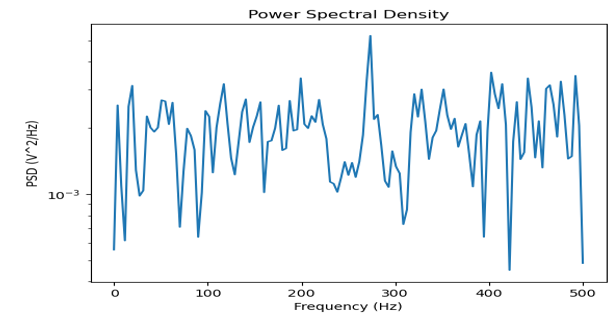
….} vs {tm, Xn…}, domain of reflects signal/noise, Γ plot in code axis, X (per Figures 1 &3), and tangent plane plot { temporal spatial reality manifesting potentially carrier wave {like cosmic microwave backgrounds radiation (CMBR)} and modulating wave {like gravitational wave} (per Figures 2 & 3). Prominent harmonic curves may thus represent indirectly vacuum flat M branes separated by typically discontinuum length, DL, and the broken curve may represent indirectly curved M branes action with gravity that creates probability of local field distortion originating particle vortex. [This code snippet demonstrates how to calculate and plot the PSD of a sample signal using Welch’s method explained above].
Quantified mathematical PHYSICS thorough domains signals operational analyses highlight significant applications to Sciences, Technology, Engineering, Mathematical Algorithm Programming IT that were demonstrated above would be inferentially explanatorily shown to come up with breakthrough extreme universal PHYSICS states below inferred critically!! Our findings indicate that at high infinite temperatures, the universe tends towards a vacuum state, while at absolute zero, it becomes superconductive. Further notes having Appendices I & II examine how this duality is bridged by the concept of time as a critical coordinate. The symmetry analysis reveals that quantum-level microsymmetry can exhibit five-fold symmetry, while macroscopic crystal structures are constrained by periodicity and space-filling properties. The M-branes theory provides a comprehensive framework for understanding the evolution of physical states, highlighting the role of open as well as those closed strings in defining gravitational and electromagnetic entities.
Temperature Extremes Analysis: Studying the behavior of the universe at high infinite temperatures and absolute zero identifies the transition between vacuum and superconductive states. Our present findings indicate that at high infinite temperatures, the universe tends towards a vacuum state, while at absolute zero, it becomes superconductive as pointed out above earlier. This duality is bridged by the concept of time as a tensor. The derivation shows that the time differential, $(f(t_q).dt_q = 0)$, suggesting a canonical transformation of energy $(E_q)$ into time as shown earlier. These results open new avenues for understanding the fundamental conservation laws in physics and challenge the traditional view of time as a mere scalar [1, 22, 37, 38, 39, 40, 41, 42, 43, 44, 45, 46, 47, 48, 49, 50, 51, 52, 53].
Applications Bottom of Form
Experimentally testing time conservation [1], Spin spectroscopy signal/noise algorithm to theoretically measure particle mass, charge, micro symmetry in quantum and macro symmetry within crystal structures, graviton as a quantum microblackhole, proof of M Branes Theories, quantum gravity grand unified PHYSICS, Wavefunction collapse, superposition, quantum entanglement phenomenological algorithmic quantum computing, sensing signals to predict path of time event progression at quantum, mesoscopic, and astrophysical levels with their interconnectedness, thereby establish origin of observable universe with dark energy, dark matter, real energy, and real matter nature!! are some of the immediate practical applications, apart to myriads of ongoing advancement in Science, Technology, Engineering, ARTS, Mathematics, Algorithm IT Machine Learning Artificial Intelligence with Quantum Computing advancements.
Innovative Techniques, Science Engineering Technology Futuristic
Signal/noise PHYSICS may be the very key that will unlock mysteries of universe, hitherto mired by exotic nature of everything!! [5, 6, 7, 8, 9, 10, 11, 12, 13, 14, 15, 16, 17, 18, 19, 20, 21, 22, 23, 24, 25, 26, 27, 28, 29, 30, 31, 32, 33, 34, 35, 36, 37, 38, 39, 40, 41, 42]. This author earlier proved that the whole universe works like a black box!! [19, 30]. Notwithstanding that, we have explored techniques to get meaningful poke, peek, observe, measure, quantify, and understand developing knowhow mathematically and physically morphological structure, properties, processes, kinematics, programmable manipulatable transformations, as well as futuristic predictions with our earth to astronomical extent. Geometric topology space characterized by DeSitter Space outside, Anti DeSitter space looking from within may give us glimpse of vast expanse that is only miniscule part of observable universe, let alone unobservable dark or imaginary phase of a multiphase, possibly consisting of infinite superluminal general condensate like "superfluids" having vacuum luminal Maxwellian Laurentian Einstein Minkowski spacetime, as well as subluminal observable matter universe delimited by wave-particle Planckian space. Hence, understanding knowledge unifying PHYSICS would herald a new era of beckoning meshing together what already we have in terms of fundamental basics with innovative techniques to proceed to scientific breakthroughs gearing to get reproducible results which are provably verifiable at mesoscopic levels as well!! Our quest would continue to unravel mysteries of the unknown sector encompassing universal nature of everything!! We have ongoing research efforts aimed to simulate theories with experimental parameter that are easily perhaps testable within a few years progressively!!
Conclusion
This study proposes that time, much like energy, may be a conserved quantity in the universe. By examining signal observables in space-time and employing Anatsz signal analysis, we uncover new insights into the behavior of physical states at extreme temperatures. Signal/noise, $\Gamma$ plot with the code axis, $X$, and tangent plane plot $\frac{\partial \alpha^m \Gamma}{\partial X^n \partial t^m}$ vs $\{t^m, X^n\}$, domain of temporal spatial reality seems to manifest potentially carrier wave-like cosmic microwave backgrounds radiation (CMBR) and modulating wave-like gravitational wave (GW). Mixed signal points to multi-order process complex system events at various domains of reality with creation as well as annihilation of entities like unparticles or particles to real matter universe. Spectral patterns will indicate discontinuum quanta and the fields. Electromagnetic fields signal possibly thermodynamically relate to time-temperature-transformations.
Appendix I & Appendix II have notes on the discrete Fourier transforms, power spectral density, crystal lattice coordinates, and macro to micro symmetry. Also, introduction of M-branes theory offers a unified framework for understanding the evolution of physical states from flat to curved and curled branes. Future research should further explore the implications of time conservation and its potential applications in various fields of physics, with applications of knowhow pattern parity to analyzing imaging picture video textual transformable communications.
Acknowledgement
Engineering Inc. International Operational Teknet Earth Global has provided a platform launching wonderful ongoing projects that will be most useful to future human progress. Scientists worldwide specifically have contributed to the success of RESEARCHGATE forums as well as Virtual Google Meetings posted on YouTube as well per TEKNET EARTH GLOBAL SYMPOSIA (TEGS) website: https://www. youtube.com/channel/UCdUnenH0oEFiSxivgVqLYw that has successfully promoted peer-reviewed publications with ongoing project work. It is with great honor and gratitude that the author would be liking to thank collaborative international physicists ‘scientists starting with Dr. Emmanouil Markoulakis, Experimental Physicist with Hellenic Mediterranean University, Greece in mutually coauthored peer publications of many ansatzes breakthrough sciences to explore and successfully pursue quantum astrophysics. The author would too like to thank and be always grateful to Mr. Christopher O’Neill, IT Physicist with Cataphysics Group, Ireland for peer coauthored papers publications, professional graphics, and expert comments with collaborative evaluator feedback on the key contents, especially with TEKNET conference sessions discussing concepts and the graphics suggestions appreciatively exceptionally mutual project workouts ongoing. With highly engaging fruitful debates as well as discussions, the author extends profoundly high appreciation to project collaboratively engaging physicists Drs. Manuel Malaver, John Hodge, Emory Taylor, Wenzhong Zhang, Andreas Gimsa, Christian Wolf, Gerd Pommerenke, and other participating scientists. The author would be always indebted to many upcoming progressive outstanding journals who have promoted publications with excellent peer reviews of our papers’ articles.
Funding Sources
The sole author received no financial support for the research, authorship, and/or publication of this article.
Conflict of Interest
The sole author does not have any conflict of interest.
Author Contributions
The sole author was responsible for the conceptualization, methodology, data collection, analysis, writing, and final approval of the manuscript.
ENGINEERINGINC INTERNATIONAL OPERATIONAL TEKNET EARTH GLOBAL
References
-
Iyer R (2023) Preliminary Results for Magnetic Hysteresis Unparticle Hod-Pdp Circuit Mehanism Within Superluminal Physics. Canadian Journal of Pure and Applied Sciences 17(30): 5789-5793.
-
Iyer R (2023) Algorithm its Quantitative Physics Coding, Quantum Astrospace Timeline. Oriental Journal of Physical Sciences 8(2).
-
Random Testing Calculating PSD from a Time-history File.
-
Howard RM (2002) Power Spectral Density. Wiley-IEEE Press, pp: 59-91.
-
(2006) Energy and Power Spectral Density and Autocorrelation.
-
(2024) What is power spectral density (PSD), and why is it important?. Example: Using power spectral density for dark matter detection.
-
Wikipedia on Discrete Fourier Transform.
-
Arar S (2017) An Introduction to the Discrete Fourier Transform. CIRCUITS.
-
Marco Taboga, Discrete Fourier transform.
-
Engineering LibreTexts on Fourier Analysis: SpringerLink on Fourier Analysis of Signals.
-
Bansal AR, Dimri VP (2021) Power Spectral Density. In: Sagar BD, et al. (Eds.), Encyclopedia of Mathematical Geosciences. Encyclopedia of Earth Sciences Series. Springer, Cham.
-
What is a Power Spectral Density (PSD)? How is it different than an autopower?
-
Maxwell-Boltzmann Distributions.
-
Kuzemsky AL (2022) The Exotic Thermodynamic States and Negative Absolute Temperatures. J Low Temp Phys 206: 281-320.
-
Iyer R (2024) Particle Charge Mass Spin Spectroscopy Ansatz Physics. Original Communications Article Review Editorial Ongoing Research. Physics & Astronomy International Journal (publication in the progress).
-
Iyer R (2023) Algorithm of time preliminary theoretical results pointing to space geometry physics transforms. Canadian Journal of Pure and Applied Sciences 17(2): 5673-5685.
-
Malaver M, Iyer R (2022) Analytical model of compact star with a new version of modified chaplygin equation of state. arXiv.
-
Iyer R (2021) Physics formalism Helmholtz Iyer Markoulakis Hamiltonian mechanics metrics towards electromagnetic gravitational Hilbert Coulomb gauge string metrics. Physical Sciences and Biophysics Journal 5(2): 000195.
-
Malaver M, Iyer R (2023) Charged stellar model with generalized Chaplygin equation of state consistent with observational data. Universal Journal of Physics Research pp: 43-59.
-
Iyer R (2024) Quantum Astrophysics General Formalisms Theoretical to Experimental Gaging. Futuristic Trends in Physical Sciences 3: 253-286.
-
Iyer R (2024) Electromagnetism Quantum Physics Conservation Laws Tensor Unveiling Nonlinear Characteristics of Time. Publication Chapter 5 (in progress) within Electromagnetic Theory: New Research and Developments, Nova Science Publishers, Inc., New York.
-
Iyer R (2024) Rank-n Tensor Physics Arithmetic Scalar Algebraic Vector Time Algorithm Matrix. Presented orally virtually July 10, 2024, at ICFAS2024 SPECIAL SESSION with 11th International Congress on Fundamental and Applied Sciences.
-
Iyer R (2024) Scalar Metrics Tensor Gradation Rank-n Quantum Gravity Physics. Short Communications Article with Research Journal of Modern Physics (with publication in progress).
-
Iyer R (2022) Observables physics general formalism. Phys Astron Int J 6 (1): 17-20.
-
Iyer R (2022) Configuring observables solving physical algorithm quantum matrix gravity. Mod Appl Phys 5: 1-5.
-
Iyer R, O’Neill C, Malaver M, Hodge J, Zhang W, et al. (2022) Modeling of gage discontinuity dissipative physics. Canadian Journal of Pure and Applied Sciences 16 (1): 5367-5377.
-
Iyer R (2022) Quantum physical observables with conjectural modeling: Paradigm shifting formalisms II: A review. Oriental Journal of Physical Sciences 7(2): 50-66.
-
Iyer R (2023) Strong gravity versus weak gravity: fiber transforms gravity-bundle-strings: preliminary results. Canadian Journal of Pure and Applied Sciences 17(2): 5697-5703.
-
Taylor E, Iyer R (2023) Electronic transitions between energy levels without the emission of electromagnetic radiation. Physics Essays 36(4): 358-360.
-
Iyer R (2024) An exact new solution of the Schrödinger equation with a zero potential energy analogous to Fick’s equation of diffusion. Physics & Astronomy International Journal 8 (1): 59-63.
-
Iyer R (2024) Problem Solving Measurement Physics References Entity Calibrational Systems: Original Research Editorial. Oriental Journal of Physical Sciences (publication in progress).
-
Iyer R (2022) Algebra Gage Matrix Physics. Oral Invited Talk Presentation at the ICFAS2022 9th International Congress on Fundamental and Applied Sciences.
-
Iyer R (2023) Algebra Fields Time Transformations Geometry of Space Gaging. Oral Invited Speaker Presentation at the ICFAS2023 10th International Congress on Fundamental and Applied Sciences.
-
Malaver M, Iyer R, Kar A, Sadhukhan S, Upadhyay S, et al. (2022) Buchdahl spacetime with compact body solution of charged fluid and scalar field theory. arXiv 2204.
-
Malaver M, Kasmaei H, Iyer R (2022) Magnetars and stellar objects: Applications in astrophysics. Eliva Press Global Ltd., Moldova, Europe.
-
Taylor E, Iyer R (2022) Discontinuum physics leads to a table of realities for making predictions. Physics Essays 35 (4): 395-397.
-
Malaver M, Iyer R (2022) Charged Dark Energy Stars in a Finch-Skea Spacetime. arXiv.
-
Malaver M, Iyer R (2024) New relativistic charged models for compact stars. AJ Planetary Space Sci 3 (1): 127.
-
Malaver M, Iyer R (2023) Some new relativistic charged models with anisotropic pressure. Phys Astron Int J 7(1): 240-249.
-
Malaver M, Iyer R (2023) Some new relativistic charged models for compact objects with anisotropic pressure. arXiv.
-
Taylor E, Iyer R (2022) Einstein’s questioning and speculations lead to theoretical photon momentum. Physics Essays 35(4): 321-322.
-
Welch PD (1967) The use of fast Fourier transform for the estimation of power spectra: A method based on time averaging over short, modified periodograms. IEEE Transactions on Audio and Electroacoustics, AU-15(2): 70-73.
-
Iyer R (2022) Review force general conjectural modeling transforms formalism physics. Physics & Astronomy 6(3): 119-124.
-
Iyer R (2024) Time Conservation Principle versus Energy Physics. Open J of Astronomy 2(2): 000139.
-
Iyer R (2023) Preliminary Results of Genesis for Distorted Fields’ quantum Mechanism Within Superluminal Quagmire. Canadian Journal of Pure and Applied Sciences 17(3): 5745-5760.
-
Iyer R, Malaver M, Taylor E (2023) Theoretical to experimental design observables general conjectural modeling transforms measurement instrumented physics compendium. Research Journal of Modern Physics 2 (1): 1-14.
-
Iyer R (2022) A brief overview general formalisms Physics. Physics & Astronomy International Journal 6 (3): 68-69.
-
Iyer R (2000) Absolute Genesis Fire Fifth Dimension Mathematical Physics. Engineeringinc International Corporation, pp: 63.
-
Iyer R (2022) Discontinuum Critical Signal/Noise Density Matrix. Physical Science & Biophysics Journal 6(1): 000210.
-
Iyer R, O’Neill C, Malaver M (2020) Helmholtz Hamiltonian mechanics electromagnetic physics gaging charge fields having novel quantum circuitry model. Oriental Journal of Physical Sciences 5 (1-2): 30-48.
-
Iyer R (2021) Proof formalism general quantum density commutator matrix physics. Physical Sciences and Biophysics Journal 5(2): 000185.
-
Iyer R, Markoulakis E (2021) Theory of a superluminous vacuum quanta as the fabric of Space. Phys Astron Int J 5 (2): 43-53.
-
Iyer R (2024) Quantum Gravity Time Rank-N Tensor Collapsing Expanding Scalar Sense Time Space Matrix Signal/Noise Physics Wavefunction Operator. Physical Science & Biophysics J 8(2): 000271.
- Sense, Gravity, Parity & Chirality in Mathematical Physics
- Quantum Lattice Simulations PHYSICS: Microcircuit Particle Formation and Observable Macroscopic Irreversible Time - A Discrete Lagrangian with Cellular Automata Framework
- Quantum Biology from Biomacromolecule to Cell, and Central Dogma Described by Quantum Theory
- Focus, Agility, Speed and Technology (FAST) for Sustainability and Growth
- Square Root Metric Geometry and Pati-Salam Model in Curved Space-Time
- A Simple System Demonstrating the Mpemba Effect in Classical Mechanics