
Symmetric Nature of Positive-Negative Matters, and Its Generalization and Test
Based on the negative matter as unified dark matter and dark energy, we first derive its three basic formulas on gravity, total energy, and field equations of general relativity. Second, we research astronomy and cosmology on the negative matter, and propose that a new test way on galaxies with different positive and negative matters have different curves of the rotational velocity with distance. Third, we discuss physics and other natural sciences of the negative matter, and search the cosmic wave function and corresponding quantum theory. The negative matter is calculable, observable and testable, and may be changed and developed. If the negative matter is confirmed by the observation, it will open up a new world.
Introduction
Dark matter and dark energy are two basic focuses in astronomy, astrophysics, cosmology and total physics in world science. Dark matters form halos [1], which may be origin of the quantum fluctuations. It is observed that the structural distribution of dark matter varies with the galaxy mass [2]. The evolution of the dynamics, for example rotation, can induce a change in the mass-to-light ratio [3]. The accelerated expansion of the universe [4, 5, 6] is a fundamental problem in modern physics [7]. This is now thought that it is origin of dark energy, which began to emerge 5 billion years (T = 8.8 billion years) ago. Astronomers and physicists have proposed many models on dark matter and dark energy. But, the tests of some models are very difficult. So far most of the published books on dark matter and dark energy are popular science books. Some believe that dark energy distributes uniformly in the whole space, and throughout the universe, even to us. But, new data show that dark matter is 25.96%, and dark energy is 69.2% in Universe [8, 9]. As long as there is some dark matter or dark energy in the solar system, general relativity cannot be so accurate, such as for Mercury the precession of perihelion adds only 43’’ per hundred years [10], therefore, there are not necessarily dark matter and dark energy in the solar system. Dark energy cannot distribute uniformly in the whole space. In this paper, we derive three basic formulas on the negative matter, and propose a new test way on galaxies, etc.
Basis and Basic Formulas of the Negative Matter
Early in 1954, Einstein proposed, one cannot understand why the gravitational masses all have the same sign. Based on Dirac negative energy, and combined Einstein mass-energy relation and principle of equivalence, since 2007 we proposed and gradually completed the negative matter as the simplest model of unified dark matter and dark energy. Because there is repulsion between positive matter and negative matter, both form two different regions of topological separation (Figure 1), so it is invisible dark matter, and repulsion as dark energy [11, 12, 13, 14, 15, 16, 17, 18, 19, 20, 21, 22, 23]. In 2024 I have systematically summarized its theories and possible observations, and published a book [24]. The first formula of the negative matter on Newton gravity is:
$$ F = - \frac {G}{r ^ {2}} M _ {1} M _ {2}, \tag {1} $$
The main characteristic of the negative matter is the universal gravitation each other, but is the universal repulsion with all positive matter. Therefore, the creation of negative matter is difficult, but its existence is stable. In general case both of positive and negative matters are two regions of topological separation by different interactions (Figure 1).
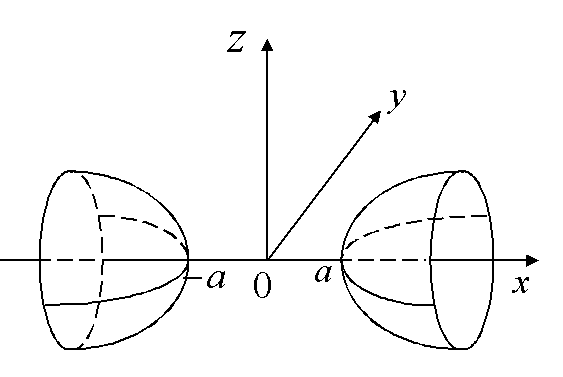
For negative mass Bondi theory [25] is a fallacy with contradictions according to the principle of equivalence. We study carefully some proofs of the positive mass (energy) theorem, and found that these proof processes all have certain premises [20, 24]. The anti-(opposite) matter and the negative matter should be distinguished exactly. The total world should include three parts: I. the positive matter; II. the negative matter; III. the world between positive and negative matters. I and II correspond to Riemann geometry, III corresponds to Lobachevsky geometry. Such the second formula on the total energy is:
$$ = \sum_ {i} m _ {i} ^ {+} c ^ {2} - \sum_ {i j} \frac {G m _ {i} ^ {+} m _ {j} ^ {+}}{r _ {i j}} - \sum_ {k} m _ {k} ^ {-} c ^ {2} - \sum_ {k l} \frac {G m _ {k} ^ {-} m _ {l} ^ {-}}{r _ {k l}} + \sum_ {i k} \frac {G m _ {i} ^ {+} m _ {k} ^ {-}}{r _ {i k}}. \tag {2} $$ Gm m Gm m Gm m E m c m c r r r
2 2 i j k l i k t i k i ij k kl ik ij kl ik
General case rik >>rij ≈ rkl, assume that
$$ M _ {+} = M _ {-}, \mathrm {s o} $$ $$ \left| E _ {+} < E _ {-} \right|. $$
. As time increases, rij, rkl will get smaller and smaller, and rik bigger, then − + < E E will continue to increase. The end result will form a huge dipole of positive matter and negative matter, even two black holes of positive and negative matters. The third formula of the negative matter on general relativity is [11, 12, 13, 14, 15, 16, 17, 18, 19, 20, 21, 22, 23, 24]:
$$ G _ {\mu \nu} = R _ {\mu \nu} - \frac {1}{2} g _ {\mu \nu} R = 8 \pi k \left(T _ {\mu \nu} - T ^ {\prime} _ {\mu \nu}\right) $$ . (3) Here µν G
is the same,
$$ T _ {\mu^ {\prime}} \rightarrow T _ {\mu} - T _ {\mu} ^ {\prime} \quad \mathrm {a n d} T _ {\mu^ {\prime}} ^ {\prime} $$ corresponds to the negative matter. It is kwon that the gravitational field equations with the cosmological constant are Einstein A [26]:
$$ G _ {\mu \nu} + \Lambda g _ {\mu \nu} = R _ {\mu \nu} - \frac {1}{2} g _ {\mu \nu} R + \Lambda g _ {\mu \nu} = 8 \pi K T _ {\mu \nu} $$ . (4) Usually assume that the dark energy connects with the cosmological constant Λ. So, the cosmological constant Λ corresponds to the negative matter, i.e.
8 / KT g µν µν π ′ Λ = . (5) The negative matter determines the cosmological constant, and is consistent with conformal gravity theory [27]. Based on (1-3), almost all theories are known, only mass includes positive and negative. This includes classical mechanics, relativity and quantum physics, etc. It agrees on Occam’s Razor, and may explain many phenomena of dark matter and dark energy.
From Equation (2) we may calculate simply and derive that the rotational velocity of galaxy is approximate constant, and an evolutional ratio between total matter and usual matter from 1 to present 11.82 or 7.88 [18, 21, 22, 23, 24]. We calculated the accelerated expansion at 9.760 billion years.
Further, it may explain the mechanism of inflation as origin of positive-negative matters created from nothing, whose expansion is exponential due to strong interactions at small microscopic scales. And it related to Higgs mechanics. In fact, phantom with a negative kinetic energy is namely a type of the negative matter. Phantom was applied to computerized tomography by Shepp, et al.
Anti-gravity is the repulsion between negative matter and positive matter.
Astronomy and Cosmology
Cosmological principle is: The universe is uniform and isotropic on large scales. But there is structure in local regions, such as the solar system. Dark matter distributions indicate they is clumps.
Based on observations of a remarkable cosmic structure called the bullet cluster, Bradac, et al., discovered that this structure is actually two clusters of galaxies passing through one another (Figure 2) [28].
As the two clusters cross at a speed of 10 million miles per hour, the luminous matter in each cluster interacts with the luminous matter in the other cluster.
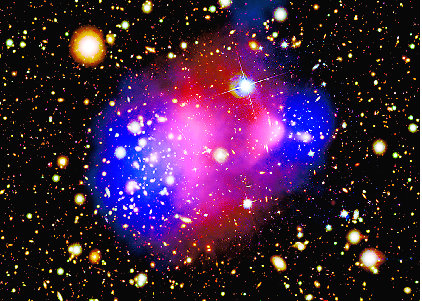
Based on the different gravitational lensing and repulsive lensing, there have three kinds: • Visible celestial body with large mass, gravitation deflection;
• Invisible black hole with large mass, gravitation deflection;
• Invisible negative matter with large mass, repulsion deflection.
• Mass of the negative matter is invariant, and mass of black hole may increase and form an accretion disk. Therefore, we may determinate three kinds of mass on the negative matter and general matter. Reid and Zheng researched to show that the Milky Way structure is a barred spiral galaxy with four spiral arms (Figure 3) [29].
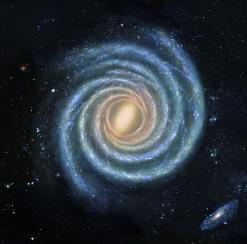
There must have dark matter in the Milky Way. We should closely observe the dark regions of the Milky Way (Figure 3), which could be three categories: gas cloud, black hole, or dark matter.
The black holes form some spherical regions, while gas cloud and dark matter may not be completely regular. When the Earth is in different positions of the solar system throughout a year, the background stars of these regions will be respectively constant, gravitational lensing, or opposite repulsive lensing if negative matter as dark matter. The both angles of deflection are:
2 4_GM_ c R φ ∆ = ±
, (6) In which R is the same for a black hole, while R for negative matter is not necessarily the same. Many observatories should be able to observe these differences [18, 19, 20, 21, 22, 23, 24].
This difference should be observed in the two locations of the earth’s annual movement, and the time difference is half-year (i.e., anniversary parallax by six months).
For some special galaxies, Hoag’s Object (Figure 4) is a perfectly symmetric ring galaxy, whose diameter is about 120,000 light-years, and the bright rings of billions of blue stars form a perfect circle around a smaller, denser sphere of red stars. In the dark gap between the two stellar rings, there is a ring. So far, Hoag’s Object is still one of the most beautiful mysteries in the Universe.
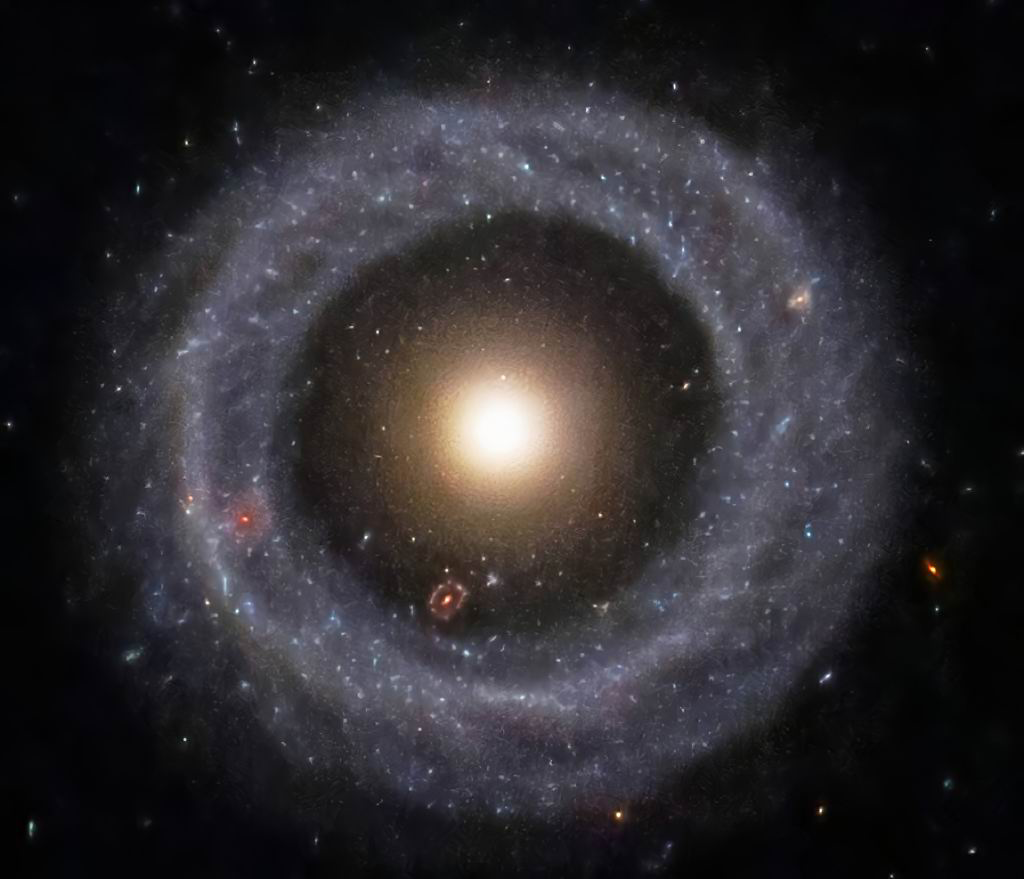
According to our theory [11, 12, 13, 14, 15, 16, 17, 18, 19, 20, 21, 22, 23, 24], this flat galaxy may be a ring structure with negative matter in the middle, similar to a sandwich structure. Both sides are positive matter. Positive matter and negative matter aggregate each other into stable rings. But, the middle core of the galaxy is so massive, when the surrounding negative matter is subtracted, it can still attract the outer layer of positive matter. Generally, the negative matter may form the dark matter rings, for example, for the Psc CL0024+17 cluster galaxies. It can explain many characteristics, such as the huge lack of mass on dark matter, the repulsive force of dark energy, the negative-dark matter rings round a cluster of galaxies form the repulsive forces and fetter the cluster of galaxies and keep its stability, etc. Further, it may include various galaxies with ring: core ring (ES0 565-11), inner ring (IC 5240), outer ring (NGC 1543), and three rings at the same time (NGC 6782) [30, 31]. Galaxy AM 0644-741 (Figure 5) shows an ellipsoid circular galaxy, whose diameter is about 130,000 light-years. It is currently believed that the left-below of this circular galaxy is an ellipsoidal galaxy, which may have crossed and formed a circular galaxy hundreds of millions of years ago.
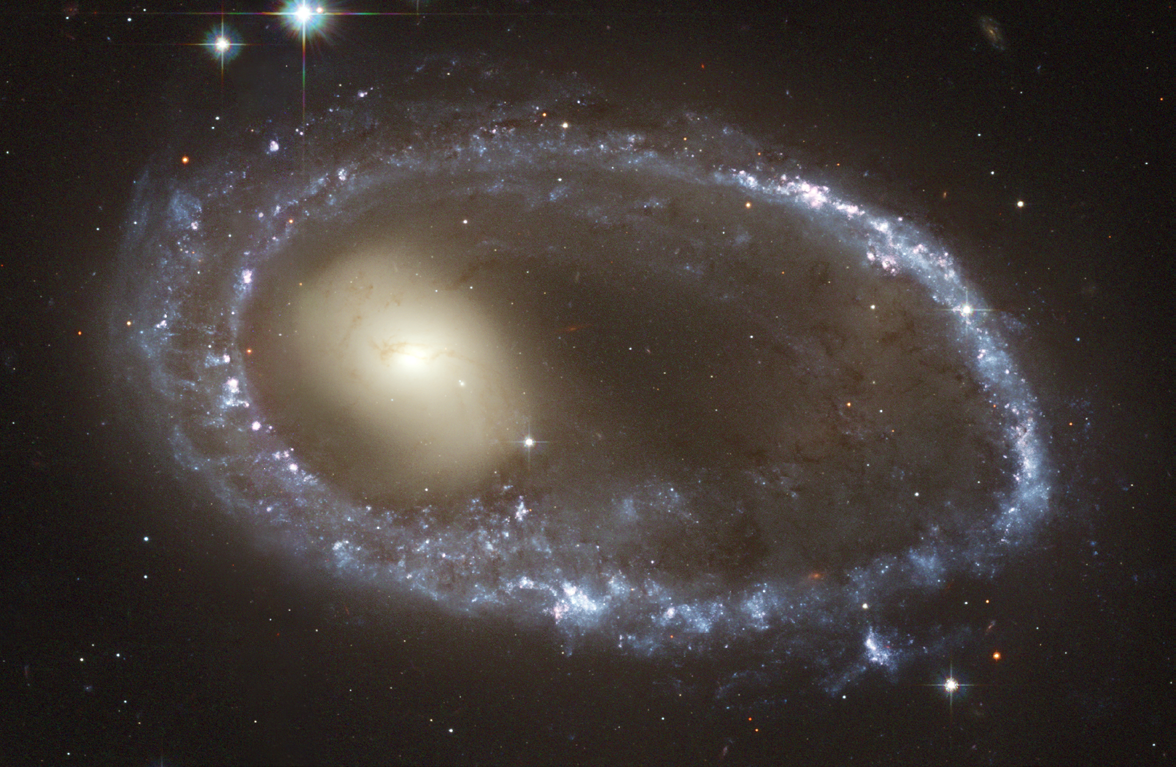
We proposed the negative-dark matter can also form black holes, which are mutually repulsion with general matter. If positive and negative black holes form double cores, they may produce huge similar cosmic electric dipoles, such as Galaxy AM 0644-741 (Figure 5), which will have various corresponding effects [23, 24]. Except nine possible tests of this hypothesis [18, 24], now we discuss a new galaxy test method of the negative matter. A rotation velocity with positive and negative matters will be [24]:
Rotational Velocity Distance:
$$ V = - \int \frac {G}{R ^ {2}} \left(M _ {+} - M _ {-}\right) d t \tag {7} $$
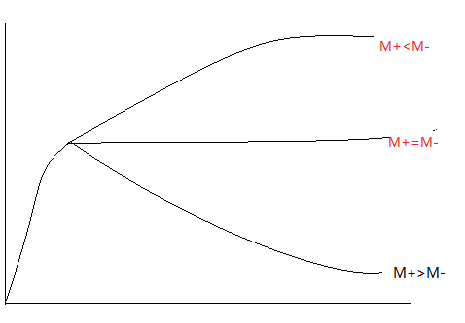
So, galaxies with different positive and negative matters
will have different mass-to-light ratios and different curves of
the rotational velocity with distance. It is briefly represented
in Figure 6.
I. The spiral galaxies
$$ \left| M _ {+} \approx M _ {-} \right|. $$
. It will be basically constant.
If + M is slightly bigger than − M , a spiral galaxy will be tighter; if + M is slightly smaller than − M , this galaxy will be thinner.
II. The elliptical galaxies
$$ M _ {+} > M _ {-}. $$
. Their curves of the rotational velocity with distance will tend to go down.
III. The Irregular galaxies
$$ M _ {+} < M _ {-} $$
. Their curves of the rotational velocity with distance will tend to go up.
IV. Hoag’s Object
$$ M _ {+} > M _ {-}. $$
. Their curves of the rotational velocity with distance will be complexity.
If 0 ≈ − M in a galaxy, its curve of the rotational velocity with distance will be known curve. Guo, et al. reported 19 dwarf galaxies that could consist mainly of baryons, and provided observational evidence that could challenge the formation theory of low-mass galaxies within the framework of standard cosmology [32].
In a word, the negative matter should have corresponding astronomy, and stars, planets, galaxies and white dwarfs, neutron stars, black holes and other objects and so on.
Physics on the Negative Matter, and Other Natural Sciences
All of this is a new world of the negative matter, which should have the corresponding physics, chemistry, the same mathematics and similar biology. But it is unlikely that a similar solar system, the Earth, especially you and I. The negative matter should have various corresponding material compositions, molecules, atoms, nuclei and electrons, and even quarks. It has solid-liquid-gaseous and plasma. For various theories of the negative matter, the basic formulas of mechanics are (1) and (2). For electrodynamics, Maxwell equations are independent of the mass M, so they should be the same. In the Lorentz equation, mass may be the opposite:
$$ \left(M _ {+} - M _ {-}\right) c \frac {d u _ {i}}{d s} = \frac {e}{c} F _ {i k} u _ {k} $$ . (8) $$ P _ {\mu} = \left(M _ {+} - M _ {-}\right) \gamma v _ {\mu} + \frac {e}{c} A _ {\mu} $$ . (9) Lorentz equation has positive and negative charges, now it will develop to positive and negative masses, so $$ \pm m a = e \left(E + \frac {v}{c} \times H\right) $$ . (10) The moving field of charged particles with the negative mass in an electromagnetic field will be [33]:
$$ - m x ^ {\prime \prime} = e \left[ E (x, t) + \frac {1}{c} \left(x ^ {\prime} \times B (x, t)\right) - \nabla V (x, t) \right. $$ . (11) Here V(x,t) is a local field depends on partial or all particles, and it will have corresponding Aharonov-Bohm effect, etc.
The movement of positive and negative matters will produce similar magnetic fields and similar magnetic monopoles. Further, we may search QED and QCD, etc., of the negative matter. Special relativity is mainly a theory of space- time, so the positive and negative matters are the same. General relativity has the corresponding equation (3). We will research thermodynamics and statistical mechanics on the negative matter, in which energy conservation still holds.
For quantum mechanics Klein-Gordon equation is the same. Dirac equations are [11, 12, 13, 14, 15, 16, 17, 18, 19, 20, 21, 22, 23, 24]:
$$ \left(\gamma_ {\mu} \partial_ {\mu} - m\right) \psi = 0 \tag {12} $$
Assume that energy-momentum operators for the negative matter are:
$$ - E = \frac {p ^ {2}}{(- 2 m)} + U (r) $$
) ( ) 2 ( . (13) The corresponding Schrödinger equation will be:
$$ i \hbar \frac {\partial \psi}{\partial t} = \frac {\hbar^ {2}}{2 m} \nabla^ {2} \psi - U (r) $$ ψ ψ ψ ) ( 2 . (14) Here only Uà-U. We obtained that Klein-Gordon equation of the negative matter is the same:
$$ (\nabla^ {2} - m ^ {2}) \varphi = G. $$
. (15) Its solution is:
$$ \varphi = - G e ^ {- m r} / r. \tag {16} $$
It is similar with a form of the strong interaction:
kr e F g r − = −
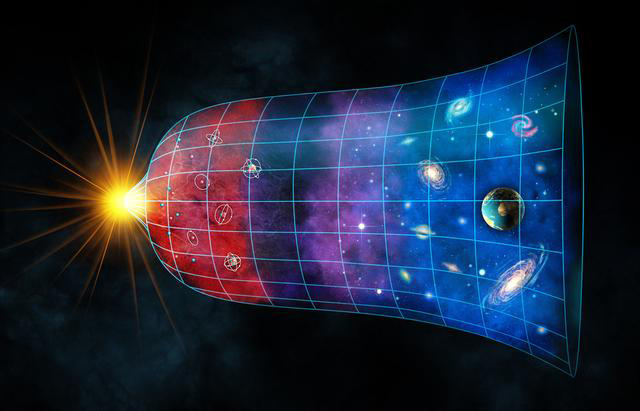
2 . (17) Ii corresponds to an exponential inflation (Figure 7). The positive matter is g, and the negative matter is –g, so F>0 is a huge strong repulsive force for the length inside 10-
13 cm. When the time is 10-34s and the length is bigger than one of the strong interactions, the inflation finishes, and the positive matter and opposite matter are created. While the force between the positive matter and negative matter will become a usual repulsion. Chaotic inflation phenomenally introduces a scalar field, which is similar to the strong repulsion field at very small scale. It produces quantum effect, and the interaction between positive-negative matters is nonlinear, which may obtain chaos.
It is currently believed that the formation of the cosmic structure originates from the cosmic waves formed by gravitation and radiation pressure (electromagnetic interaction). This may be related to the simultaneous emergence, fluctuation and amplification of positive and negative matters. In the quantum cosmic field, the cosmic wave function obeys the Wheeler-de Witt equation:
$$\left( \hbar^2 G_{ijkl} \frac{\delta}{\delta g_{ij}} \frac{\delta}{\delta g_{kl}} + \sqrt{G^3} R \right) \psi(g) = 0.$$ (18)
Assume that the cosmic wave function, which is related to the cosmic quantum mechanics and extensive quantum theory [34, 35, 36, 37], is:
$$\psi = \rho e^{ik\varphi} = \rho(\cos k\varphi + i \sin k\varphi) = a + ib.$$ (19)
It is known that the square of the wave function is the probability density:
$$|\psi|^2 = a^2 - b^2 + 2iab.$$ (20)
This corresponds to the matter, and is divided into three parts. For multimatter systems, the wave functions are very complex. But it can be expected that the systems will have several local minimal values, and correspond to different steady or metastable states. In mathematics the positive and negative matters may be unified to $m(\text{sinkx})$, for $0 < kx < \pi$,
$$m > 0; \text{ for } \pi < kx < 2\pi, m < 0.$$ Equation (19) is also a periodic function. Its inverse evolution corresponds to the antitriangular function, in which arcsinx and arccosx correspond to period functions, and arctgx is infinite flattening. Their generalization can be the hyperbolic function, and corresponding to the Lobachevsky geometry. These may perhaps describe the various possible directions of cosmic evolution. The hyperbolic geometry corresponds to the two-dimensional special projective linear group PSL2(R). Repulsive force between positive and negative matters forms the Lobachevsky geometry, and may product the wormhole due to huge electromagnetic field.
Discussion and Summary
This can be similar to CTP transformation. $Q \rightarrow Q$ is C conjugation, similar introducing energy conjugate E symmetry and mass conjugate M symmetry $M \rightarrow M$ for positive and negative matters. Where E should correspond to C, both are strictly conserved, while M may have small breaks, namely for decay and annihilation, E is invariable, and M changed to E. Further, E, M and C, P, and T can be combined. Moreover, there are the spins, and the classification of fermions and bosons. Such as M=0 and Q=0 can be neutrinos and photons. But, their moving mass is still negative. We proposed the most perfect symmetrical world on the four types of positive, opposite, and negative, negative-opposite matters. For the opposite (anti-)matter mass is unchanged, but their charge is opposite, and the charge is already positive and negative. $M \rightarrow M$ is negative matter, $Q \rightarrow Q$ is opposite matter, and both are macroscopic world. Further, it as a two-dimensional plane corresponds to gravitational and electromagnetic fields determined by mass and charge, we combine the four known fundamental interactions simplified to three-dimensional space, where the third dimension is the strong and weak interactions of the micro-short range. Two interactions are the extension of macro forces to micro forces. Both are the opposite, as strong repulsion and weak gravity. Possibly these correspond to the fifth, six forces.
Between positive and negative matters is generally repulsion. But, gravitations between (+M+Q) and (-M-Q), (+M-Q) and (-M+Q) are generally larger than the repulsion force. If Yang and Yin matters in traditional Chinese culture correspond to positive and negative matters, our theory will be consistent with the world composed by Tai-Ji Figure. In a word, we think that dark matter and dark energy are magical, but not mysterious. The negative matter as a candidate of unified dark matter and dark energy is not only the simplest, and may be calculable, observable and testable, and may be changed and developed. If the negative matter is confirmed by the observation, it will open up a new world.
References
-
White SDM, Rees MJ (1978) Core condensation in heavy halos: a two-stage theory for galaxy and clustering. Monthly Notices of the Royal Astronomical Society 183: 341-358.
-
Thomas J, Saglia RP, Bender R, Thomas D, Gebhardt K, et al. (2011) Dynamical masses of early-type galaxies: a comparison to lensing results and implications for the stellar initial mass function and the distribution of dark matter. Mon Not R Astron Soc 415: 545-562.
-
Cappellari M, Bacon R, Bureau M, Damen MC, Davies RL, et al. (2006) The SAURON project - IV. The mass-to-light ratio, the virial mass estimator and the Fundamental Plane of elliptical and lenticular galaxies. Mon Not R Astron Soc 366(4): 1126-1150.
-
Perlmutter S, Aldering G, Valle MD, Deustua S, Ellis RS, et al. (1998) Discovery of a supernovae explosion at half the age of the Universe. Nature 391: 51-54.
-
Riess AG, Filippenko AV, Challis P, Clocchiatti A, Diercks A, et al. (1998) Observational evidence from supernovae. for an accelerating universe and a cosmological constant. Astronomical J 116(3): 1009-1038.
-
Schmidt BP, Suntze NB, Phillips MM, Schommer RA, Clocchiatti A, et al. (1998) The high-Z supernova search: measuring cosmic deceleration. Astrophys J 507: 46-63.
-
Weinberg S (1989) The cosmological constant problem. Rev Mod Phys 61(1): 1-23.
-
Adam R, et al (Planck Collaboration) (2016) Planck 2015 results-I. Overview of products and scientific results. Astron & Astrophys 594: A1-A13.
-
Tanabashi (2018) Particle data group. Phys Rev D98: 030001.
-
Tangherlini FR (1961) An introduction to the general theory of relativity. Nuovo Cimento Supplemento 20(1): 1-86.
-
Chang YF (2007) Negative matter, repulsion force, dark matter and inflation cosmos, and Higgs mechanism. arXiv 0705.2908.
-
Chang YF (2011) Negative matter, dark matter and theoretical test. International Review of Physics 5(6): 340-345.
-
Chang YF (2013) Field equations of repulsive force between positive-negative matter, inflation cosmos and many worlds. International Journal of Modern Theoretical Physics 2(2): 100-117.
-
Chang YF (2014) Astronomy, black hole and cosmology on negative matter, and qualitative analysis theory. International Journal of Modern Applied Physics 4(2): 69-82.
-
Chang YF (2014) Optics in cosmos: dark matter, negative matter, GRB, and some problems on light. IJARPS 1(5): 11-20.
-
Chang YF (2017) Negative matter as unified dark matter and dark energy, and possible tests. Hadronic Journal 40(3): 291-308.
-
Chang YF (2019) Negative matter as dark matter, and its judgment test and calculation of ratio. International Journal of Modern Applied Physics 9(1): 1-12.
-
Chang YF (2020) Negative matter as unified dark matter and dark energy: simplest model, theory and nine tests: Dark Matter and Dark Energy. International Journal of Fundamental Physical Sciences 10(4): 40-54.
-
Chang YF (2021) Development of matter and testable negative matter as unified dark matter and dark energy. Philosophy Study 11(7): 517-526.
-
Chang YF (2022) The premises and simple estimation on proof of the positive mass theorem, and negative matter as unified dark matter and dark energy. Journal of Pure and Applied Mathematics 6(6): 15-21.
-
Chang YF (2023) Basis on negative matter as unified dark matter and dark energy. SCIREA Journal of Astronomy 5(1): 1-11.
-
Chang YF (2023) Negative matter as unified dark matter and dark energy, distributions of dark matter-energy, and observed ways in the Milky Way. European Journal of Theoretical and Applied Sciences 1(6): 399-410.
-
Chang YF (2024) Possible distributions of negative-dark matter in various galaxies, and new research for some peculiar galaxies. European Journal of Theoretical and Applied Sciences 2(1): 458-467.
-
Chang YF (2024) Negative Matter as Unified Dark Matter and Dark Energy: Theories and Possible Observations. Amazon Digital Publishing.
-
Bondi B (1957) Negative mass in general relativity. Rev Mod Phys 29: 423-428.
-
Einstein A (1955) The Meaning of Relativity. 5th(Edn.), Princeton University Press, USA.
-
Mannheim PD (1992) Conformal gravity and the flatness problem. ApJ 391: 429-435.
-
Bradac M, Clowe D, Gonzalez AH, Markevitch M, Randall SW, et al (2006) A direct empirical proof of the existence of dark matter. ApJ 652: 937-947.
-
Reid M, Zheng XW (2020) New View of the Milky Way. Scientific American 322(4): 28-31.
-
Buta R, Combes F (1996) Galactic rings review. Fund Cosmic Physics 17: 95.
-
Binney J, Merrifield M (1998) Galactic Astronomy. Princeton University Press, USA.
-
Guo Q, Hu H, Zheng Z, Liao S, Du W, et al. (2020) Further evidence for a population of dark-matter- deficient dwarf galaxies. Nature Astronomy 4: 246-251.
-
Weinberg S (2015) Lectures on Quantum Mechanics. Cambridge University Press.
-
Chang YF (2002) Development of Titius-Bode law and the extensive quantum theory. Physics Essays 15(2): 133-137.
-
Chang YF (2013) Nanophysics, macroscopic quantum phenomena and extensive quantum theory. International Journal of Nano and Material Sciences 2(1): 9-24.
-
Chang YF (2018) Extensive quantum theory with different quantum constants, and its applications. International Journal of Modern Mathematical Sciences 16(2): 148-164.
-
Chang YF (2024) Restructure of quantum mechanics by duality, the extensive quantum theory and applications. Physical Science & Biophysics Journal 8(1): 265.
- Sense, Gravity, Parity & Chirality in Mathematical Physics
- Quantum Lattice Simulations PHYSICS: Microcircuit Particle Formation and Observable Macroscopic Irreversible Time - A Discrete Lagrangian with Cellular Automata Framework
- Quantum Biology from Biomacromolecule to Cell, and Central Dogma Described by Quantum Theory
- Focus, Agility, Speed and Technology (FAST) for Sustainability and Growth
- Square Root Metric Geometry and Pati-Salam Model in Curved Space-Time
- A Simple System Demonstrating the Mpemba Effect in Classical Mechanics