
Improvement of Cancer Therapy by Nanotechnology
Conventional cancer therapy has many drawbacks because of the high drug dose, systemic toxicity and lacking potential targeting output. The applications of nanotechnology for cancer therapy have been shown to overcome the limitation associated with conventional treatments. It plays a pivotal role by delivering cancer drugs in a sustained and targeted manner to the malignant tumour cells, thereby reducing the systemic toxicity of the anticancer drugs. It offers a unique approach and comprehensive technology against cancer therapy through early diagnosis, prediction, prevention, personalized therapy and medicine. This review discussed the various tools of cancer nanotechnology that are presently used in the improvement of cancer therapy.
Introduction
Cancer is known to originate through a multistep carcinogenesis process involving numerous cellular physiological systems such as cell signaling and apoptosis, making it a highly unsolvable and complex disease [1, 2]. In conventional chemotherapy treatment, the anticancer drugs get to tumor site with poor specificity and dose- limiting toxicity [1, 2, 3]. In this regards, the eventual objective of cancer therapeutics is to increase the survival time and the quality of life of the patient. Thus, application of nanotechnology for cancer drug delivery has gained a lot of attention that offers major improvements in therapeutics. Nanotechnology is an very powerful promising technology, which have been shown significant impact on medical technology. The medical application of nanotechnology (that is, ‘nanomedicine’) has enormous potential to improve healthcare, particularly in cancer (that is, ‘Cancer nanotechnology’) [1, 4]. Cancer nanotechnology is coming up as a novel field of interdisciplinary study, cutting across the disciplines of biology, chemistry, engineering, and medicine, and is expected to lead to major advances in cancer detection, diagnosis, and treatment [5, 6]. Current advancement in cancer nanotechnology employ various nanocarriers (mostly in the size range from 10 nm to 100 nm) as an emerging class of therapeutics for cancer treatment [3, 4]. Examples like Liposomes and albumin nanoparticles are the two therapeutic nanocarrier that have been approved by the US FDA for clinical practices. Furthermore, invention of liposomal doxorubicin, albumin-bound paclitaxel (Abraxane1) found to augmented the permeability and retention (EPR)-based nanovector application for cancer chemotherapy [1, 7].
Approaches of Nanotechnology for Cancer Therapy
Nanotechnology based drug delivery systems meant for cancer treatments have numerous advantages over conventional treatments, for example it affords longer shelf life of delivered drug, its superior biodistribution and administration of both hydrophilic and hydrophobic substances [3, 8]. Cancer drug loaded nanocarriers have many distinctive properties that make them different from other cancer therapeutics:
- Nanocarriers have the potency to carry both therapeutic and diagnostic drugs, as well it can be designed to carry a large therapeutic/diagnostic payload.
- Nanocarriers can be attached with multivalent targeting ligands for high affinity and specificity to cancer cell targeting.
- Multiple drugs can be loaded and accommodated, which can enable combinatorial cancer therapy
- Nanocarriers can bypass the traditional drug resistance mechanisms.
Passive and active targeting strategies assisted the nanocarriers to get enhanced accumulation of drugs in cancer cells while minimizing toxicity in normal cells. These strategies are helpful to enhance the anticancer effects of cancer drug with lessen systemic toxicity.
Application of Nanotechnology for Cancer Therapy
Various nanotechnology based drug delivery systems that have been employed for cancer detection and treatment includes nanoparticles, liposomes, dendrimers, nanocantilever, carbon nanotubes, and quantum dots (Figure 1).
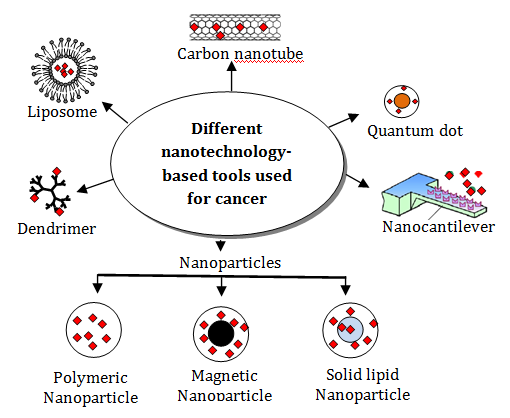
Nanoparticles
These are colloidal particles having submicron-sized with a therapeutic drug encapsulated within their polymeric matrix or adsorbed or conjugated onto the surface [9, 10]. Nanoparticles can be targeted to specific sites by surface modifications, which provide specific biochemical interactions with the receptors expressed on target cells. Further, It has the ability to deliver drugs to the target site, crossing several biological barriers such as the blood–brain barrier. Coating with polysorbates, the drug-loaded nanoparticles can be transported across the blood–brain barrier and can enhance the feasibility of brain targeting after an intravenous injection. Further, magnetic NPs have been coming up with unique small size and magnetic properties that afford magnetic-mediated drug delivery to the cancer tissues. It can be surface functionalized with different ligands for targeted drug delivery. Another section of NPs is Solid-lipid nanoparticles, which are colloidal NPs made from solid lipids and stabilized by surfactants. These NPs have shown a longer bioavailability in vivo by avoiding RES clearance. The discussed nanoparticles for various cancer treatment and drug delivery have been well studied by various groups [11, 12, 13].
Liposomes
Liposomes are colloidal carriers, formed spontaneously when certain lipids are hydrated in aqueous media. It is very adaptable tools in medicine because of their huge diversity of structure and compositions [3, 14]. Examples of liposome-mediated drug delivery are doxorubicin (Doxil) and daunorubicin (Daunoxome), which are currently being marketed as liposome delivery systems. In addition, invention of PEGylated liposomes showed low interaction with plasma proteins and mononuclear phagocytes and, exhibits greatly prolonged circulation time. PEGylated liposomal formulations, more perticularly, PEGylated liposomal doxorubicin and most extensively studied [15].
Dendrimers
Dendrimers are unique class of repeatedly branched polymeric macromolecules that comprise a series of branches around an inner core, the size and shape of which can be altered as desired, resulting in a nearly perfect 3-D geometric pattern [16]. The unique architecture of dendrimers enables for multivalent attachment of imaging probes, as well as targeting moieties; thus, it can be also used as a highly efficient diagnostic tool for cancer imaging [16]. Many researchers have also successfully delivered anticancer drugs and explored various dendrimer for effective cancer therapy [16, 17].
Nanocantilever
Nanocantilevers bend according to changes in the environment or changes on their surfaces, and this bending is in the nanometer-scale. This nanometer-scale bending allows them to be in the category of nanotechnology and can be used as a component of biosensors [1, 18]. These have been described as a simple substitute to PCR reactions and detection methods because they do not require costs associated with sample preparation such as time and expensive materials. Nanocantilevers could also be used to monitor various cancer biomarkers and expand the usefulness of microarray technologies. Nano/Microcantilevers have been applied to pH detection, protein detection, DNA/RNA-DNA/RNA hybridization events. A thorough reviews on nanocantilevers applied in biosensors have been published disclosing that these are a unique tool for detecting biomolecules of interest [18, 19].
Carbon Nanotubes
Carbon nanotubes are a network-like hydrophobic composition of carbon atom of length 100 µm and diameter to 4 nm. Its consists of either single-walled or double-walled carbon molecules self-arranged in hexagon pattern. Owing to its large surface area, this can hold high payload on graphene cavity or onto the surface area and has unique optical, electron emission, mechanical properties. It has wide application in biology as sensors for detecting DNA and protein. It is used as diagnostic devices for the separation of various proteins from serum and as carriers to deliver drug, vaccine or protein. As, it is insoluble in aqueous and organic solvent, its main hindrance in therapeutic application is its associated toxicity in biological fluid, that needs to be addressed [1, 20].
Quantum Dots
Quantum dots (QD) are the nanocrystals less than 10 nm in diameter and made up of semiconductor particles. It consists of an inorganic element in its core with a surrounding metal shell with distinctive optical and chemical properties. It showed many benefits over traditional organic fluorescent dyes and present a number of beneficial characteristics for spectroscopy, like showing high fluorescence intensity, long lifetime, and good resistance to photobleaching. QD-based nanotechnology is a possible platform for multicolor imaging for cancer behavior study. The brightness of QD- based multifunctional probes with low photobleaching and their novel physical, chemical and optical properties make them a promising candidate for in vivo fluorescent tagging and molecular cellular imaging [21]. Many researches highlighted various important general categories of QDs used in cancer diagnostics and drug delivery [21, 22].
Conclusions
The future of nanotechnology in the field of cancer therapy certainly holds great promise. More particularly, in the multifunctional nanoplatforms, which combine therapeutic cancer drugs and multimodality imaging. Nanocarriers offer various opportunities for designing and targeting properties that are not possible with other types of therapeutic drugs. Due to their distinctive physical and biological properties, nanotechnology-based cancer drug delivery systems appear to have an propensity to specifically and safely reach tumor site with improved therapeutic efficacy and low systemic toxicity. Nanoparticle-mediated combinatorial strategies holds the promise for better cancer treatment, reducing side-effects of treatment and improving cancer cure rates, and the technology progressing very fast from theory to reality.
References
-
Misra R, Acharya S, Sahoo SK (2010) Cancer nanotechnology: application of nanotechnology in cancer therapy. Drug Discov Today 15(19-20): 842- 850.
-
Shi J, Kantoff PW, Wooster R, Farokhzad OC (2016) Cancer nanomedicine: progress, challenges and opportunities. Nat Rev Cancer 17(1): 20-37.
-
Mohanty C, Das M, Sahoo SK (2012) Emerging role of nanocarriers to increase the solubility and bioavailability of curcumin. Expert Opin Drug Deliv 9(11): 1347-1364.
-
Basha M, Shamma R (2017) Nanotechnology as a promising strategy for anticancer drug delivery. Curr Drug Deliv 14(8).
-
Parhi P, Mohanty C, Sahoo SK (2012) Nanotechnology-based combinational drug delivery: an emerging approach for cancer therapy. Drug Discov Today 17(17-18): 1044-1052.
-
Raj R, Mongia P, Sahu SK, Ram A (2016) Nanocarriers Based Anticancer Drugs: Current Scenario and Future Perceptions. Curr Drug Targets 17(2): 206-228.
-
Gradishar WJ (2006) Albumin-bound paclitaxel: a next-generation taxane. Expert Opin Pharmacother 7(8): 1041-1053.
-
Wang X, Yang L, Chen Z, Shin DM (2008) Application of nanotechnology in cancer therapy and imaging. CA Cancer J Clin 58(2): 97-110.
-
Chandana M, Manasi D, Jagat RK, Sanjeeb KS (2011) Receptor mediated tumor targeting: an emerging approach for cancer therapy. Curr Drug Deliv 8(1): 45-58.
-
Tang X, Loc WS, Dong C, Matters GL, Butler PJ, et al. (2017) The use of nanoparticulates to treat breast cancer. Nanomedicine (Lond).
-
Danilova NV, Kalzhanov ZR, Nefedova NA, Mal’kov PG, Kosmas IP, et al. (2014) Docetaxel-loaded solid lipid nanoparticles as a basis for a targeted and dose- sparing personalized breast cancer treatment strategy. Int J Nanomedicine 10(1): 2417-2421.
-
Hervault A, Thanh NT (2014) Magnetic nanoparticle- based therapeutic agents for thermo-chemotherapy treatment of cancer. Nanoscale 6(20): 11553-11573.
-
Mohanty C, Sahoo SK (2010) The in vitro stability and in vivo pharmacokinetics of curcumin prepared as an aqueous nanoparticulate formulation. Biomaterials 31(25): 6597-6611.
-
Mohanty C, Acharya S, Mohanty AK, Sahoo SK (2010) Curcumin-encapsulated MePEG/PCL diblock copolymeric micelles: a novel controlled delivery vehicle for cancer therapy. Nanomedicine (Lond) 5(3): 433-449.
-
Lyseng-Williamson KA, Duggan ST, Keating GM (2013) Pegylated liposomal doxorubicin: a guide to its use in various malignancies. BioDrugs 27(5): 533- 540.
-
Sharma AK, Gothwal A, Kesharwani P, Alsaab H, Iyer AK, et al. (2017) Dendrimer nanoarchitectures for cancer diagnosis and anticancer drug delivery. Drug Discov Today 22(2): 314-326.
-
Somani S, Dufes C (2014) Applications of dendrimers for brain delivery and cancer therapy. Nanomedicine (Lond) 9(15): 2403-2414.
-
Etayash H, Jiang K, Azmi S, Thundat T, Kaur K (2015) Real-time Detection of Breast Cancer Cells Using Peptide-functionalized Microcantilever Arrays. Sci Rep 5: 13967.
-
Gdowski A, Ranjan AP, Mukerjee A, Vishwanatha JK (2014) Nanobiosensors: role in cancer detection and diagnosis. Adv Exp Med Biol 807: 33-58.
-
Singh RP, Sharma G, Sonali, Singh S, Bharti S, et al. (2017) Chitosan-folate decorated carbon nanotubes for site specific lung cancer delivery. Mater Sci Eng C Mater Biol Appl 77: 446-458.
-
Pohanka M (2017) Quantum Dots in the Therapy: Current Trends and Perspectives. Mini Rev Med Chem 17(8): 650-656.
-
Zhao M-X, Zhu B-J (2016) The Research and Applications of Quantum Dots as Nano-Carriers for Targeted Drug Delivery and Cancer Therapy. Nanoscale Res Lett 11(1): 207.
- hMPV: Is It Another Covid-19 Like Situation?
- Streptomyces: Sources of Novel Discoveries in Antibiotic Research to Combat Antimicrobial Resistance
- A Review of Mosquitoes (Diptera: Culicidae) and Their Biodiversity, Medical and Veterinary Importance
- Past and Current Immunotherapy in Cancer
- Hematological Cancer and Viral Infection
- The Growing Threat of Antimicrobial Resistance in India: Challenges and Solutions